REVIEW 3 major objections 5 minor 87 references
Density-Functional Tight Binding Meets Maxwell: Unraveling the Mysteries of (Strong) Light-Matter Coupling Efficiently
T0 review · 3 major / 5 minor · reviewed 2026-08-15 · deepseek-v4-flash
Pith's one-line read A combined DFTB+Maxwell method simulates strong light-matter coupling in realistic cavities non-perturbatively, resolving both collective and molecule-level effects.
desk verdict A readable, honest progress report on the authors' DFTB+Maxwell program: the new demonstrations are useful but the headline 2D-spectroscopy claim outruns the evidence, and the method is as-yet unvalidated outside the dilute-regime examples it actually shows. read the letter →
The pith
A machine-rendered reading of the paper's core claim, the machinery that carries it, and where it could break.
The reading
What carries the argument
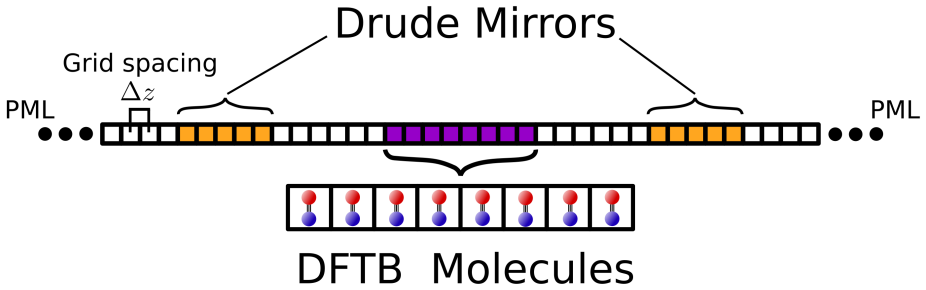
The load-bearing object is the self-consistent loop between the FDTD Maxwell solver, which updates the electric and magnetic fields from the polarization current, and the real-time time-dependent DFTB propagation of each molecule's density matrix through the Liouville-von Neumann equation in a non-orthogonal basis. The time-dependent DFTB Hamiltonian includes the electric field at the molecule's position under the dipole approximation, and the molecular polarization entering Maxwell's equations is written as a concentration-scaled expectation value of the molecular dipole, with a single simulated molecule representing many molecules at a grid point. For two-dimensional spectra, the scheme propagates several coupled Maxwell-Schrödinger systems in parallel: one with all three pulses, one with the first pump only, and one with the second pump only, then subtracts the single-pump fields from the three-pulse field to isolate the third-order nonlinear signal.
What would settle it
Compare DFTB+Maxwell transmission spectra and molecule-resolved dipole Fourier transforms for a dense molecular layer against a full minimal-coupling Maxwell-TDDFT calculation on the same geometry; if the Rabi splitting or local spectral features deviate once intermolecular distances shrink to where wavefunction overlap matters, the no-overlap grid assumption is the culprit. A simpler experiment is to keep the number of molecules fixed while compressing their spatial distribution; if the Rabi splitting changes with density beyond the field-profile effect, collective coupling depends on more than the cavity mode and the scaling argument of Eq. (8) fails.
Extended reading notes
Core claim
The central claim is that the combined DFTB+Maxwell framework correctly captures the non-perturbative feedback between a macroscopic electromagnetic environment and the microscopic electronic structure of many molecules, without partitioning the system into a 'system' and a 'bath' or invoking perturbative, rotating-wave, or Markov approximations. Concretely, the paper shows that the collective Rabi splitting grows with the square root of the number of molecules only while the ensemble is smaller than roughly half the cavity-mode wavelength; for larger ensembles the spatial mode profile breaks this scaling. Fourier-transforming individual molecular dipoles reveals a position-dependent polariton response that traces the cavity mode, plus dark-state and off-resonant features invisible in the transmission spectrum. The paper further shows that topology-optimized cavities can be designed to maximize the field at chosen molecular locations, and that spatially separated molecular groups coupled by such a cavity form a single polaritonic ensemble, evidenced by growing Rabi splitting as groups are added.
Load-bearing premise
The method places one DFTB molecule at each Maxwell grid point and multiplies its dipole by a concentration factor, assuming the electronic structures of molecules at different grid points do not overlap; all intermolecular interactions are therefore classical, with no exchange or correlation between molecules.
Editorial extensions
If this is right
- Two-dimensional spectra of strongly coupled molecular ensembles can be computed without rotating-wave, Markov, or perturbative assumptions, with the field-subtraction scheme isolating third-order signals.
- Molecule-resolved spectra expose dark states and locally varying polariton weights that ensemble transmission hides, giving a route to interpret position-dependent experimental observations.
- The breakdown of square-root-of-N scaling for extended ensembles implies that the spatial distribution of molecules, not just their total number, controls collective light-matter coupling strength.
- Inverse-designed cavities can deliberately couple molecular groups separated by hundreds of nanometers, enabling design of polaritonic networks with targeted connectivity.
- For one-dimensional cavities the framework runs in near real time on a desktop, making cavity-modified chemistry parameter sweeps practical before experiments.
Reading between the lines
- A direct consequence the paper leaves implicit is that the method is on its surest footing for dilute or gas-phase ensembles; extending to condensed phases will require explicit solvation or embedding, as the paper itself notes.
- The field-subtraction strategy for two-dimensional signals generalizes in principle to higher-order nonlinear responses by adding more auxiliary propagations, at linearly growing cost.
- The demonstrated position dependence of the Rabi splitting suggests that experiments varying the location or thickness of a molecular layer inside a cavity should see the same mode-profile modulation, offering a direct quantitative test of the framework.
- Because the electromagnetic field is treated classically, vacuum-field quantum effects such as modified London dispersion or spin-glass-like correlations lie outside the current framework; recovering them would need multi-trajectory Ehrenfest dynamics or transverse exchange-correlation functionals, directions the paper sketches.
Signed reviews
Editorial analysis
A structured set of objections, weighed in public.
Referee Report
Summary. The manuscript presents a multiscale computational framework (DFTB+Maxwell) that couples real-time density-functional tight binding (DFTB) for molecular electronic dynamics with finite-difference time-domain (FDTD) solutions of Maxwell's equations. The stated goal is to enable non-perturbative simulations of strong light-matter coupling in cavities with both collective (global) and local, molecule-resolved information. The paper reports three illustrative applications: a two-dimensional spectroscopy simulation for a strongly coupled cavity-emitter system, collective strong coupling of N2 molecules in a one-dimensional Fabry-Perot cavity with a Rabi-splitting analysis, and inverse design of two-dimensional cavities optimized for coupling to pentacene molecules. The authors claim that the method is computationally efficient and allows near real-time exploration of chemical parameter spaces on standard hardware.
Significance. If the framework performs as claimed, it would provide a practical bridge between quantum-chemistry descriptions of molecules and the spatially resolved electromagnetic environment of realistic cavities, an area where current ab initio QED tools are restricted to few molecules or effective single-mode treatments. The conceptual direction is sound: the Maxwell equations are standard, the rt-TD-DFTB formulation is established, and the explicit statement of the independent-molecule approximation in Eq. (8) is a commendable disclosure of a key limitation. However, the paper's demonstrations do not yet substantiate the advertised predictive capabilities: the two-dimensional spectroscopy example uses Bloch equations rather than the DFTB+Maxwell method, the Drude mirror parameters are explicitly fictitious, and no benchmark against analytic models, exact QED calculations, or experimental spectra is provided. The strength of the paper lies in the originality of the coupled framework and its potential user accessibility, but quantitative validation is currently missing.
major comments (3)
- [Sec. 3.1, Fig. 3] The two-dimensional spectroscopy demonstration is not performed with the DFTB+Maxwell method described in Sec. 2. The text states that the molecular layer consists of 'two-level emitters treated using standard Bloch equations,' and the resulting spectrum in Fig. 3c reports a Rabi splitting of 242 meV. This does not demonstrate the claimed capability of the DFTB+Maxwell framework. Yet Sec. 5 summarizes the paper as offering 'non-perturbative, quantitative insights into (multi-dimensional) spectroscopic observables (see e.g. Sec. 3.1).' The central claim for 2D spectroscopy therefore rests on an example that is external to the method. Please either provide a DFTB-based 2D spectrum or explicitly reframe the claim as a planned capability rather than a demonstrated one.
- [Sec. 2, Eq. (8)] The independent-molecule scaling P = N_M ⟨μ⟩ with the stated assumption 'no overlap of the electronic structure between different Maxwell-grid points' is load-bearing for the abstract's claim of access to 'realistic chemical parameter spaces' and 'large polaritonic ensembles in realistic cavities.' However, the presented applications are dilute by construction: N2 molecules in Sec. 3.2 are spaced at approximately 1 nm grid spacing, and pentacene groups in Sec. 3.3 are separated by 300 nm. No test at realistic molecular packing densities is provided, and the Outlook explicitly lists 'Beyond Gaseous Phase' as a future direction. The claim that the framework addresses realistic condensed-phase ensembles is therefore not supported by the current evidence. Please either benchmark the independent-molecule approximation at relevant densities or restrict the claims to dilute ensembles.
- [Sec. 3.2, Drude parameters] The quantitative predictions of the collective strong-coupling results are undermined by the explicit statement that the Drude parameters (Ω_p = 34 eV, γ = 0.181 eV) 'are fictitious and were selected to fit the specific frequencies of interest.' This means the Rabi splittings in Fig. 4 do not correspond to any real mirror material, and the dependence on the arbitrarily chosen parameters is not analyzed. Moreover, no comparison against an analytic coupled-mode model or a known experimental system is provided, so the accuracy of the method in a realistic cavity is untested. Please add a validation case with realistic material parameters and a quantitative benchmark.
minor comments (5)
- [After Sec. 3 heading, before Sec. 3.1] The manuscript contains a large unintegrated block of text beginning with '2 FIG. 1. 1D scheme of the numerical implementation.' and ending with 'integration time step', which duplicates a figure caption and method section from another publication. This material interrupts the flow of the paper and should be removed or properly integrated into the main text.
- [Abstract and Sec. 1] There is a duplicated parenthetical: 'density-functional tight binding (density-functional tight binding (DFTB))' appears in the abstract and again in the introduction. This should be corrected to 'density-functional tight binding (DFTB)'.
- [Sec. 5] The claim of 'almost real-time exploration of chemical or physical parameters on a desktop machine' is not supported by any timing data or hardware description. A brief runtime benchmark (e.g., wall-clock time for the N2 cavity simulation with 80 molecules) would make this claim concrete and verifiable.
- [Sec. 3.2] The first electronic transition of N2 is quoted as 13.902 eV based on DFTB. Given that this value is used to set the cavity resonance, the authors should compare it with an experimental or higher-level theoretical reference value to establish the accuracy of the DFTB description in this context.
- [References] Several references are to unpublished work (Refs. 23 and 41 are in preparation or preprint) and the companion paper Ref. 33 is an arXiv preprint. Please clarify the status of these works so that readers can assess what is established versus what is still in development.
Circularity Check
No circularity found: the DFTB+Maxwell derivation is self-contained, with explicit inputs (DFTB parameters, Drude parameters, N_M) and outputs (Rabi splittings, local spectra) that are not fitted by construction.
full rationale
The paper's core derivation chain is explicit and non-circular. Equations (1)–(8) define a well-posed coupled problem: Maxwell's equations evolved with a polarization P = N_M <mu> computed from real-time DFTB dynamics. The DFTB Hamiltonian (Eqs. (3)–(6)) is a standard second-order tight-binding expansion, and the Maxwell–matter coupling enters only through the external field term in Eq. (6) and the polarization source in Eq. (2). No result is defined in terms of the quantity it is claimed to predict. The Rabi splittings in Sec. 3.2 arise from propagating the coupled system after the user sets the cavity resonance; the Drude parameters and mirror separation are initial conditions chosen to match a known DFTB transition energy, not fitted to the output splittings. Similarly, the concentration factor N_M is an input scaling parameter, not a parameter extracted from the signals it produces. The paper honestly states the independent-molecule assumption behind Eq. (8), which is a modeling limitation and a correctness risk, but not circularity. Self-citations are numerous, but they provide context for QEDFT, spin-glass correlations, and prior DFTB+Maxwell work; the central illustrative calculations are presented in this paper via the stated coupled equations, so the demonstration does not reduce to those citations. No uniqueness theorem is imported from the authors' prior work to forbid alternatives. The lack of external benchmark validation is a serious scientific concern, but it is not an instance of circular reasoning under the criteria used here.
Assumptions & free parameters
free parameters (4)
- Drude plasma frequency Omega_p =
34 eV
- Drude damping gamma =
0.181 eV
- Mirror thickness =
20 nm
- Concentration factor N_M =
not specified
assumptions (5)
- domain assumption Classical Maxwell equations with polarization current as source fully describe the cavity field dynamics.
- domain assumption The DFTB Hamiltonian with mio-1-1 parameters provides accurate excitation energies and dynamics for the molecules studied.
- domain assumption Electric dipole approximation for the molecule-field coupling in Eq. (6).
- ad hoc to paper No overlap of electronic structure between molecules at different Maxwell grid points.
- standard math Runge-Gross theorem justifies real-time TD-DFTB propagation.
Cite this review
Pith. "Pith review of Density-Functional Tight Binding Meets Maxwell: Unraveling the Mysteries of (Strong) Light-Matter Coupling Efficiently." pith.science (2026). https://pith.science/paper/5B34INI7
@misc{pith2026250910111,
  author       = {Pith},
  title        = {Pith review of: Density-Functional Tight Binding Meets Maxwell: Unraveling the Mysteries of (Strong) Light-Matter Coupling Efficiently},
  year         = {2026},
  howpublished = {\url{https://pith.science/paper/5B34INI7}},
  note         = {Machine review of arXiv:2509.10111}
}
read the original abstract
Controlling chemical and material properties through strong light-matter coupling in optical cavities has gained considerable attention over the past decade. However, the underlying mechanisms remain insufficiently understood, and a significant gap persists between experimental observations and theoretical descriptions. This challenge arises from the intrinsically multi-scale nature of the problem, where non-perturbative feedback occurs across different spatial and temporal scales. Collective coupling between a macroscopic ensemble of molecules and a photonic environment, such as Fabry-Perot cavity, can strongly influence the microscopic properties of individual molecules, while microscopic details of the ensemble in turn affect the macroscopic coupling. To address this complexity, we present an efficient computational framework that combines density-functional tight binding (DFTB) with finite-difference time-domain (FDTD) simulations for Maxwell's equations (DFTB+Maxwell). This approach allows for a self-consistent treatment of both the cavity and microscopic details of the molecular ensemble. We demonstrate the potential for this method by tackling several open questions. First, we calculate non-perturbatively two-dimensional spectroscopic observable that directly connect to well-established experimental protocols. Second, we provide local, molecule-resolved information within collectively coupled ensembles, which is difficult to obtain experimentally. Third, we show how cavity designs can be optimized to target specific microscopic applications. Finally, we outline future directions to enhance the predictive power of this framework, including extension to finite temperature, condensed phases, and correlated quantum effects.
Figures


Figures from the paper (2 more)


Reference graph
Works this paper leans on
-
[1]
Ground-state chemical reactivity under vibrational coupling to the vacuum electromagnetic field
Thomas, A.; George, J.; Shalabney, A.; Dryzhakov, M.; Varma, S.; Moran, J.; Chervy, T.; Zhong, X.; Devaux, E.; Genet, C.; Hutchison, J.; Ebbesen, T. Ground-state chemical reactivity under vibrational coupling to the vacuum electromagnetic field. Angewandte Chemie International Edition 2016, 55, 11462--11466, tex.citation-number: 3
2016
-
[2]
Suppression of photo-oxidation of organic chromophores by strong coupling to plasmonic nanoantennas
Munkhbat, B.; Wersäll, M.; Baranov, D.; Antosiewicz, T.; Shegai, T. Suppression of photo-oxidation of organic chromophores by strong coupling to plasmonic nanoantennas. Science Advances 2018, 4, 9552, tex.citation-number: 4
2018
-
[3]
Cavity Catalysis ‒ Accelerating Reactions under Vibrational Strong Coupling
Hiura, H.; Shalabney, A.; George, J. Cavity Catalysis ‒ Accelerating Reactions under Vibrational Strong Coupling . 2018; https://doi.org/10.26434/chemrxiv.7234721.v5, Publication Title: ChemRXiv Preprint tex.ids= hiura2018a
-
[4]
Cavity catalysis by cooperative vibrational strong coupling of reactant and solvent molecules
Lather, J.; Bhatt, P.; Thomas, A.; Ebbesen, T.; George, J. Cavity catalysis by cooperative vibrational strong coupling of reactant and solvent molecules. Angewandte Chemie - International Edition 2019, 58, 10635--10638, tex.citation-number: 6
2019
-
[5]
Tilting a ground-state reactivity landscape by vibrational strong coupling
Thomas, A.; Lethuillier-Karl, L.; Nagarajan, K.; Vergauwe, R.; George, J.; Chervy, T.; Shalabney, A.; Devaux, E.; Genet, C.; Moran, J.; Ebbesen, T. Tilting a ground-state reactivity landscape by vibrational strong coupling. Science 2019, 363, 615--619, tex.citation-number: 7
2019
-
[6]
Modulation of prins cyclization by vibrational strong coupling
Hirai, K.; Takeda, R.; Hutchison, J.; Uji-i, H. Modulation of prins cyclization by vibrational strong coupling. Angewandte Chemie - International Edition 2020, 17, 201915632, tex.citation-number: 8
2020
-
[7]
Cavity catalysis: modifying linear free-energy relationship under cooperative vibrational strong coupling
Lather, J.; Thabassum, A.; Singh, J.; George, J. Cavity catalysis: modifying linear free-energy relationship under cooperative vibrational strong coupling. Chemical Science 2022, 13, 195--202, tex.citation-number: 11
2022
-
[8]
F.; Recabal, F.; Herrera, F.; Simpkins, B
Ahn, W.; Triana, J. F.; Recabal, F.; Herrera, F.; Simpkins, B. S. Modification of ground-state chemical reactivity via light–matter coherence in infrared cavities. Science 2023, 380, 1165--1168
2023
Show all 87 references
-
[9]
M.; Somaschi, N.; Michetti, P.; Clark, C.; Lagoudakis, P
Coles, D. M.; Somaschi, N.; Michetti, P.; Clark, C.; Lagoudakis, P. G.; Savvidis, P. G.; Lidzey, D. G. Polariton-mediated energy transfer between organic dyes in a strongly coupled optical microcavity. Nature Materials 2014, 13, 712--719, Number: 7 tex.ids= coles2014a
2014
-
[10]
Non-radiative energy transfer mediated by hybrid light-matter states
Zhong, X.; Chervy, T.; Wang, S.; George, J.; Thomas, A.; Hutchison, J.; Devaux, E.; Genet, C.; Ebbesen, T. Non-radiative energy transfer mediated by hybrid light-matter states. Angewandte Chemie International Edition 2016, 55, 6202--6206, tex.citation-number: 15
2016
-
[11]
Energy transfer between spatially separated entangled molecules
Zhong, X.; Chervy, T.; Zhang, L.; Thomas, A.; George, J.; Genet, C.; Hutchison, J.; Ebbesen, T. Energy transfer between spatially separated entangled molecules. Angewandte Chemie - International Edition 2017, 56, 9034--9038, tex.citation-number: 16
2017
-
[12]
Conductivity in organic semiconductors hybridized with the vacuum field
Orgiu, E.; George, J.; Hutchison, J.; Devaux, E.; Dayen, J.; Doudin, B.; Stellacci, F.; Genet, C.; Schachenmayer, J.; Genes, C.; Pupillo, G.; Samori, P.; Ebbesen, T. Conductivity in organic semiconductors hybridized with the vacuum field. Nature Materials 2015, 14, 1123--1129,...
2015
-
[13]
Conductivity and Photoconductivity of a p- Type Organic Semiconductor under Ultrastrong Coupling
Nagarajan, K.; George, J.; Thomas, A.; Devaux, E.; Chervy, T.; Azzini, S.; Joseph, K.; Jouaiti, A.; Hosseini, M.; Kumar, A.; Genet, C.; Bartolo, N.; Ciuti, C.; Ebbesen, T. Conductivity and Photoconductivity of a p- Type Organic Semiconductor under Ultrastrong Coupling . ACS Na...
2020
-
[14]
Selective crystallization via vibrational strong coupling
Hirai, K.; Ishikawa, H.; Chervy, T.; Hutchison, J.; Uji-i, H. Selective crystallization via vibrational strong coupling. Chemical Science 2021, 12, 11986--11994, tex.citation-number: 22
2021
-
[15]
Supramolecular assembly of conjugated polymers under vibrational strong coupling
Joseph, K.; Kushida, S.; Smarsly, E.; Ihiawakrim, D.; Thomas, A.; Paravicini-Bagliani, G.; Nagarajan, K.; Vergauwe, R.; Devaux, E.; Ersen, O.; Bunz, U.; Ebbesen, T. Supramolecular assembly of conjugated polymers under vibrational strong coupling. Angewandte Chemie Internationa...
2021
-
[16]
Understanding Polaritonic Chemistry from Ab Initio Quantum Electrodynamics
Ruggenthaler, M.; Sidler, D.; Rubio, A. Understanding Polaritonic Chemistry from Ab Initio Quantum Electrodynamics . Chemical Reviews 2023, Publisher: American Chemical Society
2023
-
[17]
A perspective on ab initio modeling of polaritonic chemistry: The role of non-equilibrium effects and quantum collectivity
Sidler, D.; Ruggenthaler, M.; Schäfer, C.; Ronca, E.; Rubio, A. A perspective on ab initio modeling of polaritonic chemistry: The role of non-equilibrium effects and quantum collectivity. The Journal of Chemical Physics 2022, 156, 230901
2022
-
[18]
Polaritonic Chemistry : Collective Strong Coupling Implies Strong Local Modification of Chemical Properties
Sidler, D.; Schäfer, C.; Ruggenthaler, M.; Rubio, A. Polaritonic Chemistry : Collective Strong Coupling Implies Strong Local Modification of Chemical Properties . The Journal of Physical Chemistry Letters 2021, 12, 508--516, Publisher: American Chemical Society
2021
-
[19]
Cavity Born – Oppenheimer Hartree – Fock Ansatz : Light – Matter Properties of Strongly Coupled Molecular Ensembles
Schnappinger, T.; Sidler, D.; Ruggenthaler, M.; Rubio, A.; Kowalewski, M. Cavity Born – Oppenheimer Hartree – Fock Ansatz : Light – Matter Properties of Strongly Coupled Molecular Ensembles . The Journal of Physical Chemistry Letters 2023, 14, 8024--8033, Publisher: American C...
2023
-
[20]
Unraveling a Cavity - Induced Molecular Polarization Mechanism from Collective Vibrational Strong Coupling
Sidler, D.; Schnappinger, T.; Obzhirov, A.; Ruggenthaler, M.; Kowalewski, M.; Rubio, A. Unraveling a Cavity - Induced Molecular Polarization Mechanism from Collective Vibrational Strong Coupling . The Journal of Physical Chemistry Letters 2024, 15, 5208--5214
2024
-
[21]
S.; Ronca, E.; Koch, H.; Schafer, C
Castagnola, M.; Haugland, T. S.; Ronca, E.; Koch, H.; Schafer, C. Collective strong coupling modifies aggregation and solvation. The Journal of Physical Chemistry Letters 2024, 15, 1428--1434
2024
-
[22]
Analytic model reveals local molecular polarizability changes induced by collective strong coupling in optical cavities
Horak, J.; Sidler, D.; Schnappinger, T.; Huang, W.-M.; Ruggenthaler, M.; Rubio, A. Analytic model reveals local molecular polarizability changes induced by collective strong coupling in optical cavities. Physical Review Research 2025, 7, 013242
2025
-
[23]
Collectively-modified inter-molecular electron correlations: The connection of polaritonic chemistry and spin glass physics
Sidler, D.; Ruggenthaler, M.; Rubio, A. Collectively-modified inter-molecular electron correlations: The connection of polaritonic chemistry and spin glass physics. 2025,
2025
-
[24]
T.; Koch, H
Castagnola, M.; Lexander, M. T.; Koch, H. Realistic ab initio predictions of excimer behavior under collective light-matter strong coupling. Physical Review X 2025, 15, 021040
2025
-
[25]
V.; Rubio, A
Ruggenthaler, M.; Flick, J.; Pellegrini, C.; Appel, H.; Tokatly, I. V.; Rubio, A. Quantum-electrodynamical density-functional theory: Bridging quantum optics and electronic-structure theory. Physical Review A 2014, 90, 012508, Number: 1
2014
-
[26]
I.; Csirik, M
Penz, M.; Tellgren, E. I.; Csirik, M. A.; Ruggenthaler, M.; Laestadius, A. The Structure of the Density - Potential Mapping . Part II : Including Magnetic Fields . ACS Physical Chemistry Au 2023, 3c00006
2023
-
[27]
Jestädt, R.; Ruggenthaler, M.; Oliveira, M. J. T.; Rubio, A.; Appel, H. Light-matter interactions within the Ehrenfest – Maxwell – Pauli – Kohn – Sham framework: fundamentals, implementation, and nano-optical applications. Advances in Physics 2019, 68, 225--333, Number: 4
2019
-
[28]
S.; Ronca, E.; Kjønstad, E
Haugland, T. S.; Ronca, E.; Kjønstad, E. F.; Rubio, A.; Koch, H. Coupled Cluster Theory for Molecular Polaritons : Changing Ground and Excited States . Physical Review X 2020, 10, 041043, Number: 4
2020
-
[29]
J.; Rubio, A.; Manby, F
Mordovina, U.; Bungey, C.; Appel, H.; Knowles, P. J.; Rubio, A.; Manby, F. R. Polaritonic coupled-cluster theory. Physical Review Research 2020, 2, 023262, Number: 2
2020
-
[30]
Theoretical Advances in Polariton Chemistry and Molecular Cavity Quantum Electrodynamics
Mandal, A.; Taylor, M.; Weight, B.; Koessler, E.; Li, X.; Huo, P. Theoretical Advances in Polariton Chemistry and Molecular Cavity Quantum Electrodynamics . 2022; https://chemrxiv.org/engage/chemrxiv/article-details/63903eee92f084c9612a9086
2022
-
[31]
Understanding polaritonic chemistry from ab initio quantum electrodynamics
Ruggenthaler, M.; Sidler, D.; Rubio, A. Understanding polaritonic chemistry from ab initio quantum electrodynamics. 2022; http://arxiv.org/abs/2211.04241, arXiv:2211.04241 [quant-ph]
2022 arXiv
-
[32]
P.; Albar, E
Bonaf\'e, F. P.; Albar, E. I.; Ohlmann, S. T.; Kosheleva, V. P.; Bustamante, C. M.; Troisi, F.; Rubio, A.; Appel, H. Full minimal coupling Maxwell-TDDFT: An ab initio framework for light-matter interaction beyond the dipole approximation. Phys. Rev. B 2025, 111, 085114
2025
-
[33]
M.; Bonaf \'e , F
Bustamante, C. M.; Bonaf \'e , F. P.; Sukharev, M.; Ruggenthaler, M.; Nitzan, A.; Rubio, A. Molecular polaritons dynamics in realistic cavities. arXiv preprint arXiv:2508.18842 2025,
2025
-
[34]
Coherent 2D IR spectroscopy: Molecular structure and dynamics in solution
Khalil, M.; Demird \"o ven, N.; Tokmakoff, A. Coherent 2D IR spectroscopy: Molecular structure and dynamics in solution. The Journal of Physical Chemistry A 2003, 107, 5258--5279
2003
-
[35]
Jonas, D. M. Two-dimensional femtosecond spectroscopy. Annual review of physical chemistry 2003, 54, 425--463
2003
-
[36]
Modified relaxation dynamics and coherent energy exchange in coupled vibration-cavity polaritons
Dunkelberger, A.; Spann, B.; Fears, K.; Simpkins, B.; Owrutsky, J. Modified relaxation dynamics and coherent energy exchange in coupled vibration-cavity polaritons. Nature Communications 2016, 7, 13504
2016
-
[37]
M.; Wackenhut, F.; Piatkowski, L.; Meixner, A
Takele, W. M.; Wackenhut, F.; Piatkowski, L.; Meixner, A. J.; Waluk, J. Multimode vibrational strong coupling of methyl salicylate to a Fabry--P \'e rot microcavity. The Journal of Physical Chemistry B 2020, 124, 5709--5716
2020
-
[38]
Two-dimensional infrared spectroscopy of vibrational polaritons of molecules in an optical cavity
Saurabh, P.; Mukamel, S. Two-dimensional infrared spectroscopy of vibrational polaritons of molecules in an optical cavity. The Journal of chemical physics 2016, 144
2016
-
[39]
Probing the anharmonicity of vibrational polaritons with double-quantum two-dimensional infrared spectroscopy
Sufrin, S.; Cohn, B.; Chuntonov, L. Probing the anharmonicity of vibrational polaritons with double-quantum two-dimensional infrared spectroscopy. Nanophotonics 2024, 13, 2523--2530
2024
-
[40]
G.; Mahato, M.; Pang, Y.; Nagarajan, K.; Thomas, A.; Genet, C.; Ebbesen, T
Jayachandran, A.; Patrahau, B.; Ricca, J. G.; Mahato, M.; Pang, Y.; Nagarajan, K.; Thomas, A.; Genet, C.; Ebbesen, T. W. A Phenomenological Symmetry Rule for Chemical Reactivity under Vibrational Strong Coupling. Angewandte Chemie e202503915
-
[41]
Connecting Polaritonic Chemistry and Spin Glass Physics: An Ab-initio Perspective on Quantum Collectivity and Non-canonical Equilibrium Effects
Sidler, D.; Ruggenthaler, M.; Rubio, A. Connecting Polaritonic Chemistry and Spin Glass Physics: An Ab-initio Perspective on Quantum Collectivity and Non-canonical Equilibrium Effects. in prep. 2025,
2025
-
[42]
D.; Djuri s i \'c , A
Raki \'c , A. D.; Djuri s i \'c , A. B.; Elazar, J. M.; Majewski, M. L. Optical properties of metallic films for vertical-cavity optoelectronic devices. Applied optics 1998, 37, 5271--5283
1998
-
[43]
Effective optical response of silicon to sunlight<? A3B2 show [pmg: line-break justify=" yes"/]?> in the finite-difference time-domain method
Deinega, A.; John, S. Effective optical response of silicon to sunlight<? A3B2 show [pmg: line-break justify=" yes"/]?> in the finite-difference time-domain method. Optics letters 2011, 37, 112--114
2011
-
[44]
R.; Shah, S
Clark, M. R.; Shah, S. A.; Piryatinski, A.; Sukharev, M. Harnessing complexity: Nonlinear optical phenomena in L-shapes, nanocrescents, and split-ring resonators. The Journal of Chemical Physics 2024, 161
2024
-
[45]
Self-consistent-charge density-functional tight-binding method for simulations of complex materials properties
Elstner, M.; Porezag, D.; Jungnickel, G.; Elsner, J.; Haugk, M.; Frauenheim, T.; Suhai, S.; Seifert, G. Self-consistent-charge density-functional tight-binding method for simulations of complex materials properties. Physical Review B 1998, 58, 7260
1998
-
[46]
Atomistic simulations of complexmaterials: ground-state and excited-state properties
Frauenheim, T.; Seifert, G.; Elstner, M.; Niehaus, T.; K \"o hler, C.; Amkreutz, M.; Sternberg, M.; Hajnal, Z.; Di Carlo, A.; Suhai, S. Atomistic simulations of complexmaterials: ground-state and excited-state properties. Journal of Physics: Condensed Matter 2002, 14, 3015
2002
-
[47]
Niehaus, T. A. Approximate time-dependent density functional theory. Journal of Molecular Structure: THEOCHEM 2009, 914, 38--49
2009
-
[48]
P.; Aradi, B.; Hourahine, B.; Medrano, C
Bonaf\' e , F. P.; Aradi, B.; Hourahine, B.; Medrano, C. R.; Hern\' a ndez, F. J.; Frauenheim, T.; S\' a nchez, C. G. A real-time time-dependent density functional tight-binding implementation for semiclassical excited state electron--nuclear dynamics and pump--probe spectrosc...
2020
-
[49]
P.; Aradi, B.; Guan, M.; Douglas-Gallardo, O
Bonaf \' e , F. P.; Aradi, B.; Guan, M.; Douglas-Gallardo, O. A.; Lian, C.; Meng, S.; Frauenheim, T.; S \' a nchez, C. G. Plasmon-driven sub-picosecond breathing of metal nanoparticles . Nanoscale 2017, 9, 12391--12397
2017
-
[50]
J.; Bonaf \' e , F
Hern \' a ndez, F. J.; Bonaf \' e , F. P.; Aradi, B.; Frauenheim, T.; S \' a nchez, C. G. Simulation of Impulsive Vibrational Spectroscopy . J. Phys. Chem. A 2019, 123, 2065--2072
2019
-
[51]
Maghrebi, K.; Chantrenne, I.; Messaoudi, S.; Frauenheim, T.; Fihey, A.; Lien-Medrano, C. R. Rapid Access to Ground- and Excited-State Properties of Gold Nanoclusters Coated with Organic Ligands: Evaluation of the DFTB Method Performance. The Journal of Physical Chemistry C 202...
2023
-
[52]
P.; Hern \' a ndez, F
Bonaf \' e , F. P.; Hern \' a ndez, F. J.; Aradi, B.; Frauenheim, T.; S \' a nchez, C. G. Fully Atomistic Real-Time Simulations of Transient Absorption Spectroscopy . J. Phys. Chem. Lett. 2018, 9, 4355--4359
2018
-
[53]
The Journal of chemical physics 2020, 152, 124101
Hourahine, B.; Aradi, B.; Blum, V.; Bonafe, F.; Buccheri, A.; Camacho, C.; Cevallos, C.; Deshaye, M.; Dumitric a , T.; Dominguez, A.; others DFTB+, a software package for efficient approximate density functional theory based atomistic simulations. The Journal of chemical physi...
2020
-
[54]
Extended tight-binding quantum chemistry methods
Bannwarth, C.; Caldeweyher, E.; Ehlert, S.; Hansen, A.; Pracht, P.; Seibert, J.; Spicher, S.; Grimme, S. Extended tight-binding quantum chemistry methods . Wiley Interdiscip. Rev. Comput. Mol. Sci. 2021, 11, 1--49
2021
-
[55]
The Journal of Physical Chemistry A 2025,
Hourahine, B.; Berdakin, M.; Bich, J.; Bonafe, F.; Camacho, C.; Cui, Q.; Deshaye, M.; Diaz Miron, G.; Ehlert, S.; Elstner, M.; others Recent developments in DFTB+, a software package for efficient atomistic quantum mechanical simulations. The Journal of Physical Chemistry A 2025,
2025
-
[56]
Principles of nonlinear optical spectroscopy; Oxford university press New York, 1995; Vol
Mukamel, S. Principles of nonlinear optical spectroscopy; Oxford university press New York, 1995; Vol. 6
1995
-
[57]
Nonlinear semiclassical spectroscopy of ultrafast molecular polariton dynamics
Reitz, M.; Koner, A.; Yuen-Zhou, J. Nonlinear semiclassical spectroscopy of ultrafast molecular polariton dynamics. Physical Review Letters 2025, 134, 193803
2025
-
[58]
A.; Genet, C.; Ebbesen, T
Wang, S.; Chervy, T.; George, J.; Hutchison, J. A.; Genet, C.; Ebbesen, T. W. Quantum yield of polariton emission from hybrid light-matter states. The journal of physical chemistry letters 2014, 5, 1433--1439
2014
-
[59]
Y.; Jin, W.; Vuckovi \'c , J.; Rodriguez, A
Molesky, S.; Lin, Z.; Piggott, A. Y.; Jin, W.; Vuckovi \'c , J.; Rodriguez, A. W. Inverse design in nanophotonics. Nature Photonics 2018, 12, 659--670
2018
-
[60]
M.; Oskooi, A.; Chen, M.; Lin, Z.; Johnson, S
Hammond, A. M.; Oskooi, A.; Chen, M.; Lin, Z.; Johnson, S. G.; Ralph, S. E. High-performance hybrid time/frequency-domain topology optimization for large-scale photonics inverse design. Optics Express 2022, 30, 4467--4491
2022
-
[61]
D.; Bustamante, C
Gadea, E. D.; Bustamante, C. M.; Todorov, T. N.; Scherlis, D. A. Radiative thermalization in semiclassical simulations of light-matter interaction. Physical Review A 2022, 105, 042201
2022
-
[62]
Sidler, D.; Ruggenthaler, M.; Rubio, A. Numerically Exact Solution for a Real Polaritonic System under Vibrational Strong Coupling in Thermodynamic Equilibrium : Loss of Light – Matter Entanglement and Enhanced Fluctuations . Journal of Chemical Theory and Computation 2023, 19...
2023
-
[63]
Theory of Resonance Suppression in Vibrational Polariton Chemistry
Montillo Vega, S.; Ying, W.; Huo, P. Theory of Resonance Suppression in Vibrational Polariton Chemistry . 2024; https://chemrxiv.org/engage/chemrxiv/article-details/6645505f418a5379b064c02e
2024
-
[64]
Resonance theory of vibrational strong coupling enhanced polariton chemistry and the role of photonic mode lifetime
Ying, W.; Huo, P. Resonance theory of vibrational strong coupling enhanced polariton chemistry and the role of photonic mode lifetime. Communications Materials 2024, 5, 110
2024
-
[65]
Quantum Effects in Chemical Reactions under Polaritonic Vibrational Strong Coupling
Yang, P.-Y.; Cao, J. Quantum Effects in Chemical Reactions under Polaritonic Vibrational Strong Coupling . The Journal of Physical Chemistry Letters 2021, 12, 9531--9538
2021
-
[66]
Insights into the mechanisms of optical cavity-modified ground-state chemical reactions; preprint, 2023
Ke, Y.; Richardson, J. Insights into the mechanisms of optical cavity-modified ground-state chemical reactions; preprint, 2023
2023
-
[67]
Ke, Y.; Richardson, J. O. Quantum nature of reactivity modification in vibrational polariton chemistry. The Journal of Chemical Physics 2024, 161, 054104
2024
-
[68]
P.; Mandal, A.; Reichman, D
Lindoy, L. P.; Mandal, A.; Reichman, D. R. Quantum dynamical effects of vibrational strong coupling in chemical reactivity. Nature Communications 2023, 14, 2733
2023
-
[69]
P.; Mandal, A.; Reichman, D
Lindoy, L. P.; Mandal, A.; Reichman, D. R. Resonant Cavity Modification of Ground - State Chemical Kinetics . The Journal of Physical Chemistry Letters 2022, 13, 6580--6586, Number: 28 3 citations (INSPIRE 2023/10/23) 3 citations w/o self (INSPIRE 2023/10/23) arXiv:2205.05142 ...
2022 arXiv
-
[70]
J.; Antheaume, C.; Sangchai, T.; Ragazzon, G.; Jayachandran, A.; Devaux, E.; Genet, C.; Moran, J.; Ebbesen, T
Patrahau, B.; Piejko, M.; Mayer, R. J.; Antheaume, C.; Sangchai, T.; Ragazzon, G.; Jayachandran, A.; Devaux, E.; Genet, C.; Moran, J.; Ebbesen, T. W. Direct Observation of Polaritonic Chemistry by Nuclear Magnetic Resonance Spectroscopy . Angewandte Chemie International Editio...
2024
-
[71]
G.; Ebbesen, T
Sandeep, K.; Joseph, K.; Gautier, J.; Nagarajan, K.; Sujith, M.; Thomas, K. G.; Ebbesen, T. W. Manipulating the Self - Assembly of Phenyleneethynylenes under Vibrational Strong Coupling . The Journal of Physical Chemistry Letters 2022, 13, 1209--1214
2022
-
[72]
On the role of symmetry in vibrational strong coupling: The case of charge-transfer complexation
Pang, Y.; Thomas, A.; Nagarajan, K.; Vergauwe, R.; Joseph, K.; Patrahau, B.; Wang, K.; Genet, C.; Ebbesen, T. On the role of symmetry in vibrational strong coupling: The case of charge-transfer complexation. Angewandte Chemie - International Edition 2020, 59, 10436--10440, tex...
2020
-
[73]
Controlling Electron Mobility of Strongly Coupled Organic Semiconductors in Mirrorless Cavities
Kaur, K.; Johns, B.; Bhatt, P.; George, J. Controlling Electron Mobility of Strongly Coupled Organic Semiconductors in Mirrorless Cavities . Advanced Functional Materials 2023, 33, 2306058
2023
-
[74]
S.; Chandrasekharan, G.; Mattiotti, F.; Vergauwe, R
Kumar, S.; Biswas, S.; Rashid, U.; Mony, K. S.; Chandrasekharan, G.; Mattiotti, F.; Vergauwe, R. M. A.; Hagenmuller, D.; Kaliginedi, V.; Thomas, A. Extraordinary Electrical Conductance through Amorphous Nonconducting Polymers under Vibrational Strong Coupling . Journal of the ...
2024
-
[75]
Electronic Strong Coupling Modifies the Ground -state Intermolecular Interactions in Chlorin Thin Films
Biswas, S.; Mondal, M.; Chandrasekharan, G.; Singh, A.; Thomas, A. Electronic Strong Coupling Modifies the Ground -state Intermolecular Interactions in Chlorin Thin Films . 2024; https://chemrxiv.org/engage/chemrxiv/article-details/65e9863c9138d23161e9df4b
2024
-
[76]
Y.; Montanaro, A.; Giusti, F.; Rigoni, E
Jarc, G.; Mathengattil, S. Y.; Montanaro, A.; Giusti, F.; Rigoni, E. M.; Sergo, R.; Fassioli, F.; Winnerl, S.; Dal Zilio, S.; Mihailovic, D.; Prelovšek, P.; Eckstein, M.; Fausti, D. Cavity-mediated thermal control of metal-to-insulator transition in 1T - TaS2 . Nature 2023, 62...
2023
-
[77]
Driving DNA Origami Coassembling by Vibrational Strong Coupling in the Dark
Zhong, C.; Hou, S.; Zhao, X.; Bai, J.; Wang, Z.; Gao, F.; Guo, J.; Zhang, F. Driving DNA Origami Coassembling by Vibrational Strong Coupling in the Dark . ACS Photonics 2023, 10, 1618--1623
2023
-
[78]
Thomas, A.; Devaux, E.; Nagarajan, K.; Rogez, G.; Seidel, M.; Richard, F.; Genet, C.; Drillon, M.; Ebbesen, T. W. Large Enhancement of Ferromagnetism under a Collective Strong Coupling of YBCO Nanoparticles . Nano Letters 2021, 21, 4365--4370
2021
-
[79]
M.; Sch\" a fer, C.; Rubio, A.; Kelly, A.; Appel, H
Hoffmann, N. M.; Sch\" a fer, C.; Rubio, A.; Kelly, A.; Appel, H. Capturing vacuum fluctuations and photon correlations in cavity quantum electrodynamics with multitrajectory Ehrenfest dynamics. Physical Review A 2019, 99, 063819
2019
-
[80]
a fer, C.; S\
Hoffmann, N. M.; Sch\" a fer, C.; S\" a kkinen, N.; Rubio, A.; Appel, H.; Kelly, A. Benchmarking semiclassical and perturbative methods for real-time simulations of cavity-bound emission and interference. The Journal of Chemical Physics 2019, 151, 244113
2019
-
[81]
H.; J \"a ckle, A.; Worth, G
Beck, M. H.; J \"a ckle, A.; Worth, G. A.; Meyer, H.-D. The multiconfiguration time-dependent Hartree (MCTDH) method: a highly efficient algorithm for propagating wavepackets. Physics reports 2000, 324, 1--105
2000
-
[82]
Time-dependent Multiconfigurational Theories of Electronic and Nuclear Dynamics of Molecules in Intense Laser Fields
Kato, T.; Yamanouchi, K.; Kono, H. Time-dependent Multiconfigurational Theories of Electronic and Nuclear Dynamics of Molecules in Intense Laser Fields. 2018,
2018
-
[83]
Numerically “exact” approach to open quantum dynamics: The hierarchical equations of motion (HEOM)
Tanimura, Y. Numerically “exact” approach to open quantum dynamics: The hierarchical equations of motion (HEOM). The Journal of chemical physics 2020, 153
2020
-
[84]
Nonequilibrium open quantum systems with multiple bosonic and fermionic environments: A hierarchical equations of motion approach
B \"a tge, J.; Ke, Y.; Kaspar, C.; Thoss, M. Nonequilibrium open quantum systems with multiple bosonic and fermionic environments: A hierarchical equations of motion approach. Physical Review B 2021, 103, 235413
2021
-
[85]
V.; Eimre, K.; Sch \"u tt, O.; Talirz, L.; Adorf, C
Yakutovich, A. V.; Eimre, K.; Sch \"u tt, O.; Talirz, L.; Adorf, C. S.; Andersen, C. W.; Ditler, E.; Du, D.; Passerone, D.; Smit, B.; others AiiDAlab--an ecosystem for developing, executing, and sharing scientific workflows. Computational Materials Science 2021, 188, 110165
2021
-
[86]
Efficient parallel strategy for molecular plasmonics--A numerical tool for integrating Maxwell-Schr \"o dinger equations in three dimensions
Sukharev, M. Efficient parallel strategy for molecular plasmonics--A numerical tool for integrating Maxwell-Schr \"o dinger equations in three dimensions. Journal of Computational Physics 2023, 477, 111920
2023
-
[87]
system" and
Sukharev, M.; Subotnik, J. E.; Nitzan, A. Unveiling the Dance of Molecules: Rovibrational Dynamics of Molecules under Intense Illumination at Complex Plasmonic Interfaces. Journal of Chemical Theory and Computation 2025, 21, 2165--2178 mcitethebibliography arxiv.tex00006640000...
1998
Reviewed August 15, 2026 · model on record in the stance chip above.
Discussion (0). Continue with ORCID to comment.