REVIEW 3 major objections 6 minor 48 references
Retrieval, Reasoning, Re-ranking: A Context-Enriched Framework for Knowledge Graph Completion
T0 review · 3 major / 6 minor · reviewed 2026-08-12 · deepseek-v4-flash
Pith's one-line read Three-stage LLM pipeline lifts KG-completion Hits@1 by up to 12.3%
desk verdict A useful plug-and-play KGC pipeline with real, consistent gains; the missing oracle-recall analysis leaves the central claim under-supported but not wrong. read the letter →
The pith
A machine-rendered reading of the paper's core claim, the machinery that carries it, and where it could break.
The reading
What carries the argument
The load-bearing machinery is the composition of three ranking operations. A base KGC model produces an initial ranking $A_{KGC}$ over all entities. The LLM's free-form answers are intersected with the base model's top-$\delta$ positions ($\delta=50$) to form $A_{LLM}$, keeping generative answers inside the KG. At inference the candidate set is $$A_c = A_{KGC}[0:p] \cup \{A_{LLM}\setminus A_{KGC}[0:p]\}[0:n-p]$$ with $p=10$ and $n=20$, so every final candidate is either a base-model top-10 entity or an LLM-suggested entity the base model ranked no lower than 50. A supervised-fine-tuned LLM is trained with a cross-entropy loss to select the true tail from the $n$ candidates; at test time its chosen answer is moved to the front and the rest of $A_c$ follows in base order, yielding the final list $A_{RR}$. Entity labels, descriptions, and aliases from Wikidata are the substance that lets the LLM connect entity IDs to ordinary language.
What would settle it
On a random sample of FB15k237 test triples, measure whether the ground-truth tail appears in the base model's top-50 ranking. If most KGR3 failures have ground truths outside that list, the bottleneck is candidate recall of the base model; if failures occur inside the list, the LLM or the prompt is the limiting component.
Extended reading notes
Core claim
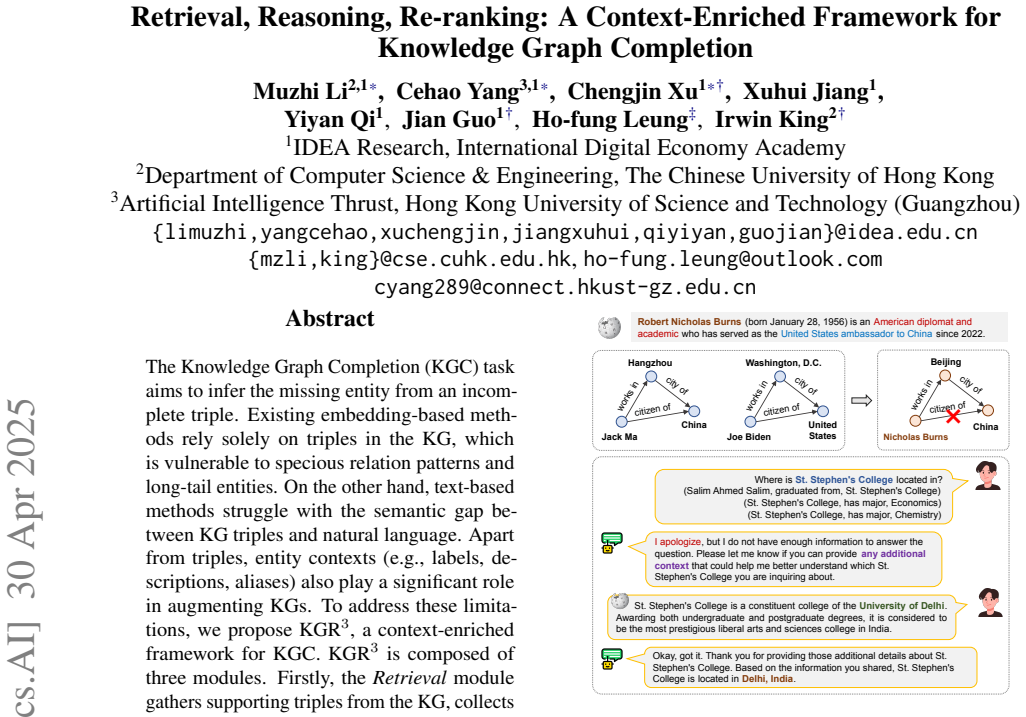
The central claim is that the semantic gap between structured KG triples and natural language can be bridged by retrieved entity contexts, and that once bridged, an LLM can both propose and select answers better than either a pure embedding model or a pure text model. Concretely, KGR3 takes a query triple, retrieves supporting triples with the same relation or similar entities, maps entity IDs to Wikidata labels, descriptions, and aliases, and asks an LLM to generate possible answers only from the base model's top-50 ranked entities. A LoRA-fine-tuned LLM is then trained to choose the ground-truth entity among twenty candidates assembled from the base model's top-10 and the LLM's suggestions. The paper reports that the best variant raises absolute Hits@1 by 12.3 percentage points on FB15k237 and 5.6 percentage points on WN18RR, and that every tested base KGC model is improved, with larger gains in Hits@1 than in Hits@3 or Hits@10.
Load-bearing premise
The framework can only return an entity the base KGC model already placed in its top-50 candidate list; if the true answer is outside that list, neither LLM reasoning nor re-ranking can recover it.
Editorial extensions
If this is right
- Any existing KGC model can be wrapped by KGR3 without retraining; the base model only needs to produce a ranked candidate list.
- Because the final candidates come from the base model's top-10 plus LLM answers already in its top-50, the framework's ceiling is the base model's top-50 recall, a constraint the paper acknowledges in its Limitations section.
- The largest gains are in Hits@1, so the practical effect is to convert near-miss rankings into exact top-ranked answers rather than to discover entirely new entities.
- Neighbor facts matter more than entity descriptions in the ablations, indicating that structured triples remain indispensable even when an LLM supplies broad world knowledge.
- The framework works with LLMs as small as 1.5B parameters and reports lower fine-tuning time, suggesting the re-ranking benefit is available without the largest models.
Reading between the lines
- A direct test of the framework's ceiling would be to report oracle recall of the base model's top-50 list; if that recall is near 100%, KGR3 is adding precision only, whereas if it is low, improving the base model's candidate recall is the next bottleneck.
- The same retrieve-candidates-then-let-an-LLM-select pattern should transfer to other KG tasks such as relation prediction or entity typing, where the final decision is a choice among a small candidate set.
- The design decision to train the LLM to pick one best answer rather than sort a full list suggests that discriminative selection is a better use of LLMs for structured ranking than full list ordering.
Editorial analysis
A structured set of objections, weighed in public.
Referee Report
Summary. The paper proposes KGR3, a three-module pipeline for transductive knowledge graph completion: a Retrieval stage that gathers supporting triples, entity contexts, and a candidate ranking from a base KGC model; a Reasoning stage that prompts an LLM to propose answers, filtered to the base model's top-δ list; and a Re-ranking stage that fine-tunes an LLM to select the best answer from a merged candidate set. Experiments on FB15k237 and WN18RR with six base KGC models and several LLMs report consistent gains, with the best variant reaching MRR 0.535/0.543 and Hits@1 0.475/0.487 on FB15k237, and the paper claims absolute Hits@1 improvements of 12.3% and 5.6% on the two datasets. The central design is that the LLM re-ranker reorders a candidate set built from base-model top-p predictions and LLM answers, rather than scoring the full entity vocabulary.
Significance. If the reported gains reproduce, KGR3 is a practical and modular contribution: it wraps any base KGC model without retraining, and the ablations isolate the contributions of reasoning, entity descriptions, neighbor facts, and re-ranking strategy. The paper also provides detailed prompts, hyperparameters, and time costs, which are useful for replication. However, the empirical claim is currently not fully bounded: the final candidate set Ac is constructed entirely from the base model's top-δ list, so the headline gains cannot be separated from the base models' oracle recall. This missing quantity, together with the absence of variance information, prevents a conclusive assessment of the framework's own contribution.
major comments (3)
- [§4.2–4.3, Eqs. (2), (4), (5)] The final Hits@1 ceiling is the oracle recall of Ac, and this is never reported. Eq. (2) filters every LLM answer through AKGC[0:δ] with δ=50, and Eq. (4) builds Ac from AKGC[0:p] plus at most n−p LLM answers that are already in that top-50 slice. Eq. (5) then places all entities outside Ac in AKGC[n:|E|], so any test triple whose ground truth is not in Ac cannot be ranked first. The Limitations section concedes that the base KGC model 'may inevitably constrain' performance, but it does not quantify how often the ground truth is even present in Ac. Please report, for each base model and dataset: the oracle Hits@n of Ac (the fraction of test triples whose ground truth is in the final candidate set), the Hits@δ of AKGC, and KGR3's Hits@1 conditioned on ground-truth-in-Ac. Without these numbers, the claimed 12.3% and 5.6% improvements cannot be attributed to the reasoning and re-ranking modules rather than to favorable candidate lists inherited from the base models.
- [§4.3, Eq. (3)] There is a train/inference distribution mismatch in the re-ranking module that is not analyzed. The SFT loss in Eq. (3) is trained on randomly sampled negatives (one ground truth plus n−1 random negatives, about half relation-hard), whereas inference re-ranks Ac, which is built from the base model's top-p candidates and LLM answers. These two distributions can be substantially different: base-model candidate lists are typically harder and more relation-confusable than random negatives. The paper does not measure the overlap between training negatives and inference candidates, nor does it ablate an SFT variant that trains on base-model top-n candidates. Without this analysis, the re-ranking module's contribution in Table 3 and Table 5 is not isolated as cleanly as the text claims; the authors should either provide this ablation or at least quantify the train/inference candidate overlap.
- [§5.3, Table 2] The main results are reported as a single run per configuration, with no standard deviations, confidence intervals, or significance tests. LLM generation is stochastic (temperature and decoding strategy are not specified for inference), so a single run does not establish that the large gains are stable across seeds. Please state the decoding settings, run at least a few seeds for the best variants, and report the spread; even a small number of repeats would materially strengthen the 'consistently' claim made throughout the paper.
minor comments (6)
- [Abstract and §5.3] The headline numbers are inconsistent across the paper: the abstract claims absolute Hits@1 improvements of 12.3% and 5.6%, while §5.3 reports 11.1% and 4.0% against 'previous state-of-the-art' with Llama3-8B, with a footnote saying Qwen2-7B is better. The 12.3% and 5.6% appear to correspond to comparisons against DIFT+CoLE and DIFT+SimKGC, but this is not stated. Please specify the exact baselines and LLM configuration for each headline number.
- [Figure 2 caption] The caption labels the three modules as '1) Reasoning (left), 2) Reasoning (middle), 3) Re-ranking (right)', but the left module is Retrieval; the caption should be corrected to Retrieval, Reasoning, and Re-ranking.
- [§4.2.2, Eq. (2)] Eq. (2) uses set intersection notation between a list (ALLM) and a slice (AKGC[0:δ]), which does not specify whether the order of LLM answers is preserved or how duplicate aliases and entity labels are resolved. Please define the operation more formally, including the handling of the δ threshold.
- [§4.3 and Table 8] Section 4.3 says 'half of them' are hard negatives, while Table 8 specifies 9 easy and 10 hard negatives; the prose should be aligned with the exact split in Table 8.
- [Reproducibility] No code, processed contexts, or candidate lists are released; given that results depend on the exact retrieved contexts and the base-model candidate filtering, releasing these artifacts would substantially aid reproducibility and verification of the candidate-ceiling analysis.
- [Throughout] There are several typographical and formatting issues, including 'Y AGO' in §3, 'LLama' capitalization in Table 2, 'pompts' in Appendix A.2, and inconsistent use of 'adjoints' in the appendix prompts; a careful proofreading pass is needed.
Circularity Check
No significant circularity: KGR3's gains are held-out benchmark results, and its candidate-set ceiling is explicitly acknowledged rather than hidden as a prediction.
full rationale
KGR3 contains no load-bearing circular step. The central claims are absolute Hits@1/MRR improvements over published baselines on held-out test splits of FB15k237 and WN18RR, so the predicted quantities are not defined in terms of, or fitted to, the framework's inputs. The re-ranking LLM is trained with the SFT loss in Eq. (3) on training triples and evaluated on disjoint test triples; no test label enters the retrieval, reasoning, or re-ranking construction. Equations (2), (4), and (5) do impose a real ceiling: the final set Ac is built from the base model's top-p list plus LLM answers intersected with the top-δ list, and any ground-truth entity outside Ac cannot be moved to rank 1. However, the paper itself states in Section 5.3 that the upper bound is 'implicitly constrained by the Hits@n performance of the base KGC model' and the Limitations section concedes that 'the base KGC model may inevitably constrain the final performance.' That is a missing oracle-recall bound on the strength of an empirical claim, not a derivation that reduces to its own input. Self-citations in the paper (e.g., Li et al. 2024 for inspiration) are peripheral and non-load-bearing; no uniqueness theorem or ansatz is imported from the authors' prior work. No fitted parameter is renamed as a prediction, and no known result is merely relabeled.
Assumptions & free parameters
free parameters (5)
- k (supporting triples per query) =
3
- n (re-ranking scope) =
20
- p (base candidates in final set) =
10
- delta (LLM answer filter) =
50
- Negative sample mix =
9 easy / 10 hard
assumptions (4)
- domain assumption Transductive setting: every test entity appears in the training set.
- domain assumption Freebase IDs in FB15k237 map cleanly to Wikidata QIDs, and the resulting labels and descriptions cover the entities used in experiments.
- domain assumption The base KGC models' top-50 candidate lists contain the ground-truth answer for enough test triples to support the reported Hits@1 gains.
- domain assumption SFT on randomly sampled negatives transfers to re-ranking base-model candidate distributions at inference.
Cite this review
Pith. "Pith review of Retrieval, Reasoning, Re-ranking: A Context-Enriched Framework for Knowledge Graph Completion." pith.science (2026). https://pith.science/paper/5DZPXSJI
@misc{pith2026241108165,
  author       = {Pith},
  title        = {Pith review of: Retrieval, Reasoning, Re-ranking: A Context-Enriched Framework for Knowledge Graph Completion},
  year         = {2026},
  howpublished = {\url{https://pith.science/paper/5DZPXSJI}},
  note         = {Machine review of arXiv:2411.08165}
}
read the original abstract
The Knowledge Graph Completion~(KGC) task aims to infer the missing entity from an incomplete triple. Existing embedding-based methods rely solely on triples in the KG, which is vulnerable to specious relation patterns and long-tail entities. On the other hand, text-based methods struggle with the semantic gap between KG triples and natural language. Apart from triples, entity contexts (e.g., labels, descriptions, aliases) also play a significant role in augmenting KGs. To address these limitations, we propose KGR3, a context-enriched framework for KGC. KGR3 is composed of three modules. Firstly, the Retrieval module gathers supporting triples from the KG, collects plausible candidate answers from a base embedding model, and retrieves context for each related entity. Then, the Reasoning module employs a large language model to generate potential answers for each query triple. Finally, the Re-ranking module combines candidate answers from the two modules mentioned above, and fine-tunes an LLM to provide the best answer. Extensive experiments on widely used datasets demonstrate that KGR3 consistently improves various KGC methods. Specifically, the best variant of KGR3 achieves absolute Hits@1 improvements of 12.3% and 5.6% on the FB15k237 and WN18RR datasets.
Figures


Reference graph
Works this paper leans on
-
[1]
Ivana Balazevic, Carl Allen, and Timothy Hospedales. 2019. https://doi.org/10.18653/v1/D19-1522 T uck ER : Tensor factorization for knowledge graph completion . In Proceedings of the 2019 Conference on Empirical Methods in Natural Language Processing and the 9th International Joint Conference on Natural Language Processing (EMNLP-IJCNLP), pages 5185--5194...
-
[2]
Kurt Bollacker, Colin Evans, Praveen Paritosh, Tim Sturge, and Jamie Taylor. 2008. https://doi.org/10.1145/1376616.1376746 Freebase: A collaboratively created graph database for structuring human knowledge . In Proceedings of the 2008 ACM SIGMOD International Conference on Management of Data, SIGMOD '08, page 1247–1250, New York, NY, USA. Association for ...
arXiv 2008
-
[3]
Antoine Bordes, Nicolas Usunier, Alberto Garcia-Dur\' a n, Jason Weston, and Oksana Yakhnenko. 2013. Translating embeddings for modeling multi-relational data. In Advances in Neural Information Processing Systems 26, volume 26. Curran Associates, Inc
work page 2013
-
[4]
Zongsheng Cao, Qianqian Xu, Zhiyong Yang, Xiaochun Cao, and Qingming Huang. 2022. https://doi.org/10.1609/aaai.v36i5.20491 Geometry interaction knowledge graph embeddings . Proceedings of the AAAI Conference on Artificial Intelligence, 36(5):5521--5529
-
[5]
Ines Chami, Adva Wolf, Da-Cheng Juan, Frederic Sala, Sujith Ravi, and Christopher R \'e . 2020. https://doi.org/10.18653/v1/2020.acl-main.617 Low-dimensional hyperbolic knowledge graph embeddings . In Proceedings of the 58th Annual Meeting of the Association for Computational Linguistics, pages 6901--6914, Online. Association for Computational Linguistics
-
[6]
Wenshuo Chao, Zhi Zheng, Hengshu Zhu, and Hao Liu. 2024. https://arxiv.org/abs/2403.19181 Make large language model a better ranker . Preprint, arXiv:2403.19181
arXiv 2024
-
[7]
Yankai Chen, Menglin Yang, Yingxue Zhang, Mengchen Zhao, Ziqiao Meng, Jianye Hao, and Irwin King. 2022 a . Modeling scale-free graphs with hyperbolic geometry for knowledge-aware recommendation. In Proceedings of the Fifteenth ACM International Conference on Web Search and Data Mining (WSDM), pages 94--102
work page 2022
-
[8]
Yankai Chen, Yaming Yang, Yujing Wang, Jing Bai, Xiangchen Song, and Irwin King. 2022 b . Attentive knowledge-aware graph convolutional networks with collaborative guidance for personalized recommendation. In 2022 IEEE 38th International Conference on Data Engineering (ICDE), pages 299--311. IEEE
work page 2022
Show all 48 references
-
[9]
Bonggeun Choi, Daesik Jang, and Youngjoong Ko. 2021. https://doi.org/10.1109/ACCESS.2021.3113329 Mem-kgc: Masked entity model for knowledge graph completion with pre-trained language model . IEEE Access, 9:132025--132032
2021
-
[10]
Jacob Devlin, Ming-Wei Chang, Kenton Lee, and Kristina Toutanova. 2019. https://doi.org/10.18653/v1/N19-1423 BERT : Pre-training of deep bidirectional transformers for language understanding . In Proceedings of the 2019 Conference of the North A merican Chapter of the Associat...
2019 doi
-
[11]
Xiou Ge, Yun Cheng Wang, Bin Wang, and C.-C. Jay Kuo. 2023. https://doi.org/10.18653/v1/2023.acl-long.384 Compounding geometric operations for knowledge graph completion . In Proceedings of the 61st Annual Meeting of the Association for Computational Linguistics (Volume 1: Lon...
2023 doi
-
[12]
Jens Lehmann, Robert Isele, Max Jakob, Anja Jentzsch, Dimitris Kontokostas, Pablo Mendes, Sebastian Hellmann, Mohamed Morsey, Patrick Van Kleef, Sören Auer, and Christian Bizer. 2014. https://doi.org/10.3233/SW-140134 Dbpedia - a large-scale, multilingual knowledge base extrac...
2014 doi
-
[13]
Muzhi Li, Minda Hu, Irwin King, and Ho fung Leung. 2024. https://arxiv.org/abs/2404.08313 The integration of semantic and structural knowledge in knowledge graph entity typing . Preprint, arXiv:2404.08313
2024 arXiv
-
[14]
Yang Liu, Zequn Sun, Guangyao Li, and Wei Hu. 2022. https://doi.org/10.1145/3511808.3557355 I know what you do not know: Knowledge graph embedding via co-distillation learning . In Proceedings of the 31st ACM International Conference on Information & Knowledge Management, CIKM...
2022
-
[15]
Yang Liu, Xiaobin Tian, Zequn Sun, and Wei Hu. 2024. https://arxiv.org/abs/2407.16127 Finetuning generative large language models with discrimination instructions for knowledge graph completion . Preprint, arXiv:2407.16127
2024 arXiv
-
[16]
Ilya Loshchilov and Frank Hutter. 2017. Decoupled weight decay regularization. arXiv preprint arXiv:1711.05101
2017 arXiv
-
[17]
Justin Lovelace, Denis Newman-Griffis, Shikhar Vashishth, Jill Fain Lehman, and Carolyn Ros \'e . 2021. https://doi.org/10.18653/v1/2021.acl-long.82 Robust knowledge graph completion with stacked convolutions and a student re-ranking network . In Proceedings of the 59th Annual...
2021 doi
-
[18]
Yueen Ma, Zixing Song, Xuming Hu, Jingjing Li, Yifei Zhang, and Irwin King. 2023. Graph component contrastive learning for concept relatedness estimation. In AAAI , pages 13362--13370. AAAI Press
2023
-
[19]
George A. Miller. 1995. https://doi.org/10.1145/219717.219748 Wordnet: a lexical database for english . Commun. ACM, 38(11):39–41
1995
-
[20]
Deepak Nathani, Jatin Chauhan, Charu Sharma, and Manohar Kaul. 2019. https://doi.org/10.18653/v1/P19-1466 Learning attention-based embeddings for relation prediction in knowledge graphs . In Proceedings of the 57th Annual Meeting of the Association for Computational Linguistic...
2019 doi
-
[21]
Michael Schlichtkrull, Thomas Kipf, Peter Bloem, Rianne Berg, Ivan Titov, and Max Welling. 2018. https://doi.org/10.1007/978-3-319-93417-4_38 Modeling Relational Data with Graph Convolutional Networks , pages 593--607
2018 doi
-
[22]
Bin Shang, Yinliang Zhao, Jun Liu, and Di Wang. 2024. https://doi.org/10.1609/aaai.v38i8.28745 Mixed geometry message and trainable convolutional attention network for knowledge graph completion . Proceedings of the AAAI Conference on Artificial Intelligence, 38(8):8966--8974
2024 doi
-
[23]
Zixing Song, Yueen Ma, and Irwin King. 2022. Individual fairness in dynamic financial networks. In NeurIPS 2022 Workshop: New Frontiers in Graph Learning
2022
-
[24]
Zixing Song, Ziqiao Meng, and Irwin King. 2024. A diffusion-based pre-training framework for crystal property prediction. In AAAI , pages 8993--9001. AAAI Press
2024
-
[25]
Zixing Song, Yifei Zhang, and Irwin King. 2023 a . No change, no gain: Empowering graph neural networks with expected model change maximization for active learning. In NeurIPS
2023
-
[26]
Zixing Song, Yifei Zhang, and Irwin King. 2023 b . Optimal block-wise asymmetric graph construction for graph-based semi-supervised learning. In NeurIPS
2023
-
[27]
Suchanek, Gjergji Kasneci, and Gerhard Weikum
Fabian M. Suchanek, Gjergji Kasneci, and Gerhard Weikum. 2007. https://doi.org/10.1145/1242572.1242667 Yago: A core of semantic knowledge . In Proceedings of the 16th International Conference on World Wide Web, WWW '07, page 697–706, New York, NY, USA. Association for Computin...
2007
-
[28]
Ni, Heung-Yeung Shum, and Jian Guo
Jiashuo Sun, Chengjin Xu, Lumingyuan Tang, Saizhuo Wang, Chen Lin, Yeyun Gong, Lionel M. Ni, Heung-Yeung Shum, and Jian Guo. 2024. https://arxiv.org/abs/2307.07697 Think-on-graph: Deep and responsible reasoning of large language model on knowledge graph . Preprint, arXiv:2307.07697
2024 arXiv
-
[29]
Zhiqing Sun, Zhi-Hong Deng, Jian-Yun Nie, and Jian Tang. 2019. Rotate: Knowledge graph embedding by relational rotation in complex space. In International Conference on Learning Representations
2019
-
[30]
Théo Trouillon, Johannes Welbl, Sebastian Riedel, Eric Gaussier, and Guillaume Bouchard. 2016. https://proceedings.mlr.press/v48/trouillon16.html Complex embeddings for simple link prediction . In Proceedings of The 33rd International Conference on Machine Learning, volume 48 ...
2016
-
[31]
Shikhar Vashishth, Soumya Sanyal, Vikram Nitin, and Partha Talukdar. 2020. https://openreview.net/forum?id=BylA_C4tPr Composition-based multi-relational graph convolutional networks . In International Conference on Learning Representations
2020
-
[32]
Denny Vrande c i\' c and Markus Kr\" o tzsch. 2014. https://doi.org/10.1145/2629489 Wikidata: A free collaborative knowledgebase . Commun. ACM, 57(10):78–85
2014 doi
-
[33]
Haoran Wang and Kai Shu. 2023. https://doi.org/10.18653/v1/2023.findings-emnlp.416 Explainable claim verification via knowledge-grounded reasoning with large language models . In Findings of the Association for Computational Linguistics: EMNLP 2023, pages 6288--6304, Singapore...
2023 doi
-
[34]
Liang Wang, Wei Zhao, Zhuoyu Wei, and Jingming Liu. 2022. https://doi.org/10.18653/v1/2022.acl-long.295 S im KGC : Simple contrastive knowledge graph completion with pre-trained language models . In Proceedings of the 60th Annual Meeting of the Association for Computational Li...
2022 doi
-
[35]
Xiaozhi Wang, Tianyu Gao, Zhaocheng Zhu, Zhengyan Zhang, Zhiyuan Liu, Juanzi Li, and Jian Tang. 2021. https://doi.org/10.1162/tacl_a_00360 KEPLER: A Unified Model for Knowledge Embedding and Pre-trained Language Representation . Transactions of the Association for Computationa...
2021 doi
-
[36]
Yanbin Wei, Qiushi Huang, Yu Zhang, and James Kwok. 2023. https://doi.org/10.18653/v1/2023.findings-emnlp.580 KICGPT : Large language model with knowledge in context for knowledge graph completion . In Findings of the Association for Computational Linguistics: EMNLP 2023, page...
2023 doi
-
[37]
Hong Wu, Zhe Wang, Kewen Wang, Pouya Ghiasnezhad Omran, and Jiangmeng Li. 2023. https://doi.org/10.4230/TGDK.1.1.7 Rule Learning over Knowledge Graphs: A Review . Transactions on Graph Data and Knowledge, 1(1):7:1--7:23
2023 doi
-
[38]
Bishan Yang, Wen - tau Yih, Xiaodong He, Jianfeng Gao, and Li Deng. 2015. Embedding entities and relations for learning and inference in knowledge bases. In 3rd International Conference on Learning Representations, ICLR 2015, San Diego, CA, USA, May 7-9, 2015, Conference Track...
2015
-
[39]
Liang Yao, Chengsheng Mao, and Yuan Luo. 2019. https://arxiv.org/abs/1909.03193 Kg-bert: Bert for knowledge graph completion
2019 arXiv
-
[40]
Yongqi Zhang and Quanming Yao. 2022. https://doi.org/10.1145/3485447.3512008 Knowledge graph reasoning with relational digraph . In Proceedings of the ACM Web Conference 2022, WWW '22, page 912–924, New York, NY, USA. Association for Computing Machinery
2022
-
[41]
Yunxiang Zhao, Jianzhong Qi, Qingwei Liu, and Rui Zhang. 2021. https://doi.org/10.1145/3404835.3462834 Wgcn: Graph convolutional networks with weighted structural features . In Proceedings of the 44th International ACM SIGIR Conference on Research and Development in Informatio...
2021
-
[42]
Yaowei Zheng, Richong Zhang, Junhao Zhang, Yanhan Ye, Zheyan Luo, and Yongqiang Ma. 2024. http://arxiv.org/abs/2403.13372 Llamafactory: Unified efficient fine-tuning of 100+ language models . arXiv preprint arXiv:2403.13372
2024 arXiv
-
[43]
Jie Zhou, Ganqu Cui, Shengding Hu, Zhengyan Zhang, Cheng Yang, Zhiyuan Liu, Lifeng Wang, Changcheng Li, and Maosong Sun. 2020. https://doi.org/10.1016/j.aiopen.2021.01.001 Graph neural networks: A review of methods and applications . AI Open, 1:57--81
2020 doi
-
[44]
Yuqi Zhu, Xiaohan Wang, Jing Chen, Shuofei Qiao, Yixin Ou, Yunzhi Yao, Shumin Deng, Huajun Chen, and Ningyu Zhang. 2023 a . Llms for knowledge graph construction and reasoning: Recent capabilities and future opportunities. arXiv preprint arXiv:2305.13168
2023 arXiv
-
[45]
Zhaocheng Zhu, Xinyu Yuan, Michael Galkin, Louis-Pascal Xhonneux, Ming Zhang, Maxime Gazeau, and Jian Tang. 2023 b . https://proceedings.neurips.cc/paper_files/paper/2023/file/b9e98316cb72fee82cc1160da5810abc-Paper-Conference.pdf Aast net: A scalable path-based reasoning appro...
2023
-
[46]
Zhaocheng Zhu, Zuobai Zhang, Louis-Pascal Xhonneux, and Jian Tang. 2021. https://proceedings.neurips.cc/paper_files/paper/2021/file/f6a673f09493afcd8b129a0bcf1cd5bc-Paper.pdf Neural bellman-ford networks: A general graph neural network framework for link prediction . In Advanc...
2021
-
[47]
online" 'onlinestring :=
ENTRY address archivePrefix author booktitle chapter edition editor eid eprint eprinttype howpublished institution journal key month note number organization pages publisher school series title type volume year doi pubmed url lastchecked label extra.label sort.label short.list...
-
[48]
write newline
" write newline "" before.all 'output.state := FUNCTION n.dashify 't := "" t empty not t #1 #1 substring "-" = t #1 #2 substring "--" = not "--" * t #2 global.max substring 't := t #1 #1 substring "-" = "-" * t #2 global.max substring 't := while if t #1 #1 substring * t #2 gl...
Reviewed August 12, 2026 · model on record in the stance chip above.
Discussion (0). Continue with ORCID to comment.