REVIEW 4 major objections 5 minor 4 cited by
Detection of a Higher Harmonic Quasi-normal Mode in the Ringdown Signal of GW231123
T0 review · 4 major / 5 minor · reviewed 2026-08-05 · deepseek-v4-flash
Pith's one-line read The ringdown of GW231123 contains the fundamental 220 quasinormal mode and a statistically significant 200 mode, with log10 Bayes factor 5.3 at a start time 12 M after peak, and the pair passes a no-hair test.
desk verdict A clever new F-statistic evidence formalism wrapped around a ringdown detection whose headline claim looks physically doubtful because the 200 mode would have to be about a hundred times the fundamental at the merger peak. read the letter →
The pith
A machine-rendered reading of the paper's core claim, the machinery that carries it, and where it could break.
The reading
What carries the argument
The load-bearing mechanism is the F-statistic extended to time-domain ringdown analysis. The quasinormal-mode waveform is split into linear amplitude/phase parameters and nonlinear parameters such as remnant mass, spin, inclination, sky location, and peak time; the linear parameters are maximized analytically, giving a profile likelihood in a low-dimensional nonlinear parameter space. The paper adds a Gaussian reconstruction of the linear-parameter posteriors plus an importance-sampling formula for the full Bayesian evidence, making model comparison possible. The central physical object is the (ell, |m|, n) = (2, 0, 0) Kerr quasinormal mode, the higher harmonic whose presence is claimed in t
What would settle it
Re-analyze the same data while marginalizing over sky location, polarization angle, and peak time rather than fixing them, and check whether the log10 Bayes factor for 220+200 over 220 stays above about 3 and the mass-spin posterior still overlaps the inspiral-merger-ringdown posteriors; alternatively, inject a 220-only signal into the same noise realization and ask how often the pipeline reports comparable 200-mode evidence.
Extended reading notes
Core claim
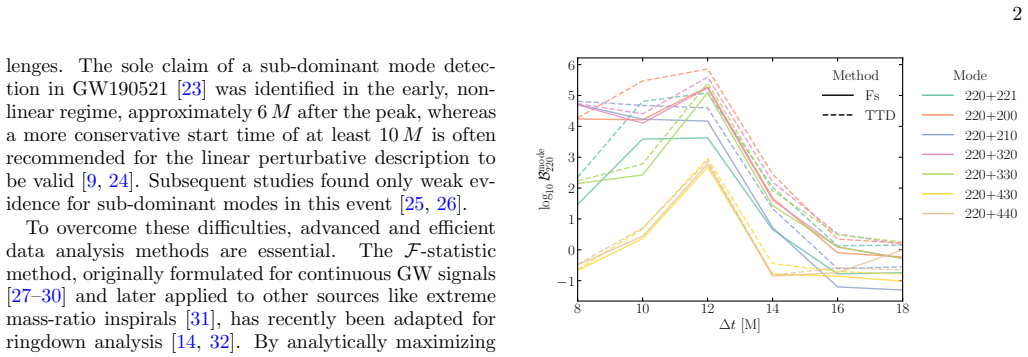
The central claim is that GW231123's ringdown contains at least two Kerr quasinormal modes: the fundamental 220 mode and the higher harmonic 200 mode, with the latter strongly preferred by the data at a start time 12 M after the polarization peak. The paper estimates the detection significance as log10 Bayes factor 5.3 with the F-statistic and 5.9 with the traditional time-domain sampler, and finds the 200-mode amplitude roughly ten times the 220-mode amplitude at the maximum likelihood. From the two-mode fit it derives remnant mass and spin, reports consistency with the NRSur7dq4 and SEOBNRv5PHM inspiral-merger-ringdown posteriors, and finds the frequency and damping time of the 200 mode co
Load-bearing premise
The detection rests on assuming that at 12 M after peak (about 18 ms) the signal is a linear Kerr ringdown, and that fixing sky location, polarization angle, and peak time to the NRSur7dq4 maximum-likelihood values does not bias the comparison.
Editorial extensions
If this is right
- GW231123 becomes a two-tone black-hole spectroscopy source: the ringdown alone fixes the remnant's mass and spin, and those values agree with full inspiral-merger-ringdown analyses without the bimodal posteriors seen in fundamental-mode-only fits.
- Start times as early as 12 M after peak can be used for ringdown model selection when subdominant modes are included, extending the usable ringdown data.
- The no-hair test with the two detected modes places a direct observational constraint on the 200-mode frequency and damping time, and finds them compatible with Kerr predictions.
- The F-statistic evidence-reconstruction formalism makes Bayesian model comparison between different quasinormal-mode combinations computationally practical, so scanning many mode combinations becomes feasible.
- No three-mode combination, including 220+200+330, beats the two-mode model at safe start times, so the claimed spectrum is exactly two resolved tones.
Reading between the lines
- Because the sky location, polarization angle, and peak time are fixed to the NRSur7dq4 maximum-likelihood values rather than marginalized, the 200-mode evidence could change under a fully marginalized analysis; re-running with those parameters varying would give the cleanest test.
- The 200-to-220 amplitude ratio at 12 M is so large that it implies an even larger ratio at earlier times unless the 200 mode decays much faster; this points toward a strongly precessing or non-quasi-circular source, and comparing the measured mode amplitudes with precessing numerical-relativity templates would discriminate among the scenarios the paper lists.
- The same F-statistic evidence and posterior reconstruction could be applied to other disputed ringdown claims, such as the earlier subdominant-mode detection in GW190521, where the conservative start time was a central issue.
- If the 200-mode dominance is reproduced by independent pipelines, it would imply that some binary black holes ring down with mode energies quite different from quasi-circular aligned-spin expectations, informing ringdown templates for future detectors.
Signed reviews
Editorial analysis
A structured set of objections, weighed in public.
Referee Report
Summary. The paper presents a Bayesian time-domain ringdown analysis of GW231123 using two methods: a traditional stochastic sampler (TTD) and a newly extended F-statistic framework. It reports that the model containing the 220 and 200 quasinormal modes is strongly preferred over a 220-only model, with log10 Bayes factor 5.3 (F-statistic) at Δt=12M after the polarization peak, and that the two methods agree. The inferred remnant parameters are Mf=305.6^{+35.7}_{-47.3} Msun and χf=0.84^{+0.07}_{-0.14} (F-statistic), overlapping with full IMR results. A no-hair test allowing deviations in the 200 mode frequency and damping time finds no deviation at the preferred start time. A search for a third mode finds no compelling evidence.
Significance. If the detection is real, it would be an important result: a higher harmonic (200) mode in a ringdown, enabling a multimode no-hair test. The extension of the F-statistic to compute evidences and posteriors is a useful methodological contribution, and the cross-check between TTD and F-statistic is a strength. The authors are candid about the anomaly of the large 200 amplitude. However, the central claim depends on the assumption that at Δt=12M the signal is a linear superposition of Kerr QNMs; the paper does not yet provide the validation needed to exclude the alternative explanation that the fast-decaying 200 template absorbs the nonlinear merger transient.
major comments (4)
- [Sec. III; Fig. 4] The linear-regime assumption at Δt=12M is load-bearing and is not validated. The recovered amplitudes are A200=(2.9–3.9)e-20 and A220=(1.4–3.1)e-21, so A200/A220≈20. For the m=0 mode with τ≈6M, the corresponding peak amplitude would be far larger than the 220 mode, which is difficult to reconcile with a subdominant linear perturbation. The authors themselves write that 'The pronounced dominance of the 200 mode raises questions about its origin' and offer untested explanations. Moreover, Fig. 4 shows δf200 deviating from GR at Δt=8M and 10M, demonstrating sensitivity to non-linear contamination at nearby start times. I ask for an NR/IMR injection-recovery test showing that (i) a known 200 mode with moderate amplitude is recovered without bias at 12M, and (ii) a non-linear merger residual does not produce a spurious 200 detection with log10 BF≈5. Without such a test, the detection and the
- [Sec. II; Fig. 1] The headline log10 BF=5.3 is the maximum over a scan of start times (8 to 18M in 2M steps) and seven mode combinations. No trials-factor or look-elsewhere correction is applied. This inflates the statistical significance of the 200 detection. Please report the evidence integrated over the scan or a corrected Bayes factor. If the trials factor is applied, the evidence may remain large, but it must be quantified.
- [Sec. II] The analysis fixes RA, DEC, ψ, and the polarization peak time to the NRSur7dq4 maximum-likelihood values and then compares the resulting posteriors with NRSur7dq4 IMR posteriors. This makes the claimed consistency partially built in and can bias ringdown amplitudes and evidence if the extrinsic parameters are inaccurate. A marginalization over these nuisance parameters, or an injection test demonstrating that fixing them does not bias the 200 amplitude and evidence, is needed. Comparing with SEOBNRv5PHM is helpful but is not a substitute.
- [Appendix A, Eqs. (A13)–(A15)] The F-statistic evidence reconstruction is a new contribution, but no validation on simulated injections is shown. The cross-check with TTD is reassuring, but an explicit test that the importance-sampling evidence estimator is unbiased for the adopted priors and ACF would strengthen the methodological claim and the model comparison.
minor comments (5)
- [Fig. 5 caption] The caption says '220 + 201' in the bottom-right panel; it should be '220 + 200'.
- [Introduction] Typo: 'NRSurd7q4' should be 'NRSur7dq4'.
- [Sec. III] The statement that the 200 amplitude is 'approximately an order of magnitude larger' is imprecise; the maximum-likelihood ratio is about 20.
- [Sec. II] The sentence 'To isolate the ringdown signal and mitigate contamination from the pre-merger phase, we fix the sky location...' is confusing: fixing extrinsic parameters does not by itself remove pre-merger contamination. Please clarify.
- [Sec. II / Appendix A] The no-hair deviation parameters δf200 and δτ200 are introduced only in words; please include their definitions in the model equations and specify their priors.
Circularity Check
No significant circularity; the ringdown detection is a likelihood-based model comparison using GR-derived QNM frequencies, not a reduction to fitted inputs or self-citations.
full rationale
The central claim—detection of the 200 mode—is obtained by comparing two time-domain likelihood models (220-only vs 220+200) on the same strain data, with QNM frequencies and damping times computed from Kerr perturbation theory for sampled (Mf, χf). The Bayes factor is a model-comparison statistic, not a refit of an input quantity; the 220+200 model is not derived from the 220-only fit. The fixed RA/DEC/ψ/tc values taken from the NRSur7dq4 IMR analysis are nuisance parameters used to isolate the ringdown segment, and the subsequent consistency check against IMR posteriors is a comparison, not an input to the detection. The no-hair test parameterizes deviations from GR and measures them, rather than assuming GR. The F-statistic evidence formalism is derived in Appendix A, and the methodological self-citations to earlier F-statistic work are not load-bearing for the physical result because the necessary likelihood and evidence expressions are presented in the paper. No equation reduces the claimed detection to a fitted value, to a self-citation chain, or to a uniqueness theorem. The physical concern that A200 ≫ A220 at Δt = 12M may indicate nonlinear contamination is a correctness and interpretation risk, not circularity: it does not make the Bayes factor equivalent to its input by construction. The paper also cross-checks against an independent TTD method and against the external SEOBNRv5PHM IMR model, so the analysis is not self-referential in a way that forces the conclusion.
Assumptions & free parameters
free parameters (8)
- Redshifted final mass Mf =
305.6+35.7-47.3 Msun (F-stat, 90% CL)
- Final spin chi_f =
0.84+0.07-0.14 (F-stat, 90% CL)
- Inclination cos iota =
posterior not quoted; flat prior [-1,1]
- Amplitude A220 =
1.4e-21 (maximum likelihood, F-stat at dt=12M)
- Amplitude A200 =
2.9e-20 (maximum likelihood, F-stat at dt=12M)
- Phases phi220 and phi200 =
not quoted; uniform prior [0, 2pi]
- No-hair deviation parameters delta_f200 and delta_tau200 =
0.26+0.68-0.38 and -0.24+0.51-0.32 (90% CL)
- Analysis start time dt/M =
12 M (selected from discrete scan over [8,18] M)
assumptions (7)
- domain assumption Kerr no-hair theorem: QNM frequencies and damping times are functions of only Mf and chi_f.
- domain assumption The ringdown at dt >= 12 M is linear and well described by a finite sum of Kerr QNMs (here 220 and 200).
- domain assumption Detector noise is stationary and Gaussian with covariance estimated from the same data segment.
- ad hoc to paper Sky location, polarization angle, and peak time can be fixed to NRSur7dq4 maximum-likelihood values without marginalizing.
- domain assumption Spin-weighted spheroidal harmonics can be replaced by spin-weighted spherical harmonics.
- domain assumption Analysis priors: amplitudes uniform in [0,5e-19], Mf flat in [100,500] Msun, chi flat in [0,0.99], phase uniform.
- standard math The F-statistic evidence reconstruction via importance sampling, Eq. (A13) to (A15), is unbiased with the finite number of draws used.
Cite this review
Pith. "Pith review of Detection of a Higher Harmonic Quasi-normal Mode in the Ringdown Signal of GW231123." pith.science (2026). https://pith.science/paper/5FMFDDN4
@misc{pith2026250902047,
  author       = {Pith},
  title        = {Pith review of: Detection of a Higher Harmonic Quasi-normal Mode in the Ringdown Signal of GW231123},
  year         = {2026},
  howpublished = {\url{https://pith.science/paper/5FMFDDN4}},
  note         = {Machine review of arXiv:2509.02047}
}
abstract
The ringdown phase of a gravitational wave signal from a binary black hole merger offers a unique laboratory for testing general relativity in the strong-field regime and probing the properties of the final remnant black hole. In this study, we analyze the ringdown of GW231123 and find strong evidence for a multimode quasinormal spectrum. Our analysis employs two time-domain methodologies: a full Bayesian inference and an enhanced F-statistic framework, which we extend to enable the calculation of Bayesian evidence and the reconstruction of posterior distributions for all model parameters. We report a statistically significant detection of the $\ell|m|n=200$ mode, with a $\log_{10}$(Bayes factor) of $5.3$, commencing at $12\,M$ after the peak amplitude--a time well within the accepted linear regime. This two-mode analysis yields a redshifted final mass of $305.6^{+35.7}_{-47.3}M _{\odot}$ and a final spin of $0.84^{+0.07}_{-0.14}$ at $90\%$ credibility, from a ringdown signal with a network signal-to-noise ratio of approximately $14.5$. Furthermore, a test of the no-hair theorem performed using the two detected modes reveals no deviation from the predictions of general relativity. These results highlight the power of the F-statistic methodology to uncover nuanced features in gravitational wave signals, thereby providing novel insights into the fundamental properties of black holes.
Figures


Figures from the paper (5 more)


Forward citations
Cited by 4 Pith papers
-
Foundations of Direct Waves in Schwarzschild Ringdown
Direct waves in filtered Schwarzschild ringdown are the anti-causal filter-pole contribution sourced by near-horizon trajectory dynamics and do not vanish.
-
Ensemble-Based Residual Tests of GW231123 across Waveform Models
GW231123's residuals are consistent with detector noise for all five waveform models, and the strain-level differences between models are too small to be detected.
-
GW250114 reveals black hole horizon signatures
The merger signal of GW250114 contains a residual 'direct wave' component whose frequency and damping match the remnant horizon's rotation frequency and surface gravity.
-
First Overtone Mode in the Ringdown Signal of GW231028
The ringdown of GW231028 contains evidence for the 221 first overtone mode alongside the dominant 220 mode, with a Bayes factor of 193 at 10M after the peak.
Reference graph
Works this paper leans on
-
[1]
C. V. Vishveshwara, Phys. Rev. D 1, 2870 (1970)
1970
-
[2]
W. H. Press, Astrophys. J. Lett. 170, L105 (1971)
work page 1971
-
[3]
S. A. Teukolsky, Astrophys. J. 185, 635 (1973)
1973
- [4]
-
[5]
S. W. Hawking, Commun. Math. Phys. 25, 152 (1972)
1972
-
[6]
D. C. Robinson, Phys. Rev. Lett. 34, 905 (1975)
work page 1975
-
[7]
R. P. Kerr, Physical Review Letters 11, 237 (1963)
work page 1963
-
[8]
V. Cardoso and P. Pani, Living Rev. Rel. 22, 4 (2019), arXiv:1904.05363 [gr-qc]
arXiv 2019
Show all 58 references
-
[9]
Berti et al., (2025), arXiv:2505.23895 [gr-qc]
E. Berti et al., (2025), arXiv:2505.23895 [gr-qc]
2025 arXiv
-
[10]
Sperhake, E
U. Sperhake, E. Berti, V. Cardoso, J. A. Gonzalez, B. Bruegmann, and M. Ansorg, Phys. Rev. D 78, 064069 (2008), arXiv:0710.3823 [gr-qc]
2008 arXiv
-
[11]
M. Isi, M. Giesler, W. M. Farr, M. A. Scheel, and S. A. Teukolsky, Phys. Rev. Lett 123, 111102 (2019), arXiv:1905.00869 [gr-qc]
2019 arXiv
-
[12]
Cotesta, G
R. Cotesta, G. Carullo, E. Berti, and V. Cardoso, Phys. Rev. Lett 129, 111102 (2022), arXiv:2201.00822 [gr-qc]
2022 arXiv
-
[13]
Wang and L
H.-T. Wang and L. Shao, Phys. Rev. D 108, 123018 (2023), arXiv:2311.13300 [gr-qc]
2023 arXiv
-
[14]
H.-T. Wang, Z. Wang, Y. Dong, G. Yim, and L. Shao, Phys. Rev. D 111, 064037 (2025), arXiv:2411.13333 [gr- qc]
2025 arXiv
-
[15]
Siegel, M
H. Siegel, M. Isi, and W. M. Farr, Phys. Rev. D 111, 044070 (2025), arXiv:2410.02704 [gr-qc]
2025 arXiv
-
[16]
Finch and C
E. Finch and C. J. Moore, Phys. Rev. D 106, 043005 (2022), arXiv:2205.07809 [gr-qc]
2022 arXiv
-
[17]
Correia, Y.-F
A. Correia, Y.-F. Wang, J. Westerweck, and C. D. Capano, Phys. Rev. D 110, L041501 (2024), arXiv:2312.14118 [gr-qc]
2024 arXiv
-
[18]
Baibhav, M
V. Baibhav, M. H.-Y. Cheung, E. Berti, V. Cardoso, G. Carullo, R. Cotesta, W. Del Pozzo, and F. Duque, Phys. Rev. D 108, 104020 (2023), arXiv:2302.03050 [gr- qc]
2023 arXiv
-
[19]
P. J. Nee, S. H. V¨ olkel, and H. P. Pfeiffer, Phys. Rev. D 108, 044032 (2023), arXiv:2302.06634 [gr-qc]
2023 arXiv
-
[20]
H. Zhu, J. L. Ripley, A. C´ ardenas-Avenda˜ no, and F. Pretorius, Phys. Rev. D 109, 044010 (2024), arXiv:2309.13204 [gr-qc]
2024 arXiv
-
[21]
T. A. Clarke et al., Phys. Rev. D 109, 124030 (2024), arXiv:2402.02819 [gr-qc]
2024 arXiv
-
[22]
Giesler et al., Phys
M. Giesler et al., Phys. Rev. D 111, 084041 (2025), arXiv:2411.11269 [gr-qc]
2025 arXiv
-
[23]
C. D. Capano, M. Cabero, J. Westerweck, J. Abedi, S. Kastha, A. H. Nitz, Y.-F. Wang, A. B. Nielsen, and B. Krishnan, Phys. Rev. Lett. 131, 221402 (2023), 7 arXiv:2105.05238 [gr-qc]
2023 arXiv
-
[24]
Mitman et al., (2025), arXiv:2503.09678 [gr-qc]
K. Mitman et al., (2025), arXiv:2503.09678 [gr-qc]
2025 arXiv
-
[25]
Siegel, M
H. Siegel, M. Isi, and W. M. Farr, Phys. Rev. D 108, 064008 (2023), arXiv:2307.11975 [gr-qc]
2023 arXiv
-
[26]
Gennari, G
V. Gennari, G. Carullo, and W. Del Pozzo, Eur. Phys. J. C 84, 233 (2024), arXiv:2312.12515 [gr-qc]
2024 arXiv
-
[27]
Jaranowski, A
P. Jaranowski, A. Krolak, and B. F. Schutz, Phys. Rev. D 58, 063001 (1998), arXiv:gr-qc/9804014
1998 arXiv
-
[28]
Cutler and B
C. Cutler and B. F. Schutz, Phys. Rev. D 72, 063006 (2005), arXiv:gr-qc/0504011
2005 arXiv
-
[29]
Dreissigacker, R
C. Dreissigacker, R. Prix, and K. Wette, Phys. Rev. D 98, 084058 (2018), arXiv:1808.02459 [gr-qc]
2018 arXiv
-
[30]
Sieniawska, M
M. Sieniawska, M. Bejger, and A. Kr´ olak, Class. Quant. Grav. 36, 225008 (2019), arXiv:1905.13488 [astro-ph.IM]
2019 arXiv
-
[31]
Y. Wang, Y. Shang, and S. Babak, Phys. Rev. D 86, 104050 (2012), arXiv:1207.4956 [gr-qc]
2012 arXiv
-
[32]
H.-T. Wang, G. Yim, X. Chen, and L. Shao, Astrophys. J. 974, 230 (2024), arXiv:2409.00970 [gr-qc]
2024 arXiv
-
[33]
A. G. Abac et al. (LIGO Scientific, VIRGO, KAGRA), (2025), arXiv:2507.08219 [astro-ph.HE]
2025 arXiv
-
[34]
Varma, S
V. Varma, S. E. Field, M. A. Scheel, J. Blackman, D. Gerosa, L. C. Stein, L. E. Kidder, and H. P. Pfeiffer, Phys. Rev. Research. 1, 033015 (2019), arXiv:1905.09300 [gr-qc]
2019 arXiv
-
[35]
Ramos-Buades, A
A. Ramos-Buades, A. Buonanno, H. Estell´ es, M. Khalil, D. P. Mihaylov, S. Ossokine, L. Pompili, and M. Shiferaw, Phys. Rev. D 108, 124037 (2023), arXiv:2303.18046 [gr-qc]
2023 arXiv
- [36]
-
[37]
Calder´ on Bustillo, N
J. Calder´ on Bustillo, N. Sanchis-Gual, A. Torres-Forn´ e, and J. A. Font, Phys. Rev. Lett. 126, 201101 (2021), arXiv:2009.01066 [gr-qc]
2021 arXiv
-
[38]
M. H.-Y. Cheung et al., Phys. Rev. Lett. 130, 081401 (2023), arXiv:2208.07374 [gr-qc]
2023 arXiv
-
[39]
Rossell´ o-Sastre, S
M. Rossell´ o-Sastre, S. Husa, S. Bera, and Y. Xu, (2025), arXiv:2506.05859 [gr-qc]
2025
-
[40]
Palenzuela, I
C. Palenzuela, I. Olabarrieta, L. Lehner, and S. L. Liebling, Phys. Rev. D 75, 064005 (2007), arXiv:gr- qc/0612067
2007
-
[41]
Calder´ on Bustillo, N
J. Calder´ on Bustillo, N. Sanchis-Gual, A. Torres-Forn´ e, J. A. Font, A. Vajpeyi, R. Smith, C. Herdeiro, E. Radu, and S. H. W. Leong, Phys. Rev. Lett.126, 081101 (2021), arXiv:2009.05376 [gr-qc]
2021 arXiv
-
[43]
Abbott et al
R. Abbott et al. (KAGRA, VIRGO, LIGO Scientific), Astrophys. J. Suppl. 267, 29 (2023), arXiv:2302.03676 [gr-qc]
2023 arXiv
-
[44]
E. W. Leaver, Proc. Roy. Soc. Lond. A 402, 285 (1985)
1985
-
[45]
Berti, V
E. Berti, V. Cardoso, and C. M. Will, Phys. Rev. D 73, 064030 (2006), arXiv:gr-qc/0512160
2006 arXiv
- [46]
-
[47]
Wang and L
H.-T. Wang and L. Shao, Phys. Rev. D 109, 043027 (2024), arXiv:2401.13997 [gr-qc]
2024 arXiv
-
[48]
Khan and S
M. Khan and S. Agha, Analog Integrated Circuits and Signal Processing 105, 99 (2020)
2020
-
[49]
P. D. Welch, IEEE Trans. Audio & Electroacoust 15 (1967), 10.1109/TAU.1967.1161901
1967
-
[50]
Allen, W
B. Allen, W. G. Anderson, P. R. Brady, D. A. Brown, and J. D. E. Creighton, Phys. Rev. D 85, 122006 (2012), arXiv:gr-qc/0509116 [gr-qc]
2012 arXiv
-
[51]
Ashton et al., Astrophys
G. Ashton et al., Astrophys. J. Suppl. 241, 27 (2019), arXiv:1811.02042 [astro-ph.IM]
2019 arXiv
-
[52]
I. M. Romero-Shaw et al., Mon. Not. Roy. Astron. Soc. 499, 3295 (2020), arXiv:2006.00714 [astro-ph.IM]. Appendix A: Methodology
2020 arXiv
-
[53]
Each individ- ual QNM is identified by a set of indices: the angular numbers (ℓ, m) and the overtone number n = 0, 1, 2
The Ringdown W aveform Model The gravitational wave emission during the ringdown phase is modeled as a superposition of quasinormal modes (QNMs), which represent the characteristic vi- brations of the final, settled black hole. Each individ- ual QNM is identified by a set of i...
-
[54]
This method aims to infer the posterior distributions of all model parameters, denoted by the vector Θ, by directly evaluating the likelihood function for the data
The traditional time-domain method Our first analysis approach is the TTD method. This method aims to infer the posterior distributions of all model parameters, denoted by the vector Θ, by directly evaluating the likelihood function for the data. The ob- served data in a detec...
-
[55]
All procedures are implemented using the PyCBC pack- age (version 2.7.2) [50]
with an inverse spectrum truncationalgorithm. All procedures are implemented using the PyCBC pack- age (version 2.7.2) [50]. Finally, the ACF is obtained via an inverse Fourier transform of the PSD, from which the Toeplitz covariance matrix C is constructed. To ensure this TD ...
-
[56]
lin- ear
The F -statistic As an alternative to TTD, we employ the F -statistic method, a semi-analytical approach designed to enhance computational efficiency by reducing the dimensionality of the parameter space. The core principle is to sepa- rate the waveform parameters into two gro...
-
[57]
The first step consists of the primary analysis, where we efficiently explore the reduced-dimension, non-linear parameter space of θ us- ing the profile likelihood (Eq
Parameter Estimation Strategy and Priors The use of the F -statistic necessitates a two-step strat- egy for parameter estimation. The first step consists of the primary analysis, where we efficiently explore the reduced-dimension, non-linear parameter space of θ us- ing the pr...
-
[58]
While nested sampling algorithms di- rectly compute the evidence for TTD by integrating over the full parameter space Θ, this is not the case for the F -statistic method
Evidence and Bayes F actor Calculation A primary advantage of Bayesian inference is the abil- ity to perform model selection using the Bayes factor, B, which is the ratio of the Bayesian evidence, Z, for two competing models. While nested sampling algorithms di- rectly compute...
-
[59]
rwalk” method for the primary sampling. The random walk was configured with 20 autocorrelation lengths, and proposals were drawn using a mix of “diff
Sampler Configuration All Bayesian inference analyses were conducted using the Bilby package [v2.4.0; 51], with Dynesty [v2.1.5; 52] as the nested sampling engine. We configured the sampler with 1000 live points and used the “rwalk” method for the primary sampling. The random ...
Reviewed August 5, 2026 · model on record in the stance chip above.
Discussion (0). Continue with ORCID to comment.