REVIEW 4 major objections 6 minor 1 cited by
The ringdown of GW231028 contains the first overtone quasinormal mode alongside the fundamental, with a Bayes factor near 190 supporting the two-mode fit.
Reviewed by Pith at T0; open to challenge. T0 means a machine referee read the full paper against a public rubric. the ladder, T0–T4 →
T0 review · deepseek-v4-flash
2026-08-04 20:16 UTC pith:CVKVCTDQ
load-bearing objection Potentially important overtone claim in GW231028, but the abstract overstates what the body supports: the cited injection validation is missing and the detection sits on a steeply decaying Bayes factor. the 4 major comments →
First Overtone Mode in the Ringdown Signal of GW231028
The pith
A machine-rendered reading of the paper's core claim, the machinery that carries it, and where it could break.
Core claim
On the paper's own terms: the ringdown of GW231028 is best described by the superposition of the fundamental quadrupole mode (220) and its first overtone (221). With the F-statistic starting 10M after the polarization peak, the 220+221 model beats the fundamental-only model by a Bayes factor near 190, the overtone amplitude is non-zero at more than 7σ, and the inferred remnant — mass 243.0+22.7/−22.7 M⊙, spin 0.80+0.07/−0.11 — agrees with two independent full IMR waveform posteriors. The numerical-relativity injection SXS:BBH:1282 is cited as showing this multimode content is physically expected for this remnant's spin and mass ratio. The paper calls this the first decisive overtone detectio
What carries the argument
The engine is the F-statistic, a time-domain likelihood method that analytically maximizes the ringdown fit over each mode's linear parameters (amplitude and phase), leaving only the nonlinear parameters — remnant mass, spin, and any frequency or damping deviations — to the search; this dimensionality reduction is what lets a sub-dominant mode as faint as the 221 overtone compete with the noise at a network SNR near 10.5. The signal model is a superposition of damped sinusoids (quasinormal modes), each indexed by (ℓ, m, n), whose complex frequency is fixed uniquely by the remnant's mass and spin — so every additional detected mode is an independent measurement of the same two parameters, whi
Load-bearing premise
The load-bearing premise is that at Δt = 10M after the SEOBNRv5PHM-defined peak, GW231028's ringdown is already in the linear perturbation regime, so the extra power modeled as the 221 overtone is a genuine quasinormal mode rather than nonlinear or transient merger content; the reported Bayes factor falls from about 193 at 10M to essentially zero by 14–16M, so a slightly later linearity boundary erases the detection.
What would settle it
Run the same pipeline on noise-only stretches of the same detector data and on injections containing only the 220 mode, and count how often the 220+221 model wins with a Bayes factor above 190 when no overtone is present; a false-alarm rate much above 1/190 would undercut 'decisive'. Separately, repeat the 10M analysis starting at 12M and 14M: Fig. 1 of the paper shows log10 B dropping from ≈2.3 at 10M to ≈0 at 14–16M, so the >7σ amplitude exclusion must survive those later, uncontroversially linear start times for the detection to stand.
If this is right
- If the detection holds, black-hole spectroscopy becomes a two-mode discipline: remnant mass and spin can be pinned from the ringdown alone, as done here, without needing the inspiral part of the signal.
- The two-mode no-hair test becomes usable on real events; the paper's 90% bounds on the overtone frequency and damping-time deviations (δf221, δτ221) are the template for future tests.
- Mode content becomes a diagnostic of merger dynamics: GW231028 shows the 221 overtone with no 200 mode, whereas GW231123's ringdown was 200-dominated, which the paper links to different merger geometries and formation channels.
- Ringdown-only remnant parameters that agree with two independent full IMR waveform models give gravitational-wave astronomy a cross-check on inspiral-merger-ringdown waveform accuracy.
- The evidence landscape across start times (log10 B ≈ 5.2 at 8M, ≈2.3 at 10M, ≈0 at 14–16M) maps where overtone searches should look: as early in the linear regime as the data allow.
Where Pith is reading between the lines
- My read: the steep decay of the Bayes factor between 8M and 16M puts the whole detection on the question of where linearity begins for this specific event; an event-specific numerical-relativity injection study at the inferred mass and spin — rather than the generic ≈8M rule — would settle whether the 10M boundary is safe.
- My read: the >7σ amplitude exclusion is quoted for 10M, but the mode's SNR decays from 10.5 at 10M to 5.9 at 20M; checking the overtone amplitude posterior at 12M and 14M would show how quickly that significance decays.
- My read: the peak time, sky location, and polarization are anchored to the SEOBNRv5PHM waveform; redoing the analysis with the NRSur7dq4 anchor or marginalizing over sky position would reveal how much of the Bayes factor depends on that single-model choice.
- My read: a genuine overtone implies a predictable A221/A220 excitation ratio from numerical relativity; measuring that ratio across a population of high-mass, high-spin remnants would turn this single detection into a calibration of overtone excitation physics.
Editorial analysis
A structured set of objections, weighed in public.
Referee Report
Summary. The paper analyzes the ringdown of GW231028_153006 using a time-domain F-statistic method that fixes the sky location and polarization and varies the analysis start time from 8M to 20M after the SEOBNRv5PHM polarization peak. It claims a decisive detection of the first overtone 221 in addition to the fundamental 220, with a Bayes factor of 193 at Δt=10M, remnant parameters Mf=243.0^{+22.7}_{-22.7} M⊙ and χf=0.80^{+0.07}_{-0.11} consistent with full IMR analyses, and a no-hair test consistent with GR. The abstract additionally claims validation against the NR injection SXS:BBH:1282 and an amplitude exclusion from zero at >7σ, and reports slightly different numerical values (BF 189.2, Mf=246.2, χf=0.81). The main evidence is summarized in Fig. 1 (Bayes factors for several two-mode combinations) and in the start-time dependence of the 220+221 evidence and amplitudes (Fig. 3).
Significance. If correct, this would be the first decisive detection of an overtone in a BBH ringdown and would enable a two-mode no-hair test; the result is therefore of considerable interest for BH spectroscopy. The manuscript has several genuine strengths: the QNM frequencies and damping times are fixed by GR and the inferred remnant parameters rather than fitted; the F-statistic reduces the search dimension; and the supplementary figures show the full start-time and model dependence of the posteriors, which is good practice. The significance statement is however weakened by the steep start-time dependence of the evidence, the absent NR-injection validation promised in the abstract, and the unresolved model-selection degeneracy between the 221 overtone and the 210 harmonic. These issues, not the method itself, currently prevent the result from being verified as stated.
major comments (4)
- [Abstract vs §II–IV] The abstract states the findings are 'rigorously validated against the numerical relativity injection SXS:BBH:1282'. The body never mentions this injection or any injection-recovery test; the only calibration invoked is that the pipeline is 'identical' to that validated for GW231123 [28], a different event with different mass, spin, SNR, and noise. The false-alarm rate and amplitude bias of the F-statistic are therefore uncalibrated for GW231028, and the claimed BF=193 and >7σ significance are unsupported. Also, abstract and body disagree on BF (189.2 vs 193), Mf (246.2 vs 243.0), and χf (0.81 vs 0.80). Either include the SXS:BBH:1282 validation or retract the claim, and reconcile the numbers.
- [§III, Fig. 1; §II start-time choices] The evidence for 220+221 decays steeply with start time: log10B is ≈5.2 at Δt=8M, ≈2.3 at 10M (BF=193), ≈1.5 at 12M, and near zero by 14–16M. The choice Δt=10M as 'firmly within the linear perturbation regime' is asserted with citations [11–15] but no event-specific check is given: no NR injection into GW231028's noise, no stability test of the 221 amplitude or phase across start times, and no marginalization over the linear-regime boundary. The peak time t_pol_c=1382542224.18917 s is fixed (Sec. II). Given this steep gradient, a slightly later linearity boundary erases the detection. The authors should demonstrate linearity for this event (e.g., recover an injected NR waveform at 10M) or report a start-time-marginalized Bayes factor; otherwise the 'decisive' claim is not robust.
- [§III, model selection] Sec. III states that the 220+210 model is 'marginally favored' over 220+221 by evidence (Fig. 1) but is rejected because it 'fails to provide meaningful constraints' on Mf and χf. The reported BF=193 is only for 220+221 vs 220. Since the data do not clearly prefer 221 over 210, the specific claim of an overtone (n=1) identification requires a direct comparison of 220+221 vs 220+210, or a model average over the candidate set with explicit priors. As written, the selection of 221 over 210 rests on consistency with IMR posteriors—an external physical expectation—rather than on the evidence. This is not circular, but it must be quantified and reported so the reader can see the posterior weight of each candidate.
- [Abstract vs §III (amplitude significance)] The abstract claims an amplitude exclusion from zero at '>7σ credibility' for the 221 mode, but the body never reports this significance level or the A221 posterior at Δt=10M. Fig. 3 shows that the 221 amplitude posterior is consistent with zero at later start times, so the σ value is a headline result that must be derived or explicitly stated. The abstract also says the analysis uses 'both a time-domain F-statistic framework and full Bayesian time-domain sampling', but Sec. II describes only the F-statistic method; either the Bayesian analysis must be reported or the abstract corrected.
minor comments (6)
- [§II, Eq. (1)] Clarify the handling of the azimuth angle δ and its relation to the fixed polarization angle ψ; the notation ℓ|m|n in the introduction is ambiguous (e.g., '22' should be '220').
- [§III header] Typo in the section header: 'MUL TIMODE SEARCH' should be 'MULTIMODE SEARCH'.
- [§II] The paper should state the noise model and PSD estimation used, even if identical to [28], for reproducibility.
- [§II, Eq. (1)] The spherical-harmonic approximation should be quantified for χf≈0.8; spheroidal corrections for the 221 mode could bias the amplitudes or Bayes factor at the claimed precision.
- [Abstract vs §III] The abstract's 'decisive evidence for multimode content' also names the 210 mode, but the body does not claim a 210 detection; clarify the status of 210.
- [Fig. 3] The top-panel axis label 'log10B220+221 220' is hard to read; use explicit subscript/superscript formatting.
Circularity Check
No constructional circularity: the 221 detection is a genuine model comparison; the SXS-injection validation promised in the abstract is absent, and the pipeline calibration is sourced to the same author's prior work, but these are validation/reproducibility gaps, not by-construction reductions.
full rationale
I walked the derivation chain. The ringdown model (Eq. 1) is a superposition of damped sinusoids whose complex frequencies are fixed by GR for given M_f and chi_f; the amplitudes and phases are free parameters maximized by the F-statistic. The 221 detection therefore does not reduce to a fitted input: the Bayes factor in Fig. 1 is a genuine comparison of 220+221 versus 220-only, and the >7 sigma amplitude claim is a posterior constraint, not a renaming of the model choice. The remnant parameters (M_f=243.0, chi_f=0.80) are inferred from the ringdown data and compared with independent IMR posteriors; the sky location and peak time are imported from SEOBNRv5PHM, but M_f and chi_f are not, so the consistency check is an external benchmark rather than an input to the likelihood. The 8-10M linear-regime rule is cited to external NR studies, not to the author's own work. I explicitly flag two concerns that are not constructional circularity. First, the abstract states the findings are 'rigorously validated against the numerical relativity injection SXS:BBH:1282', but this validation never appears in the body; instead, Section II says the implementation is 'identical to the validated pipeline detailed in Wang et al. [28]', a same-first-author paper. Thus the calibration of the reported Bayes factor and amplitude significance is imported from a self-citation rather than demonstrated for GW231028 in this manuscript. This is a missing-support/reproducibility problem, not an equivalence-by-construction. Second, Section III prefers 220+221 over 220+210 partly because 210 gives IMR-inconsistent remnant posteriors, a post-hoc physicality criterion; however, the 221 model's Bayes factor of 193 is reported independently, so the central claim does not reduce to that criterion. No equation is defined in terms of its own conclusion, and no fitted parameter is relabeled as a prediction. Score 2 reflects the self-citation and the absent SXS validation without inflating them into circularity.
Axiom & Free-Parameter Ledger
free parameters (4)
- Analysis start time Δt = 10M =
10M post-peak
- Fixed sky location and polarization angle (RA, DEC, psi) = (0.04, -0.10, 1.26) =
Maximum-likelihood values from IMR analysis with SEOBNRv5PHM
- Peak reference time t_pol_c = 1382542224.18917 GPS =
From SEOBNRv5PHM analysis of the same event
- Remnant mass and spin priors and amplitude priors =
Mass uniform [50,300] Msun; remaining priors 'identical to Wang et al. [28]'
axioms (4)
- standard math Kerr QNM frequencies and damping times are uniquely determined by Mf and chi_f (Leaver; Berti et al.)
- domain assumption The signal is in the linear perturbation regime at Δt ≥ 8M after the peak
- domain assumption Noise is stationary and Gaussian over the analyzed stretch, and the noise PSD is correctly estimated by the pipeline of Wang et al. [28]
- domain assumption Approximating spheroidal harmonics by spin-weighted spherical harmonics is adequate here
read the original abstract
The properties of a remnant black hole can be probed by analyzing the gravitational waves emitted during its ringdown phase. This signal provides a direct test of general relativity in the strong-field regime. In this study, we apply both a time-domain F-statistic framework and full Bayesian time-domain sampling to the ringdown of GW231028\_153006. We report decisive evidence for multimode content, specifically identifying both the first overtone ($\ell|m|n=221$) and the higher order ($\ell|m|n=210$). The detection of the $221$ mode is statistically significant, achieving a Bayes factor of $\sim 189.2$ and an amplitude exclusion from zero at $>7\sigma$ credibility for an analysis beginning at $10\,M$ postpeak. These findings are rigorously validated against the numerical relativity injection SXS:BBH:1282, which confirms that such multimode features are physically expected for a remnant with the inferred high spin and mass ratio. The inclusion of the overtone mode allows for precise constraints on the remnant's properties, yielding a redshifted final mass of $246.2^{+22.3}_{-22.4}\,{\rm M}_{\odot}$ and a final spin of $0.81_{-0.10}^{+0.07}$ (at $90\%$ credibility), consistent with full inspiral-merger-ringdown predictions. A test of the no-hair theorem, enabled by this robust multimode detection, shows consistency with general relativity.
Figures


Forward citations
Cited by 1 Pith paper
-
GW250114 reveals black hole horizon signatures
The merger signal of GW250114 contains a residual 'direct wave' component whose frequency and damping match the remnant horizon's rotation frequency and surface gravity.
Reference graph
Works this paper leans on
-
[1]
C. V. Vishveshwara, Phys. Rev. D1, 2870 (1970)
1970
-
[2]
W. H. Press, Astrophys. J. Lett.170, L105 (1971)
1971
-
[3]
S. A. Teukolsky, Astrophys. J.185, 635 (1973)
1973
-
[4]
E. Berti, V. Cardoso, and A. O. Starinets, Class. Quant. Grav.26, 163001 (2009), arXiv:0905.2975 [gr-qc]
Pith/arXiv arXiv 2009
-
[5]
S. W. Hawking, Commun. Math. Phys.25, 152 (1972)
1972
-
[6]
D. C. Robinson, Phys. Rev. Lett.34, 905 (1975)
1975
-
[7]
R. P. Kerr, Physical Review Letters11, 237 (1963)
1963
-
[8]
V. Cardoso and P. Pani, Living Rev. Rel.22, 4 (2019), arXiv:1904.05363 [gr-qc]
Pith/arXiv arXiv 2019
-
[9]
Bertiet al., (2025), arXiv:2505.23895 [gr-qc]
E. Bertiet al., (2025), arXiv:2505.23895 [gr-qc]
Pith/arXiv arXiv 2025
-
[10]
U. Sperhake, E. Berti, V. Cardoso, J. A. Gonzalez, B. Bruegmann, and M. Ansorg, Phys. Rev. D78, 064069 (2008), arXiv:0710.3823 [gr-qc]
Pith/arXiv arXiv 2008
-
[11]
V. Baibhav, M. H.-Y. Cheung, E. Berti, V. Cardoso, G. Carullo, R. Cotesta, W. Del Pozzo, and F. Duque, Phys. Rev. D108, 104020 (2023), arXiv:2302.03050 [gr- qc]
Pith/arXiv arXiv 2023
-
[12]
P. J. Nee, S. H. V¨ olkel, and H. P. Pfeiffer, Phys. Rev. D 108, 044032 (2023), arXiv:2302.06634 [gr-qc]
Pith/arXiv arXiv 2023
-
[13]
H. Zhu, J. L. Ripley, A. C´ ardenas-Avenda˜ no, and F. Pretorius, Phys. Rev. D109, 044010 (2024), arXiv:2309.13204 [gr-qc]
Pith/arXiv arXiv 2024
-
[14]
T. A. Clarkeet al., Phys. Rev. D109, 124030 (2024), arXiv:2402.02819 [gr-qc]
Pith/arXiv arXiv 2024
-
[15]
M. Giesleret al., Phys. Rev. D111, 084041 (2025), arXiv:2411.11269 [gr-qc]
Pith/arXiv arXiv 2025
-
[16]
S.-P. Tang, H.-T. Wang, Y.-J. Li, and Y.-Z. Fan, (2025), arXiv:2509.03480 [gr-qc]
arXiv 2025
-
[17]
A. G. Abacet al.(LIGO Scientific, VIRGO, KAGRA), (2025), arXiv:2509.07348 [astro-ph.HE]
Pith/arXiv arXiv 2025
-
[18]
R. Cotesta, G. Carullo, E. Berti, and V. Cardoso, Phys. Rev. Lett129, 111102 (2022), arXiv:2201.00822 [gr-qc]
Pith/arXiv arXiv 2022
-
[19]
E. Finch and C. J. Moore, Phys. Rev. D106, 043005 (2022), arXiv:2205.07809 [gr-qc]
Pith/arXiv arXiv 2022
-
[20]
A. Correia, Y.-F. Wang, J. Westerweck, and C. D. Capano, Phys. Rev. D110, L041501 (2024), arXiv:2312.14118 [gr-qc]
Pith/arXiv arXiv 2024
-
[21]
H.-T. Wang and L. Shao, Phys. Rev. D108, 123018 (2023), arXiv:2311.13300 [gr-qc]
Pith/arXiv arXiv 2023
-
[22]
H.-T. Wang, Z. Wang, Y. Dong, G. Yim, and L. Shao, Phys. Rev. D111, 064037 (2025), arXiv:2411.13333 [gr- qc]
Pith/arXiv arXiv 2025
-
[23]
Abbottet al.(LIGO Scientific Collaboration and Virgo Collaboration), Phys
R. Abbottet al.(LIGO Scientific Collaboration and Virgo Collaboration), Phys. Rev. Lett125, 101102 (2020), arXiv:2009.01075 [gr-qc]
arXiv 2020
-
[24]
A. G. Abacet al.(LIGO Scientific, VIRGO, KAGRA), (2025), arXiv:2507.08219 [astro-ph.HE]
Pith/arXiv arXiv 2025
-
[25]
was found to weaken considerably when the analy- sis was restricted to the later, linear regime [26, 27], a result attributable to the event’s limited ringdown SNR since the total signal SNR is only approximately 14.7 [23]. More recently, the analysis of GW231123, which also had a high remnant mass and ringdown SNR, yielded the first decisive evidence for...
Pith/arXiv arXiv 2025
-
[26]
C. D. Capano, M. Cabero, J. Westerweck, J. Abedi, 6 S. Kastha, A. H. Nitz, Y.-F. Wang, A. B. Nielsen, and B. Krishnan, Phys. Rev. Lett.131, 221402 (2023), arXiv:2105.05238 [gr-qc]
Pith/arXiv arXiv 2023
-
[27]
H. Siegel, M. Isi, and W. M. Farr, Phys. Rev. D108, 064008 (2023), arXiv:2307.11975 [gr-qc]
Pith/arXiv arXiv 2023
-
[28]
V. Gennari, G. Carullo, and W. Del Pozzo, Eur. Phys. J. C84, 233 (2024), arXiv:2312.12515 [gr-qc]
Pith/arXiv arXiv 2024
-
[29]
H.-T. Wang, S.-P. Tang, P.-C. Li, and Y.-Z. Fan, (2025), arXiv:2509.02047 [gr-qc]
Pith/arXiv arXiv 2025
-
[30]
P. Jaranowski, A. Krolak, and B. F. Schutz, Phys. Rev. D58, 063001 (1998), arXiv:gr-qc/9804014
Pith/arXiv arXiv 1998
-
[31]
C. Cutler and B. F. Schutz, Phys. Rev. D72, 063006 (2005), arXiv:gr-qc/0504011
Pith/arXiv arXiv 2005
-
[32]
C. Dreissigacker, R. Prix, and K. Wette, Phys. Rev. D 98, 084058 (2018), arXiv:1808.02459 [gr-qc]
Pith/arXiv arXiv 2018
-
[33]
M. Sieniawska, M. Bejger, and A. Kr´ olak, Class. Quant. Grav.36, 225008 (2019), arXiv:1905.13488 [astro-ph.IM]
Pith/arXiv arXiv 2019
-
[34]
Y. Wang, Y. Shang, and S. Babak, Phys. Rev. D86, 104050 (2012), arXiv:1207.4956 [gr-qc]
Pith/arXiv arXiv 2012
-
[35]
H.-T. Wang, G. Yim, X. Chen, and L. Shao, Astrophys. J.974, 230 (2024), arXiv:2409.00970 [gr-qc]
Pith/arXiv arXiv 2024
-
[36]
Y. Dong, Z. Wang, H.-T. Wang, J. Zhao, and L. Shao, (2025), arXiv:2502.01093 [gr-qc]
Pith/arXiv arXiv 2025
-
[37]
V. Varma, S. E. Field, M. A. Scheel, J. Blackman, D. Gerosa, L. C. Stein, L. E. Kidder, and H. P. Pfeiffer, Phys. Rev. Research.1, 033015 (2019), arXiv:1905.09300 [gr-qc]
Pith/arXiv arXiv 2019
-
[38]
A. Ramos-Buades, A. Buonanno, H. Estell´ es, M. Khalil, D. P. Mihaylov, S. Ossokine, L. Pompili, and M. Shiferaw, Phys. Rev. D108, 124037 (2023), arXiv:2303.18046 [gr-qc]
Pith/arXiv arXiv 2023
-
[39]
E. W. Leaver, Proc. Roy. Soc. Lond. A402, 285 (1985)
1985
-
[40]
E. Berti, V. Cardoso, and C. M. Will, Phys. Rev. D73, 064030 (2006), arXiv:gr-qc/0512160
Pith/arXiv arXiv 2006
-
[41]
R. E. Kass and A. E. Raftery, J. Am. Statist. Assoc.90, 773 (1995). [41]https://gwosc.org
1995
-
[42]
Abbottet al.(KAGRA, VIRGO, LIGO Scientific), Astrophys
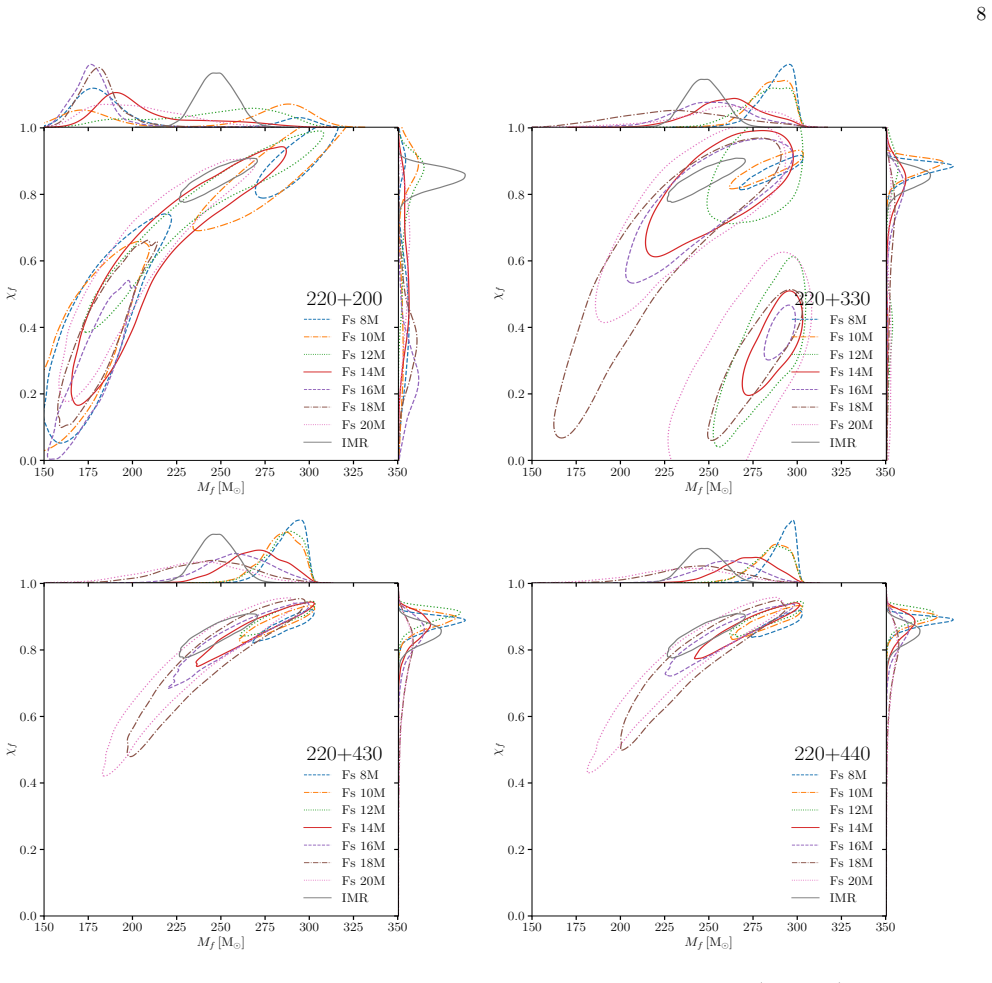
R. Abbottet al.(KAGRA, VIRGO, LIGO Scientific), Astrophys. J. Suppl.267, 29 (2023), arXiv:2302.03676 [gr-qc]. Appendix A: Results of Different Combinations To supplement the model comparison discussed in the main text, this appendix presents a detailed ex- amination of the posterior distributions for the final mass and spin under various ringdown models. ...
Pith/arXiv arXiv 2023
discussion (0)
Sign in with ORCID, Apple, or X to comment. Anyone can read and Pith papers without signing in.