REVIEW 2 major objections 4 minor 55 references
Mesoscale computational protocols for the design of highly cooperative bivalent macromolecules
T0 review · 2 major / 4 minor · reviewed 2026-08-14 · deepseek-v4-flash
Pith's one-line read The kinetics of the second binding step in bivalent nanobody constructs can be extracted from coarse-grained simulations by splitting paratope trajectories into flight and residence events.
desk verdict A credible mesoscale protocol for studying second-binding kinetics, but the absolute rate constants in ns/µs are not reproducible because the simulation-time-to-physical-time conversion is never specified. read the letter →
The pith
A machine-rendered reading of the paper's core claim, the machinery that carries it, and where it could break.
The reading
What carries the argument
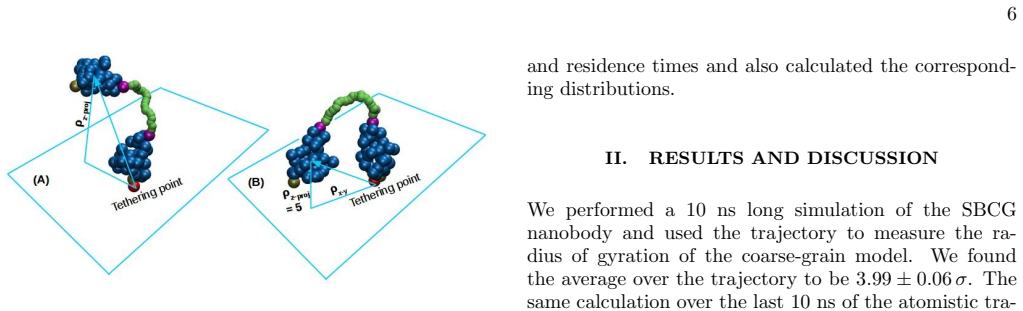
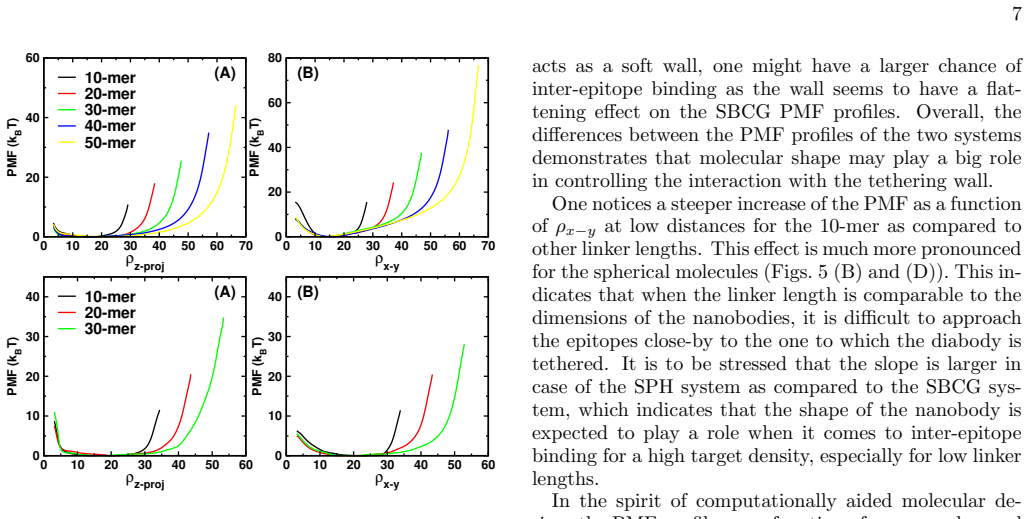
The machine that carries the argument is the thresholded paratope-height trajectory. The authors define flight and residence domains by $z \ge z_{\mathrm{th}}$ and $z < z_{\mathrm{th}}$, require events to last at least 0.5 ns, and convert the event-time histograms into survival probabilities. The identity connecting the two is first-passage: the survival probability in a domain is the integral of the exit-time distribution, so the inverse mean exit time is the escape rate (Eqs. 7–10). A second piece of machinery is the set of potentials of mean force from umbrella sampling along the vertical and lateral reaction coordinates; these show the entropic barrier a shaped nanobody feels near the wall, explaining why the simple spherical model misrepresents wall encounters.
What would settle it
An explicit-solvent atomistic simulation of a single nanobody tethered near a wall, run long enough to accumulate residence events, would provide an independent mean residence time; if it disagrees with the corresponding SBCG value of a few nanoseconds by more than the statistical error, the coarse-grained time conversion is wrong.
Extended reading notes
Core claim
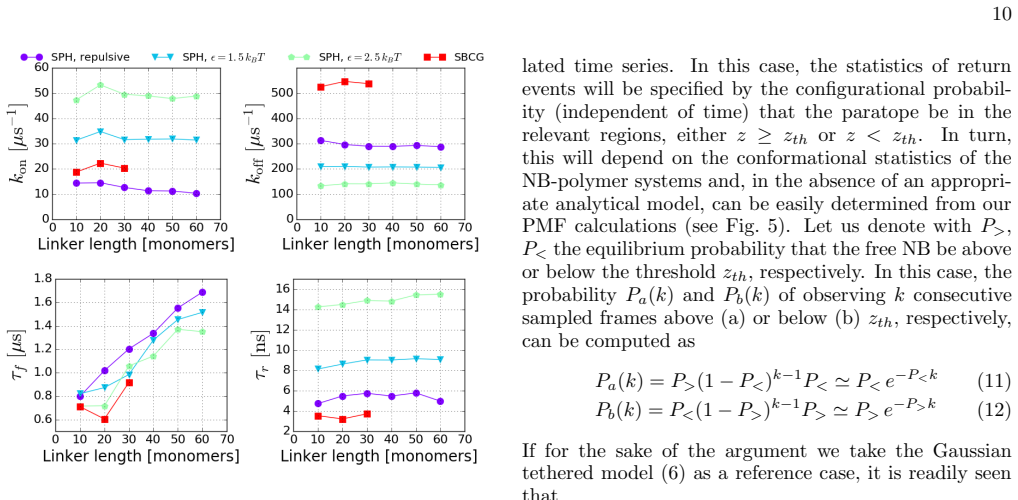
The central claim is that the encounter and dissociation kinetics of the free nanobody with the target surface, the determinants of avidity in a bivalent construct, can be read directly from a coarse-grained trajectory. The operational definition is a height threshold $z_{\mathrm{th}}=3.5\sigma$ for the paratope above the tethering wall; consecutive frames below that threshold are residence events, above it flight events, with events shorter than 0.5 ns discarded to avoid recrossing noise. The survival probabilities $S_f(t)$ and $S_r(t)$ of the two event types are related to exit times by $P_f=-dS_f/dt$ and $P_r=-dS_r/dt$, so the inverse mean exit times give $k_{\mathrm{on}}=[\int_0^\infty S_f(t)\,dt]^{-1}$ and $k_{\mathrm{off}}=[\int_0^\infty S_r(t)\,dt]^{-1}$. Applied to rigid-sphere and shape-based models, the protocol yields $\langle t_f\rangle$ of order 100 ns and $\langle t_r\rangle$ of order 2–3 ns, with the shape-based model showing shorter times and higher on-rates, and weak wall attraction raising $k_{\mathrm{on}}$ and lowering $k_{\mathrm{off}}$.
Load-bearing premise
The reported nanosecond rates rest on an implicit conversion of Lennard-Jones simulation time to real time: the paper sets $\sigma=3.5$ Å and $\epsilon=100$ K, leaves bead masses and time units uncalibrated, and therefore the absolute values of $k_{\mathrm{on}}$ and $k_{\mathrm{off}}$ depend on an unstated time mapping.
Editorial extensions
If this is right
- Linker length can be screened in silico: the protocol predicts a non-monotonic flight time with a minimum near a linker length comparable to the nanobody size, about 20 monomers.
- Weak nonspecific surface attraction of 1–2 $k_B T$ becomes a design variable: it raises the second-binding on-rate and lengthens residence times.
- Shape-based coarse graining is needed for wall-proximal kinetics; the rigid-sphere model overestimates flight and residence times for short linkers.
- Rare, long events are quantitatively significant: exponential tails set tens-of-nanosecond residence scales and microsecond flight scales, which matters in low-copy geometries such as the immune synapse.
Reading between the lines
- A direct extension would be to feed the extracted $k_{\mathrm{on}}$ and $k_{\mathrm{off}}$ into a two-site kinetic model of avidity and convert the per-encounter rates into a predicted fold-gain in effective affinity; the paper does not carry out that conversion.
- The threshold $z_{\mathrm{th}}=3.5\sigma$ and the 0.5 ns cutoff are free choices; one could test whether the ranking of designs is invariant under modest changes in these choices, turning the method into a robust first-passage observable.
- I infer the method should transfer to the immune-synapse geometry by replacing the single wall with two parallel walls and counting residence events in the inter-membrane gap, where experimental rebinding measurements would provide a direct check.
- Because the shape-based model is built from one crystal structure, the protocol could be run on multiple nanobody sequences or epitopes to see whether shape alone, not chemistry, sets the ranking.
Signed reviews
Editorial analysis
A structured set of objections, weighed in public.
Referee Report
Summary. The paper introduces two coarse-grained models of a polymer-linked bivalent nanobody construct—a spherical model (SPH) and a shape-based coarse-grained model (SBCG) derived from an atomistic simulation—and uses Langevin dynamics to study the thermodynamics and kinetics of the free nanobody relative to a tethering wall. Umbrella sampling is used to compute potentials of mean force along two reaction coordinates, and long trajectories are analyzed by classifying paratope z-coordinate excursions into flight and residence events relative to a threshold. Survival probabilities of these events are then used to extract encounter and dissociation rates via Eqs. (9)-(10), with a focus on how linker length, nanobody shape, and weak nonspecific wall attractions affect these rates. The central claim is that this mesoscale protocol can quantify the kinetic determinants of the second, cooperative binding step and that the SBCG model captures shape-dependent features missed by the simpler SPH model.
Significance. If the quantitative timescale issue is resolved, this is a useful contribution to mesoscale computational design of multivalent therapeutics. The PMF calculations are extensive and the distinction between short-time diffusive t^{-1/2} survival and exponential rare-event tails is clearly supported by the data. The paper's strengths include the direct measurement of survival statistics from long trajectories, the transparent first-passage formulas, and the explicit comparison of two coarse-graining schemes. The main limitation is that the reported absolute kinetic constants in nanoseconds/microseconds are not reproducible without specifying the mapping from Lennard-Jones reduced time to physical time; the relative trends among models and wall types are robust to a global time rescaling, but the design-oriented absolute rates are not.
major comments (2)
- [I.A, II.C, Eqs. (9)-(10), Tables II-VI] The paper reports all flight/residence times and rates in ns/µs, but the conversion from Lennard-Jones reduced time to physical time is never specified. Section I.A states σ = 3.5 Å, ε = 100 K, and bead masses of 1, but gives no mass unit, no timestep, and no Langevin damping/friction coefficient. In an overdamped Langevin simulation, the reduced friction coefficient (LAMMPS Tdamp) sets the diffusion coefficient and therefore the physical timescale; for an inertial mapping one would need the physical bead mass. Without this information, the numerical values in Tables II-VI and Figures 8-11, as well as the 0.5 ns minimum event duration in Section II.C, cannot be reproduced or compared with experiments. The authors should provide the full reduced-to-physical time conversion protocol, or explicitly state that all times are in reduced units and remove the physical units throughout.
- [I.E, Table VI, Section II.C] The SBCG flight/residence time data are obtained from a single 15 µs simulation per linker length and are reported without error bars (Table VI). The central conclusion that the SBCG model yields systematically shorter times than the SPH model (e.g., ~50 ns versus ~80 ns flight time for the 30-mer) rests on this comparison. Without a statistical uncertainty estimate, it is difficult to assess whether the observed differences are significant. The authors should provide error estimates via block averaging, bootstrap, or replicate simulations for the SBCG systems, as is already done for the SPH data.
minor comments (4)
- [II.B-II.C, Eqs. (13)-(16)] The symbol z0 is used both for the tethering height introduced in Section II.B (z0 = 7.5σ) and as the lower integration limit/threshold in Eqs. (13)-(16). Since the flight/residence threshold is zth = 3.5σ, using z0 in these equations is confusing and should be replaced with zth or a distinct symbol.
- [I.A] The statement that the energy unit is ε = 100 K is imprecise; it should read ε/k_B = 100 K or the numerical value in joules should be given. Also, no timestep is reported anywhere, even though the manuscript states simulation lengths in time steps and in physical time units.
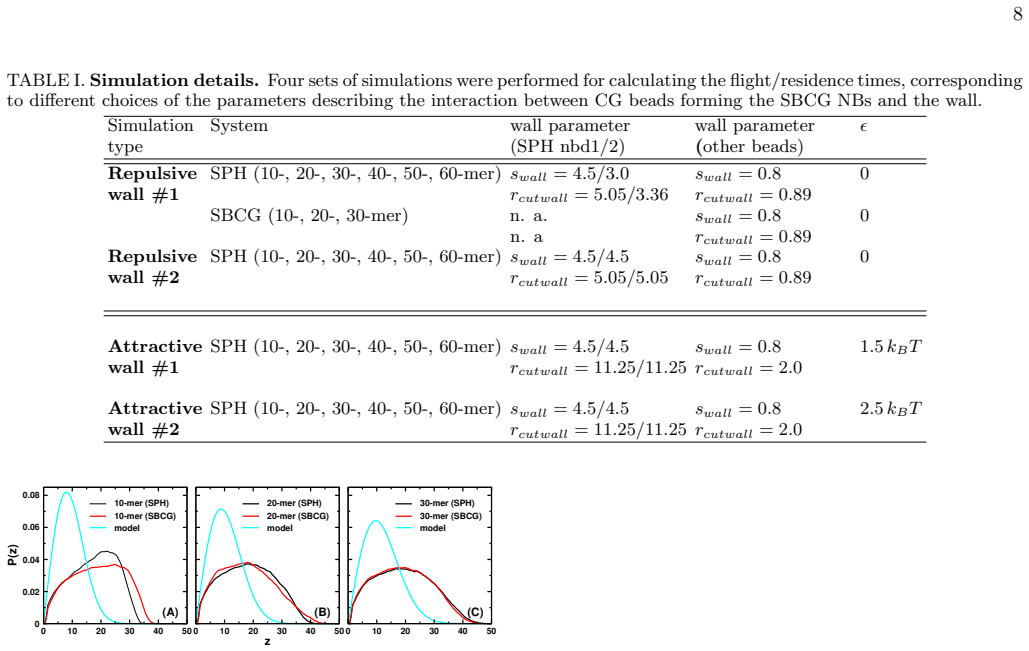
- [Figure 5 caption] The caption appears to contain duplicated panel labels: the text references panels (A), (B), (C), (D), but the displayed caption lines show '(A) (B)' twice. Please verify the panel labeling in the figure and caption.
- [Abstract] The phrase 'free/constrained dynamics (100 ns − µs)' should be written as '100 ns to µs' or '100 ns - 1 µs' to avoid ambiguity.
Circularity Check
No significant circularity: the flight/residence kinetics are direct trajectory measurements, and the first-passage and Gaussian-chain relations are derived independently of any fitted input.
full rationale
The derivation chain is self-contained. The flight and residence times are read off equilibrium Langevin trajectories using a fixed geometric threshold z_th = 3.5 sigma (Section I.E), and Eqs. (7)-(10) are standard survival/first-passage identities relating S_f(t), S_r(t), k_on, and k_off; no fitted parameter is injected into these measured rates. The rare-event relations in Eqs. (11)-(16) are derived from the equilibrium Gaussian tethered-chain distribution and then compared with simulation, not used as inputs to generate the data. The only fit in Section II.B, the effective Kuhn length N_eff^k for 40-60mer SPH systems, is a diagnostic comparison and is not propagated into the Section II.C kinetics. The self-citations [10,51] frame the sequential-binding picture but carry no mathematical load: no uniqueness theorem, ansatz, or fitted input is imported from them, and the SBCG parametrization follows the external protocol of Schulten and co-workers. The absence of an explicit Lennard-Jones-to-physical-time mass or damping conversion is a reproducibility and calibration weakness that would rescale all absolute rates uniformly, but it is not a circularity of the derivation and does not affect the relative trends emphasized in the paper.
Assumptions & free parameters
free parameters (5)
- SPH nanobody radius =
10 sigma
- Linker bending stiffness k_theta =
1.8 kBT
- Wall attraction energies =
0, 1.5 kBT, 2.5 kBT
- Threshold zth and minimum event duration =
3.5 sigma and 0.5 ns
- Effective Kuhn length Neff =
108, 115, 119 for 40-, 50-, 60-mer
assumptions (8)
- standard math First-passage and survival-probability definitions: kon and koff are the inverse mean exit times from flight and residence domains (Eqs. 7-10).
- standard math Gaussian-chain end distribution for a tethered polymer near a reflecting wall (Eqs. 5-6).
- standard math Rare-event approximation treating successive frames as uncorrelated Bernoulli trials (Eqs. 11-16).
- domain assumption Langevin dynamics in the overdamped regime with the chosen CG force field faithfully models the 100 ns to microsecond dynamics of polymer-linked nanobodies.
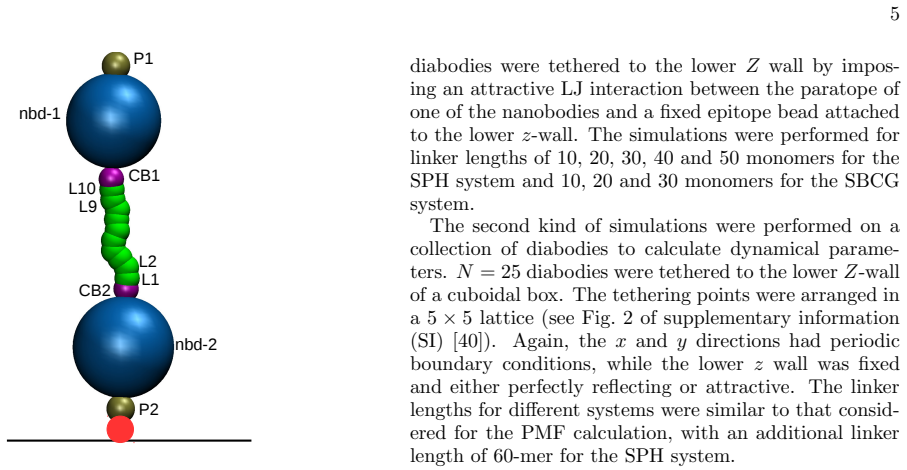
- domain assumption The planar LJ wall represents a target-covered cell or viral surface, and the paratope-wall distance below zth defines the binding-competent state.
- domain assumption Simulation time is implicitly mapped to physical time (masses set to 1 with no stated mass unit), allowing rates to be quoted in ns/microseconds.
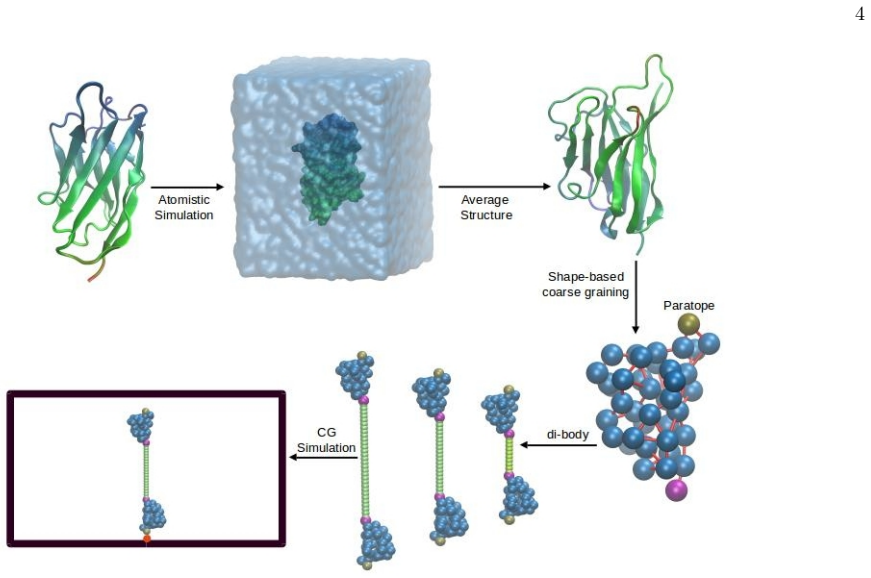
- domain assumption The SBCG nanobody model, built from one 100 ns atomistic trajectory of the 1qd0 structure with the dye removed, preserves the flexibility and surface shape relevant to wall interactions.
- ad hoc to paper The restraints enforcing 180 degree angles at the linker-nanobody joints and restraining SBCG nanobody rotation about the long axis mimic real linker attachment.
Cite this review
Pith. "Pith review of Mesoscale computational protocols for the design of highly cooperative bivalent macromolecules." pith.science (2026). https://pith.science/paper/5GNCU6RS
@misc{pith2026190808309,
  author       = {Pith},
  title        = {Pith review of: Mesoscale computational protocols for the design of highly cooperative bivalent macromolecules},
  year         = {2026},
  howpublished = {\url{https://pith.science/paper/5GNCU6RS}},
  note         = {Machine review of arXiv:1908.08309}
}
abstract
The last decade has witnessed a swiftly increasing interest in the design and production of novel multivalent molecules as powerful alternatives for conventional antibodies in the fight against cancer and infectious diseases. However, while it is widely accepted that large-scale flexibility ($10-100$ nm) and free/constrained dynamics (100 ns $- \mu$s) control the activity of such novel molecules, computational strategies at the mesoscale still lag behind experiments in optimizing the design of crucial features, such as the binding cooperativity (a.k.a. avidity). In this study, we introduced different coarse-grained models of a polymer-linked, two-nanobody composite molecule, with the aim of laying down the physical bases of a thorough computational drug design protocol at the mesoscale. We show that the calculation of suitable potentials of mean force allows one to apprehend the nature, range and strength of the thermodynamic forces that govern the motion of free and wall-tethered molecules. Furthermore, we develop a simple computational strategy to quantify the encounter/dissociation dynamics between the free end of a wall-tethered molecule and the surface, at the roots of binding cooperativity. This procedure allows one to pinpoint the role of internal flexibility and weak non-specific interactions on the kinetic constants of the NB-wall encounter and dissociation. Finally, we quantify the role and weight of rare events, which are expected to play a major role in real-life situations, such as in the immune synapse, where the binding kinetics is likely dominated by fluctuations.
Figures

Figures from the paper (17 more)



Reference graph
Works this paper leans on
-
[1]
Interaction parameters for the SBCG nanobodies and the linker All the CG beads were kept neutral. The connectivity and spring constants for the bonds between the beads were used as generated by the SBCG scheme. It is to be noted that the bonds are not set by a distance-based cut- off scheme, but are in accordance with the bonds present in the atomistic sys...
-
[2]
Interaction of the beads with the box walls The walls of the simulation box in theX andY directions had periodic boundary condition, while the Z walls were fixed. The Z walls interact with the beads via LJ (12-6) interaction given by VvdW wall = 4ϵ [(swall rwall )12 − (swall rwall )6] (4) Here rwall is the distance of the center of any bead from the wall. ...
-
[3]
A Desmyter, S Spinelli, A Roussel, C Cambillau, Current Opinion in Structural Biology. 32, 1−8 (2015)
work page 2015
-
[4]
P Chames, M V Regenmortel, E Weiss, D Baty, Br J Pharmacol. 157(2), 220−233 (2009)
work page 2009
-
[5]
G Behar, S Sib´ eril, A Groulet, P Chames, M Pugnire, C Boix, C Sauts-Fridman, J L Teillaud, D Baty, Protein Engineering Design and Selection 21(1), 1-10 (2008)
work page 2008
-
[6]
M Turini, P Chames, P Bruhns, D Baty, B Kerfele, On- cotarget. 5(14), 5304−5319 (2014)
work page 2014
-
[7]
P Bannas, A Lenz, V Kunick, W Fumey, B Rissiek, J Schmid, F Haag, A Leing¨ artner, M Trepel, G Adam and F Koch-Nolte, J Vis Exp 98, e52462 (2015)
work page 2015
-
[8]
P Bannas, A Lenz, V Kunick, L Well, W Fumey, B Rissiek, F Haag, J Schmid, K Sch¨ utze, A Eichhoff, M Trepel, G Adam, H Ittrich, F Koch-Nolte, Contrast Me- dia Mol Imaging 10(5), 367−78 (2015)
work page 2015
Show all 55 references
-
[9]
M Kijanka, B Dorresteijn, S Oliveira, P M van Bergen en Henegouwen, Nanomedicine (Lond) 10(1), 161−74 (2015)
2015
-
[10]
2015 10(5), 367−78 (2015)
P Bannas, A Lenz, V Kunick, L Well, W Fumey, B Rissiek, F Haag, J Schmid, K Sch¨ utze, A Eichhoff, M Trepel, G Adam, H Ittrich and F Koch-Nolte, Contrast Media Mol Imaging. 2015 10(5), 367−78 (2015)
2015
-
[11]
S A Kostelny, M S Cole and J Y Tso, J Immunol.148(5), 1547−53 (1992)
1992
-
[12]
C De Michele, P De Los Rios, G Foffi, F Piazza, PLOS Computational Biology, 12(3), e1004752 (2016)
2016
-
[13]
C Kimchi-Sarfaty , T Schiller, N Hamasaki-Katagiri, M A Khan, C Yanover and Z E Sauna, 34(10), 534−548 (2013)
2013
-
[14]
Re- cent advances in (therapeutic protein) drug development
H A Lagass´ e, A Alexaki, V L Simhadri, N H Katagiri, W Jankowski, Z E Sauna and C Kimchi-Sarfaty. Re- cent advances in (therapeutic protein) drug development. F1000Res 7(6), 113 (2017)
2017
-
[15]
E Chertova, J W Bess, B Crise Jr., R C Sowder II, T M Schaden, J M Hilburn, J A Hoxie, R E Benveniste, J 14 D Lifson, L E Henderson and L O Arthur, J. Virol. 76, 5315−5325 (2002)
2002
-
[16]
J Liu, A Bartesaghi, M J Borgnia, G Sapiro, and S Sub- ramaniam, Nature 455, 109−113 (2008)
2008
-
[17]
P Zhu, J Liu, J Bess Jr., E Chertova, J D Lifson, H Gris´ e, G A Ofek, K A Taylor, and K H Roux, Nature 441, 847−852 (2006)
2006
-
[18]
PLoS Pathog 6, e1000908 (2010)
J S Klein and P J Bjorkman. PLoS Pathog 6, e1000908 (2010)
2010
-
[19]
H Mouquet, J F Scheid, M J Zoller, M Krogsgaard, R G Ott, S Shukair, M N Artyomov, J Pietzsch, M Connors, F Pereyra, B D Walker, D D Ho, P C Wilson, M S Seaman, H N Eisen, A K Chakraborty, T J Hope, J V Ravetch, H Wardemann, M C Nussenzweig, Nature 467, 591−595 (2010)
2010
-
[20]
H Wu, D S Pfarr, Y Tang, L L An, N K Patel, J D Watkins, W D Huse, P A Kiener and J F Young, J. Mol. Biol. 350, 126−144 (2005)
2005
-
[21]
and P J Bjorkman, Cell 160, 433−446, a2015 Elsevier Inc (2015)
R P Galimidi, J S Klein, A P West Jr. and P J Bjorkman, Cell 160, 433−446, a2015 Elsevier Inc (2015)
2015
-
[22]
S J¨ ahnichen, C Blanchetot, D Maussang, M Gonzalez- Pajuelo, K Y Chow, L Bosch, S De Vrieze, B Serruys, H Ulrichts, W Vandevelde, M Saunders, H J De Haard, D Schols, R Leurs, P Vanlandschoot, T Verrips, M J Smit, Proc Natl Acad Sci U S A 107(47), 20565−70 (2010)
2010
-
[23]
J Mol Biol
J Zhang, J Tanha, T Hirama, N H Khieu, H Tong-Sevinc, E Stone, J R Brisson and C R MacKenzie. J Mol Biol. 335(1), 49−56 (2004)
2004
-
[24]
T Yang, O K Baryshnikova, H Mao, M A Holden, P S Cremer, J. Am. Chem. Soc. 125(16), 4779−4784 (2003)
2003
-
[25]
C Fasting, C A Schalley, M Weber, O Seitz, S Hecht, B Koksch, J Dernedde, C Graf, E Knapp, R Haag, Ange- wandte Chemie 51(42), 10472−98 (2012)
2012
-
[26]
V L Schiavom P Robert, L Limozin, P Bongrand, PLoS One 7(9), e44070 (2012)
2012
-
[27]
Gonzlez C1, Chames P2, Kerfelec B2, Baty D2, Robert P3, Limozin L4, Biophys J 116(8), 1516−1526 (2019)
2019
-
[28]
M van Rosmalen and M K Maarten, Biochemistry 56(50), 6565−6574 (2017)
2017
-
[29]
C Xiaoying, Z Jennica and S Wei-Chiang, Adv Drug De- liv Rev 65(10), 1357−1369 (2013)
2013
-
[30]
J S Klein, S Jiang, R P Galimidi, J R Keeffe and P J Bjorkman, Protein Engineering, Design and Selection, 27(10), 325−330 (2014)
2014
-
[31]
R Arai, H Ueda, A Kitayama, N Kamiya and T Naga- mune, Protein Engineering, Design and Selection, 14(8), 529−532 (2001)
2001
-
[32]
H Zhao and A Caflisch, European Journal of Medicinal Chemistry 91 4e14 (2015)
2015
-
[33]
J Jung, W Nishima, M Daniels, G Bascom, C Kobayashi, A Adedoyin, M Wall, A Lappala, D Phillips, W Fis- cher, C S Tung, T Schlick, Y Sugita, K Y Sanbonmatsu, Journal of Computational Chemistry 40(21), 1919−1930 (2019)
2019
-
[34]
B Windisch, D Bray and T Duke, Biophys J 91(7), 2383−2392 (2006)
2006
-
[35]
Roos, G J L Wuite, and K Schulten, Biophys J 97(7), 2061−2069
A Arkhipov, W H. Roos, G J L Wuite, and K Schulten, Biophys J 97(7), 2061−2069
-
[36]
S Spinelli, L G Frenken, P Hermans, T Verrips, K Brown, M Tegoni and C Cambillau, Biochemistry 39(6), 1217−22 (2000)
2000
-
[37]
M P Allen and D J Tildesley, Computer simulation of liquids, Oxford university press: New York, (1991)
1991
-
[38]
J C Phillips, R Braun, W Wang, J Gumbart, E Tajkhor- shid, E Villa, C Chipot, R D Skeel, L Kale and K Schulten, Journal of Computational Chemistry 26(16), 1781−1802 (2005)
2005
-
[39]
R B Best, X Zhu, J Shim, P E M Lopes, J Mittal, M Feig, and A D MacKerell Jr., J. Chem. Theory Comput 8(9), 3257−3273 (2012)
2012
-
[40]
W Humphrey, A Dalke and K Schulten, J Mol Graphics 14(1), 33−38 (1996)
1996
-
[41]
J D Weeks, D Chandler, H C Andersen, The Journal of Chemical Physics, 54(12), 5237−5247 (1971)
1971
-
[42]
See Supplemental Material at [URL] for the details of the system simulated for calculating the flight/residence times, comparison of the interaction force between the tethering wall and nbd-1 for the two models, the radial distribution of the position of P1, Distribution of the...
-
[43]
95(4), 1590−1599 (2008)
H Lee, R M Venable, A D MacKerell Jr., and R W Pastor, Biophys J. 95(4), 1590−1599 (2008)
2008
-
[44]
S Plimpton, J Comp Phys 117, 1−19 (1995)
1995
-
[45]
C Gutierrez and R Schiff, Arch Pathol Lab Med 135(1), 55−62 (2011)
2011
-
[46]
F Y Frejd and K T Kim, Exp Mol Med, 49(3), (2017)
2017
-
[47]
J L¨ ofblom, J Feldwisch, V Tolmachev, J Carlsson, S St˚ ahl and F Y Frejd, FEBS Lett 584(12), 2670−80 (2010)
2010
-
[48]
C Eigenbrot, M Ultsch, A Dubnovitsky, L Abrahmsn and T H¨ ard, Proc Natl Acad Sci U S A 107(34), 15039−44 (2010)
2010
-
[49]
K A Dill, S Bromberg, Molecular Driving Forces: Sta- tistical Thermodynamics in Biology, Chemistry, Physics, and Nanoscience, 2nd ed., 2010 (New York: Garland Sci- ence (2010)
2010
-
[50]
E A DiMarzio, J. Chem. Phys. 42, 2101 (1965)
1965
-
[51]
Proceedings of the National Academy of Sciences, 103(16), 61666171 (2006)
P De Los Rios, A Ben-Zvi, O Slutsky, A Azem, P Goloubinoff, P. Proceedings of the National Academy of Sciences, 103(16), 61666171 (2006)
2006
-
[52]
S Redner, A guide to First-Passage processes, Cambridge University Press, Cambridge (2001)
2001
-
[53]
PLoS Computational Biology, 12(3):e1004752 (2016)
C De Michele, P De Los Rios, G Foffi, F Piazza, F. PLoS Computational Biology, 12(3):e1004752 (2016)
2016
-
[54]
Rubinstein and R
See for example M. Rubinstein and R. H. Colby, Polymer physics, Oxford University Press (2003). 15 Appendix A: Supplementary Information (SI)
2003
-
[55]
z4E48txx8y4FYsGbjpQpH2bw3eQ=
The angle-bending coefficient for the coarse-grained model of the linker The bond-bond correlation function (BBCF) for a freely rotating chain is an exponentially decaying function of the monomer-monomer separation along the chain [52], ⟨⃗ti+m·⃗ti⟩ =a2 (cosθ)m =a2e−ma/𝓁p (A1) wh...
Reviewed August 14, 2026 · model on record in the stance chip above.
Discussion (0). Continue with ORCID to comment.