REVIEW 3 major objections 6 minor 47 references
How Effective Can Dropout Be in Multiple Instance Learning ?
T0 review · 3 major / 6 minor · reviewed 2026-08-16 · deepseek-v4-flash
Pith's one-line read This paper argues that removing the top-ranked instances from a bag during MIL training—the opposite of what intuition suggests—consistently lowers gradient error, flattens the loss landscape, and improves classification, and it packages…
desk verdict The top-k instance-drop observation is genuinely worth testing, but the main tables conflate MIL-Dropout with an added feature extractor, so the advertised gains are not established. read the letter →
The pith
A machine-rendered reading of the paper's core claim, the machinery that carries it, and where it could break.
The reading
What carries the argument
MIL-Dropout is a non-parametric instance-selection mask inserted into the shallow feature extractor of an existing MIL pipeline. At layer $l$, each instance's importance is the sigmoid of its average-pooled embedding; the top-K instances are chosen, and then for each of them the G most cosine-similar instances among the rest are added to the drop set. The mask zeroes those rows of the feature map and rescales the survivors by $\gamma = N/(N-K(1+G))$ to stabilize training. The load-bearing object is not the mask itself but the ranking: the mask removes the currently most attended evidence, forcing the aggregator to discover additional positive instances while the bag label stays unchanged. In experiments the mask is placed after each of three added fully-connected layers before the ABMIL, DSMIL, TransMIL, or DTFD-MIL aggregator.
What would settle it
Take the CAMELYON16 setup and train the same three-layer-feature-extractor ABMIL variant under three conditions: no dropout, random instance dropout of the same mask size, and top-k MIL-Dropout. If random-dropping or no-dropping matches MIL-Dropout in accuracy, F1, AUC, and epsilon-sharpness, then the top-k selection rule is not what carries the reported gains.
Extended reading notes
Core claim
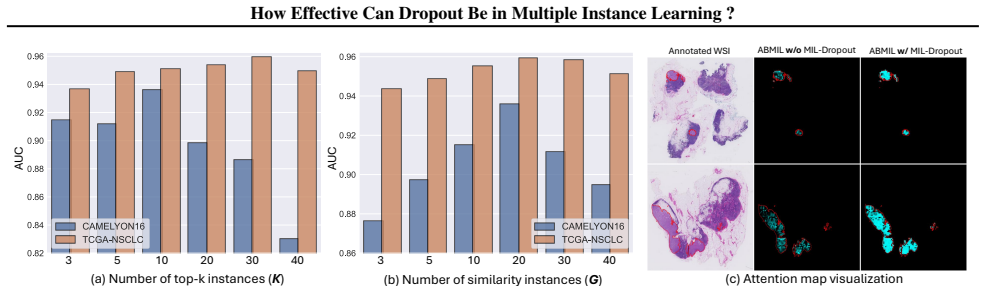
The central discovery is the counterintuitive empirical finding that, within a bag, removing the instances the model currently considers most important is not harmful but beneficial. A positive bag remains positive after masking, so the network must find alternative, less obvious positive evidence; this behaves like data augmentation and prevents the model from locking onto a single group of easy instances. The paper frames this in optimization terms: among the strategies tested (random, bottom-k, top-k, none), only top-k dropping consistently lowers the gradient direction error relative to the whole-dataset gradient and drives the model to flatter local minima, which is associated with better generalization under Gaussian, Poisson, and salt-and-pepper noise. The paper packages the finding as MIL-Dropout, which computes instance importance with a parameter-free average-pooling attention score, selects the top-K instances plus the G neighbors most similar to each, masks them, and rescales the remaining features.
Load-bearing premise
The load-bearing premise is that the accuracy and robustness gains come from dropping the top-k instances themselves, not from the extra three-layer feature extractor that only the augmented models receive, and the paper includes no control run with that extractor but without the dropout mask.
Editorial extensions
If this is right
- Plugging MIL-Dropout into the simple ABMIL and ABMIL-Gated aggregators lifts average accuracy by roughly 9.7 to 9.8 points across MUSK1, MUSK2, FOX, TIGER, and ELEPHANT, reaching state-of-the-art numbers on those benchmarks.
- On CAMELYON16 and TCGA-NSCLC, MIL-Dropout adds on average about 2.0 to 2.5 points of accuracy, F1, and AUC across four MIL aggregators with both ImageNet and self-supervised (SimCLR) features.
- The method improves robustness to test-time noise and sharpens attention-based lesion localization, so the model's high-attention regions agree better with annotated tumor regions.
- Because MIL-Dropout adds no learnable parameters and only $\mathcal{O}(N \log N + K(N-K)D^{(l)})$ mask computation per layer, it can be applied to any existing attention-based, transformer-based, or distillation-based MIL aggregator at negligible cost.
- The paper's extra experiments show MIL-Dropout also improves the concordance index on survival prediction for ABMIL, DSMIL, TransMIL, and DTFD-MIL on TCGA-LUAD and TCGA-BRCA.
Reading between the lines
- If the masking effect is causal, MIL-Dropout is effectively a hard-example mining regularizer: it forces the bag-level model to explain the positive label with evidence outside the current maximum-attention cluster, which should help in tasks where positive evidence is spatially scattered or where easy positives are unrepresentative of the whole disease.
- The drop-top-k rule could be combined with instance-level uncertainty or with a curriculum that anneals K from large to small, turning the method into a schedule rather than a fixed hyperparameter; the paper does not test this.
- Because the augmented models in the main comparisons add a three-layer feature extractor that baselines do not have, the cleanest test of the dropout hypothesis would be an ablation that adds the same extractor with dropout disabled; the paper reports no such control.
- The same importance-ranking idea could be ported to other weakly supervised problems such as video anomaly detection or 3D point-cloud classification, which the paper lists as future work rather than testing.
Signed reviews
Editorial analysis
A structured set of objections, weighed in public.
Referee Report
Summary. The paper studies dropout in multiple instance learning. Section 3 reports investigation experiments showing that, within an ABMIL architecture with a shared three-layer feature extractor, dropping the top-k most important instances yields lower gradient-direction error (GDE), flatter minima under epsilon-sharpness, and better noise robustness than DropNeuron, random, or bottom-k strategies. Based on this, Section 4 proposes MIL-Dropout, which computes instance importance by average pooling over embedding dimensions and drops the top-k instances plus G instances most similar to each top-k instance, with a normalization factor gamma. Sections 5-6 evaluate MIL-Dropout by adding a three-layer feature extractor and the dropout to ABMIL, ABMIL-Gated, DSMIL, TransMIL, and DTFD-MIL on five MIL benchmark datasets and two WSI datasets, reporting large gains (e.g., 9.72% average accuracy on benchmarks and 2-4% AUC on WSI). The appendix includes ablations over K and G, attention-map visualization, a failed attempt to integrate into transformer blocks, and extra survival experiments.
Significance. If the reported effect is causal, MIL-Dropout would be a cheap, architecture-agnostic regularizer for MIL, and the paper's investigation of gradient-direction error, sharpness, and noise robustness would be a useful empirical contribution. The investigation experiments in Section 3 and Appendix A are internally well designed: the same three-layer extractor is used for all dropout variants, and the GDE and sharpness measurements support the top-k observation against DropNeuron. Code is released, and the rebuttal appendix adds extra datasets and survival tasks. However, the main evaluation in Tables 1 and 2 conflates MIL-Dropout with an added trainable feature extractor, so the central quantitative claim is not currently established. The hyperparameter selection on the evaluation datasets further inflates the reported gains. With a proper control arm and a validated selection protocol, the paper's contribution could become solid; as written, the evidence is suggestive rather than conclusive.
major comments (3)
- [Section 5.4, Appendix B.1.2, B.2.3, Tables 1-2] The +MIL-Dropout models add a three-layer MLP (256-128-64 on benchmarks; 512/256-256/128-128/64 on WSIs) before the aggregator, while baselines consume raw features (166/230/1024/512 dimensions) directly. No "extra MLP without dropout" control is included, so the gains in Table 1 (e.g., 9.72% average accuracy) and Table 2 (e.g., up to 4% AUC) cannot be attributed to the masking mechanism; they may be due to the extra representation capacity. The investigation experiments in Appendix A use the same extractor for both DropNeuron and DropInstance, which supports the internal comparison, but they also lack an augmented no-dropout arm. Please add control experiments that apply the same f_theta without MIL-Dropout, and ideally with plain neuron dropout, for every aggregator and dataset in Tables 1 and 2.
- [Section 6.3, Appendix C.4.1] The optimal values of K and G are identified from Figure 5 on CAMELYON16 and TCGA-NSCLC, and Appendix C.4.1 states that all experiments in Table 2 use these optimal values. The paper does not describe a validation-based selection procedure or a separate test set for hyperparameter selection. If Figure 5 is computed on the same test partitions used in Table 2, the reported gains are optimistically selected. Please either use validation-based selection, report results across a grid without test-set selection, or justify that the chosen K and G are not tuned to the test set.
- [Section 3.4, Impact Statement, Conclusion] The paper repeatedly claims "theoretical guarantees" for top-k dropping, but Section 3.4 is a heuristic explanation and the sharpness/GDE analyses are empirical measurements with a standard Taylor expansion; no formal theorem or proof is stated. In addition, the claim that MIL-Dropout can be "seamlessly integrated into existing MIL frameworks" is contradicted by Appendix C.2 and C.3, which report that integration into transformer blocks fails to converge (Table 4 shows 52.5 AUC versus 86.5 for TransMIL). Please temper these claims and specify in the abstract and impact statement that the method is intended for shallow feature extractors before MIL aggregation.
minor comments (6)
- [Section 5.2, Table 2] The dataset name "CAMELOYON16" is misspelled and should be "CAMELYON16".
- [Section 6.2] The sentence "MIL aggregators trained with features extracted using SimCLR outperforms that trained with features extracted by SimCLR" appears to compare SimCLR with itself; the second instance should presumably be "ImageNet."
- [Section 4.0.1] The complexity statement "The complexity is substantially reduced to the fact that O(ND(l)) due to K is typically much smaller than N" is garbled; the stated complexity includes O(K(N-K)D(l)), so with K constant it is O(ND(l)). Please rewrite for clarity.
- [Related Work] The sentence "this paper also serves as a theoretical supplement to PDL" is unclear because PDL is not described and no supplement is provided in this manuscript; please either remove the claim or clarify the relationship.
- [Appendix C.4.3] The observation that restricting dropout to at most 10% of the average instance count yields consistent improvements is stated only in the rebuttal appendix; if this is a design principle, it should be incorporated into the main text.
- [Section 4, Eq. (7)] It is unclear why the sigmoid is applied to the average-pooled values and how the importance scores are normalized across instances before top-k selection; please clarify.
Circularity Check
No derivation-level circularity in the method or its equations; the headline gains are mildly compromised by test-set selection of K and G, which makes them selected rather than predicted.
-
other
[Section 6.3 (ablation) and Appendix C.4.1, applied to Table 2.]
"All experiments in Table 2 use the optimal values of K and G identified in Figure 5(c)."
The two hyperparameters K and G are chosen by maximizing AUC on the same CAMELYON16 and TCGA-NSCLC datasets whose accuracy, F1, and AUC gains are later reported in Table 2 as evidence that MIL-Dropout boosts existing MIL methods. The reported gains are therefore the output of a selection procedure over the evaluation data rather than an independent prediction of the method with fixed hyperparameters. This is a post-hoc tuning problem rather than a definitional Eq-X = Eq-Y identity, so it is a mild circularity that lowers the evidential value of the headline claim without collapsing the whole derivation.
full rationale
The paper is an empirical study, and the derivation chain from the top-k DropInstance observation to the MIL-Dropout algorithm is not definitionally circular. Equations (7)-(9) define a new non-parametric importance scorer and a similarity-based query selection; the top-k observation in the investigation experiments uses ABMIL attention maps from Eq. (11), while MIL-Dropout uses a different averaging-based importance, so the method's success is not identical to the input observation. No load-bearing self-citation chain is present: the note that the paper 'serves as a theoretical supplement to PDL' is contextual, and the sharpness/GDE analyses rely on standard external results. The main experimental weakness is a confound: augmented models receive an additional three-layer MLP (Appendix B.1.2 and B.2.3) that baselines do not have, so the causal role of the dropout mask itself is not isolated; this is a correctness/validity concern, not a definitional circularity, and it does not raise the circularity score. Because the only circularity-adjacent issue is the test-set selection of K and G, the score is 2 rather than 0.
Assumptions & free parameters
free parameters (2)
- K (top-k number) =
K = 10 on CAMELYON16, K = 30 on TCGA-NSCLC (Figure 5)
- G (number of similar instances per top-k instance) =
Not stated numerically; selected from ablation in Figure 5(b)
assumptions (5)
- domain assumption MIL weak-supervision model: bag label is positive iff at least one instance is positive (Eq. 1).
- standard math Flatter minima generalize better, measured by epsilon-sharpness (Keskar et al., Dinh et al.).
- ad hoc to paper Average pooling over embedding dimensions yields a valid instance importance score (Eq. 7).
- ad hoc to paper Cosine similarity identifies redundant instances whose removal encourages diverse representations (Eq. 8).
- domain assumption The whole-dataset gradient with DropInstance in inference mode is the correct ground truth for GDE.
Cite this review
Pith. "Pith review of How Effective Can Dropout Be in Multiple Instance Learning ?." pith.science (2026). https://pith.science/paper/5GWMAVY7
@misc{pith2026250414783,
  author       = {Pith},
  title        = {Pith review of: How Effective Can Dropout Be in Multiple Instance Learning ?},
  year         = {2026},
  howpublished = {\url{https://pith.science/paper/5GWMAVY7}},
  note         = {Machine review of arXiv:2504.14783}
}
read the original abstract
Multiple Instance Learning (MIL) is a popular weakly-supervised method for various applications, with a particular interest in histological whole slide image (WSI) classification. Due to the gigapixel resolution of WSI, applications of MIL in WSI typically necessitate a two-stage training scheme: first, extract features from the pre-trained backbone and then perform MIL aggregation. However, it is well-known that this suboptimal training scheme suffers from "noisy" feature embeddings from the backbone and inherent weak supervision, hindering MIL from learning rich and generalizable features. However, the most commonly used technique (i.e., dropout) for mitigating this issue has yet to be explored in MIL. In this paper, we empirically explore how effective the dropout can be in MIL. Interestingly, we observe that dropping the top-k most important instances within a bag leads to better performance and generalization even under noise attack. Based on this key observation, we propose a novel MIL-specific dropout method, termed MIL-Dropout, which systematically determines which instances to drop. Experiments on five MIL benchmark datasets and two WSI datasets demonstrate that MIL-Dropout boosts the performance of current MIL methods with a negligible computational cost. The code is available at https://github.com/ChongQingNoSubway/MILDropout.
Figures


Figures from the paper (5 more)



Reference graph
Works this paper leans on
-
[1]
write newline
" write newline "" before.all 'output.state := FUNCTION n.dashify 't := "" t empty not t #1 #1 substring "-" = t #1 #2 substring "--" = not "--" * t #2 global.max substring 't := t #1 #1 substring "-" = "-" * t #2 global.max substring 't := while if t #1 #1 substring * t #2 global.max substring 't := if while FUNCTION format.date year duplicate empty "emp...
-
[2]
Support vector machines for multiple-instance learning
Andrews, S., Tsochantaridis, I., and Hofmann, T. Support vector machines for multiple-instance learning. Advances in neural information processing systems, 15, 2002
work page 2002
-
[3]
Robust object tracking with online multiple instance learning
Babenko, B., Yang, M.-H., and Belongie, S. Robust object tracking with online multiple instance learning. IEEE transactions on pattern analysis and machine intelligence, 33 0 (8): 0 1619--1632, 2010
work page 2010
-
[4]
Chen, R. J., Ding, T., Lu, M. Y., Williamson, D. F., Jaume, G., Chen, B., Zhang, A., Shao, D., Song, A. H., Shaban, M., et al. Towards a general-purpose foundation model for computational pathology. Nature Medicine, 2024 a
work page 2024
-
[5]
A simple framework for contrastive learning of visual representations
Chen, T., Kornblith, S., Norouzi, M., and Hinton, G. A simple framework for contrastive learning of visual representations. In International conference on machine learning, pp.\ 1597--1607. PMLR, 2020
2020
-
[6]
Chen, X., Qiu, P., Zhu, W., Li, H., Wang, H., Sotiras, A., Wang, Y., and Razi, A. Timemil: advancing multivariate time series classification via a time-aware multiple instance learning. In Proceedings of the 41st International Conference on Machine Learning, pp.\ 7190--7206, 2024 b
work page 2024
-
[7]
Choe, J. and Shim, H. Attention-based dropout layer for weakly supervised object localization. In Proceedings of the IEEE/CVF Conference on Computer Vision and Pattern Recognition, pp.\ 2219--2228, 2019
work page 2019
-
[8]
Dietterich, T. G., Lathrop, R. H., and Lozano-P \'e rez, T. Solving the multiple instance problem with axis-parallel rectangles. Artificial intelligence, 89 0 (1-2): 0 31--71, 1997
work page 1997
Show all 47 references
-
[9]
Sharp minima can generalize for deep nets
Dinh, L., Pascanu, R., Bengio, S., and Bengio, Y. Sharp minima can generalize for deep nets. In International Conference on Machine Learning, pp.\ 1019--1028. PMLR, 2017
2017
-
[10]
K., Cutajar, K., Xie, H., Kandola, J., and Twomey, N
Early, J., Cheung, G. K., Cutajar, K., Xie, H., Kandola, J., and Twomey, N. Inherently interpretable time series classification via multiple instance learning. arXiv preprint arXiv:2311.10049, 2023
2023 arXiv
-
[11]
and Zhou, Z.-H
Feng, J. and Zhou, Z.-H. Deep miml network. In Proceedings of the AAAI conference on artificial intelligence, volume 31, 2017
2017
-
[12]
Sharpness-aware minimization for efficiently improving generalization
Foret, P., Kleiner, A., Mobahi, H., and Neyshabur, B. Sharpness-aware minimization for efficiently improving generalization. In International Conference on Learning Representations, 2021. URL https://openreview.net/forum?id=6Tm1mposlrM
2021
-
[13]
Ghiasi, G., Lin, T.-Y., and Le, Q. V. Dropblock: A regularization method for convolutional networks. Advances in neural information processing systems, 31, 2018
2018
-
[14]
E., Srivastava, N., Krizhevsky, A., Sutskever, I., and Salakhutdinov, R
Hinton, G. E., Srivastava, N., Krizhevsky, A., Sutskever, I., and Salakhutdinov, R. R. Improving neural networks by preventing co-adaptation of feature detectors. arXiv preprint arXiv:1207.0580, 2012
2012 arXiv
-
[15]
M., Gao, Y., Davis, J
Hou, L., Samaras, D., Kurc, T. M., Gao, Y., Davis, J. E., and Saltz, J. H. Patch-based convolutional neural network for whole slide tissue image classification. In Proceedings of the IEEE conference on computer vision and pattern recognition, pp.\ 2424--2433, 2016
2016
-
[16]
Unleash the power of state space model for whole slide image with local aware scanning and importance resampling
Huang, Y., Zhao, W., Fu, Y., Zhu, L., and Yu, L. Unleash the power of state space model for whole slide image with local aware scanning and importance resampling. IEEE Transactions on Medical Imaging, 2024
2024
-
[17]
Attention-based deep multiple instance learning
Ilse, M., Tomczak, J., and Welling, M. Attention-based deep multiple instance learning. In International conference on machine learning, pp.\ 2127--2136. PMLR, 2018
2018
-
[18]
The break-even point on optimization trajectories of deep neural networks
Jastrzebski, S., Szymczak, M., Fort, S., Arpit, D., Tabor, J., Cho, K., and Geras, K. The break-even point on optimization trajectories of deep neural networks. arXiv preprint arXiv:2002.09572, 2020
2002 arXiv
-
[19]
J., Williamson, D
Jaume, G., Vaidya, A., Chen, R. J., Williamson, D. F., Liang, P. P., and Mahmood, F. Modeling dense multimodal interactions between biological pathways and histology for survival prediction. In Proceedings of the IEEE/CVF Conference on Computer Vision and Pattern Recognition, ...
2024
-
[20]
T., and Cevher, V
Kavis, A., Skoulakis, S., Antonakopoulos, K., Dadi, L. T., and Cevher, V. Adaptive stochastic variance reduction for non-convex finite-sum minimization. Advances in Neural Information Processing Systems, 35: 0 23524--23538, 2022
2022
-
[21]
S., Mudigere, D., Nocedal, J., Smelyanskiy, M., and Tang, P
Keskar, N. S., Mudigere, D., Nocedal, J., Smelyanskiy, M., and Tang, P. T. P. On large-batch training for deep learning: Generalization gap and sharp minima. arXiv preprint arXiv:1609.04836, 2016
2016 arXiv
-
[22]
Li, B., Li, Y., and Eliceiri, K. W. Dual-stream multiple instance learning network for whole slide image classification with self-supervised contrastive learning. In Proceedings of the IEEE/CVF conference on computer vision and pattern recognition, pp.\ 14318--14328, 2021
2021
-
[23]
Dropout reduces underfitting
Liu, Z., Xu, Z., Jin, J., Shen, Z., and Darrell, T. Dropout reduces underfitting. In International Conference on Machine Learning, pp.\ 22233--22248. PMLR, 2023
2023
-
[24]
Park, J., Woo, S., Lee, J.-Y., and Kweon, I. S. Bam: Bottleneck attention module. arXiv preprint arXiv:1807.06514, 2018
2018 arXiv
-
[25]
Pytorch: An imperative style, high-performance deep learning library
Paszke, A., Gross, S., Massa, F., Lerer, A., Bradbury, J., Chanan, G., Killeen, T., Lin, Z., Gimelshein, N., Antiga, L., et al. Pytorch: An imperative style, high-performance deep learning library. Advances in neural information processing systems, 32, 2019
2019
-
[26]
Sc-mil: Sparsely coded multiple instance learning for whole slide image classification
Qiu, P., Xiao, P., Zhu, W., Wang, Y., and Sotiras, A. Sc-mil: Sparsely coded multiple instance learning for whole slide image classification. arXiv preprint arXiv:2311.00048, 2023
2023 arXiv
-
[27]
Boosting whole slide image classification from the perspectives of distribution, correlation and magnification
Qu, L., Yang, Z., Duan, M., Ma, Y., Wang, S., Wang, M., and Song, Z. Boosting whole slide image classification from the perspectives of distribution, correlation and magnification. In Proceedings of the IEEE/CVF International Conference on Computer Vision, pp.\ 21463--21473, 2023
2023
-
[28]
Multiple-instance learning for medical image and video analysis
Quellec, G., Cazuguel, G., Cochener, B., and Lamard, M. Multiple-instance learning for medical image and video analysis. IEEE reviews in biomedical engineering, 10: 0 213--234, 2017
2017
-
[29]
Transmil: Transformer based correlated multiple instance learning for whole slide image classification
Shao, Z., Bian, H., Chen, Y., Wang, Y., Zhang, J., Ji, X., et al. Transmil: Transformer based correlated multiple instance learning for whole slide image classification. Advances in neural information processing systems, 34: 0 2136--2147, 2021
2021
-
[30]
H., Chen, R
Song, A. H., Chen, R. J., Jaume, G., Vaidya, A. J., Baras, A. S., and Mahmood, F. Multimodal prototyping for cancer survival prediction. arXiv preprint arXiv:2407.00224, 2024
2024 arXiv
-
[31]
Dropout: A simple way to prevent neural networks from overfitting
Srivastava, N., Hinton, G., Krizhevsky, A., Sutskever, I., and Salakhutdinov, R. Dropout: A simple way to prevent neural networks from overfitting. Journal of Machine Learning Research, 15 0 (56): 0 1929--1958, 2014. URL http://jmlr.org/papers/v15/srivastava14a.html
1929
-
[32]
Multiple instance learning framework with masked hard instance mining for whole slide image classification
Tang, W., Huang, S., Zhang, X., Zhou, F., Zhang, Y., and Liu, B. Multiple instance learning framework with masked hard instance mining for whole slide image classification. In Proceedings of the IEEE/CVF International Conference on Computer Vision, pp.\ 4078--4087, 2023
2023
-
[33]
Efficient object localization using convolutional networks
Tompson, J., Goroshin, R., Jain, A., LeCun, Y., and Bregler, C. Efficient object localization using convolutional networks. In Proceedings of the IEEE conference on computer vision and pattern recognition, pp.\ 648--656, 2015
2015
-
[35]
Multiple instance learning with graph neural networks
Tu, M., Huang, J., He, X., and Zhou, B. Multiple instance learning with graph neural networks. arXiv preprint arXiv:1906.04881, 2019 b
1906 arXiv
-
[36]
Non-local neural networks
Wang, X., Girshick, R., Gupta, A., and He, K. Non-local neural networks. In Proceedings of the IEEE conference on computer vision and pattern recognition, pp.\ 7794--7803, 2018 a
2018
-
[37]
Revisiting multiple instance neural networks
Wang, X., Yan, Y., Tang, P., Bai, X., and Liu, W. Revisiting multiple instance neural networks. Pattern Recognition, 74: 0 15--24, 2018 b
2018
-
[38]
Woo, S., Park, J., Lee, J.-Y., and Kweon, I. S. Cbam: Convolutional block attention module. In Proceedings of the European conference on computer vision (ECCV), pp.\ 3--19, 2018
2018
-
[39]
and Zhang, J
Xiang, J. and Zhang, J. Exploring low-rank property in multiple instance learning for whole slide image classification. In The Eleventh International Conference on Learning Representations, 2023
2023
-
[40]
Camel: A weakly supervised learning framework for histopathology image segmentation
Xu, G., Song, Z., Sun, Z., Ku, C., Yang, Z., Liu, C., Wang, S., Ma, J., and Xu, W. Camel: A weakly supervised learning framework for histopathology image segmentation. In Proceedings of the IEEE/CVF International Conference on computer vision, pp.\ 10682--10691, 2019
2019
-
[41]
Deep multi-instance learning with dynamic pooling
Yan, Y., Wang, X., Guo, X., Fang, J., Liu, W., and Huang, J. Deep multi-instance learning with dynamic pooling. In Asian Conference on Machine Learning, pp.\ 662--677. PMLR, 2018
2018
-
[42]
E., and Zheng, Y
Zhang, H., Meng, Y., Zhao, Y., Qiao, Y., Yang, X., Coupland, S. E., and Zheng, Y. Dtfd-mil: Double-tier feature distillation multiple instance learning for histopathology whole slide image classification. In Proceedings of the IEEE/CVF Conference on Computer Vision and Pattern...
2022
-
[43]
and Xu, Z.-Q
Zhang, Z. and Xu, Z.-Q. J. Implicit regularization of dropout. IEEE Transactions on Pattern Analysis and Machine Intelligence, 2024
2024
-
[44]
Dynamic policy-driven adaptive multi-instance learning for whole slide image classification
Zheng, T., Jiang, K., and Yao, H. Dynamic policy-driven adaptive multi-instance learning for whole slide image classification. In Proceedings of the IEEE/CVF Conference on Computer Vision and Pattern Recognition, pp.\ 8028--8037, 2024
2024
-
[45]
M., and Wang, Y
Zhu, W., Qiu, P., Chen, X., Dumitrascu, O. M., and Wang, Y. Pdl: Regularizing multiple instance learning with progressive dropout layers. arXiv preprint arXiv:2308.10112, 2023 a
2023 arXiv
-
[46]
M., and Wang, Y
Zhu, W., Qiu, P., Lepore, N., Dumitrascu, O. M., and Wang, Y. Self-supervised equivariant regularization reconciles multiple-instance learning: Joint referable diabetic retinopathy classification and lesion segmentation. In 18th International Symposium on Medical Information P...
2023
-
[47]
Dgr-mil: Exploring diverse global representation in multiple instance learning for whole slide image classification
Zhu, W., Chen, X., Qiu, P., Sotiras, A., Razi, A., and Wang, Y. Dgr-mil: Exploring diverse global representation in multiple instance learning for whole slide image classification. In European Conference on Computer Vision, pp.\ 333--351. Springer, 2024
2024
-
[48]
Asymmetric non-local neural networks for semantic segmentation
Zhu, Z., Xu, M., Bai, S., Huang, T., and Bai, X. Asymmetric non-local neural networks for semantic segmentation. In Proceedings of the IEEE/CVF International Conference on Computer Vision, pp.\ 593--602, 2019
2019
Reviewed August 16, 2026 · model on record in the stance chip above.
Discussion (0). Continue with ORCID to comment.