REVIEW 4 major objections 5 minor 66 references
RALLY: Role-Adaptive LLM-Driven Yoked Navigation for Agentic UAV Swarms
T0 review · 4 major / 5 minor · reviewed 2026-08-06 · deepseek-v4-flash
Pith's one-line read This paper claims that a two-stage LLM consensus module paired with a role-value mixing network gives UAV swarms higher task coverage, faster convergence, and better generalization than MARL-only, LLM-only, or fixed-role baselines on the…
desk verdict A useful LLM-MARL integration with a prompt-leakage confound and a circular theorem; engineering is real, but the empirical claim needs a missing control. read the letter →
The pith
A machine-rendered reading of the paper's core claim, the machinery that carries it, and where it could break.
The reading
What carries the argument
Three components carry the argument. First, LLMHC, the two-stage LLM consensus module: LLMinit maps local observation $o_i^t$ to an initial intention $g'_i$, and LLMcons, given neighbors' intents and roles, outputs the consensus goal $g_i^t$; role definitions and threat logic are injected through structured prompts with chain-of-thought guidance. Second, RMIX (Role-value Mixing Network): a monotonic mixing network in the style of QMIX that combines individual role-values $Q_i(o_i^t, k_i^t)$ into $Q_{tot}$ with non-negative hypernetwork weights, guaranteeing $\partial Q_{tot}/\partial Q_i \ge 0$ and making role selection $\arg\max_k Q_i$ trainable by TD updates over a buffer seeded with GPT-4o role assignments. Third, capacity migration: LoRA fine-tuning of a small Qwen2.5 model (1.5B-7B) on roughly 8,231 filtered GPT-4o samples shrinks memory to under 5GB so consensus inference can run distributively, while a contingency rule handles illegal LLM outputs: a Commander keeps its intent, a Coordinator defers to a valid Commander, and an Executor follows any available superior.
What would settle it
Run the DS-CEFC benchmark with RALLY's prompts stripped of strategy leakage: remove the sentence describing the enemy's 'pursue the nearest cluster of 3 or more nodes' behavior and drop the explicit scoring and role-choice rules, leaving only the raw positions, velocities, and targets of Eq. (1). If the Fig. 6 mean-reward gap between RALLY and CIHRL collapses to noise while CoNavGPT and DITTO also shift, the central claim of algorithmic superiority is refuted.
Extended reading notes
Core claim
RALLY's central claim is that two-stage LLM consensus inference yoked to a role-value mixing network outperforms both learning-only and LLM-only approaches on the DS-CEFC task. Each agent first asks the LLM, prompted with its local observation and task rules, for an initial target intention; after exchanging intentions and roles with neighbors, a second LLM pass refines them into a consensus goal. The RMIX network, a QMIX-style monotonic mixer with non-negative weights, aggregates per-agent role-values $Q_i(o_i^t, k_i^t)$ into a global $Q_{tot}$, so role assignments are chosen by $\arg\max_k Q_i$ and trained semi-offline on a replay buffer seeded by GPT-4o role suggestions. The paper formalizes the two-stage design as Theorem 1: under monotonic value factorization and the assumption that contextual reasoning improves Q-values, the two-stage policy's expected return strictly exceeds the one-stage policy's whenever the refinement helps at least one reachable agent. Empirically (Figs. 6, 9, 10), RALLY achieves higher mean reward with smaller variance than CIHRL, CoNavGPT, and DITTO, keeps scoring as swarm size grows to 9-11, and holds its performance across $3\times 3$, $2\times 4$, and $4\times 2$ target grids.
Load-bearing premise
The comparison assumes RALLY's margin reflects its algorithm and not the privileged information baked into its prompts: the task prompt states the enemy's exact strategy and the scoring rules, while MARL baselines must discover those regularities from raw observations and rewards; if prompts were limited to baseline-equivalent information, the reported advantage could shrink or vanish.
Editorial extensions
If this is right
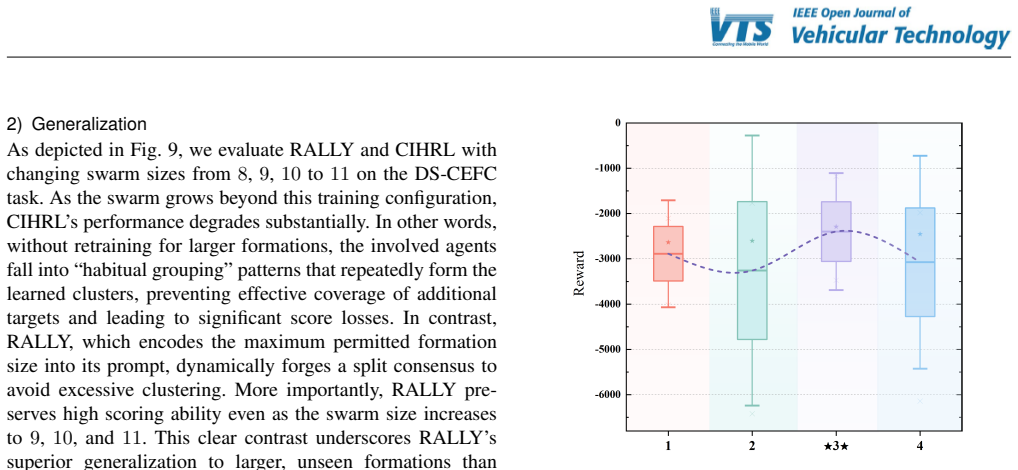
- Generalization to unseen swarm sizes: because the maximum permitted formation size is encoded in the prompt, RALLY forms split sub-clusters as the swarm grows, avoiding the 'habitual grouping' collapse the authors document for CIHRL at 9-11 agents.
- Practical deployment: the fine-tuned 1.5B model runs in 2.9 GB memory with about 14.5 s average inference on an RTX 4090, and the SITL experiment shows the full Gazebo-ROS-PX4 loop executing distributed consensus with dynamic role transitions mid-episode.
- Sample-efficient role learning: seeding the RMIX replay buffer with LLM-generated role assignments shrinks the cold-start problem in a $3^8$ joint role space, letting a small MLP learn role selection without large online exploration budgets.
- Three roles is the design sweet spot: a role-count ablation (Fig. 12) finds that one role collapses performance, two roles raise variance, and a fourth 'Decoy' role lowers mean reward, so the three-role hierarchy is the claimed optimum.
- Interpretability as a byproduct: the consensus output is a natural-language recommendation with role alignment, so a human can audit why a swarm split or regrouped at each decision step.
Reading between the lines
- The headline comparison may overstate the algorithmic gain: RALLY's task prompt discloses the enemy's exact pursuit strategy and the scoring rules, while CIHRL must infer them from raw observations and rewards, so a prompt-restricted ablation could shrink the reported margin substantially.
- A concrete test: give the MARL baseline the same privileged knowledge as an auxiliary observation or shaped reward; if RALLY's advantage persists, it is the semantic-consensus mechanism, and if not, it is prompt-side information rather than the architecture.
- The RMIX monotonicity guarantee could carry over to other LLM+MARL role hierarchies, not just DS-CEFC: as long as a role improvement never decreases joint value, injecting LLM priors into other hierarchical task decompositions should inherit the same convergence argument.
- Because the LLM stage is memoryless, the paper's own stated remedies-test-time training and diversified reasoning paths to escape CoT local optima-are the natural next experiments, and the appendix's prompt-sensitivity examples suggest performance depends heavily on prompt wording.
Editorial analysis
A structured set of objections, weighed in public.
Referee Report
Summary. The paper proposes RALLY, a framework for the DS-CEFC UAV swarm task that combines a two-stage LLM-based semantic consensus mechanism (LLM_init followed by LLM_cons) with a role-value mixing network (RMIX) for dynamic role assignment and credit assignment. The authors claim that RALLY outperforms the MARL baseline CIHRL, the LLM planner CoNavGPT, and the role-play baseline DITTO in task coverage, convergence speed, and generalization, based on experiments in the Multi-Agent Particle Environment (MPE) and a Gazebo-ROS-PX4 software-in-the-loop (SITL) platform. They also present a capacity-migration method that fine-tunes a smaller Qwen model from GPT-4o-generated data, with runtime and memory measurements on an RTX 4090.
Significance. The problem is timely and the integration of LLM semantic reasoning with MARL value decomposition for role selection is a plausible and potentially useful direction. The paper is commendably transparent about its prompts (Figs. 4 and 18) and provides a real SITL deployment with a fine-tuned 1.5B model, which is a strength. If the privileged-information confound I describe below is resolved and the statistical evidence is added, the approach would be a meaningful advance over both pure MARL and pure LLM planners for the DS-CEFC setting. As it stands, however, the empirical advantage and the theoretical superiority claim are not yet established.
major comments (4)
- [§IV.B.1, Fig. 4, Eq. (1)] The headline comparison in Fig. 6 is confounded by privileged information. The X_task prompt in Fig. 4 tells the LLM that 'the strategy of a known enemy node is to directly pursue the nearest cluster of 3 or more nodes', states the scoring rule ('Scoring happens only when more than 3 agents covering one of scoring points'), and lists the eight candidate target coordinates, while Section IV.A separately states that the adversary is trained with PPO to chase the nearest cluster of at least three agents. CIHRL, positioned as the SOTA MARL baseline, receives only the local observation o_i^t of Eq. (1) and scalar rewards, so it must infer exactly the regularities that RALLY is handed in text. The Fig. 6 result, and the generalization results in Figs. 9 and 10, therefore do not establish that RALLY's architecture is superior; they may only establish that RALLY's prompt contains task information the baselines lack. Please add a control that removes the enemy-strategy and scoring details from X_task, or grant the baselines the same information, and report the comparison.
- [§III.A, Assumption 2, Eq. (13), Theorem 1] Theorem 1 is circular as stated. Assumption 2 asserts that 'extra contextual reasoning ... leads to higher-quality Q-values', which is precisely the conclusion of the theorem, and Eq. (13) claims Qi(o_i^t, k_i^t, g_i^t) >= Qi(o_i^t, k_i^t, g'_i^t) 'by construction of LLM_cons' rather than by any property proved from the Dec-POMDP structure. The proof then applies Assumption 1 to a strict improvement that has been assumed, not derived. Please either prove a nontrivial sufficient condition under which the refinement step improves expected return, or explicitly downgrade the result to a conditional proposition whose premise is validated empirically, for example by the missing one-stage ablation.
- [§IV.B, Figs. 6, 9, 10, 12] The empirical claims are not supported with statistical evidence. Fig. 6 is described as 'average rewards over 30 test episodes', but no error bars, number of independent seeds, standard deviations, or significance tests are reported anywhere, and the text's assertion that RALLY has the 'narrowest variance distribution' is not backed by displayed variance. Figs. 9, 10, and 12 make generalization and role-number claims from what appear to be single curves or box plots without confidence information. Please report multiple seeds with confidence intervals and appropriate statistical tests for all headline comparisons.
- [§III.A and §IV.B] The two-stage consensus component LLM_cons is never empirically ablated. The only support for the second stage is Theorem 1, which is circular as noted above, and the experiments compare the full RALLY against external baselines, not against RALLY with the consensus refinement removed. Please add a one-stage versus two-stage ablation to the main comparison; without it, the contribution of the consensus stage to the Fig. 6 result is untested.
minor comments (5)
- [Eq. (10)] The expression for Qtot has an unmatched parenthesis, with 'at' appearing before the closing parenthesis; please fix the typo.
- [Fig. 4] The prompt says 'clusters of three or more nodes' but the scoring rule says 'more than 3 agents covering one of scoring points', while the CoT prompt says 'needs cluster with other two teammates'; please harmonize these thresholds.
- [Figs. 7 and 8] The reproduced figures lack axis labels and legends; please ensure all figures are self-contained and readable.
- [Abstract and Section III.B] The abstract says 'offline training of role selection strategies', while Section III.B describes an offline pre-collection phase followed by online RMIX training; please align the terminology.
- [Title and Section I] The term 'yoked' in the title is never defined in the paper; please add a sentence explaining the intended meaning.
Assumptions & free parameters
free parameters (5)
- Reward weights ωf, ωn, ωtc, ωe, ωc =
15, 4, 10, 100, 100
- Role set K and role count =
Commander, Coordinator, Executor (3 roles)
- Data filter thresholds and weights (Eq. 21) =
(τr, Lmin, Lmax) = (-3, 200, 400); weights (0.45, 0.25, 0.2, 0.1)
- Discount factors and RMIX hyperparameters =
γ=0.92, γrmix=0.95, α=1e-5, batch 256
- Handcrafted prompt content (Xtask, MCoT) =
Text including enemy strategy and scoring rules
assumptions (5)
- standard math Assumption 1: monotonic value factorization with nonnegative mixing weights
- ad hoc to paper Assumption 2: extra contextual LLM reasoning improves Q-values
- domain assumption Existence and correctness of mid/low-level policies πM and πL from [2]
- domain assumption LLM outputs parse into valid goals despite occasional illegal outputs
- domain assumption Fine-tuned Qwen2.5 models preserve GPT-4o decision quality
invented entities (2)
-
Role set {Commander, Coordinator, Executor}
-
Decoy role (ablation only)
Cite this review
Pith. "Pith review of RALLY: Role-Adaptive LLM-Driven Yoked Navigation for Agentic UAV Swarms." pith.science (2026). https://pith.science/paper/5H3HLR5Q
@misc{pith2026250701378,
  author       = {Pith},
  title        = {Pith review of: RALLY: Role-Adaptive LLM-Driven Yoked Navigation for Agentic UAV Swarms},
  year         = {2026},
  howpublished = {\url{https://pith.science/paper/5H3HLR5Q}},
  note         = {Machine review of arXiv:2507.01378}
}
read the original abstract
Intelligent control of Unmanned Aerial Vehicles (UAVs) swarms has emerged as a critical research focus, and it typically requires the swarm to navigate effectively while avoiding obstacles and achieving continuous coverage over multiple mission targets. Although traditional Multi-Agent Reinforcement Learning (MARL) approaches offer dynamic adaptability, they are hindered by the semantic gap in numerical communication and the rigidity of homogeneous role structures, resulting in poor generalization and limited task scalability. Recent advances in Large Language Model (LLM)-based control frameworks demonstrate strong semantic reasoning capabilities by leveraging extensive prior knowledge. However, due to the lack of online learning and over-reliance on static priors, these works often struggle with effective exploration, leading to reduced individual potential and overall system performance. To address these limitations, we propose a Role-Adaptive LLM-Driven Yoked navigation algorithm RALLY. Specifically, we first develop an LLM-driven semantic decision framework that uses structured natural language for efficient semantic communication and collaborative reasoning. Afterward, we introduce a dynamic role-heterogeneity mechanism for adaptive role switching and personalized decision-making. Furthermore, we propose a Role-value Mixing Network (RMIX)-based assignment strategy that integrates LLM offline priors with MARL online policies to enable semi-offline training of role selection strategies. Experiments in the Multi-Agent Particle Environment (MPE) environment and a Software-In-The-Loop (SITL) platform demonstrate that RALLY outperforms conventional approaches in terms of task coverage, convergence speed, and generalization, highlighting its strong potential for collaborative navigation in agentic multi-UAV systems.
Figures


Figures from the paper (15 more)




Reference graph
Works this paper leans on
-
[1]
UA V vision-based nonlinear formation control applied to inspection of electrical power lines,
T. Uzakov, T. P. Nascimento, and M. Saska, “UA V vision-based nonlinear formation control applied to inspection of electrical power lines,” in Proc. ICUAS, Athens, Greece, Jun. 2020
work page 2020
-
[2]
Y . Xiang, S. Li, R. Li , et al. , “Decentralized consensus inference- based hierarchical reinforcement learning for multi-constrained UA V pursuit-evasion game,” IEEE Trans. Neural Netw. Learn. Syst. , Jun. 2025, early access
work page 2025
-
[3]
Dynamic role discovery and assignment in multi-agent task decomposition,
Y . Xia, J. fang Zhu, and L. Zhu, “Dynamic role discovery and assignment in multi-agent task decomposition,” Complex Intell. Syst , vol. 9, p. 6211–6222, Apr. 2023
work page 2023
-
[4]
Multi-agent self-motivated learning via role representation,
Y . Jin and Q. Liu, “Multi-agent self-motivated learning via role representation,” in Proc. IJCNN, Yokohama, Japan, Jul. 2024
work page 2024
-
[5]
Outdoor flocking and formation flight with autonomous aerial robots,
G. V ´as´arhelyi, C. Vir ´agh, G. Somorjai , et al. , “Outdoor flocking and formation flight with autonomous aerial robots,” in Proc. IROS, Chicago, USA, Sep. 2014
work page 2014
-
[6]
A review of consensus-based multi-agent UA V implementations,
F. F. Lizzio, E. Capello, and G. Guglieri, “A review of consensus-based multi-agent UA V implementations,”Intell. Robot. Syst, vol. 106, no. 2, p. 43, Oct. 2022
work page 2022
-
[7]
Relative distributed formation and obstacle avoidance with multi-agent reinforcement learning,
Y . Yan, X. Li, X. Qiu , et al. , “Relative distributed formation and obstacle avoidance with multi-agent reinforcement learning,” in Proc. ICRA, Philadelphia, PA, USA, May 2022
work page 2022
-
[8]
Rethinking modern communication from semantic coding to semantic communication,
K. Lu, Q. Zhou, R. Li , et al. , “Rethinking modern communication from semantic coding to semantic communication,” IEEE Wireless Commun., vol. 30, no. 1, pp. 158–164, Feb. 2023
work page 2023
Show all 66 references
-
[9]
Self-critical alternate learning-based semantic broadcast communication,
Z. Lu, R. Li, M. Lei , et al. , “Self-critical alternate learning-based semantic broadcast communication,” IEEE Trans. Commun. , vol. 73, no. 5, pp. 3347–3363, May 2025
2025
-
[10]
Value-Decomposition networks for cooperative multi-agent learning based on team reward,
P. Sunehag, G. Lever, A. Gruslys , et al. , “Value-Decomposition networks for cooperative multi-agent learning based on team reward,” in Proc. AAMAS, Stockholm, Sweden, Jul. 2018
2018
-
[11]
TarMAC: Targeted multi-agent communication,
A. Das, T. Gervet, J. Romoff , et al. , “TarMAC: Targeted multi-agent communication,” in Proc. ICML, Long Beach, CA, USA, Jun. 2019
2019
-
[12]
Multi-agent reinforcement learning: Independent vs. cooper- ative agents,
M. Tan, “Multi-agent reinforcement learning: Independent vs. cooper- ative agents,” in Proc. ICML, Amherst, MA, USA, Jul. 1993
1993
-
[13]
A review of cooperative multi- agent deep reinforcement learning,
A. Oroojlooy and D. Hajinezhad, “A review of cooperative multi- agent deep reinforcement learning,” Appl. Intell., vol. 53, no. 11, pp. 13 677–13 722, Oct. 2023
2023
-
[14]
The rise and potential of large language model based agents: A survey,
Z. Xi, W. Chen, X. Guo , et al. , “The rise and potential of large language model based agents: A survey,” Sci. China Inf. Sci. , vol. 68, no. 2, p. 121101, Jan. 2025
2025
-
[15]
Large language models for UA Vs: Current state and pathways to the future,
S. Javaid, H. Fahim, B. He , et al., “Large language models for UA Vs: Current state and pathways to the future,” IEEE Open J. Veh. Technol., vol. 5, pp. 1166–1192, Aug. 2024
2024
-
[16]
Human-level control through deep reinforcement learning,
V . Mnih, K. Kavukcuoglu, D. Silver , et al. , “Human-level control through deep reinforcement learning,” Nature, vol. 518, no. 7540, pp. 529–533, Feb. 2015
2015
-
[17]
Multi-agent actor-critic for mixed cooperative-competitive environments,
R. Lowe, Y . Wu, A. Tamar , et al. , “Multi-agent actor-critic for mixed cooperative-competitive environments,” in Proc. NeurIPS, Red Hook, NY , USA, Dec. 2017
2017
-
[18]
The surprising effectiveness of PPO in cooperative multi-agent games,
C. Yu, A. Velu, E. Vinitsky, et al., “The surprising effectiveness of PPO in cooperative multi-agent games,” in Proc. NeurIPS , New Orleans, LA, USA, Dec. 2022
2022
-
[19]
Distillation strategies for proximal policy optimization,
S. Green, C. M. Vineyard, and C. K. Koc, “Distillation strategies for proximal policy optimization,” arXiv preprint arXiv:1901.08128 , Jan. 2019
1901 arXiv
-
[20]
Imitation learning: A survey of learning methods,
A. Hussein, M. M. Gaber, E. Elyan , et al. , “Imitation learning: A survey of learning methods,” ACM Comput. Surv., vol. 50, no. 2, pp. 1–35, Apr. 2017
2017
-
[21]
QMIX: Monotonic value function factorisation for deep multi-agent reinforcement learn- ing,
T. Rashid, M. Samvelyan, C. Schroeder , et al. , “QMIX: Monotonic value function factorisation for deep multi-agent reinforcement learn- ing,” in Proc. ICML, Stockholm, Sverige, Jul. 2018
2018
-
[22]
QTRAN: Learning to factorize with transformation for cooperative multi-agent reinforcement learn- ing,
K. Son, D. Kim, W. J. Kang , et al. , “QTRAN: Learning to factorize with transformation for cooperative multi-agent reinforcement learn- ing,” in Proc. ICML, Long Beach, CA, USA, Jun. 2019
2019
-
[23]
Cooperative multiagent attentional communication for large-scale task space,
Q. Zou, Y . Hu, D. Yi , et al. , “Cooperative multiagent attentional communication for large-scale task space,” Wirel. Commun. Mob. Comput., vol. 2022, no. 1, p. 13, Jan. 2022
2022
-
[24]
Learning multi-agent communi- cation with double attentional deep reinforcement learning,
H. Mao, Z. Zhang, Z. Xiao , et al. , “Learning multi-agent communi- cation with double attentional deep reinforcement learning,” Auton. Agents Multi-Agent Syst. , vol. 34, no. 1, p. 32, Apr. 2020
2020
-
[25]
Semantics-empowered communication: A tutorial-cum-survey,
Z. Lu, R. Li, X. Chen , et al. , “Semantics-empowered communication: A tutorial-cum-survey,” IEEE Commun. Surveys Tuts. , vol. 26, no. 1, pp. 41–79, Mar. 2024
2024
-
[26]
Separate source channel coding is still what you need: An LLM-based rethinking,
T. Ren, R. Li, M.-m. Zhao , et al. , “Separate source channel coding is still what you need: An LLM-based rethinking,” ZTE Commun. , vol. 23, no. 1, pp. 30–44, Mar. 2025
2025
-
[27]
Leader-Follower formation strategy in a UA V swarm for tree plantation: Design and effectiveness,
M. M. Alam, S. Poudel, S. M. A. Huda , et al. , “Leader-Follower formation strategy in a UA V swarm for tree plantation: Design and effectiveness,” in Proc. ICCTech, Bali, Indonesia, Feb. 2024
2024
-
[28]
Hierarchical reinforcement learning: A comprehensive survey,
S. Pateria, B. Subagdja, A.-h. Tan , et al. , “Hierarchical reinforcement learning: A comprehensive survey,”ACM Comput. Surv., vol. 54, no. 5, pp. 1–35, Jan. 2021
2021
-
[29]
Multi-UA V collaborative path planning using hierarchical reinforcement learning and simulated annealing,
Y . Cheng, D. Li, W. E. Wong , et al. , “Multi-UA V collaborative path planning using hierarchical reinforcement learning and simulated annealing,” Int. J. Perform. Eng. , vol. 18, no. 7, p. 463, Jan. 2022
2022
-
[30]
Co-NavGPT: Multi-robot coopera- tive visual semantic navigation using large language models,
B. Yu, H. Kasaei, and M. Cao, “Co-NavGPT: Multi-robot coopera- tive visual semantic navigation using large language models,” arXiv preprint arXiv:2310.07937, May 2025
2025 arXiv
-
[31]
Roco: Dialectic multi-robot collab- oration with large language models,
Z. Mandi, S. Jain, and S. Song, “Roco: Dialectic multi-robot collab- oration with large language models,” in Proc. ICRA, May 2024
2024
-
[32]
Improving factuality and reasoning in language models through multiagent debate,
Y . Du, S. Li, A. Torralba , et al. , “Improving factuality and reasoning in language models through multiagent debate,” in Proc. ICML, Jul. 2024
2024
-
[33]
Encouraging divergent thinking in large language models through multi-agent debate,
T. Liang, Z. He, W. Jiao , et al. , “Encouraging divergent thinking in large language models through multi-agent debate,” in Proc. EMNLP, Miami, Florida, USA, Nov. 2024
2024
-
[34]
Chateval: Towards better LLM- based evaluators through multi-agent debate,
C.-M. Chan, W. Chen, Y . Su , et al. , “Chateval: Towards better LLM- based evaluators through multi-agent debate,” in Proc. ICLR, Vienna Austria, May 2024
2024
-
[35]
Metagpt: Meta programming for multi-agent collaborative framework,
S. Hong, X. Zheng, J. Chen , et al. , “Metagpt: Meta programming for multi-agent collaborative framework,” in Proc. ICLR, Vienna Austria, May 2024
2024
-
[36]
Camel: Communicative agents for “mind
G. Li, H. Hammoud, H. Itani , et al. , “Camel: Communicative agents for “mind” exploration of large scale language model society,” in Proc. NeurIPS, New Orleans, Louisiana, Dec. 2023
2023
-
[37]
ChatDev: Communicative agents for software development,
C. Qian, X. Cong, C. Yang , et al. , “ChatDev: Communicative agents for software development,” in Proc. ACL, Bangkok, Thailand, Aug. 2024
2024
-
[38]
Siren’s song in the AI ocean: A survey on hallucination in large language models,
Y . Zhang, Y . Li, L. Cui , et al. , “Siren’s song in the AI ocean: A survey on hallucination in large language models,” arXiv preprint arXiv:2309.01219, Sep. 2023
2023 arXiv
-
[39]
Persllm: A personified training ap- proach for large language models,
Z. Zeng, J. Chen, H. Chen , et al., “Persllm: A personified training ap- proach for large language models,” arXiv preprint arXiv:2407.12393 , Jul. 2024
2024 arXiv
-
[40]
Simulating opinion dynamics with networks of LLM-based agents,
Y .-S. Chuang, A. Goyal, N. Harlalka , et al. , “Simulating opinion dynamics with networks of LLM-based agents,” in Proc. ACL, Mexico City, Mexico, Jun. 2024
2024
-
[41]
Multi-agent consensus seeking via large language models,
H. Chen, W. Ji, L. Xu , et al., “Multi-agent consensus seeking via large language models,” arXiv preprint arXiv:2310.20151 , Oct. 2023. 14 VOLUME 00, 2024
2023 arXiv
-
[42]
Determinants of LLM-assisted decision- making,
E. Eigner and T. H ¨andler, “Determinants of LLM-assisted decision- making,” arXiv preprint arXiv:2402.17385 , Feb. 2024
2024 arXiv
-
[43]
LLM-based multi-agent rein- forcement learning: Current and future directions,
C. Sun, S. Huang, and D. Pompili, “LLM-based multi-agent rein- forcement learning: Current and future directions,” arXiv preprint arXiv:2405.11106, May 2024
2024 arXiv
-
[44]
LLM-Mediated guidance of MARL systems,
P. D. Siedler and I. M. Gemp, “LLM-Mediated guidance of MARL systems,” arXiv preprint arXiv:2503.13553 , May 2025
2025
-
[45]
Building cooperative embodied agents modularly with large language models,
H. Zhang, W. Du, J. Shan , et al. , “Building cooperative embodied agents modularly with large language models,” in Proc. ICLR, Vienna Austria, May 2024
2024
-
[46]
Cognitive architectures for language agents,
T. R. Sumers, S. Yao, K. Narasimhan , et al. , “Cognitive architectures for language agents,” Trans. Mach. Learn. Res., vol. 2024, Sep. 2023
2024
-
[47]
Emergency networking using UA Vs: A reinforcement learning approach with large language model,
Y . Xu, Z. Jian, J. Zha , et al. , “Emergency networking using UA Vs: A reinforcement learning approach with large language model,” in Proc. IPSN, Hong Kong, China, May 2024
2024
-
[48]
YOLO-MARL: You only LLM once for multi-agent reinforcement learning,
Z. Yuan, Y . Shen, Z. Zhang , et al. , “YOLO-MARL: You only LLM once for multi-agent reinforcement learning,” arXiv preprint arXiv:2410.03997, Oct. 2024
2024 arXiv
-
[49]
Multi-agent actor-critic for mixed cooperative-competitive environments,
R. Lowe, Y . I. Wu, A. Tamar , et al. , “Multi-agent actor-critic for mixed cooperative-competitive environments,” inProc. NeurIPS, Long Beach, CA, USA, Mar. 2017
2017
-
[50]
Vision-Based software- in-the-loop-simulation for unmanned aerial vehicles using gazebo and PX4 open source,
K. D. N. Dang Nguyen and T.-T. Nguyen, “Vision-Based software- in-the-loop-simulation for unmanned aerial vehicles using gazebo and PX4 open source,” in Proc. ICSSE, Dong Hoi, Quang Binh, Vietnam, Jul. 2019
2019
-
[51]
Large language models are superposi- tions of all characters: Attaining arbitrary role-play via self-alignment,
K. Lu, B. Yu, C. Zhou , et al. , “Large language models are superposi- tions of all characters: Attaining arbitrary role-play via self-alignment,” in Proc. ACL, Bangkok, Thailand, Aug. 2024
2024
-
[52]
Proximal policy optimiza- tion algorithms,
J. Schulman, F. Wolski, P. Dhariwal , et al., “Proximal policy optimiza- tion algorithms,” arXiv preprint arXiv:1707.06347 , Jul. 2017
2017 arXiv
-
[53]
PX4: A node-based multithreaded open source robotics framework for deeply embedded platforms,
L. Meier, D. Honegger, and M. Pollefeys, “PX4: A node-based multithreaded open source robotics framework for deeply embedded platforms,” in Proc. ICRA, Seattle, W A, USA, May 2015
2015
-
[54]
Language models are few- shot learners,
T. B. Brown, B. Mann, N. Ryder , et al. , “Language models are few- shot learners,” in Proc. NeurIPS., Virtual Edition, Dec. 2020
2020
-
[55]
Chain-of-thought prompting elicits reasoning in large language models,
J. Wei, X. Wang, D. Schuurmans , et al., “Chain-of-thought prompting elicits reasoning in large language models,” in Proc. NeurIPS , New Orleans, LA, USA, Dec. 2022
2022
-
[56]
Language models don’t always Say what they think,
M. Turpin, J. Michael, E. Perez , et al., “Language models don’t always Say what they think,” in Proc. NeurIPS, New Orleans, Louisiana, Dec. 2023
2023
-
[57]
A survey on curriculum learning,
X. Wang, Y . Chen, and W. Zhu, “A survey on curriculum learning,” IEEE Trans. Pattern Anal. Mach. Intell., vol. 44, no. 9, pp. 4555–4576, Sep. 2022
2022
-
[58]
GPT-4o system card,
OpenAI, A. Hurst, A. Lerer , et al. , “GPT-4o system card,” arXiv preprint arXiv:2410.21276, Oct. 2024
2024 arXiv
-
[59]
Self-Instruct: Aligning language models with self-generated instructions,
Y . Wang, Y . Kordi, S. Mishra, et al., “Self-Instruct: Aligning language models with self-generated instructions,” in Proc. ACL , Toronto, Canada, Jul. 2023
2023
-
[60]
Any-Precision LLM: Low-cost de- ployment of multiple, different-sized LLMs,
Y . Park, J. Hyun, S. Cho , et al. , “Any-Precision LLM: Low-cost de- ployment of multiple, different-sized LLMs,” in Proc. ICML, Vienna, Austria, Jul. 2024
2024
-
[61]
LlamaFactory: Unified effi- cient fine-tuning of 100+ language models,
Y . Zheng, R. Zhang, J. Zhang , et al. , “LlamaFactory: Unified effi- cient fine-tuning of 100+ language models,” in Proc. ACL, Bangkok, Thailand, Aug. 2024
2024
-
[62]
LoRA: Low-rank adaptation of large language models,
J. E. Hu, Y . Shen, P. Wallis , et al. , “LoRA: Low-rank adaptation of large language models,” in Proc. ICLR, Virtual Edition, Apr. 2022
2022
-
[63]
Modelling, identifi- cation and control of a quadrotor UA V,
M. Walid, N. Slaheddine, A. Mohamed , et al. , “Modelling, identifi- cation and control of a quadrotor UA V,” in Proc. SSD, Hammamet, Tunisia, Mar. 2018. Appendix In the Appendix, we provide the detailed prompts in Fig. 18 and give the reasoning sensitivity in Fig. 19. VOLUME ...
2018
-
[64]
The commander will be firm in his opinions and do what is best for him in the decision-making stage
-
[65]
The coordinator judges gains and losses depending on commander's intention and conduct executors to ensure the interests of the commander
-
[66]
My priority is [x], next target point is [y,z]
The executor always follows intention and choose the coordinator's target points. Role Select Logic𝑴𝑪 When you are closer to the enemy than neighbor and it's better to change another points for covering scoring neighbor, you are supposed to be the coordinator and lead other ne...
2024
Reviewed August 6, 2026 · model on record in the stance chip above.
Discussion (0). Sign in to comment.