REVIEW 4 major objections 6 minor 3 cited by
3D-LLaVA: Towards Generalist 3D LMMs with Omni Superpoint Transformer
T0 review · 4 major / 6 minor · reviewed 2026-08-10 · deepseek-v4-flash
Pith's one-line read One point-cloud module unifies 3D dialogue, prompting, and mask output.
desk verdict A clean point-cloud-only 3D LMM with a genuinely unified OST connector; strong results but overclaimed SOTA and two missing analyses (distillation ablation, token-selection recall on referring tasks). read the letter →
The pith
A machine-rendered reading of the paper's core claim, the machinery that carries it, and where it could break.
The reading
What carries the argument
The Omni Superpoint Transformer (OST) is a superpoint-based transformer that deliberately omits cross-attention layers, using superpoint features as both queries and source features with distance-adaptive self-attention, and carries a mask head, classification head, and alignment head. It is pre-trained with a hybrid loss combining ScanNet200 instance segmentation and 2D-to-3D knowledge distillation from a 2D LMM's visual encoder, then frozen and reused at inference as the feature selector, visual prompt encoder, and mask decoder. A parameter-free visual sampler turns clicks, boxes, and masks into prompt features that OST projects into the same embedding space as visual tokens.
What would settle it
Compute, on ScanRefer or Multi3DRefer validation, the recall of the ground-truth target instance's superpoints among the top-100 objectness-ranked superpoints; if a large share of failed predictions correspond to targets that fall outside the top-100, the objectness-based selection assumption is the reason for the failure. A direct probe would feed the same scene with and without the target's superpoints forced into the top-100 and measure whether the model then answers or segments correctly.
Extended reading notes
Core claim
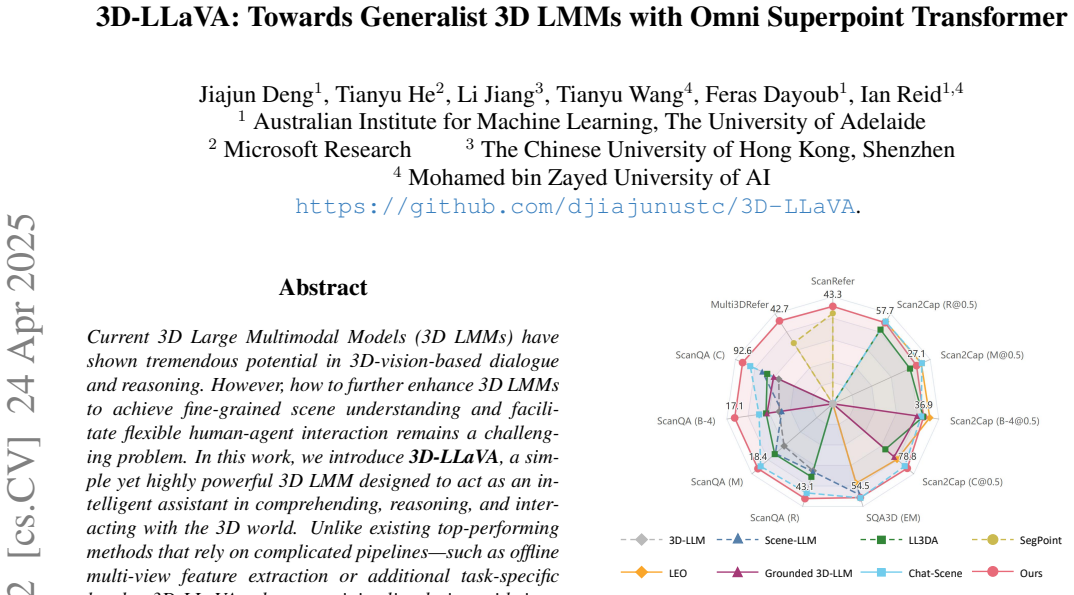
The discovery is that a transformer operating on superpoints, pre-trained with instance segmentation and 2D-to-3D feature distillation, can serve every visual role a 3D LMM needs: it selects which scene regions become LLM tokens, encodes any user-provided click, box, or mask prompt into the same token space, and, when the LLM emits a [SEG] token, decodes the hidden state into a 3D mask. With this one shared connector, 3D-LLaVA reports best results on the evaluated benchmarks among 3D LMMs trained jointly on multiple tasks: 43.3% mIoU on ScanRefer, 42.7% mIoU on Multi3DRefer, 92.6% CiDEr on ScanQA, and best-or-comparable scores on SQA3D and Scan2Cap, all with point clouds as the only input.
Load-bearing premise
The pipeline keeps only the 100 superpoints with the highest objectness score, where objectness is the max foreground-class logit from a classifier trained on ScanNet200 categories; everything rests on those 100 tokens containing the regions needed to answer the user's question or match the referring expression.
Editorial extensions
If this is right
- Offline multi-view feature extraction and extra task-specific heads can be removed from 3D LMM pipelines without losing performance.
- The same frozen OST can ground language to 3D masks and answer or describe scenes, so referring segmentation no longer requires a separate aligned segmentation network.
- On the paper's benchmarks, the model improves referring segmentation over the previous best (1.6 mIoU on ScanRefer, 6.6 on Multi3DRefer) and raises ScanQA CiDEr by 4.9 absolute over the prior best.
- Visual prompts of different forms (click, box, mask) are handled by one mechanism, including masks from any external proposer such as Mask3D, without retraining.
- When a referred object is absent, the LLM can answer that it cannot find the object and skip mask decoding, avoiding false-positive masks.
Reading between the lines
- A likely pressure point the paper leaves implicit is the objectness-based top-K selection: since only the 100 highest-scoring superpoints reach the LLM, making selection query-aware (for example, conditioned on the text or prompt) could improve recall of low-saliency but referenced objects.
- The same architecture could be tested on open-vocabulary or zero-shot settings by replacing the fixed category classification head with a text-aligned feature space, which may let the connector ground expressions beyond ScanNet200 categories.
- Because OST is frozen during instruction tuning, it may be feasible to swap the LLM for a stronger or lighter one later without retraining the visual connector, turning the 3D encoder into a reusable front end.
- The unified prompting mechanism suggests an interactive point, box, or text control scheme for 3D assistants that could transfer to embodied tasks like robot manipulation, but the paper only benchmarks static ScanNet scenes.
Signed reviews
Editorial analysis
A structured set of objections, weighed in public.
Referee Report
Summary. The paper introduces 3D-LLaVA, a 3D large multimodal model built around a single Omni Superpoint Transformer (OST) that serves as a visual feature selector, a visual prompt encoder, and a referring mask decoder. The model takes only point clouds as input, uses superpoint pooling and a top-K objectness-based token selection to obtain visual tokens for the LLM, and decodes a [SEG] token into a 3D mask through the frozen OST. The OST and the Sparse 3D U-Net are pretrained with instance segmentation plus 2D-to-3D feature distillation, and the whole system is instruction-tuned on ScanRefer, Nr3D, Multi3DRefer, ScanQA, SQA3D, and Scan2Cap. Experiments report results on ScanRefer, Multi3DRefer, ScanQA, SQA3D, and Scan2Cap, with the strongest gains on referring segmentation and ScanQA CiDEr.
Significance. If the central claim holds, the paper is a useful step toward unified 3D LMMs: a single point-cloud-based connector can replace offline multi-view feature extraction and task-specific heads for referring segmentation, visual prompting, and mask decoding. The architecture is clean, the code is released, and the evaluation protocol uses standard train/validation splits with held-out test sets, so I found no circularity in the evaluation. The strongest evidence is the referring-segmentation performance (43.3% mIoU on ScanRefer and 42.7% on Multi3DRefer) and the 92.6% CiDEr on ScanQA, obtained without the 2D instance features used by Chat-Scene. However, the query-blind top-100 objectness selection and the use of Mask3D proposals for dense captioning are not adequately validated, and the blanket SOTA claim is not supported by the paper's own table. These issues are fixable but need to be addressed before the central claims can be accepted.
major comments (4)
- [Section 3.3 (Visual Feature Selection) and Table 5] The top-K=100 superpoint selection is query-blind: the objectness score is the maximum foreground-class logit from a ScanNet200 classifier computed before the language instruction is seen, and any superpoint outside the top 100 is irrecoverable. This is a load-bearing bottleneck for referring segmentation because the LLM can never ground a [SEG] token to a discarded target, and Section 3.4 states that the Sparse 3D U-Net and OST are kept frozen during instruction tuning, so the selection cannot be adapted by the downstream data. Table 5 sweeps the token count only on ScanQA and Scan2Cap, where global scene statistics and large objects dominate; it does not measure target recall on ScanRefer or Multi3DRefer. I request a recall analysis (fraction of referred objects whose superpoints are among the top K) and a K-ablation on the referring-segmentation mIoU. Without this, the reported 43.3% and 42.7% mIoU are unverified upper bounds set by the selection step.
- [Section 4.3 (3D Dense Captioning)] The dense captioning experiment uses Mask3D-predicted mask proposals as visual prompts. This is an external task-specific proposal generator applied at inference, which is in tension with the paper's stated contribution of removing offline preprocessing and task-specific heads. The claim that the pipeline 'only takes point clouds as input' is technically true at the modality level, but it does not address the extra module. Please clarify whether Mask3D is part of the deployed system, report results without Mask3D (e.g., using ground-truth boxes or a simple unsupervised grouping), and discuss how the Scan2Cap comparison is affected for methods that do not use an external proposal generator.
- [Abstract, Introduction, and Table 2] The claim of state-of-the-art performance on all evaluated datasets is contradicted by Table 2. On SQA3D, Chat-Scene achieves EM 54.6 versus 54.5 for 3D-LLaVA; on Scan2Cap, Chat-Scene achieves METEOR 28.0 versus 27.1 and Rouge-L 58.1 versus 57.7. The text should report per-metric wins and losses rather than stating blanket SOTA, and the Figure 1 caption ('most of the benchmarks') should be aligned with the main text.
- [Section 3.4, Eq. (2)] The hybrid pretraining objective combines classification, mask, and 2D-to-3D distillation losses, and the distillation is motivated as a bridge for language alignment. Yet no experiment isolates L_KD: there is no ablation trained without distillation or without the instance-segmentation supervision. Given that the 2D teacher (CLIP-ViT-L via LLaVA-1.5) is an external component and a stated source of alignment, its contribution should be quantified. I consider this a missing experiment rather than a flaw in the derivation, but it is needed to support the design choice.
minor comments (6)
- [Section 3.3] The text says 'the objections score of each superpoint query'; this should be 'objectness score'.
- [Section 3.4] The subsection heading uses 'pre-training' but the text contains 'pretaining' (e.g., 'at the pertaining stage'); please correct the typo.
- [Table 4] The metric name 'Rough-L' should be 'Rouge-L' for consistency with Table 2 and the main text.
- [Section 4.3] The benchmark name 'Scanerfer' in the sentence 'the single-target setting (Scanerfer [7])' should be 'ScanRefer'.
- [Section 3.2, Eq. (1)] Please clarify the definition of D in Eq. (1): is it the Euclidean distance between superpoint centroids, and is the softmax computed over all superpoint queries? Also state how the learnable scale sigma is initialized.
- [Section 4.2] The implementation details do not report the number of training seeds or whether results are from a single run; adding error bars or at least an explicit statement about single-run results would help assess stability.
Circularity Check
No significant circularity: the central claims are supported by held-out benchmark evaluations, not by definitions or fitted predictions.
full rationale
The paper is an empirical systems paper: the claimed contribution is that a single Omni Superpoint Transformer (OST) can serve as visual feature selector, visual prompt encoder, and referring mask decoder, and this is validated on standard external benchmarks (ScanRefer, Multi3DRefer, ScanQA, SQA3D, Scan2Cap) using held-out validation/test splits and standard metrics. No derived quantity is defined in terms of the quantity it is said to predict: the top-K objectness-based token selection is a fixed architectural design choice, and the only related study (Table 5) is an ablation of token count, not a fit of test metrics. The mask decoding path uses the frozen OST with a [SEG] query, and its outputs are scored against external ground-truth masks. There is no fitted parameter that is later renamed as a prediction, no uniqueness theorem imported from the authors' own prior work, and no load-bearing self-citation: the cited prior work overlapping with the authors (e.g., Agent3D-Zero) appears only in related-work context and does not justify the paper's core claims. The known weakness of query-blind top-100 pruning is a potential correctness or generalization risk, not a circularity, because the benchmark numbers would still be independent evidence even if the selection rule is suboptimal. Accordingly, no circular step can be exhibited and the circularity score is 0.
Assumptions & free parameters
free parameters (3)
- Top-K visual tokens (K) =
100
- Mask loss coefficient =
0.1
- Pretraining epochs =
512
assumptions (3)
- domain assumption CLIP-ViT-L features lifted from 2D to 3D via geometric correspondence provide reliable dense semantic supervision for superpoint pretraining.
- domain assumption Superpoint clustering (bottom-up algorithm from [38]) yields segments that align with object instances sufficiently for mask decoding.
- domain assumption Objectness scores from a classifier trained on ScanNet200 categories generalize to all objects queried by ScanRefer, Multi3DRefer, ScanQA, SQA3D, and Scan2Cap.
Cite this review
Pith. "Pith review of 3D-LLaVA: Towards Generalist 3D LMMs with Omni Superpoint Transformer." pith.science (2026). https://pith.science/paper/5H7ZOZK6
@misc{pith2026250101163,
  author       = {Pith},
  title        = {Pith review of: 3D-LLaVA: Towards Generalist 3D LMMs with Omni Superpoint Transformer},
  year         = {2026},
  howpublished = {\url{https://pith.science/paper/5H7ZOZK6}},
  note         = {Machine review of arXiv:2501.01163}
}
read the original abstract
Current 3D Large Multimodal Models (3D LMMs) have shown tremendous potential in 3D-vision-based dialogue and reasoning. However, how to further enhance 3D LMMs to achieve fine-grained scene understanding and facilitate flexible human-agent interaction remains a challenging problem. In this work, we introduce 3D-LLaVA, a simple yet highly powerful 3D LMM designed to act as an intelligent assistant in comprehending, reasoning, and interacting with the 3D world. Unlike existing top-performing methods that rely on complicated pipelines-such as offline multi-view feature extraction or additional task-specific heads-3D-LLaVA adopts a minimalist design with integrated architecture and only takes point clouds as input. At the core of 3D-LLaVA is a new Omni Superpoint Transformer (OST), which integrates three functionalities: (1) a visual feature selector that converts and selects visual tokens, (2) a visual prompt encoder that embeds interactive visual prompts into the visual token space, and (3) a referring mask decoder that produces 3D masks based on text description. This versatile OST is empowered by the hybrid pretraining to obtain perception priors and leveraged as the visual connector that bridges the 3D data to the LLM. After performing unified instruction tuning, our 3D-LLaVA reports impressive results on various benchmarks.
Figures


Figures from the paper (2 more)


Forward citations
Cited by 3 Pith papers
-
SAVVY: Spatial Awareness via Audio-Visual LLMs through Seeing and Hearing
SAVVY-Bench tests audio-visual LLMs on dynamic 3D spatial questions, and the SAVVY pipeline, combining visual tracks with spatial audio and global mapping, lifts Gemini-2.5-pro accuracy from 50.9% to 58.0%.
-
LLaVA-4D: Embedding SpatioTemporal Prompt into LMMs for 4D Scene Understanding
A vision-language model that embeds 3D coordinates plus time into visual and linguistic tokens beats 3D-only models on dynamic scene captioning, grounding, and QA.
-
Multi-View Relational Distillation for Spatial Reasoning with Vision-Language Models
Multi-view relational distillation transfers geometric knowledge to vision-language models by matching cross-view patch similarity matrices, improving spatial reasoning with minimal overhead.
Reference graph
Works this paper leans on
-
[1]
Referit3d: Neural listeners for fine-grained 3d object identification in real-world scenes
Panos Achlioptas, Ahmed Abdelreheem, Fei Xia, Mohamed Elhoseiny, and Leonidas Guibas. Referit3d: Neural listeners for fine-grained 3d object identification in real-world scenes. In European Conference on Computer Vision , pages 422–
-
[2]
Flamingo: a visual language model for few-shot learning
Jean-Baptiste Alayrac, Jeff Donahue, Pauline Luc, Antoine Miech, Iain Barr, Yana Hasson, Karel Lenc, Arthur Men- sch, Katherine Millican, Malcolm Reynolds, et al. Flamingo: a visual language model for few-shot learning. Advances in neural information processing systems, 35:23716–23736,
-
[3]
Scanqa: 3d question answering for spatial scene understanding
Daichi Azuma, Taiki Miyanishi, Shuhei Kurita, and Motoaki Kawanabe. Scanqa: 3d question answering for spatial scene understanding. In proceedings of the IEEE/CVF conference on computer vision and pattern recognition , pages 19129– 19139, 2022. 2, 5, 6, 7, 8
work page 2022
-
[4]
Lan- guage models are few-shot learners
Tom Brown, Benjamin Mann, Nick Ryder, Melanie Sub- biah, Jared D Kaplan, Prafulla Dhariwal, Arvind Neelakan- tan, Pranav Shyam, Girish Sastry, Amanda Askell, et al. Lan- guage models are few-shot learners. Advances in neural in- formation processing systems, 33:1877–1901, 2020. 1
1901
-
[5]
Lan- guage models are few-shot learners
Tom Brown, Benjamin Mann, Nick Ryder, Melanie Sub- biah, Jared D Kaplan, Prafulla Dhariwal, Arvind Neelakan- tan, Pranav Shyam, Girish Sastry, Amanda Askell, et al. Lan- guage models are few-shot learners. Advances in Neural Information Processing Systems (NeurIPS) , 33:1877–1901,
1901
-
[6]
3djcg: A unified framework for joint dense captioning and visual grounding on 3d point clouds
Daigang Cai, Lichen Zhao, Jing Zhang, Lu Sheng, and Dong Xu. 3djcg: A unified framework for joint dense captioning and visual grounding on 3d point clouds. In Proceedings of the IEEE/CVF Conference on Computer Vision and Pattern Recognition, pages 16464–16473, 2022. 2, 6
work page 2022
-
[7]
Scanrefer: 3d object localization in rgb-d scans using natu- ral language
Dave Zhenyu Chen, Angel X Chang, and Matthias Nießner. Scanrefer: 3d object localization in rgb-d scans using natu- ral language. In European Conference on Computer Vision, pages 202–221. Springer, 2020. 2, 5, 7
work page 2020
-
[8]
Dave Zhenyu Chen, Qirui Wu, Matthias Nießner, and An- gel X Chang. D3net: A speaker-listener architecture for semi-supervised dense captioning and visual grounding in rgb-d scans. arXiv preprint arXiv:2112.01551, 2021. 2, 6
arXiv 2021
Show all 68 references
-
[9]
End-to-end 3d dense captioning with vote2cap-detr
Sijin Chen, Hongyuan Zhu, Xin Chen, Yinjie Lei, Gang Yu, and Tao Chen. End-to-end 3d dense captioning with vote2cap-detr. In Proceedings of the IEEE/CVF Conference on Computer Vision and Pattern Recognition, pages 11124– 11133, 2023. 2, 6
2023
-
[10]
V ote2cap-detr++: Decoupling localization and de- scribing for end-to-end 3d dense captioning
Sijin Chen, Hongyuan Zhu, Mingsheng Li, Xin Chen, Peng Guo, Yinjie Lei, Gang Yu, Taihao Li, and Tao Chen. V ote2cap-detr++: Decoupling localization and de- scribing for end-to-end 3d dense captioning. arXiv preprint arXiv:2309.02999, 2023. 2
2023 arXiv
-
[11]
Ll3da: Visual interactive instruction tuning for omni-3d understand- ing reasoning and planning
Sijin Chen, Xin Chen, Chi Zhang, Mingsheng Li, Gang Yu, Hao Fei, Hongyuan Zhu, Jiayuan Fan, and Tao Chen. Ll3da: Visual interactive instruction tuning for omni-3d understand- ing reasoning and planning. InProceedings of the IEEE/CVF Conference on Computer Vision and Pattern Re...
2024
-
[12]
Grounded 3d-llm with referent tokens
Yilun Chen, Shuai Yang, Haifeng Huang, Tai Wang, Ruiyuan Lyu, Runsen Xu, Dahua Lin, and Jiangmiao Pang. Grounded 3d-llm with referent tokens. arXiv preprint arXiv:2405.10370, 2024. 3, 6, 7
2024 arXiv
-
[13]
Scan2cap: Context-aware dense captioning in rgb-d scans
Zhenyu Chen, Ali Gholami, Matthias Nießner, and Angel X Chang. Scan2cap: Context-aware dense captioning in rgb-d scans. In Proceedings of the IEEE/CVF Conference on Com- puter Vision and Pattern Recognition , pages 3193–3203,
-
[14]
Unit3d: A unified trans- former for 3d dense captioning and visual grounding
Zhenyu Chen, Ronghang Hu, Xinlei Chen, Matthias Nießner, and Angel X Chang. Unit3d: A unified trans- former for 3d dense captioning and visual grounding. In Proceedings of the IEEE/CVF International Conference on Computer Vision, pages 18109–18119, 2023. 6
2023
-
[15]
Palm: Scaling language modeling with pathways
Aakanksha Chowdhery, Sharan Narang, Jacob Devlin, Maarten Bosma, Gaurav Mishra, Adam Roberts, Paul Barham, Hyung Won Chung, Charles Sutton, Sebastian Gehrmann, et al. Palm: Scaling language modeling with pathways. Journal of Machine Learning Research, 24(240): 1–113, 2023. 2
2023
-
[16]
4d spatio-temporal convnets: Minkowski convolutional neural networks
Christopher Choy, JunYoung Gwak, and Silvio Savarese. 4d spatio-temporal convnets: Minkowski convolutional neural networks. In Proceedings of the IEEE/CVF conference on computer vision and pattern recognition, pages 3075–3084,
-
[17]
Scannet: Richly-annotated 3d reconstructions of indoor scenes
Angela Dai, Angel X Chang, Manolis Savva, Maciej Hal- ber, Thomas Funkhouser, and Matthias Nießner. Scannet: Richly-annotated 3d reconstructions of indoor scenes. In Proceedings of the IEEE conference on computer vision and pattern recognition, pages 5828–5839, 2017. 5
2017
-
[18]
Instructblip: Towards general- purpose vision-language models with instruction tuning,
Wenliang Dai, Junnan Li, Dongxu Li, Anthony Meng Huat Tiong, Junqi Zhao, Weisheng Wang, Boyang Li, Pascale Fung, and Steven Hoi. Instructblip: Towards general- purpose vision-language models with instruction tuning,
-
[19]
A density-based algorithm for discovering clusters in large spatial databases with noise
Martin Ester, Hans-Peter Kriegel, J ¨org Sander, Xiaowei Xu, et al. A density-based algorithm for discovering clusters in large spatial databases with noise. In kdd, pages 226–231,
-
[20]
Scene-llm: Extending language model for 3d visual understanding and reasoning
Rao Fu, Jingyu Liu, Xilun Chen, Yixin Nie, and Wen- han Xiong. Scene-llm: Extending language model for 3d visual understanding and reasoning. arXiv preprint arXiv:2403.11401, 2024. 3, 6
2024 arXiv
-
[21]
Segpoint: Segment any point cloud via large language model
Shuting He, Henghui Ding, Xudong Jiang, and Bihan Wen. Segpoint: Segment any point cloud via large language model. In European Conference on Computer Vision, pages 349–367, 2024. 1, 2, 3, 6, 7
2024
-
[22]
Training compute-optimal large language mod- els
Jordan Hoffmann, Sebastian Borgeaud, Arthur Mensch, Elena Buchatskaya, Trevor Cai, Eliza Rutherford, Diego de Las Casas, Lisa Anne Hendricks, Johannes Welbl, Aidan Clark, et al. Training compute-optimal large language mod- els. arXiv preprint arXiv:2203.15556, 2022. 2
2022 arXiv
-
[23]
3d-llm: In- 9 jecting the 3d world into large language models
Yining Hong, Haoyu Zhen, Peihao Chen, Shuhong Zheng, Yilun Du, Zhenfang Chen, and Chuang Gan. 3d-llm: In- 9 jecting the 3d world into large language models. Advances in Neural Information Processing Systems, 36:20482–20494,
-
[24]
Lora: Low-rank adaptation of large language models
Edward J Hu, Yelong Shen, Phillip Wallis, Zeyuan Allen- Zhu, Yuanzhi Li, Shean Wang, Lu Wang, and Weizhu Chen. Lora: Low-rank adaptation of large language models. arXiv preprint arXiv:2106.09685, 2021. 5, 6
2021 arXiv
-
[25]
Chat-scene: Bridging 3d scene and large language models with object identifiers
Haifeng Huang, Yilun Chen, Zehan Wang, Rongjie Huang, Runsen Xu, Tai Wang, Luping Liu, Xize Cheng, Yang Zhao, Jiangmiao Pang, et al. Chat-scene: Bridging 3d scene and large language models with object identifiers. In The Thirty- eighth Annual Conference on Neural Information P...
2024
-
[26]
An embodied generalist agent in 3d world
Jiangyong Huang, Silong Yong, Xiaojian Ma, Xiongkun Linghu, Puhao Li, Yan Wang, Qing Li, Song-Chun Zhu, Baoxiong Jia, and Siyuan Huang. An embodied generalist agent in 3d world. arXiv preprint arXiv:2311.12871, 2023. 6
2023 arXiv
-
[27]
Reason3d: Searching and reasoning 3d segmentation via large language model
Kuan-Chih Huang, Xiangtai Li, Lu Qi, Shuicheng Yan, and Ming-Hsuan Yang. Reason3d: Searching and reasoning 3d segmentation via large language model. arXiv preprint arXiv:2405.17427, 2024. 2
2024 arXiv
-
[28]
Text-guided graph neural networks for re- ferring 3d instance segmentation
Pin-Hao Huang, Han-Hung Lee, Hwann-Tzong Chen, and Tyng-Luh Liu. Text-guided graph neural networks for re- ferring 3d instance segmentation. In Proceedings of the AAAI Conference on Artificial Intelligence , pages 1610– 1618, 2021. 2, 6
2021
-
[29]
Multi- view transformer for 3d visual grounding
Shijia Huang, Yilun Chen, Jiaya Jia, and Liwei Wang. Multi- view transformer for 3d visual grounding. In Proceedings of the IEEE/CVF Conference on Computer Vision and Pattern Recognition, pages 15524–15533, 2022. 2
2022
-
[30]
Oneformer: One transformer to rule universal image segmentation
Jitesh Jain, Jiachen Li, Mang Tik Chiu, Ali Hassani, Nikita Orlov, and Humphrey Shi. Oneformer: One transformer to rule universal image segmentation. In Proceedings of the IEEE/CVF Conference on Computer Vision and Pattern Recognition, pages 2989–2998, 2023. 4
2023
-
[31]
More: Multi-order relation min- ing for dense captioning in 3d scenes
Yang Jiao, Shaoxiang Chen, Zequn Jie, Jingjing Chen, Lin Ma, and Yu-Gang Jiang. More: Multi-order relation min- ing for dense captioning in 3d scenes. arXiv preprint arXiv:2203.05203, 2022. 2, 6
2022 arXiv
-
[32]
Tod3cap: Towards 3d dense captioning in outdoor scenes
Bu Jin, Yupeng Zheng, Pengfei Li, Weize Li, Yuhang Zheng, Sujie Hu, Xinyu Liu, Jinwei Zhu, Zhijie Yan, Haiyang Sun, et al. Tod3cap: Towards 3d dense captioning in outdoor scenes. In European Conference on Computer Vision, pages 367–384. Springer, 2024. 2
2024
-
[33]
Context-aware alignment and mutual masking for 3d- language pre-training
Zhao Jin, Munawar Hayat, Yuwei Yang, Yulan Guo, and Yin- jie Lei. Context-aware alignment and mutual masking for 3d- language pre-training. In Proceedings of the IEEE/CVF Con- ference on Computer Vision and Pattern Recognition, pages 10984–10994, 2023. 2, 6
2023
-
[34]
Bi-directional contextual attention for 3d dense captioning
Minjung Kim, Hyung Suk Lim, Soonyoung Lee, Bumsoo Kim, and Gunhee Kim. Bi-directional contextual attention for 3d dense captioning. In European Conference on Com- puter Vision, pages 385–401. Springer, 2024. 2
2024
-
[35]
Oneformer3d: One transformer for unified point cloud segmentation
Maxim Kolodiazhnyi, Anna V orontsova, Anton Konushin, and Danila Rukhovich. Oneformer3d: One transformer for unified point cloud segmentation. In Proceedings of the IEEE/CVF Conference on Computer Vision and Pattern Recognition, pages 20943–20953, 2024. 3
2024
-
[36]
Mask-attention-free transformer for 3d in- stance segmentation
Xin Lai, Yuhui Yuan, Ruihang Chu, Yukang Chen, Han Hu, and Jiaya Jia. Mask-attention-free transformer for 3d in- stance segmentation. In Proceedings of the IEEE/CVF Inter- national Conference on Computer Vision, pages 3693–3703,
-
[37]
Lisa: Reasoning segmentation via large language model
Xin Lai, Zhuotao Tian, Yukang Chen, Yanwei Li, Yuhui Yuan, Shu Liu, and Jiaya Jia. Lisa: Reasoning segmentation via large language model. In Proceedings of the IEEE/CVF Conference on Computer Vision and Pattern Recognition , pages 9579–9589, 2024. 5
2024
-
[38]
Large-scale point cloud semantic segmentation with superpoint graphs
Loic Landrieu and Martin Simonovsky. Large-scale point cloud semantic segmentation with superpoint graphs. InPro- ceedings of the IEEE conference on computer vision and pat- tern recognition, pages 4558–4567, 2018. 3
2018
-
[39]
Blip-2: Bootstrapping language-image pre-training with frozen image encoders and large language models
Junnan Li, Dongxu Li, Silvio Savarese, and Steven Hoi. Blip-2: Bootstrapping language-image pre-training with frozen image encoders and large language models. arXiv preprint arXiv:2301.12597, 2023. 1, 2, 3
2023 arXiv
-
[40]
Visual instruction tuning
Haotian Liu, Chunyuan Li, Qingyang Wu, and Yong Jae Lee. Visual instruction tuning. arXiv preprint arXiv:2304.08485,
-
[41]
Sparsebev: High-performance sparse 3d object de- tection from multi-camera videos
Haisong Liu, Yao Teng, Tao Lu, Haiguang Wang, and Limin Wang. Sparsebev: High-performance sparse 3d object de- tection from multi-camera videos. In Proceedings of the IEEE/CVF International Conference on Computer Vision , pages 18580–18590, 2023. 4
2023
-
[42]
Improved baselines with visual instruction tuning
Haotian Liu, Chunyuan Li, Yuheng Li, and Yong Jae Lee. Improved baselines with visual instruction tuning. In Pro- ceedings of the IEEE/CVF Conference on Computer Vision and Pattern Recognition, pages 26296–26306, 2024. 1, 2, 5, 6
2024
-
[43]
Vicuna: An open-source chatbot impressing gpt-4 with 90quality, 2023
LMSYS.org. Vicuna: An open-source chatbot impressing gpt-4 with 90quality, 2023. https://lmsys.org. 1, 6
2023
-
[44]
Sqa3d: Situated question answering in 3d scenes
Xiaojian Ma, Silong Yong, Zilong Zheng, Qing Li, Yi- tao Liang, Song-Chun Zhu, and Siyuan Huang. Sqa3d: Situated question answering in 3d scenes. arXiv preprint arXiv:2210.07474, 2022. 2, 5, 7, 8
2022 arXiv
-
[45]
Clip-guided vision-language pre-training for question answering in 3d scenes
Maria Parelli, Alexandros Delitzas, Nikolas Hars, Geor- gios Vlassis, Sotirios Anagnostidis, Gregor Bachmann, and Thomas Hofmann. Clip-guided vision-language pre-training for question answering in 3d scenes. In Proceedings of the IEEE/CVF Conference on Computer Vision and Patt...
2023
-
[46]
Openscene: 3d scene understanding with open vocabularies
Songyou Peng, Kyle Genova, Chiyu Jiang, Andrea Tagliasacchi, Marc Pollefeys, Thomas Funkhouser, et al. Openscene: 3d scene understanding with open vocabularies. In Proceedings of the IEEE/CVF conference on computer vi- sion and pattern recognition, pages 815–824, 2023. 2, 5
2023
-
[47]
Pointnet++: Deep hierarchical feature learning on point sets in a metric space
Charles Ruizhongtai Qi, Li Yi, Hao Su, and Leonidas J Guibas. Pointnet++: Deep hierarchical feature learning on point sets in a metric space. Advances in neural information processing systems, 30, 2017. 3, 4
2017
-
[48]
X- refseg3d: Enhancing referring 3d instance segmentation via structured cross-modal graph neural networks
Zhipeng Qian, Yiwei Ma, Jiayi Ji, and Xiaoshuai Sun. X- refseg3d: Enhancing referring 3d instance segmentation via structured cross-modal graph neural networks. In Proceed- 10 ings of the AAAI Conference on Artificial Intelligence, pages 4551–4559, 2024. 2, 6
2024
-
[49]
Language models are unsu- pervised multitask learners
Alec Radford, Jeffrey Wu, Rewon Child, David Luan, Dario Amodei, Ilya Sutskever, et al. Language models are unsu- pervised multitask learners. OpenAI blog, 1(8):9, 2019. 1
2019
-
[50]
Learning transferable visual models from natural language supervi- sion
Alec Radford, Jong Wook Kim, Chris Hallacy, Aditya Ramesh, Gabriel Goh, Sandhini Agarwal, Girish Sastry, Amanda Askell, Pamela Mishkin, Jack Clark, et al. Learning transferable visual models from natural language supervi- sion. In International conference on machine learning, ...
2021
-
[51]
Language- grounded indoor 3d semantic segmentation in the wild
David Rozenberszki, Or Litany, and Angela Dai. Language- grounded indoor 3d semantic segmentation in the wild. In European Conference on Computer Vision, pages 125–141,
-
[52]
Mask3d: Mask trans- former for 3d semantic instance segmentation
Jonas Schult, Francis Engelmann, Alexander Hermans, Or Litany, Siyu Tang, and Bastian Leibe. Mask3d: Mask trans- former for 3d semantic instance segmentation. In 2023 IEEE International Conference on Robotics and Automation (ICRA), pages 8216–8223. IEEE, 2023. 4, 7
2023
-
[53]
Superpoint transformer for 3d scene instance segmentation
Jiahao Sun, Chunmei Qing, Junpeng Tan, and Xiangmin Xu. Superpoint transformer for 3d scene instance segmentation. In Proceedings of the AAAI Conference on Artificial Intelli- gence, pages 2393–2401, 2023. 3, 4
2023
-
[54]
Gemini: a family of highly capable multimodal models
Gemini Team, Rohan Anil, Sebastian Borgeaud, Jean- Baptiste Alayrac, Jiahui Yu, Radu Soricut, Johan Schalkwyk, Andrew M Dai, Anja Hauth, Katie Millican, et al. Gemini: a family of highly capable multimodal models. arXiv preprint arXiv:2312.11805, 2023. 2
2023 arXiv
-
[55]
Llama 2: Open foundation and fine-tuned chat models.arXiv preprint arXiv:2307.09288, 2023
Hugo Touvron, Louis Martin, Kevin Stone, Peter Albert, Amjad Almahairi, Yasmine Babaei, Nikolay Bashlykov, Soumya Batra, Prajjwal Bhargava, Shruti Bhosale, et al. Llama 2: Open foundation and fine-tuned chat models.arXiv preprint arXiv:2307.09288, 2023. 1, 2
2023 arXiv
-
[56]
Four ways to improve verbo-visual fusion for dense 3d visual grounding
Ozan Unal, Christos Sakaridis, Suman Saha, and Luc Van Gool. Four ways to improve verbo-visual fusion for dense 3d visual grounding. InEuropean Conference on Com- puter Vision, pages 196–213. Springer, 2024. 7
2024
-
[57]
Spatiality-guided transformer for 3d dense captioning on point clouds
Heng Wang, Chaoyi Zhang, Jianhui Yu, and Weidong Cai. Spatiality-guided transformer for 3d dense captioning on point clouds. arXiv preprint arXiv:2204.10688, 2022. 6
2022 arXiv
-
[58]
3d-stmn: Dependency- driven superpoint-text matching network for end-to-end 3d referring expression segmentation
Changli Wu, Yiwei Ma, Qi Chen, Haowei Wang, Gen Luo, Jiayi Ji, and Xiaoshuai Sun. 3d-stmn: Dependency- driven superpoint-text matching network for end-to-end 3d referring expression segmentation. In Proceedings of the AAAI Conference on Artificial Intelligence , pages 5940– 59...
2024
-
[59]
Pointllm: Empowering large language models to understand point clouds
Runsen Xu, Xiaolong Wang, Tai Wang, Yilun Chen, Jiang- miao Pang, and Dahua Lin. Pointllm: Empowering large language models to understand point clouds. arXiv preprint arXiv:2308.16911, 2023. 2
2023 arXiv
-
[60]
Sat: 2d semantics assisted training for 3d visual grounding
Zhengyuan Yang, Songyang Zhang, Liwei Wang, and Jiebo Luo. Sat: 2d semantics assisted training for 3d visual grounding. In Proceedings of the IEEE/CVF International Conference on Computer Vision, pages 1856–1866, 2021. 2
2021
-
[61]
X-trans2cap: Cross- modal knowledge transfer using transformer for 3d dense captioning
Zhihao Yuan, Xu Yan, Yinghong Liao, Yao Guo, Guan- bin Li, Shuguang Cui, and Zhen Li. X-trans2cap: Cross- modal knowledge transfer using transformer for 3d dense captioning. In Proceedings of the IEEE/CVF Conference on Computer Vision and Pattern Recognition , pages 8563– 8573...
2022
-
[62]
Agent3d-zero: An agent for zero-shot 3d understanding
Sha Zhang, Di Huang, Jiajun Deng, Shixiang Tang, Wanli Ouyang, Tong He, and Yanyong Zhang. Agent3d-zero: An agent for zero-shot 3d understanding. arXiv preprint arXiv:2403.11835, 2024. 3
2024 arXiv
-
[63]
Omg-llava: Bridging image-level, object-level, pixel-level reasoning and understanding
Tao Zhang, Xiangtai Li, Hao Fei, Haobo Yuan, Shengqiong Wu, Shunping Ji, Chen Change Loy, and Shuicheng Yan. Omg-llava: Bridging image-level, object-level, pixel-level reasoning and understanding. arXiv preprint arXiv:2406.19389, 2024. 2
2024 arXiv
-
[64]
Multi3drefer: Grounding text description to multiple 3d ob- jects
Yiming Zhang, ZeMing Gong, and Angel X Chang. Multi3drefer: Grounding text description to multiple 3d ob- jects. In Proceedings of the IEEE/CVF International Con- ference on Computer Vision, pages 15225–15236, 2023. 2, 5, 6, 7
2023
-
[65]
Contextual modeling for 3d dense captioning on point clouds
Yufeng Zhong, Long Xu, Jiebo Luo, and Lin Ma. Contextual modeling for 3d dense captioning on point clouds. arXiv preprint arXiv:2210.03925, 2022. 8
2022 arXiv
-
[66]
Minigpt-4: Enhancing vision-language understanding with advanced large language models
Deyao Zhu, Jun Chen, Xiaoqian Shen, Xiang Li, and Mo- hamed Elhoseiny. Minigpt-4: Enhancing vision-language understanding with advanced large language models. arXiv preprint arXiv:2304.10592, 2023. 1
2023 arXiv
-
[67]
3d-vista: Pre-trained transformer for 3d vision and text alignment
Ziyu Zhu, Xiaojian Ma, Yixin Chen, Zhidong Deng, Siyuan Huang, and Qing Li. 3d-vista: Pre-trained transformer for 3d vision and text alignment. In Proceedings of the IEEE/CVF International Conference on Computer Vision, pages 2911– 2921, 2023. 2, 6, 7 11
2023
-
[440]
Springer, 2020. 2, 5
2020
Reviewed August 10, 2026 · model on record in the stance chip above.
Discussion (0). Continue with ORCID to comment.