REVIEW 5 major objections 6 minor 13 references
MR-LDM -- The Merge-Reactive Longitudinal Decision Model: Game Theoretic Human Decision Modeling for Interactive Sim Agents
T0 review · 5 major / 6 minor · reviewed 2026-08-06 · deepseek-v4-flash
Pith's one-line read A nine-parameter repeated game with four explicit lag actions, bounded payoffs, and bounded rationality reproduces real highway-merge behavior with a reported MAE of 0.17, beating a 26-parameter baseline.
desk verdict A useful model design, but the validation is in-sample and the ground truth collapses two of four actions, so the headline accuracy number is not credible. read the letter →
The pith
A machine-rendered reading of the paper's core claim, the machinery that carries it, and where it could break.
The reading
What carries the argument
The load-bearing machinery is a decision loop repeated every decision window. At each step, the lag vehicle's four actions (yield behind, yield ahead, block, do nothing) and the merger's two actions are scored by payoffs; every payoff is produced by the usmht function, a bounded S-shaped modified hyperbolic tangent with adjustable curvature, direction, and a shifted center, applied to the scaled predictive time headway (PTH) between the vehicles, a forward-looking gap measured in seconds after a short constant-velocity horizon. The resulting payoff matrix defines a mixed Nash equilibrium, whose action probabilities are re-weighted by a quantal-response bounded-rationality layer and sampled to select the next behavior. A fixed decision window of about two seconds (optionally plus Gaussian noise) suppresses oscillation, and the underlying car-following dynamics layer executes the chosen behavior in continuous simulation.
What would settle it
Re-run the calibration and evaluation on the same data but with behavior labels produced by human annotators or by lateral and intent-based cues (steering input, turn signals, eye or head motion), then compare the model's predicted behavior distribution to those independent intents. If the MAE rises substantially, or if the lag-specific parameter distributions no longer separate cleanly by behavior class, the claim that the model reproduces real driver decisions rather than gap-threshold artifacts is falsified.
Extended reading notes
Core claim
The central claim is that MR-LDM—a two-player, non-zero-sum, repeated game between the merging vehicle and the lag vehicle—reproduces observed lag-vehicle behavior on real highway on-ramp data with a mean absolute error of 0.17, compared with 0.27 for the prior two-action model (or 0.87 when do-nothing observations are included), using only nine tunable parameters. Each lag action's payoff is a bounded, S-shaped function of predictive time headway, and a quantal-response-equilibrium layer converts equilibrium payoffs into probabilistic action selection that can switch over time. The paper also claims that lag-specific calibrated parameter sets separate drivers by their dominant behavior, and that the model, paired with a car-following dynamics layer, drives twenty independently controlled vehicles in real time inside a high-fidelity simulator.
Load-bearing premise
The whole validation rests on hand-chosen thresholds (±0.08 seconds per second average change and ±1.0 second total change after smoothing) that convert continuous trajectories into behavior labels; if a driver's actual intent differs from what those thresholds infer, then both the fitted payoff parameters and the reported 0.17 MAE measure fit to the labels rather than fidelity to real driving intent.
Editorial extensions
If this is right
- A simulation engineer can tune nine scalar payoff-shaping parameters to produce spreading, blocking, or passive driver styles without re-training a model.
- Modeling yield-ahead and do-nothing alongside yield-behind and block lets the simulator cover the full observed range of gap-opening, gap-closing, and neutral reactions, including occasional change-of-mind switches.
- Bounded payoff values avoid the extreme and unrealistic utility values that linear payoff sums can produce in near-crash or very large gaps, which should stabilize equilibria across varied densities and ramp geometries.
- Real-time execution with twenty independently modeled vehicles makes the decision layer usable for software-in-the-loop testing of merging planners in a high-fidelity dynamics simulator.
- The reported accuracy gain (MAE 0.17 vs 0.27) comes from the wider action set and the predictive headway metric while using less than half the baseline's parameters.
Reading between the lines
- The ground-truth labeling merges yield-ahead and block into a single 'gap closing' class, so the reported MAE measures the model's fit against a coarser label than its own action set; evaluation against human-annotated intent or lateral cues would likely change both the number and the ranking of the model's successes.
- The decoupled decision-and-dynamics design suggests a reusable recipe for other interactive traffic scenarios—lane drops, roundabouts, unsignalized intersections—where the same bounded payoff core and quantal response layer could be paired with a different action set.
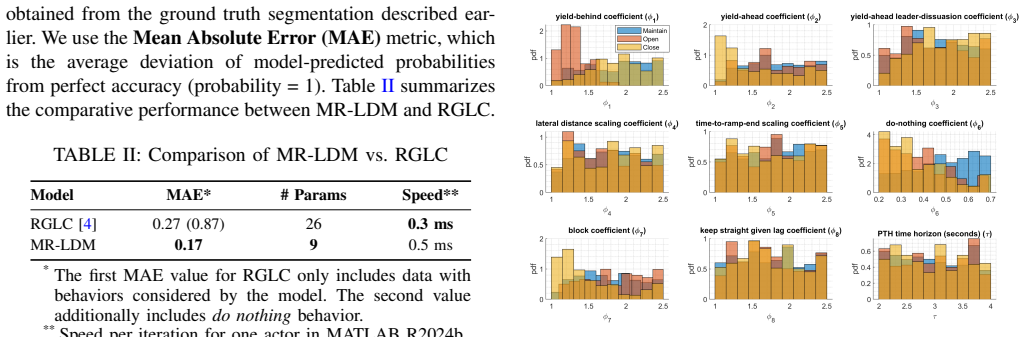
- The lag-specific parameter distributions imply that the payoff parameters encode driver identity; online adaptation of these parameters from a driver's observed behavior is a natural extension that the paper lists as future work, and the calibration pipeline already provides the ingredients.
- PTH assumes constant speed over the prediction horizon; in heavy braking or stop-and-go merge traffic, upgrading the prediction to constant acceleration would be a cheap, testable extension and would probe whether the metric's realism claim extends beyond the calibration data.
Signed reviews
Editorial analysis
A structured set of objections, weighed in public.
Referee Report
Summary. The paper proposes MR-LDM, a game-theoretic decision model for the lag vehicle in highway on-ramp merging scenarios. The model defines four discrete lag actions (yield behind, yield ahead, block, do nothing), uses a bounded Soboleva-type payoff function (usmht), introduces a predictive time headway (PTH) metric, and adds stochasticity via quantal response equilibrium. The model is calibrated on the HOMER dataset using bi-level optimization, compared against the RGLC baseline in terms of mean absolute error, and integrated with MR-IDM dynamics in IPG CarMaker for real-time simulation of a 20-vehicle highway merge scenario. The central claim is that MR-LDM reproduces real-world lag-vehicle decisions more accurately than RGLC with only nine tunable parameters.
Significance. If the validation were sound, the paper would make a useful contribution to interactive traffic simulation for AV testing: the four-action decision set is more complete than prior lag models, the bounded payoff function is interpretable and tunable, PTH is a sensible forward-looking metric, and the real-time integration with a high-fidelity simulator is practically valuable. The strengths are real: the model architecture is clearly specified, the parameter count is genuinely small, and the execution strategy is concrete. However, the current evaluation does not support the central claim of reproducing real-world behavior, because the reported accuracy is an in-sample fit on labels that cannot distinguish two of the four modeled actions. The significance of the empirical comparison is therefore conditional on re-validation with held-out data and an evaluation target that matches the model's action set.
major comments (5)
- [III-C and III-D, Table II] The calibration objective in Section III-C is min sum_k (1 - q_{a_k}), and the reported MAE in Table II is the average of the same quantity (1 - q_{a_k}) over the same observations. No held-out split or cross-validation is described anywhere in Section III. Consequently, the MAE of 0.17 is an in-sample training error and does not demonstrate that the model generalizes to new merge interactions. This is load-bearing for the central claim of reproducing real-world lag-vehicle decisions.
- [III-B and III-D, Table II] The ground-truth segmentation explicitly groups yield-ahead and block into a single 'yield ahead or block' class because both decrease the time gap, and the evaluation resolves the ambiguity by taking the maximum of the model's yield-ahead and block probabilities. This means an observation is counted as correct if the model assigns high probability to either of two behaviors that the labels cannot distinguish. As a result, the payoff parameters phi_2 and phi_7 are not identifiable from the calibration labels, and the reported accuracy cannot support the claim that MR-LDM correctly distinguishes yield-ahead from block. The comparison against RGLC is thus performed on a coarser target than the model's four-action set.
- [Table II and Section III-C] The RGLC comparison is not apples-to-apples. The first RGLC MAE excludes observations with behaviors not considered by that model (i.e., do-nothing), while the MR-LDM value appears to include all observations; the second RGLC value includes do-nothing but is computed on a different label set. Additionally, the 'nine tunable parameters' count omits the decision-window duration t_window in Eq. (10), the bounded-rationality coefficient beta in Eq. (11), and the hand-chosen segmentation thresholds in Section III-B (0.08 s/s rate, 1.0 s total change). The stated advantage 'approximately 10% higher accuracy' is therefore not a controlled comparison of model capability.
- [III-D, Figure 4] The parameter-distribution analysis in Figure 4 is circular with respect to the calibration objective. The lag-specific parameters are fitted to the ground-truth behavior labels, and the figure then groups those fitted parameters by the same labels. The reported 'clear distinctions' (e.g., do-nothing drivers having higher phi_6) are expected consequences of optimizing the parameters to reproduce those labels and do not provide independent evidence that the parameters capture behavioral heterogeneity. No confidence intervals or statistical tests are reported to support the qualitative claims.
- [III-B] The ground-truth segmentation relies on hand-chosen thresholds (minimum average rate of 0.08 s/s and total change of 1.0 s) without any sensitivity analysis. Since these thresholds define the labels used for both calibration and evaluation, the reported MAE depends directly on these arbitrary choices. A sensitivity study over the thresholds, or an alternative label-generation method with clear separation of yield-ahead and block, is needed to establish that the evaluation is robust.
minor comments (6)
- [Section III-D] The phrase 'approximately 10% higher accuracy' is imprecise: the improvement is a 0.10 reduction in MAE (0.27 to 0.17), which is a 37% relative reduction. Please state the metric and relative change explicitly.
- [Eq. (1)] The PTH definition assumes constant velocity over the horizon tau, but tau is later treated as a fitted parameter. Please state this assumption explicitly in the text and clarify whether the fitted tau is shared between the PTH metric and the decision-window formulation.
- [Eq. (2) and shift definition] The definition of shift(x, c, d) as an arg max over x is confusing because the same symbol x is used as the argument of usmht and as the optimization variable. Please rewrite with a dummy variable (e.g., s) and specify the domain over which the arg max is taken.
- [Section IV] In the description of blocking behavior, the parameters a and b are referenced but not defined in this paper; they appear to be MR-IDM acceleration and deceleration parameters. Please define them or point to the MR-IDM reference at the point of use.
- [References [9]--[11]] The Soboleva tangent references are conference/technical reports with minimal bibliographic detail. Please provide DOIs or stable identifiers, or cite a more accessible source for the updated Soboleva function.
- [Figures 2 and 3] Both figures lack axis labels and units. The caption of Figure 3 says the peak is shifted, but the mechanism (the shift function) is not visually evident; please annotate the figures more clearly.
Circularity Check
The reported MAE is the calibration objective evaluated on the same labels, and the label set collapses two of the model's four actions; the central reproducibility claim therefore reduces to an in-sample fit on a coarsened target.
-
fitted input called prediction
[Section III-C (Calibration Procedure) and Section III-D (Results)]
"At the upper level, we optimized the model parameters {ϕ1, . . . , ϕ8, τ} to minimize the deviation between the predicted behavior probabilities and the observed behavior labels. We defined the objective as: min_phi sum_{k=1}^N (1 - q_{a_k}) ... We use the Mean Absolute Error (MAE) metric, which is the average deviation of model-predicted probabilities from perfect accuracy (probability = 1)."
The calibration objective is exactly the sum that MAE averages: MAE = (1/N) sum_k (1 - q_{a_k}). The same observed behavior labels are used for calibration and evaluation, and the paper does not describe a held-out split. Consequently the reported 0.17 MAE is the minimized training criterion, not an independent measure of reproducibility; the fitted quantity is renamed as a predictive validation result.
-
self definitional
[Section III-B (Ground Truth Generation)]
"Although MR-LDM treats yield ahead and block as distinct decisions, our segmentation process could not reliably separate them based on longitudinal data alone. Both behaviors exhibit a decreasing time gap, and without lateral or intent-specific cues, the segmentation algorithm grouped them under a single gap closing behavior. During evaluation, we resolved this ambiguity by taking the highest output probability between yield ahead and block for each gap closing observation."
The ground-truth class 'gap closing' is defined to contain two of the model's four actions, and the evaluation rule counts a gap-closing observation as correct when either of those two model outputs is confident. The accuracy metric is therefore defined partly in terms of the model's own outputs, giving MR-LDM two chances to be correct and making the comparison with RGLC non-commensurate. The calibration labels also cannot identify separate payoff parameters for yield ahead versus block.
full rationale
The paper's modeling contribution—the four-action repeated game with usmht payoffs and the PTH metric—is a substantive modeling choice and is not itself circular. The circularity sits in the empirical validation chain. The upper-level calibration objective min sum(1 - q_{a_k}) is the same function that is later averaged and reported as MAE, and it is evaluated on the same behavior labels used for calibration; the paper describes no held-out split. Thus the headline 'good reproducibility of complex interactions' is an in-sample fit, not an independent prediction. In addition, the ground-truth label set collapses the model's distinct yield-ahead and block actions into one 'gap closing' class, and the evaluation counts the higher of the two corresponding output probabilities as correct, so the reported accuracy is inflated by construction and the comparison with RGLC is not on a common action set. The self-citations to the authors' prior MR-IDM and HOMER work provide the dynamics model and the dataset and are not themselves load-bearing for this circularity. Overall score 7: the central empirical claim reduces to the calibration objective and a deliberately coarsened correctness rule.
Assumptions & free parameters
free parameters (11)
- phi_1 (yield behind payoff shape) =
not reported (distribution plots only)
- phi_2 (yield ahead payoff shape) =
not reported
- phi_3 (leader influence) =
not reported
- phi_4 (lateral scaling) =
not reported
- phi_5 (ramp-end scaling) =
not reported
- phi_6 (do-nothing payoff) =
not reported
- phi_7 (block payoff shape) =
not reported
- phi_8 (MA keep-straight lag gap shape) =
not reported
- tau (prediction horizon) =
not reported
- Ground-truth segmentation thresholds =
+/-0.08 s/s rate; +/-1.0 s total change
- Decision window twindow =
2 s (plus Gaussian noise with std sigma)
assumptions (5)
- domain assumption The merge interaction can be modeled as a two-player, non-cooperative, repeated game with simultaneous moves.
- domain assumption Constant velocity over prediction horizon tau is sufficient for predicting future headway.
- ad hoc to paper The usmht payoff structure with fitted curvature parameters captures driver utility for each action.
- ad hoc to paper Ground-truth behavior labels from time-gap segmentation are valid.
- domain assumption QRE with a single rationality coefficient beta describes human decision noise.
invented entities (2)
-
Predictive Time Headway (PTH)
-
usmht payoff function
Cite this review
Pith. "Pith review of MR-LDM -- The Merge-Reactive Longitudinal Decision Model: Game Theoretic Human Decision Modeling for Interactive Sim Agents." pith.science (2026). https://pith.science/paper/5HXH7RP4
@misc{pith2026250712494,
  author       = {Pith},
  title        = {Pith review of: MR-LDM -- The Merge-Reactive Longitudinal Decision Model: Game Theoretic Human Decision Modeling for Interactive Sim Agents},
  year         = {2026},
  howpublished = {\url{https://pith.science/paper/5HXH7RP4}},
  note         = {Machine review of arXiv:2507.12494}
}
read the original abstract
Enhancing simulation environments to replicate real-world driver behavior, i.e., more humanlike sim agents, is essential for developing autonomous vehicle technology. In the context of highway merging, previous works have studied the operational-level yielding dynamics of lag vehicles in response to a merging car at highway on-ramps. Other works focusing on tactical decision modeling generally consider limited action sets or utilize payoff functions with large parameter sets and limited payoff bounds. In this work, we aim to improve the simulation of the highway merge scenario by targeting a game theoretic model for tactical decision-making with improved payoff functions and lag actions. We couple this with an underlying dynamics model to have a unified decision and dynamics model that can capture merging interactions and simulate more realistic interactions in an explainable and interpretable fashion. The proposed model demonstrated good reproducibility of complex interactions when validated on a real-world dataset. The model was finally integrated into a high fidelity simulation environment and confirmed to have adequate computation time efficiency for use in large-scale simulations to support autonomous vehicle development.
Figures


Figures from the paper (3 more)


Reference graph
Works this paper leans on
-
[1]
D. Holley, J. D’sa, H. N. Mahjoub, G. Ali, B. Chalaki, and E. Moradi- Pari, “MR-IDM - merge reactive intelligent driver model: Towards en- hancing laterally aware car-following models,” in 2023 IEEE 26th In- ternational Conference on Intelligent Transportation Systems (ITSC) , 2023, pp. 1460–1467
work page 2023
-
[2]
M. Treiber, A. Hennecke, and D. Helbing, “Congested traffic states in empirical observations and microscopic simulations, Tech. Rep. 2, 2000
work page 2000
-
[3]
Modeling the lane-change reactions to merging vehicles for highway on-ramp simulations,
D. Holley, J. D’sa, H. N. Mahjoub, G. Ali, T. Naes, E. Moradi-Pari, and P. S. Kallepalli, “Modeling the lane-change reactions to merging vehicles for highway on-ramp simulations,” in 2024 IEEE Intelligent Vehicles Symposium (IV), 2024, pp. 651–658
work page 2024
-
[4]
A Repeated Game Freeway Lane Changing Model,
K. Kang and H. A. Rakha, “A Repeated Game Freeway Lane Changing Model,” Sensors, vol. 20, no. 6, p. 1554, Mar. 2020. [Online]. Available: https://www.mdpi.com/1424-8220/20/6/1554
work page 2020
-
[5]
A game-theory-based approach to modeling lane-changing interactions on highway on-ramps: Considering the bounded rationality of drivers,
W. Chen, G. Ren, Q. Cao, J. Song, Y . Liu, and C. Dong, “A game-theory-based approach to modeling lane-changing interactions on highway on-ramps: Considering the bounded rationality of drivers,” Mathematics, vol. 11, no. 2, p. 402, 2023
2023
-
[6]
Y . Ali, Z. Zheng, M. M. Haque, and M. Wang, “A game theory-based approach for modelling mandatory lane-changing behaviour in a connected environment,” Transportation Research Part C: Emerging Technologies, vol. 106, pp. 220–242, 2019. [Online]. Available: https: //www.sciencedirect.com/science/article/pii/S0968090X19302244
work page 2019
-
[7]
A Stackelberg Game Theoretic Model of Lane-Merging,
J. Yoo and R. Langari, “A Stackelberg Game Theoretic Model of Lane-Merging,” 2020
work page 2020
-
[8]
Lane-Merging Strategy for a Self-Driving Car in Dense Traffic Using the Stackelberg Game Approach,
K. Ji, M. Orsag, and K. Han, “Lane-Merging Strategy for a Self-Driving Car in Dense Traffic Using the Stackelberg Game Approach,” Electronics, vol. 10, no. 8, p. 894, Apr. 2021. [Online]. Available: https://www.mdpi.com/2079-9292/10/8/894
work page 2021
Show all 13 references
-
[9]
The utility function in prob- lems of structural optimization of distributed objects,
E. V . Soboleva and V . V . Beskorovainyi, “The utility function in prob- lems of structural optimization of distributed objects,” Ivan Kozhedub Kharkiv University of Air Forces , p. 121, Apr. 2008
2008
-
[10]
The s-shaped utility function of individual criteria for multi-objective decision-making in design,
E. V . Soboleva, “The s-shaped utility function of individual criteria for multi-objective decision-making in design,” Kharkiv National University of Radioelectroniks , p. 247, 2009
2009
-
[11]
Identification of utility func- tions in multi-objective choice modelling by using s-shaped functions,
V . V . Beskorovainyi and E. V . Soboleva, “Identification of utility func- tions in multi-objective choice modelling by using s-shaped functions,” Kharkiv National University of Radioelectroniks , vol. 72, no. 1, pp. 50–54, 2010
2010
-
[12]
Smoothing and differentiation of data by simplified least squares procedures
A. Savitzky and M. J. Golay, “Smoothing and differentiation of data by simplified least squares procedures.” Analytical chemistry, vol. 36, no. 8, pp. 1627–1639, 1964
1964
-
[13]
(2023) MultiStart: Find multiple local minima
MathWorks. (2023) MultiStart: Find multiple local minima. [Online]. Available: https://www.mathworks.com/help/gads/multistart.html
2023
Reviewed August 6, 2026 · model on record in the stance chip above.
Discussion (0). Continue with ORCID to comment.