REVIEW 3 major objections 6 minor 59 references
Learning Hemodynamic Scalar Fields on Coronary Artery Meshes: A Benchmark of Geometric Deep Learning Models
T0 review · 3 major / 6 minor · reviewed 2026-08-10 · deepseek-v4-flash
Pith's one-line read This paper claims that transformer-based geometric deep learning models, in particular LaB-GATr, are the only backends that generalize to patient-specific coronary artery meshes for predicting pressure-derived vFFR fields, and that…
desk verdict Useful benchmark with a solid synthetic study, but the patient-specific split is unspecified and the 'only transformers' claim is overstated. read the letter →
The pith
A machine-rendered reading of the paper's core claim, the machinery that carries it, and where it could break.
The reading
What carries the argument
The enabling setup is surface-only training: under an assumption of laminar, developed flow, pressure is taken as constant across each vessel cross-section, so the wall mesh carries all information needed for pressure, pressure drop, and vFFR fields. Each mesh vertex is assigned 28 input features that combine geometric descriptors (surface normal, geodesic distance to the inlet, centerline radius and tangent, Laplacian eigenvectors, heat and wave kernel signatures) with physical boundary conditions (inflow rate, inlet pressure, CFD node type). The decisive component for patient data is the transformer backend: LaB-GATr compresses the mesh through cross-attention to a coarse token set and interpolates back, giving each output vertex global context that local-convolution models such as DiffusionNet, DeltaConv, and PointNet++ lack.
What would settle it
Run the same six backends on stenotic patient-specific meshes while also computing the CFD pressure difference between the vessel wall and the centerline in the lesion; if that wall-to-centerline difference exceeds the few-Pa error the paper reports, or if wall-only vFFR diverges from volumetric vFFR in the cases LaB-GATr misses, the surface-only premise rather than the architectures is the bottleneck.
Extended reading notes
Core claim
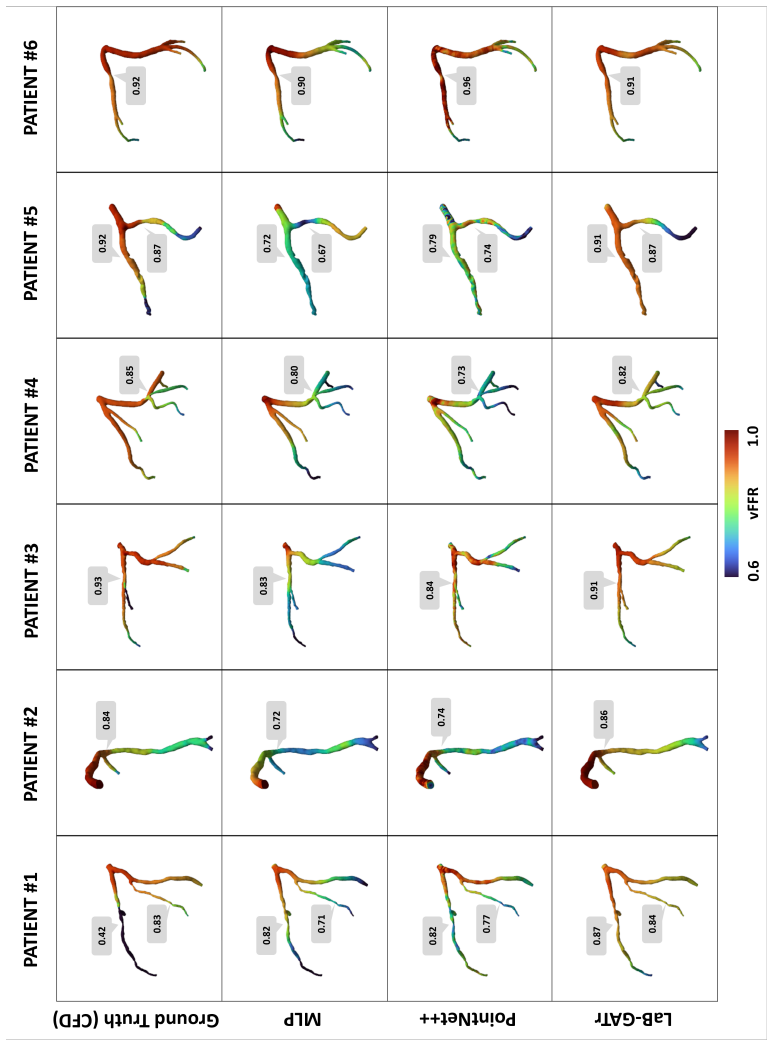
On the paper's own terms, the central discovery is that architecture choice determines whether learned hemodynamics transfer from synthetic to patient-specific anatomies. In the synthetic benchmark, several backends reached good accuracy, and pressure drop was consistently the best training target for all of them. On 427 patient-specific CFD runs, however, only LaB-GATr—a geometric algebra transformer for large biomedical meshes—achieved strong per-point accuracy and diagnostic vFFR accuracy in stenotic lesions, with the smallest bias (0.004 in stenotic-region vFFR) and the highest accuracy (0.79). The paper interprets this as evidence that global-context aggregation, which transformers provide, is what is needed for topologically complex and heterogeneous datasets.
Load-bearing premise
The load-bearing premise is that pressure is constant across each vessel cross-section under laminar, developed flow, which justifies training only on surface meshes; if stenotic or recirculating flow breaks that uniformity, every model loses information that the CFD ground truth contains.
Editorial extensions
If this is right
- Machine-learning vFFR can be produced in under two minutes per case, compared with 30 to 60 minutes of steady-state CFD, if feature precomputation and inference are as fast as reported.
- On simple bifurcation geometries, a range of backends can replace CFD for pressure-related fields, so model choice matters less in that regime.
- New work in this area should default to pressure drop as the network output, with inlet pressure supplied as an input feature, rather than predicting absolute pressure or vFFR directly.
- For patient-specific coronary anatomies, transformer-based backends, and specifically LaB-GATr, are the models to use if the goal is accurate stenosis-level vFFR.
- The essential input features are surface normals, geodesics, vessel radius, inflow, and inlet pressure; spectral descriptors add little once these are present.
Reading between the lines
- An implication the authors do not develop is that the surface-only premise could be stress-tested by comparing wall and centerline CFD pressures in the exact lesions where LaB-GATr still fails; that would separate architecture limits from modeling limits.
- A testable extension is to retrain LaB-GATr on a larger multi-center cohort and validate against invasive FFR rather than CFD, since the benchmark's ground truth is itself simulated.
- The conclusion that global-context transformers are needed on heterogeneous topologies plausibly transfers to other surface hemodynamic fields such as wall shear stress, but that is an extrapolation beyond the pressure-related fields this paper measures.
- Because the ablation found a small feature subset matching the full set, the clinical pipeline could be simplified by dropping spectral descriptors, potentially reducing preprocessing time and sensitivity to mesh discretization.
Signed reviews
Editorial analysis
A structured set of objections, weighed in public.
Referee Report
Summary. The paper presents a benchmark of six geometric deep learning backends (MLP, PointNet++, DiffusionNet, DeltaConv, LaB-VaTr, and LaB-GATr) for predicting pressure-related scalar fields on coronary artery surface meshes, using steady-state CFD solutions as ground truth. Two experiments are reported: a synthetic dataset of 1,500 left-coronary bifurcations, where models are trained to predict pressure, pressure drop, or vFFR directly; and a patient-specific dataset of 427 CFD simulations from 105 anatomies, where models are trained only on the pressure-drop output. The main claims are that pressure drop is the optimal learning variable, that transformer-based architectures (specifically LaB-GATr) are the only models achieving strong performance on patient-specific data, and that GDL surrogates can estimate vFFR in under two minutes per case. An ablation study on input features is included, identifying surface normals, geodesics, vessel radius, inflow, and inlet pressure as important.
Significance. If the central claims hold, the paper provides a useful empirical comparison for an application of practical interest: replacing expensive patient-specific CFD with learned surrogates for vFFR estimation. The benchmark is systematic in its control of input features, model sizes, and evaluation metrics, and the synthetic-dataset portion is large and well-defined. A notable strength is that all models are trained and evaluated on the same held-out CFD fields, making the comparison internally fair. The patient-specific results are, however, the load-bearing part of the paper, and they are currently undermined by an undocumented split and the absence of statistical testing. In addition, the selection of the pressure-drop output is not fully consistent with the reported synthetic-dataset metrics. These issues are fixable within the manuscript's scope, but they need to be addressed before the conclusions can be accepted.
major comments (3)
- [Section 2.1.2 and Section 2.4] The patient-specific dataset comprises 427 CFD simulations from 105 anatomies, with 3–5 runs per anatomy, but the manuscript never describes how these runs are split into training, validation, and test sets. If the split is performed at the simulation level, the same coronary anatomy appears in both training and test, and the geometry-derived input features listed in Table 2 (normals, geodesics, centerline radius, spectral descriptors) allow the model to memorize an anatomy and interpolate among its boundary-condition variants rather than to learn a surrogate that generalizes to unseen patients. Because the central claim is generalization to patient-specific anatomies, the split must be at the patient level, i.e., all CFD runs of a single geometry should be kept in the same fold. Please state the exact split (number of patients per fold) and, if the initial analysis was simulation-level, re-run the experiments with a patient-level split and report the revised Tables 6 and 7.
- [Section 3.2, Tables 6 and 7] The claim that 'transformer-based architectures were the only ones to achieve strong performance' is not supported by the reported metrics alone. DiffusionNet (S) achieves a correlation of 0.72 in Table 7, which is higher than LaB-GATr (S)'s 0.69, and its accuracy of 0.71 is close to LaB-GATr's 0.79; LaB-GATr is better on per-point difference and bias, but the differences are small relative to the reported standard deviations. No paired significance tests, confidence intervals, or per-patient/per-lesion analyses are provided, and pointwise metrics over meshes contain thousands of spatially correlated vertices, so visual inspection of Figure 6 is not a substitute. Please add paired statistical comparisons (e.g., bootstrap or Wilcoxon tests with the patient as the unit of analysis) and revise the 'only' claim in accordance with the results.
- [Section 2.4.2 and Tables 4–5] The choice of pressure drop as the best output variable is not fully supported by the synthetic-dataset results. In Table 5, LaB-GATr trained to predict vFFR directly attains a per-point difference of 2.28E-04 and an approximation disparity of 5.40E-04 for the S variant, which is an order of magnitude better than the corresponding pressure-drop results in Table 4 (4.39E-03 and 4.97E-03). The paper's own Section 4.4 acknowledges that the superiority of pressure drop may not transfer to patient-specific data. The criterion used to select the output variable should be stated explicitly (e.g., average performance across all backends, training stability, or a defined composite metric) and applied consistently; as written, the selection procedure conflicts with the quantitative results for the best-performing model and weakens the third claimed contribution.
minor comments (6)
- [Section 2] The assumption that pressure is constant on the vessel cross-section justifies training exclusively on surface meshes. Since the target is wall pressure, this assumption is not fatal for the benchmark, but it would be helpful to add an empirical check on the CFD data (e.g., comparing wall and interior pressures in stenotic regions) to quantify its validity.
- [Section 2.5] The text states that 'All statistical tests were conducted in Python using the SciPy library,' but no statistical test results are reported anywhere in the manuscript. Please either add the significance tests or remove this sentence.
- [Section 3.2 and Figure 6] The text says 'Figure 6 shows for each model (rows) the reconstructed vFFR field for 6 cases,' but Figure 6 displays only three models. Please make the number of displayed models explicit and consistent between text and figure caption.
- [Section 3.2] The sentence 'DiffusionNet (S-variant) yielded the highest correlation coefficient (0.72), and together with LaB-GATr (S-variant) was the only model to achieve an accuracy above 0.7' should read 'the only models' because two models satisfy this condition.
- [Section 2.2.2] In Eq. (1), the notation r_{i-j} for the relative position is ambiguous; define it explicitly as the difference of coordinate vectors, e.g., r_i - r_j.
- [Section 4.1] The discussion of why pressure drop is preferable (homogeneity across patients, zero value at the ostium) is reasonable, but it is a post hoc explanation; a quantitative comparison of the target distributions (e.g., variance of pressure drop vs. pressure across the training set) would make the argument more concrete.
Circularity Check
No significant circularity: the benchmark is an empirical supervised-learning comparison evaluated on held-out CFD fields; the only mild issue is an acknowledged transfer of the pressure-drop output choice from synthetic to patient data without re-testing alternatives.
full rationale
The paper makes no derivational claim that reduces to its own inputs. Models are trained on CFD-computed pressure-related fields and evaluated on held-out CFD fields; the target quantities (pressure drop, vFFR) are not encoded in the input feature vector in a way that forces the output. The surface-constancy assumption in Section 2 is a physical modeling premise, not a circular step. Self-citations to the authors' previous CFD pipeline [22], LaB-GATr architecture [36], and approximation disparity metric [54] supply data and tooling but are not invoked as a uniqueness theorem or as a substitute for the benchmark; the CFD pipeline was previously validated against invasive FFR, which is an external benchmark. The one mild issue is output-variable selection: pressure drop was chosen on the synthetic dataset and then used exclusively for patient-specific experiments, as stated in Section 2.4: 'For the patient-specific dataset, we only trained models using pressure drop as a target variable.' Thus the claim that pressure drop is also optimal for patient data is not independently tested there. The authors explicitly acknowledge this in Section 4.4: 'we cannot definitively conclude that the pressure drop, which yielded the best results as the network's output variable in experiments on the synthetic dataset, exhibits the same behavior when applied to real-life patient anatomies.' That is an honest limitation and a selection/correctness concern, not a circular reduction. Separately, Section 2.1.2 reports 3-5 CFD runs per patient geometry without stating whether the train/test split was patient-level or simulation-level, which could affect the generalization claim; this is a data-leakage/correctness risk, not a circularity of definition. No equation in the paper is equivalent to its input by construction, and no fitted parameter is renamed as a prediction.
Assumptions & free parameters
free parameters (3)
- Target standardization mean and standard deviation =
computed from training dataset
- Training hyperparameters (learning rate, decay, epochs, batch size) =
3e-4, 0.987, 500, 2
- Architecture-specific downsampling and compression ratios =
0.05 to 0.90 depending on backend
assumptions (4)
- domain assumption Steady, laminar, incompressible flow with pressure constant across each vessel cross-section, so the surface mesh suffices
- domain assumption CFD solutions are a valid ground truth for FFR
- domain assumption Aortic pressure approximates coronary ostium pressure and is used as input pin
- domain assumption Randomly sampled boundary conditions in physiological ranges cover the clinically relevant distribution
Cite this review
Pith. "Pith review of Learning Hemodynamic Scalar Fields on Coronary Artery Meshes: A Benchmark of Geometric Deep Learning Models." pith.science (2026). https://pith.science/paper/5I2CLLD5
@misc{pith2026250109046,
  author       = {Pith},
  title        = {Pith review of: Learning Hemodynamic Scalar Fields on Coronary Artery Meshes: A Benchmark of Geometric Deep Learning Models},
  year         = {2026},
  howpublished = {\url{https://pith.science/paper/5I2CLLD5}},
  note         = {Machine review of arXiv:2501.09046}
}
read the original abstract
Coronary artery disease, caused by the narrowing of coronary vessels due to atherosclerosis, is the leading cause of death worldwide. The diagnostic gold standard, fractional flow reserve (FFR), measures the trans-stenotic pressure ratio during maximal vasodilation but is invasive and costly. This has driven the development of virtual FFR (vFFR) using computational fluid dynamics (CFD) to simulate coronary flow. Geometric deep learning algorithms have shown promise for learning features on meshes, including cardiovascular research applications. This study empirically analyzes various backends for predicting vFFR fields in coronary arteries as CFD surrogates, comparing six backends for learning hemodynamics on meshes using CFD solutions as ground truth. The study has two parts: i) Using 1,500 synthetic left coronary artery bifurcations, models were trained to predict pressure-related fields for vFFR reconstruction, comparing different learning variables. ii) Using 427 patient-specific CFD simulations, experiments were repeated focusing on the best-performing learning variable from the synthetic dataset. Most backends performed well on the synthetic dataset, especially when predicting pressure drop over the manifold. Transformer-based backends outperformed others when predicting pressure and vFFR fields and were the only models achieving strong performance on patient-specific data, excelling in both average per-point error and vFFR accuracy in stenotic lesions. These results suggest geometric deep learning backends can effectively replace CFD for simple geometries, while transformer-based networks are superior for complex, heterogeneous datasets. Pressure drop was identified as the optimal network output for learning pressure-related fields.
Figures


Figures from the paper (3 more)


Reference graph
Works this paper leans on
-
[1]
K. Okrainec, D. K. Banerjee, M. J. Eisenberg, Coronary artery disease in the developing world, American heart journal 148 (1) (2004) 7–15
work page 2004
- [2]
-
[3]
N. H. Pijls, B. Van Gelder, P. Van der V oort, K. Peels, F. A. Bracke, H. J. Bonnier, M. I. El Gamal, Fractional flow reserve: a useful index to evaluate the influence of an epicardial coronary stenosis on myocardial blood flow, Circulation 92 (11) (1995) 3183–3193
work page 1995
-
[4]
N. H. Pijls, J.-W. E. Sels, Functional measurement of coronary stenosis, Journal of the American College of Cardi- ology 59 (12) (2012) 1045–1057
work page 2012
-
[5]
L. X. van Nunen, F. M. Zimmermann, P. A. Tonino, E. Barbato, A. Baumbach, T. Engstrøm, V . Klauss, P. A. MacCarthy, G. Manoharan, K. G. Oldroyd, et al., Fractional flow reserve versus angiography for guidance of pci in patients with multivessel coronary artery disease (fame): 5-year follow-up of a randomised controlled trial, The Lancet 386 (10006) (2015)...
work page 2015
-
[6]
B.-K. Koo, A. Erglis, J.-H. Doh, D. V . Daniels, S. Jegere, H.-S. Kim, A. Dunning, T. DeFrance, A. Lansky, J. Leip- sic, et al., Diagnosis of ischemia-causing coronary stenoses by noninvasive fractional flow reserve computed from coronary computed tomographic angiograms: results from the prospective multicenter discover-flow (diagnosis of ischemia-causing...
work page 2011
-
[7]
B. L. Nørgaard, J. Leipsic, S. Gaur, S. Seneviratne, B. S. Ko, H. Ito, J. M. Jensen, L. Mauri, B. De Bruyne, H. Bezerra, et al., Diagnostic performance of noninvasive fractional flow reserve derived from coronary computed tomography angiography in suspected coronary artery disease: the nxt trial (analysis of coronary blood flow using ct angiography: Next ...
work page 2014
-
[8]
P. A. Tonino, B. De Bruyne, N. H. Pijls, U. Siebert, F. Ikeno, M. vant Veer, V . Klauss, G. Manoharan, T. Engstrøm, K. G. Oldroyd, et al., Fractional flow reserve versus angiography for guiding percutaneous coronary intervention, New England Journal of Medicine 360 (3) (2009) 213–224
work page 2009
Show all 59 references
-
[9]
F. M. Zimmermann, A. Ferrara, N. P. Johnson, L. X. Van Nunen, J. Escaned, P. Albertsson, R. Erbel, V . Legrand, H.-C. Gwon, W. S. Remkes, et al., Deferral vs. performance of percutaneous coronary intervention of functionally non-significant coronary stenosis: 15-year follow-up...
2015
-
[10]
C. A. Taylor, T. A. Fonte, J. K. Min, Computational fluid dynamics applied to cardiac computed tomography for noninvasive quantification of fractional flow reserve: scientific basis, Journal of the American College of Cardiol- ogy 61 (22) (2013) 2233–2241
2013
-
[11]
Coenen, M
A. Coenen, M. M. Lubbers, A. Kurata, A. Kono, A. Dedic, R. G. Chelu, M. L. Dijkshoorn, F. J. Gijsen, M. Ouhlous, R.-J. M. van Geuns, et al., Fractional flow reserve computed from noninvasive ct angiography data: diagnostic performance of an on-site clinician-operated computati...
2015
-
[12]
C. K. Zarins, C. A. Taylor, J. K. Min, Computed fractional flow reserve ( fft ct) derived from coronary ct angiogra- phy, Journal of cardiovascular translational research 6 (2013) 708–714
2013
-
[13]
Candreva, G
A. Candreva, G. De Nisco, M. L. Rizzini, F. D’Ascenzo, G. M. De Ferrari, D. Gallo, U. Morbiducci, C. Chiastra, Current and future applications of computational fluid dynamics in coronary artery disease, Reviews in Cardiovas- cular Medicine 23 (11) (2022) 377
2022
-
[14]
Zhong, J.-M
L. Zhong, J.-M. Zhang, B. Su, R. S. Tan, J. C. Allen, G. S. Kassab, Application of patient-specific computational fluid dynamics in coronary and intra-cardiac flow simulations: Challenges and opportunities, Frontiers in physiol- ogy 9 (2018) 742
2018
-
[15]
Bezerra, P
C. Bezerra, P. A. Lemos, F. A. Pinton, L. M ¨uller, C. Bulant, G. M. Talou, R. A. Feij ´oo, A. E. Filh Esteves, P. Blanco, Tct-619 comparison of one-dimensional (1d) and three-dimensional (3d) models for the estimation of coronary fractional flow reserve through cardiovascular...
2018
-
[16]
Boileau, S
E. Boileau, S. Pant, C. Roobottom, I. Sazonov, J. Deng, X. Xie, P. Nithiarasu, Estimating the accuracy of a reduced- order model for the calculation of fractional flow reserve ( ffr), International journal for numerical methods in biomedical engineering 34 (1) (2018) e2908
2018
-
[17]
L. Itu, P. Sharma, V . Mihalef, A. Kamen, C. Suciu, D. Lomaniciu, A patient-specific reduced-order model for coronary circulation, in: 2012 9th IEEE international symposium on biomedical imaging (ISBI), IEEE, 2012, pp. 832–835
2012
-
[18]
Grande Guti ´errez, T
N. Grande Guti ´errez, T. Sinno, S. L. Diamond, A 1d–3d hybrid model of patient-specific coronary hemodynamics, Cardiovascular Engineering and Technology (2022) 1–12
2022
-
[19]
M. R. Pfaller, J. Pham, A. Verma, L. Pegolotti, N. M. Wilson, D. W. Parker, W. Yang, A. L. Marsden, Automated generation of 0d and 1d reduced-order models of patient-specific blood flow, International journal for numerical methods in biomedical engineering 38 (10) (2022) e3639
2022
-
[20]
Sankaran, H
S. Sankaran, H. J. Kim, G. Choi, C. A. Taylor, Uncertainty quantification in coronary blood flow simulations: impact of geometry, boundary conditions and blood viscosity, Journal of biomechanics 49 (12) (2016) 2540–2547
2016
-
[21]
Valen-Sendstad, A
K. Valen-Sendstad, A. W. Bergersen, Y . Shimogonya, L. Goubergrits, J. Bruening, J. Pallares, S. Cito, S. Piskin, K. Pekkan, A. J. Geers, et al., Real-world variability in the prediction of intracranial aneurysm wall shear stress: the 2015 international aneurysm cfd challenge,...
2018
-
[22]
Nannini, S
G. Nannini, S. Saitta, L. Mariani, R. Maragna, A. Baggiano, S. Mushtaq, G. Pontone, A. Redaelli, An automated and time-efficient framework for simulation of coronary blood flow under steady and pulsatile conditions, Computer Methods and Programs in Biomedicine 257 (2024) 108415
2024
-
[23]
Nannini, S
G. Nannini, S. Saitta, A. Baggiano, R. Maragna, S. Mushtaq, G. Pontone, A. Redaelli, A fully automated deep learning approach for coronary artery segmentation and comprehensive characterization, APL bioengineering 8 (1) (2024)
2024
-
[24]
Gu, X.-C
L. Gu, X.-C. Cai, Fusing 2d and 3d convolutional neural networks for the segmentation of aorta and coronary arteries from ct images, Artificial Intelligence in Medicine 121 (2021) 102189. 18
2021
-
[25]
Gharleghi, D
R. Gharleghi, D. Adikari, K. Ellenberger, S.-Y . Ooi, C. Ellis, C.-M. Chen, R. Gao, Y . He, R. Hussain, C.-Y . Lee, et al., Automated segmentation of normal and diseased coronary arteries–the asoca challenge, Computerized Medical Imaging and Graphics 97 (2022) 102049
2022
-
[26]
Saitta, F
S. Saitta, F. Sturla, A. Caimi, A. Riva, M. C. Palumbo, G. Nano, E. V otta, A. D. Corte, M. Glauber, D. Chiappino, et al., A deep learning-based and fully automated pipeline for thoracic aorta geometric analysis and planning for endovascular repair from computed tomography, Jo...
2022
-
[27]
Alblas, J
D. Alblas, J. Suk, C. Brune, K. K. Yeung, J. M. Wolterink, Sire: scale-invariant, rotation-equivariant estimation of artery orientations using graph neural networks, arXiv preprint arXiv:2311.05400 (2023)
2023 arXiv
-
[28]
L. Itu, S. Rapaka, T. Passerini, B. Georgescu, C. Schwemmer, M. Schoebinger, T. Flohr, P. Sharma, D. Comaniciu, A machine-learning approach for computation of fractional flow reserve from coronary computed tomography, Journal of applied physiology 121 (1) (2016) 42–52
2016
-
[29]
Su, J.-M
B. Su, J.-M. Zhang, H. Zou, D. Ghista, T. T. Le, C. Chin, Generating wall shear stress for coronary artery in real- time using neural networks: Feasibility and initial results based on idealized models, Computers in biology and medicine 126 (2020) 104038
2020
-
[30]
M. M. Bronstein, J. Bruna, Y . LeCun, A. Szlam, P. Vandergheynst, Geometric deep learning: going beyond eu- clidean data, IEEE Signal Processing Magazine 34 (4) (2017) 18–42
2017
-
[31]
M. M. Bronstein, J. Bruna, T. Cohen, P. Veli ˇckovi´c, Geometric deep learning: Grids, groups, graphs, geodesics, and gauges, arXiv preprint arXiv:2104.13478 (2021)
2021 arXiv
-
[32]
Rygiel, P
P. Rygiel, P. Pluszka, M. Zieba, T. Konopczynski, Centerlinepointnet++: A new point cloud based architecture for coronary artery pressure drop and vffr estimation, in: International Conference on Medical Image Computing and Computer-Assisted Intervention, Springer, 2023, pp. 781–790
2023
-
[33]
S. Wang, D. Wu, G. Li, Z. Zhang, W. Xiao, R. Li, A. Qiao, L. Jin, H. Liu, Deep learning-based hemodynamic pre- diction of carotid artery stenosis before and after surgical treatments, Frontiers in Physiology 13 (2023) 1094743
2023
-
[34]
Zhang, B
X. Zhang, B. Mao, Y . Che, J. Kang, M. Luo, A. Qiao, Y . Liu, H. Anzai, M. Ohta, Y . Guo, et al., Physics-informed neural networks (pinns) for 4d hemodynamics prediction: an investigation of optimal framework based on vascular morphology, Computers in Biology and Medicine 164 ...
2023
-
[35]
J. Suk, C. Brune, J. M. Wolterink, Se (3) symmetry lets graph neural networks learn arterial velocity estimation from small datasets, in: International Conference on Functional Imaging and Modeling of the Heart, Springer, 2023, pp. 445–454
2023
-
[36]
J. Suk, B. Imre, J. M. Wolterink, Lab-gatr: geometric algebra transformers for large biomedical surface and volume meshes, in: International Conference on Medical Image Computing and Computer-Assisted Intervention, Springer, 2024, pp. 185–195
2024
-
[37]
Brehmer, P
J. Brehmer, P. De Haan, S. Behrends, T. S. Cohen, Geometric algebra transformer, Advances in Neural Information Processing Systems 36 (2024)
2024
-
[38]
Pegolotti, M
L. Pegolotti, M. R. Pfaller, N. L. Rubio, K. Ding, R. B. Brufau, E. Darve, A. L. Marsden, Learning reduced-order models for cardiovascular simulations with graph neural networks, Computers in Biology and Medicine 168 (2024) 107676
2024
-
[39]
Gharleghi, A
R. Gharleghi, A. Sowmya, S. Beier, Transient wall shear stress estimation in coronary bifurcations using convolu- tional neural networks, Computer Methods and Programs in Biomedicine 225 (2022) 107013
2022
-
[40]
C. R. Qi, H. Su, K. Mo, L. J. Guibas, Pointnet: Deep learning on point sets for 3d classification and segmentation, in: Proceedings of the IEEE conference on computer vision and pattern recognition, 2017, pp. 652–660
2017
-
[41]
Sharp, S
N. Sharp, S. Attaiki, K. Crane, M. Ovsjanikov, Di ffusionnet: Discretization agnostic learning on surfaces, ACM Transactions on Graphics (TOG) 41 (3) (2022) 1–16
2022
-
[42]
Wiersma, A
R. Wiersma, A. Nasikun, E. Eisemann, K. Hildebrandt, Deltaconv: anisotropic operators for geometric deep learn- ing on point clouds, ACM Transactions on Graphics (TOG) 41 (4) (2022) 1–10
2022
-
[43]
Updegrove, N
A. Updegrove, N. M. Wilson, J. Merkow, H. Lan, A. L. Marsden, S. C. Shadden, Simvascular: an open source pipeline for cardiovascular simulation, Annals of biomedical engineering 45 (2017) 525–541
2017
-
[44]
Fedorov, R
A. Fedorov, R. Beichel, J. Kalpathy-Cramer, J. Finet, J.-C. Fillion-Robin, S. Pujol, C. Bauer, D. Jennings, F. Fen- nessy, M. Sonka, et al., 3d slicer as an image computing platform for the quantitative imaging network, Magnetic resonance imaging 30 (9) (2012) 1323–1341
2012
-
[45]
Pontone, S
G. Pontone, S. Moharem-Elgamal, P. Maurovich-Horvat, O. Gaemperli, F. Pugliese, D. reviewers, M. Westwood, A. Stefanidis, K. F. Fox, B. A. Popescu, Training in cardiac computed tomography: Eacvi certification process, European Heart Journal-Cardiovascular Imaging 19 (2) (2018) 123–126
2018
-
[46]
Paszke, S
A. Paszke, S. Gross, F. Massa, A. Lerer, J. Bradbury, G. Chanan, T. Killeen, Z. Lin, N. Gimelshein, L. Antiga, et al., Pytorch: An imperative style, high-performance deep learning library, Advances in neural information processing systems 32 (2019)
2019
-
[47]
M. Fey, J. E. Lenssen, Fast graph representation learning with pytorch geometric, arXiv preprint arXiv:1903.02428 (2019)
2019 arXiv
-
[48]
Io ffe, Batch normalization: Accelerating deep network training by reducing internal covariate shift, arXiv 19 preprint arXiv:1502.03167 (2015)
S. Io ffe, Batch normalization: Accelerating deep network training by reducing internal covariate shift, arXiv 19 preprint arXiv:1502.03167 (2015)
2015 arXiv
-
[49]
Xu, Empirical evaluation of rectified activations in convolutional network, arXiv preprint arXiv:1505.00853 (2015)
B. Xu, Empirical evaluation of rectified activations in convolutional network, arXiv preprint arXiv:1505.00853 (2015)
2015 arXiv
-
[50]
Piccinelli, A
M. Piccinelli, A. Veneziani, D. A. Steinman, A. Remuzzi, L. Antiga, A framework for geometric analysis of vascular structures: application to cerebral aneurysms, IEEE transactions on medical imaging 28 (8) (2009) 1141– 1155
2009
-
[51]
B. L ´evy, Laplace-beltrami eigenfunctions towards an algorithm that” understands” geometry, in: IEEE International Conference on Shape Modeling and Applications 2006 (SMI’06), IEEE, 2006, pp. 13–13
2006
-
[52]
J. Sun, M. Ovsjanikov, L. Guibas, A concise and provably informative multi-scale signature based on heat diffusion, in: Computer graphics forum, V ol. 28, Wiley Online Library, 2009, pp. 1383–1392
2009
-
[53]
Aubry, U
M. Aubry, U. Schlickewei, D. Cremers, The wave kernel signature: A quantum mechanical approach to shape analysis, in: 2011 IEEE international conference on computer vision workshops (ICCV workshops), IEEE, 2011, pp. 1626–1633
2011
-
[54]
J. Suk, G. Nannini, P. Rygiel, C. Brune, G. Pontone, A. Redaelli, J. M. Wolterink, Deep vectorised operators for pulsatile hemodynamics estimation in coronary arteries from a steady-state prior, arXiv preprint arXiv:2410.11920 (2024)
2024 arXiv
-
[55]
Virtanen, R
P. Virtanen, R. Gommers, T. E. Oliphant, M. Haberland, T. Reddy, D. Cournapeau, E. Burovski, P. Peterson, W. Weckesser, J. Bright, et al., Scipy 1.0: fundamental algorithms for scientific computing in python, Nature methods 17 (3) (2020) 261–272
2020
-
[56]
J. Suk, P. de Haan, P. Lippe, C. Brune, J. M. Wolterink, Mesh neural networks for se (3)-equivariant hemodynamics estimation on the artery wall, Computers in Biology and Medicine 173 (2024) 108328
2024
-
[57]
H. Yang, B. K. Nallamothu, C. A. Figueroa, K. Garikipati, Attention-based multi-fidelity machine learning model for fractional flow reserve assessment, Computer Methods in Applied Mechanics and Engineering 432 (2024) 117338
2024
-
[58]
Vaswani, Attention is all you need, Advances in Neural Information Processing Systems (2017)
A. Vaswani, Attention is all you need, Advances in Neural Information Processing Systems (2017)
2017
-
[59]
Ronneberger, P
O. Ronneberger, P. Fischer, T. Brox, U-net: Convolutional networks for biomedical image segmentation, in: Med- ical image computing and computer-assisted intervention–MICCAI 2015: 18th international conference, Munich, Germany, October 5-9, 2015, proceedings, part III 18, Spri...
2015
Reviewed August 10, 2026 · model on record in the stance chip above.
Discussion (0). Continue with ORCID to comment.