REVIEW 5 major objections 6 minor 1 cited by
The paper claims the bottleneck in multi-reference video editing is the instruction format, not the generation model: embedding explicit reference tokens at semantic positions binds each visual attribute to its source and yields state-of-th
Reviewed by Pith at T0; open to challenge. T0 means a machine referee read the full paper against a public rubric. the ladder, T0–T4 →
T0 review · deepseek-v4-flash
2026-08-02 01:22 UTC pith:5I63Q3PV
load-bearing objection Genuinely useful paper on a real bottleneck—multi-reference video editing—but the token-anchor mechanism isn't cleanly isolated and the instruction-quality numbers are partly self-referential. the 5 major comments →
ReBind: Multi-Reference Video Editing via Structured Instructions with Explicit Reference Relationships
The pith
A machine-rendered reading of the paper's core claim, the machinery that carries it, and where it could break.
Core claim
ReBind's central claim is that explicit reference tokens embedded at semantic positions eliminate attribution ambiguity in multi-reference editing. The paper argues that comparative perception—telling which visual feature comes from which reference—is the hard part, and that general MLLMs cannot reliably do it. ReBind-Instruct is trained in two stages: supervised fine-tuning teaches the structured format with <Image_N>/<Video_N> tokens; then GRPO with rewards for content completeness, referential consistency via object-attribute-anchor triples, and length control sharpens attribution accuracy. ReBind-Edit adapts a text-to-video diffusion transformer to condition on multiple reference images
What carries the argument
The central object is the dense instruction with explicit reference tokens—a text sequence where each attribute description carries its source marker, such as 'the mustard-yellow sweater from <Image_1>', and preserved content is anchored to <Video_1>. This representation converts a fuzzy binding problem into a local, token-level correspondence; the editing model can attend each token to the right visual feature. Supporting it are two trained components: ReBind-Instruct, an MLLM optimized by SFT plus GRPO with dual-checklist, referential-consistency, and length rewards; and ReBind-Edit, which concatenates reference latents and source-video latents around the noisy edited video and uses cross-
Load-bearing premise
The framework stands on two assumptions: that the GPT-5.1 judge and manual dense annotations measure instruction quality without favoring the paper's own format, and that the synthetic inverse-edited training triplets resemble real multi-reference edits.
What would settle it
Take a fixed set of multi-reference editing tasks, have a general MLLM and ReBind-Instruct each generate instructions, and have a panel of human annotators blind to source rate which instructions lead to better edited videos when fed to the same frozen editor. If human-preference ratings do not track ReBind-Instruct's higher GPT-5.1 instruction-quality scores, the core claim that instruction quality is the bottleneck is not supported.
If this is right
- Editing quality becomes a function of instruction quality: improving the instructor should transfer directly to editing gains, as the ablation shows dense ReBind instructions outperform a general MLLM in the same format.
- Multi-reference scaling may become tractable: because each attribute-source binding is stated locally, the approach may extend beyond the 2-5 references tested without the confusion that grows with reference count.
- The representation separates understanding from generation, suggesting that stronger video-understanding models can be swapped into ReBind-Instruct to improve editing without retraining the editor.
- Benchmarks for video editing should include reference-attribution-aware instruction evaluation, not just final video scoring, since the paper's instruction-quality metric predicts editing quality.
- The GRPO reward design—triple matching with strict object-attribute-anchor agreement—gives a concrete recipe for training captioners to avoid cross-reference confusion.
Where Pith is reading between the lines
- A testable consequence the paper leaves implicit: if a general MLLM's instructions are automatically rewritten into the token-dense format without changing content, ReBind-Edit's gains may shrink, isolating how much of the improvement comes from format versus from the instructor's perception.
- The instruction format may transfer to other multimodal generation tasks—image editing, multi-image generation, or retrieval—wherever attribution ambiguity arises; the same token-anchoring trick could act as a general interface between vision-language models and generative backbones.
- The reliance on GPT-5.1 both as GRPO reward and evaluation judge suggests a risk of format overfitting; a human-preference study or a judge from a different model family would clarify whether the instruction-quality gains are semantic or stylistic.
- Because the synthetic training data is produced by inverse editing with a single editing model, the editor may inherit that model's failure distribution; training on real user edit pairs could reveal whether the gains persist outside synthetic distributions.
Editorial analysis
A structured set of objections, weighed in public.
Referee Report
Summary. The paper argues that the main bottleneck in multi-reference image-conditioned video editing (MRVE) is the instruction representation rather than the generation model. It proposes ReBind, a framework with two components: ReBind-Instruct, an MLLM trained via SFT followed by GRPO to produce dense instructions containing explicit <Image_N>/<Video_N> reference tokens at semantic positions; and ReBind-Edit, an LTX-2.3-based editor that consumes these instructions through cross-attention binding. The authors construct a ~100K synthetic training dataset by inverse editing with Bernini, annotate dense instructions, and evaluate instruction quality and video editing quality on IntelligentVBench and UniVBench. The paper reports state-of-the-art open-source results on UniVBench MRVE (6.41 overall) and large instruction-quality gains over general-purpose MLLMs.
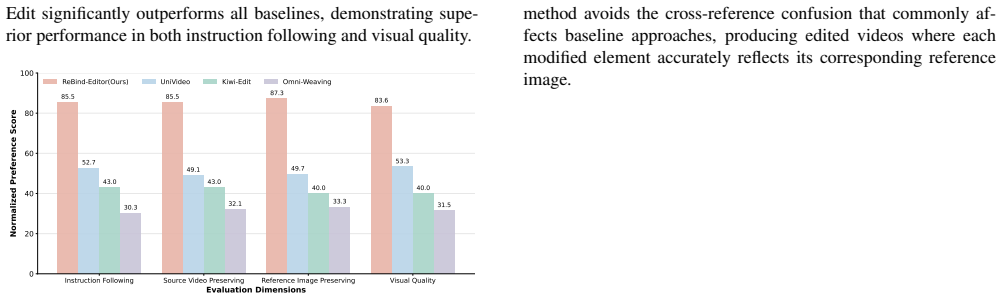
Significance. If the central claim holds, the paper makes a useful practical contribution: an intermediate instruction format for MRVE, a scalable synthetic data pipeline, and a two-stage instructor trained with customized rewards. The paper includes a small user study, training curves, and detailed hyperparameters, which support reproducibility. However, the main mechanistic claim—that explicit reference-token placement, rather than instruction length or detail, is the active ingredient—is not isolated by the current experiments. Moreover, the instruction-quality evaluation uses the same GPT-5.1-based machinery that serves as the GRPO reward, so the reported instruction-quality gains may be inflated by reward overfitting. These two issues are load-bearing for the paper's headline conclusions.
major comments (5)
- [§5.5.1, Table 4] The ablation that is supposed to isolate the effect of instruction design varies instruction length/detail, writing quality, and reference-token placement simultaneously. Basic vs Dense(Qwen3-Omni-Instruct) changes all of these, and Dense(ReBind-Instruct) changes writing quality again. There is no condition that keeps the textual content identical and toggles only the <Image_N>/<Video_N> anchors, nor a basic-instruction-plus-tokens condition. Consequently, the +0.45 and +0.41 gains cannot be attributed specifically to explicit reference tokens, which is the paper's stated key insight. Please add at least two additional conditions: dense instructions with the reference tokens removed (plain text) and basic instructions augmented with the same token anchors, with all other text held fixed.
- [§4.2.2–4.2.3 vs §5.2, Table 3] The instruction-quality metric (IQ) and reference-accuracy metric (RA) use GPT-5.1 with checklist/triple-matching procedures that are essentially identical to the dual-checklist reward (Eqs. 4–5) and referential-consistency reward (Eqs. 6–9) used to train ReBind-Instruct via GRPO. The model is therefore optimized against the same judge on which it is later evaluated, making Table 3's gains potentially a form of reward hacking or format overfitting. To support the claim of genuine instruction-quality improvement, report agreement with human raters or evaluate with an independent LLM judge that was not involved in training, and provide a correlation analysis between the GPT-5.1 scores and human judgments.
- [§5.2, Tables 1–2] All video-editing scores are reported without confidence intervals, error bars, or significance tests. With 210 samples on IntelligentVBench and 1,240 samples on UniVBench, differences of 0.2–0.4 may not be reliable. In addition, UniVBench originally used Seed-1.6 as the evaluation LLM; the authors substitute GPT-5.1. Published baseline numbers (e.g., UniVideo) were obtained under the original protocol, so direct comparisons in Tables 1–2 may not be apples-to-apples. Please re-run all baselines under the same judge/protocol and report variance estimates.
- [§3, D.2–D.3] The training data are synthetic: source videos are produced by applying inverse instructions to target videos with Bernini, and reference images are generated via SAM3 + Flux2 inpainting. Errors in any of these steps become training noise. The filtering thresholds (CLIP cosine similarity between 0.3 and 0.95, GPT-5.1 verification) are presented as fixed choices without sensitivity analysis. The paper does not quantify how many synthetic triplets are actually correct or how downstream editing performance varies with filtering strictness. A validation set or an ablation on filtering thresholds would make the data pipeline claim more robust.
- [§5.4, Table 3] The instruction-generation comparison may disadvantage general-purpose MLLMs because they are not prompted or fine-tuned to emit the exact ReBind format with explicit <Image_N>/<Video_N> tokens. Since the evaluation metric explicitly rewards that format, the comparison conflates format familiarity with capability. Please report a few-shot setting in which all baselines are given examples of the target structured format, or otherwise control for prompt format.
minor comments (6)
- [Figure 1 caption] Typo: “the the <Video_1>” should read “the <Video_1>”.
- [Figure 8] The label “ReBind-Editor” should be “ReBind-Edit” for consistency with the rest of the paper.
- [§4.2.4 vs Appendix I] Eq. (10) sets τ1=512 as approximately the longest ground-truth instruction, but Appendix I states that instructions longer than 512 tokens are considered severe length anomalies and are filtered. These two characterizations of the 512-token threshold should be reconciled.
- [Appendix D.5] The text refers to “Section 3.2,” but the paper has no Section 3.2; the dataset construction is described in Section 3 and Section 4.1.
- [Table 5] The rows labeled “✓” under Reward components are ambiguous because the reader cannot tell which of RD, RC, and RL are enabled in each row. Please use explicit column marks or a legend.
- [Section 1, Contributions] The bullet states ReBind-Instruct achieves “near-parity with closed-source frontier MLLMs,” but Table 3 shows it outperforms Gemini-3.1-Pro by about 5% overall. The wording should be updated to reflect the actual comparison.
Circularity Check
Instruction-quality evaluation is the same GPT-5.1 reward objective used to train ReBind-Instruct; editing comparisons remain independent.
specific steps
-
fitted input called prediction
[Sec. 4.2.2-4.2.3 (Eqs. 4-9) and Sec. 5.2 / Table 3]
"Given the unified keypoint set K and generated instruction S_gen, we employ GPT-5.1 to identify three types of events: ... We employ GPT-5.1 to extract triples from both ground-truth and generated captions ... For evaluating instruction quality, we propose two metrics. Instruction Quality measures content completeness: we use GPT-5.1 to compare the generated instruction against ground-truth keypoints ... Reference Accuracy ... extract object-descriptor-anchor triples from both generated and ground-truth instructions, then compute the F1 score based on exact matches."
The Table 3 evaluation metrics are the same GPT-5.1 computations used as the GRPO training rewards. R_pre and R_diff (Eqs. 4-5) are missing/incorrect/hallucination ratios over keypoints, and IQ is described as the ratio of correctly captured keypoints. R_C (Eq. 9) is the F1 over object-attribute-reference triples extracted by GPT-5.1, and RA is the F1 over the same triple extraction. ReBind-Instruct was RL-optimized to maximize R_D and R_C (Eq. 3), so its reported IQ/RA advantage over general MLLMs that were not trained against this GPT-5.1 judge is substantially alignment with the training objective rather than independent evidence of instruction quality. The editing comparisons are less affected because ReBind-Edit's diffusion objective (Eq. 11) does not use GPT-5.1, so this is partial c
full rationale
One substantive circular step is present. The paper trains ReBind-Instruct with GRPO rewards built on GPT-5.1 keypoint-checking and triple-matching (Sec. 4.2.2-4.2.3, Eqs. 4-9), then evaluates instruction quality in Table 3 with GPT-5.1 keypoint-ratio and triple-F1 metrics (Sec. 5.2). Those metrics are the same computations the model was optimized to satisfy, so the headline instruction-quality gains over Gemini-3.1-Pro and other general MLLMs are partly a measure of reward alignment rather than an independent confirmation of instruction quality. This fits the 'fitted input called prediction' pattern, but it is not total circularity: the video-editing results (Tables 1-2) and the dense-vs-basic editing ablation (Table 4) involve a diffusion training loss that does not use GPT-5.1, and external benchmarks provide independent content. I did not count the Table 4 confound (basic vs dense instructions differ simultaneously in length, detail, and token placement) as a circular step, because it is an experimental confound rather than an equation-level reduction. The self-citations to prior author works ([8], [9], [29], [50], [51]) are used for ancillary design choices and motivation, not as load-bearing derivations, so they do not raise the score further.
Axiom & Free-Parameter Ledger
free parameters (2)
- Length reward thresholds tau1, tau2 =
tau1=512, tau2=1024 tokens
- CLIP cosine filtering thresholds =
0.3 and 0.95
axioms (4)
- domain assumption Bernini inverse editing produces valid source-video/edited-video pairs from which multi-reference editing can be learned.
- domain assumption Gemini-3.1-Pro dense instructions on 40K synthetic triplets are accurate enough to serve as ground truth for SFT.
- domain assumption GPT-5.1 can reliably extract checklists and object-attribute-reference triples, and can judge video editing quality.
- domain assumption LTX-2.3 text encoder and cross-attention can bind latent reference features to textual reference tokens.
invented entities (1)
-
Explicit reference tokens `<Image_N>` / `<Video_N>` embedded in instructions
no independent evidence
read the original abstract
Recent diffusion-based video generation models have made significant progress in multi-reference image-conditioned video editing. However, existing methods still struggle to coordinate information from multiple visual sources accurately. We identify a critical deficiency in existing approaches. Existing editing instructions lack explicit reference relationships, and most multimodal large language models (MLLMs) cannot generate them reliably. To address this problem, we propose ReBind, a systematic framework that introduces semantic instructions with embedded reference tokens as the intermediate representation for multi-reference image-conditioned video editing. Our key insight is embedding reference tokens at semantic positions to eliminate ambiguity and establish precise bindings between visual attributes and their sources. We develop ReBind-Instruct, a specialized MLLM that learns to establish explicit bindings between visual attributes and their reference sources through a two-stage progressive scheme for precise reference relationships. We further develop ReBind-Edit, which enables lightweight adaptation of text-to-video models to coordinate multiple references by binding visual attributes to their designated sources. Extensive experiments demonstrate that ReBind substantially outperforms general-purpose MLLMs in instruction quality and achieves state-of-the-art performance among open-source methods on reference image conditioned video editing. Our project webpage: https://rebind-mrv2v.github.io/.
Figures




Forward citations
Cited by 1 Pith paper
-
RefCaptioner: Multi-Reference Image-Grounded Video Captioning
Mixed-data SFT plus Hierarchical Coverage-Discounted GRPO yields open-source SOTA multi-reference image-grounded video captions on MRVBench without hurting general captioning.
Reference graph
Works this paper leans on
-
[1]
Qwen3-vl technical report.arXiv preprint arXiv:2511.21631, 2025
Shuai Bai, Yuxuan Cai, Ruizhe Chen, Keqin Chen, Xionghui Chen, Zesen Cheng, Lianghao Deng, Wei Ding, Chang Gao, Chunjiang Ge, et al. Qwen3-vl technical report.arXiv preprint arXiv:2511.21631, 2025. 3
Pith/arXiv arXiv 2025
-
[2]
Sam 3: Segment anything with concepts.arXiv preprint arXiv:2511.16719, 2025
Nicolas Carion, Laura Gustafson, Yuan-Ting Hu, Shoub- hik Debnath, Ronghang Hu, Didac Suris, Chaitanya Ryali, Kalyan Vasudev Alwala, Haitham Khedr, Andrew Huang, et al. Sam 3: Segment anything with concepts.arXiv preprint arXiv:2511.16719, 2025. 3
Pith/arXiv arXiv 2025
-
[3]
Stable- video: Text-driven consistency-aware diffusion video edit- ing
Wenhao Chai, Xun Guo, Gaoang Wang, and Yan Lu. Stable- video: Text-driven consistency-aware diffusion video edit- ing. InProceedings of the IEEE/CVF International Confer- ence on Computer Vision, pages 23040–23050, 2023. 3
2023
-
[4]
Auroracap: Efficient, performant video detailed captioning and a new benchmark
Wenhao Chai, Enxin Song, Yilun Du, Chenlin Meng, Vashisht Madhavan, Omer Bar-Tal, Jenq-Neng Hwang, Sain- ing Xie, and Christopher Manning. Auroracap: Efficient, performant video detailed captioning and a new benchmark. InInternational Conference on Learning Representations, pages 16845–16889, 2025. 2
2025
-
[5]
Jiuhai Chen, Zhiyang Xu, Xichen Pan, Yushi Hu, Can Qin, Tom Goldstein, Lifu Huang, Tianyi Zhou, Saining Xie, Sil- vio Savarese, et al. Blip3-o: A family of fully open unified multimodal models-architecture, training and dataset.arXiv preprint arXiv:2505.09568, 2025. 3
Pith/arXiv arXiv 2025
-
[6]
Junyi Chen, Tong He, Zhoujie Fu, Pengfei Wan, Kun Gai, and Weicai Ye. Vino: A unified visual genera- tor with interleaved omnimodal context.arXiv preprint arXiv:2601.02358, 2026. 8, 13
arXiv 2026
-
[7]
Sharegpt4video: Improving video understand- ing and generation with better captions.Advances in Neural Information Processing Systems, 37:19472–19495, 2024
Lin Chen, Xilin Wei, Jinsong Li, Xiaoyi Dong, Pan Zhang, Yuhang Zang, Zehui Chen, Haodong Duan, Bin Lin, Zhenyu Tang, et al. Sharegpt4video: Improving video understand- ing and generation with better captions.Advances in Neural Information Processing Systems, 37:19472–19495, 2024. 2
2024
-
[8]
Xinlong Chen, Yue Ding, Weihong Lin, et al. Avocado: An audiovisual video captioner driven by temporal orches- tration.arXiv preprint arXiv:2510.10395, 2025. 2, 3, 6
arXiv 2025
-
[9]
Xinlong Chen, Weihong Lin, Jingyun Hua, Liang Wang, Tie- niu Tan, et al. Diadem: Advancing dialogue descriptions in audiovisual video captioning for multimodal large language models.arXiv preprint arXiv:2601.19267, 2026. 3
arXiv 2026
-
[10]
Avset-10m: An open large-scale audio-visual dataset with high correspondence
Xize Cheng, Ziang Zhang, Minghui Fang, Zehan Wang, Ruofan Hu, Siqi Zheng, Rongjie Huang, Tao Jin, and Zhou Zhao. Avset-10m: An open large-scale audio-visual dataset with high correspondence. 2024. 3
2024
-
[11]
Gheorghe Comanici, Eric Bieber, Mike Schaekermann, Ice Pasupat, Noveen Sachdeva, Inderjit Dhillon, Marcel Blis- tein, Ori Ram, Dan Zhang, Evan Rosen, et al. Gemini 2.5: Pushing the frontier with advanced reasoning, multimodality, long context, and next generation agentic capabilities.arXiv preprint arXiv:2507.06261, 2025. 8, 9
Pith/arXiv arXiv 2025
-
[12]
Gemini api: Gemini 3.1 pro.https://ai
Google. Gemini api: Gemini 3.1 pro.https://ai. google.dev/gemini-api, 2026. Version 3.1 Pro. 9
2026
-
[13]
Gemma 4: Multimodal open models
Google DeepMind. Gemma 4: Multimodal open models. https://ai.google.dev/gemma/docs, 2025. Ver- sion 31B. 9
2025
-
[15]
Ltx-2: Efficient joint audio-visual foundation model.arXiv preprint arXiv:2601.03233, 2026
Yoav HaCohen, Benny Brazowski, Nisan Chiprut, Yaki Bitterman, Andrew Kvochko, Avishai Berkowitz, Daniel Shalem, Daphna Lifschitz, Dudu Moshe, Eitan Porat, et al. Ltx-2: Efficient joint audio-visual foundation model.arXiv preprint arXiv:2601.03233, 2026. 6, 7
Pith/arXiv arXiv 2026
-
[16]
HappyHorse: Ai video generation platform
HappyHorse. HappyHorse: Ai video generation platform. https://happyhorses.io/, 2026. Accessed: 2026- 06-23. 8
2026
-
[17]
Haoyang He, Jie Wang, Jiangning Zhang, Zhucun Xue, Xingyuan Bu, Qiangpeng Yang, Shilei Wen, and Lei Xie. Openve-3m: A large-scale high-quality dataset for instruction-guided video editing.arXiv preprint arXiv:2512.07826, 2025. 3
arXiv 2025
-
[18]
Video dif- fusion models.Advances in neural information processing systems, 35:8633–8646, 2022
Jonathan Ho, Tim Salimans, Alexey Gritsenko, William Chan, Mohammad Norouzi, and David J Fleet. Video dif- fusion models.Advances in neural information processing systems, 35:8633–8646, 2022. 1
2022
-
[19]
Vace: All-in-one video creation and editing.arXiv preprint arXiv:2503.07598, 2025
Zeyinzi Jiang, Zhen Han, Chaojie Mao, Jingfeng Zhang, Yulin Pan, and Yu Liu. Vace: All-in-one video creation and editing.arXiv preprint arXiv:2503.07598, 2025. 3, 8, 13
Pith/arXiv arXiv 2025
-
[20]
Weiyang Jin, Yuwei Niu, Jiaqi Liao, Chengqi Duan, Aoxue Li, Shenghua Gao, and Xihui Liu. Srum: Fine-grained self- rewarding for unified multimodal models.arXiv preprint arXiv:2510.12784, 2025. 3
Pith/arXiv arXiv 2025
-
[21]
Weijie Kong, Qi Tian, Zijian Zhang, Rox Min, Zuozhuo Dai, Jin Zhou, Jiangfeng Xiong, Xin Li, Bo Wu, Jianwei Zhang, et al. Hunyuanvideo: A systematic framework for large video generative models.arXiv preprint arXiv:2412.03603, 2024. 1
Pith/arXiv arXiv 2024
-
[22]
Kling ai video generation platform
Kuaishou Technology. Kling ai video generation platform. https://klingai.com, 2024. Accessed: 2026-07-01. 8, 9
2024
-
[23]
Black Forest Labs, Stephen Batifol, Andreas Blattmann, Frederic Boesel, Saksham Consul, Cyril Diagne, Tim Dock- horn, Jack English, Zion English, Patrick Esser, et al. Flux. 1 kontext: Flow matching for in-context image generation and editing in latent space.arXiv preprint arXiv:2506.15742,
-
[24]
Yiqi Lin, Guoqiang Liang, Ziyun Zeng, Zechen Bai, Yanzhe Chen, and Mike Zheng Shou. Kiwi-edit: Versatile video edit- ing via instruction and reference guidance.arXiv preprint arXiv:2603.02175, 2026. 8, 9, 13, 15
Pith/arXiv arXiv 2026
-
[25]
Stablev2v: Stabilizing shape consistency in video-to- video editing.IEEE Transactions on Circuits and Systems for Video Technology, 2025
Chang Liu, Rui Li, Kaidong Zhang, Yunwei Lan, and Dong Liu. Stablev2v: Stabilizing shape consistency in video-to- video editing.IEEE Transactions on Circuits and Systems for Video Technology, 2025. 3
2025
-
[26]
Bernini: Latent semantic planning for video diffusion.arXiv preprint arXiv:2605.22344, 2026
Chenchen Liu, Junyi Chen, Lei Li, Lu Chi, Mingzhen Sun, Zhuoying Li, Yi Fu, Ruoyu Guo, Yiheng Wu, Ge Bai, and Zehuan Yuan. Bernini: Latent semantic planning for video diffusion.arXiv preprint arXiv:2605.22344, 2026. 3
Pith/arXiv arXiv 2026
-
[27]
Improving video generation with hu- man feedback.Advances in Neural Information Processing Systems, 38:82155–82192, 2026
Jie Liu, Gongye Liu, Jiajun Liang, Ziyang Yuan, Xiaokun Liu, Mingwu Zheng, Xiele Wu, Qiulin Wang, Menghan Xia, Xintao Wang, et al. Improving video generation with hu- man feedback.Advances in Neural Information Processing Systems, 38:82155–82192, 2026. 3
2026
-
[28]
Qi Liu, Gang Yue, Mingyu Yin, Lisai Zhang, Yidi Wu, Yaole Wang, Yaohui Wang, Chang Yao, Jingyuan Chen, and Lin Ma. Tide: Task-isolated diffusion for unified video editing and generation.arXiv preprint arXiv:2606.08260, 2026. 3
Pith/arXiv arXiv 2026
-
[29]
Xinyu Liu, Hangjie Yuan, Yujie Wei, Jiazheng Xing, Yujin Han, Jiahao Pan, Yanbiao Ma, Chi-Min Chan, Kang Zhao, Shiwei Zhang, et al. Revise: Towards reason-informed video editing in unified models with self-reflective learning.arXiv preprint arXiv:2512.09924, 2025. 3
arXiv 2025
-
[30]
Video-chatgpt: Towards detailed video un- derstanding via large vision and language models
Muhammad Maaz, Hanoona Rasheed, Salman Khan, and Fahad Khan. Video-chatgpt: Towards detailed video un- derstanding via large vision and language models. InPro- ceedings of the 62nd Annual Meeting of the Association for Computational Linguistics (Volume 1: Long Papers), pages 12585–12602, 2024. 2
2024
-
[31]
Desen Meng, Rui Huang, Zhilin Dai, Xinhao Li, Yifan Xu, Jun Zhang, Zhenpeng Huang, Meng Zhang, Lingshu Zhang, Yi Liu, et al. Videocap-r1: Enhancing mllms for video captioning via structured thinking.arXiv preprint arXiv:2506.01725, 2025. 3
Pith/arXiv arXiv 2025
-
[32]
Dreamix: Video diffusion models are general video editors.arXiv preprint arXiv:2302.01329, 2023
Eyal Molad, Eliahu Horwitz, Dani Valevski, Alex Rav Acha, Yossi Matias, Yael Pritch, Yaniv Leviathan, and Yedid Hoshen. Dreamix: Video diffusion models are general video editors.arXiv preprint arXiv:2302.01329, 2023. 3
Pith/arXiv arXiv 2023
-
[33]
Openvid-1m: A large-scale high-quality dataset for text-to- video generation
Kepan Nan, Rui Xie, Penghao Zhou, Tiehan Fan, Zhen- heng Yang, Zhijie Chen, Xiang Li, Jian Yang, and Ying Tai. Openvid-1m: A large-scale high-quality dataset for text-to- video generation. InInternational Conference on Learning Representations, pages 1045–1064, 2025. 3
2025
-
[34]
Omniweaving: Towards unified video generation with free-form composition and reasoning
Kaihang Pan, Qi Tian, Jianwei Zhang, Weijie Kong, Jiangfeng Xiong, Yanxin Long, Shixue Zhang, Haiyi Qiu, Tan Wang, Zheqi Lv, et al. Omniweaving: Towards unified video generation with free-form composition and reasoning. arXiv preprint arXiv:2603.24458, 2026. 2, 8, 9, 13, 15
arXiv 2026
-
[35]
Trans- fer between modalities with metaqueries.arXiv preprint arXiv:2504.06256, 2025
Xichen Pan, Satya Narayan Shukla, Aashu Singh, Zhuokai Zhao, Shlok Kumar Mishra, Jialiang Wang, Zhiyang Xu, Jiuhai Chen, Kunpeng Li, Felix Juefei-Xu, et al. Trans- fer between modalities with metaqueries.arXiv preprint arXiv:2504.06256, 2025. 3
Pith/arXiv arXiv 2025
-
[36]
Scalable diffusion models with transformers
William Peebles and Saining Xie. Scalable diffusion models with transformers. InProceedings of the IEEE/CVF inter- national conference on computer vision, pages 4195–4205,
-
[37]
Instructvid2vid: Controllable video editing with natural language instructions
Bosheng Qin, Juncheng Li, Siliang Tang, Tat-Seng Chua, and Yueting Zhuang. Instructvid2vid: Controllable video editing with natural language instructions. In2024 IEEE International Conference on Multimedia and Expo (ICME), pages 1–6. IEEE, 2024. 3
2024
-
[38]
Learning transferable visual models from natural language supervi- sion
Alec Radford, Jong Wook Kim, Chris Hallacy, Aditya Ramesh, Gabriel Goh, Sandhini Agarwal, Girish Sastry, Amanda Askell, Pamela Mishkin, Jack Clark, et al. Learning transferable visual models from natural language supervi- sion. InInternational conference on machine learning, pages 8748–8763. PmLR, 2021. 14
2021
-
[39]
Direct preference optimization: Your language model is secretly a reward model.Advances in neural information processing systems, 36:53728–53741, 2023
Rafael Rafailov, Archit Sharma, Eric Mitchell, Christo- pher D Manning, Stefano Ermon, and Chelsea Finn. Direct preference optimization: Your language model is secretly a reward model.Advances in neural information processing systems, 36:53728–53741, 2023. 3
2023
-
[40]
Medgemma technical report.arXiv preprint arXiv:2507.05201, 2025
Andrew Sellergren, Sahar Kazemzadeh, Tiam Jaroen- sri, Atilla Kiraly, Madeleine Traverse, Timo Kohlberger, Shawn Xu, Fayaz Jamil, C ´ıan Hughes, Charles Lau, et al. Medgemma technical report.arXiv preprint arXiv:2507.05201, 2025. 7, 8
Pith/arXiv arXiv 2025
-
[41]
Zhihong Shao, Peiyi Wang, Qihao Zhu, Runxin Xu, Junxiao Song, Xiao Bi, Haowei Zhang, Mingchuan Zhang, YK Li, Yang Wu, et al. Deepseekmath: Pushing the limits of math- ematical reasoning in open language models.arXiv preprint arXiv:2402.03300, 2024. 3
Pith/arXiv arXiv 2024
-
[42]
Mavors: Multi-granularity video representation for multimodal large language model
Yang Shi, Jiaheng Liu, Yushuo Guan, Zhenhua Wu, Yuanx- ing Zhang, Zihao Wang, Weihong Lin, Jingyun Hua, Zekun Wang, Xinlong Chen, et al. Mavors: Multi-granularity video representation for multimodal large language model. InPro- ceedings of the 33rd ACM International Conference on Mul- timedia, pages 10994–11003, 2025. 2
2025
-
[43]
Guangzhi Sun, Wenyi Yu, Changli Tang, Xianzhao Chen, Tian Tan, Wei Li, Lu Lu, Zejun Ma, Yuxuan Wang, and Chao Zhang. video-salmonn: Speech-enhanced audio-visual large language models.arXiv preprint arXiv:2406.15704, 2024. 2
Pith/arXiv arXiv 2024
-
[44]
Changli Tang, Yixuan Li, Yudong Yang, Jimin Zhuang, Guangzhi Sun, Wei Li, Zejun Ma, and Chao Zhang. video- salmonn 2: Caption-enhanced audio-visual large language models.arXiv preprint arXiv:2506.15220, 2025. 3
arXiv 2025
-
[45]
Kling-omni technical report.arXiv preprint arXiv:2512.16776, 2025
Kling Team, Jialu Chen, Yuanzheng Ci, Xiangyu Du, Zipeng Feng, Kun Gai, Sainan Guo, Feng Han, Jingbin He, Kang He, et al. Kling-omni technical report.arXiv preprint arXiv:2512.16776, 2025. 6
Pith/arXiv arXiv 2025
-
[46]
Ang Wang, Baole Ai, Bin Wen, Chaojie Mao, Chen-Wei Xie, Di Chen, Feiwu Yu, Haiming Zhao, Jianxiao Yang, Jianyuan Zeng, et al. Wan: Open and advanced large-scale video gen- erative models.arXiv preprint arXiv:2503.20314, 3(4):6,
-
[47]
Videodirector: Precise video editing via text-to-video models
Yukun Wang, Longguang Wang, Zhiyuan Ma, Qibin Hu, Kai Xu, and Yulan Guo. Videodirector: Precise video editing via text-to-video models. InProceedings of the IEEE/CVF Con- ference on Computer Vision and Pattern Recognition, pages 2589–2598, 2025. 3
2025
-
[48]
Univideo: Unified understanding, generation, and editing for videos
Cong Wei, Quande Liu, Zixuan Ye, Qiulin Wang, Xintao Wang, Pengfei Wan, Kun Gai, and Wenhu Chen. Univideo: Unified understanding, generation, and editing for videos. arXiv preprint arXiv:2510.08377, 2025. 3, 8, 9, 13, 15
Pith/arXiv arXiv 2025
-
[49]
Univbench: Towards unified evaluation for video founda- tion models
Jianhui Wei, Xiaotian Zhang, Yichen Li, Yuan Wang, Yan Zhang, Ziyi Chen, Zhihang Tang, Wei Xu, and Zuozhu Liu. Univbench: Towards unified evaluation for video founda- tion models. InProceedings of the IEEE/CVF Conference on Computer Vision and Pattern Recognition, pages 25654– 25666, 2026. 2, 13
2026
-
[50]
Yujie Wei, Xinyu Liu, Shiwei Zhang, Hangjie Yuan, Jinbo Xing, Zhekai Chen, Xiang Wang, Haonan Qiu, Rui Zhao, Yutong Feng, et al. Dreamvideo-omni: Omni-motion con- trolled multi-subject video customization with latent identity reinforcement learning.arXiv preprint arXiv:2603.12257,
-
[51]
Vidic: Video difference captioning.arXiv preprint arXiv:2512.03405, 2025
Jiangtao Wu, Shihao Li, Zhaozhou Bian, Jialu Chen, Runzhe Wen, An Ping, Yiwen He, Jiakai Wang, Yuanxing Zhang, and Jiaheng Liu. Vidic: Video difference captioning.arXiv preprint arXiv:2512.03405, 2025. 1, 2
arXiv 2025
-
[52]
Jianzong Wu, Hao Lian, Jiongfan Yang, Dachao Hao, Ye Tian, Yunhai Tong, Jingyuan Zhu, Biaolong Chen, Qiaosong Qi, Aixi Zhang, et al. Loomvideo: Unifying multimodal inputs into video generation and editing.arXiv preprint arXiv:2606.06042, 2026. 3
Pith/arXiv arXiv 2026
-
[53]
Insvie-1m: Effective instruction-based video editing with elaborate dataset construction
Yuhui Wu, Liyi Chen, Ruibin Li, Shihao Wang, Chenxi Xie, and Lei Zhang. Insvie-1m: Effective instruction-based video editing with elaborate dataset construction. InProceedings of the IEEE/CVF International Conference on Computer Vi- sion, pages 16692–16701, 2025. 3
2025
-
[54]
Qwen2.5-omni technical report.arXiv preprint arXiv:2503.20215, 2025
Jin Xu, Zhifang Guo, Jinzheng He, Hangrui Hu, Ting He, Shuai Bai, Keqin Chen, Jialin Wang, Yang Fan, Kai Dang, Bin Zhang, Xiong Wang, Yunfei Chu, and Jun- yang Lin. Qwen2.5-omni technical report.arXiv preprint arXiv:2503.20215, 2025. 9
Pith/arXiv arXiv 2025
-
[55]
Qwen3-omni technical report.arXiv preprint arXiv:2509.17765, 2025
Jin Xu, Zhifang Guo, Hangrui Hu, Yunfei Chu, Xiong Wang, Jinzheng He, Yuxuan Wang, Xian Shi, Ting He, Xinfa Zhu, et al. Qwen3-omni technical report.arXiv preprint arXiv:2509.17765, 2025. 2, 3, 9
Pith/arXiv arXiv 2025
-
[56]
Videograin: Modulating space-time attention for multi- grained video editing
Xiangpeng Yang, Linchao Zhu, Hehe Fan, and Yi Yang. Videograin: Modulating space-time attention for multi- grained video editing. InThe Thirteenth International Con- ference on Learning Representations, 2025. 3
2025
-
[57]
Cogvideox: Text-to- video diffusion models with an expert transformer
Zhuoyi Yang, Jiayan Teng, Wendi Zheng, Ming Ding, Shiyu Huang, Jiazheng Xu, Yuanming Yang, Wenyi Hong, Xi- aohan Zhang, Guanyu Feng, et al. Cogvideox: Text-to- video diffusion models with an expert transformer. InIn- ternational Conference on Learning Representations, pages 83048–83077, 2025. 1
2025
-
[58]
Unic: Unified in-context video editing.arXiv preprint arXiv:2506.04216, 2025
Zixuan Ye, Xuanhua He, Quande Liu, Qiulin Wang, Xintao Wang, Pengfei Wan, Di Zhang, Kun Gai, Qifeng Chen, and Wenhan Luo. Unic: Unified in-context video editing.arXiv preprint arXiv:2506.04216, 2025. 3
Pith/arXiv arXiv 2025
-
[59]
Veg- gie: Instructional editing and reasoning video concepts with grounded generation
Shoubin Yu, Difan Liu, Ziqiao Ma, Yicong Hong, Yang Zhou, Hao Tan, Joyce Chai, and Mohit Bansal. Veg- gie: Instructional editing and reasoning video concepts with grounded generation. InProceedings of the IEEE/CVF In- ternational Conference on Computer Vision, pages 15147– 15158, 2025. 3
2025
-
[60]
Video-llama: An instruction-tuned audio-visual language model for video un- derstanding
Hang Zhang, Xin Li, and Lidong Bing. Video-llama: An instruction-tuned audio-visual language model for video un- derstanding. InProceedings of the 2023 conference on empirical methods in natural language processing: system demonstrations, pages 543–553, 2023. 2
2023
-
[61]
Llava-video: Video instruction tuning with synthetic data.arXiv preprint arXiv:2410.02713,
Yuanhan Zhang, Jinming Wu, Wei Li, Bo Li, Zejun Ma, Zi- wei Liu, and Chunyuan Li. Llava-video: Video instruction tuning with synthetic data.arXiv preprint arXiv:2410.02713,
-
[62]
Yabo Zhang, Kunchang Li, Dewei Zhou, Xinyu Huang, and Xun Wang. Images in sentences: Scaling interleaved instructions for unified visual generation.arXiv preprint arXiv:2605.12305, 2026. 1
Pith/arXiv arXiv 2026
-
[63]
Donghao Zhou, Guisheng Liu, Hao Yang, Jiatong Li, Jingyu Lin, Xiaohu Huang, Yichen Liu, Xin Gao, Cunjian Chen, Shilei Wen, et al. Omnishow: Unifying multimodal condi- tions for human-object interaction video generation.arXiv preprint arXiv:2604.11804, 2026. 3
Pith/arXiv arXiv 2026
-
[64]
Se ˜norita-2m: A high-quality instruction- based dataset for general video editing by video special- ists.Advances in Neural Information Processing Systems, 38, 2026
Bojia Zi, Penghui Ruan, Marco Chen, Xianbiao Qi, Shaozhe Hao, Shihao Zhao, Youze Huang, Bin Liang, Rong Xiao, and Kam-Fai Wong. Se ˜norita-2m: A high-quality instruction- based dataset for general video editing by video special- ists.Advances in Neural Information Processing Systems, 38, 2026. 3 Appendix A. Evaluation Benchmark Details To complement the e...
2026
-
[65]
No hallucinated or missing tokens
Reference Token Consistency:All reference tokens must exist in the available list, follow correct format (<image N>or<video N>), and be correctly attributed. No hallucinated or missing tokens
-
[66]
No excessive repetition (same phrase more than 3 times)
Content Quality:Length should be 50-300 tokens. No excessive repetition (same phrase more than 3 times). Logical flow and clear structure. Covers both preserved and changed elements
-
[67]
Clear distinction between preserved and modified elements
Format Correctness:Proper grammar and sentence structure. Clear distinction between preserved and modified elements. No truncated or incomplete sentences. Decision Rules:FILTER if: reference token errors, severe length anomalies (less than 20 or more than 512 tokens), high repetition, or critical format errors. KEEP if: all tokens are valid, content is co...
-
[68]
- It serves as the semantic and informational baseline, defining what should be preserved or transformed
Original Video (OriginalVideo) - A reference video provided by the user, given as sampled images with corresponding timestamps. - It serves as the semantic and informational baseline, defining what should be preserved or transformed
-
[69]
- These images reflect the specific visual characteristics (e.g., subject appearance, lighting, color palette) the user hopes the generated video will achieve
Reference Images (ReferenceImages) - A set of images representing reference visual style, tone, frame composition, and subject references. - These images reflect the specific visual characteristics (e.g., subject appearance, lighting, color palette) the user hopes the generated video will achieve
-
[70]
- Example: ”change daytime to nighttime”, ”replace the person with the subject from ReferenceImage1.” - It may also work together with ReferenceImages for modification
Edit Instruction (EditInstruction) - A natural language description indicating the edits or style adjustments the user wants to apply to the original video. - Example: ”change daytime to nighttime”, ”replace the person with the subject from ReferenceImage1.” - It may also work together with ReferenceImages for modification
-
[71]
— Core Inspection Framework Before checklist evaluation, internally decompose all input using the structured attributes below
Generated Video (GeneratedVideo) - The output produced by the video understanding and generation model, also provided as timestamped sampled images. — Core Inspection Framework Before checklist evaluation, internally decompose all input using the structured attributes below. video attribute requirements (Static Video Attributes) - subjects: quantity, gend...
-
[72]
Content Fidelity (1) Subject: - Does the GeneratedVideo maintain high consistency with the OriginalVideo in terms of subject quantity, appearance, clothing, and details? - You must also consider the EditInstruction and ReferenceImages. If the instruction explicitly requires subject changes (e.g., ”replace person A with person B from ReferenceImage1”), the...
-
[73]
Style Consistency & Visual Alignment (1) Color & Tone: - Does the GeneratedVideo match the OriginalVideo in overall tone, saturation, and contrast? - If ReferenceImages provide specific color palettes, are those colors accurately reflected in GeneratedVideo? (2) Lighting & Atmosphere: - Are lighting direction, lighting effect, and overall brightness consi...
-
[74]
Temporal & Motion Coherence In multi-reference image editing scenarios, the primary goal is successful edit execution. You should balance two aspects: (1) Edit Success: Whether the edit specified in EditInstruction is correctly implemented (2) Temporal Consistency: Whether appropriate consistency is maintained Both aspects matter, but successful edit exec...
-
[75]
Technical Quality (1) Generation Quality: - Does the GeneratedVideo contain artifacts, distortions, blurriness, or misalignments? - Are there issues like deformation of subjects or objects? (2) Consistency: - Do the main subjects and objects maintain visual consistency across frames (appearance, clothing, features)?
-
[76]
Artistic Expressiveness & Narrative Integrity - Does the GeneratedVideo demonstrate artistic rhythm, lighting composition, and atmosphere? - Is the narrative compelling with appropriate shot selection and scene transitions?
-
[77]
Qualitative comparisons for single-reference image-conditioned video editing on UniVBench
IP & Privacy Compliance - The GeneratedVideo must not contain recognizable copyrighted materials, including: * Brand logos, trademarks, or corporate IP * Licensed IP characters (e.g., Mickey Mouse, Marvel characters) * Recognizable public figures or celebrities (unless authorized) * Copyrighted artwork or designs UniVideo OmniWeaving SourceVideo Kiwi-Edit...
-
[78]
Refer to the reference image1, change the golden wide bracelet on the wrist of the female character appearing at the beginning of the video into the plain circle silver bracelet; 2. Refer to the reference image2, modify the original retro female in the first shape in the video into the female image with long black hair and black cheongsam dress with black...
discussion (0)
Sign in with ORCID, Apple, or X to comment. Anyone can read and Pith papers without signing in.