REVIEW 3 major objections 5 minor 68 references
Dendro-GR stably and efficiently evolves black-hole binaries at mass ratios up to 24 and spins up to 0.8, including precessing configurations, producing low-noise gravitational waveforms through multipole ℓ=8.
Reviewed by Pith at T0; open to challenge. T0 means a machine referee read the full paper against a public rubric. the ladder, T0–T4 →
T0 review · deepseek-v4-flash
2026-08-01 17:27 UTC pith:5IVLNC7T
load-bearing objection A genuine capability advance for Dendro-GR at high mass ratio and spin, but the abstract's 'accurate waveform' claim outruns the evidence—no convergence study is provided. the 3 major comments →
Dendro-GR at high mass ratios with high spins
The pith
A machine-rendered reading of the paper's core claim, the machinery that carries it, and where it could break.
Core claim
The paper's central claim is that Dendro-GR, built on a wavelet-adaptive multiresolution (WAMR) octree grid, can simulate high-mass-ratio binary black holes with strong spins without catastrophic cost or instability. For the first time in this code, binaries with q=24 and q=12 with spins up to χ=0.8 are evolved through merger and ringdown. The runs produce gravitational waveforms with the expected mode hierarchy up to ℓ=8, keep total constraint violations bounded and nearly constant, and conserve apparent-horizon masses to better than 10^-4 in the best-resolved cases. The authors interpret this as strong evidence that the code is not limited in this regime and can begin systematic exploratio
What carries the argument
The central mechanism is Wavelet Adaptive Multi-Resolution (WAMR), which expands the evolved BSSN fields in a local interpolating wavelet basis and uses the wavelet coefficients as a direct error estimator to drive an unstructured octree grid. A single user-set wavelet tolerance controls refinement, giving built-in h- and p-like adaptivity. Around this, the paper adds several supporting techniques: an 'onion' refinement floor that enforces a smooth nested grid around each black hole; ORBIT, a causal refinement floor that Nyquist-resolves target multipoles; a multi-step Runge-Kutta scheme (RK4-3) that cuts right-hand-side evaluations; Hamiltonian constraint damping tuned to the integration sc
Load-bearing premise
The results rest on the assumption that the code's internal error diagnostics (wavelet tolerance, constraint violations, horizon mass conservation) are sufficient proxies for waveform accuracy, since no multi-resolution convergence study was performed and the secondary black hole is resolved by only ~38 points across its horizon in the high-spin runs.
What would settle it
A direct way to test the central claim is to run one of the same configurations (e.g., q=12, χ=0.8, anti-aligned) at a significantly smaller wavelet tolerance (e.g., 10^-5) and compare the extracted (2,2) waveform phase and amplitude. If the phase difference at merger exceeds a few tenths of a radian or the ℓ=8 modes change by more than the reported noise level, the claim that the runs are low-noise and accurate would be undermined. Similarly, an independent code evolving the same initial data and disagreeing in the kick velocity by more than the reported error bars would falsify the recoil cl
If this is right
- High-mass-ratio, high-spin binaries (q up to 24, spin up to 0.8) become computationally accessible to full numerical relativity, reducing the undersampling that biases parameter estimation.
- The demonstrated stability through merger suggests the same methods can push to even larger mass ratios and higher spins than those reported.
- The low wall-clock costs (days on current supercomputers) make production runs for waveform catalogs feasible within human timescales.
- Lowering the wavelet tolerance reduces waveform noise by an order of magnitude, giving a single-user knob to trade cost against accuracy.
- If confirmed, these runs will provide LISA-era templates for precessing, spinning high-mass-ratio inspirals.
Where Pith is reading between the lines
- Because the grid follows the solution's features rather than a predetermined box-in-box structure, the same machinery should gracefully handle other problems with moving, small-scale features (e.g., eccentric or extreme-mass-ratio inspirals) without redesign of the refinement criterion.
- The reported kick velocities (up to ~1680 km/s for the precessing run) are far outside existing model predictions; if they survive convergence studies, they imply that current post-Newtonian and surrogate models badly miss recoil in this corner of parameter space.
- The paper's own caveat about missing multi-resolution convergence means the waveforms should be treated as proof-of-concept until a convergence series is run; the internal diagnostics are reassuring but not a substitute.
- The 'golden ratio' coarsening factor and the Nyquist-style mode resolution floor suggest a general cost-geometry tradeoff that could be formalized to predict the cheapest grid that achieves a given ℓ_max waveform accuracy.
Editorial analysis
A structured set of objections, weighed in public.
Referee Report
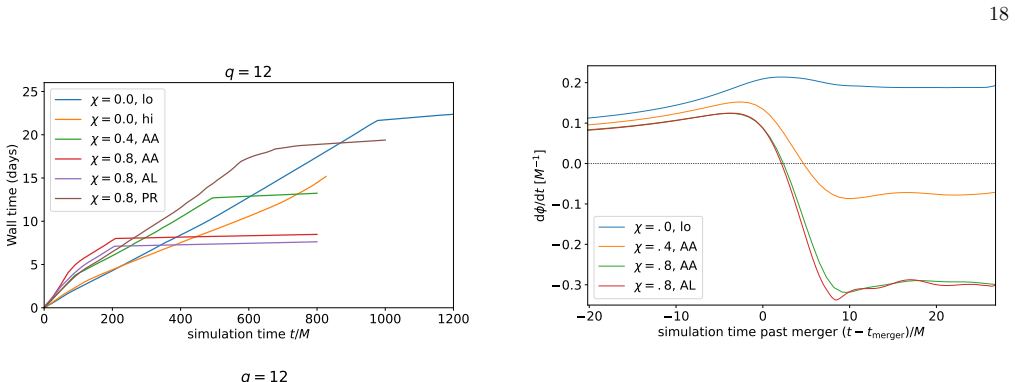
Summary. This paper reports proof-of-concept binary black hole evolutions with the Dendro-GR code at mass ratio q=24 (nonspinning) and q=12 with spins up to χ=0.8, including precessing and (anti-)aligned configurations. The technical core consists of code developments: wavelet adaptive multiresolution (WAMR) with a causal refinement floor (ORBIT), an 'onion' refinement geometry around each puncture, slow-start lapse (SSL), RK4-3 multi-step time integration, and Hamiltonian constraint damping. The reported evidence includes stable evolutions through merger and ringdown, bounded leaf-weighted constraint violations (Figs. 12–13), horizon mass conservation at the ~10^-4 to 10^-3 level (Figs. 14–15), Ψ4 multipoles up to ℓ=8 (Figs. 2–3, 8–11), an amplitude bookending comparison of the q=24 run against RIT q=16 and q=32 data (Fig. 4), and kick magnitudes compared with gwModels (Table II). The abstract claims 'accurate gravitational waveforms,' while §III explicitly disclaims multi-resolution convergence studies.
Significance. If the reported stability and efficiency are genuine, this is a useful contribution to a regime that is currently undersampled: high mass ratio (q≥10) with high spin is directly relevant to LISA and 3G parameter estimation, and the public availability of the code (MIT license) plus promised input files on Zenodo is a concrete reproducibility asset. The paper uses appropriate external anchors (RIT amplitude comparison; gwModels kick comparison) that avoid relying solely on internal diagnostics, and the wall-clock/CPU cost reporting (Figs. 16–17) is valuable for the community. The competitive performance of wavelet-based AMR at q=24/χ=0.8, if confirmed at higher resolution, would be a real technical step. The significance is tempered by the gap between the abstract's accuracy language and the body's explicit caveats, and by the unresolved order-of-magnitude kick discrepancy in the precessing case, which should be addressed before the high-spin results are used as benchmarks.
major comments (3)
- [Abstract; §III; Table I; Fig. 4] The abstract claims 'accurate gravitational waveforms through multipole modes up to ℓ=8,' but §III explicitly disclaims multi-resolution convergence studies and states the runs are 'not necessarily ... catalog-ready, fully converged waveforms.' This internal inconsistency sits on the paper's central claim. The evidence does not establish waveform accuracy: Table I shows N2≈38 across the secondary horizon for the χ=0.8 runs; Fig. 4 checks only amplitude bookending of the q=24 (2,2)/(4,4) modes against RIT runs and compares R=50M extraction to RIT data extrapolated to infinity, with no phase or higher-multipole comparison; Appendix B concedes the (8,8) mode is 'often noisy.' Recommend softening to 'stable, low-noise waveforms' or adding a quantitative phase/mismatch estimate, plus at least one limited convergence test.
- [Table II; Appendix F] The precessing χ=0.8 run reports v_kick=1680±100 km/s, ~13× the gwModels NF prediction (126±74 km/s); the χ=0.8 aligned runs also exceed GPR predictions by 2–3σ. Appendix F defers the discrepancy, noting that 'low-resolution runs may yield significantly different kick velocities.' Since the precessing run is a headline result (Figs. 1 and 3) with only ~38 points across the secondary (Table I), an order-of-magnitude kick discrepancy is a red flag for the accuracy of the high-spin dynamics rather than a minor detail. Please either include a resolution study of the kick (e.g., a second run with larger N2), or explicitly state that the χ=0.8 kick values and the corresponding precessing waveform are not yet quantitatively reliable.
- [§IV A; Appendix C 1; Figs. 5–6] The convergence argument in Appendix C1 is self-referential: the wavelet coefficients are kept below the tolerance by construction, so lowering ϵψ shrinks the stated error measure by definition. The demonstration in Figs. 5–6 is also confounded: the two q=24 runs differ in initial separation (D0=8M vs 7M), number of orbits (11.1 vs 4.6), and code version (the ϵψ=10^-4 run benefits from all §II improvements). The 'order-of-magnitude noise reduction' shown in Fig. 5 is therefore not attributable to ϵψ alone. A clean test would hold D0 and code version fixed while varying ϵψ, and would report phase/amplitude differences between resolutions rather than the wavelet residual.
minor comments (5)
- [§II C; Table I] Notation conflict: m_min denotes the smaller BH mass in Eq. (7) and §II F (m_min = 1/25), but Table I and §III A use the same symbol for the ORBIT maximum resolved multipole (12 or 7). Rename the latter (e.g., m_ORBIT or m_max) to avoid confusion.
- [Figs. 5, 18; passim] Typos and formatting: 'L VK' (p. 1) should be 'LVK'; 'inDendro-GR' and 'Dendro-GRcan' (p. 3 and elsewhere) missing spaces; Fig. 18 caption '= . 0, lo' should read 'χ = 0.0, lo'; footnote [23] 'mrelates' missing space.
- [§II F] The improved SSL parameters (h_SSL=0.12/m_min, σ_SSL=100m_min) were found after the runs were started. Please state explicitly which runs used which parameters, and whether the newer values affect the reported constraint or waveform results.
- [§II C; Eq. (3)] Eq. (3) is presented without derivation or a citation for the Nyquist-error relation. Since the ORBIT floor is a load-bearing resolution choice, a one-line derivation or reference would help the reader assess its validity.
- [Appendix F] The kick error estimates are described only as 'linear extrapolation toward 1/r=0.' Please specify the extraction radii and the fitting procedure, and note whether the same procedure was used for all runs.
Circularity Check
Minor self-referential wavelet-convergence diagnostic; central capability claim is externally benchmarked and not circular.
specific steps
-
self definitional
[Appendix C 1 (Wavelet multi-resolution convergence); also Section III and Section IV A]
"First, we note that W AMR automatically measures the local convergence of the solution as it generates the multi-resolution grid. By construction, the wavelet coefficients remain below the set tolerance ε everywhere on the grid. ... As shown in §IV A, as we dial down the wavelet tolerance, the simulation naturally converges toward its true solution."
The internal convergence evidence is the wavelet coefficient magnitude, and WAMR constructs the grid by requiring |c_k| < ε (§II A, Eq. 1). Thus 'the solution is resolved' is enforced by construction rather than demonstrated by an independent convergence test. The paper explicitly disclaims multi-resolution convergence studies ('we do not perform multi-resolution convergence studies here'), so this diagnostic alone cannot establish the abstract's 'accurate gravitational waveforms through ℓ=8' claim. The circularity is minor/partial because the central capability claim is also checked externally against RIT catalog amplitudes (Fig. 4) and gwModels kick predictions (Table II).
full rationale
The paper's derivation chain is largely self-contained and non-circular. The numerical methods (WAMR, ORBIT, MSRK, HD, SSL) are either described with explicit equations or cited to prior work; no parameter is fitted to the target waveforms and then renamed as a prediction. The q=24 result is validated against external RIT catalog runs at q=16 and q=32, and kick magnitudes are compared against independent gwModels predictions; these are genuinely external benchmarks. The only self-referential element is the wavelet-tolerance convergence argument in Appendix C 1: WAMR's resolution is defined by the same ε that is used as the error diagnostic, so the statement that the expansion error is controlled is true by construction. The paper also explicitly warns that it does not perform multi-resolution convergence studies and that waveforms are not catalog-ready, which limits the strength of the 'accurate waveforms' claim but does not make the central code-capability claim circular. Numerous self-citations to Black et al. (2025) and Fernando et al. (2023) provide method provenance, but they are not used as an external uniqueness theorem or as the sole justification; the current simulations and external comparisons carry the argument. Overall circularity is minor and not load-bearing.
Axiom & Free-Parameter Ledger
free parameters (7)
- wavelet_tolerance_epsilon_psi =
1e-3, 1e-4, 1e-4.5
- SSL_amplitude_h_SSL =
0.3/m_min (later 0.12/m_min)
- SSL_duration_sigma_SSL =
40 m_min (later 100 m_min)
- Hamiltonian_damping_coefficient_c_H =
0.06 (RK4), 0.03 (RK4-3)
- AMR_ratio_gamma_AMR =
2.0 -> 1.618
- ORBIT_max_mode_m_max =
12 (q=24), 7 (q=12)
- horizon_exclusion_radius_R_excl =
1.55 m_i
axioms (5)
- standard math BSSN/moving puncture formulation correctly solves the vacuum Einstein equations
- domain assumption TwoPunctures initial data plus NRPyPN quasi-circular orbit solver provide low-eccentricity astrophysical initial data
- domain assumption Wavelet coefficient thresholding yields a convergent approximation to the PDE solution
- standard math Apparent horizon irreducible mass follows the Kerr formula (Eq. C1)
- domain assumption Leaf-weighted constraint violations are a meaningful measure of simulation quality
read the original abstract
The Laser Interferometer Space Antenna (LISA) launches in less than a decade; it will detect spinning high-mass-ratio binary black hole inspirals annually, alongside other third-generation gravitational wave detectors. High-mass-ratio systems occupy a regime where numerical-relativity simulations remain computationally expensive and technically demanding, especially with high spins at precessing orientations. This portion of parameter space thus remains undersampled, leading to significant bias in parameter estimation. We must close these gaps. Here we report key progress in Dendro-GR toward reducing the computational cost of high-mass-ratio binaries with spin. We evolve the first Dendro-GR binaries at mass ratio $q=24$ (nonspinning) and at $q=12$ with spins up to $\chi=0.8$ on both black holes, spanning various configurations. These proof-of-concept runs show strong evidence that Dendro-GR can simulate in this regime and beyond. The simulations generate accurate gravitational waveforms through multipole modes up to $\ell=8$, remain stable, keep constraint violations low and largely constant, conserve horizon mass, and have high computational efficiency with relatively low wall-hour cost. These results establish our starting line for systematic exploration of the high-mass-ratio, high-spin binary black hole systems that are needed for gravitational wave analysis.
Figures



Reference graph
Works this paper leans on
-
[1]
Coordinate trajectories The coordinate trajectories for theq= 24 run and the precessingq= 12 runs are shown in Figure 1; BH posi- tions are shift-integrated. The left panel shows the cir- 7 10 5 0 5 10 (2, 2) 4 ×10⁵ Im Re 1400 1200 1000 800 600 400 200 0 200 (t tmerger)/M 10 9 10 8 10 7 10 6 10 5 10 4 GW amplitude | 4| ( , m) (2, 2) (3, 3) (4, 4) (5, 5) (...
-
[2]
Waveforms We extract spin-weighted spherical harmonics of the Weyl tensor Ψ (ℓ,m) 4 at radiusR GW = 50Mto high- light waveform noise otherwise less visible at larger radii. Figures 2 & 3 show real and imaginary portions of the (ℓ, m) = (2,2) mode alongside an amplitude plot of all 8 10 4 10 3 10 2 r | (2, 2) 4 | q = 16 LazEv q = 24 Dendro-GR q = 32 LazEv ...
-
[3]
However, the RIT catalog [19] does haveℓ≤4 waveforms at nearby mass ratios ofq= 16 andq= 32 (RIT:BBH:1965 and RIT:BBH:1025 respectively)
Comparison to RIT catalog Public gravitational wave catalogs do not currently containq= 24 waveforms for comparison. However, the RIT catalog [19] does haveℓ≤4 waveforms at nearby mass ratios ofq= 16 andq= 32 (RIT:BBH:1965 and RIT:BBH:1025 respectively). Peak waveform amplitude runs roughly linearly with respect to symmetric mass ra- tioν≡q/(1 +q) 2 [52],...
1965
-
[4]
B. P. Abbottet al.(LIGO Scientific, Virgo), Phys. Rev. Lett.119, 161101 (2017), arXiv:1710.05832 [gr-qc]
Pith/arXiv arXiv 2017
-
[5]
A. G. Abacet al.(LIGO Scientific, Virgo, KAGRA), Phys. Rev. Lett.135, 111403 (2025), arXiv:2509.08054 [gr-qc]
Pith/arXiv arXiv 2025
-
[6]
T. L. S. Collaboration, the Virgo Collaboration, and the KAGRA Collaboration, Gwtc-5.0: An introduction to version 5.0 of the gravitational-wave transient catalog (2026), arXiv:2605.27223 [gr-qc]
Pith/arXiv arXiv 2026
-
[7]
Maggiore, C
M. Maggiore, C. V. D. Broeck, N. Bartolo, E. Belgacem, D. Bertacca, M. A. Bizouard, M. Branchesi, S. Clesse, S. Foffa, J. Garc ´ ıa-Bellido, S. Grimm, J. Harms, T. Hin- derer, S. Matarrese, C. Palomba, M. Peloso, A. Riccia- rdone, and M. Sakellariadou, Journal of Cosmology and Astroparticle Physics2020(03), 050–050
-
[8]
D. Reitze, R. X. Adhikari, S. Ballmer, B. Barish, L. Bar- sotti, G. Billingsley, D. A. Brown, Y. Chen, D. Coyne, R. Eisenstein, M. Evans, P. Fritschel, E. D. Hall, A. Laz- zarini, G. Lovelace, J. Read, B. S. Sathyaprakash, D. Shoemaker, J. Smith, C. Torrie, S. Vitale, R. Weiss, C. Wipf, and M. Zucker, Cosmic explorer: The u.s. con- tribution to gravitatio...
Pith/arXiv arXiv 2019
-
[9]
P. Amaro-Seoane, H. Audley, S. Babak, J. Baker, E. Ba- rausse, P. Bender, E. Berti, P. Binetruy, M. Born, D. Bor- toluzzi, J. Camp, C. Caprini, V. Cardoso, M. Colpi, J. Conklin, N. Cornish, C. Cutler, K. Danzmann, R. Dolesi, L. Ferraioli, V. Ferroni, E. Fitzsimons, J. Gair, L. G. Bote, D. Giardini, F. Gibert, C. Grimani, H. Hal- loin, G. Heinzel, T. Herto...
Pith/arXiv arXiv 2017
-
[10]
I. Guptaet al., Class. Quant. Grav.41, 245001 (2024), arXiv:2307.10421 [gr-qc]
Pith/arXiv arXiv 2024
-
[11]
P¨ urrer and C.-J
M. P¨ urrer and C.-J. Haster, Physical Review Research2, 023151 (2020)
2020
-
[12]
Ferguson, K
D. Ferguson, K. Jani, P. Laguna, and D. Shoemaker, Physical Review D104, 044037 (2021)
2021
-
[13]
A. Jan, D. Ferguson, J. Lange, D. Shoemaker, and A. Zimmerman, arXiv 10.48550/arXiv.2312.10241 (2024), arXiv:2312.10241 [gr-qc]
work page internal anchor Pith review Pith/arXiv arXiv doi:10.48550/arxiv.2312.10241 2024
-
[14]
J. E. Thompson, C. Hoy, E. Fauchon-Jones, and M. Han- nam, Phys. Rev. D112, 064011 (2025), arXiv:2506.10530 [gr-qc]
Pith/arXiv arXiv 2025
-
[15]
Mezzasoma, C.-J
S. Mezzasoma, C.-J. Haster, and N. Yunes, Phys. Rev. D 113, 124043 (2026)
2026
-
[16]
P. Mahapatra, J. E. Thompson, E. Fauchon-Jones, and M. Hannam, The high-mass-ratio challenge in gravita- tional waveform modelling (2026), arXiv:2603.26521 [gr- qc]
arXiv 2026
-
[17]
Pompili, A
L. Pompili, A. Buonanno, H. Estell´ es, M. Khalil, M. van de Meent, D. P. Mihaylov, S. Ossokine, M. P¨ urrer, A. Ramos-Buades, A. K. Mehta, R. Cotesta, S. Marsat, M. Boyle, L. E. Kidder, H. P. Pfeiffer, M. A. Scheel, H. R. R¨ uter, N. Vu, R. Dudi, S. Ma, K. Mitman, D. Mel- chor, S. Thomas, and J. Sanchez, Physical Review D108, 124035 (2023)
2023
-
[18]
J. A. Gonz´ alez, U. Sperhake, and B. Br¨ ugmann, Physical Review D79, 124006 (2009)
2009
-
[19]
Boyle, K
M. Boyle, K. Mitman, M. Scheel, and L. Stein, The SXS package (2025)
2025
-
[20]
SXS Collaboration, The third SXS collaboration catalog of binary black-hole simulations (2025)
2025
-
[21]
SXS Collaboration, The SXS catalog of simulations v3.0.0 (2025)
2025
-
[22]
Healy and C
J. Healy and C. O. Lousto, Physical Review D105, 124010 (2022)
2022
-
[23]
Ferguson, E
D. Ferguson, E. Allsup, S. Anne, G. Bouyer, M. Gracia- Linares, H. Iglesias, A. Jan, P. Laguna, J. Lange, E. Mar- tinez, F. Meoni, R. Nowicki, D. Shoemaker, B. Steadham, M. L. Trostel, B.-J. Tsao, and F. Valorz, Physical Review D112, 044043 (2025)
2025
-
[24]
Afshordiet al.(LISA Consortium Waveform Working Group), Living Rev
N. Afshordiet al.(LISA Consortium Waveform Working Group), Living Rev. Rel.28, 9 (2025), arXiv:2311.01300 [gr-qc]
Pith/arXiv arXiv 2025
-
[25]
Maggiore,Gravitational Waves: Volume 1: Theory and Experiments(Oxford University Press, 2008)
M. Maggiore,Gravitational Waves: Volume 1: Theory and Experiments(Oxford University Press, 2008)
2008
-
[26]
Because the mass of the smaller BHmrelates to mass ratioqasm= 1/(1 +q), we expect point count to roughly increase with mass ratio as log 2(1 +q), which approaches log2 qforq≫1
Assuming self-similar structure, each halving of the smaller BH’s mass leads to an identical increase in mesh size (octree leaves on the grid, proportional to total point count). Because the mass of the smaller BHmrelates to mass ratioqasm= 1/(1 +q), we expect point count to roughly increase with mass ratio as log 2(1 +q), which approaches log2 qforq≫1
-
[27]
Radia, U
M. Radia, U. Sperhake, A. Drew, K. Clough, P. Figueras, E. A. Lim, J. L. Ripley, J. C. Aurrekoetxea, T. Fran¸ ca, and T. Helfer, Classical and Quantum Gravity39, 135006 (2022)
2022
-
[28]
Rashti, M
A. Rashti, M. Bhattacharyya, D. Radice, B. Daszuta, W. Cook, and S. Bernuzzi, Classical and Quantum Grav- ity41, 095001 (2024)
2024
-
[29]
Sundar, R
H. Sundar, R. S. Sampath, and G. Biros, SIAM Journal on Scientific Computing30, 2675–2708 (2008)
2008
-
[30]
Fernando, D
M. Fernando, D. Duplyakin, and H. Sundar, inPro- ceedings of the 26th International Symposium on High- Performance Parallel and Distributed Computing, HPDC ’17 (Association for Computing Machinery, New York, NY, USA, 2017) p. 231–242
2017
-
[31]
Fernando, D
M. Fernando, D. Neilsen, H. Lim, E. Hirschmann, and H. Sundar, SIAM Journal on Scientific Computing41, C97–C138 (2019)
2019
-
[32]
Paolucci, Z
S. Paolucci, Z. J. Zikoski, and D. Wirasaet, J. Comput. Phys.272, 814 (2014)
2014
-
[33]
Paolucci, Z
S. Paolucci, Z. J. Zikoski, and T. Grenga, J. Comput. Phys.272, 842 (2014)
2014
-
[34]
DeBuhr, B
J. DeBuhr, B. Zhang, M. Anderson, D. Neilsen, E. W. Hirschmann, T. Grenga, and S. Paolucci, The Astrophys- ical Journal867, 112 (2018)
2018
-
[35]
Fernando, D
M. Fernando, D. Neilsen, Y. Zlochower, E. W. Hirschmann, and H. Sundar, Physical Review D107, 064035 (2023)
2023
-
[36]
Bertoluzza and G
S. Bertoluzza and G. Naldi, Appl. Comput. Harmon. A. 3, 1 (1996)
1996
-
[37]
O. V. Vasilyev and C. Bowman, J. Comput. Phys.165, 660 (2000)
2000
-
[38]
J. D. Regele and O. V. Vasilyev, Int. J. Comput. Fluid D.23, 503 (2009)
2009
-
[39]
O. V. Vasilyev, S. Paolucci, and M. Sen, J. Comput. Phys.120, 33 (1995)
1995
-
[40]
O. V. Vasilyev and S. Paolucci, J. Comput. Phys.125, 498 (1996)
1996
-
[41]
O. V. Vasilyev and S. Paolucci, J. Comput. Phys.138, 16 (1997)
1997
-
[42]
Nakamura, K
T. Nakamura, K. Oohara, and Y. Kojima, Progress of Theoretical Physics Supplement90, 1 (1987)
1987
-
[43]
Shibata and T
M. Shibata and T. Nakamura, Physical Review D52, 5428 (1995)
1995
-
[44]
T. W. Baumgarte and S. L. Shapiro, Physical Review D 59, 024007 (1999), gr-qc/9810065
Pith/arXiv arXiv 1999
-
[45]
M. Campanelli, C. O. Lousto, P. Marronetti, and Y. Zlochower, Phys. Rev. Lett.96, 111101 (2006), gr- qc/0511048
arXiv 2006
-
[46]
W. K. Black, D. Neilsen, E. W. Hirschmann, D. F. Van Komen, and M. Fernando, Physical Review D111, 124001 (2025)
2025
-
[47]
Sundar, R
H. Sundar, R. Sampath, and G. Biros, SIAM Journal on Scientific Computing30, 2675 (2008)
2008
-
[48]
Varma, P
V. Varma, P. Ajith, S. Husa, J. C. Bustillo, M. Hannam, 13 and M. P¨ urrer, Physical Review D90, 124004 (2014)
2014
-
[49]
Calder´ on Bustillo, S
J. Calder´ on Bustillo, S. Husa, A. M. Sintes, and M. P¨ urrer, Physical Review D93, 084019 (2016)
2016
-
[50]
Harry, Physical Review D97, 10.1103/Phys- RevD.97.023004 (2018)
I. Harry, Physical Review D97, 10.1103/Phys- RevD.97.023004 (2018)
doi:10.1103/phys- 2018
-
[51]
Timotheo Sanches, S
L. Timotheo Sanches, S. Robert Brandt, J. Kalinani, L. Ji, and E. Schnetter, Classical and Quantum Grav- ity43, 065010 (2026)
2026
-
[52]
In these cases, the standard RK4 scheme seeds the RK4-3 algorithm
There will be occasions, such as following refinement, that those previous time steps will not be available. In these cases, the standard RK4 scheme seeds the RK4-3 algorithm
-
[53]
Z. B. Etienne, Phys. Rev. D110, 064045 (2024)
2024
-
[54]
We find that the time of maximum relative velocity co- incides closely with common horizon formation time; we therefore use it as a proxy for merge time, as not all cases had a fully functional implementation of BHaHAHA
-
[55]
Healy, C
J. Healy, C. O. Lousto, and Y. Zlochower, Physical Re- view D96, 024031 (2017)
2017
-
[56]
Wu and J
L. Wu and J. W. Kim, Journal of Computational Physics 504, 112887 (2024)
2024
-
[57]
Garey, E
N. Garey, E. Hirschmann, D. Neilsen, A. Carroll, L. Papenfuss, W. Black, A. Peck, and J. Bleazard, Bulletin of the American Physical Society (2026), https://summit.aps.org/smt/2026/events/APR-P94/2
2026
-
[58]
I. Ruchlin, Z. B. Etienne, and T. W. Baumgarte, Phys. Rev. D97, 064036 (2018), arXiv:1712.07658 [gr-qc]
Pith/arXiv arXiv 2018
-
[59]
Ansorg, B
M. Ansorg, B. Br¨ ugmann, and W. Tichy, Phys. Rev. D 70, 064011 (2004)
2004
-
[60]
Z. B. Etienne, Nrpypn: Validated post-newtonian expres- sions for binary black hole initial data (2023)
2023
-
[61]
Z. B. Etienne, T. Assump¸ c˜ ao, L. R. Werneck, and S. D. Tootle, BHaHAHA: A fast, robust apparent horizon finder library for numerical relativity (2025), arXiv:2505.15912 [gr-qc]
Pith/arXiv arXiv 2025
-
[62]
This ringing seems to follow quasinormal mode (QNM) ringing timescales:τ decay ≥11.241m i, diverging as spin approaches extremal values (χ→1)
-
[63]
R. H. Price, G. Khanna, and S. A. Hughes, Physical Re- view D88, 104004 (2013)
2013
-
[64]
slow-start lapse
T. Islam and D. Wadekar, Physical Review D113, 104017 (2026). Appendix A: Other methods We use the open-source codeDendro-GRfor all the simulations in this paper. Our current code builds on the structures introduced in Fernandoet al.[32] and Black et al.[43], with several modifications described in II. We evolve the BSSN equations using the standard movin...
2026
-
[65]
By construction, the wavelet coefficients remain below the set toleranceϵeverywhere on the grid
W avelet multi-resolution convergence First, we note that W AMR automatically measures the local convergence of the solution as it generates the multi- resolution grid. By construction, the wavelet coefficients remain below the set toleranceϵeverywhere on the grid. The combination of expanding the wavelet representa- tion and generating finer grid points ...
-
[66]
These regions are scaled by the individual BH masses and have radii Rexcl ∼1.55m i
Constraint violation stability As a diagnostic,Dendro-GRevaluates the Hamilto- nian and momentum constraints at all grid points outside small exclusion regions around each BH. These regions are scaled by the individual BH masses and have radii Rexcl ∼1.55m i. This allows the punctures and their im- mediate neighborhoods to be excluded while still includ- ...
-
[67]
BHaHAHA provides fast and accurate measures of the apparent horizons for all of our simu- lations
Horizon mass conservation After the longest run (q= 24,ϵ ψ = 10 −3) began, we added the BHaHAHA apparent horizon finder [58] toDendro-GR. BHaHAHA provides fast and accurate measures of the apparent horizons for all of our simu- lations. BHaHAHA measures horizon circumferences in each Cartesian plane to estimate the BH spin. The BHs take some time to settl...
-
[68]
Generally, the lower the noise in the waveform, the lower the errors in the simu- lation
W aveform quality As we discuss in§IV A, waveform purity in and of itself is a good measure of run quality. Generally, the lower the noise in the waveform, the lower the errors in the simu- lation. In the current work, we quantify waveform noise by first subtracting a secular (time-smoothed) fit to the waveform. Second, we measure the amplitude of varia- ...
2000
discussion (0)
Sign in with ORCID, Apple, or X to comment. Anyone can read and Pith papers without signing in.