REVIEW 3 cited by
Improved Constraints on Modified Gravity with Eccentric Gravitational Waves
T0 review · reviewed 2026-08-14 · deepseek-v4-flash
Pith's one-line read This paper shows that in Jordan-Brans-Dicke-Fierz theory, adding orbital eccentricity to gravitational-wave templates first degrades and then, above e0≈0.03, improves the projected bound on the coupling ω, with future detectors beating…
desk verdict Careful waveform construction and a plausible but PN-limited forecast; the missing higher-PN ST terms could shift the headline recovery curve, so read the Fisher numbers as provisional. read the letter →
The pith
A machine-rendered reading of the paper's core claim, the machinery that carries it, and where it could break.
The reading
What carries the argument
The load-bearing object is the new frequency-domain waveform, specifically the Brans-Dicke phase correction $\Xi^{\rm BD}$ of Eq. (37): an expansion of the stationary-phase Fourier phase in the post-circular approximation to $O(e_0^8)$ and leading Newtonian order, proportional to $b=(5/48)S^2/\omega$. Its $-1$PN frequency dependence is what makes the eccentricity and the modified-gravity parameter covary in the Fisher matrix. Around it stand two supporting tools: an analytic maximization of the overlap over coalescence time and mean anomaly for multi-harmonic waveforms, and a 3PN accurate eccentric time-domain numerical model in general relativity used to calibrate the maximum eccentricity up to which the analytic model is trustworthy.
What would settle it
Evolve an eccentric black-hole-neutron-star inspiral in full scalar-tensor theory numerically, Fourier-transform the strain, and compare the phase with Eq. (37) over the $1$–$10$ Hz band relevant to third-generation ground-based detectors or the $0.1$–$0.5$ Hz LISA band; if the phase disagreement integrated over the band exceeds $1/\mathrm{SNR}$ for a loud event, the predicted deterioration-then-recovery curve is not robust. The cleanest variant is to compute the 1PN scalar-tensor eccentric phase corrections and check whether they change the $e_0$–$b$ covariance by more than the Fisher forecast's reported suppression factors.
Extended reading notes
Core claim
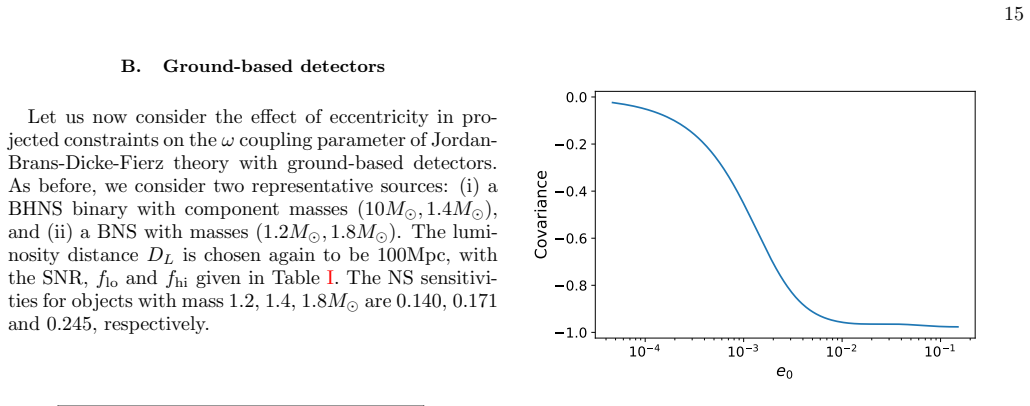
The central claim is that mild eccentricity first weakens and then strengthens projected constraints on Jordan-Brans-Dicke-Fierz theory. The paper derives the scalar-tensor correction to the stationary-phase Fourier phase of an eccentric inspiral to $O(e_0^8)$ at leading Newtonian order, and this correction enters at $-1$PN order relative to the leading general-relativistic term. In a Fisher analysis of a future signal consistent with general relativity, that term creates a partial covariance between $e_0$ and the scalar-tensor parameter $b$, so the inferred lower bound on $\omega$ drops as $e_0$ grows from $10^{-4}$ toward $10^{-2}$; above $e_0\approx 0.03$ the covariance weakens and the bound recovers. With third-generation ground-based detectors the recovered constraints can beat the current solar-system bound by roughly an order of magnitude, and LISA reaches comparable or better levels for the intermediate-mass-ratio sources studied.
Load-bearing premise
The forecast stands on the newly derived scalar-tensor phase corrections, which are computed only at leading Newtonian order in the post-Newtonian expansion and are never tested against a numerical scalar-tensor inspiral; if higher-order scalar-tensor terms are comparable to the leading dipole term in the low-frequency band, the covariance and the $e_0\approx 0.03$ recovery curve could shift.
Editorial extensions
If this is right
- For initial eccentricities below about $0.01$, analyses that ignore the scalar-tensor eccentric corrections will overstate the projected bound on $\omega$ by a factor of roughly three to five.
- The bound recovers once $e_0$ exceeds about $0.03$, so future eccentric detections do not monotonically degrade modified-gravity tests; the turning point is a target for waveform development.
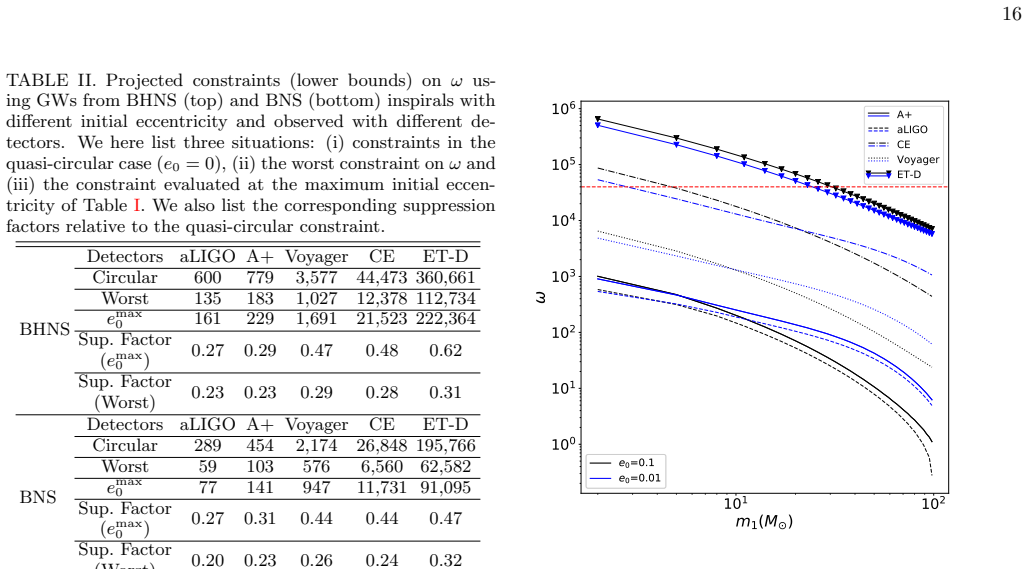
- Third-generation ground-based detectors and LISA can constrain $\omega$ to levels an order of magnitude stronger than the current solar-system bound for the black-hole-neutron-star and neutron-star-neutron-star sources considered.
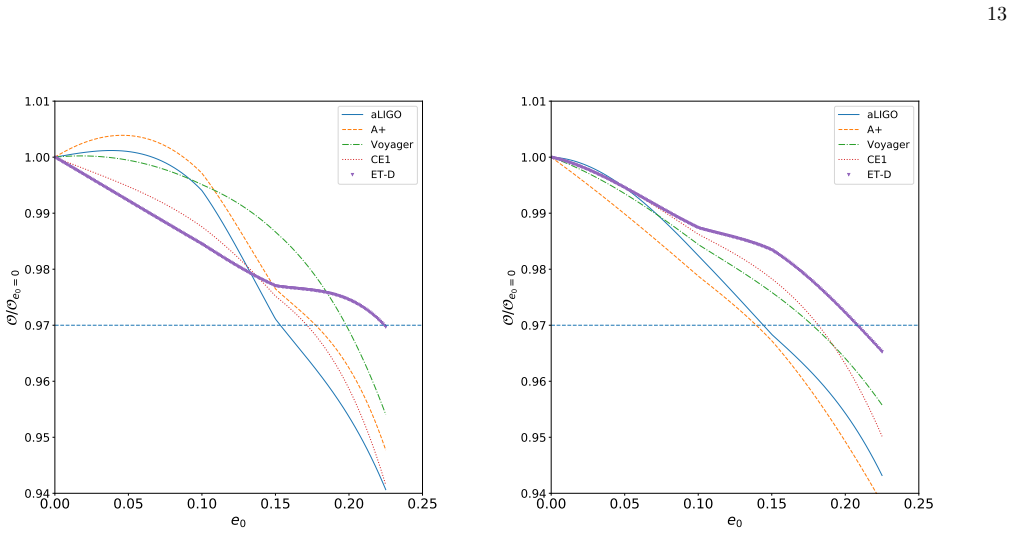
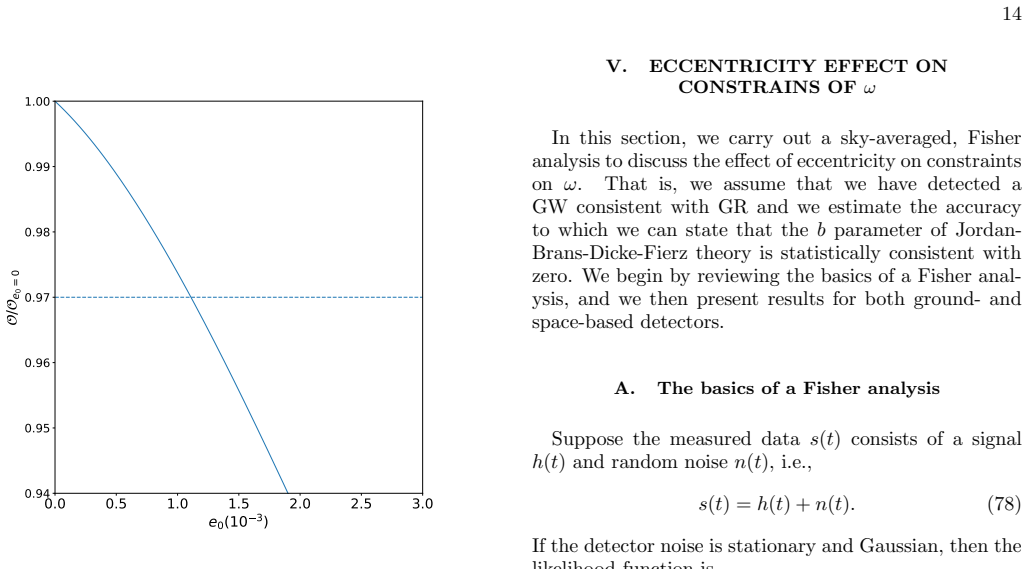
- The analytic model is valid up to $e_0\sim 0.14$–$0.22$ for ground-based comparable-mass sources but only up to $\sim 10^{-3}$ for the LISA intermediate-mass-ratio sources, so the LISA forecast does not reach the recovery regime.
Reading between the lines
- The non-monotonic constraint curve is likely generic: any modified-gravity parameter whose phase correction enters at negative post-Newtonian order will partially cross-correlate with $e_0$ at small eccentricity, and the turnover point should shift with the theory's frequency dependence.
- The degeneracy could in principle be broken independently of waveform accuracy by using astrophysical priors on the initial eccentricity, for example from the formation channels that produce eccentric black-hole-neutron-star mergers, which would restore tighter bounds at low $e_0$.
- One testable extension is to repeat the Fisher forecast with priors on $e_0$ informed by eccentric-binary population synthesis; the predicted deterioration factor of roughly two to five would shrink if the eccentricity is well constrained.
- Another consequence left implicit by the paper is that the same $-1$PN scalar-tensor phase will bias estimates of the chirp mass and symmetric mass ratio if analyzed with quasi-circular general-relativistic templates; quantifying that bias is a direct follow-up.
Signed reviews
Editorial analysis
A structured set of objections, weighed in public.
Circularity Check
No significant circularity: the ST waveform and Fisher forecast are derived from the field-theory flux equations, not fitted or renamed inputs.
full rationale
The paper's derivation chain is self-contained rather than circular. The ST-sector phase (Eq. 37) is obtained by solving the Jordan-Brans-Dicke-Fierz flux equations (Eqs. 9-12) from Eardley and Will-Zaglauer, expanding in the small parameters b and e0, and then applying the SPA; the b parameter is not fitted to any target constraint on omega. The Fisher analysis assumes a GR signal (b=0) and estimates the covariance of b and e0 from waveform derivatives, so the reported deterioration and recovery of the omega bound is an emergent model prediction, not an input. The overlap validation in Section IV compares the GR limit (b=0) of the analytic model to an independent 3PN eccentric TaylorT4 model, which tests the post-circular expansion rather than encoding the modified-gravity result. Citations to Yunes et al. [41] and related works supply the GR-phase and post-circular framework, but these are parameter-free prior derivations, and the paper's new ST-sector calculation is carried out explicitly in Eqs. (21)-(37) rather than imported by citation. Footnote 2 explicitly limits the ST sector to leading PN order, and Section IV does not validate the ST terms against a numerical scalar-tensor evolution; these are robustness caveats, not instances of circular reasoning. The minor self-citations in the paper are not load-bearing in the sense required for circularity: the central forecast would stand or fall on the correctness of the derived waveform, not on an unverified self-citation chain.
Assumptions & free parameters
assumptions (5)
- domain assumption The post-circular expansion truncated at O(e0^8) accurately represents eccentric inspiral waveforms in the regime studied.
- domain assumption No-hair theorems hold for JBD black holes, so BH-NS binaries are the relevant sources for ST tests.
- domain assumption The restricted PN approximation with Newtonian amplitudes and 3PN phase suffices for parameter estimation.
- standard math The Fisher information matrix provides reliable projected errors at high SNR.
- standard math The stationary phase approximation with a single stationary point per harmonic is valid.
Cite this review
Pith. "Pith review of Improved Constraints on Modified Gravity with Eccentric Gravitational Waves." pith.science (2026). https://pith.science/paper/5JBEPLVG
@misc{pith2026190807089,
  author       = {Pith},
  title        = {Pith review of: Improved Constraints on Modified Gravity with Eccentric Gravitational Waves},
  year         = {2026},
  howpublished = {\url{https://pith.science/paper/5JBEPLVG}},
  note         = {Machine review of arXiv:1908.07089}
}
read the original abstract
Recent gravitational wave observations have allowed stringent new constraints on modifications to General Relativity (GR) in the extreme gravity regime. Although these observations were consistent with compact binaries with no orbital eccentricity, gravitational waves emitted in mildly eccentric binaries may be observed once detectors reach their design sensitivity. In this paper, we study the effect of eccentricity in gravitational wave constraints of modified gravity, focusing on Jordan-Brans- Dicke-Fierz theory as an example. Using the stationary phase approximation and the post-circular approximation (an expansion in small eccentricity), we first construct an analytical expression for frequency-domain gravitational waveforms produced by inspiraling compact binaries with small eccentricity in this theory. We then calculate the overlap between our approximate analytical waveforms and an eccentric numerical model (TaylorT4) to determine the regime of validity (in eccentricity) of the former. With this at hand, we carry out a Fisher analysis to determine the accuracy to which Jordan-Brans-Dicke-Fierz theory could be constrained given future eccentric detections consistent with General Relativity. We find that the constraint on the theory initially deteriorates (due to covariances between the eccentricity and the Brans-Dicke coupling parameter), but then it begins to recover, once the eccentricity is larger than approximately 0.03. We also find that third-generation ground-based detectors and space-based detectors could allow for constraints that are up to an order of magnitude more stringent than current Solar System bounds. Our results suggest that waveforms in modified gravity for systems with moderate eccentricity should be developed to maximize the theoretical physics that can be extracted in the future.
Figures


Figures from the paper (6 more)

Forward citations
Cited by 3 Pith papers
-
Constraining Dipole Radiation with Multiband Gravitational Waves from Eccentric Binary Black Holes
Multiband observations of eccentric binary black holes can constrain dipole-radiation deviations from general relativity to |b| ≲ 10^{-7} for a GW231123-like event when combining one year of space-based data with grou...
-
A parametrized test of general relativity for inspiralling eccentric binaries in LISA
For eccentric black-hole binaries observed by LISA, a parametrized deformation of the periastron-precession rate could be constrained to |δα|≲10^-4 at 90% credibility with the full-model template.
-
Tidal effects in gravitational waves from neutron stars in scalar-tensor theories of gravity
Tidal contributions to neutron-star binary gravitational-wave phase in scalar-tensor gravity involve scalar, tensor, and mixed Love numbers, and generally combine to reduce the net tidal signal below the general-relat...
Reference graph
Works this paper leans on
-
[1]
and to leading Newtonian order in the PN approximation2. We find that the eccentric ST cor- rections, just like in the GR case, introduce negative PN order corrections, relative to the leading Newtonian or- der term in the quasi-circular limit. Such terms are very large at large separations (or small velocities) provided the eccentricity is not vanishingly...
- [2]
-
[3]
andO(b1), we find τ =τGR +τBD, (34) where τGR is given in Eq. (4.27) of [41] and τBD is τBD =− 5 96 ˜bM (2πMF )−10/3 [ 1 + (785 72 χ−13/9− 1511 72 χ−19/9 ) e2 0 + (87685679 328320 χ−38/9− 5222765 32832 χ−32/9 −5021053 65664 χ−19/9 + 4171333 164160 χ−13/9 ) e4 0 + ( −30003281383 10165760 χ−19/3 + 678205125 369664 χ−17/3 + 291379511317 149713920 χ−38/9 8 −14...
-
[4]
in the PC expansion and to leading Newtonian order in the PN approximation. This is the most accurate (in the PN and PC sense) Fourier phase in Jordan-Brans-Dicke-Fierz theory we can construct as of the writing of this paper. 9 B. Numerical model In the next section, we estimate roughly the maxi- mum initial eccentricity the previous analytical model is v...
work page 1920
-
[5]
(28) must be rescaled as h = √ 3/2(F+h+ +F×h×)
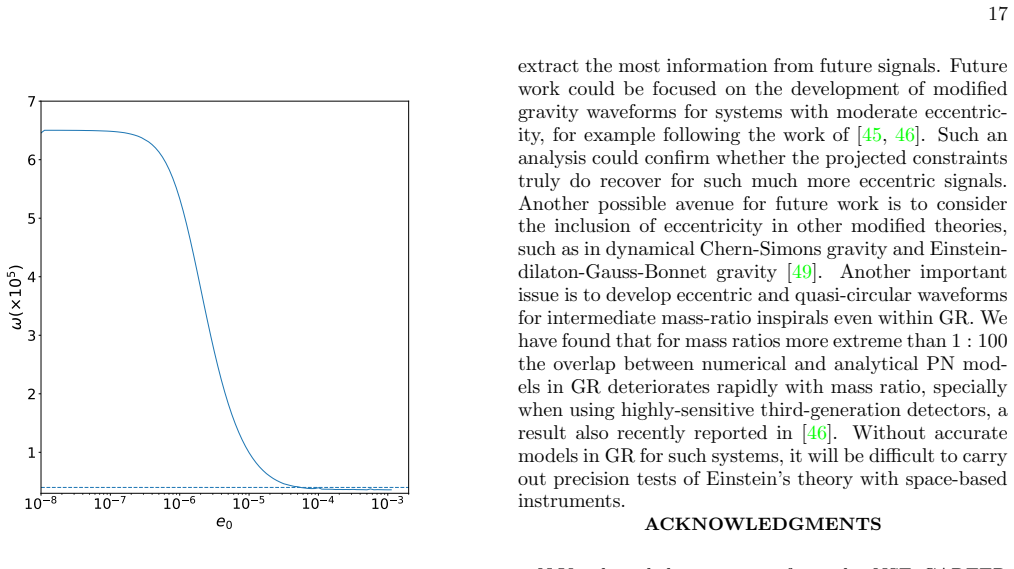
In addition, because of the triangular shape of the LISA configuration, the strain in Eq. (28) must be rescaled as h = √ 3/2(F+h+ +F×h×). Figure 8 shows the projected constraint onω as a func- tion of initial eccentricity e0, terminating the curve at the maximum initial eccentricity we found in Sec. IV C. As in the ground-based case, the projected constrai...
-
[6]
B. P. Abbott et al. (LIGO Scientific Collaboration and Virgo Collaboration), Phys. Rev. Lett. 116, 061102 (2016), URL https://link.aps.org/doi/10. 1103/PhysRevLett.116.061102
work page 2016
-
[7]
B. P. Abbott et al. (LIGO Scientific Collaboration and Virgo Collaboration), Phys. Rev. Lett. 116, 241103 (2016), URL https://link.aps.org/doi/10. 1103/PhysRevLett.116.241103
work page 2016
-
[9]
B. P. Abbott et al. (LIGO Scientific Collaboration and Virgo Collaboration), The Astrophysical Journal Let- ters 851, L35 (2017), URL http://stacks.iop.org/ 2041-8205/851/i=2/a=L35
work page 2017
Show all 74 references
-
[10]
B. P. Abbott et al. (LIGO Scientific Collaboration and Virgo Collaboration), Phys. Rev. Lett. 119, 141101 (2017), URL https://link.aps.org/doi/10. 1103/PhysRevLett.119.141101
2017
-
[11]
B. P. Abbott et al. (LIGO Scientific Collaboration and Virgo Collaboration), Phys. Rev. Lett. 119, 161101 (2017), URL https://link.aps.org/doi/10. 1103/PhysRevLett.119.161101
2017
-
[12]
B. P. Abbott et al. (LIGO Scientific Collaboration and Virgo Collaboration), Phys. Rev. Lett. 116, 241102 (2016), URL https://link.aps.org/doi/10. 1103/PhysRevLett.116.241102
2016
-
[13]
B. P. Abbott et al. (LIGO Scientific Collaboration and Virgo Collaboration), The Astrophysical Journal Let- ters 818, L22 (2016), URL http://stacks.iop.org/ 2041-8205/818/i=2/a=L22
2016
-
[14]
P. C. Peters and J. Mathews, Phys. Rev. 131, 435 (1963), URL https://link.aps.org/doi/10.1103/ PhysRev.131.435
1963
-
[15]
P. C. Peters, Phys. Rev. 136, B1224 (1964), URL https: //link.aps.org/doi/10.1103/PhysRev.136.B1224
1964 doi
-
[17]
Antonini and H
F. Antonini and H. B. Perets, The Astrophysical Jour- nal 757, 27 (2012), URL http://stacks.iop.org/ 0004-637X/757/i=1/a=27
2012
-
[18]
Samsing, M
J. Samsing, M. MacLeod, and E. Ramirez-Ruiz, The Astrophysical Journal 784, 71 (2014), URL http:// stacks.iop.org/0004-637X/784/i=1/a=71
2014
-
[19]
T. A. Thompson, The Astrophysical Journal 741, 82 (2011), URL http://stacks.iop.org/0004-637X/741/ i=2/a=82
2011
-
[20]
W. E. East, S. T. McWilliams, J. Levin, and F. Pretorius, Phys. Rev. D 87, 043004 (2013), URL https://link. aps.org/doi/10.1103/PhysRevD.87.043004
2013 doi
-
[21]
R. M. O’Leary, B. Kocsis, and A. Loeb, MNRAS 395, 2127 (2009), 0807.2638
2009 arXiv
-
[22]
Willems, A
B. Willems, A. Vecchio, and V. Kalogera, Phys. Rev. Lett. 100, 041102 (2008), URL https://link.aps.org/ doi/10.1103/PhysRevLett.100.041102
2008 doi
-
[23]
Berentzen, M
I. Berentzen, M. Preto, P. Berczik, D. Merritt, and R. Spurzem, Astrophys. J. 695, 455 (2009), 0812.2756
2009 arXiv
-
[24]
E. A. Huerta, P. Kumar, S. T. McWilliams, R. O’Shaughnessy, and N. Yunes, Phys. Rev. D 90, 084016 (2014), URL https://link.aps.org/doi/10. 1103/PhysRevD.90.084016
2014
-
[25]
Amaro-Seoane, H
P. Amaro-Seoane, H. Audley, S. Babak, J. Baker, E. Ba- rausse, P. Bender, E. Berti, P. Binetruy, M. Born, D. Bor- toluzzi, et al., ArXiv e-prints (2017), 1702.00786
2017 arXiv
-
[26]
Martel and E
K. Martel and E. Poisson, Phys. Rev. D 60, 124008 (1999), URL https://link.aps.org/doi/10. 1103/PhysRevD.60.124008
1999
-
[27]
D. A. Brown and P. J. Zimmerman, Phys. Rev. D 81, 024007 (2010), URL https://link.aps.org/doi/ 10.1103/PhysRevD.81.024007
2010 doi
-
[28]
E. K. Porter and A. Sesana, ArXiv e-prints (2010), 1005.5296
2010 arXiv
-
[29]
Tessmer and A
M. Tessmer and A. Gopakumar, Phys. Rev. D 78, 084029 (2008), URL https://link.aps.org/doi/10. 1103/PhysRevD.78.084029
2008
-
[30]
E. A. Huerta and D. A. Brown, Phys. Rev. D87, 127501 (2013), 1301.1895
2013 arXiv
-
[31]
Cutler and M
C. Cutler and M. Vallisneri, Phys. Rev. D 76, 104018 (2007), URL https://link.aps.org/doi/10. 1103/PhysRevD.76.104018
2007
-
[32]
B. Sun, Z. Cao, Y. Wang, and H.-C. Yeh, Phys. Rev. D 92, 044034 (2015), URL https://link.aps.org/doi/ 10.1103/PhysRevD.92.044034
2015 doi
-
[33]
Wahlquist, General Relativity and Gravitation 19, 1101 (1987), ISSN 1572-9532, URL https://doi.org/ 10.1007/BF00759146
H. Wahlquist, General Relativity and Gravitation 19, 1101 (1987), ISSN 1572-9532, URL https://doi.org/ 10.1007/BF00759146
1987 doi
- [34]
-
[35]
Junker and G
W. Junker and G. Schaefer, MNRAS 254, 146 (1992)
1992
-
[36]
Blanchet and G
L. Blanchet and G. Schafer, Classical and Quantum Gravity 10, 2699 (1993)
1993
-
[37]
Gopakumar and B
A. Gopakumar and B. R. Iyer, Phys. Rev. D 65, 084011 (2002), URL https://link.aps.org/doi/10. 1103/PhysRevD.65.084011
2002
-
[38]
Damour, A
T. Damour, A. Gopakumar, and B. R. Iyer, Phys. Rev. D 70, 064028 (2004), URL https://link.aps.org/doi/ 10.1103/PhysRevD.70.064028
2004 doi
-
[39]
K. G. Arun, L. Blanchet, B. R. Iyer, and M. S. S. Qu- sailah, Phys. Rev. D 77, 064035 (2008), URL https: //link.aps.org/doi/10.1103/PhysRevD.77.064035
2008 doi
-
[40]
K. G. Arun, L. Blanchet, B. R. Iyer, and M. S. S. Qu- sailah, Phys. Rev. D 77, 064034 (2008), URL https: //link.aps.org/doi/10.1103/PhysRevD.77.064034
2008 doi
-
[41]
K. G. Arun, L. Blanchet, B. R. Iyer, and S. Sinha, Phys. Rev. D 80, 124018 (2009), URL https://link.aps.org/ doi/10.1103/PhysRevD.80.124018
2009 doi
-
[42]
Kr´ olak, K
A. Kr´ olak, K. D. Kokkotas, and G. Sch¨ afer, Phys. Rev. D 52, 2089 (1995), URL https://link.aps.org/doi/10. 1103/PhysRevD.52.2089
1995
-
[43]
Favata, Phys
M. Favata, Phys. Rev. Lett. 112, 101101 (2014), URL https://link.aps.org/doi/10.1103/PhysRevLett. 112.101101
2014 doi
-
[44]
Moore, M
B. Moore, M. Favata, K. G. Arun, and C. K. Mishra, Phys. Rev. D 93, 124061 (2016), URL https://link. aps.org/doi/10.1103/PhysRevD.93.124061
2016 doi
-
[45]
Yunes, K
N. Yunes, K. G. Arun, E. Berti, and C. M. Will, Phys. Rev. D 80, 084001 (2009), URL https://link.aps.org/ doi/10.1103/PhysRevD.80.084001
2009 doi
-
[46]
Tessmer, J
M. Tessmer, J. Hartung, and G. Sch¨ afer, Classical and Quantum Gravity 27, 165005 (2010), 1003.2735
2010 arXiv
-
[47]
Tessmer and G
M. Tessmer and G. Sch¨ afer, Phys. Rev. D 82, 124064 (2010), URL https://link.aps.org/doi/10. 1103/PhysRevD.82.124064
2010
-
[48]
Tanay, M
S. Tanay, M. Haney, and A. Gopakumar, Phys. Rev. D 93, 064031 (2016), URL https://link.aps.org/doi/ 10.1103/PhysRevD.93.064031
2016 doi
-
[49]
Moore, T
B. Moore, T. Robson, N. Loutrel, and N. Yunes, Class. Quant. Grav. 35, 235006 (2018), 1807.07163
2018 arXiv
- [50]
-
[51]
S. Ma, Z. Cao, C.-Y. Lin, H.-P. Pan, and H.-J. Yo, Phys. Rev. D 96, 084046 (2017), URL https://link.aps.org/ doi/10.1103/PhysRevD.96.084046
2017 doi
-
[52]
Mik´ oczi, B
B. Mik´ oczi, B. Kocsis, P. Forg´ acs, and M. Vas´ uth, Phys. Rev. D 86, 104027 (2012), URL https://link.aps.org/ doi/10.1103/PhysRevD.86.104027
2012 doi
- [53]
-
[54]
Brans and R
C. Brans and R. H. Dicke, Phys. Rev. 124, 925 (1961), URL https://link.aps.org/doi/10.1103/ PhysRev.124.925
1961
-
[55]
C. M. Will, IAU Symp. 261, 198 (2010)
2010
-
[56]
D. M. Eardley, Astrophys. J. 196, L59 (1975)
1975
-
[57]
C. M. Will, Astrophys. J. 214, 826 (1977)
1977
-
[58]
C. M. Will and H. W. Zaglauer, Astrophys. J. 346, 366 (1989)
1989
-
[59]
Bertotti, L
B. Bertotti, L. Iess, and P. Tortora, Nature (London) 425, 374 (2003)
2003
-
[60]
C. M. Will, Phys. Rev. D 50, 6058 (1994), URL https: //link.aps.org/doi/10.1103/PhysRevD.50.6058
1994 doi
-
[61]
P. D. Scharre and C. M. Will, Phys. Rev. D 65, 042002 (2002), URL https://link.aps.org/doi/10. 1103/PhysRevD.65.042002
2002
-
[62]
C. M. Will and N. Yunes, Classical and Quantum Gravity 21, 4367 (2004), gr-qc/0403100
2004 arXiv
- [63]
-
[64]
Berti, A
E. Berti, A. Buonanno, and C. M. Will, Phys. Rev. D 71, 084025 (2005), URL https://link.aps.org/doi/ 10.1103/PhysRevD.71.084025
2005 doi
-
[67]
S. W. Hawking, Commun. Math. Phys. 25, 167 (1972)
1972
-
[68]
T. P. Sotiriou and V. Faraoni, Phys. Rev. Lett. 108, 081103 (2012), 1109.6324
2012 arXiv
-
[69]
T. B. Littenberg and N. Yunes, Class. Quant. Grav. 36, 095017 (2019), 1811.01093
2019 arXiv
-
[70]
Yunes and E
N. Yunes and E. Berti, Phys. Rev. D77, 124006 (2008), [Erratum: Phys. Rev.D83,109901(2011)], 0803.1853
2008 arXiv
-
[71]
Yunes, A
N. Yunes, A. Buonanno, S. A. Hughes, M. Cole- man Miller, and Y. Pan, Phys. Rev. Lett. 104, 091102 (2010), 0909.4263
2010 arXiv
-
[72]
Akmal, V
A. Akmal, V. R. Pandharipande, and D. G. Ravenhall, Phys. Rev. C58, 1804 (1998), nucl-th/9804027
1998 arXiv
-
[73]
Loutrel, N
N. Loutrel, N. Yunes, and F. Pretorius, Phys. Rev. D 90, 104010 (2014), URL https://link.aps.org/doi/ 10.1103/PhysRevD.90.104010
2014 doi
-
[74]
Chatziioannou, N
K. Chatziioannou, N. Yunes, and N. Cornish, Phys.Rev. D86, 022004 (2012), 1204.2585
2012 arXiv
-
[75]
S. Droz, D. J. Knapp, E. Poisson, and B. J. Owen, Phys. Rev. D 59, 124016 (1999), URL https://link.aps.org/ doi/10.1103/PhysRevD.59.124016
1999 doi
-
[76]
K¨ onigsd¨ orffer and A
C. K¨ onigsd¨ orffer and A. Gopakumar, Phys. Rev. D 73, 124012 (2006), URL https://link.aps.org/doi/ 10.1103/PhysRevD.73.124012
2006 doi
-
[77]
Chamberlain and N
K. Chamberlain and N. Yunes, Phys. Rev. D 96, 084039 (2017), URL https://link.aps.org/doi/10. 1103/PhysRevD.96.084039
2017
-
[78]
Vallisneri, Phys
M. Vallisneri, Phys. Rev. D 77, 042001 (2008), URL https://link.aps.org/doi/10.1103/PhysRevD. 77.042001
2008 doi
Reviewed August 14, 2026 · model on record in the stance chip above.
Discussion (0). Continue with ORCID to comment.