REVIEW 74 references
How neutron star properties disfavor a nuclear chiral density wave
T0 review · reviewed 2026-08-12 · deepseek-v4-flash
Pith's one-line read Within this nucleon-meson model, a chiral density wave in neutron star cores is only stable for equations of state too soft to support observed two-solar-mass pulsars, predicting isotropic cores.
desk verdict A careful and honest model study whose central conclusion—no CDW in realistic neutron stars—rests on an uncontrolled one-loop Dirac sea term that the authors themselves flag. read the letter →
The pith
A machine-rendered reading of the paper's core claim, the machinery that carries it, and where it could break.
The reading
Solving the mean-field equations gives the phase diagram and the equation of state. The main result is a mismatch. The chiral density wave is thermodynamically preferred only for parameter sets in which the equation of state is very soft, meaning the maximum neutron star mass is far below two solar masses. The parameter sets that reproduce a realistic two-solar-mass pulsar do not allow the wave at all. This holds even when the authors choose the renormalization scale that most favors the wave, the stiffest reasonable incompressibility, and the largest allowed nucleon mass.
The calculation has caveats the authors state openly: the nucleon Yukawa couplings are large, so the one-loop vacuum contribution, which suppresses the wave, is not controlled by a small parameter; the CDW ansatz is only one of many possible modulations; and the effective potential is unbounded in one direction for the most realistic parameter sets. The conclusion is therefore a model-based prediction, not a QCD theorem.
Extended reading notes
Core claim
From the abstract: "the chiral density wave is energetically preferred only in a corner of the parameter space where matter is too soft to generate stars with realistic masses. Therefore, taking into account constraints from astrophysical data, our calculation predicts an isotropic neutron star core." If the paper is correct, the CDW phase is absent from the interior of realistic neutron stars within this nucleon-meson model class.
Load-bearing premise
The one-loop fermionic vacuum (Dirac sea) contribution is treated as quantitatively reliable even though the Yukawa couplings are large (g_sigma around 10), and this contribution is what drastically shrinks the CDW region. In Sec. III D the authors write: "it is conceivable that our approximation overestimates the effect of the nucleonic vacuum fluctuations due to the large values of the couplings" and that this "may result in an underestimate of the importance of the CDW." If a strong-coupling calculation reduces this contribution, the CDW could become preferred in parameter sets that still give two-solar-mass stars, overturning the central conclusion.
Editorial analysis
A structured set of objections, weighed in public.
Assumptions & free parameters
free parameters (6)
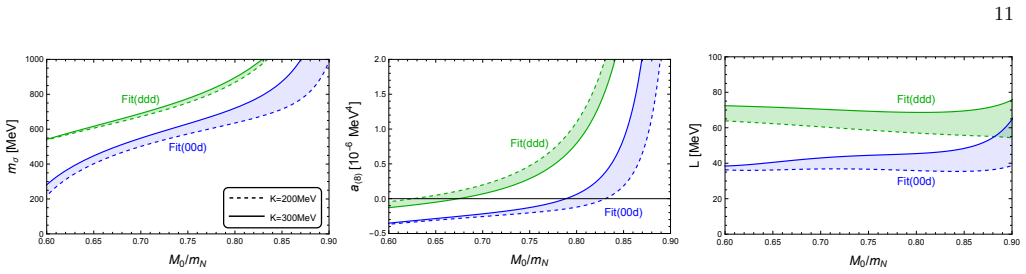
- M0 (Dirac effective mass at saturation) =
varied from 0.60 to 0.90 m_N; representative values 0.700, 0.760, 0.890 m_N
- K (incompressibility at saturation) =
fixed to 300 MeV for main results, with 200 MeV checked
- Vector meson quartic couplings d_omega, d_rho, d_omega_rho =
Fit(ddd): d ~ 10^3 to 10^4; Fit(00d): d_omega_rho ~ 1.5 to 1.9 x 10^3
- Renormalization scale parameter c =
c = 1 and c = c0 ~ 0.3 (Eq. 31)
- Scalar potential parameters a2, a3, a4 =
functions of d, M0, K; examples in Table I
- Yukawa couplings g_sigma, g_omega, g_rho =
g_sigma ~ 10.2; g_omega and g_rho from Eqs. (46), examples in Table I
assumptions (6)
- domain assumption A nucleon-meson mean-field Lagrangian captures the relevant degrees of freedom of dense hadronic matter, including chiral symmetry breaking.
- domain assumption The CDW ansatz of a single plane wave in the sigma-pi3 sector, Eq. (9), is the relevant anisotropic phase; other spatial modulations are neglected.
- ad hoc to paper One-loop fermionic vacuum fluctuations with renormalization scale sqrt(m_N^2 + (2cq)^2) give a quantitatively reliable effective potential at strong coupling.
- domain assumption Neutron star matter satisfies beta equilibrium and local electric charge neutrality at T = 0.
- domain assumption Anisotropic CDW matter can be described by isotropic TOV equations because wave-vector domains average out or the CDW core is small.
- domain assumption The chiEFT band for pure neutron matter from Ref. [41] is a valid external benchmark for the fit.
Cite this review
Pith. "Pith review of How neutron star properties disfavor a nuclear chiral density wave." pith.science (2026). https://pith.science/paper/5JRY4VHT
@misc{pith2026241108023,
  author       = {Pith},
  title        = {Pith review of: How neutron star properties disfavor a nuclear chiral density wave},
  year         = {2026},
  howpublished = {\url{https://pith.science/paper/5JRY4VHT}},
  note         = {Machine review of arXiv:2411.08023}
}
read the original abstract
Cold and dense matter may break rotational symmetry spontaneously and thus form an anisotropic phase in the interior of neutron stars. We consider the concrete example of an anisotropic chiral condensate in the form of a chiral density wave. Employing a nucleon-meson model and taking into account fermionic vacuum fluctuations, we improve and extend previous results by imposing the conditions of electric charge neutrality and electroweak equilibrium, by allowing for a more general form of the vector meson self-interactions, and by including properties of pure neutron matter into the fit of the model parameters. We find that the conditions inside neutron stars postpone the onset of the chiral density wave to larger densities compared to isospin-symmetric nuclear matter. While this still allows for the construction of stars with an anisotropic core, we find that the chiral density wave is energetically preferred only in a corner of the parameter space where matter is too soft to generate stars with realistic masses. Therefore, taking into account constraints from astrophysical data, our calculation predicts an isotropic neutron star core.
Figures


Figures from the paper (4 more)


Reference graph
Works this paper leans on
-
[1]
Vacuum In the vacuum, where there is no CDW, i.e., q = 0, we require ϕ = ⟨σ⟩ = fπ. This condition and the expression for the pion mass in our model (obtained by temporarily reinstating pion fluctuations) yield a1 = m2 π ≃ 1.96 × 10⁴ MeV2, ϵ = fπm2 π ≃ 1.80 × 10⁶ MeV3. Due to ϕ = fπ the nucleon mass in the vacuum is mN = gσfπ, which we use to fix gσ ≃ 10.2...
-
[2]
Symmetric matter at saturation We can express the Yukawa coupling constants for the vector mesons in terms of the saturation properties of symmetric nuclear matter, g2 ω = m2 ω 2n0 (µ0 − µ∗ 0) " 1 + s 1 + 4dωn0(µ0 − µ∗ 0) m4ω # , (46a) g2 ρ = 3π2m2 ρ k3 F S − k2 F 6µ∗ 0 1 + dωρω2 0 m2ρ , (46b) where µ∗ 0 = p k2 F + M 2 0 and kF = (3π2n0/2)1/3, and where ω...
-
[3]
Pure neutron matter Besides the freedom in M0 and K, it remains to fix the vector meson self-couplings dω, dρ, dωρ. If the mesonic self-interactions are constructed from chirally invariant terms, one finds that there are two independent couplings, dω = dρ and dωρ, see for instance Appendix A of Ref. [18]. Since chiral symmetry is broken explicitly, one ma...
-
[4]
M. Buballa and S. Carignano, Prog. Part. Nucl. Phys. 81, 39 (2015), 1406.1367
arXiv 2015
- [5]
- [6]
- [7]
-
[8]
M. G. Alford, A. Schmitt, K. Rajagopal, and T. Sch¨ afer, Rev.Mod.Phys. 80, 1455 (2008), 0709.4635
arXiv 2008
Show all 74 references
-
[9]
M. G. Alford, J. A. Bowers, and K. Rajagopal, Phys. Rev. D 63, 074016 (2001), hep-ph/0008208
2001 arXiv
-
[10]
Therefore, a controlled approximation would require more sophisticated (strong-coupling) methods beyond our one-loop calculation of the pressure
and the mean-field approximation is a drastic simplification to begin with. Therefore, a controlled approximation would require more sophisticated (strong-coupling) methods beyond our one-loop calculation of the pressure. More concretely, while at weak coupling the Dirac sea c...
- [11]
- [12]
-
[13]
Pitsinigkos and A
S. Pitsinigkos and A. Schmitt, Phys. Rev. D 109, 014024 (2024), 2309.01603
2024 arXiv
- [14]
-
[15]
Boguta, Phys
J. Boguta, Phys. Lett. 120B, 34 (1983)
1983
-
[16]
Boguta and J
J. Boguta and J. Kunz, Nucl. Phys. A501, 637 (1989)
1989
-
[17]
Floerchinger and C
S. Floerchinger and C. Wetterich, Nucl.Phys. A890-891, 11 (2012), 1202.1671
2012 arXiv
-
[18]
Drews, T
M. Drews, T. Hell, B. Klein, and W. Weise, Phys. Rev. D 88, 096011 (2013), 1308.5596
2013 arXiv
- [19]
-
[20]
E. S. Fraga, M. Hippert, and A. Schmitt, Phys. Rev. D 99, 014046 (2019), 1810.13226
2019 arXiv
- [21]
-
[22]
E. S. Fraga, R. da Mata, S. Pitsinigkos, and A. Schmitt, Phys. Rev. D 106, 074018 (2022), 2206.09219
2022 arXiv
- [23]
-
[24]
I. E. Frolov, V. C. Zhukovsky, and K. G. Klimenko, Phys.Rev. D82, 076002 (2010), 1007.2984
2010 arXiv
-
[25]
Carignano and M
S. Carignano and M. Buballa, Acta Phys. Polon. Supp. 5, 641 (2012), 1111.4400
2012 arXiv
-
[26]
Carignano, M
S. Carignano, M. Buballa, and B.-J. Schaefer, Phys. Rev. D 90, 014033 (2014), 1404.0057
2014 arXiv
- [27]
-
[28]
Adhikari, J
P. Adhikari, J. O. Andersen, and P. Kneschke, Phys. Rev. D 96, 016013 (2017), [Erratum: Phys.Rev.D 98, 099902 (2018)], 1702.01324
2017 arXiv
-
[29]
J. O. Andersen and P. Kneschke, Phys. Rev. D 97, 076005 (2018), 1802.01832
2018 arXiv
-
[30]
E. J. Ferrer and V. de la Incera, Phys. Rev. D 102, 014010 (2020), 1902.06810. 21
2020 arXiv
- [31]
-
[32]
Lakaschus, M
P. Lakaschus, M. Buballa, and D. H. Rischke, Phys. Rev. D 103, 034030 (2021), 2012.07520
2021 arXiv
-
[33]
Buballa, S
M. Buballa, S. Carignano, and L. Kurth, Eur. Phys. J. ST 229, 3371 (2020), 2006.02133
2020 arXiv
-
[34]
Heinz, F
A. Heinz, F. Giacosa, and D. H. Rischke, Nucl. Phys. A 933, 34 (2015), 1312.3244
2015 arXiv
- [35]
-
[36]
Abuki, D
H. Abuki, D. Ishibashi, and K. Suzuki, Phys. Rev. D 85, 074002 (2012), 1109.1615
2012 arXiv
- [37]
-
[38]
R. D. Pisarski, A. M. Tsvelik, and S. Valgushev, Phys. Rev. D 102, 016015 (2020), 2005.10259
2020 arXiv
-
[39]
Winstel and S
M. Winstel and S. Valgushev, in Excited QCD 2024 Workshop (2024), 2403.18640
2024 arXiv
-
[40]
N. K. Glendenning, Phys. Rev. D46, 1274 (1992)
1992
-
[41]
Heiselberg, C
H. Heiselberg, C. J. Pethick, and E. F. Staubo, Phys. Rev. Lett. 70, 1355 (1993)
1993
-
[42]
Carignano, E
S. Carignano, E. J. Ferrer, V. de la Incera, and L. Paulucci, Phys. Rev. D 92, 105018 (2015), 1505.05094
2015 arXiv
-
[43]
E. J. Ferrer and V. de la Incera, Universe 7, 458 (2021), 2201.04032
2021 arXiv
- [44]
-
[45]
I. Tews, J. Carlson, S. Gandolfi, and S. Reddy, Astrophys. J. 860, 149 (2018), 1801.01923
2018 arXiv
-
[46]
M. G. Alford, L. Brodie, A. Haber, and I. Tews, Phys. Rev. C 106, 055804 (2022), 2205.10283
2022 arXiv
-
[47]
N. K. Glendenning, Compact Stars (Springer, 2000), ISBN 978-0-387-98977-8
2000
-
[48]
A. W. Steiner, M. Prakash, J. M. Lattimer, and P. J. Ellis, Phys. Rept. 411, 325 (2005), nucl-th/0410066
2005 arXiv
-
[49]
Kapusta and C
J. Kapusta and C. Gale, Finite-temperature field theory: principles and applications (Cambridge University Press, Cam- bridge, 2023), 2nd ed
2023
-
[50]
Kurkela, P
A. Kurkela, P. Romatschke, and A. Vuorinen, Phys.Rev. D81, 105021 (2010), 0912.1856
2010 arXiv
-
[51]
E. S. Fraga, L. F. Palhares, and T. E. Restrepo, Phys. Rev. D 108, 034026 (2023), 2303.12140
2023 arXiv
- [52]
-
[53]
J. P. Blaizot, J. F. Berger, J. Decharge, and M. Girod, Nucl.Phys. A591, 435 (1995)
1995
-
[54]
Vretenar, T
D. Vretenar, T. Niksic, and P. Ring, Phys. Rev. C 68, 024310 (2003), nucl-th/0302070
2003 arXiv
-
[55]
D. H. Youngblood, Y. W. Lui, H. L. Clark, B. John, Y. Tokimoto, et al., Phys.Rev. C69, 034315 (2004)
2004
-
[56]
Shlomo, V
S. Shlomo, V. M. Kolomietz, and G. Col` o, Eur. Phys. J. A 30, 23 (2006)
2006
-
[57]
Liu, J.-D
X. Liu, J.-D. Jiang, X. Chen, X.-J. Wu, B. He, and X.-H. Li, Phys. Rev. C 110, 034329 (2024)
2024
-
[58]
Skokov, B
V. Skokov, B. Friman, E. Nakano, K. Redlich, and B. J. Schaefer, Phys. Rev. D 82, 034029 (2010), 1005.3166
2010 arXiv
-
[59]
Adhikari et al
D. Adhikari et al. (PREX), Phys. Rev. Lett. 126, 172502 (2021), 2102.10767
2021 arXiv
- [60]
- [61]
-
[62]
Adhikari et al
D. Adhikari et al. (CREX), Phys. Rev. Lett. 129, 042501 (2022), 2205.11593
2022 arXiv
-
[63]
J. M. Lattimer, Particles 6, 30 (2023), 2301.03666
2023 arXiv
-
[64]
Giacalone, G
G. Giacalone, G. Nijs, and W. van der Schee, Phys. Rev. Lett. 131, 202302 (2023), 2305.00015
2023 arXiv
-
[65]
R. C. Tolman, Relativity, Thermodynamics and Cosmology (Oxford University Press, 1934)
1934
-
[66]
R. C. Tolman, Phys. Rev. 55, 364 (1939)
1939
-
[67]
J. R. Oppenheimer and G. M. Volkoff, Phys. Rev. 55, 374 (1939)
1939
-
[68]
Kovensky, A
N. Kovensky, A. Poole, and A. Schmitt, Phys. Rev. D 105, 034022 (2022), 2111.03374
2022 arXiv
-
[69]
J. M. Bardeen, K. S. Thorne, and D. W. Meltzer, Astrophys. J. 145, 505 (1966)
1966
-
[70]
Fonseca et al., Astrophys
E. Fonseca et al., Astrophys. J. Lett. 915, L12 (2021), 2104.00880
2021 arXiv
-
[71]
R. W. Romani, D. Kandel, A. V. Filippenko, T. G. Brink, and W. Zheng, Astrophys. J. Lett. 934, L17 (2022), 2207.05124
2022 arXiv
-
[72]
Christian, A
J.-E. Christian, A. Zacchi, and J. Schaffner-Bielich, Eur. Phys. J. A 54, 28 (2018), 1707.07524
2018 arXiv
- [73]
-
[74]
Kovensky, A
N. Kovensky, A. Poole, and A. Schmitt, SciPost Phys. 15, 162 (2023), 2302.10675
2023 arXiv
Reviewed August 12, 2026 · model on record in the stance chip above.
Discussion (0). Continue with ORCID to comment.