REVIEW 3 major objections 3 minor 1 cited by
Asymmetric Non-local Neural Networks for Semantic Segmentation
T0 review · 3 major / 3 minor · reviewed 2026-08-14 · deepseek-v4-flash
Pith's one-line read Replacing a non-local block's dense pairwise attention with 110 pyramid-pooled anchors keeps segmentation accuracy while cutting memory by 28x.
desk verdict Good efficiency engineering for non-local blocks, but the 'without sacrificing performance' claim is not backed by the reported experiments. read the letter →
The pith
A machine-rendered reading of the paper's core claim, the machinery that carries it, and where it could break.
The reading
What carries the argument
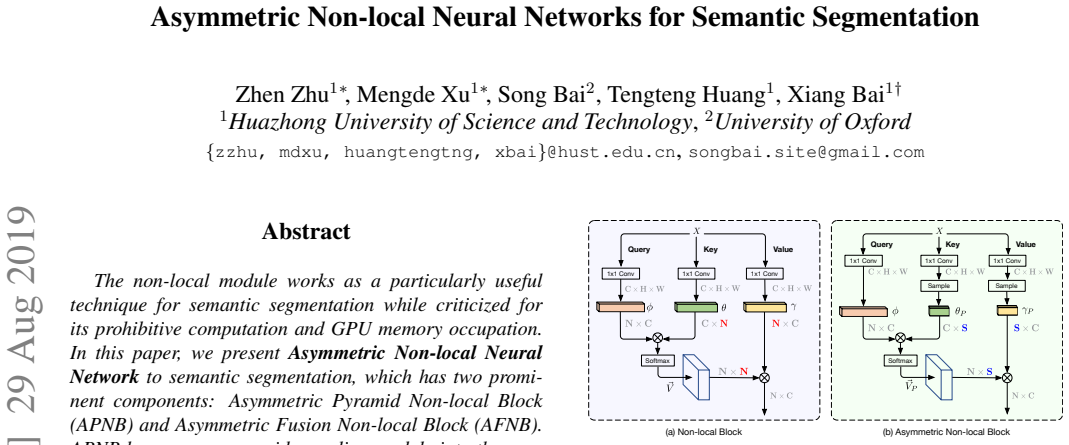
The load-bearing mechanism is the asymmetric non-local block built on the observation that the output size of a non-local block is fixed once the query branch's $N$ and channel count are set; the key and value branches may carry any number $S$ of locations. APNB instantiates this by inserting a parameter-free spatial pyramid pooling module---adaptive average pools of sizes $1,3,6,8$, flattened and concatenated---after the key and value embeddings, producing $S=110$ anchor points. The same construction with two input feature maps gives AFNB, which fuses Stage4 and Stage5 features through the same $N\times S$ attention pattern. Sharing the $1\times 1$ convolutions for key and value further cuts parameters. The mechanism carrying the argument is therefore the replacement of the dense $N\times N$ similarity matrix by an $N\times S$ one, with $S$ chosen so that the pooled anchors carry global, multi-scale statistics.
What would settle it
Run the exact same training setup but replace the pyramid average pooling with a random selection of the same $110$ anchor locations from the key and value maps. If Cityscapes validation mIoU stays near $79.9$, the pyramid statistics are not what preserves accuracy; if it drops, the pyramid sampling is carrying the claim. A second check is to plot mIoU against anchor count $S\in\{50,110,225\}$: if accuracy keeps rising past $110$, the 'without sacrificing performance' claim is only partial.
Extended reading notes
Core claim
The central claim is that a non-local block's two large matrix multiplications, each $O(CH^2W^2)$, can be made asymmetric: only the query branch keeps all $N=H\cdot W$ locations, while the key and value branches are subsampled to $S$ representative points. Since the output shape of a non-local block is determined by the query and the channel dimension, changing $N$ to $S$ in the key/value branches leaves the output unchanged. The paper's specific instantiation is spatial pyramid average pooling with output sizes $\{1,3,6,8\}$, giving $S=110$ anchors, which reduces the multiplications to $O(CNS)$ and, at $H=128, W=256$, saves roughly $298\times$ of the multiplication cost. Empirically the approximation costs nothing: replacing a non-local block with APNB gives $78.6$ validation mIoU against $78.4$ for the non-local block, and the full AFNB+APNB model reaches $79.9$ on Cityscapes validation and $81.3$ on the test set. The ablation also shows that pyramid pooling outperforms max, random, and flat average sampling at equal anchor counts, and that accuracy rises with more anchors, which is why the paper attributes the preserved accuracy to the pyramid statistics rather than to the anchor count alone.
Load-bearing premise
The load-bearing premise is that the $S=110$ anchor points produced by pyramid average pooling over the key and value features preserve enough information for the attention operation, so replacing every pixel location with these anchors does not cost accuracy; the paper supports this only by experiments, with no error bound or theoretical guarantee.
Editorial extensions
If this is right
- A non-local block can be made roughly $298\times$ cheaper in matrix-multiplication cost at a $256\times 128$ input by using $S=110$ anchors, with no loss of validation accuracy ($78.6$ vs $78.4$ mIoU on Cityscapes).
- At the same input size APNB uses about $28\times$ less GPU memory ($277$ vs $7797$ MB) and runs about $6\times$ faster ($30.8$ vs $179.4$ ms) than the standard non-local block.
- Long-range fusion of Stage4 and Stage5 features through AFNB improves over a common fusion module ($77.1$ vs $76.5$ mIoU), and the full model with both APNB and AFNB reaches $79.9$ mIoU on Cityscapes validation.
- On the test set of Cityscapes the full network reports $81.3$ mIoU, on ADE20K validation $45.24$ mIoU, and on PASCAL Context validation $52.8$ mIoU, each above the other listed methods.
Reading between the lines
- A testable extension is to apply the same asymmetric sampling to other attention-based tasks, since the output-shape argument only requires the query branch to keep all locations; the paper mentions future vision tasks but does not try them.
- The anchor count $S=110$ was tuned on Cityscapes; on a 150-class dataset like ADE20K the curve in Table 7 might shift, so a grid over $S$ there would show whether the no-sacrifice claim generalizes.
- The full model concatenates Stage5 features alongside AFNB's output, which the paper says protects training; ablating that skip connection would quantify how much of AFNB's benefit is real fusion versus stabilization.
Signed reviews
Editorial analysis
A structured set of objections, weighed in public.
Referee Report
Summary. The manuscript proposes two non-local network variants for semantic segmentation: the Asymmetric Pyramid Non-local Block (APNB), which uses spatial pyramid pooling to sub-sample the key and value branches of the standard non-local block so that the attention matrix is N x S with S=110 instead of N x N, and the Asymmetric Fusion Non-local Block (AFNB), which adapts the same idea to fuse features from different stages. The network is built on a ResNet-101 FCN and evaluated on Cityscapes, ADE20K, and PASCAL Context, with additional results on COCO-Stuff-10K and NYUD-V2 in the appendix. The paper reports state-of-the-art or competitive mIoU scores and large efficiency gains: for a 256 x 128 input, APNB is about 6 times faster and uses about 28 times less GPU memory than a standard non-local block. Ablation studies on Cityscapes validation compare the proposed blocks with non-local and fusion baselines.
Significance. If the accuracy-parity claim holds, APNB is a genuinely useful contribution: it replaces the quadratic cost of non-local attention with a simple, parameter-free sampling module, and the efficiency gains are directly measured and backed by released code. The efficiency evidence is strong and concrete. However, the paper's central claim that APNB reduces computation 'without sacrificing performance' is not currently established: the only head-to-head evidence is a single-run 0.2 mIoU difference that is within the paper's own documented hardware/toolchain noise, and the APNB comparison is confounded by parameter sharing between the key and value branches. The AFNB/APNB combination is interesting, but the controlled evidence needs strengthening before the main claim can be accepted.
major comments (3)
- [Section 4.4, Table 6; Appendix C] The only evidence supporting the central claim that APNB does not sacrifice accuracy is the row pair '+ NB 78.4' vs '+ APNB 78.6'. Appendix C reports that the same model trained on 8x Titan V is about 0.5 mIoU better than when trained on 8x Titan Xp, and all ablation tables report single-run point estimates without variance. A 0.2 mIoU difference is therefore within the noise level the authors themselves document. To support the parity claim, the paper should report mean and standard deviation over multiple seeds (at least three) for the key rows, and should state the seeding protocol in the implementation details.
- [Section 3.4 and Figure 3; Section 3.1; Table 1] The comparison between APNB and the non-local block is confounded. Table 1 states that APNB and NB are 'entirely identical' apart from the pooling layers, but Section 3.4 says that in APNB the 1x1 convolutions W_theta and W_gamma share parameters, whereas the standard non-local block in Section 3.1 uses three separate 1x1 convolutions W_phi, W_theta, and W_gamma. The +APNB versus +NB comparison therefore changes two things at once: the pyramid sampling module and the weight-sharing scheme. The observed parity, or the small 0.2 gain, could be caused by the regularization effect of weight sharing alone. Please run and report NB with shared theta/gamma weights and APNB with separate weights, or otherwise isolate the effect of the pyramid sampling module.
- [Section 4.4, Tables 6 and 7] There is an apparent inconsistency in the ablation numbers. Table 7's default row (pyramid average, n=(1,3,6,8), S=110) reports 79.9 mIoU, which matches the Full model in Table 6, while Table 6's '+ APNB' row reports 78.6 mIoU for what is described as the same module. The text does not state whether the Table 7 experiments are run with APNB alone or with the full model including AFNB. This must be clarified, because Table 7 is used to select the pooling sizes and the sampling method; if Table 7 is the +APNB-alone configuration, the numbers are inconsistent, and if it is the full model, the hyperparameter selection was performed on the full system and should be reported as such.
minor comments (3)
- [Section 4.3.1] The text says 'The comparison results are given in Tab. 2' when referring to the single-block efficiency comparison; the actual table is Table 1, while Table 2 is the whole-network comparison.
- [Section 4.2] The implementation details report all results as point estimates. Please state the number of runs and the random seed policy used for each experiment, including the validation ablations.
- [Appendix C and Figures 5-6] The supplied PDF figures contain 'Huawei Confidential' watermarks; these should be removed for any public or camera-ready version of the paper.
Circularity Check
No significant circularity; the efficiency and accuracy claims are empirical benchmark results, not derivations from fitted inputs.
full rationale
The paper's derivation chain is constructive rather than circular. Section 3.2 introduces pyramid sampling after the key and value embeddings (Eqs. 8-10) and correctly counts the resulting complexity as O(CN S) instead of O(CN^2); Eq. (13), T = S/N, is a direct arithmetic consequence of the construction, not a fitted prediction. The claim that APNB is 'without sacrificing performance' is supported by the ablation in Table 6 (78.4 vs 78.6 mIoU) and Table 7, which are empirical measurements on the Cityscapes validation set, not quantities derived from the method's own assumptions. The sampling levels {1,3,6,8} are selected from ablation results, but this is standard hyperparameter selection on a validation benchmark rather than a parameter fitted to data and then renamed as a prediction; no equation in the paper reduces to its own input. The only self-involvement is the citation of the authors' own torchcv repository [37] as the implementation base for training, which is not load-bearing for any scientific claim and does not substitute for the external benchmarks. Appendix C's note that hardware can shift mIoU by about 0.5 points, and the key/value weight-sharing confound noted in Section 3.4, are validity concerns about the strength of the empirical comparison, not circularity: they do not make any derived claim equivalent to its inputs. Because the central results are benchmark measurements obtained from externally defined datasets and baselines, the appropriate finding is no significant circularity.
Assumptions & free parameters
free parameters (3)
- Pyramid pooling output sizes n =
{1, 3, 6, 8} with S=110
- Auxiliary loss weight lambda =
0.4
- Initial learning rates per dataset =
0.01 for Cityscapes and PASCAL Context, 0.02 for ADE20K
assumptions (4)
- domain assumption Pyramid-sampled anchors preserve enough information for non-local attention.
- standard math Softmax is an appropriate normalization for the similarity matrix.
- domain assumption Average pooling summarizes local regions better than max or random sampling for this task.
- domain assumption ImageNet-pretrained ResNet-101 features transfer to semantic segmentation.
Cite this review
Pith. "Pith review of Asymmetric Non-local Neural Networks for Semantic Segmentation." pith.science (2026). https://pith.science/paper/5K46PLPO
@misc{pith2026190807678,
  author       = {Pith},
  title        = {Pith review of: Asymmetric Non-local Neural Networks for Semantic Segmentation},
  year         = {2026},
  howpublished = {\url{https://pith.science/paper/5K46PLPO}},
  note         = {Machine review of arXiv:1908.07678}
}
read the original abstract
The non-local module works as a particularly useful technique for semantic segmentation while criticized for its prohibitive computation and GPU memory occupation. In this paper, we present Asymmetric Non-local Neural Network to semantic segmentation, which has two prominent components: Asymmetric Pyramid Non-local Block (APNB) and Asymmetric Fusion Non-local Block (AFNB). APNB leverages a pyramid sampling module into the non-local block to largely reduce the computation and memory consumption without sacrificing the performance. AFNB is adapted from APNB to fuse the features of different levels under a sufficient consideration of long range dependencies and thus considerably improves the performance. Extensive experiments on semantic segmentation benchmarks demonstrate the effectiveness and efficiency of our work. In particular, we report the state-of-the-art performance of 81.3 mIoU on the Cityscapes test set. For a 256x128 input, APNB is around 6 times faster than a non-local block on GPU while 28 times smaller in GPU running memory occupation. Code is available at: https://github.com/MendelXu/ANN.git.
Figures


Figures from the paper (4 more)


Forward citations
Cited by 1 Pith paper
-
Deep High-Resolution Representation Learning for Visual Recognition
HRNet maintains high-resolution feature maps in parallel with low-resolution streams and repeatedly fuses them, improving accuracy on pose, segmentation, detection, and face alignment benchmarks.
Reference graph
Works this paper leans on
-
[1]
Segnet: A deep convolutional encoder-decoder architecture for image segmentation
Vijay Badrinarayanan, Alex Kendall, and Roberto Cipolla. Segnet: A deep convolutional encoder-decoder architecture for image segmentation. IEEE Trans. Pattern Anal. Mach. Intell., 39(12):2481–2495, 2017. 1
work page 2017
-
[2]
A non-local algorithm for image denoising
Antoni Buades, Bartomeu Coll, and Jean-Michel Morel. A non-local algorithm for image denoising. In Proc. CVPR, pages 60–65, 2005. 1
work page 2005
-
[3]
Holger Caesar, Jasper R. R. Uijlings, and Vittorio Ferrari. Coco-stuff: Thing and stuff classes in context. In Proc. CVPR, pages 1209–1218, 2018. 5
work page 2018
-
[4]
Fast, exact and multi-scale inference for semantic image segmentation with deep gaussian crfs
Siddhartha Chandra and Iasonas Kokkinos. Fast, exact and multi-scale inference for semantic image segmentation with deep gaussian crfs. In Proc. ECCV, pages 402–418, 2016. 2
work page 2016
-
[5]
Liang-Chieh Chen, George Papandreou, Iasonas Kokkinos, Kevin Murphy, and Alan L. Yuille. Semantic image segmen- tation with deep convolutional nets and fully connected crfs. In Proc. ICLR, 2015. 1, 2
work page 2015
-
[6]
Liang-Chieh Chen, George Papandreou, Iasonas Kokkinos, Kevin Murphy, and Alan L. Yuille. Deeplab: Semantic im- age segmentation with deep convolutional nets, atrous con- volution, and fully connected crfs.IEEE Trans. Pattern Anal. Mach. Intell., 40(4):834–848, 2018. 2, 4, 7, 11
work page 2018
-
[7]
Rethinking atrous convolution for semantic image segmentation
Liang-Chieh Chen, George Papandreou, Florian Schroff, and Hartwig Adam. Rethinking atrous convolution for semantic image segmentation. CoRR, abs/1706.05587, 2017. 6, 7, 8
arXiv 2017
-
[8]
Encoder-decoder with atrous separable convolution for semantic image segmentation
Liang-Chieh Chen, Yukun Zhu, George Papandreou, Florian Schroff, and Hartwig Adam. Encoder-decoder with atrous separable convolution for semantic image segmentation. In Proc. ECCV, pages 833–851, 2018. 2
work page 2018
Show all 54 references
-
[9]
The cityscapes dataset for semantic urban scene understanding
Marius Cordts, Mohamed Omran, Sebastian Ramos, Timo Rehfeld, Markus Enzweiler, Rodrigo Benenson, Uwe Franke, Stefan Roth, and Bernt Schiele. The cityscapes dataset for semantic urban scene understanding. In Proc. CVPR, pages 3213–3223, 2016. 2, 5, 11, 12
2016
-
[10]
Imagenet: A large-scale hierarchical image database
Jia Deng, Wei Dong, Richard Socher, Li-Jia Li, Kai Li, and Fei-Fei Li. Imagenet: A large-scale hierarchical image database. In Proc. CVPR, pages 248–255, 2009. 6, 11, 12
2009
-
[11]
Context contrasted feature and gated multi- scale aggregation for scene segmentation
Henghui Ding, Xudong Jiang, Bing Shuai, Ai Qun Liu, and Gang Wang. Context contrasted feature and gated multi- scale aggregation for scene segmentation. In Proc. CVPR, pages 2393–2402, 2018. 7, 11
2018
-
[12]
Spatial pyramid pooling in deep convolutional networks for visual recognition
Kaiming He, Xiangyu Zhang, Shaoqing Ren, and Jian Sun. Spatial pyramid pooling in deep convolutional networks for visual recognition. IEEE Trans. Pattern Anal. Mach. Intell., 37(9):1904–1916, 2015. 1, 2
1904
-
[13]
Deep residual learning for image recognition
Kaiming He, Xiangyu Zhang, Shaoqing Ren, and Jian Sun. Deep residual learning for image recognition. In Proc. CVPR, pages 770–778, 2016. 5
2016
-
[14]
Tsung-Wei Ke, Jyh-Jing Hwang, Ziwei Liu, and Stella X. Yu. Adaptive affinity fields for semantic segmentation. In Proc. ECCV, pages 605–621, 2018. 7
2018
-
[15]
Lafferty, Andrew McCallum, and Fernando C
John D. Lafferty, Andrew McCallum, and Fernando C. N. Pereira. Conditional random fields: Probabilistic models for segmenting and labeling sequence data. In Proc. ICML, pages 282–289, 2001. 2
2001
-
[16]
Be- yond bags of features: Spatial pyramid matching for recog- nizing natural scene categories
Svetlana Lazebnik, Cordelia Schmid, and Jean Ponce. Be- yond bags of features: Spatial pyramid matching for recog- nizing natural scene categories. In Proc. CVPR, pages 2169– 2178, 2006. 1, 2, 4
2006
-
[17]
Dynamic- structured semantic propagation network
Xiaodan Liang, Hongfei Zhou, and Eric Xing. Dynamic- structured semantic propagation network. In Proc. CVPR, pages 752–761, 2018. 7
2018
-
[18]
Guosheng Lin, Anton Milan, Chunhua Shen, and Ian D. Reid. Refinenet: Multi-path refinement networks for high- resolution semantic segmentation. In Proc. CVPR, pages 5168–5177, 2017. 1, 4, 7, 11
2017
-
[19]
Guosheng Lin, Chunhua Shen, Anton van den Hengel, and Ian D. Reid. Efficient piecewise training of deep structured models for semantic segmentation. In Proc. CVPR, pages 3194–3203, 2016. 7, 11
2016
-
[20]
Wei Liu, Andrew Rabinovich, and Alexander C. Berg. Parsenet: Looking wider to see better. CoRR, abs/1506.04579, 2015. 1, 2
2015 arXiv
-
[21]
The role of context for object detection and se- mantic segmentation in the wild
Roozbeh Mottaghi, Xianjie Chen, Xiaobai Liu, Nam-Gyu Cho, Seong-Whan Lee, Sanja Fidler, Raquel Urtasun, and Alan Yuille. The role of context for object detection and se- mantic segmentation in the wild. In Proc. CVPR, 2014. 2, 5
2014
-
[22]
Learning deconvolution network for semantic segmentation
Hyeonwoo Noh, Seunghoon Hong, and Bohyung Han. Learning deconvolution network for semantic segmentation. In Proc. ICCV, pages 1520–1528, 2015. 2
2015
-
[23]
Automatic differentiation in pytorch
Adam Paszke, Sam Gross, Soumith Chintala, Gregory Chanan, Edward Yang, Zachary DeVito, Zeming Lin, Al- ban Desmaison, Luca Antiga, and Adam Lerer. Automatic differentiation in pytorch. 2017. 6
2017
-
[24]
Large kernel matters - improve semantic segmenta- tion by global convolutional network
Chao Peng, Xiangyu Zhang, Gang Yu, Guiming Luo, and Jian Sun. Large kernel matters - improve semantic segmenta- tion by global convolutional network. In Proc. CVPR, pages 1743–1751, 2017. 2, 7
2017
-
[25]
U-net: Convolutional networks for biomedical image segmentation
Olaf Ronneberger, Philipp Fischer, and Thomas Brox. U-net: Convolutional networks for biomedical image segmentation. In Proc. MICCAI, pages 234–241, 2015. 2
2015
-
[26]
Fully convolutional networks for semantic segmentation
Evan Shelhamer, Jonathan Long, and Trevor Darrell. Fully convolutional networks for semantic segmentation. IEEE Trans. Pattern Anal. Mach. Intell., 39(4):640–651, 2017. 1, 2, 4, 7
2017
-
[27]
Deep semantic segmentation for auto- mated driving: Taxonomy, roadmap and challenges
Mennatullah Siam, Sara Elkerdawy, Martin J ¨agersand, and Senthil Yogamani. Deep semantic segmentation for auto- mated driving: Taxonomy, roadmap and challenges. InProc. ITSC, pages 1–8, 2017. 1
2017
-
[28]
A 9 comparative study of real-time semantic segmentation for autonomous driving
Mennatullah Siam, Mostafa Gamal, Moemen Abdel-Razek, Senthil Yogamani, Martin J ¨agersand, and Hong Zhang. A 9 comparative study of real-time semantic segmentation for autonomous driving. In CVPR workshop, pages 587–597,
-
[29]
Indoor segmentation and support inference from RGBD images
Nathan Silberman, Derek Hoiem, Pushmeet Kohli, and Rob Fergus. Indoor segmentation and support inference from RGBD images. In Proc. ECCV, pages 746–760, 2012. 5, 11
2012
-
[30]
Gomez, Lukasz Kaiser, and Illia Polosukhin
Ashish Vaswani, Noam Shazeer, Niki Parmar, Jakob Uszko- reit, Llion Jones, Aidan N. Gomez, Lukasz Kaiser, and Illia Polosukhin. Attention is all you need. In Proc. NeurIPS, pages 6000–6010, 2017. 3
2017
-
[31]
Gaussian conditional random field network for semantic segmentation
Raviteja Vemulapalli, Oncel Tuzel, Ming-Yu Liu, and Rama Chellappa. Gaussian conditional random field network for semantic segmentation. In Proc. CVPR, pages 3224–3233,
-
[32]
Cottrell
Panqu Wang, Pengfei Chen, Ye Yuan, Ding Liu, Zehua Huang, Xiaodi Hou, and Garrison W. Cottrell. Understand- ing convolution for semantic segmentation. In Proc. WACV, pages 1451–1460, 2018. 7
2018
-
[33]
Girshick, Abhinav Gupta, and Kaiming He
Xiaolong Wang, Ross B. Girshick, Abhinav Gupta, and Kaiming He. Non-local neural networks. In Proc. CVPR, pages 7794–7803, 2018. 1, 2, 3, 4
2018
-
[34]
Wider or deeper: Revisiting the resnet model for visual recognition
Zifeng Wu, Chunhua Shen, and Anton van den Hengel. Wider or deeper: Revisiting the resnet model for visual recognition. CoRR, abs/1611.10080, 2016. 7
2016 arXiv
-
[35]
Unified perceptual parsing for scene understand- ing
Tete Xiao, Yingcheng Liu, Bolei Zhou, Yuning Jiang, and Jian Sun. Unified perceptual parsing for scene understand- ing. In Proc. ECCV, pages 432–448, 2018. 7
2018
-
[36]
Denseaspp for semantic segmentation in street scenes
Maoke Yang, Kun Yu, Chi Zhang, Zhiwei Li, and Kuiyuan Yang. Denseaspp for semantic segmentation in street scenes. In Proc. CVPR, pages 3684–3692, 2018. 2, 6, 7
2018
-
[37]
Torchcv: A pytorch-based framework for deep learning in computer vision
Ansheng You, Xiangtai Li, Zhen Zhu, and Yunhai Tong. Torchcv: A pytorch-based framework for deep learning in computer vision. https://github.com/donnyyou/ torchcv, 2019. 6
2019
-
[38]
Bisenet: Bilateral segmenta- tion network for real-time semantic segmentation
Changqian Yu, Jingbo Wang, Chao Peng, Changxin Gao, Gang Yu, and Nong Sang. Bisenet: Bilateral segmenta- tion network for real-time semantic segmentation. In Proc. ECCV, pages 334–349, 2018. 5, 7
2018
-
[39]
Learning a discriminative feature network for semantic segmentation
Changqian Yu, Jingbo Wang, Chao Peng, Changxin Gao, Gang Yu, and Nong Sang. Learning a discriminative feature network for semantic segmentation. In Proc. CVPR, pages 1857–1866, 2018. 7
2018
-
[40]
Multi-scale context aggrega- tion by dilated convolutions
Fisher Yu and Vladlen Koltun. Multi-scale context aggrega- tion by dilated convolutions. CoRR, abs/1511.07122, 2015. 1, 2
2015 arXiv
-
[41]
Deep layer aggregation
Fisher Yu, Dequan Wang, Evan Shelhamer, and Trevor Dar- rell. Deep layer aggregation. In Proc. CVPR, pages 2403– 2412, 2018. 4
2018
-
[42]
Ocnet: Object context net- work for scene parsing
Yuhui Yuan and Jingdong Wang. Ocnet: Object context net- work for scene parsing. CoRR, abs/1809.00916, 2018. 5
2018 arXiv
-
[43]
Dana, Jianping Shi, Zhongyue Zhang, Xiaogang Wang, Ambrish Tyagi, and Amit Agrawal
Hang Zhang, Kristin J. Dana, Jianping Shi, Zhongyue Zhang, Xiaogang Wang, Ambrish Tyagi, and Amit Agrawal. Context encoding for semantic segmentation. In Proc. CVPR, pages 7151–7160, 2018. 1, 2, 6, 7
2018
-
[44]
Goodfellow, Dimitris N
Han Zhang, Ian J. Goodfellow, Dimitris N. Metaxas, and Augustus Odena. Self-attention generative adversarial net- works. In Proc. ICML, pages 7354–7363, 2019. 1, 3
2019
-
[45]
Scale-adaptive convolutions for scene pars- ing
Rui Zhang, Sheng Tang, Yongdong Zhang, Jintao Li, and Shuicheng Yan. Scale-adaptive convolutions for scene pars- ing. In Proc. ICCV, pages 2050–2058, 2017. 7
2017
-
[46]
Exfuse: Enhancing feature fusion for semantic segmentation
Zhenli Zhang, Xiangyu Zhang, Chao Peng, Xiangyang Xue, and Jian Sun. Exfuse: Enhancing feature fusion for semantic segmentation. In Proc. CVPR, pages 273–288, 2018. 4, 11
2018
-
[47]
Pyramid scene parsing network
Hengshuang Zhao, Jianping Shi, Xiaojuan Qi, Xiaogang Wang, and Jiaya Jia. Pyramid scene parsing network. In Proc. CVPR, pages 6230–6239, 2017. 1, 2, 4, 5, 6, 7, 8
2017
-
[48]
Psanet: Point- wise spatial attention network for scene parsing
Hengshuang Zhao, Yi Zhang, Shu Liu, Jianping Shi, Chen Change Loy, Dahua Lin, and Jiaya Jia. Psanet: Point- wise spatial attention network for scene parsing. In Proc. ECCV, pages 270–286, 2018. 5, 6, 7
2018
-
[49]
Shuai Zheng, Sadeep Jayasumana, Bernardino Romera- Paredes, Vibhav Vineet, Zhizhong Su, Dalong Du, Chang Huang, and Philip H. S. Torr. Conditional random fields as recurrent neural networks. In Proc. ICCV, pages 1529–1537,
-
[50]
Scene parsing through ADE20K dataset
Bolei Zhou, Hang Zhao, Xavier Puig, Sanja Fidler, Adela Barriuso, and Antonio Torralba. Scene parsing through ADE20K dataset. In Proc. CVPR, pages 5122–5130, 2017. 2, 5
2017
-
[51]
Similarity fusion for visual tracking
Yu Zhou, Xiang Bai, Wenyu Liu, and Longin Jan Latecki. Similarity fusion for visual tracking. International Journal of Computer Vision, 118(3):337–363, 2016. 4
2016
-
[52]
Prior-aware neu- ral network for partially-supervised multi-organ segmenta- tion
Yuyin Zhou, Zhe Li, Song Bai, Chong Wang, Xinlei Chen, Mei Han, Elliot Fishman, and Alan Yuille. Prior-aware neu- ral network for partially-supervised multi-organ segmenta- tion. In Proc. ICCV, 2019. 1
2019
-
[53]
Semi-supervised 3d ab- dominal multi-organ segmentation via deep multi-planar co- training
Yuyin Zhou, Yan Wang, Peng Tang, Song Bai, Wei Shen, Elliot Fishman, and Alan Yuille. Semi-supervised 3d ab- dominal multi-organ segmentation via deep multi-planar co- training. In Proc. WACV, pages 121–140, 2019. 1 10 A. Quantitative comparisons on COCO-Stuff- 10K and NYUD-V2...
2019
-
[54]
is a small benchmark and COCO-Stuff-10K is quite challenging and large, these results further verify the effec- tiveness of our method on both small and large benchmarks. Method BackbonemIoU (%)Method BackbonemIoU (%)RefineNet [18]ResNet-10133.6 Piecewise [19]VGG16 40.6CCL [11]...
Reviewed August 14, 2026 · model on record in the stance chip above.
Discussion (0). Continue with ORCID to comment.