Proactivity and pinning in the non-reciprocal XY model with vision anisotropy
Pith reviewed 2026-06-26 02:08 UTC · model grok-4.3
The pith
In the non-reciprocal XY model with vision anisotropy, both reactive and proactive terms in the Langevin dynamics produce global pinning of spin orientation to lattice directions.
A machine-rendered reading of the paper's core claim, the machinery that carries it, and where it could break.
Core claim
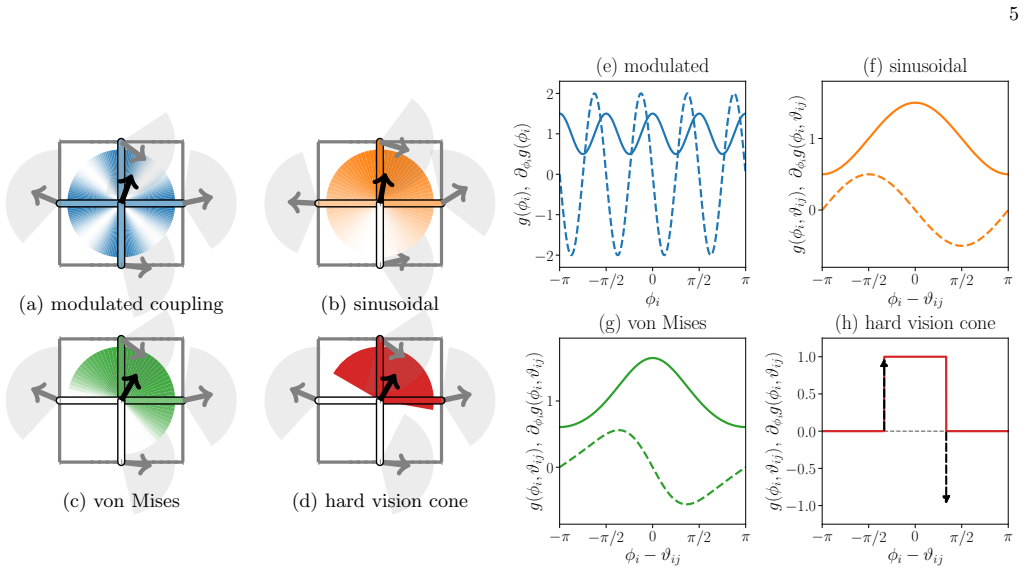
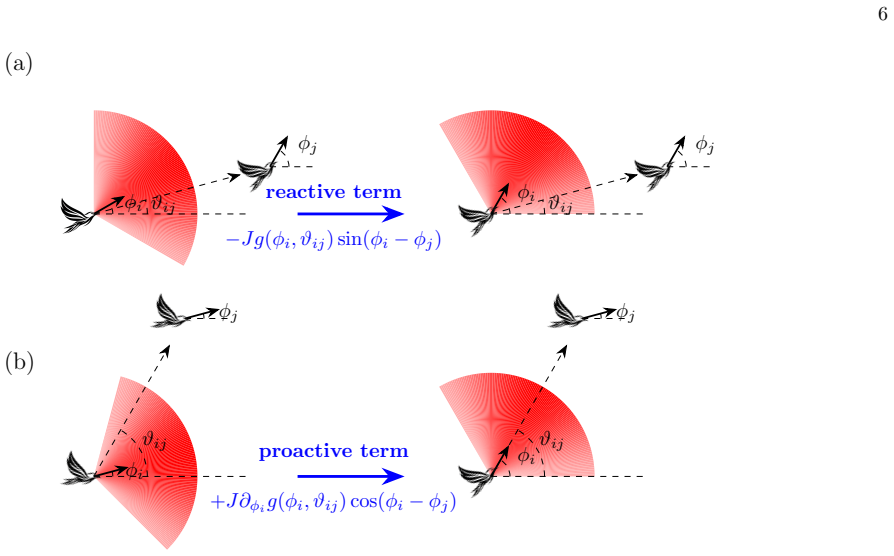
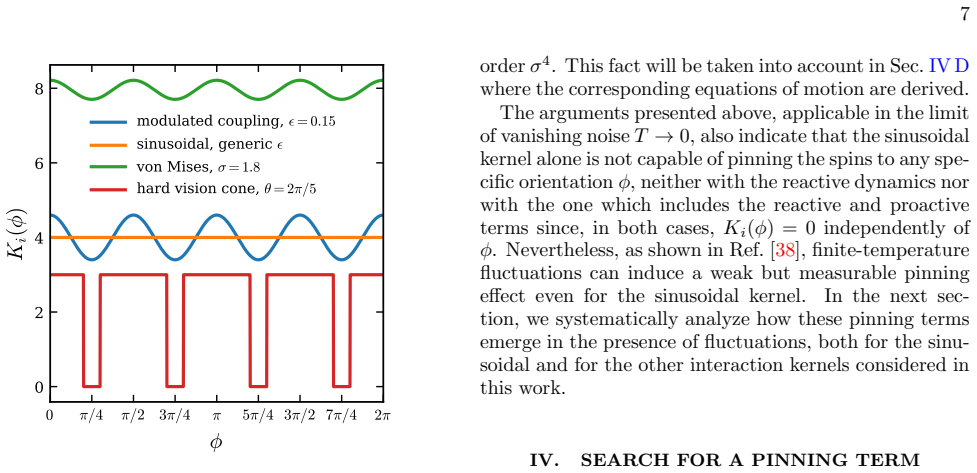
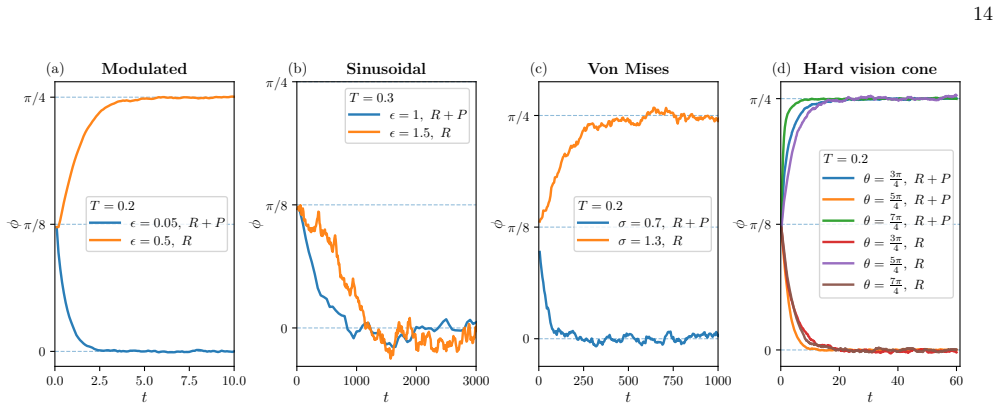
The central claim is that the Langevin formulation naturally separates the interaction into reactive and proactive terms; both terms generate global pinning of the overall spin orientation, whereas their respective roles in local pinning vary qualitatively with the choice of vision kernel such as modulated, sinusoidal, von Mises, or hard-cone forms.
What carries the argument
The decomposition of the Langevin drift into reactive and proactive terms, which separately govern the dynamics of local fluctuations and the global orientation to produce directional pinning.
If this is right
- Both reactive and proactive contributions generate global pinning for modulated, sinusoidal, von Mises, and hard-cone kernels.
- The contribution of each term to local pinning differs qualitatively depending on the specific interaction kernel.
- The framework distinguishes local from global pinning and accounts for the emergence of preferred lattice directions under non-reciprocal interactions.
- The same separation applies under both Glauber and Langevin microscopic update rules.
Where Pith is reading between the lines
- The same term separation could be applied to non-reciprocal models on other lattices to test whether pinning remains tied to square symmetry.
- The proactive term may connect to anticipatory mechanisms in related active-matter systems with broken reciprocity.
- Numerical checks with continuous-time versus discrete-time updates could reveal whether the clean separation holds beyond the rules examined here.
Load-bearing premise
The interaction term in the Langevin equation can be cleanly separated into reactive and proactive contributions that remain distinct and physically meaningful for the family of vision kernels and update rules considered.
What would settle it
A simulation in which one of the two terms is removed from the Langevin equation and global pinning to lattice directions disappears would show that both terms are required for the reported effect.
Figures
read the original abstract
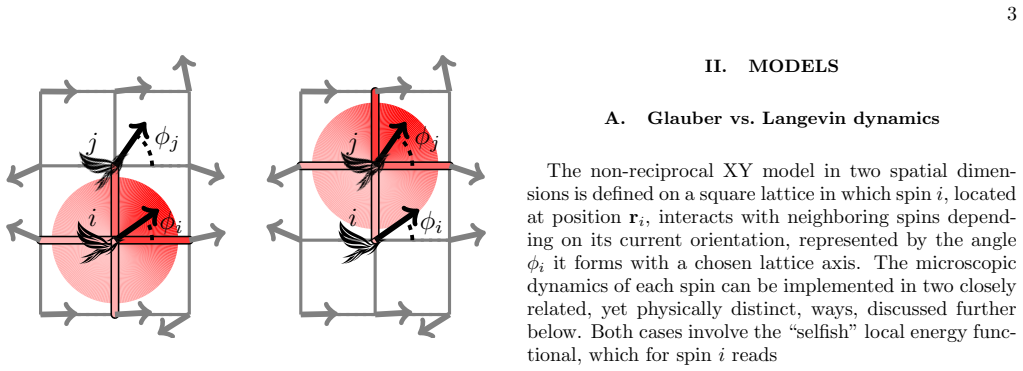
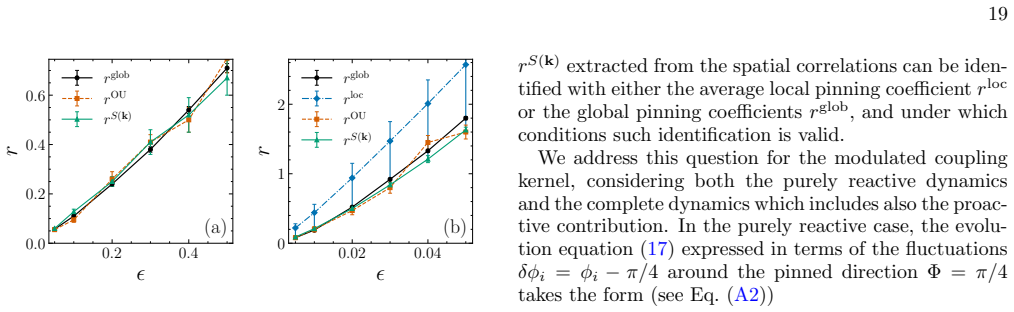
We study a non-reciprocal XY model on a square lattice, in which spins interact with their nearest neighbors through vision-induced anisotropic interaction. Such anisotropy breaks rotational symmetry and leads to the pinning of the spin orientation along preferred lattice directions. We systematically characterize this phenomenon for different interaction kernels, including modulated, sinusoidal, von Mises, and hard vision-cone couplings, and for two classes of microscopic update rules: Glauber and Langevin dynamics. A central result of this work is the identification and detailed analysis of two distinct contributions that naturally arise in the Langevin formulation, which we refer to as the reactive and the proactive term. We derive the corresponding equations governing both local fluctuations and the global orientation, and use them to characterize the mechanisms responsible for directional pinning. We show that both reactive and proactive contributions can generate global pinning, whereas their role in determining local pinning depends on the specific interaction kernel and may differ qualitatively. Our analysis clarifies the distinction between local and global pinning, explains the emergence of preferred lattice directions in the different models considered, and reconciles apparent discrepancies reported in previous studies. More generally, it provides a microscopic framework for understanding lattice-induced orientational selection in non-reciprocal XY models.
Editorial analysis
A structured set of objections, weighed in public.
Referee Report
Summary. The manuscript studies a non-reciprocal XY model on a square lattice with vision-induced anisotropic interactions that break rotational symmetry and produce directional pinning. It examines four interaction kernels (modulated, sinusoidal, von Mises, hard vision-cone) under Glauber and Langevin dynamics, identifies reactive and proactive terms that arise in the Langevin formulation, derives equations for local fluctuations and global orientation, and shows that both terms can generate global pinning while their roles in local pinning depend on the kernel.
Significance. If the derivations are valid, the work supplies a microscopic decomposition that distinguishes local from global pinning mechanisms and reconciles apparent discrepancies across prior studies of lattice-induced orientational selection in non-reciprocal XY models. The explicit tracking of separate contributions to the drift is a clear strength.
major comments (1)
- [Langevin formulation and decomposition] Langevin formulation section: the claim that the interaction drift cleanly separates into reactive and proactive terms whose effects on pinning can be tracked independently is load-bearing for the central results. For the hard vision-cone and von Mises kernels the microscopic update produces a non-analytic truncation; the continuous-time limit therefore requires an explicit Itô–Stratonovich convention, and the manuscript must demonstrate that cross terms do not mix reactive components into the proactive equation (or vice versa).
minor comments (1)
- Figure captions and equation numbering should be checked for consistency when referring to the four kernels; a short table summarizing which term dominates local versus global pinning for each kernel would improve readability.
Simulated Author's Rebuttal
We thank the referee for their careful reading and for highlighting a key technical point regarding the Langevin formulation. We address the concern below and commit to revisions that strengthen the presentation of the reactive/proactive decomposition.
read point-by-point responses
-
Referee: Langevin formulation section: the claim that the interaction drift cleanly separates into reactive and proactive terms whose effects on pinning can be tracked independently is load-bearing for the central results. For the hard vision-cone and von Mises kernels the microscopic update produces a non-analytic truncation; the continuous-time limit therefore requires an explicit Itô–Stratonovich convention, and the manuscript must demonstrate that cross terms do not mix reactive components into the proactive equation (or vice versa).
Authors: We agree that an explicit statement of the stochastic calculus convention is necessary for the non-analytic kernels. In the revised manuscript we will add a dedicated subsection (or appendix) that (i) specifies the Itô interpretation adopted for the continuous-time limit of the hard vision-cone and von Mises updates, (ii) derives the drift terms under that convention, and (iii) explicitly verifies that the reactive and proactive contributions remain orthogonal—no cross terms appear in the respective equations of motion. This demonstration will be performed both analytically for the sinusoidal and modulated kernels and numerically for the non-analytic cases, confirming that the separation used in the main text is preserved. The main conclusions are unaffected, but the added material removes any ambiguity. revision: yes
Circularity Check
No significant circularity; derivations follow from model definitions
full rationale
The paper's central claims rest on explicit derivations of reactive and proactive terms from the Langevin equation applied to the defined non-reciprocal XY model with various vision kernels (modulated, sinusoidal, von Mises, hard cone) under Glauber and Langevin dynamics. These terms are stated to 'naturally arise' in the formulation, and the subsequent equations for local fluctuations and global orientation are obtained directly from the microscopic rules without fitting parameters to the pinning phenomenon or reducing the decomposition to prior self-citations. No load-bearing step equates a prediction to its input by construction, imports uniqueness via self-citation, or renames a known result; the analysis of directional pinning is therefore self-contained and independent of the target observations.
Axiom & Free-Parameter Ledger
axioms (1)
- domain assumption The microscopic dynamics (Glauber or Langevin) are Markovian and the interaction is strictly nearest-neighbor on the square lattice.
invented entities (1)
-
proactive term
no independent evidence
Reference graph
Works this paper leans on
-
[1]
H. P. Zhang, A. Be’er, E.-L. Florin, and H. L. Swinney, Proceedings of the National Academy of Sciences107, 13626 (2010)
2010
-
[2]
D. H. Kelley and N. T. Ouellette, Scientific Reports3, 1073 (2013)
2013
-
[3]
J. E. Herbert-Read, A. Perna, R. P. Mann, T. M. Schaerf, D. J. T. Sumpter, and A. J. W. Ward, Proceedings of the National Academy of Sciences108, 18726 (2011)
2011
-
[4]
Ballerini, N
M. Ballerini, N. Cabibbo, R. Candelier, A. Cavagna, E. Cisbani, I. Giardina, V. Lecomte, A. Orlandi, G. Parisi, A. Procaccini, M. Viale, and V. Zdravkovic, Proceedings of the National Academy of Sciences105, 1232 (2008)
2008
-
[5]
Cavagna, A
A. Cavagna, A. Cimarelli, I. Giardina, G. Parisi, R. San- tagati, F. Stefanini, and M. Viale, Proceedings of the National Academy of Sciences of the United States of America107, 11865 (2010)
2010
-
[6]
Vicsek, A
T. Vicsek, A. Czir´ ok, E. Ben-Jacob, I. Cohen, and O. Shochet, Phys. Rev. Lett.75, 1226 (1995)
1995
-
[7]
Toner and Y
J. Toner and Y. Tu, Phys. Rev. Lett.75, 4326 (1995)
1995
-
[8]
Solon, H
A. Solon, H. Chat´ e, J. Toner, and J. Tailleur, Phys. Rev. Lett.128, 208004 (2022)
2022
-
[9]
A. V. Ivlev, J. Bartnick, M. Heinen, C.-R. Du, V. Nosenko, and H. L¨ owen, Phys. Rev. X5, 011035 (2015)
2015
-
[10]
Fruchart, R
M. Fruchart, R. Hanai, P. B. Littlewood, and V. Vitelli, Nature592, 363 (2021)
2021
-
[11]
M. Fruchart and V. Vitelli, Nonreciprocal many-body physics (2026), arXiv:2602.11111 [cond-mat]
arXiv 2026
-
[12]
S. M. Chakraborty, B. Sahoo, P. Sollich, and R. Mandal, Effects of Non-reciprocity on Coupled Kuramoto Oscilla- tors (2025), arXiv:2511.15845 [cond-mat]
arXiv 2025
-
[13]
Zhang and R
Z. Zhang and R. Garcia-Millan, Phys. Rev. Res.5, L022033 (2023)
2023
-
[14]
Uchida and R
N. Uchida and R. Golestanian, Phys. Rev. Lett.104, 178103 (2010)
2010
-
[15]
Shankar, A
S. Shankar, A. Souslov, M. J. Bowick, M. C. Marchetti, and V. Vitelli, Nat. Rev. Phys.4, 380 (2022)
2022
-
[16]
S. Saha, S. Ramaswamy, and R. Golestanian, New J. Phys.21, 063006 (2019)
2019
-
[17]
M. Nagy, Z. ´Akos, D. Biro, and T. Vicsek, Nature464, 890 (2010)
2010
-
[18]
Cavagna, I
A. Cavagna, I. Giardina, A. Jelic, S. Melillo, L. Parisi, E. Silvestri, and M. Viale, Phys. Rev. Lett.118, 138003 (2017)
2017
-
[19]
Yllanes, M
D. Yllanes, M. Leoni, and M. C. Marchetti, New J. Phys. 19, 103026 (2017)
2017
-
[20]
T. H. Tan, A. Mietke, J. Li, Y. Chen, H. Higinbotham, P. J. Foster, S. Gokhale, J. Dunkel, and N. Fakhri, Nature 607, 287 (2022)
2022
-
[21]
Besse, H
M. Besse, H. Chat´ e, and A. Solon, Phys. Rev. Lett.129, 268003 (2022)
2022
-
[22]
M. C. Marchetti, J. F. Joanny, S. Ramaswamy, T. B. Liverpool, J. Prost, M. Rao, and R. A. Simha, Rev. Mod. Phys.85, 1143 (2013)
2013
-
[23]
A. K. Dutta, S. Chatterjee, M. Mangeat, and R. Paul, Stability and breakdown of chiral motion in non- reciprocal flocking (2026), arXiv:2604.18125 [cond-mat]. 22
Pith/arXiv arXiv 2026
-
[24]
M. Gaur, A. Saha, and S. Paul, From Global Flocking to Local Clustering: Interplay between Velocity Align- ment and Visual Perception of Active Particles (2026), arXiv:2602.21338 [cond-mat]
arXiv 2026
-
[25]
W.-C. Guo, Z. Wang, P.-F. Wu, L.-J. Lang, B.-Q. Ai, and L. He, Emergent Macroscopic Nonreciprocity from Iden- tical Active Particles via Spontaneous Symmetry Break- ing (2026), arXiv:2604.00552 [cond-mat]
arXiv 2026
-
[26]
L. Parkavousi and S. Saha, Nonreciprocal surface ten- sion: Anisotropy-induced defect motility and organiza- tion (2026), arXiv:2605.23425 [cond-mat.soft]
Pith/arXiv arXiv 2026
-
[27]
Sandoval, Information transfer enhanced by non- reciprocity in a model of turning flocks (2026)
M. Sandoval, Information transfer enhanced by non- reciprocity in a model of turning flocks (2026)
2026
-
[28]
Welker and R
T. Welker and R. Alert, Soft Matter21, 7228 (2025)
2025
-
[29]
Y. Du, Y. Cao, W. Liu, and Y. Li, Newton , 100291 (2025)
2025
-
[30]
Scheibner, A
C. Scheibner, A. Souslov, D. Banerjee, P. Sur´ owka, W. T. M. Irvine, and V. Vitelli, Nat. Phys.16, 475 (2020)
2020
-
[31]
Brandenbourger, X
M. Brandenbourger, X. Locsin, E. Lerner, and C. Coulais, Nat. Commun.10, 4608 (2019)
2019
-
[32]
Montbri´ o and D
E. Montbri´ o and D. Paz´ o, Phys. Rev. Lett.120, 244101 (2018)
2018
-
[33]
Sompolinsky and I
H. Sompolinsky and I. Kanter, Phys. Rev. Lett.57, 2861 (1986)
1986
-
[34]
L. P. Dadhichi, J. Kethapelli, R. Chajwa, S. Ramaswamy, and A. Maitra, Phys. Rev. E101, 052601 (2020)
2020
-
[35]
S. A. M. Loos, S. H. L. Klapp, and T. Martynec, Phys. Rev. Lett.130, 198301 (2023)
2023
-
[36]
Bandini, D
G. Bandini, D. Venturelli, S. A. M. Loos, A. Jelic, and A. Gambassi, Journal of Statistical Mechanics: Theory and Experiment2025, 053205 (2025)
2025
-
[37]
Popli, A
P. Popli, A. Maitra, and S. Ramaswamy, Phys. Rev. Lett. 135, 088303 (2025)
2025
-
[38]
Dopierala, H
D. Dopierala, H. Chat´ e, X.-q. Shi, and A. Solon, Phys. Rev. Lett.135, 088302 (2025)
2025
-
[39]
Rouzaire, D
Y. Rouzaire, D. J. G. Pearce, I. Pagonabarraga, and D. Levis, Phys. Rev. Lett.134, 167101 (2025)
2025
-
[40]
Y. Rouzaire, D. J. Pearce, I. Pagonabarraga, and D. Levis, Dynamics of O(2) excitations in a non- reciprocal medium (2026), arXiv:2603.23225 [cond-mat]
arXiv 2026
-
[41]
Solon, Journal Club for Condensed Matter Physics (2022)
A. Solon, Journal Club for Condensed Matter Physics (2022)
2022
-
[42]
Y.-B. Shi, R. Moessner, R. Alert, and M. Bukov, Nature Physics 10.1038/s41567-026-03317-0 (2026)
-
[43]
Toner, Phys
J. Toner, Phys. Rev. Lett.108, 088102 (2012)
2012
-
[44]
By construction,−1≤Corr(A, δϕ)≤1
The correlation coefficient Corr(A, δϕ) is com- puted from the stationary time series ofA(t) and δϕ(t) as the normalized covariance, Corr(A, δϕ) = A(t)− A δϕ(t)− δϕ /σAσδϕ,where the overline denotes a time average in the stationary state. By construction,−1≤Corr(A, δϕ)≤1
-
[45]
We emphasize that the error bars associated withr loc are of a fundamentally different nature from those ofr OU, rglob, andr S(k). While the fluctuations underlying the latter quantities vanish in the thermodynamic limit, the uncertainty associated withr loc i corresponds to the in- trinsic standard deviation ∆rloc. It therefore reflects gen- uine spatial...
-
[46]
Strandburg-Peshkin, C
A. Strandburg-Peshkin, C. R. Twomey, N. W. Bode, A. B. Kao, Y. Katz, C. C. Ioannou, S. B. Rosenthal, C. J. Torney, H. S. Wu, S. A. Levin, and I. D. Couzin, Current Biology23, R709 (2013)
2013
-
[47]
Cavagna, L
A. Cavagna, L. Del Castello, S. Dey, I. Giardina, S. Melillo, L. Parisi, and M. Viale, Phys. Rev. E92, 012705 (2015). Appendix A: Local equations In order to identify the local pinning terms, we start from the Langevin equation reported in Eq. (3), substitute the different interaction kernels discussed in Sec. II B, and rearrange the resulting expressions...
2015
-
[48]
(3) forϕ i with the modulated coupling kernel (see Eq
Modulated coupling We consider Eq. (3) forϕ i with the modulated coupling kernel (see Eq. (4)) and rewrite it in the form of Eq. (17), in order to identify the effective pinning terms. We then introduce the coarse-grained fieldϕ x and perform the continuum expansion described in Eq. (A1). Reactive term.The reactive contribution (indicated by the subscript...
-
[49]
(3) forϕ i in the case of the sinusoidal coupling (see Eq
Sinusoidal coupling We rewrite Eq. (3) forϕ i in the case of the sinusoidal coupling (see Eq. (5)) in the form of Eq. (17), in order to identify the pinning terms. We then take the continuum limit by introducing the coarse-grained fieldϕ x and perform the continuum expansion as in Eq. (A1). Reactive term.We consider the reactive term (∂tϕi)R =− X j∈Ni h 1...
-
[50]
(3) for the evolution ofϕ i in the case of the von Mises coupling (see Eq
V on Mises coupling We now consider Eq. (3) for the evolution ofϕ i in the case of the von Mises coupling (see Eq. (6)), casting in the form of Eq. (17) in order to identify the pinning terms. As discussed in Sec. IV D, we restrict the analysis to 25 the contributions of orderO(σ 0),O(σ), andO(σ 4), which are sufficient to understand the emergence of pinn...
-
[51]
Modulated coupling We consider the reactive (first line) and the proactive (second line) contributions together, and obtain ∂tϕ=− ϵ N X ⟨i,j⟩ cos(4(ϕ+δ ˜ϕi))−cos(4(ϕ+δ ˜ϕj)) sin(δ ˜ϕi −δ ˜ϕj) − 4ϵ N X ⟨i,j⟩ sin(4(ϕ+δ ˜ϕi)) + sin(4(ϕ+δ ˜ϕj)) cos(δ ˜ϕi −δ ˜ϕj), (B1) where we expressed the local valueϕ i of the phase in terms of its deviationδ ˜ϕi from the g...
-
[52]
(5), we find convenient to treat separately the reactive and proactive contributions to the equation of motion in Eq
Sinusoidal coupling For the case of the sinusoidal coupling in Eq. (5), we find convenient to treat separately the reactive and proactive contributions to the equation of motion in Eq. (3), which we then use to determine the equation of motion for the average orientationϕ(t), as done above. Reactive term.The deterministic contribution to the Langevin dyna...
-
[53]
(6), we find convenient to treat separately the reactive and proactive contributions to the equation of motion in Eq
V on Mises coupling As done above, also for the case of the von Mises coupling in Eq. (6), we find convenient to treat separately the reactive and proactive contributions to the equation of motion in Eq. (3), which we then use to determine the equation of motion for the average orientationϕ(t). In particular, we consider the ordersO(σ) andO(σ 4) of the ex...
discussion (0)
Sign in with ORCID, Apple, or X to comment. Anyone can read and Pith papers without signing in.