REVIEW 4 major objections 4 minor 58 references
Optimal Transport with Heterogeneously Missing Data
T0 review · 4 major / 4 minor · reviewed 2026-08-07 · deepseek-v4-flash
Pith's one-line read Missing data need not ruin optimal transport distances
desk verdict Promising first treatment of OT with missing data, but two proof gaps—Proposition 4.1 and Theorem 6.1—need fixing before the claims hold. read the letter →
The pith
A machine-rendered reading of the paper's core claim, the machinery that carries it, and where it could break.
The reading
What carries the argument
The load-bearing objects are the debiasing identities of Lemma A.9, which express the true covariance as a function of the imputed covariance and the diagonal missingness matrices $P$ and $Q$; the plug-in Bures-Wasserstein estimator built from debiased means and covariances; and the two-step impute-then-transport pipeline in which iterative singular value thresholding (a spectral matrix completion algorithm) feeds a cost matrix into entropic optimal transport, with cost-sensitivity bounds transferring completion error to transport error. The validation-free hyperparameter selection uses the debiased Bures-Wasserstein distance between imputed and raw data as a proxy for distributional fidelity.
What would settle it
Generate data where missingness depends on the value of an unobserved coordinate (MNAR), then run the debiased Bures-Wasserstein estimator while pretending missingness is MCAR; if the estimator's error does not converge to zero as sample size grows, the MCAR assumption is load-bearing. For the ISVT result, check a rank-deficient setting with known noise level and verify the predicted coupling error rate by measuring Kullback-Leibler divergence between estimated and true plans.
Extended reading notes
Core claim
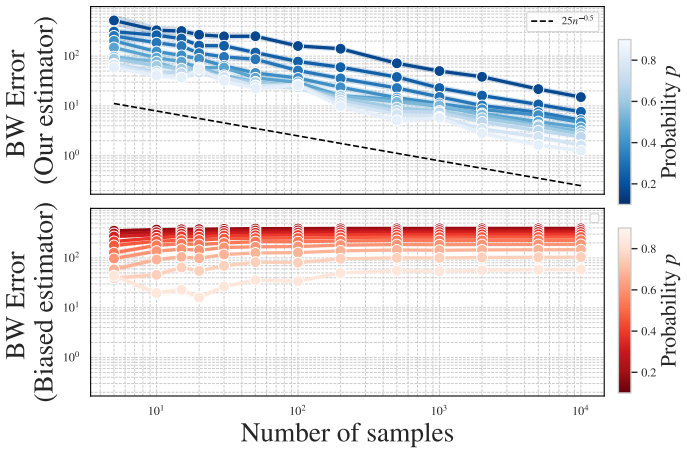
The paper's central claim is that zero-imputed, heterogeneously missing data still carries enough information to recover true optimal transport quantities, provided the missingness is completely at random and the observation probabilities per feature are known. The mechanism is an exact covariance identity linking the imputed covariance to the true covariance through the diagonal matrices $P$ and $Q$ of observation probabilities; inverting $P$ and $Q$ on the imputed moments and plugging the result into the Bures-Wasserstein formula yields an estimator that is unbiased up to lower-order terms and converges at rate $n^{-1/2}$ independent of dimension. The same plug-in logic extends to linear Monge maps between arbitrary distributions for domain adaptation. Beyond Gaussians, the paper shows that first completing the data with iterative singular value thresholding and then computing entropic regularized optimal transport gives consistent estimates of both the transport cost and the optimal coupling, with rates that degrade only through constants that blow up as observation probabilities go to zero.
Load-bearing premise
Data are missing completely at random with known, strictly positive per-feature observation probabilities; if missingness depends on the unobserved values, the inverse-probability debiasing is invalid and the estimators are biased.
Editorial extensions
If this is right
- Complete-case analysis can be replaced by all observed entries: with MCAR data, the debiased Bures-Wasserstein estimator achieves the complete-data $n^{-1/2}$ rate, so no rows need to be discarded.
- Domain adaptation with partially observed source data inherits the same convergence rates as the complete-data setting, up to missingness-dependent constants, so pre-trained models can be aligned to targets even when the source set is incomplete.
- Entropic regularized optimal transport between distributions on compact sets is consistently estimated by ISVT imputation followed by a Sinkhorn-type solve, with both cost and coupling errors vanishing in $n$ and $m$.
- The Bures-Wasserstein criterion gives a validation set-free hyperparameter choice for matrix completion that tracks the true transport distance, in contrast to Frobenius validation which can mislead under heavy missingness.
Reading between the lines
- A natural extension would be to replace the known-probability MCAR assumption with estimated observation probabilities and to characterize the extra bias; the paper's experiments estimate probabilities in the MNAR robustness check, but no guarantees are given.
- The same debiasing identities could apply to other distributional statistics beyond optimal transport, such as maximum mean discrepancy or sliced Wasserstein distances, whenever they depend on low-order moments.
- The ISVT consistency theorem requires a low-rank data matrix; for high-rank data, one could test whether soft-thresholding still works with rank-adaptive tuning, using the Bures-Wasserstein criterion as a termination rule.
Editorial analysis
A structured set of objections, weighed in public.
Referee Report
Summary. The paper studies optimal transport between two empirical distributions when both datasets have missing entries. Under a heterogeneous MCAR assumption with known per-feature missingness probabilities, the authors propose two strategies: (i) a plug-in debiased estimator of the Bures-Wasserstein distance between Gaussian models, together with a linear Monge map and domain-adaptation bounds; and (ii) a two-step estimator of entropic-regularized optimal transport that first imputes the incomplete data matrices by iterative singular value thresholding (ISVT) and then solves the OT problem on the completed cost matrix. The paper also introduces a validation-set-free hyperparameter selection rule for ISVT based on the debiased Bures-Wasserstein criterion, and it reports numerical experiments on synthetic data, the diabetes dataset, and a domain-adaptation setup.
Significance. If the proofs are repaired, the paper would make a useful contribution: dimension-free consistency of a debiased Bures-Wasserstein estimator under heterogeneous MCAR, a modular extension of linear Monge-map domain adaptation to missing data, and a practical OT-based criterion for tuning matrix-completion algorithms. The hyperparameter selection idea is of independent interest, and the experimental section is broad and generally supportive. However, the two central theoretical results, Proposition 4.1 and Theorem 6.1, currently have proof gaps that affect the stated claims and their interpretation. These gaps appear repairable without changing the overall framework, so the appropriate decision is a major revision rather than rejection.
major comments (4)
- [Section 4 / Appendix B.1, Proposition 4.1] The derivation of the equivalent cost is inconsistent. A direct computation gives E[||X^NA - Y^NA||_M^2 | X,Y] = ||X-Y||_M^2 + 2 X^T (M - P M Q) Y plus terms that depend on X alone and on Y alone, so the coupling-dependent part of the objective is C + 2 X^T \tilde M Y with \tilde M = M - P M Q, not C - X^T \tilde M Y. The proof in Appendix B.1 first obtains the cross term with the sign of M - P M Q and then flips it to P M Q - M when passing to the objective, and the factor 2 is lost in the process. Consequently, the stated interpretation that naive imputation implicitly regularizes by reducing the cost of aligned, infrequently observed pairs is reversed relative to the corrected expression, and Proposition 4.1 as stated is not established.
- [Section 6.1 / Appendix B.6, Theorem 6.1] The proof uses the false inequality |a^2 - b^2| <= |a-b|^2. Specifically, it bounds | ||M^{1/2}(x_i-y_j)||^2 - ||M^{1/2}(\hat x_i-\hat y_j)||^2 | by (||M^{1/2}(\hat x_i-x_i)|| + ||M^{1/2}(\hat y_j-y_j)||)^2, dropping the multiplicative factor ||M^{1/2}(x_i-y_j)|| + ||M^{1/2}(\hat x_i-\hat y_j)||. Under Assumption 5 this factor is of order R_x + R_y. The stated bounds in Theorem 6.1 omit this factor, so neither the cost consistency bound nor the plan bound H(\Pi_\varepsilon(C) | \Pi_\varepsilon(\hat C)) is proved as written. The consistency claim may survive after correcting the factor, but the constants and the comparison with complete-data convergence rates must be revised.
- [Section 6.1 / Assumption 5 and proof of Theorem 6.1] The proof invokes Klopp's low-rank matrix-completion guarantee and writes rank(X) and rank(Y), while the theorem statement and Assumption 5 only mention bounded support and the dimensions k_mu and k_eta of the covariance matrices. The paper should state explicitly that the data matrices X and Y have rank at most kx and ky after centering, or explain how the covariance-rank assumption implies this. Without such a clarification, the ISVT consistency step is not justified under the assumptions as written, and the notation kx, ky in the theorem is ambiguous.
- [Section 5.1 / Theorem 5.2 and definition of \hat\Sigma_x] The estimator \hat\Sigma_x = P^{-1}(I-P^{-1})diag(S^{NA}_{xn}) + P^{-1}S^{NA}_{xn}P^{-1} + P^{-1}(I-P^{-1})diag(m^{NA}_{xn} m^{NA\top}_{xn}) is not shown to be positive semidefinite for finite samples; the diagonal correction P^{-1}(I-P^{-1}) has negative entries. Yet Theorem 5.2 and its proof use (\hat\Sigma_x)^{1/2} and lower-bound lambda_min((\hat\Sigma_x^{1/2}\hat\Sigma_y\hat\Sigma_x^{1/2})^{1/2}). The theorem should either include the high-probability event on which both estimators are positive definite, which Lemma 5.1 can supply when Sigma_x and Sigma_y have a positive eigen-gap, or define the estimator with a projection onto the PSD cone and adjust the constants. As written, the estimator and the supporting Lemma C.4 are not well-defined on all sample paths.
minor comments (4)
- [Appendix B.6] The first inequality in the proof of Theorem 6.1 writes K_epsilon sqrt(nm) ||C - \hat C||_F, but Theorem A.8 gives K_epsilon / sqrt(nm) ||C - \hat C||_F. The subsequent derivation uses the correct normalization, so this appears to be a typo, but it should be fixed.
- [Throughout] There are several typographical and grammatical errors, including 'the the line of work', 'Bayses risk', 'assess wether', and 'downsized points'. A careful proofreading pass is needed.
- [Lemma 5.1] The displayed bound contains a parenthesis mismatch involving r(Sigma_x), log r(Sigma_x), ||P||_{op}, and n log n; please check the formula for consistency with the proof.
- [Section 6.2] The description of the Bures-Wasserstein hyperparameter criterion would benefit from a precise statement of how the estimated missingness probabilities are plugged into the debiased estimator, since the main text refers to 'missingness probabilities are estimated from the data' without specifying the estimator used.
Circularity Check
No circularity: the debiased estimators and entropic OT consistency are derived from stated MCAR identities, plug-in estimation, and external concentration/matrix-completion bounds; self-citations are not load-bearing.
full rationale
The paper's central derivations are not circular. Lemma A.9 derives an algebraic identity relating the covariance of the 0-imputed data to the true covariance under the MCAR Assumption 2 with known missingness matrices P and Q. The estimator bSigma_x is then constructed by replacing population quantities with their empirical counterparts in exactly that identity, which is a standard plug-in construction rather than a fit to the target Bures-Wasserstein distance. Theorem 5.2 then proves a concentration bound for the plug-in BW estimator using the covariance deviation bound of Lemma 5.1, which in turn relies on the non-commutative Bernstein inequality from Pacreau and Lounici [42] and on Bernstein inequalities for sub-exponential variables. These are external, machine-checkable or published results with stated assumptions; they do not assume the conclusion. The same holds for Theorem 5.3, which explicitly adapts Flamary et al. [17, Theorem 2] to missing data; the missingness enters only through the debiased covariance and mean estimators. Theorem 6.1 combines two external ingredients: ISVT matrix completion guarantees from Klopp [30] and cost-sensitivity bounds for entropic OT from Keriven [28]. No parameter is fitted to force the stated consistency; the missingness probabilities are inputs, not fitted constants. The validation-free hyperparameter criterion is an empirically evaluated heuristic, not a derivation of the target OT distance from the criterion itself. Self-citations by the authors (e.g., Josse et al. 2020, Muzellec et al. 2020, Perez-Lebel et al. 2022) appear only as related work or as extensions of cited methods, and no load-bearing argument reduces to an unverified self-citation. One flagged issue in Appendix B.6 is a genuine mathematical error: the proof of Theorem 6.1 bounds |a^2 - b^2| by (a-b)^2 via 'Lipschitz continuity of the norm', which is false because |a^2-b^2| = |a-b||a+b|; this introduces an omitted support-radius factor. That is a correctness defect, not a circular reduction, because the theorem is not equivalent to its inputs by construction. It lowers confidence in the stated rate but does not raise the circularity score.
Assumptions & free parameters
free parameters (1)
- ISVT regularization lambda =
selected on a logspace(-2,2,20) grid by the BW or Frobenius criterion
assumptions (7)
- domain assumption Assumption 2: heterogeneous MCAR with known invertible diagonal missingness matrices P=diag(p) and Q=diag(q)
- domain assumption Assumption 1: sub-Gaussian data with finite psi_2 norms
- domain assumption Assumption 5: bounded support and bounded covariance 'dimensions' (rank) of the measures
- domain assumption Assumption 4: additive noise entries with zero mean and variance at most b
- domain assumption Assumption 3: target distribution is the linear Monge pushforward of the source
- standard math External concentration and recovery bounds: Pacreau-Lounici covariance estimator, Klopp matrix completion, Keriven cost-sensitivity, Hsu-Kakade-Zhang, and Hanson-Wright type inequalities
- ad hoc to paper The debiased covariance estimator is PSD and invertible for finite samples
Cite this review
Pith. "Pith review of Optimal Transport with Heterogeneously Missing Data." pith.science (2026). https://pith.science/paper/5KNEZG4C
@misc{pith2026250517291,
  author       = {Pith},
  title        = {Pith review of: Optimal Transport with Heterogeneously Missing Data},
  year         = {2026},
  howpublished = {\url{https://pith.science/paper/5KNEZG4C}},
  note         = {Machine review of arXiv:2505.17291}
}
read the original abstract
We consider the problem of solving the optimal transport problem between two empirical distributions with missing values. Our main assumption is that the data is missing completely at random (MCAR), but we allow for heterogeneous missingness probabilities across features and across the two distributions. As a first contribution, we show that the Wasserstein distance between empirical Gaussian distributions and linear Monge maps between arbitrary distributions can be debiased without significantly affecting the sample complexity. Secondly, we show that entropic regularized optimal transport can be estimated efficiently and consistently using iterative singular value thresholding (ISVT). We propose a validation set-free hyperparameter selection strategy for ISVT that leverages our estimator of the Bures-Wasserstein distance, which could be of independent interest in general matrix completion problems. Finally, we validate our findings on a wide range of numerical applications.
Figures


Figures from the paper (7 more)


Reference graph
Works this paper leans on
-
[1]
Anass Aghbalou and Guillaume Staerman. Hypothesis transfer learning with surrogate classifi- cation losses: Generalization bounds through algorithmic stability. In International Conference on Machine Learning , pages 280–303. PMLR, 2023. 8
work page 2023
-
[2]
Mokhtar Z Alaya and Olga Klopp. Collective matrix completion. Journal of Machine Learning Research, 20(148):1–43, 2019. 3, 45
work page 2019
-
[3]
Naive imputation implicitly regularizes high-dimensional linear models
Alexis Ayme, Claire Boyer, Aymeric Dieuleveut, and Erwan Scornet. Naive imputation implicitly regularizes high-dimensional linear models. In International Conference on Machine Learning , pages 1320–1340. PMLR, 2023. 1, 3, 6
work page 2023
-
[4]
Random features models: a way to study the success of naive imputation
Alexis Ayme, Claire Boyer, Aymeric Dieuleveut, and Erwan Scornet. Random features models: a way to study the success of naive imputation. arXiv preprint arXiv:2402.03839 , 2024. 3 17
work page Pith review arXiv 2024
-
[5]
Doubly robust estimation in missing data and causal inference models
Heejung Bang and James M Robins. Doubly robust estimation in missing data and causal inference models. Biometrics, 61(4):962–973, 2005. 1
work page 2005
-
[6]
Optimal transport in learning, control, and dynamical systems
Charlotte Bunne. Optimal transport in learning, control, and dynamical systems. ICML Tutorial,
-
[7]
Exact low-rank matrix completion via convex optimization
Emmanuel J Candes and Benjamin Recht. Exact low-rank matrix completion via convex optimization. In 2008 46th Annual Allerton Conference on Communication, Control, and Computing, pages 806–812. IEEE, 2008. 3
work page 2008
-
[8]
The power of convex relaxation: Near-optimal matrix completion
Emmanuel J Cand` es and Terence Tao. The power of convex relaxation: Near-optimal matrix completion. IEEE transactions on information theory , 56(5):2053–2080, 2010. 3
work page 2010
Show all 58 references
-
[9]
Parametric mmd estimation with missing values: Robustness to missingness and data model misspecification
Badr-Eddine Ch´ erief-Abdellatif and Jeffrey N¨ af. Parametric mmd estimation with missing values: Robustness to missingness and data model misspecification. arXiv preprint arXiv:2503.00448 ,
-
[10]
Statistical optimal transport
Sinho Chewi, Jonathan Niles-Weed, and Philippe Rigollet. Statistical optimal transport. arXiv preprint arXiv:2407.18163, 2024. 3
2024 arXiv
-
[11]
Optimal transport for domain adaptation
Nicolas Courty, R´ emi Flamary, Devis Tuia, and Alain Rakotomamonjy. Optimal transport for domain adaptation. IEEE transactions on pattern analysis and machine intelligence , 39(9): 1853–1865, 2016. 8
2016
-
[12]
The statistical effect of entropic regularization in optimal transportation
Eustasio del Barrio and Jean-Michel Loubes. The statistical effect of entropic regularization in optimal transportation. arXiv preprint arXiv:2006.05199 , 2020. 7
2006 arXiv
-
[13]
Maximum likelihood from incomplete data via the em algorithm
Arthur P Dempster, Nan M Laird, and Donald B Rubin. Maximum likelihood from incomplete data via the em algorithm. Journal of the royal statistical society: series B (methodological) , 39 (1):1–22, 1977. 1, 3
1977
-
[14]
Online matrix completion through nuclear norm regularisation
Charanpal Dhanjal, Romaric Gaudel, and St´ ephan Cl´ emen¸ con. Online matrix completion through nuclear norm regularisation. In Proceedings of the 2014 SIAM International Conference on Data Mining , pages 623–631. SIAM, 2014. 3
2014
-
[15]
Domain adaptation using optimal transport for invariant learning using histopathology datasets
Kianoush Falahkheirkhah, Alex Lu, David Alvarez-Melis, and Grace Huynh. Domain adaptation using optimal transport for invariant learning using histopathology datasets. arXiv preprint arXiv:2303.02241, 2023. 2
2023 arXiv
-
[16]
Interpolating between optimal transport and mmd using sinkhorn divergences
Jean Feydy, Thibault S´ ejourn´ e, Fran¸ cois-Xavier Vialard, Shun-ichi Amari, Alain Trouv´ e, and Gabriel Peyr´ e. Interpolating between optimal transport and mmd using sinkhorn divergences. In The 22nd International Conference on Artificial Intelligence and Statistics , page...
2019
-
[17]
Concentration bounds for linear monge mapping estimation and optimal transport domain adaptation
R´ emi Flamary, Karim Lounici, and Andr´ e Ferrari. Concentration bounds for linear monge mapping estimation and optimal transport domain adaptation. arXiv preprint arXiv:1905.10155 ,
1905 arXiv
-
[18]
Optimal transport methods in economics
Alfred Galichon. Optimal transport methods in economics . Princeton University Press, 2018. 2
2018
-
[19]
On a formula for the l2 wasserstein metric between measures on euclidean and hilbert spaces
Matthias Gelbrich. On a formula for the l2 wasserstein metric between measures on euclidean and hilbert spaces. Mathematische Nachrichten , 147(1):185–203, 1990. 10, 25 18
1990
-
[20]
Sample complexity of sinkhorn divergences
Aude Genevay, L´ enaic Chizat, Francis Bach, Marco Cuturi, and Gabriel Peyr´ e. Sample complexity of sinkhorn divergences. In The 22nd international conference on artificial intelligence and statistics, pages 1574–1583. PMLR, 2019. 5
2019
-
[21]
Conformalized matrix completion
Yu Gui, Rina Barber, and Cong Ma. Conformalized matrix completion. Advances in Neural Information Processing Systems, 36:4820–4844, 2023. 3
2023
-
[22]
Matrix completion and low- rank svd via fast alternating least squares
Trevor Hastie, Rahul Mazumder, Jason D Lee, and Reza Zadeh. Matrix completion and low- rank svd via fast alternating least squares. The Journal of Machine Learning Research , 16(1): 3367–3402, 2015. 3, 13
2015
-
[23]
A tail inequality for quadratic forms of subgaussian random vectors
Daniel Hsu, Sham Kakade, and Tong Zhang. A tail inequality for quadratic forms of subgaussian random vectors. 2012. 43
2012
-
[24]
Generalization bounds and representation learning for estimation of potential outcomes and causal effects
Fredrik D Johansson, Uri Shalit, Nathan Kallus, and David Sontag. Generalization bounds and representation learning for estimation of potential outcomes and causal effects. Journal of Machine Learning Research, 23(166):1–50, 2022. 2
2022
-
[25]
Adaptive shrinkage of singular values
Julie Josse and Sylvain Sardy. Adaptive shrinkage of singular values. Statistics and Computing , 26:715–724, 2016. 3
2016
-
[26]
Debiasing stochastic gradient descent to handle missing values
Julie Josse, Aude Sportisse, Claire Boyer, and Aymeric Dieuleveut. Debiasing stochastic gradient descent to handle missing values. arXiv preprint arXiv:2002.09338 , 2020. 3, 4
2002 arXiv
-
[27]
On the consistency of supervised learning with missing values
Julie Josse, Jacob M Chen, Nicolas Prost, Ga¨ el Varoquaux, and Erwan Scornet. On the consistency of supervised learning with missing values. Statistical Papers, 65(9):5447–5479, 2024. 1
2024
-
[28]
Entropic optimal transport in random graphs
Nicolas Keriven. Entropic optimal transport in random graphs. arXiv preprint arXiv:2201.03949,
-
[29]
Uniform hanson-wright type concentration inequalities for unbounded entries via the entropy method
Yegor Klochkov and Nikita Zhivotovskiy. Uniform hanson-wright type concentration inequalities for unbounded entries via the entropy method. 2020. 4, 6, 7
2020
-
[30]
Matrix completion by singular value thresholding: sharp bounds
Olga Klopp. Matrix completion by singular value thresholding: sharp bounds. 2015. 3, 9, 37, 45
2015
-
[31]
Stability and hypothesis transfer learning
Ilja Kuzborskij and Francesco Orabona. Stability and hypothesis transfer learning. In Interna- tional Conference on Machine Learning , pages 942–950. PMLR, 2013. 8
2013
-
[32]
Neumiss networks: differentiable programming for supervised learning with missing values
Marine Le Morvan, Julie Josse, Thomas Moreau, Erwan Scornet, and Ga¨ el Varoquaux. Neumiss networks: differentiable programming for supervised learning with missing values. Advances in Neural Information Processing Systems , 33:5980–5990, 2020. 1, 3
2020
-
[33]
What’s a good imputation to predict with missing values? Advances in Neural Information Processing Systems , 34: 11530–11540, 2021
Marine Le Morvan, Julie Josse, Erwan Scornet, and Ga¨ el Varoquaux. What’s a good imputation to predict with missing values? Advances in Neural Information Processing Systems , 34: 11530–11540, 2021. 1
2021
-
[34]
Statistical analysis with missing data
Roderick JA Little and Donald B Rubin. Statistical analysis with missing data . John Wiley & Sons, 2019. 1, 3
2019
-
[35]
High-dimensional covariance matrix estimation with missing observations
Karim Lounici. High-dimensional covariance matrix estimation with missing observations. 2014. 3, 4, 6, 38 19
2014
-
[36]
Estimation beyond missing (completely) at random
Tianyi Ma, Kabir A Verchand, Thomas B Berrett, Tengyao Wang, and Richard J Samworth. Estimation beyond missing (completely) at random. arXiv preprint arXiv:2410.10704 , 2024. 1, 11
2024 arXiv
-
[37]
Spectral regularization algorithms for learning large incomplete matrices
Rahul Mazumder, Trevor Hastie, and Robert Tibshirani. Spectral regularization algorithms for learning large incomplete matrices. The Journal of Machine Learning Research , 11:2287–2322,
-
[38]
M´ emoire sur la th´ eorie des d´ eblais et des remblais.Mem
Gaspard Monge. M´ emoire sur la th´ eorie des d´ eblais et des remblais.Mem. Math. Phys. Acad. Royale Sci., pages 666–704, 1781. 2
-
[39]
Imputation for prediction: beware of diminishing returns
Marine Le Morvan and Ga¨ el Varoquaux. Imputation for prediction: beware of diminishing returns. arXiv preprint arXiv:2407.19804 , 2024. 1, 3, 17
2024 arXiv
-
[40]
Missing data imputation using optimal transport
Boris Muzellec, Julie Josse, Claire Boyer, and Marco Cuturi. Missing data imputation using optimal transport. In International Conference on Machine Learning , pages 7130–7140. PMLR,
-
[41]
Bi-cross-validation of the svd and the nonnegative matrix factorization
Art B Owen and Patrick O Perry. Bi-cross-validation of the svd and the nonnegative matrix factorization. 2009. 3
2009
-
[42]
Robust covariance estimation with missing values and cell-wise contamination
Gr´ egoire Pacreau and Karim Lounici. Robust covariance estimation with missing values and cell-wise contamination. Advances in Neural Information Processing Systems , 36, 2024. 2, 3, 4, 6, 7, 27
2024
-
[43]
Benchmarking missing-values approaches for predictive models on health databases
Alexandre Perez-Lebel, Ga¨ el Varoquaux, Marine Le Morvan, Julie Josse, and Jean-Baptiste Poline. Benchmarking missing-values approaches for predictive models on health databases. GigaScience, 11:giac013, 2022. 1, 3, 17
2022
-
[44]
Computational optimal transport: With applications to data science
Gabriel Peyr´ e, Marco Cuturi, et al. Computational optimal transport: With applications to data science. Foundations and Trends® in Machine Learning , 11(5-6):355–607, 2019. 2, 3, 5
2019
-
[45]
Entropic estimation of optimal transport maps
Aram-Alexandre Pooladian and Jonathan Niles-Weed. Entropic estimation of optimal transport maps. arXiv preprint arXiv:2109.12004 , 2021. 5
2021 arXiv
-
[46]
High-dimensional statistics
Philippe Rigollet and Jan-Christian H¨ utter. High-dimensional statistics. arXiv preprint arXiv:2310.19244, 2023. 22
2023 arXiv
-
[47]
Optimal transport for applied mathematicians
Filippo Santambrogio. Optimal transport for applied mathematicians. Birk¨ auser, NY, 55(58-63): 94, 2015. 3
2015
-
[48]
Perturbation bounds for matrix square roots and pythagorean sums
Bernhard A Schmitt. Perturbation bounds for matrix square roots and pythagorean sums. Linear algebra and its applications , 174:215–227, 1992. 22
1992
-
[49]
Van Buuren
S. Van Buuren. Flexible Imputation of Missing Data. Second Edition. CRC Press, Boca Raton, FL., 2018. 1, 3
2018
-
[50]
Multiple imputation of discrete and continuous data by fully conditional specification
Stef Van Buuren. Multiple imputation of discrete and continuous data by fully conditional specification. Statistical methods in medical research, 16(3):219–242, 2007. 1, 3
2007
-
[51]
mice: Multivariate imputation by chained equations in r
Stef Van Buuren and Karin Groothuis-Oudshoorn. mice: Multivariate imputation by chained equations in r. Journal of statistical software , 45:1–67, 2011. 1, 2, 3 20
2011
-
[52]
High-dimensional logistic regression with missing data: Imputation, regularization, and universality
Kabir Aladin Verchand and Andrea Montanari. High-dimensional logistic regression with missing data: Imputation, regularization, and universality. arXiv preprint arXiv:2410.01093 , 2024. 1
2024 arXiv
-
[53]
Introduction to the non-asymptotic analysis of random matrices
Roman Vershynin. Introduction to the non-asymptotic analysis of random matrices. arXiv preprint arXiv:1011.3027, 2010. 22
2010 arXiv
-
[54]
High-dimensional probability: An introduction with applications in data science, volume 47
Roman Vershynin. High-dimensional probability: An introduction with applications in data science, volume 47. Cambridge university press, 2018. 28, 30
2018
-
[55]
Springer, 2009
C´ edric Villani et al.Optimal transport: old and new , volume 338. Springer, 2009. 3
2009
-
[56]
Accelerated and inexact soft-impute for large-scale matrix and tensor completion
Quanming Yao and James T Kwok. Accelerated and inexact soft-impute for large-scale matrix and tensor completion. arXiv preprint arXiv:1703.05487 , 2017. 3
2017 arXiv
-
[57]
1 n nX i=1 xNA i 1 n nX i=1 xNA i ⊤ − mNA x mNA⊤ x # op . Since the second term is a diagonal matrix, we have diag
Ziwei Zhu, Tengyao Wang, and Richard J Samworth. High-dimensional principal component analysis with heterogeneous missingness. Journal of the Royal Statistical Society Series B: Statistical Methodology, 84(5):2000–2031, 2022. 1, 3, 4, 23 21 A Supplementary Results and Mathemat...
2000
-
[2019]
3, 5, 8, 9, 28, 33, 36, 43
Reviewed August 7, 2026 · model on record in the stance chip above.
Discussion (0). Continue with ORCID to comment.