Resonant and collective modification of London dispersion interactions under vibrational strong coupling
Pith reviewed 2026-07-01 02:15 UTC · model grok-4.3
The pith
Vibrational strong coupling modifies London dispersion interactions between molecules, producing resonant rate enhancements for two molecules coupled to a cavity mode.
A machine-rendered reading of the paper's core claim, the machinery that carries it, and where it could break.
Core claim
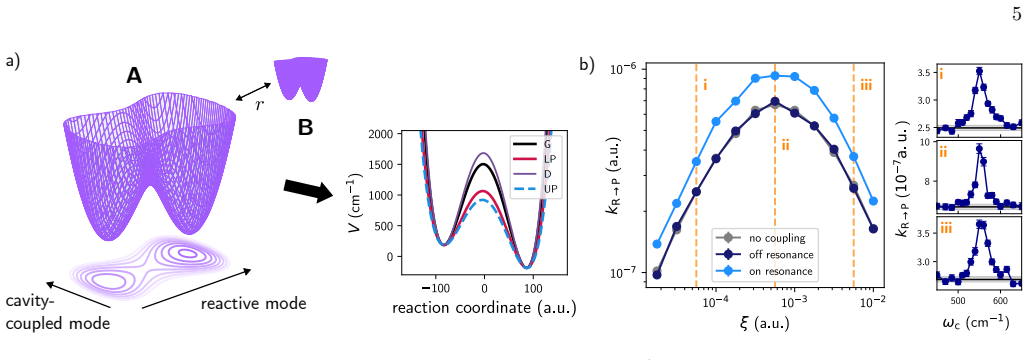
Vibrational strong coupling leads to resonant modification of vibrationally-resolved London dispersion interactions. This modification produces resonant rate enhancement when two molecules are strongly coupled to the cavity mode, and the enhancement holds for all regimes of solvent friction. The resonant changes in the London dispersion interaction continue when the number of molecules is increased, but whether this produces altered rates in the collective limit remains open.
What carries the argument
Mixed quantum-classical dynamics scheme that tracks vibrationally-resolved London dispersion under vibrational strong coupling to a cavity mode.
If this is right
- Resonant rate enhancement occurs for two molecules across all solvent friction regimes.
- The modification of London dispersion forces remains when the number of molecules is increased.
- The presented framework supplies a route to investigate mechanisms in vibropolaritonic chemistry.
Where Pith is reading between the lines
- If the dispersion modification scales to many molecules, it could account for rate changes seen in collective strong-coupling experiments.
- The same simulation approach could be applied to other intermolecular forces to test for similar resonant cavity effects.
- Direct measurement of dispersion forces in small-molecule cavity systems would provide an independent check on the predicted shift.
Load-bearing premise
The mixed quantum-classical scheme stays accurate for the resonant two-molecule case and the computed shift in London dispersion is the main cause of any rate change.
What would settle it
An experiment that measures reaction rates for two molecules inside a cavity tuned to their vibrational frequency and finds no resonant rate increase relative to the detuned case would falsify the central claim.
Figures
read the original abstract
Experiments have shown that, by tuning a microcavity to resonance with a vibrational mode of the molecules contained within it, one can modify chemical properties, such as reaction rates. This gives rise to the exciting prospect of steering chemical reactivity, just by placing a pair of carefully spaced mirrors around the reaction mixture. However, a decade after the first demonstration, the mechanism behind this effect remains ill-understood. Here, we show how vibrational strong coupling can lead to resonant modification of vibrationally-resolved London dispersion interactions. Employing a mixed quantum-classical dynamics scheme, we then show how this in turn can give rise to resonant rate enhancement in the case of two molecules strongly coupled to the cavity mode, for all regimes of solvent friction. The resonant changes of the London dispersion interaction seem to persist when increasing the number of molecules. Whether this also leads to altered reaction rates in the experimentally relevant collective limit remains an open question, as this regime falls outside the range of applicability of our mixed quantum-classical dynamics approach. Nevertheless, the framework presented here offers an exciting new avenue to explore, and hopefully bring us a step closer towards explaining the mechanism behind vibropolaritonic chemistry.
Editorial analysis
A structured set of objections, weighed in public.
Referee Report
Summary. The manuscript claims that vibrational strong coupling leads to resonant modification of vibrationally-resolved London dispersion interactions. Using a mixed quantum-classical dynamics scheme, it shows this can produce resonant rate enhancement for two molecules strongly coupled to the cavity mode across all solvent friction regimes. The authors explicitly note that the mixed quantum-classical approach falls outside its range of applicability in the collective regime relevant to experiments, leaving open whether rate effects persist there.
Significance. If the two-molecule results hold, the work identifies a concrete mechanism (resonant dispersion modification) that could contribute to observed vibropolaritonic rate changes and supplies a simulation framework for small-N systems. The paper is transparent about scope limitations and does not overclaim applicability to collective experiments.
major comments (2)
- [Abstract and Methods] Abstract and § on mixed quantum-classical dynamics: the central claim that MQCD-computed changes in London dispersion drive resonant rate enhancement for two molecules requires the scheme to correctly capture cavity-induced vibrational dressing and interaction potentials. No benchmarks against exact quantum dynamics, limiting analytic cases, or alternative quantum-classical methods are reported, which is load-bearing for the claim that the effect is physical rather than an artifact of the approximation.
- [Results] Results on N>2: the statement that resonant changes 'seem to persist when increasing the number of molecules' is presented without quantitative data, error estimates, or analysis of how the dispersion modification scales, weakening the connection to the collective regime even within the method's stated applicability.
minor comments (2)
- [Abstract] Abstract supplies no equations, numerical values for rate enhancements, or error analysis, making the quantitative strength of the resonant effect difficult to assess from the summary alone.
- [Methods] Notation for the vibrationally-resolved London dispersion term and the precise definition of the MQCD propagation should be cross-referenced to standard formulations or prior work for clarity.
Simulated Author's Rebuttal
We thank the referee for the careful reading of the manuscript, the positive assessment of its significance, and the constructive comments. We address each major comment below, indicating where revisions will be made.
read point-by-point responses
-
Referee: [Abstract and Methods] Abstract and § on mixed quantum-classical dynamics: the central claim that MQCD-computed changes in London dispersion drive resonant rate enhancement for two molecules requires the scheme to correctly capture cavity-induced vibrational dressing and interaction potentials. No benchmarks against exact quantum dynamics, limiting analytic cases, or alternative quantum-classical methods are reported, which is load-bearing for the claim that the effect is physical rather than an artifact of the approximation.
Authors: We agree that the lack of explicit benchmarks for the MQCD implementation in this setting is a substantive point. Exact quantum dynamics remain intractable for the relevant system sizes and dimensionality, which motivated the choice of MQCD; the approach has been validated in related cavity-QED and vibronic contexts in the literature. In the revised manuscript we will expand the Methods section with additional justification, references to prior validations of the scheme, and results for analytically tractable limiting cases where direct comparison is feasible. We view this as a partial but meaningful strengthening of the presentation. revision: partial
-
Referee: [Results] Results on N>2: the statement that resonant changes 'seem to persist when increasing the number of molecules' is presented without quantitative data, error estimates, or analysis of how the dispersion modification scales, weakening the connection to the collective regime even within the method's stated applicability.
Authors: We accept this criticism. The N>2 data were included only as a preliminary indication. In the revised manuscript we will supply quantitative results with error estimates obtained from trajectory ensembles, together with an explicit analysis of how the dispersion modification scales with molecule number N. This will be confined to the regime where the MQCD approach remains applicable, as already stated in the text. revision: yes
Circularity Check
No circularity: forward simulation from independent dynamics scheme
full rationale
The paper's central derivation applies a mixed quantum-classical dynamics scheme to compute resonant modifications to London dispersion interactions and resulting rate enhancements under vibrational strong coupling. This is a forward simulation from the scheme's equations of motion rather than any parameter fitted to the target rate effect or any self-definitional reduction. No load-bearing step reduces by construction to the inputs via the enumerated circularity patterns; the scheme itself is treated as an external method whose accuracy is an assumption about correctness, not a circularity issue. The derivation remains self-contained against external benchmarks.
Axiom & Free-Parameter Ledger
axioms (1)
- domain assumption Mixed quantum-classical dynamics accurately models the resonant modification of London dispersion under vibrational strong coupling for two molecules.
Reference graph
Works this paper leans on
-
[1]
dark states
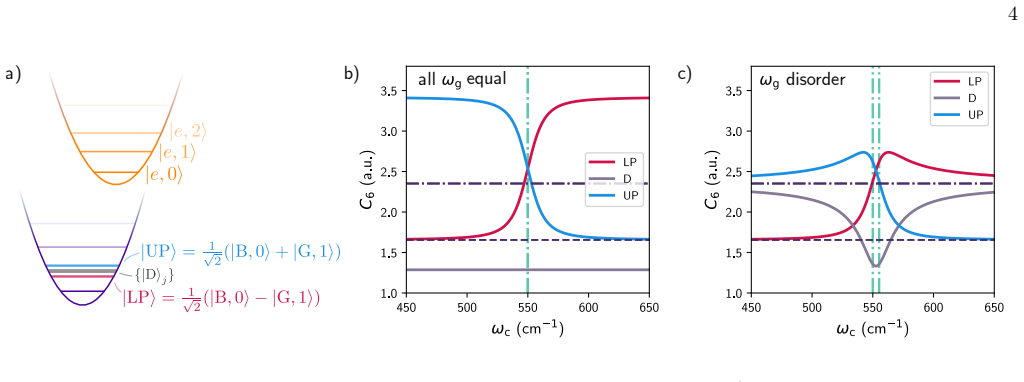
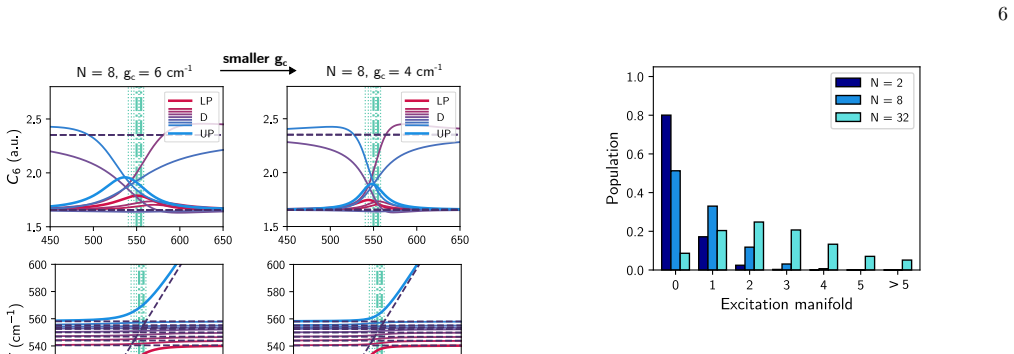
The otherN−1 states in the single-excitation subspace are “dark states”|D⟩ j,i.e.an- tisymmetric linear combinations of molecular excitations [10]. We start by investigating the case ofN= 2 molecules in the cavity, with results summarized in Fig. 3. In this case, the antisymmetry of the dark state weakens the dispersive forces, C6(|D⟩) = 1 2ℏωeg M11M00 −M...
-
[2]
on resonance
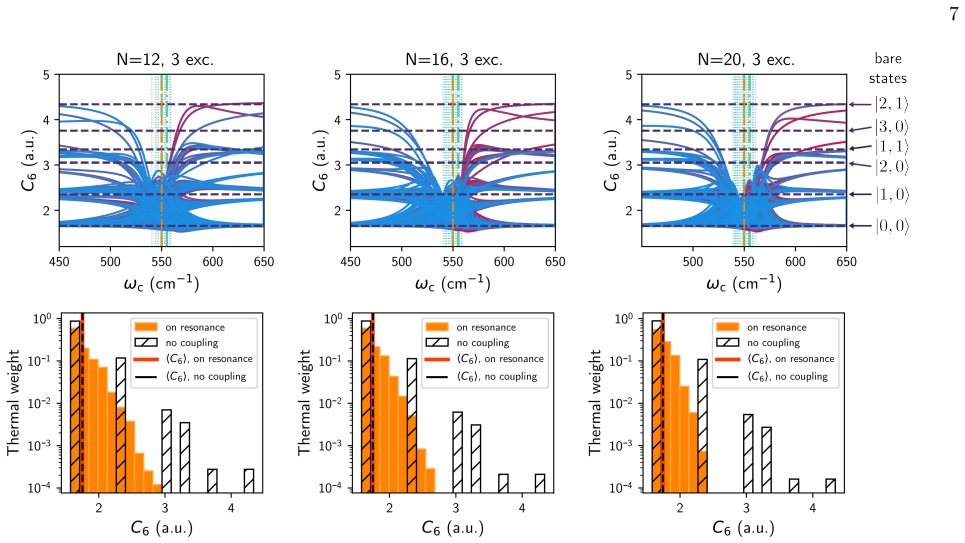
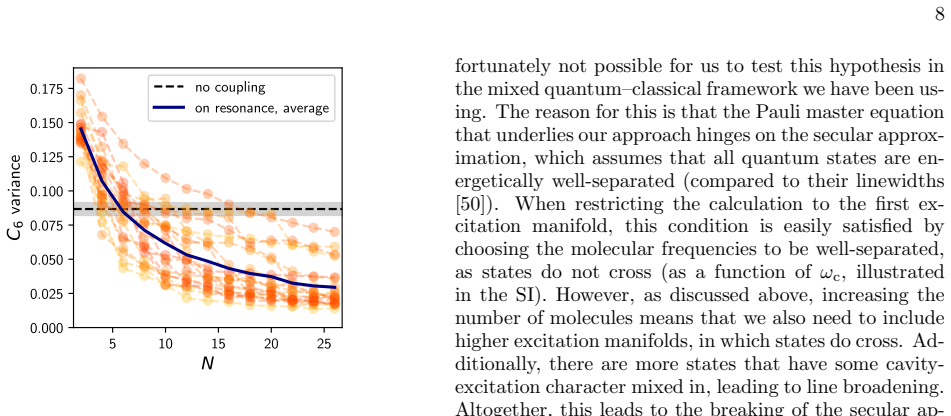
asN→ ∞, washing away the interest- ing features we saw in theN= 2 case. Physically, the reason for this is that the excitation is spread out all over the ensemble; adding more molecules effectively di- lutes the excitation on moleculesAandB. This trend can also be observed for the case with frequency disor- der. For example, from Fig. 5, where theC 6 coef...
-
[3]
Thomas, J
A. Thomas, J. George, A. Shalabney, M. Dryzhakov, S. J. Varma, J. Moran, T. Chervy, X. Zhong, E. De- vaux, C. Genet, J. A. Hutchison, and T. W. Ebbesen, Ground-state chemical reactivity under vibrational cou- pling to the vacuum electromagnetic field, Angew. Chem. Int. Edit.55, 11462 (2016)
2016
-
[4]
Nagarajan, A
K. Nagarajan, A. Thomas, and T. W. Ebbesen, Chem- istry under vibrational strong coupling, J. Am. Chem. Soc.143, 16877 (2021)
2021
-
[5]
B. S. Simpkins, A. D. Dunkelberger, and J. C. Owrut- sky, Mode-specific chemistry through vibrational strong coupling (or a wish come true), J. Phys. Chem. C125, 19081 (2021)
2021
-
[6]
A. D. Dunkelberger, B. S. Simpkins, I. Vurgaftman, and J. C. Owrutsky, Vibration-cavity polariton chemistry and dynamics, Annu. Rev. Phys. Chem.73, 429 (2022)
2022
-
[7]
Xiang and W
B. Xiang and W. Xiong, Molecular polaritons for chem- istry, photonics and quantum technologies, Chem. Rev. 124, 2512 (2024)
2024
-
[8]
Hirai and H
K. Hirai and H. Uji-i, Reactions and assembly under vi- brational strong coupling, inPolariton Chemistry(John Wiley & Sons, Ltd, 2025) Chap. 12, pp. 271–288
2025
-
[9]
R. F. Ribeiro, L. A. Mart´ ınez-Mart´ ınez, M. Du, J. Campos-Gonzalez-Angulo, and J. Yuen-Zhou, Polari- ton chemistry: controlling molecular dynamics with op- tical cavities, Chem. Sci.9, 6325 (2018)
2018
-
[10]
Fregoni, F
J. Fregoni, F. J. Garcia-Vidal, and J. Feist, Theoreti- cal challenges in polaritonic chemistry, ACS Photonics 9, 1096 (2022)
2022
-
[11]
T. E. Li, B. Cui, J. E. Subotnik, and A. Nitzan, Molecu- lar polaritonics: Chemical dynamics under strong light– matter coupling, Annu. Rev. Phys. Chem.73, 43 (2022). 13
2022
-
[12]
Mandal, M
A. Mandal, M. A. Taylor, B. M. Weight, E. R. Koessler, X. Li, and P. Huo, Theoretical advances in polariton chemistry and molecular cavity quantum electrodynam- ics, Chem. Rev.123, 9786 (2023)
2023
-
[13]
J. A. Campos-Gonzalez-Angulo, Y. R. Poh, M. Du, and J. Yuen-Zhou, Swinging between shine and shadow: The- oretical advances on thermally activated vibropolaritonic chemistry, J. Chem. Phys.158, 230901 (2023)
2023
-
[14]
Ruggenthaler, D
M. Ruggenthaler, D. Sidler, and A. Rubio, Understand- ing polaritonic chemistry from ab initio quantum electro- dynamics, Chem. Rev.123, 11191 (2023)
2023
-
[15]
W. Ying, M. E. Mondal, E. R. Koessler, S. M. Vega, and P. Huo, Collective effects in polariton chemistry and photophysics, Ann. Rev. Phys. Chem.77(2025)
2025
-
[16]
P. A. Thomas and W. L. Barnes, Strong coupling-induced frequency shifts of highly detuned photonic modes in multimode cavities, J. Chem. Phys.160(2024)
2024
-
[17]
M. A. Michon and B. S. Simpkins, Impact of cavity length non-uniformity on reaction rate extraction in strong cou- pling experiments, J. Am. Chem. Soc.146, 30596 (2024)
2024
-
[18]
M. A. Michon and B. S. Simpkins, Controlling and prob- ing molecular polaritons, inPolariton Chemistry(John Wiley & Sons, Ltd, 2025) Chap. 13, pp. 289–314
2025
-
[19]
Toward Reliable Spectroscopic Analysis of Reaction Kinetics in Polaritonic Chemistry
R. Vergauwe, J. J. Toppari, and G. Groenhof, Toward re- liable spectroscopic analysis of reaction kinetics in polari- tonic chemistry, arXiv preprint arXiv:2605.06002 (2026)
work page internal anchor Pith review Pith/arXiv arXiv 2026
-
[20]
L. P. Lindoy, A. Mandal, and D. R. Reichman, Quan- tum dynamical effects of vibrational strong coupling in chemical reactivity, Nat. Commun.14, 2733 (2023)
2023
-
[21]
S. M. Vega, W. Ying, and P. Huo, Theoretical insights into the resonant suppression effect in vibrational polari- ton chemistry, J. Am. Chem. Soc. (2025)
2025
-
[22]
Ke and J
Y. Ke and J. O. Richardson, Insights into the mecha- nisms of optical cavity-modified ground-state chemical reactions, J. Chem. Phys.160(2024)
2024
-
[23]
Ke, Stochastic resonance in vibrational polariton chemistry, J
Y. Ke, Stochastic resonance in vibrational polariton chemistry, J. Chem. Phys.162(2025)
2025
-
[24]
M. R. Fiechter, J. E. Runeson, J. E. Lawrence, and J. O. Richardson, How quantum is the resonance behavior in vibrational polariton chemistry?, J. Phys. Chem. Lett. 14, 8261 (2023)
2023
-
[25]
Ying and P
W. Ying and P. Huo, Resonance theory and quantum dynamics simulations of vibrational polariton chemistry, J. of Chem. Phys.159(2023)
2023
-
[26]
Ying and P
W. Ying and P. Huo, Resonance theory of vibrational strong coupling enhanced polariton chemistry and the role of photonic mode lifetime, Commun. Mater.5, 110 (2024)
2024
-
[27]
Peters,Reaction rate theory and rare events(Elsevier, 2017)
B. Peters,Reaction rate theory and rare events(Elsevier, 2017)
2017
-
[28]
L. P. Lindoy, A. Mandal, and D. R. Reichman, Investi- gating the collective nature of cavity-modified chemical kinetics under vibrational strong coupling, Nanophoton- ics13, 2617 (2024)
2024
-
[29]
P. W. Atkins and J. De Paula,Physical chemistry, 9th ed. (W. H. Freeman and Company, New York, 2010)
2010
-
[30]
A. J. Stone,The theory of intermolecular forces, 2nd ed. (Oxford University Press, 2013)
2013
-
[31]
Joseph, S
K. Joseph, S. Kushida, E. Smarsly, D. Ihiawakrim, A. Thomas, G. L. Paravicini-Bagliani, K. Nagarajan, R. Vergauwe, E. Devaux, O. Ersen, U. H. F. Bunz, and T. W. Ebbesen, Supramolecular assembly of conjugated polymers under vibrational strong coupling, Angew. Chem. Int. Ed.60, 19665 (2021)
2021
-
[32]
Patrahau, M
B. Patrahau, M. Piejko, R. J. Mayer, C. Antheaume, T. Sangchai, G. Ragazzon, A. Jayachandran, E. De- vaux, C. Genet, J. Moran,et al., Direct observation of polaritonic chemistry by nuclear magnetic resonance spectroscopy, Angew. Chem. Int. Edit.63, e202401368 (2024)
2024
-
[33]
S. Imai, T. Hamada, M. Nozaki, T. Fujita, M. Takahashi, Y. Fujita, K. Harano, H. Uji-i, A. Takai, and K. Hi- rai, Accessing a hidden pathway to supramolecular toroid through vibrational strong coupling, J. Am. Chem. Soc. (2025)
2025
-
[34]
Sandeep, S
K. Sandeep, S. Swaminathan, A. Jayachandran, K. Na- garajan, J. Gautier, S. Kushida, T. Chervy, R. Ver- gauwe, A. Thomas, and T. Ebbesen, Cluster formation and phase transitions induced by vibrational strong cou- pling, Angew. Chem. Int. Edit.65, e16917 (2026)
2026
-
[35]
S. Y. Buhmann,Dispersion Forces I: Macroscopic quan- tum electrodynamics and ground-state Casimir, Casimir– Polder and van der Waals forces, Vol. 247 (Springer, 2013)
2013
-
[36]
Mahanty and B
J. Mahanty and B. W. Ninham, Boundary effects on the dispersion force between oscillators, J. Phys. A6, 1140 (1973)
1973
-
[37]
Cho and R
M. Cho and R. J. Silbey, Suppression and enhancement of van der waals interactions, J. Chem. Phys.104, 8730 (1996)
1996
-
[38]
Marcovitch and H
M. Marcovitch and H. Diamant, Enhanced dispersion interaction in confined geometry, Phys. Rev. Lett.95, 223203 (2005)
2005
-
[39]
T. S. Haugland, C. Sch¨ afer, E. Ronca, A. Rubio, and H. Koch, Intermolecular interactions in optical cavities: An ab initio QED study, J. Chem. Phys.154, 094113 (2021)
2021
-
[40]
J. P. Philbin, T. S. Haugland, T. K. Ghosh, E. Ronca, M. Chen, P. Narang, and H. Koch, Molecular van der Waals fluids in cavity quantum electrodynamics, J. Phys. Chem. Lett.14, 8988 (2023)
2023
-
[41]
Cao and E
J. Cao and E. Pollak, Cavity-induced quantum interfer- ence and collective interactions in van der Waals systems, J. Phys. Chem. Lett.16, 5466 (2025)
2025
-
[42]
T. S. Haugland, J. P. Philbin, T. K. Ghosh, M. Chen, H. Koch, and P. Narang, Understanding the polari- tonic ground state in cavity quantum electrodynamics, J. Chem. Phys.162(2025)
2025
-
[43]
Galego, C
J. Galego, C. Climent, F. J. Garcia-Vidal, and J. Feist, Cavity Casimir-Polder forces and their effects in ground- state chemical reactivity, Phys. Rev. X9, 021057 (2019)
2019
-
[44]
E. W. Fischer, Cavity-modified local and non-local elec- tronic interactions in molecular ensembles under vibra- tional strong coupling, J. Chem. Phys.161(2024)
2024
-
[45]
Sidler, M
D. Sidler, M. Ruggenthaler, and A. Rubio, Collectively- modified intermolecular electron correlations: The con- nection of polaritonic chemistry and spin glass physics, Chem. Rev.126, 4 (2026)
2026
-
[46]
Flick, H
J. Flick, H. Appel, M. Ruggenthaler, and A. Rubio, Cavity Born–Oppenheimer approximation for correlated electron–nuclear-photon systems, J. Chem. Theory Com- put.13, 1616 (2017)
2017
-
[47]
E. W. Fischer and P. Saalfrank, Beyond cavity Born– Oppenheimer: On nonadiabatic coupling and effective ground state Hamiltonians in vibro-polaritonic chem- istry, J. Chem. Theory Comput.19, 7215 (2023)
2023
-
[48]
M. R. Fiechter and J. O. Richardson, Understanding the cavity Born–Oppenheimer approximation, J. Chem. 14 Phys.160(2024)
2024
-
[49]
Tavis and F
M. Tavis and F. W. Cummings, Exact solution for an n- molecule—radiation-field hamiltonian, Phys. Rev.170, 379 (1968)
1968
-
[50]
Breuer and F
H.-P. Breuer and F. Petruccione,The theory of open quantum systems(Oxford University Press, 2002)
2002
-
[51]
May and O
V. May and O. K¨ uhn,Charge and energy transfer dy- namics in molecular systems(John Wiley & Sons, 2023)
2023
-
[52]
Du and J
M. Du and J. Yuen-Zhou, Catalysis by dark states in vibropolaritonic chemistry, Phys. Rev. Lett.128, 096001 (2022)
2022
-
[53]
Botzung, D
T. Botzung, D. Hagenm¨ uller, S. Sch¨ utz, J. Dubail, G. Pupillo, and J. Schachenmayer, Dark state semilo- calization of quantum emitters in a cavity, Phys. Rev. B 102, 144202 (2020)
2020
-
[54]
Nitzan,Chemical dynamics in condensed phases: re- laxation, transfer and reactions in condensed molecular systems(Oxford University Press, 2006)
A. Nitzan,Chemical dynamics in condensed phases: re- laxation, transfer and reactions in condensed molecular systems(Oxford University Press, 2006)
2006
-
[55]
Pavoˇ sevi´ c, T
F. Pavoˇ sevi´ c, T. Culpitt, and S. Hammes-Schiffer, Mul- ticomponent quantum chemistry: Integrating electronic and nuclear quantum effects via the nuclear–electronic orbital method, Chem. Rev.120, 4222 (2020)
2020
- [56]
- [57]
-
[58]
M. O. Scully and M. S. Zubairy,Quantum optics(Cam- bridge University Press, 1997)
1997
-
[59]
H. J. Carmichael,Statistical methods in quantum optics 1: master equations and Fokker-Planck equations, Vol. 1 (Springer Science & Business Media, 1999)
1999
-
[60]
Meystre and M
P. Meystre and M. Sargent III,Elements of quantum op- tics(Springer Science & Business Media, 2007)
2007
-
[61]
A. M. Fox,Quantum optics: an introduction, Vol. 15 (Ox- ford University Press, 2006)
2006
-
[62]
Xiang, R
B. Xiang, R. F. Ribeiro, L. Chen, J. Wang, M. Du, J. Yuen-Zhou, and W. Xiong, State-selective polariton to dark state relaxation dynamics, J. Phys. Chem. A123, 5918 (2019)
2019
discussion (0)
Sign in with ORCID, Apple, or X to comment. Anyone can read and Pith papers without signing in.