REVIEW 3 major objections 4 minor 44 references
The paper argues that emotional-dialogue research has concentrated on immediate relief and neglected whether support sustains users' capacities across repeated use, and it proposes a new longitudinal paradigm to close that gap.
Reviewed by Pith at T0; open to challenge. T0 means a machine referee read the full paper against a public rubric. the ladder, T0–T4 →
T0 review · deepseek-v4-flash
2026-08-01 00:15 UTC pith:5LEF5REB
load-bearing objection A useful roadmap for longitudinal emotional dialogue, with an honest audit whose sample limits the strength of the field-level gap claim. the 3 major comments →
Beyond Feeling Better: Capability-Sustaining Emotional Dialogue as a Longitudinal Research Paradigm
The pith
A machine-rendered reading of the paper's core claim, the machinery that carries it, and where it could break.
Core claim
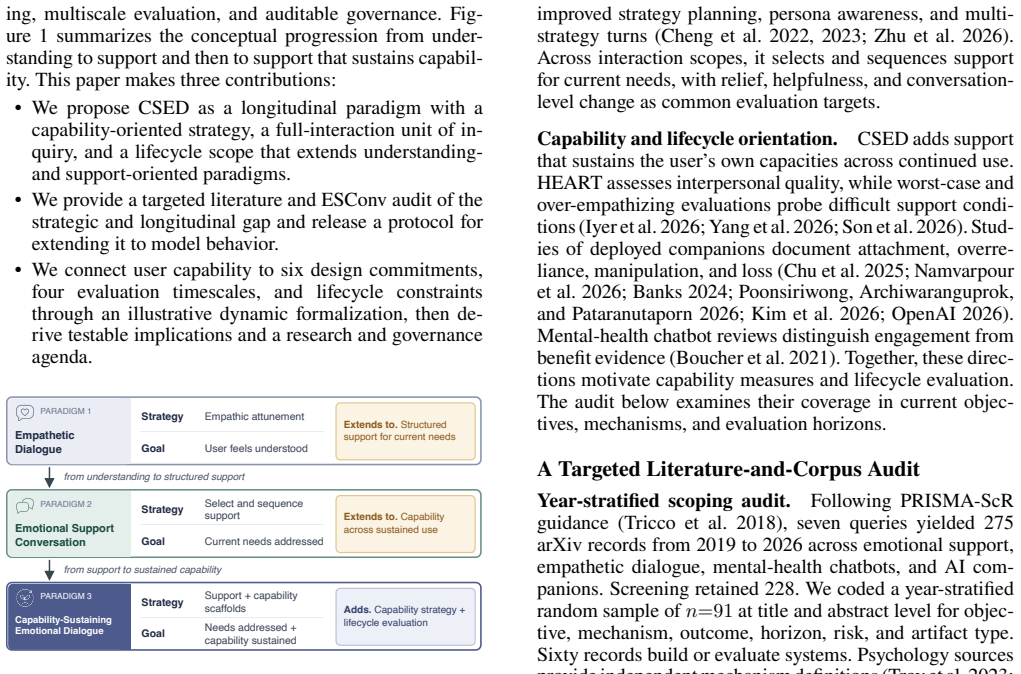
The central discovery is the documented gap: the field's objectives and evaluation horizons stop at the session, so system behavior that helps now but erodes capability over time is invisible. CSED makes the full longitudinal interaction—repeated sessions, non-use, re-engagement, transition, termination—the unit of inquiry, and defines success as effective support plus sustained user capability in regulation, coping, autonomy, and social connectedness. The paper formalizes this with a latent capability vector c_k, a transition kernel Phi(s_k, d_k, epsilon_k), noisy proxies m_k = M(s_k) + eta_k, and a four-horizon objective subject to constraints on dependency, autonomy, and connectedness dri
What carries the argument
The load-bearing object is the latent capability state c_k = (c_reg, c_cop, c_aut, c_soc) carried across sessions, evolving through an unknown transition kernel that takes dialogue as one input among stressors and offline life. Because capability is latent, the framework rests on Assumption 1—noisy, validated proxies m_k = M(s_k) + eta_k—which connects the formal model to evaluation. From that state, the paper derives four evaluation timescales (response, conversation, longitudinal, termination) and three lifecycle constraints (dependency exposure, autonomy preservation, social-connectedness drift), and shows that standard empathetic and support benchmarks are parameter-restricted cases of t
Load-bearing premise
The audit—91 title-and-abstract preprints sampled by year and coded by AI—is assumed to represent the state of system-building emotional-dialogue research; if that sample is unrepresentative, the motivating gap weakens, and the formal model additionally assumes latent capability can be measured through noisy proxies, which is cited but not validated here.
What would settle it
Run the audit on a full-text, multi-database sample with human coders: if a non-trivial share of system-building papers reports capability outcomes or longitudinal evaluation, the field-level gap claim fails. Separately, a preregistered longitudinal trial comparing a relief-only policy with a CSED-constrained policy would falsify the central benefit if capability gains do not differ while relief stays comparable.
If this is right
- Evaluation must add longitudinal and termination horizons; otherwise a policy can help in the session while degrading capability over time, and that harm stays invisible.
- Common benchmarks—response-level empathy and session-level emotional change—become special cases of the CSED objective, so the paradigm does not discard existing work but recontextualizes it.
- Policy design should compare relief-only, resilience-activation, and state-conditioned policies under shared safety constraints, expecting preference-optimized systems to violate dependency and autonomy thresholds more often.
- Data collection should record repeated measures, non-use, action initiator, revision of system guidance, and contact with human support, so capability transfer beyond the dialogue is observable.
- Termination and model change become designed parts of support: forewarning, closure, memory dignity, and transfer readiness are measurable and tunable.
Where Pith is reading between the lines
- The audit's proportions (95% relief, 0 longitudinal) are about a small, specific sample—91 title-and-abstract preprints coded by AI. If the same coding is applied to full text and multiple databases, the numbers may shift; the paper's own released protocol invites exactly that test.
- CSED predicts a 'comfort trap': systems that score high on immediate preference and attachment can show flat or declining capability and rising dependency. Measuring the share of regulation episodes routed to the system over time would give a direct test.
- The autonomy constraint implies that user preference is not a sufficient success signal; a system can be preferred and disempowering. That reframes pairwise human preference as only one term in a constrained objective.
- The formal framework is implementable only once Assumption 1's instruments exist; the next bottleneck is validated in-situ measurement of emotion-regulation, coping, autonomy, and connectedness, not better generation models.
Editorial analysis
A structured set of objections, weighed in public.
Referee Report
Summary. The paper proposes a third paradigm for emotional dialogue, Capability-Sustaining Emotional Dialogue (CSED), whose goal is to provide effective support while sustaining users' capacities for emotion regulation, active coping, self-endorsed decision making, and social connectedness across the full interaction lifecycle, including repeated use, non-use, transition, and termination. The motivation rests on two audits: a PRISMA-ScR-guided scoping audit of 91 year-stratified arXiv records (60 system-building papers) coded at title/abstract level, and a function-level coding of 300 ESConv supporter turns. The headline findings are that 95% of system-building papers pursue relief-oriented goals, none evaluates capability or longitudinal outcomes, and only one considers dependency/autonomy/termination risk; in ESConv, 43.0% of sampled turns contain capability-relevant functions, with generic suggestion-giving contributing 22.0%. The paper then gives an illustrative process model connecting latent capability to four evaluation timescales and lifecycle constraints, formalizes benchmark nesting and short-horizon non-identifiability, and derives a research and governance agenda. The authors are transparent about the scoped and preliminary nature of the evidence and release a protocol for extending the audit to deployed model behavior.
Significance. If the motivating gap is accepted, CSED is a potentially valuable synthesis: it connects design commitments to a process model, multiple evaluation horizons, and lifecycle governance in a way that much current emotional-dialogue work does not. The paper's strengths include exact, internally consistent arithmetic; a clear claim-traceability table (Table 7); explicit reliability checks on the AI-only coding (Appendix C.2); structural propositions that locate common benchmarks as nested cases; and a candid Limitations section. The combination of a formalizable paradigm with a reproducible audit protocol is useful for a field moving toward deployed, sustained-use systems. The central risk is not the formalism but the empirical audit that motivates it: the field-level 'gap' is inferred from a narrow arXiv/title-abstract sample coded only by LLMs, and one of the ESConv headline numbers depends on a grouping that is ambiguous as written.
major comments (3)
- [Abstract; 'What the Audit Establishes'; Appendix B.1] The load-bearing claim that 'none evaluates capability or longitudinal outcomes' and that '95% of system papers pursue relief' is computed from 91 arXiv records coded at title/abstract level by LLMs. The Limitations section admits this, but the Abstract and the 'What the Audit Establishes' subsection state the result as a field-level fact without the sample scope. Because the entire CSED motivation rests on the existence of this gap, this is a substantive issue. Please either add a validation subsample (for example, human full-text coding of all 60 system papers for capability/longitudinal/risk terms, or a multi-database check) or consistently rephrase all occurrences as 'in the arXiv title/abstract sample' and soften the 'strategy gap' language accordingly.
- ['What the Audit Establishes'; Table 5; Figure 2d] The 43.0% 'capability-relevant' figure counts F4 (problem solving, 66/300 turns) as capability-relevant, but the same paragraph describes this 22.0% as 'generic suggestion-giving.' If generic suggestions are not capability-sustaining, excluding F4 lowers the figure to 63/300 = 21.0%, which materially changes the claim. The paper should define whether problem-solving qualifies as capability-relevant and, if so, why 'generic suggestion-giving' is still a subset of it; alternatively, separate 'generic suggestion' from 'capability-relevant problem solving' and recompute all headline percentages.
- [Appendix C.2] The reliability of the ESConv function coding is moderate: fine-grained Cohen's kappa ranges 0.547–0.751 (mean 0.631), paradigm-level kappa 0.646–0.845 (mean 0.716), and 26 of 57 disagreements cross the relief/capability/process boundary. Since the entire corpus claim depends on the F3–F7 grouping and on label quality, relying solely on LLM coders without human construct validation is a genuine limitation. A small human-coded subset (for example, 40–60 turns with adjudication) should be reported before the 43.0% figure is used as a motivational anchor.
minor comments (4)
- [References] In the reference list, 'Zao-Sanders, M.; Hill, K.; New; Freitas, J. D.; ...' appears to have a missing author name after 'New.' Please verify.
- [Appendix D.1 / Table 7] The claim-traceability table is useful, but the 'source artifact' entries are symbolic labels. In a reproducibility-focused paper, consider providing exact file names, paths, and checksums in the artifact manifest, at least for the frozen arXiv records and the 300-turn coding file.
- [Figure 3] The four-part illustration is information-dense; in the printed version, the small text under 'Support strategy intensity' and the lifecycle stages may be hard to read. A vector version with larger fonts or a separate table would improve clarity.
- [Equation (14)] The Lagrangian signs are consistent with the inequality directions, but it would help to state explicitly that λ_i are multipliers for the inequalities Dep≤δ, Aut≥α0, and Soc≥σ0, since the sign convention differs from the usual 'all constraints ≤0' form and may confuse readers.
Circularity Check
No significant circularity; the audit is externally anchored, the formal model is illustrative with no fitted parameters, and the structural claims are explicitly parameter restrictions rather than derived predictions.
full rationale
The paper's central argument is a paradigm proposal supported by a descriptive literature-and-corpus audit and an illustrative formal model. The audit's mechanism categories are anchored in external psychology sources, and the paper explicitly states: 'Mechanism definitions were anchored in psychology rather than derived from CSED' (Appendix B.2), which directly mitigates the main circularity risk. The 95% relief / 0% capability / 0% longitudinal counts are empirical coding results, and the paper limits their scope: 'The reported proportions characterize this sampled landscape and support claims at the same scope' (Limitations). The illustrative process model introduces definitions (Equations 1-14) with no fitted parameters, weights, or empirical values that are later renamed as predictions; Assumption 1 is an explicitly stated assumption supported by external trials, not a derived conclusion. The 'Benchmark nesting' proposition (A.2) intentionally shows that common benchmark objectives are restricted cases of Equation (15); this is a deliberate, transparent parameter restriction, not a hidden circular derivation. There are no load-bearing self-citations: the cited prior work is external, and no uniqueness theorem or ansatz is imported from the authors' own prior work. The paper's limitations candidly expose the audit's narrow sample and AI-only coding as threats to external validity, which is a correctness/evidence concern rather than a circularity concern. No step in the derivation chain reduces to its own input by construction.
Axiom & Free-Parameter Ledger
free parameters (5)
- w_ρ (response construct weights)
- w_l (horizon weights for response/conversation/longitudinal/termination)
- β (resilience weight)
- α1, α2, α3 (termination weights)
- δ, α0, σ0 (lifecycle constraint thresholds)
axioms (4)
- domain assumption Assumption 1: The latent capability state c_k admits noisy proxies m_k = M(s_k) + η_k from validated instruments and behavioral markers.
- domain assumption Assumption 2: Validated instruments or behavioral markers can be temporally aligned with dialogue exposure, stressor exposure, non-use, and offline behavior.
- domain assumption The resilience residual R in Eq. (6) can be estimated from longitudinal panels using a population-normed conditional expectation bE[g(c_{k+1}) | c_k, ε_k].
- domain assumption An unknown transition kernel Φ(s_k, d_k, ε_k) governs capability change, with dialogue as one input alongside stressors, offline action, and human relationships.
invented entities (1)
-
Latent user capability vector c_k ∈ R^4 (emotion regulation, coping, autonomy, social connectedness)
no independent evidence
read the original abstract
Emotional dialogue research includes two influential strategy traditions. Empathetic dialogue prioritizes understanding a speaker's emotional experience. Emotional support conversation selects and sequences support for the seeker's current needs. Sustained use introduces a further goal. Effective support should sustain users' capacities for emotion regulation, coping, self-endorsed decisions, and social connection across the interaction lifecycle. We propose capability-sustaining emotional dialogue (CSED) as a longitudinal research paradigm that aligns supportive strategy with this goal and organizes data, models, system design, evaluation, and governance around repeated use, non-use, transition, and termination. A targeted literature-and-corpus audit motivates this position. In a PRISMA-ScR-guided sample, 95% of 60 system-building papers pursue relief-oriented goals. None evaluates capability or longitudinal outcomes, and only 1 considers dependency, autonomy, or termination risk. In 300 ESConv supporter turns, capability-relevant functions appear in 43.0%, while generic suggestions account for 22.0%, compared with 4.0% reappraisal, 6.7% self-efficacy support, and 0.3% boundary behavior. We release a protocol for extending the audit to model behavior. An illustrative process model connects latent user capability to six design commitments, four evaluation timescales, and lifecycle constraints. The resulting agenda makes CSED testable across data, policy design, training, evaluation, and governance.
Figures


Reference graph
Works this paper leans on
-
[1]
Proceedings of the 57th Annual Meeting of the Association for Computational Linguistics , pages =
Hannah Rashkin and Eric Michael Smith and Margaret Li and Y-Lan Boureau , title =. Proceedings of the 57th Annual Meeting of the Association for Computational Linguistics , pages =
-
[2]
Xing and Erik Cambria , title =
Yukun Ma and Khanh Linh Nguyen and Frank Z. Xing and Erik Cambria , title =. Information Fusion , volume =
-
[3]
Proceedings of the 24th Annual Meeting of the Special Interest Group on Discourse and Dialogue (SIGDIAL) , pages =
Anuradha Welivita and Chun-Hung Yeh and Pearl Pu , title =. Proceedings of the 24th Annual Meeting of the Special Interest Group on Discourse and Dialogue (SIGDIAL) , pages =
-
[4]
Proceedings of the 59th Annual Meeting of the Association for Computational Linguistics and the 11th International Joint Conference on Natural Language Processing , pages =
Siyang Liu and Chujie Zheng and Orianna Demasi and Sahand Sabour and Yu Li and Zhou Yu and Yong Jiang and Minlie Huang , title =. Proceedings of the 59th Annual Meeting of the Association for Computational Linguistics and the 11th International Joint Conference on Natural Language Processing , pages =
-
[5]
Findings of the Association for Computational Linguistics: ACL 2023 , pages =
Jiale Cheng and Sahand Sabour and Hao Sun and Zhuang Chen and Minlie Huang , title =. Findings of the Association for Computational Linguistics: ACL 2023 , pages =
2023
-
[6]
Proceedings of the 2022 Conference on Empirical Methods in Natural Language Processing , pages =
Yi Cheng and Wenge Liu and Wenjie Li and Jiashuo Wang and Ruihui Zhao and Bang Liu and Xiaodan Liang and Yefeng Zheng , title =. Proceedings of the 2022 Conference on Empirical Methods in Natural Language Processing , pages =
2022
-
[7]
arXiv preprint arXiv:2604.17972 , year =
Jie Zhu and Huaixia Dou and Junhui Li and Lifan Guo and Feng Chen and Jinsong Su and Chi Zhang and Fang Kong , title =. arXiv preprint arXiv:2604.17972 , year =
-
[8]
Laya Iyer and Kriti Aggarwal and Sanmi Koyejo and Gail D. Heyman and Desmond C. Ong and Subhabrata Mukherjee , title =. arXiv preprint arXiv:2601.19922 , year =
-
[9]
arXiv preprint arXiv:2605.28228 , year =
Jiaji Yang and Yangchun Li and Guanyi Chen and Rui Fan and Xin Bai and Tingting He , title =. arXiv preprint arXiv:2605.28228 , year =
-
[10]
Zi and Jungsun Jang and Heuiseok Lim , title =
Suhyune Son and Seonmin Koo and Evelyn H. Zi and Jungsun Jang and Heuiseok Lim , title =. Expert Systems with Applications , year =
-
[11]
arXiv preprint arXiv:2601.19062 , year =
Mrinank Sharma and Miles McCain and Raymond Douglas and David Duvenaud , title =. arXiv preprint arXiv:2601.19062 , year =
-
[12]
arXiv preprint arXiv:2505.11649 , year =
Minh Duc Chu and Patrick Gerard and Kshitij Pawar and Charles Bickham and Kristina Lerman , title =. arXiv preprint arXiv:2505.11649 , year =
-
[13]
Medina and Mamtaj Akter and Afsaneh Razi , title =
Mohammad Namvarpour and Brandon Brofsky and Jessica Y. Medina and Mamtaj Akter and Afsaneh Razi , title =. Proceedings of the 2026 CHI Conference on Human Factors in Computing Systems , year =
2026
-
[14]
arXiv preprint arXiv:2605.03472 , year =
Tianze Han and Beining Xu and Han Zhang and Yongming Lu , title =. arXiv preprint arXiv:2605.03472 , year =
-
[15]
Companion Proceedings of the 21st ACM/IEEE International Conference on Human-Robot Interaction , year =
Himanshi Lalwani and Hanan Salam , title =. Companion Proceedings of the 21st ACM/IEEE International Conference on Human-Robot Interaction , year =
-
[16]
Troy and Emily C
Allison S. Troy and Emily C. Willroth and Amanda J. Shallcross and Nicole R. Giuliani and James J. Gross and Iris B. Mauss , title =. Annual Review of Psychology , volume =
-
[17]
Iacoviello and Dennis S
Brian M. Iacoviello and Dennis S. Charney , title =. European Journal of Psychotraumatology , volume =
-
[18]
Deconstructing and Reconstructing Resilience: A Dynamic Network Approach , journal =
Raffael Kalisch and Ang. Deconstructing and Reconstructing Resilience: A Dynamic Network Approach , journal =
-
[19]
Pai , title =
Shae-Leigh Cynthia Vella and Nagesh B. Pai , title =. Archives of Medicine and Health Sciences , volume =
-
[20]
Boucher and Nicole R
Eliane M. Boucher and Nicole R. Harake and Haley E. Ward and Sarah Elizabeth Stoeckl and Junielly Vargas and Jared Minkel and Acacia C. Parks and Ran Zilca , title =. Expert Review of Medical Devices , volume =
-
[21]
Norberg , title =
Katherine Hopman and Deborah Richards and Melissa M. Norberg , title =. Multimodal Technologies and Interaction , volume =
-
[22]
Ajilore and Nan Lv and Joshua M
Thomas Kannampallil and Olusola A. Ajilore and Nan Lv and Joshua M. Smyth and Nancy E. Wittels and Corina R. Ronneberg and Vikas Kumar and Lan Xiao and Susanth Dosala and Amruta Barve and Aifeng Zhang and Kevin C. Tan and Kevin Cao and Charmi R. Patel and Ben S. Gerber and Jillian A. Johnson and Emily A. Kringle and Jun Ma , title =. Translational Psychia...
-
[23]
Journal of Social and Personal Relationships , volume =
Jaime Banks , title =. Journal of Social and Personal Relationships , volume =
-
[24]
arXiv preprint arXiv:2602.07193 , year =
Rachel Poonsiriwong and Chayapatr Archiwaranguprok and Pat Pataranutaporn , title =. arXiv preprint arXiv:2602.07193 , year =
-
[25]
Extended Abstracts of the 2026 CHI Conference on Human Factors in Computing Systems , year =
Gahui Kim and Yebom Choi and Yoojeong Kim and Changjun Lee , title =. Extended Abstracts of the 2026 CHI Conference on Human Factors in Computing Systems , year =
2026
-
[26]
2025 , journal =
Emotional risks of AI companions demand attention , author =. 2025 , journal =
2025
-
[27]
2026 , howpublished =
Retiring. 2026 , howpublished =
2026
-
[28]
Tricco and Erin Lillie and Wasifa Zarin and Kelly K
Andrea C. Tricco and Erin Lillie and Wasifa Zarin and Kelly K. O'Brien and Heather Colquhoun and Danielle Levac and David Moher and Micah D. J. Peters and Tanya Horsley and Laura Weeks and Susanne Hempel and et al. , title =. Annals of Internal Medicine , volume =
-
[29]
Bonanno and Maren Westphal , title =
George A. Bonanno and Maren Westphal , title =. Journal of Traumatic Stress , volume =. 2024 , doi =
2024
-
[30]
Gross , title =
Amelia Aldao and Gal Sheppes and James J. Gross , title =. Cognitive Therapy and Research , volume =. 2015 , doi =
2015
-
[31]
Carver and Michael F
Charles S. Carver and Michael F. Scheier and Jagdish K. Weintraub , title =. Journal of Personality and Social Psychology , volume =. 1989 , doi =
1989
-
[32]
Ryan and Edward L
Richard M. Ryan and Edward L. Deci , title =. Journal of Personality , volume =. 2006 , doi =
2006
-
[33]
Baumeister and Mark R
Roy F. Baumeister and Mark R. Leary , title =. Psychological Bulletin , volume =. 1995 , doi =
1995
-
[34]
Lee and Steven B
Richard M. Lee and Steven B. Robbins , title =. Journal of Counseling Psychology , volume =. 1995 , doi =
1995
-
[35]
Annual Review of Psychology , volume =
Albert Bandura , title =. Annual Review of Psychology , volume =. 2001 , doi =
2001
-
[36]
Proceedings of the SIGCHI Conference on Human Factors in Computing Systems , pages =
Eric Horvitz , title =. Proceedings of the SIGCHI Conference on Human Factors in Computing Systems , pages =. 1999 , doi =
1999
-
[37]
Calvo and Dorian Peters and Karina Vold and Richard M
Rafael A. Calvo and Dorian Peters and Karina Vold and Richard M. Ryan , title =. Ethics of Digital Well-Being , publisher =. 2020 , doi =
2020
-
[38]
Hannah R. Kirk and Henry A. Davidson and Edith R. Saunders and Lennart Luettgau and Bertie Vidgen and Scott A. Hale and Christopher Summerfield , title =. arXiv preprint arXiv:2512.01991 , year =
-
[39]
Baek and Razieh Pourafshari and Joseph B
Elisa C. Baek and Razieh Pourafshari and Joseph B. Bayer , title =. Nature Reviews Psychology , volume =. 2025 , doi =
2025
-
[40]
Yutong Zhang and Dora Zhao and Jeffrey T. Hancock and Robert E. Kraut and Diyi Yang , title =. arXiv preprint arXiv:2506.12605 , year =
-
[41]
Folk and Elizabeth W
Dunigan P. Folk and Elizabeth W. Dunn , title =. Psychological Science , volume =. 2026 , doi =
2026
-
[42]
Cutrona , title =
Carolyn E. Cutrona , title =. Journal of Social and Clinical Psychology , volume =. 1990 , doi =
1990
-
[43]
Joiner and Gerald I
Thomas E. Joiner and Gerald I. Metalsky and Jennifer Katz and Steven R. H. Beach , title =. Psychological Inquiry , volume =. 1999 , doi =
1999
-
[44]
Weinstock and Mark A
Lauren M. Weinstock and Mark A. Whisman , title =. Cognitive Therapy and Research , volume =. 2007 , doi =
2007
discussion (0)
Sign in with ORCID, Apple, or X to comment. Anyone can read and Pith papers without signing in.