REVIEW 4 major objections 4 minor 72 references
Scalar fields from nonlinear sigma models on black hole spacetimes
T0 review · 4 major / 4 minor · reviewed 2026-08-05 · deepseek-v4-flash
Pith's one-line read The sign of the curvature of a scalar field's internal space determines whether dark-matter clouds around black-hole binaries make them merge earlier or later, provided the field is light enough.
desk verdict A careful first numerical pass at sigma-model scalars on BH spacetimes; the qualitative attractive/repulsive story holds up, but the BBH dephasing sign lacks the convergence evidence to be taken as final. read the letter →
The pith
A machine-rendered reading of the paper's core claim, the machinery that carries it, and where it could break.
The reading
What carries the argument
The load-bearing object is the unified complex-field action, obtained from the axion–dilaton kinetic term by the field redefinition with complex field tau. Its target space is the hyperbolic plane for gamma^2 > 0 (SL(2,R) symmetry), the two-sphere for gamma^2 < 0 (O(3) symmetry), and flat space for gamma^2 = 0, where the theory reduces to a free massive complex scalar. The parameter gamma^2 thus continuously interpolates between repulsive, free, and attractive kinematics. The paper uses gamma^2 as the control variable and shows that this kinetic curvature, rather than a separate potential term, determines whether scalar clouds compress or disperse around black holes and whether they push a b
What would settle it
Re-run the muM = 0.3 binary simulations with the finer coarsest-level time step used for the heavier-field runs, including the gamma^2 < 0 case; if the sign ordering of merger times reverses or disappears, the claimed dephasing is a numerical artifact rather than physics.
Extended reading notes
Core claim
The central claim is that a nonlinear sigma model's scalar-manifold curvature acts as an intrinsic self-interaction, with its sign selecting the phenomenology. On isolated Schwarzschild black holes, the SL(2,R) model (gamma^2 > 0) produces denser, more compact accretion than a free massive scalar, while the O(3) model (gamma^2 < 0) produces lower, more diffuse densities; at larger field mass the mass term dominates and the three models agree. In equal-mass binary evolutions with a light field (muM = 0.3), the attractive sign makes the binary merge earlier and the repulsive sign later, measured as positive and negative dephasing of the l = m = 2 gravitational-wave phase relative to gamma^2 =
Load-bearing premise
The binary results stand on the assumption that the time step used on the coarsest grid resolves the oscillating scalar field well enough that the measured waveform dephasing is real; the paper states this resolution is likely imperfect and verifies convergence for only one of the six binary configurations.
Editorial extensions
If this is right
- A scalar environment with hyperbolic field-space curvature makes an equal-mass binary lose orbital energy faster, producing a positive gravitational-wave dephasing relative to free-field inspirals; spherical curvature gives negative dephasing.
- The effect is conditional: it appears when the scalar's Compton wavelength is larger than the binary separation, and at smaller wavelengths the ordering flips, so waveform searches must be mass-dependent.
- The integrated scalar mass outside the binary tracks the merger time across all runs, implying cloud mass, not just interaction sign, is the physical driver of the inspiral evolution.
- Ringdown frequencies remain consistent with the Kerr (2,2) mode to about 2% for the explored parameters, so this environment does not, at this level, disturb standard black-hole spectroscopy.
- The absence of bosenova in the attractive-sign runs suggests sigma-model kinetic nonlinearities can stabilize scalar clouds that ordinary phi^4 self-interactions would blow apart.
Reading between the lines
- Beyond the paper: a parameter scan in gamma^2 near zero could map the dephasing sign continuously onto an effective self-coupling, connecting these runs to ordinary lambda|Phi|^4 phenomenology.
- Beyond the paper: since |gamma^2| = 10^5 keeps the effective self-coupling below observational bounds for the simulated masses, a detector-level study is needed to see whether the predicted dephasing survives realistic astrophysical constraints.
- Beyond the paper: the companion-mass scaling hints that negative-curvature models mimic a lower-mass binary and positive-curvature models a higher-mass one in vacuum-template parameter estimation, a potential systematic for future space-based gravitational-wave detectors.
- Beyond the paper: the heavy-field reversal suggests a competition between dynamical friction and the gravitational pull of the cloud; a run with fixed field mass but varied initial separation could isolate which regime controls the sign of dephasing.
Editorial analysis
A structured set of objections, weighed in public.
Referee Report
Summary. The paper studies complex scalar fields with nonlinear-sigma-model kinetic terms on black hole spacetimes. The model is parametrized by γ², with γ²>0 corresponding to the SL(2,R) (hyperbolic) sigma model and γ²<0 to the O(3) (spherical) one; γ²=0 reduces to a free massive complex scalar. The authors implement the model in GRChombo/GRTresna, evolve it around a Schwarzschild BH and in an equal-mass BBH inspiral, and compare accretion profiles and gravitational-wave dephasing across γ² and scalar mass μM. They report that for light fields the SL(2,R) model behaves attractively (denser, more compact cloud; earlier merger) and the O(3) model repulsively (diffuse cloud; later merger) relative to the non-interacting case, while for μM=0.6 the SL(2,R) model instead yields the longest inspiral. They also report the absence of bosenova emission. The ADM equations are given explicitly in Appendix A, the initial data are constraint-satisfying, and the code is publicly available.
Significance. If the reported effects are robust, the paper makes a useful contribution by showing that non-canonical kinetic terms can qualitatively change the environmental back-reaction on binaries, including flipping the sign of the dephasing relative to a free massive scalar. The explicit equations, the use of constraint-satisfying initial data, and the public code release are strengths that will facilitate follow-up work. However, the numerical evidence supporting the central cross-γ² comparison is currently incomplete, and one parameter statement is internally inconsistent. The conclusions are not circular: the measured dephasing is a direct numerical output and no equation is fitted to the target result.
major comments (4)
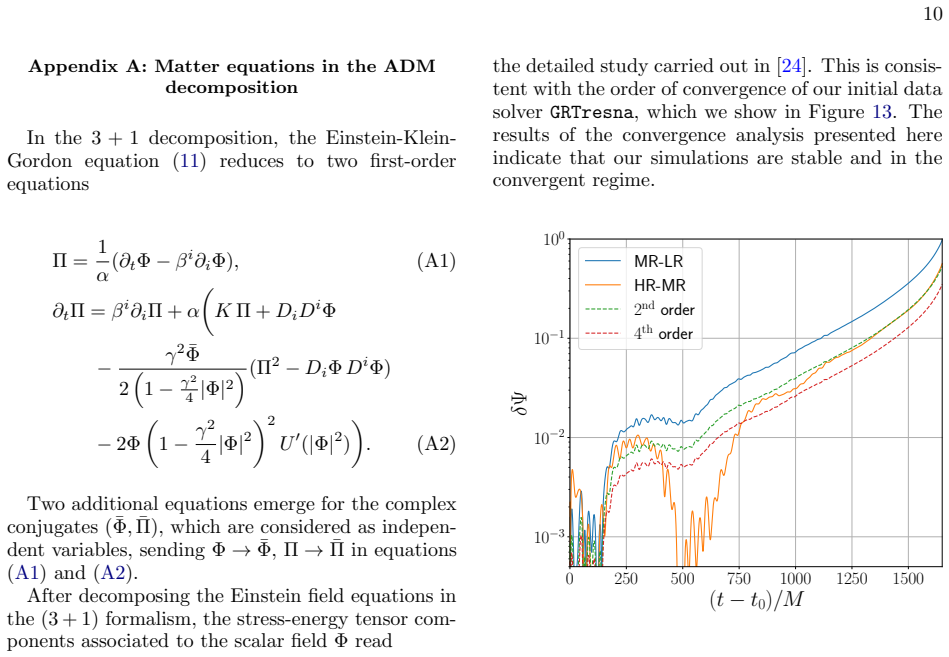
- [Appendix B / §III B 1] The convergence test is performed only for μ=0.3, γ²=10^5 and only for the accumulated orbital phase Ψ. The central claim is a comparison of the sign of dephasing among γ²>0, γ²=0, and γ²<0. The γ²<0 cloud is more diffuse and therefore lives on coarser parts of the grid; a differential resolution error could in principle change the relative merger order. No error bars are given on Ψ. I request convergence tests, or at least a resolution study of the scalar energy/phase, for the γ²=0 and γ²<0 runs and for scalar-field quantities, before the sign of the effect is stated as robust.
- [§III B 2] The manuscript states that dtmultiplier=0.25 'is likely to introduce some errors in resolving the scalar field oscillations at the coarsest level'. For μ=0.3 the coarsest time step is Δt≈2M and the coarsest grid spacing is 8M, while the scalar period and Compton wavelength are both ≈21M. Thus the outer region is sampled at only ~10 steps per cycle and ~2.6 points per Compton wavelength. Because the γ²<0 cloud is the most extended, this is exactly the case where a differential outer-grid resolution error is most plausible. The statement that the code 'converges properly' needs to be demonstrated for this case, not only for γ²>0.
- [§III B 2] The μ=0.6 case, used to argue that γ²>0 now merges last and that the simple Compton-wavelength rule is modified, has no convergence test at all. This is a counterintuitive numerical result and needs at least one resolution study; otherwise it is not supported. I request a convergence run for at least the γ²>0, μ=0.6 configuration, or a clear statement that the μ=0.6 comparison is exploratory.
- [§III A] The text says 'We choose the values of γ² to be ±10^5 so that M²|γ²|ρ|t=0 ∼ 3', after stating ρ|t=0 ∼ 10^{-9}M^{-2}. With |γ²|=10^5 one obtains M²|γ²|ρ|t=0 = 10^{-4}, not 3. This discrepancy affects the effective self-interaction strength and must be corrected or explained; if the intended value is 3, the initial amplitude must be much larger than stated.
minor comments (4)
- [Abstract / §III B 1] The phrases 'positive or negative dephasing' are used without an explicit sign convention. A sentence defining positive dephasing (e.g., larger accumulated phase, earlier merger) would improve interpretability of Figs. 3 and 5.
- [§II, Eq. (10)] The potential term is written with a denominator involving γ², making the relation between U(|Φ|²) in Eq. (10) and the mass term slightly opaque. A short clarification would help readers connect Eq. (10) to (11).
- [Fig. 12 caption] The caption notation 'N^3=64^3' is confusing; the runs are specified by N on the coarsest level, and the same notation should be used consistently as in the text.
- [References] Reference [37] is cited as an arXiv preprint; if a journal version exists it should be updated.
Circularity Check
No significant circularity: the dephasing and accretion results are direct numerical outputs, with no fitted-input-called-prediction and no load-bearing self-citation chain.
full rationale
The paper's central claims (attractive vs repulsive phenomenology for SL(2,R) vs O(3); positive vs negative GW dephasing) are direct outputs of GRChombo evolutions of the fixed Lagrangian in Eq. (10), with the curvature parameter gamma^2 set a priori to ±10^5 and the field amplitude set by a stated density choice. No parameter is fitted to the dephasing or density profiles; the dephasing is read off the accumulated orbital phase Ψ in Fig. 3 without any fitting to the conclusion. The only self-citations are [22] (Cano, Machet, Myin) providing the sigma-model action, and [37] (Aresté Saló et al.) providing the waveform-alignment convention. The citation to [22] supplies the model input—'These models were derived in [22] to study spherically symmetric soliton solutions (boson stars)'—but this paper does not claim to derive a prediction from [22]; it uses the Lagrangian as the starting point, which is legitimate. The alignment method from [37] is a numerical analysis convention with no feedback into the measured dephasing. The paper also performs external validation: a convergence test for the orbital phase (Appendix B, Fig. 12), comparison of ringdown QNMs to the known Kerr value (Eq. 16, 'the fitted QNMs differ from the reference value ... of ~2%'), and an extraction-radius consistency check (Fig. 9). The admitted resolution limitation—'dtmultiplier = 0.25, which is likely to introduce some errors in resolving the scalar field oscillations at the coarsest level'—is a numerical accuracy caveat, not circularity; no equation is redefined to encode the answer. The discussion's comparison with [19] and [22] is interpretive consistency checking, not a load-bearing derivation. Thus the derivation chain is self-contained: the predictions are produced by evolving stated equations, not by renaming inputs or fitting outputs.
Assumptions & free parameters
free parameters (4)
- gamma^2 (sigma model curvature) =
+10^5 and -10^5
- initial scalar amplitude phi_0 =
adjusted per mu to set rho(0) ~ 10^-9 M^-2
- scalar mass mu M =
0.1, 1 (single BH); 0.3, 0.6 (BBH)
- BBH initial separation and momenta =
d=12.21358 M, p_i/M=(0.0841746, -0.000510846) and opposite
assumptions (4)
- domain assumption The sigma-model Lagrangian (10) and equation of motion (11) correctly describe the axion-dilaton-like scalar sector.
- domain assumption The hybrid CTTK initial data solver produces constraint-satisfying initial data.
- domain assumption Extrapolating first-order boundary conditions with a large simulation box approximate an asymptotically oscillating scalar background.
- domain assumption The remnant Kerr BH spin used for QNM comparison (chi=0.69) and the reference Kerr QNM values [58] are trusted.
Cite this review
Pith. "Pith review of Scalar fields from nonlinear sigma models on black hole spacetimes." pith.science (2026). https://pith.science/paper/5LFA4I72
@misc{pith2026250818362,
  author       = {Pith},
  title        = {Pith review of: Scalar fields from nonlinear sigma models on black hole spacetimes},
  year         = {2026},
  howpublished = {\url{https://pith.science/paper/5LFA4I72}},
  note         = {Machine review of arXiv:2508.18362}
}
abstract
Scalar fields with non-trivial kinetic term derived from a nonlinear sigma model are motivated by UV completions of gravity such as string theory. We discuss the $\mathrm{SL}(2,\mathbb{R})$ and $\mathrm{O}(3)$ sigma models with interacting potentials and simulate their full nonlinear dynamics on black hole spacetimes. We study the properties of the field as a function of the curvature of the sigma model with respect to the free massive scalar case. In the accretion process, the $\mathrm{SL}(2,\mathbb{R})$ model behaves as a self-interacting field with attractive interaction, while the $\mathrm{O}(3)$ one exhibits a repulsive phenomenology. In the case of a binary black hole system, these models cause a positive or negative dephasing of the gravitational waveform, respectively, when compared to the non-interacting case and as long as the field's Compton wavelength is larger than the binary separation. We observe no bosenova emission, which suggests that nonlinearities tend to suppress this phenomenon. Our results highlight how the kinetic and potential terms are both relevant in determining the field dynamics.
Figures


Figures from the paper (7 more)



Reference graph
Works this paper leans on
-
[22]
D. Baumann, G. Bertone, J. Stout, and G. M. Tomaselli, Phys. Rev. D 105, 115036 (2022), arXiv:2112.14777 [gr-qc]
arXiv 2022
-
[1]
µM = 0.3 We first consider a scalar field mass of µM = 0.3. The Compton wavelength of the field λC = 2π/µ ∼ 20 is then larger than the initial separation of the bi- nary. We run three simulations with the same initial conditions and γ2 ∈ {105, 0, −105} respectively. We plot the density evolution on the z = 0 plane in Fig. 2, normalised with respect to the...
-
[2]
µM = 0.6 We perform the same analysis as the one presented in section III B 1 with a scalar field of double the mass, i.e. we now consider µM = 0.6. The Comp- ton wavelength is thus λC ∼ 10M , comparable to the initial separation of the BHs. In Fig. 4 we plot the scalar field density at different times of the evo- −0.05 0.00 0.05 rM Re(ψ4,22) 0.00 0.05 rM...
-
[3]
Ringdown phase The frequency content of the ringdown stage is of key importance to perform high-precision tests of the Kerr hypothesis [52, 53] and can receive correc- tions from beyond-GR extensions [54–57]. In Fig. 8 we plot the absolute value of ψ4,22 with µM = 0.3 and varying γ2. In order to study the impact of the sigma models on the quasi-normal mod...
-
[4]
Scalar emission We characterise the scalar field dynamics extract- ing the scalar field value at several radii from the BBH centre of mass and projecting it on spheri- cal harmonics. We focus our discussion on the be- haviour of the l = 2, m= 2 mode, as it is the domi- nant one sourced by the quadrupolar GW emission. −20 0 20 40 60 (t − tmerger)/M 10−5 10...
work page 1900
-
[5]
Z. Carson and K. Yagi, Phys. Rev. D 101, 044047 (2020), arXiv:1911.05258 [gr-qc]
arXiv 2020
- [6]
-
[7]
L. Pompili, E. Maggio, H. O. Silva, and A. Buonanno, Phys. Rev. D 111, 124040 (2025), arXiv:2504.10130 [gr-qc]
arXiv 2025
Show all 72 references
-
[8]
N. V. Krishnendu and F. Ohme, Universe 7, 497 (2021), arXiv:2201.05418 [gr-qc]
2021 arXiv
-
[9]
Abbott et al
R. Abbott et al. (LIGO Scientific, VIRGO, KA- GRA), (2021), arXiv:2112.06861 [gr-qc]
2021 arXiv
-
[10]
Ishibashi and M
W. Ishibashi and M. Gr¨ obner, Astron. Astrophys. 639, A108 (2020), arXiv:2006.07407 [astro-ph.GA]
2020 arXiv
-
[11]
Cornish, L
N. Cornish, L. Sampson, N. Yunes, and F. Pretorius, Phys. Rev. D 84, 062003 (2011), arXiv:1105.2088 [gr-qc]
2011 arXiv
-
[12]
Barausse, V
E. Barausse, V. Cardoso, and P. Pani, J. Phys. Conf. Ser. 610, 012044 (2015), arXiv:1404.7140 [astro-ph.CO]
2015 arXiv
-
[13]
Gliorio, E
S. Gliorio, E. Berti, A. Maselli, and N. Speeney, (2025), arXiv:2503.16649 [gr-qc]
2025
-
[14]
Duque, C
F. Duque, C. F. B. Macedo, R. Vicente, and V. Cardoso, Phys. Rev. Lett. 133, 121404 (2024), arXiv:2312.06767 [gr-qc]
2024 arXiv
-
[15]
Brito, V
R. Brito, V. Cardoso, and P. Pani, Lect. Notes Phys. 906, pp.1 (2015)
2015
-
[16]
P. S. Cole, G. Bertone, A. Coogan, D. Gaggero, T. Karydas, B. J. Kavanagh, T. F. M. Spieksma, and G. M. Tomaselli, Nature Astron. 7, 943 (2023), arXiv:2211.01362 [gr-qc]
2023
-
[17]
Zwick, P
L. Zwick, P. R. Capelo, and L. Mayer, Mon. Not. Roy. Astron. Soc. 521, 4645 (2023), arXiv:2209.04060 [gr-qc]
2023 arXiv
-
[18]
Arvanitaki, S
A. Arvanitaki, S. Dimopoulos, S. Dubovsky, N. Kaloper, and J. March-Russell, Phys. Rev. D 81, 123530 (2010), arXiv:0905.4720 [hep-th]
2010 arXiv
-
[19]
Halverson, C
J. Halverson, C. Long, and P. Nath, Phys. Rev. D 96, 056025 (2017), arXiv:1703.07779 [hep-ph]
2017 arXiv
-
[20]
C. P. Burgess, R. C. Myers, and F. Quevedo, Nucl. Phys. B 442, 75 (1995), arXiv:hep-th/9410142
1995 arXiv
-
[21]
Baumann, H
D. Baumann, H. S. Chia, J. Stout, and L. ter Haar, JCAP 12, 006 (2019), arXiv:1908.10370 [gr-qc]
2019 arXiv
-
[23]
Bamber, J
J. Bamber, J. C. Aurrekoetxea, K. Clough, and P. G. Ferreira, Phys. Rev. D 107, 024035 (2023)
2023
-
[24]
J. C. Aurrekoetxea, J. Marsden, K. Clough, and P. G. Ferreira, Phys. Rev. D 110, 083011 (2024)
2024
-
[25]
Figueras, M
P. Figueras, M. Kunesch, and S. Tunyasuvu- nakool, Phys. Rev. Lett. 116, 071102 (2016), arXiv:1512.04532 [hep-th]
2016 arXiv
-
[26]
P. Brax, C. P. Burgess, and F. Quevedo, JHEP 02, 130 (2024), arXiv:2308.12004 [hep-th]
2024 arXiv
-
[27]
P. A. Cano, L. Machet, and C. Myin, Phys. Rev. D 109, 044043 (2024)
2024
-
[28]
Andrade et al
T. Andrade et al. , J. Open Source Softw. 6, 3703 (2021), arXiv:2201.03458 [gr-qc]
2021 arXiv
-
[29]
Radia, U
M. Radia, U. Sperhake, A. Drew, K. Clough, P. Figueras, E. A. Lim, J. L. Ripley, J. C. Aur- rekoetxea, T. Fran¸ ca, and T. Helfer, Class. Quan- tum Grav. 39, 135006 (2022), comment: 46 pages, 10 figures, to match version published in CQG, arXiv:2112.10567 [gr-qc]
2022 arXiv
-
[30]
G. A. Marks, S. J. Staelens, T. Evstafyeva, and U. Sperhake, (2025), arXiv:2504.17775 [gr-qc]
2025
-
[31]
Helfer, E
T. Helfer, E. A. Lim, M. A. G. Garcia, and M. A. Amin, Phys. Rev. D 99, 044046 (2019), arXiv:1802.06733 [gr-qc]
2019 arXiv
-
[32]
Figueras, T
P. Figueras, T. Fran¸ ca, C. Gu, and T. Andrade, Phys. Rev. D 107, 044028 (2023), arXiv:2210.13501 [hep-th]
2023 arXiv
-
[33]
Evstafyeva, U
T. Evstafyeva, U. Sperhake, T. Helfer, R. Croft, M. Radia, B.-X. Ge, and E. A. Lim, Class. Quant. Grav. 40, 085009 (2023), arXiv:2212.08023 [gr-qc]
2023 arXiv
-
[34]
B.-X. Ge, E. A. Lim, U. Sperhake, T. Evstafyeva, D. Cors, E. de Jong, R. Croft, and T. Helfer, (2024), arXiv:2410.23839 [gr-qc]
2024
-
[35]
D. D. Doneva, L. Arest´ e Sal´ o, K. Clough, P. Figueras, and S. S. Yazadjiev, Phys. Rev. D 108, 084017 (2023), arXiv:2307.06474 [gr-qc]
2023 arXiv
-
[36]
Figueras and T
P. Figueras and T. Fran¸ ca, Class. Quant. Grav.37, 225009 (2020), arXiv:2006.09414 [gr-qc]
2020 arXiv
-
[37]
Figueras and T
P. Figueras and T. Fran¸ ca, Phys. Rev. D 105, 124004 (2022), arXiv:2112.15529 [gr-qc]
2022 arXiv
-
[38]
Arest´ e Sal´ o, K
L. Arest´ e Sal´ o, K. Clough, and P. Figueras, Phys. Rev. Lett. 129, 261104 (2022), arXiv:2208.14470 [gr-qc]
2022 arXiv
-
[39]
Arest´ e Sal´ o, K
L. Arest´ e Sal´ o, K. Clough, and P. Figueras, Phys. Rev. D 108, 084018 (2023), arXiv:2306.14966 [gr- qc]
2023 arXiv
-
[40]
Guerra, C
D. Guerra, C. F. B. Macedo, and P. Pani, JCAP 09, 061 (2019), [Erratum: JCAP 06, E01 (2020)], arXiv:1909.05515 [gr-qc]
2019 arXiv
-
[41]
D. D. Doneva, L. Arest´ e Sal´ o, and S. S. Yazadjiev, Phys. Rev. D 110, 024040 (2024), arXiv:2404.15526 [gr-qc]
2024 arXiv
-
[42]
Arest´ e Sal´ o, D
L. Arest´ e Sal´ o, D. D. Doneva, K. Clough, P. Figueras, and S. S. Yazadjiev, (2025), arXiv:2507.13046 [gr-qc]
2025 arXiv
-
[43]
R. M. Wald, General Relativity (Chicago Univ. Pr., Chicago, USA, 1984)
1984
-
[44]
Ortin, Gravity and Strings , 2nd ed., Cambridge Monographs on Mathematical Physics (Cambridge University Press, 2015)
T. Ortin, Gravity and Strings , 2nd ed., Cambridge Monographs on Mathematical Physics (Cambridge University Press, 2015)
2015
-
[45]
J. C. Aurrekoetxea et al., (2025), arXiv:2501.13046 [gr-qc]. 12
2025 arXiv
-
[46]
For the runs with single BHs we use a computa- tional domain of L = 512 M with the BH situated at the centre of the grid, and N = 64 grid points on the coarsest level
for further details) to solve the constraints equa- tions, which enables us to obtain second-order con- vergent initial data (see Appendix B). For the runs with single BHs we use a computa- tional domain of L = 512 M with the BH situated at the centre of the grid, and N = 64 g...
-
[47]
Richards, A
C. Richards, A. Dima, D. Ferguson, and H. Witek, Phys. Rev. D 111, 124039 (2025), arXiv:2501.14034 [gr-qc]
2025 arXiv
- [48]
-
[49]
C. A. R. Herdeiro and E. Radu, Int. J. Mod. Phys. D 24, 1542014 (2015), arXiv:1504.08209 [gr-qc]
2015 arXiv
-
[50]
R. L. Arnowitt, S. Deser, and C. W. Misner, Gen. Rel. Grav. 40, 1997 (2008), arXiv:gr-qc/0405109
1997 arXiv
-
[51]
J. C. Aurrekoetxea, K. Clough, and E. A. Lim, Class. Quantum Grav. 40, 075003 (2023)
2023
-
[52]
Y. T. Liu, Z. B. Etienne, and S. L. Shapiro, Phys. Rev. D 80, 121503 (2009), arXiv:1001.4077 [gr-qc]
2009 arXiv
-
[53]
Clough, P
K. Clough, P. G. Ferreira, and M. Lagos, Phys. Rev. D 100, 063014 (2019), arXiv:1904.12783 [gr-qc]
2019 arXiv
-
[54]
T. W. Baumgarte and S. L. Shapiro, Numerical Rel- ativity: Solving Einstein ’s Equations on the Com- puter (Cambridge University Press, 2010)
2010
-
[55]
J. M. Bowen and J. W. York, Jr., Phys. Rev. D 21, 2047 (1980)
-
[56]
J. C. Aurrekoetxea, K. Clough, J. Bamber, and P. G. Ferreira, Phys. Rev. Lett. 132, 211401 (2024)
2024
-
[57]
Ferrari and L
V. Ferrari and L. Gualtieri, Gen. Rel. Grav. 40, 945 (2008), arXiv:0709.0657 [gr-qc]
2008 arXiv
-
[58]
Dreyer, B
O. Dreyer, B. J. Kelly, B. Krishnan, L. S. Finn, D. Garrison, and R. Lopez-Aleman, Class. Quant. Grav. 21, 787 (2004), arXiv:gr-qc/0309007
2004 arXiv
-
[59]
Pierini and L
L. Pierini and L. Gualtieri, Phys. Rev. D 103, 124017 (2021), arXiv:2103.09870 [gr-qc]
2021 arXiv
-
[60]
P. A. Cano, K. Fransen, T. Hertog, and S. Maenaut, Phys. Rev. D 108, 124032 (2023), arXiv:2307.07431 [gr-qc]
2023 arXiv
-
[61]
Pezzella, K
L. Pezzella, K. Destounis, A. Maselli, and V. Cardoso, Phys. Rev. D 111, 064026 (2025), arXiv:2412.18651 [gr-qc]
2025 arXiv
-
[62]
Chakraborty, G
S. Chakraborty, G. Comp` ere, and L. Machet, Phys. Rev. D 112, 024015 (2025), arXiv:2412.14831 [gr- qc]
2025 arXiv
-
[63]
Berti, V
E. Berti, V. Cardoso, and A. O. Starinets, Class. Quant. Grav. 26, 163001 (2009), arXiv:0905.2975 [gr-qc]
2009 arXiv
-
[64]
J. C. Aurrekoetxea, P. G. Ferreira, K. Clough, E. A. Lim, and O. J. Tattersall, Phys. Rev. D106, 104002 (2022), arXiv:2205.15878 [gr-qc]
2022 arXiv
-
[65]
J. Eby, C. Kouvaris, N. G. Nielsen, and L. C. R. Wijewardhana, JHEP 02, 028 (2016), arXiv:1511.04474 [hep-ph]
2016 arXiv
-
[66]
Visinelli, Int
L. Visinelli, Int. J. Mod. Phys. D 30, 2130006 (2021), arXiv:2109.05481 [gr-qc]
2021 arXiv
-
[67]
Hui, Ann
L. Hui, Ann. Rev. Astron. Astrophys. 59, 247 (2021), arXiv:2101.11735 [astro-ph.CO]
2021 arXiv
-
[68]
B. Li, T. Rindler-Daller, and P. R. Shapiro, Phys. Rev. D 89, 083536 (2014), arXiv:1310.6061 [astro- ph.CO]
2014 arXiv
-
[69]
Diez-Tejedor, A
A. Diez-Tejedor, A. X. Gonzalez-Morales, and S. Profumo, Phys. Rev. D 90, 043517 (2014), arXiv:1404.1054 [astro-ph.GA]
2014 arXiv
-
[70]
Roy and R
S. Roy and R. Vicente, Phys. Rev. D 111, 084037 (2025), arXiv:2410.16388 [gr-qc]
2025 arXiv
-
[71]
De Luca, L
V. De Luca, L. Del Grosso, F. Iacovelli, A. Maselli, and E. Berti, Phys. Rev. D 111, 124046 (2025), arXiv:2503.10746 [gr-qc]
2025 arXiv
- [72]
Reviewed August 5, 2026 · model on record in the stance chip above.
Discussion (0). Sign in to comment.