REVIEW 2 major objections 6 minor 1 cited by
Strong Molecule-Light Entanglement with Molecular Cavity Optomechanics
T0 review · 2 major / 6 minor · reviewed 2026-08-07 · deepseek-v4-flash
Pith's one-line read This paper claims that a single molecule in a hybrid plasmonic–whispering-gallery-mode cavity can sustain steady photon–phonon entanglement at room temperature, reaching logarithmic negativity $E_N^{a|b} = 1.05$ and surpassing the $\ln 2…
desk verdict A careful theoretical proposal with a genuinely new redirection mechanism, but the headline E_N=1.05 rests on an unvalidated assumption that the WGM keeps its ultrahigh Q while strongly coupled to a lossy nanoparticle. read the letter →
The pith
A machine-rendered reading of the paper's core claim, the machinery that carries it, and where it could break.
The reading
What carries the argument
The argument rests on a linearized three-mode Gaussian model: the WGM photon mode $\hat{a}$, the molecular vibration $\hat{b}$, and the plasmonic mode $\hat{c}$, coupled by beam-splitter strength $J$ and effective radiation-pressure coupling $G = 2g_c c_s$. The steady state is obtained from the $6\times 6$ covariance matrix $V$ that solves the Lyapunov equation $AV + VA^T = -D$, and bipartite entanglement is quantified by logarithmic negativity $E_N = \max[0, -\ln(2\nu^-_{m,n})]$, where $\nu^-_{m,n}$ is the minimum symplectic eigenvalue of the partial transpose of the reduced covariance matrix. Two analytic objects carry the physics: the photon-redirection ratio $R_{ac} = -iJ/[\kappa_a + i(\omega_b + \Delta_a)]$, which measures how much of a Stokes photon produced in the plasmon mode ends up in the WGM, and the absorption rate $A_+ \approx G^2\kappa_a/(2J^2)$ for $J\gg\kappa_a$, whose suppression keeps $\langle \hat{N}_b\rangle < 1$. The relevant regime is the Stokes sideband $\Delta_a = \Delta_c = -\omega_b$, where the pump is effectively decoupled from the WGM while Stokes photons are redirected into it.
What would settle it
One concrete check is to measure the effective linewidth of the WGM-like mode in a fabricated hybrid device with a metal nanoparticle in the evanescent field: if $\kappa_a^{\mathrm{eff}}/2\pi \gtrsim 0.1$ THz at $J/2\pi = 1.5$ THz, the predicted $E_N^{a|b} = 1.05$ would fall below $\ln 2 \approx 0.69$ and the central claim would fail. Alternatively, the paper's two-WGM homodyne protocol can be run at room temperature, and failure to observe the Duan inseparability criterion $\langle(\Delta X_S + \Delta X_{AS})^2\rangle + \langle(\Delta P_S - \Delta P_{AS})^2\rangle < 2$ would refute the predicted entanglement.
Extended reading notes
Core claim
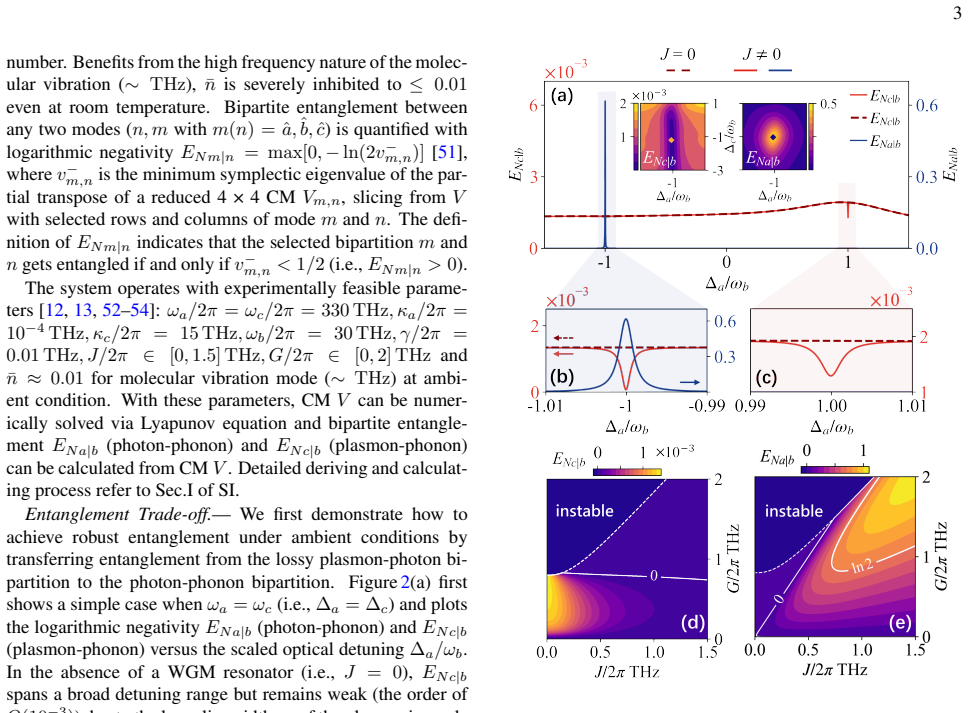
The central claim is that stationary photon-phonon entanglement in a single-molecule optomechanical system can surpass the conventional two-mode stationary squeezing bound. With a 30 THz molecular vibration, a 330 THz plasmon mode of linewidth $\kappa_c/2\pi = 15$ THz, and a high-Q WGM of linewidth $\kappa_a/2\pi = 10^{-4}$ THz, the model yields $E_N^{a|b} = 1.05$ at photon-plasmon coupling $J/2\pi = 1.5$ THz and effective plasmon-phonon coupling $G/2\pi = 2$ THz, while the plasmon-phonon entanglement $E_N^{c|b}$ is pushed toward zero. The mechanism is twofold: the beam-splitter coupling $J$ redirects Stokes photons from the lossy plasmon mode into the high-Q WGM (response ratio $R_{ac}\gg 1$), and the reduced optical absorption rate $A_+$ keeps the phonon occupancy $\langle \hat{N}_b\rangle$ below unity. The paper therefore claims that this hybrid architecture realizes ground-state cooling of the molecular vibration at ambient temperature, separating entanglement generation at the lossy hotspot from entanglement storage in the quiet WGM.
Load-bearing premise
The load-bearing premise is that the ultrahigh-Q WGM mode keeps its bare narrow linewidth ($\kappa_a/2\pi = 10^{-4}$ THz) even while evanescently coupled to a lossy plasmonic nanocavity containing a metal nanoparticle, since the model treats $\kappa_a$ as an independent constant and does not include the extra loss channels that a metal nanoparticle in the evanescent field would open; if the effective linewidth grew to roughly 0.1 THz, the absorption rate $A_+$ would rise, ground-state cooling would fail, and the $E_N^{a|b} > \ln 2$ result would collapse.
Editorial extensions
If this is right
- Stationary entanglement between a single molecule's vibration and cavity photons becomes feasible at room temperature, because the 30 THz vibration has thermal occupancy $\bar{n}\approx 0.01$ and the WGM suppresses reabsorption.
- The stationary logarithmic negativity can exceed the $\ln 2 \approx 0.69$ bound of conventional two-mode optomechanical squeezing, reaching $1.05$ in the predicted parameter window.
- Entanglement generation and storage are spatially separated: the lossy plasmonic hotspot creates the photon-phonon correlations, while the high-Q WGM stores them, making the entanglement insensitive to plasmonic dissipation.
- The hybrid architecture widens the dynamical stability region: larger $J$ raises the instability threshold in $G$, permitting stronger effective coupling and larger entanglement.
- A two-WGM extension with zero pump detuning provides a concrete path to experimental verification through homodyne detection of Stokes and anti-Stokes outputs.
Reading between the lines
- This suggests a general design principle: generate fragile quantum correlations in a strongly coupled but lossy element, then transfer them to a quiet high-Q element, a strategy that could apply to other solid-state quantum emitters such as color centers or excitons.
- If the two-WGM verification protocol works, experimenters would not need to detect terahertz radiation directly; homodyne detection of the optical outputs would certify the phonon entanglement, sidestepping a major experimental bottleneck.
- The claim implicitly predicts that the bare WGM linewidth is largely unchanged by the nearby nanoparticle; an independent linewidth measurement would be a sharper test than the entanglement measurement itself.
- A directly measurable optical signature of the mechanism is that, at the Stokes sideband, the ratio of Stokes emission into the WGM versus the plasmon mode should scale as $|R_{ac}|^2 \approx J^2/\kappa_a^2$, which could be checked in a Raman scattering experiment.
Editorial analysis
A structured set of objections, weighed in public.
Referee Report
Summary. The manuscript proposes a hybrid optomechanical setup in which a single molecule in a plasmonic nanocavity (NPoM) is evanescently coupled to a high-Q WGM microdisk resonator. The authors linearize the quantum Langevin equations around a driven steady state, solve the Lyapunov equation for the 6×6 covariance matrix, and compute logarithmic negativity for the bipartitions. The central finding is that at Stokes-sideband (blue-detuned) driving, the photon-phonon logarithmic negativity E_N^{a|b} reaches approximately 1.05 for J/2π=1.5 THz and G/2π=2 THz, exceeding the often-quoted ln2 stationary bound for conventional two-mode optomechanical squeezing. The explanation is a combination of Stokes-photon redirection into the low-loss WGM and suppression of the molecular absorption rate A_+, which keeps the phonon near its ground state. The SI contains derivations of the Stokes response functions, the absorption/emission rates, a finite-γ correction to A_+, and a two-WGM detection protocol.
Significance. If the predicted regime is physically realizable, the result is significant: it would be a concrete proposal for stationary, ambient-temperature photon-phonon entanglement in a single-molecule platform, with a clear mechanism (photon redirection plus heating suppression) and a detection scheme. The linearized QLE/Lyapunov treatment is standard and internally consistent; the SI is unusually careful in validating the S_FF(ω) approach against the covariance-matrix result, including the κa<<γ correction to A_+ in Sec. V. The paper also gives a plausible experimental protocol with two WGMs for homodyne verification. The main weakness is not in the mathematics but in the physical modeling of the high-Q WGM when it is strongly coupled to a lossy metal nanoparticle, which is the load-bearing idealization behind the headline number.
major comments (2)
- [The System (parameter list) and SI Eq. (S18)] The headline value E_N=1.05 at J/2π=1.5 THz, G/2π=2 THz assumes κa/2π=10^-4 THz while the WGM is strongly evanescently coupled to a plasmonic nanocavity containing a metal nanoparticle. The model treats κa as an independent constant and includes no extra loss channel for the WGM. If the nanoparticle loads the WGM so that κa/2π rises to only 0.1 THz (Q≈3×10^3 rather than 3×10^6), then Eq. (S18) gives A+≈(G^2/2)κa/(J^2+κaκc)≈0.053 THz at the optimum, exceeding 2γ=0.02 THz. In that case the denominator in Eq. (S15) becomes negative and the steady state used for Fig. 3(c) does not exist. The manuscript should provide a model or experimental bound for the J-induced loading of κa, or demonstrate that the bound-breaking regime survives under a realistic loaded linewidth; without this, the central claim is contingent on an unvalidated idealization.
- [Fig. 3 and Eq. (S15)] The manuscript states that all points in Fig. 3 are in the stable parameter region but does not show the stability boundary. The maximum in Fig. 3(c) is controlled by the competition between A+ and 2γ in Eq. (S15): as A+ approaches 2γ, the stationary phonon occupation diverges and the linearized steady state ceases to exist. Because the optimal point lies near this boundary, the authors should provide a stability diagram in the (J,G) plane for the stated κa and also for modest perturbations of κa, so the reader can judge how fragile the E_N≈1.05 result is to parameter uncertainty.
minor comments (6)
- [Introduction and Entanglement Trade-off] The phrase 'plasmon-photon subsystem' appears where 'plasmon-phonon subsystem' is meant (the bipartition in question is c–b); please correct this terminology throughout.
- [Abstract] The abstract's claim of 'robust entanglement among bosonic modes' overstates the results, since only bipartite entanglement measures are reported and no tripartite measure is computed; please adjust the wording.
- [SI Eq. (S13b) and Eq. (S16)] The denominators in these equations contain an extra closing parenthesis; please fix the typography.
- [Fig. 3(c)] The maximum E_N≈1.05 is reported at J/2π=1.5 THz and G/2π=2 THz, which is the edge of the plotted parameter window; please state explicitly whether this is an interior maximum of the optimization or a boundary value of the chosen range.
- [SI Sec. VI] The 'optimal pump power P=8.24 mW' should be accompanied by the corresponding steady-state amplitude |c_s| and the resulting G value, so that the consistency of the parameter set can be checked.
- [Breaking the entanglement bound] The statement that E_N exceeds the 'theoretical bound' should clarify that the bound applies to stationary two-mode optomechanical systems without auxiliary modes; in a three-mode system with an auxiliary mode the bound does not apply, as the authors themselves note via Refs. [39,44-46].
Circularity Check
No significant circularity: E_N is a direct Lyapunov-equation output with independent analytical cross-checks and no fitted target.
full rationale
The central claim (stationary E_N^{a|b}=1.05 at J/2π=1.5 THz, G/2π=2 THz) is obtained by numerically solving the linearized Lyapunov equation AV+VA^T=-D (SI Eq. S9) for the stated Hamiltonian and parameters; no parameter is fitted to this result and no measured data are invoked. The explanatory quantities introduced afterwards—R_ac (Eq. 2/S14), A_+ (Eq. S18), and the mean phonon number (Eq. 3/S15)—are derived analytically from the same linearized equations, but they are not used as inputs to compute E_N; instead the paper explicitly checks them against the covariance-matrix solution (Fig. 4(a) and Fig. S2), which is a consistency test, not a circular reduction. The ln2 comparison is an external benchmark from the cited optomechanics literature, rather than an input or a self-citation. The only self-citations (Refs. [15] and [47], by Jiao/Jing) appear in contextual or feasibility remarks—single-mode backscattering and synthetic gauge fields—and do not carry the derivation of the entanglement result. The acknowledged limitation in SI Sec. VI (neglect of WGM-induced renormalization of g_c and practical detuning challenges) concerns the physical validity of parameter assumptions, not definitional circularity. Accordingly, no step of the claimed derivation reduces to its own inputs.
Assumptions & free parameters
free parameters (3)
- Effective plasmon-phonon coupling G/2π =
0 to 2 THz, peak result at 2 THz
- Plasmon-WGM coupling J/2π =
0 to 1.5 THz, peak result at 1.5 THz
- WGM linewidth κa/2π =
10^-4 THz
assumptions (7)
- standard math Markovian white-noise quantum Langevin equations with delta-correlated input noises
- standard math Linearization around a stable steady state under strong driving
- domain assumption Neglect of direct WGM-molecular vibration coupling
- domain assumption Neglect of the increase of plasmonic mode volume due to plasmon-WGM coupling
- domain assumption WGM retains its bare ultrahigh Q (κa/2π = 10^-4 THz) in the hybrid metal-nanoparticle structure
- domain assumption Single-mode operation of the WGM (CW mode only)
- domain assumption Stability of the molecule under the required pump power (~8 mW)
Cite this review
Pith. "Pith review of Strong Molecule-Light Entanglement with Molecular Cavity Optomechanics." pith.science (2026). https://pith.science/paper/5LS2RKBE
@misc{pith2026250521227,
  author       = {Pith},
  title        = {Pith review of: Strong Molecule-Light Entanglement with Molecular Cavity Optomechanics},
  year         = {2026},
  howpublished = {\url{https://pith.science/paper/5LS2RKBE}},
  note         = {Machine review of arXiv:2505.21227}
}
read the original abstract
We propose a molecular optomechanical platform to generate robust entanglement among bosonic modes-photons, phonons, and plasmons-under ambient conditions. The system integrates an ultrahigh-Q whispering-gallery-mode (WGM) optical resonator with a plasmonic nanocavity formed by a metallic nanoparticle and a single molecule. This hybrid architecture offers two critical advantages over standalone plasmonic systems: (i) Efficient redirection of Stokes photons from the lossy plasmonic mode into the long-lived WGM resonator, and (ii) Suppression of molecular absorption and approaching vibrational ground states via plasmon-WGM interactions. These features enable entanglement to transfer from the fragile plasmon-phonon subsystem to a photon-phonon bipartition in the blue-detuned regime, yielding robust stationary entanglement resilient to environmental noise. Remarkably, the achieved entanglement surpasses the theoretical bound for conventional two-mode squeezing in certain parameter regimes. Our scheme establishes a universal approach to safeguard entanglement in open quantum systems and opens avenues for noise-resilient quantum information technologies.
Figures


Figures from the paper (1 more)

Forward citations
Cited by 1 Pith paper
-
Enhancing Optomechanical Entanglement and Mechanical Squeezing by the Synergistic Effect of Quadratic Optomechanical Coupling and Coherent Feedback
Simulations show that combining quadratic optomechanical coupling with coherent feedback can enhance optomechanical entanglement about fivefold and generate mechanical squeezing above 10 dB.
Reference graph
Works this paper leans on
-
[2]
W. Zhao, S.-D. Zhang, A. Miranowicz, and H. Jing, Sci. China- Phys. Mech. Astron. 63, 224211 (2020)
work page 2020
-
[3]
I. Wilson-Rae, N. Nooshi, J. Dobrindt, T. J. Kippenberg, and W. Zwerger, New J. Phys.10, 095007 (2008)
work page 2008
- [4]
- [5]
- [6]
-
[7]
M. K. Schmidt, R. Esteban, A. Gonz ´alez-Tudela, G. Giedke, and J. Aizpurua, ACS Nano 10, 6291 (2016)
work page 2016
-
[8]
M. K. Schmidt, R. Esteban, F. Benz, J. J. Baumberg, and J. Aizpurua, Faraday Discuss. 205, 31 (2017)
work page 2017
-
[9]
R. Esteban, J. J. Baumberg, and J. Aizpurua, Acc. Chem. Res. 55, 1889 (2022)
work page 2022
Show all 81 references
-
[10]
L. A. Jakob, W. M. Deacon, Y . Zhang, B. De Nijs, E. Pavlenko, S. Hu, C. Carnegie, T. Neuman, R. Esteban, J. Aizpurua, and J. J. Baumberg, Nat. Commun. 14, 3291 (2023)
2023
-
[11]
Y . Xu, H. Hu, W. Chen, P. Suo, Y . Zhang, S. Zhang, and H. Xu, ACS Nano 16, 12711 (2022)
2022
-
[12]
Lombardi, M
A. Lombardi, M. K. Schmidt, L. Weller, W. M. Deacon, F. Benz, B. De Nijs, J. Aizpurua, and J. J. Baumberg, Phys. Rev. X 8, 011016 (2018)
2018
-
[13]
W. Chen, P. Roelli, H. Hu, S. Verlekar, S. P. Amirtharaj, A. I. Barreda, T. J. Kippenberg, M. Kovylina, E. Verhagen, A. Mart´ınez, and C. Galland, Science 374, 1264 (2021)
2021
-
[14]
Xomalis, X
A. Xomalis, X. Zheng, R. Chikkaraddy, Z. Koczor-Benda, E. Miele, E. Rosta, G. A. E. Vandenbosch, A. Mart ´ınez, and J. J. Baumberg, Science 374, 1268 (2021). 6
2021
-
[15]
Abutalebi, S
S. Abutalebi, S. M. Ashrafi, H. Ranjbar Askari, and A. Bahram- pour, Opt. Mater. Express 14, 2134 (2024)
2024
-
[16]
Moradi Kalarde, F
F. Moradi Kalarde, F. Ciccarello, C. S ´anchez Mu ˜noz, J. Feist, and C. Galland, Nanophotonics 14, 59 (2025)
2025
-
[17]
J. Liu, F. He, and K. D. Zhu, EPL 137, 25002 (2022)
2022
-
[18]
S. M. Ashrafi, R. Malekfar, A. R. Bahrampour, and J. Feist, Phys. Rev. A 100, 013826 (2019)
2019
-
[19]
Carretta, D
S. Carretta, D. Zueco, A. Chiesa, A. G ´omez-Le´on, and F. Luis, Appl. Phys. Lett. 118, 240501 (2021)
2021
-
[20]
D. K. Ruttley, T. R. Hepworth, A. Guttridge, and S. L. Cornish, Nature 637, 827 (2025)
2025
-
[21]
S. L. Cornish, M. R. Tarbutt, and K. R. A. Hazzard, Nat. Phys. 20, 730 (2024)
2024
-
[22]
Y . Li, W. Chen, X. He, J. Shi, X. Cui, J. Sun, and H. Xu, Adv. Mater. 36, 2405186 (2024)
2024
-
[23]
Chiesa, P
A. Chiesa, P. Santini, E. Garlatti, F. Luis, and S. Carretta, Rep. Prog. Phys. 87, 034501 (2024)
2024
-
[24]
Weedbrook, S
C. Weedbrook, S. Pirandola, R. Garc´ıa-Patr´on, N. J. Cerf, T. C. Ralph, J. H. Shapiro, and S. Lloyd, Rev. Mod. Phys. 84, 621 (2012)
2012
-
[25]
C. H. Bennett, D. P. DiVincenzo, J. A. Smolin, and W. K. Woot- ters, Phys. Rev. A 54, 3824 (1996)
1996
-
[26]
Raussendorf and H
R. Raussendorf and H. J. Briegel, Phys. Rev. Lett. 86, 5188 (2001)
2001
-
[27]
T. D. Ladd, F. Jelezko, R. Laflamme, Y . Nakamura, C. Monroe, and J. L. O’Brien, Nature 464, 45 (2010)
2010
-
[28]
Y . Xia, W. Li, W. Clark, D. Hart, Q. Zhuang, and Z. Zhang, Phys. Rev. Lett. 124, 150502 (2020)
2020
-
[29]
C. L. Degen, F. Reinhard, and P. Cappellaro, Rev. Mod. Phys. 89, 035002 (2017)
2017
-
[30]
Z. Zhao, Y . A. Chen, A. N. Zhang, T. Yang, H. J. Briegel, and J. W. Pan, Nature 430, 54 (2004)
2004
-
[31]
A. C. Dada, J. Leach, G. S. Buller, M. J. Padgett, and E. An- dersson, Nat. Phys. 7, 677 (2011)
2011
-
[32]
Mazzanti, R
M. Mazzanti, R. X. Schussler, J. D. A. Espinoza, Z. Wu, R. Ger- ritsma, and A. Safavi-Naini, Phys. Rev. Lett. 127, 260502 (2021)
2021
-
[33]
Haffner, C
H. Haffner, C. F. Roos, and R. Blatt, Phys. Rep. 469, 155 (2008)
2008
-
[34]
Clarke and F
J. Clarke and F. K. Wilhelm, Nature 453, 1031 (2008)
2008
-
[35]
Kotler, G
S. Kotler, G. A. Peterson, E. Shojaee, F. Lecocq, K. Cicak, A. Kwiatkowski, S. Geller, S. Glancy, E. Knill, R. W. Sim- monds, J. Aumentado, and J. D. Teufel, Science 372, 622 (2021)
2021
-
[36]
Mercier de L ´epinay, C
L. Mercier de L ´epinay, C. F. Ockeloen-Korppi, M. J. Woolley, and M. A. Sillanp¨a¨a, Science 372, 625 (2021)
2021
-
[37]
Vitali, S
D. Vitali, S. Gigan, A. Ferreira, H. R. B ¨ohm, P. Tombesi, A. Guerreiro, V . Vedral, A. Zeilinger, and M. Aspelmeyer, Phys. Rev. Lett. 98, 030405 (2007)
2007
-
[38]
T. A. Palomaki, J. D. Teufel, R. W. Simmonds, and K. W. Lehn- ert, Science 342, 710 (2013)
2013
-
[39]
Wang and A
Y .-D. Wang and A. A. Clerk, Phys. Rev. Lett. 110, 253601 (2013)
2013
-
[41]
Wang, X.-Y
M. Wang, X.-Y . L¨u, Y .-D. Wang, J. Q. You, and Y . Wu, Phys. Rev. A 94, 053807 (2016)
2016
-
[42]
Hu, L.-T
C.-S. Hu, L.-T. Shen, Z.-B. Yang, H. Wu, Y . Li, and S.-B. Zheng, Phys. Rev. A 100, 043824 (2019)
2019
-
[43]
Huang and A
S. Huang and A. Chen, Phys. Rev. A 98, 063843 (2018)
2018
-
[44]
Zhang, C.-S
Y .-L. Zhang, C.-S. Yang, Z. Shen, C.-H. Dong, G.-C. Guo, C.- L. Zou, and X.-B. Zou, Phys. Rev. A 101, 063836 (2020)
2020
-
[45]
Liao, R.-X
C.-G. Liao, R.-X. Chen, H. Xie, and X.-M. Lin, Phys. Rev. A 97, 042314 (2018)
2018
-
[46]
Tian, Phys
L. Tian, Phys. Rev. Lett. 110, 233602 (2013)
2013
-
[47]
Liu, Y .-F
J.-X. Liu, Y .-F. Jiao, Y . Li, X.-W. Xu, Q.-Y . He, and H. Jing, Sci. China-Phys. Mech. Astron. 66, 230312 (2023)
2023
-
[48]
Huang, D
J. Huang, D. Lei, G. S. Agarwal, and Z. Zhang, Phys. Rev. B 110, 184306 (2024)
2024
-
[49]
K. B. Emale, J.-X. Peng, A. Sohail, P. Djorwe, A.-H. Abdel- Aty, N. Alessa, K. S. Nisar, and S. G. N. Engo, (2025), 2501.14045
2025 arXiv
-
[50]
H. M. Doeleman, E. Verhagen, and A. F. Koenderink, ACS Photonics 3, 1943 (2016)
2016
-
[52]
J. Sun, H. Hu, Y . Xu, Y . Li, and H. Xu, Laser Photonics Rev. 16, 2100564 (2022)
2022
-
[53]
Shlesinger, J
I. Shlesinger, J. Vandersmissen, E. Oksenberg, E. Verhagen, and A. F. Koenderink, Sci. Adv.9, eadj4637 (2023)
2023
-
[54]
Shlesinger, K
I. Shlesinger, K. G. Cogn ´ee, E. Verhagen, and A. F. Koen- derink, ACS Photonics 8, 3506 (2021)
2021
-
[56]
Liu, Y .-W
Y .-C. Liu, Y .-W. Hu, C. W. Wong, and Y .-F. Xiao, Chinese Phys. B 22, 114213 (2013)
2013
-
[57]
Genes, D
C. Genes, D. Vitali, P. Tombesi, S. Gigan, and M. Aspelmeyer, Phys. Rev. A 77, 033804 (2008)
2008
-
[58]
W. Mao, Y . Li, X. Jiang, Z. Liu, and L. Yang, Light Sci. Appl. 12, 247 (2023)
2023
-
[59]
Chikkaraddy, A
R. Chikkaraddy, A. Xomalis, L. A. Jakob, and J. J. Baumberg, Light Sci. Appl. 11, 19 (2022)
2022
-
[60]
Zhang, S
Z. Zhang, S. Mouradian, F. N. C. Wong, and J. H. Shapiro, Phys. Rev. Lett. 114, 110506 (2015)
2015
-
[61]
Sunami, S
S. Sunami, S. Tamiya, R. Inoue, H. Yamasaki, and A. Goban, PRX Quantum 6, 010101 (2025)
2025
-
[62]
Aghaee Rad, T
H. Aghaee Rad, T. Ainsworth, R. N. Alexander, B. Altieri, and M. F. Askarani, Nature 638, 912 (2025). Supplemental Information: Strong Molecule-Light Entanglement with Molecular Cavity Optomechanics Hong-Yun Yu,1 Ya-Feng Jiao,2, 3 Jie Wang,4 Feng Li,5 Bin Yin,4 Tian Jiang,6, 1...
2025 arXiv
-
[63]
Coupling asymmetry: Small discrepancies betweenJ1 andJ2 (< 10%) induce bearable entanglement degradation (Fig. S4(b))
-
[64]
S4(c)), achievable through thermal compensa- tion of WGMs and pump tuning
Detuning mismatch: Strict maintenance of ∆a1≈− ∆a2 is crucial (Fig. S4(c)), achievable through thermal compensa- tion of WGMs and pump tuning
-
[65]
Pump detuning tolerance: Moderate ∆c variations preserve entanglement (Fig. S4(d))
-
[66]
For κa/2π <10−4 THz, the improvement in entanglement becomes negligible (Fig
High-Q resonator requirement While a higher Q factor ( κa) enhances the entanglement strength ENa 1|a2, ultra-high Q values are not strictly necessary. For κa/2π <10−4 THz, the improvement in entanglement becomes negligible (Fig. S4(e)). Then by measuring the quadrature operat...
-
[67]
S. H. Strogatz, Nonlinear Dynamics and Chaos: With Applications to Physics, Biology, Chemistry, and Engineering , second edition ed. (Westview Press, 2015)
2015
-
[68]
E. X. DeJesus and C. Kaufman, Phys. Rev. A 35, 5288 (1987)
1987
-
[69]
Adesso, A
G. Adesso, A. Serafini, and F. Illuminati, Phys. Rev. A 70, 022318 (2004)
2004
-
[70]
Roelli, C
P. Roelli, C. Galland, N. Piro, and T. J. Kippenberg, Nat. Nanotechnol. 11, 164 (2016)
2016
-
[71]
J. Sun, H. Hu, Y . Xu, Y . Li, and H. Xu, Laser Photon. Rev.16, 2100564 (2022)
2022
-
[72]
Shlesinger, J
I. Shlesinger, J. Vandersmissen, E. Oksenberg, E. Verhagen, and A. F. Koenderink, Sci. Adv. 9, eadj4637 (2023)
2023
-
[73]
Shlesinger, K
I. Shlesinger, K. G. Cogn ´ee, E. Verhagen, and A. F. Koenderink, ACS Photonics 8, 3506 (2021)
2021
-
[74]
Genes, A
C. Genes, A. Mari, P. Tombesi, and D. Vitali, Phys. Rev. A 78, 032316 (2008)
2008
-
[75]
Wang and A
Y .-D. Wang and A. A. Clerk, Phys. Rev. Lett.110, 253601 (2013)
2013
-
[76]
Liu, Y .-W
Y .-C. Liu, Y .-W. Hu, C. W. Wong, and Y .-F. Xiao, Chinese Phys. B22, 114213 (2013)
2013
-
[77]
Aspelmeyer, T
M. Aspelmeyer, T. J. Kippenberg, and F. Marquardt, Rev. Mod. Phys. 86, 1391 (2014)
2014
-
[78]
A. A. Clerk, M. H. Devoret, S. M. Girvin, F. Marquardt, and R. J. Schoelkopf, Rev. Mod. Phys. 82, 1155 (2010)
2010
-
[79]
A. O. Svela, J. M. Silver, L. Del Bino, S. Zhang, M. T. M. Woodley, M. R. Vanner, and P. Del’Haye, Light Sci. Appl. 9, 204 (2020)
2020
-
[80]
Wiersig, Phys
J. Wiersig, Phys. Rev. A 84, 063828 (2011)
2011
-
[81]
Jiao, S.-D
Y .-F. Jiao, S.-D. Zhang, Y .-L. Zhang, A. Miranowicz, L.-M. Kuang, and H. Jing, Phys. Rev. Lett.125, 143605 (2020)
2020
-
[82]
Marquardt, J
F. Marquardt, J. P. Chen, A. A. Clerk, and S. M. Girvin, Phys. Rev. Lett. 99, 093902 (2007)
2007
-
[83]
Shlesinger, I
I. Shlesinger, I. M. Palstra, and A. F. Koenderink, Phys. Rev. Lett. 130, 016901 (2023)
2023
-
[84]
L.-M. Duan, G. Giedke, J. I. Cirac, and P. Zoller, Phys. Rev. Lett. 84, 2722 (2000)
2000
-
[85]
T. A. Palomaki, J. D. Teufel, R. W. Simmonds, and K. W. Lehnert, Science 342, 710 (2013)
2013
Reviewed August 7, 2026 · model on record in the stance chip above.
Discussion (0). Continue with ORCID to comment.