REVIEW 2 major objections 1 minor 78 references
3D Imaging of Complex Skyrmion and Hopf Topologies in an Extended Sample
T0 review · 2 major / 1 minor · reviewed 2026-06-26 · grok-4.3
Pith's one-line read Vector ptycho-tomography images barrel-shaped skyrmion tubes with twisted helicity and fractional Hopf indices in Fe/Gd multilayers.
desk verdict This reports the first experimental 3D reconstruction of an extended skyrmion lattice with depth-dependent helicity and fractional Hopf index, but the reconstruction algorithm lacks shown validation against known structures or noise. read the letter →
The pith
A machine-rendered reading of the paper's core claim, the machinery that carries it, and where it could break.
The reading
What carries the argument
Vector ptycho-tomography, a coherent diffractive imaging method that reconstructs the three-dimensional magnetization vector field element-specifically from diffraction patterns without relying on prior assumptions about sample structure.
What would settle it
An independent three-dimensional magnetic vector imaging measurement, such as electron holography tomography performed on the same Fe/Gd multilayer region, would produce a measurably different domain-wall shape, helicity profile, or Hopf index if the ptycho-tomographic reconstruction contains systematic artifacts.
Extended reading notes
Core claim
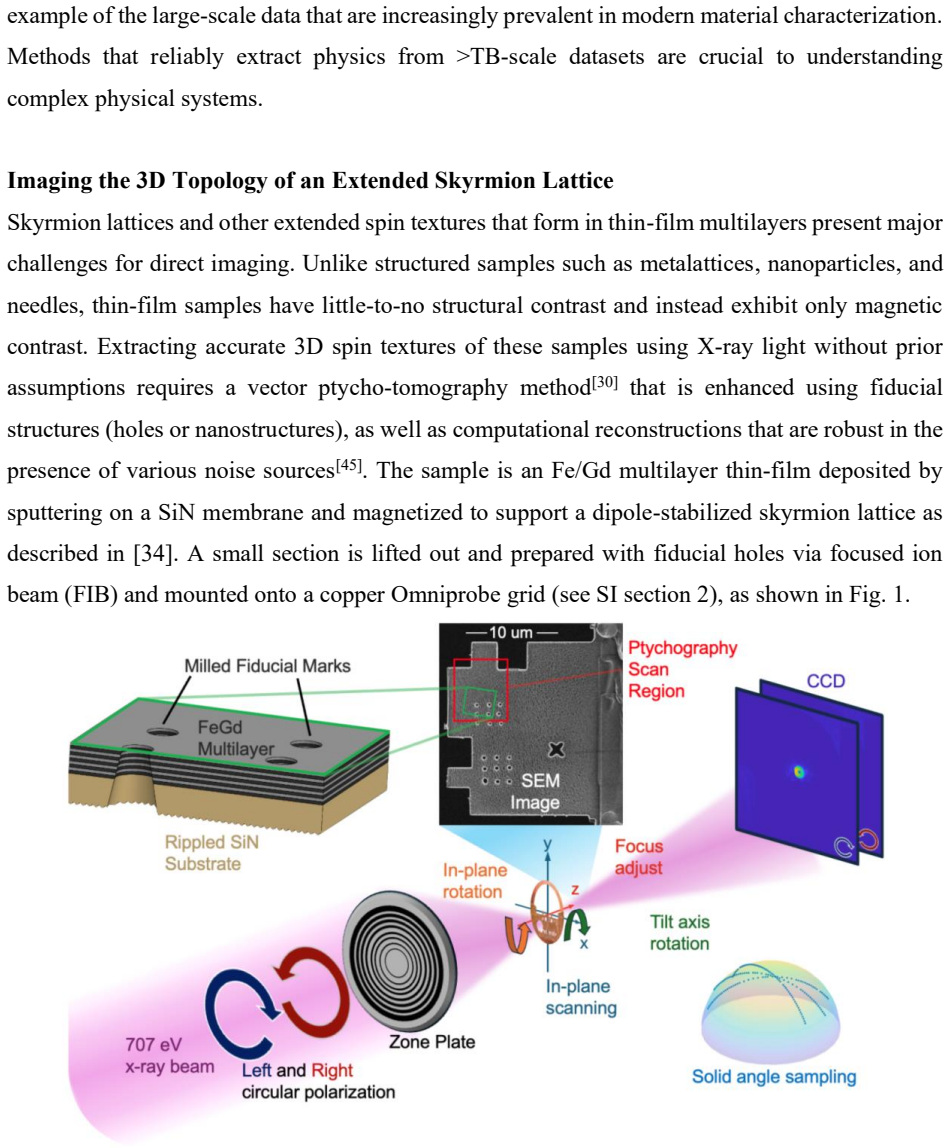
Vector ptycho-tomography, combined with noise-robust algorithms, images the three-dimensional magnetic texture of skyrmion and Hopf topologies with no prior assumptions about the sample. This directly reveals an extended 3D skyrmion lattice in Fe/Gd multilayers consisting of barrel-shaped skyrmion tubes with twisted helicity that transitions from Néel-type winding at the surfaces to both clockwise and counterclockwise Bloch-type winding in the bulk, structures that can also be described as fractional hopfions. A lattice of 24 skyrmions with topological charge 1, average depth-dependent domain wall width of 23 to 40 nm, depth-dependent twisted helicity from ±155° to ±30°, and fractional Hopf
Load-bearing premise
The vector ptycho-tomography reconstruction algorithms are robust to noise and recover the true three-dimensional magnetization vector field without introducing artifacts or relying on prior assumptions about the sample structure.
Editorial extensions
If this is right
- Dipole-stabilized skyrmions in Fe/Gd multilayers form barrel-shaped tubes rather than simple cylinders and exhibit depth-dependent helicity that can be classified as fractional hopfions.
- Domain wall widths and helicity angles vary continuously with depth through the multilayer stack, from 23–40 nm and ±155° to ±30° respectively.
- A lattice containing 24 individual skyrmions, each carrying topological charge 1, can be mapped over volumes exceeding 0.4 μm³ at 8 nm resolution.
- The method produces fully resolved three-dimensional reconstructions from more than 10 TB of data down to the Nyquist limit without element-specific priors.
Reading between the lines
- The same reconstruction approach could be applied to other multilayer systems to test whether similar barrel shapes and fractional Hopf indices appear when different magnetic materials or stacking sequences are used.
- Accounting for the observed helicity twist may alter predictions of skyrmion mobility or stability in racetrack or logic devices that assume uniform winding along the tube length.
- Time-resolved extensions of the technique could reveal whether the depth-dependent helicity changes dynamically under current or field drive.
- The ability to extract fractional Hopf indices from experimental data opens a route to classifying and controlling a broader family of three-dimensional topological textures beyond integer skyrmions.
Signed reviews
Editorial analysis
A structured set of objections, weighed in public.
Referee Report
Summary. The manuscript reports the first experimental 3D reconstruction of an extended skyrmion lattice in Fe/Gd multilayers using vector ptycho-tomography. It claims to directly image 24 skyrmions (topological charge 1 each) with barrel-shaped tubes, depth-dependent domain-wall widths averaging 23–40 nm, helicity twisting from ±155° (Néel-type at surfaces) to ±30° (Bloch-type in bulk), and fractional Hopf indices of ±0.3, achieving 8 nm resolution over >0.4 μm³ with no prior assumptions on sample structure and robustness to noise.
Significance. If the reconstruction is shown to recover the true magnetization vector field, the work would constitute a notable advance by providing quantitative, element-specific 3D access to complex topological textures at scale, addressing a longstanding gap between 2D imaging and full 3D topological characterization in magnetic materials.
major comments (2)
- [Abstract] Abstract: The assertion of 'high fidelity down to the Nyquist limit of 8 nm' and 'algorithms that are robust to noise' is unsupported by any validation metrics, error bars, synthetic-data tests, or comparisons to known structures; these are required to substantiate the reported quantitative values for domain-wall widths, helicity angles, and Hopf indices.
- [Methods] Reconstruction algorithm description (likely in Methods): The claim of recovering the magnetization 'with no prior assumptions' requires explicit documentation of any regularization, support constraints, or phase-retrieval steps, because even small directional biases in the vector tomography can propagate into the integrated helicity and fractional Hopf numbers that form the central quantitative results.
minor comments (1)
- [Abstract] Abstract: The notation '±155$\\,\deg$' should be written consistently as degrees throughout to avoid ambiguity.
Simulated Author's Rebuttal
We thank the referee for their careful reading of the manuscript and constructive comments. We address each major comment point-by-point below and will revise the manuscript to strengthen the validation and documentation as requested.
read point-by-point responses
-
Referee: [Abstract] Abstract: The assertion of 'high fidelity down to the Nyquist limit of 8 nm' and 'algorithms that are robust to noise' is unsupported by any validation metrics, error bars, synthetic-data tests, or comparisons to known structures; these are required to substantiate the reported quantitative values for domain-wall widths, helicity angles, and Hopf indices.
Authors: We agree that the abstract claims would be strengthened by explicit supporting evidence. In the revised manuscript we will add synthetic-data validation tests, error bars on the reported domain-wall widths, helicity angles and Hopf indices, and direct comparisons to known structures to substantiate the quantitative results and the stated fidelity down to the Nyquist limit. revision: yes
-
Referee: [Methods] Reconstruction algorithm description (likely in Methods): The claim of recovering the magnetization 'with no prior assumptions' requires explicit documentation of any regularization, support constraints, or phase-retrieval steps, because even small directional biases in the vector tomography can propagate into the integrated helicity and fractional Hopf numbers that form the central quantitative results.
Authors: We acknowledge the importance of full transparency on algorithmic details. The Methods section already outlines the vector ptycho-tomography procedure, but we will expand it in revision to explicitly document any regularization terms, support constraints and phase-retrieval steps. These are purely algorithmic choices and do not encode prior assumptions about the sample magnetization; the expanded description will make this distinction clear and allow readers to assess possible propagation into the helicity and Hopf-index values. revision: yes
Circularity Check
No circularity: pure experimental imaging with no derivation chain
full rationale
The manuscript reports direct experimental reconstruction of 3D magnetization via vector ptycho-tomography applied to measured coherent diffraction data from a physical Fe/Gd multilayer sample. Reported values (domain-wall widths 23-40 nm, helicity twists, fractional Hopf indices) are outputs of the imaging pipeline on raw data, with explicit claims of no prior assumptions or fitted inputs. No equations, predictions, ansatzes, or self-citations reduce any result to its own inputs by construction; the work contains no mathematical derivation chain at all.
Assumptions & free parameters
assumptions (1)
- domain assumption Vector ptycho-tomography combined with noise-robust algorithms can reconstruct 3D vector magnetic fields from diffraction data without prior sample assumptions.
Cite this review
Pith. "Pith review of 3D Imaging of Complex Skyrmion and Hopf Topologies in an Extended Sample." pith.science (2026). https://pith.science/paper/5MSCBHUP
@misc{pith2026260627365,
  author       = {Pith},
  title        = {Pith review of: 3D Imaging of Complex Skyrmion and Hopf Topologies in an Extended Sample},
  year         = {2026},
  howpublished = {\url{https://pith.science/paper/5MSCBHUP}},
  note         = {Machine review of arXiv:2606.27365}
}
abstract
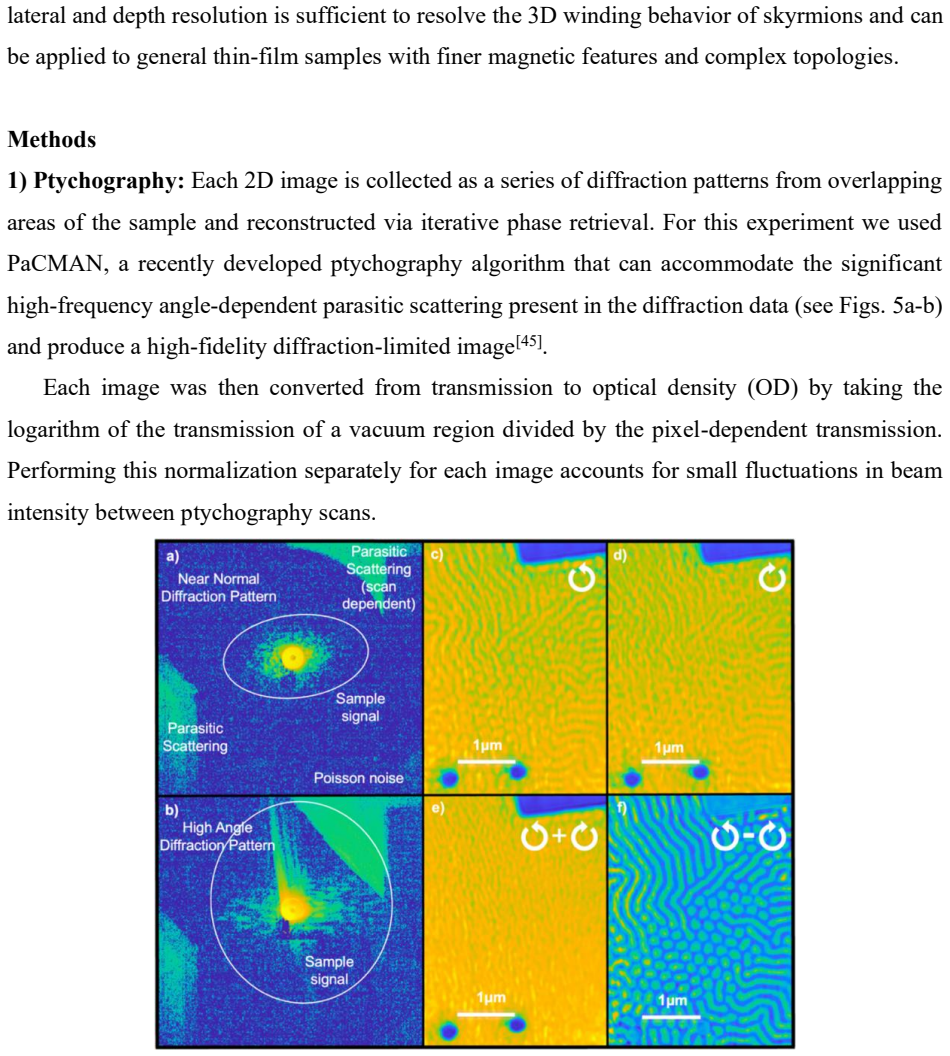
Spin textures are key for emergent magnetic phenomena such as topological protection and underpin novel spintronic device paradigms based on racetrack memory, logic gates, and neuromorphic computing. Using a coherent diffractive imaging technique called vector ptycho-tomography, in combination with algorithms that are robust to noise, we image the 3D magnetic texture of skyrmion and Hopf topologies with no prior assumptions about the sample. This directly reveals experimentally for the first time an extended 3D skyrmion lattice, including the domain wall shape, topological charge, helicity, and Hopf index. Our findings demonstrate experimentally that dipole stabilized skyrmions in Fe/Gd multilayers exhibit barrel-shaped skyrmion tubes with a twisted helicity, transitioning from N$\'e$el-type winding at the surfaces to both clockwise and counterclockwise Bloch-type winding in the bulk, that can also be described as fractional hopfions. We image a lattice of 24 skyrmions with topological charge 1, average depth-dependent domain wall width of 23 to 40 nm, depth-dependent twisted helicity from $\pm$155$\deg$ to $\pm$30$\deg$, and fractional Hopf index of $\pm$0.3. Over 10 TB of data were analyzed to yield a fully-resolved 3D reconstruction over a >0.4 $\mu$m$^3$ volume, with high fidelity down to the Nyquist limit of 8 nm. This method fills a key gap in the current landscape of magnetic imaging by enabling high-resolution, element-specific 3D reconstructions of full-field extended spin textures - offering a new route for exploring the topological complexity of magnetic materials in three dimensions.
Figures
Reference graph
Works this paper leans on
-
[1]
S., Colombo, L., & Seidel, J
Sharma, P., Moise, T. S., Colombo, L., & Seidel, J. Roadmap for ferroelectric domain wall nanoelectronics. Advanced Functional Materials, 32(10), 2110263. (2022)
2022
-
[2]
Q., Yuan, S., Hou, Z
Chen, S. Q., Yuan, S., Hou, Z. P., Tang, Y., Zhang, J., Wang, T., Li, K., Zhao, W., Liu, X. J., Chen, L., Martin, L. W., & Chen, Z. H. Recent progress on topological structures in ferroic thin films and heterostructures. Advanced Materials, 33(6), 2000857. (2021)
2021
-
[3]
S., Kolesnikov, A
Samardak, A. S., Kolesnikov, A. G., Davydenko, A. V., Steblii, M. E., & Ognev, A. V. Topologically nontrivial spin textures in thin magnetic films. Phys. Metals Metallogr., 123, 238–260. (2022)
2022
-
[4]
Topological properties and dynamics of magnetic skyrmions
Nagaosa, N., & Tokura, Y. Topological properties and dynamics of magnetic skyrmions. Nature Nanotechnology, 8(12), 899–911. (2013)
2013
-
[5]
Parkin, S. S. P., Hayashi, M., & Thomas, L. Magnetic domain-wall racetrack memory. Science, 320(5873), 190–194. (2008)
2008
-
[6]
Topological spin textures: Basic physics and devices
Zhou, Y., Li, S., Liang, X., & Zhou, Y. Topological spin textures: Basic physics and devices. Advanced Materials, 37(2), 2312935. (2025)
2025
-
[7]
Skyrmions on the track
Fert, A., Cros, V., & Sampaio, J. Skyrmions on the track. Nature Nanotechnology, 8(3), 152–156. (2013). 17
2013
-
[8]
Grollier, J., Querlioz, D., & Stiles, M. D. Spintronic nanodevices for bioinspired computing. Proceedings of the IEEE, 104(10), 2024–2039. (2016)
2024
Show all 78 references
-
[9]
Device-size dependence of field- free spin-orbit torque induced magnetization switching in antiferromagnet/ferromagnet structures
Kurenkov, A., Zhang, C., DuttaGupta, S., Fukami, S., & Ohno, H. Device-size dependence of field- free spin-orbit torque induced magnetization switching in antiferromagnet/ferromagnet structures. Applied Physics Letters, 110(9), 092410. (2017)
2017
-
[10]
Reconfigurable skyrmion logic gates
Luo, S., Song, M., Li, X., Zhang, Y., Hong, J., Yang, X., Zou, X., Xu, N., & You, L. Reconfigurable skyrmion logic gates. Nano Letters, 18(2), 1180–1184. (2018)
2018
-
[11]
Y., Everschor-Sitte, K., Fukami, S., & Stiles, M
Grollier, J., Querlioz, D., Camsari, K. Y., Everschor-Sitte, K., Fukami, S., & Stiles, M. D. Neuromorphic spintronics. Nature Electronics, 3(7), 360–370. (2020)
2020
-
[12]
Skyrmion qubits: A new class of quantum logic elements based on nanoscale magnetization
Psaroudaki, C., & Panagopoulos, C. Skyrmion qubits: A new class of quantum logic elements based on nanoscale magnetization. Physical Review Letters, 127(6), 067201. (2021)
2021
-
[13]
Zou, J., Bosco, S., Pal, B., Parkin, S. S. P., Klinovaja, J., & Loss, D. Quantum computing on magnetic racetracks with flying domain wall qubits. Physical Review Research, 5(3), 033166. (2023)
2023
-
[14]
Frontiers of magnetic force microscopy
Kazakova, O., Puttock, R., Barton, C., Corte-León, H., Jaafar, M., Neu, V., & Asenjo, A. Frontiers of magnetic force microscopy. Journal of Applied Physics, 125(6), 060901. (2019)
2019
-
[15]
Lorentz transmission electron microscopy for magnetic skyrmions imaging
Tang, J., Kong, L., Wang, W., Du, H., & Tian, M. Lorentz transmission electron microscopy for magnetic skyrmions imaging. Chinese Physics B, 28(8), 087503. (2019)
2019
-
[16]
Reciprocal space tomography of 3D skyrmion lattice order in a chiral magnet
Zhang, S., Van Der Laan, G., Müller, J., Heinen, L., Garst, M., Bauer, A., Berger, H., Pfleiderer, C., & Hesjedal, T. Reciprocal space tomography of 3D skyrmion lattice order in a chiral magnet. Proceedings of the National Academy of Sciences, 115(25), 6386–6391. (2018)
2018
-
[17]
Spin disorder control of topological spin texture
Zhang, H., Shao, Y.-T., Chen, X., Zhang, B., Wang, T., Meng, F., Xu, K., Meisenheimer, P., Chen, X., Huang, X., Behera, P., Husain, S., Zhu, T., Pan, H., Jia, Y., Settineri, N., Giles-Donovan, N., He, Z., Scholl, A., … Ramesh, R. Spin disorder control of topological spin textu...
2024
-
[18]
S., Reddinger, J., Moraski, R., Fullerton, E
Parker, W. S., Reddinger, J., Moraski, R., Fullerton, E. E., Montoya, S. A., & McMorran, B. J. Real space imaging of dipole-stabilized hybrid skyrmions in magnetic multilayer thin films. Physical Review B, 112(9), 094415. (2025)
2025
-
[19]
V., Yasin, F
Yu, X., Iakoubovskii, K. V., Yasin, F. S., Peng, L., Nakajima, K., Schneider, S., Karube, K., Arima, T., Taguchi, Y., & Tokura, Y. Real-space observations of three-dimensional antiskyrmions and skyrmion strings. Nano Letters, 22(23), 9358–9364. (2022)
2022
-
[20]
K., Kovács, A., Schmidt, M., Dunin-Borkowski, R
Wolf, D., Schneider, S., Rößler, U. K., Kovács, A., Schmidt, M., Dunin-Borkowski, R. E., Büchner, B., Rellinghaus, B., & Lubk, A. Unveiling the three-dimensional magnetic texture of skyrmion tubes. Nature Nanotechnology, 17(3), 250–255. (2022)
2022
-
[21]
S., Masell, J., Takahashi, Y., Akashi, T., Baba, N., Karube, K., Shindo, D., Arima, T., Taguchi, Y., Tokura, Y., Tanigaki, T., & Yu, X
Yasin, F. S., Masell, J., Takahashi, Y., Akashi, T., Baba, N., Karube, K., Shindo, D., Arima, T., Taguchi, Y., Tokura, Y., Tanigaki, T., & Yu, X. Bloch point quadrupole constituting hybrid topological strings revealed with electron holographic vector field tomography. Advanced...
2024
-
[22]
S., Yu, X., Aizawa, S., Tanigaki, T., Akashi, T., Takahashi, Y., Matsuda, T., Kanazawa, N., Onose, Y., Shindo, D., Tonomura, A., & Tokura, Y
Park, H. S., Yu, X., Aizawa, S., Tanigaki, T., Akashi, T., Takahashi, Y., Matsuda, T., Kanazawa, N., Onose, Y., Shindo, D., Tonomura, A., & Tokura, Y. Observation of the magnetic flux and three- dimensional structure of skyrmion lattices by electron holography. Nature Nanotech...
-
[23]
E., Heacock, B., Bleuel, M., Cory, D
Henderson, M. E., Heacock, B., Bleuel, M., Cory, D. G., Heikes, C., Huber, M. G., Krzywon, J., Nahman-Levesqué, O., Luke, G. M., Pula, M., Sarenac, D., Zhernenkov, K., & Pushin, D. A. Three- dimensional neutron far-field tomography of a bulk skyrmion lattice. Nature Physics, 1...
-
[24]
G., & Makarov, D
Streubel, R., Kronast, F., Fischer, P., Parkinson, D., Schmidt, O. G., & Makarov, D. Retrieving spin textures on curved magnetic thin films with full-field soft X-ray microscopies. Nature Communications, 6(1), 7612. (2015)
2015
-
[25]
M., Martín, J
Hierro-Rodriguez, A., Quirós, C., Sorrentino, A., Alvarez-Prado, L. M., Martín, J. I., Alameda, J. M., McVitie, S., Pereiro, E., Vélez, M., & Ferrer, S. Revealing 3D magnetization of thin films with soft X- 18 ray tomography: Magnetic singularities and topological charges. Nat...
2020
-
[26]
A., Förster, J., Reeve, R
Litzius, K., Lemesh, I., Krüger, B., Bassirian, P., Caretta, L., Richter, K., Büttner, F., Sato, K., Tretiakov, O. A., Förster, J., Reeve, R. M., Weigand, M., Bykova, I., Stoll, H., Schütz, G., Beach, G. S. D., & Kläui, M. Skyrmion Hall effect revealed by direct time-resolved ...
2017
-
[27]
Three-dimensional tomographic imaging of the magnetization vector field using Fourier transform holography
Di Pietro Martínez, M., Wartelle, A., Herrero Martínez, C., Fettar, F., Blondelle, F., Motte, J.-F., Donnelly, C., Turnbull, L., Ogrin, F., Van Der Laan, G., Popescu, H., Jaouen, N., Yakhou-Harris, F., & Beutier, G. Three-dimensional tomographic imaging of the magnetization ve...
2023
-
[28]
J., Grelier, M., Battistelli, R., Bouckaert, W., Joy, K
Chiliquinga-Jacome, J. J., Grelier, M., Battistelli, R., Bouckaert, W., Joy, K. P., Collin, S., Godel, F., Martínez, M. D. P., Donnelly, C., Büttner, F., Popescu, H., Cros, V., Reyren, N., & Jaouen, N. Three- dimensional tomographic imaging of skyrmionic cocoons using HERALDO....
2026
-
[29]
Donnelly, C., Guizar-Sicairos, M., Scagnoli, V., Gliga, S., Holler, M., Raabe, J., & Heyderman, L. J. Three-dimensional magnetization structures revealed with X-ray vector nanotomography. Nature, 547(7663), 328–331. (2017)
2017
-
[30]
H., Ryan, S
Rana, A., Liao, C.-T., Iacocca, E., Zou, J., Pham, M., Lu, X., Cating-Subramanian, E.-E., Lo, Y. H., Ryan, S. A., Bevis, C. S., Karl, R. M., Glaid, A. J., Rable, J., Mahale, P., Hirst, J., Ostler, T., Liu, W., O’Leary, C. M., Yu, Y.-S., … Miao, J. Three-dimensional topological...
2023
-
[31]
V., Dhuey, S., Bayaraa, T., Ashby, P., Raabe, J., Santos, T., Griffin, S., & Fischer, P
Raftrey, D., Finizio, S., Chopdekar, R. V., Dhuey, S., Bayaraa, T., Ashby, P., Raabe, J., Santos, T., Griffin, S., & Fischer, P. Quantifying the topology of magnetic skyrmions in three dimensions. Science Advances, 10(40), eadp8615. (2024)
2024
-
[32]
Z., Kanazawa, N., Onose, Y., Kimoto, K., Zhang, W
Yu, X. Z., Kanazawa, N., Onose, Y., Kimoto, K., Zhang, W. Z., Ishiwata, S., Matsui, Y., & Tokura, Y. Near room-temperature formation of a skyrmion crystal in thin-films of the helimagnet FeGe. Nature Materials, 10(2), 106–109. (2011)
2011
-
[33]
Spontaneous atomic-scale magnetic skyrmion lattice in two dimensions
Heinze, S., Von Bergmann, K., Menzel, M., Brede, J., Kubetzka, A., Wiesendanger, R., Bihlmayer, G., & Blügel, S. Spontaneous atomic-scale magnetic skyrmion lattice in two dimensions. Nature Physics, 7(9), 713–718. (2011)
2011
-
[34]
A., Couture, S., Chess, J
Montoya, S. A., Couture, S., Chess, J. J., Lee, J. C. T., Kent, N., Henze, D., Sinha, S. K., Im, M.-Y., Kevan, S. D., Fischer, P., McMorran, B. J., Lomakin, V., Roy, S., & Fullerton, E. E. Tailoring magnetic energies to form dipole skyrmions and skyrmion lattices. Physical Rev...
2017
-
[35]
D., DeBeer-Schmitt, L., Montoya, S
Desautels, R. D., DeBeer-Schmitt, L., Montoya, S. A., Borchers, J. A., Je, S.-G., Tang, N., Im, M.-Y., Fitzsimmons, M. R., Fullerton, E. E., & Gilbert, D. A. Realization of ordered magnetic skyrmions in thin films at ambient conditions. Physical Review Materials, 3(10), 104406. (2019)
2019
-
[36]
Skyrmion lattice in a chiral magnet
Mühlbauer, S., Binz, B., Jonietz, F., Pfleiderer, C., Rosch, A., Neubauer, A., Georgii, R., & Böni, P. Skyrmion lattice in a chiral magnet. Science, 323(5916), 915–919. (2009)
2009
-
[37]
N., Morshed, M
Vakili, H., Xu, J.-W., Zhou, W., Sakib, M. N., Morshed, M. G., Hartnett, T., Quessab, Y., Litzius, K., Ma, C. T., Ganguly, S., Stan, M. R., Balachandran, P. V., Beach, G. S. D., Poon, S. J., Kent, A. D., & Ghosh, A. W. Skyrmionics—Computing and memory technologies based on top...
2021
-
[38]
Dipolar-stabilized first and second-order antiskyrmions in ferrimagnetic multilayers
Heigl, M., Koraltan, S., Vaňatka, M., Kraft, R., Abert, C., Vogler, C., Semisalova, A., Che, P., Ullrich, A., Schmidt, T., Hintermayr, J., Grundler, D., Farle, M., Urbánek, M., Suess, D., & Albrecht, M. Dipolar-stabilized first and second-order antiskyrmions in ferrimagnetic m...
2021
-
[39]
X-ray holography of skyrmionic cocoons in aperiodic magnetic multilayers
Grelier, M., Godel, F., Vecchiola, A., Collin, S., Bouzehouane, K., Cros, V., Reyren, N., Battistelli, R., Popescu, H., Léveillé, C., Jaouen, N., & Büttner, F. X-ray holography of skyrmionic cocoons in aperiodic magnetic multilayers. Physical Review B, 107(22), L220405. (2023). 19
2023
-
[40]
W., Alexe, M., Hesse, D., & Vrejoiu, I
Jia, C.-L., Urban, K. W., Alexe, M., Hesse, D., & Vrejoiu, I. Direct observation of continuous electric dipole rotation in flux-closure domains in ferroelectric pb(Zr,ti)o3. Science, 331(6023), 1420–1423. (2011)
2011
-
[41]
Kent, N., Reynolds, N., Raftrey, D., Campbell, I. T. G., Virasawmy, S., Dhuey, S., Chopdekar, R. V., Hierro-Rodriguez, A., Sorrentino, A., Pereiro, E., Ferrer, S., Hellman, F., Sutcliffe, P., & Fischer, P. Creation and observation of Hopfions in magnetic multilayer systems. Na...
-
[42]
S., Rybakov, F
Zheng, F., Kiselev, N. S., Rybakov, F. N., Yang, L., Shi, W., Blügel, S., & Dunin-Borkowski, R. E. Hopfion rings in a cubic chiral magnet. Nature, 623(7988), 718–723. (2023)
2023
-
[43]
K., Montoya, S
Je, S.-G., Han, H.-S., Kim, S. K., Montoya, S. A., Chao, W., Hong, I.-S., Fullerton, E. E., Lee, K.-S., Lee, K.-J., Im, M.-Y., & Hong, J.-I. Direct demonstration of topological stability of magnetic skyrmions via topology manipulation. ACS Nano, 14(3), 3251–3258. (2020)
2020
-
[44]
S., Reddinger, J
Parker, W. S., Reddinger, J. A., & McMorran, B. J. Hybrid skyrmions in magnetic multilayer thin films are half-integer hopfions. Physical Review B, 110(22), 224420. (2024)
2024
-
[45]
W., & Murnane, M
Shearer, B., Kapteyn, H., Binnie, I., Jenkins, N. W., & Murnane, M. Robust broadband ptychography algorithms for high-harmonic soft X-ray supercontinua. Optics Express, 33(1), 717. (2025)
2025
-
[46]
H., Shpyrko, O
Tripathi, A., Mohanty, J., Dietze, S. H., Shpyrko, O. G., Shipton, E., Fullerton, E. E., Kim, S. S., & McNulty, I. Dichroic coherent diffractive imaging. Proceedings of the National Academy of Sciences, 108(33), 13393–13398. (2011)
2011
-
[47]
T., Cortés-Ortuño, D., Turnbull, L
Birch, M. T., Cortés-Ortuño, D., Turnbull, L. A., Wilson, M. N., Groß, F., Träger, N., Laurenson, A., Bukin, N., Moody, S. H., Weigand, M., Schütz, G., Popescu, H., Fan, R., Steadman, P., Verezhak, J. A. T., Balakrishnan, G., Loudon, J. C., Twitchett-Harrison, A. C., Hovorka, ...
2020
-
[48]
fit_ellipse (https://www.mathworks.com/matlabcentral/fileexchange/3215-fit_ellipse), MATLAB Central File Exchange
Gal, O. fit_ellipse (https://www.mathworks.com/matlabcentral/fileexchange/3215-fit_ellipse), MATLAB Central File Exchange. (2026). Retrieved March 13, 2026
2026
-
[49]
S., Yuan, H
Wang, X. S., Yuan, H. Y., & Wang, X. R. A theory on skyrmion size. Communications Physics, 1(1),
-
[50]
C., & Slaney, M
Kak, A. C., & Slaney, M. (Eds.). Principles of computerized tomographic imaging. IEEE Press
-
[51]
Whitehead, J. H. C. (1947). An expression of hopf’s invariant as an integral. Proceedings of the National Academy of Sciences, 33(5), 117–123. (1988)
1947
-
[52]
Göbel, B., Mook, A., Henk, J., Mertig, I., & Tretiakov, O. A. Magnetic bimerons as skyrmion analogues in in-plane magnets. Physical Review B, 99(6), 060407. (2019)
2019
-
[53]
R., Vesselle, H., Lewellyn, T
Mattes, D., Haynor, D. R., Vesselle, H., Lewellyn, T. K., & Eubank, W. Nonrigid multimodality image registration (M. Sonka & K. M. Hanson, Eds.; pp. 1609–1620). (2001)
2001
-
[54]
Accurate real space iterative reconstruction (RESIRE) algorithm for tomography
Pham, M., Yuan, Y., Rana, A., Osher, S., & Miao, J. Accurate real space iterative reconstruction (RESIRE) algorithm for tomography. Scientific Reports, 13(1), 5624. (2023)
2023
-
[55]
Real space iterative reconstruction for vector tomography (RESIRE-V)
Pham, M., Lu, X., Rana, A., Osher, S., & Miao, J. Real space iterative reconstruction for vector tomography (RESIRE-V). Scientific Reports, 14(1), 9541. (2024)
2024
-
[56]
Phase–contrast X–ray computed tomography for observing biological soft tissues
Momose, A., Takeda, T., Itai, Y., & Hirano, K. Phase–contrast X–ray computed tomography for observing biological soft tissues. Nature Medicine, 2(4), 473–475. (1996)
1996
-
[57]
Three-dimensional electron microscopy of macromolecular assemblies: Visualization of biological molecules in their native state (1st ed)
Frank, J. Three-dimensional electron microscopy of macromolecular assemblies: Visualization of biological molecules in their native state (1st ed). Oxford University Press, Incorporated. (2006)
2006
-
[58]
Marchesini, H
S. Marchesini, H. Krishnan, B. J. Daurer, D. A. Shapiro, T. Perciano, J. A. Sethian, & F. R. N. C. Maia. SHARP: A distributed GPU-based ptychographic solver. Journal of Applied Crystallography, 49(4), 1245–1252. (2016)
2016
-
[59]
Definition and statistical distributions of a topological number in the lattice O(3) σ-model
Berg, B., & Lüscher, M. Definition and statistical distributions of a topological number in the lattice O(3) σ-model. Nuclear Physics B, 190(2), 412–424. (1981)
1981
-
[60]
Numerical calculation of the Hopf index for three-dimensional magnetic textures
Knapman, R., Azhar, M., Pignedoli, A., Gallard, L., Hertel, R., Leliaert, J., & Everschor-Sitte, K. Numerical calculation of the Hopf index for three-dimensional magnetic textures. Physical Review B, 111(13), 134408. (2025). 20
2025
-
[61]
On quantifying the topological charge in micromagnetics using a lattice- based approach
Kim, J.-V., & Mulkers, J. On quantifying the topological charge in micromagnetics using a lattice- based approach. IOP SciNotes, 1(2), 025211. (2020)
2020
-
[62]
L., & Schroer, C
Yang, X., Kahnt, M., Brückner, D., Schropp, A., Fam, Y., Becher, J., Grunwaldt, J.-D., Sheppard, T. L., & Schroer, C. G. Tomographic reconstruction with a generative adversarial network. Journal of Synchrotron Radiation, 27(2), 486–493. (2020)
2020
-
[63]
K., & Gürsoy, D
Barutcu, S., Aslan, S., Katsaggelos, A. K., & Gürsoy, D. Limited-angle computed tomography with deep image and physics priors. Scientific Reports, 11(1), 17740. (2021)
2021
-
[64]
S., & Yan, H
Zhao, C., Ge, M., Yang, X., Chu, Y. S., & Yan, H. Limited-angle x-ray nano-tomography with machine-learning enabled iterative reconstruction engine. Npj Computational Materials, 11(1), 240. (2025)
2025
-
[65]
The design and verification of MuMax3
Vansteenkiste, A., Leliaert, J., Dvornik, M., Helsen, M., Garcia-Sanchez, F., & Van Waeyenberge, B. The design and verification of MuMax3. AIP Advances, 4(10), 107133. (2014)
2014
-
[66]
P., & Mauser, N
Exl, L., Bance, S., Reichel, F., Schrefl, T., Stimming, H. P., & Mauser, N. J. LaBonte’s method revisited: An effective steepest descent method for micromagnetic energy minimization. Journal of Applied Physics, 115(17), 17D118. (2014)
2014
-
[67]
/ slandarer 200 colormaps (https://www.mathworks.com/matlabcentral/fileexchange/120088- 200-colormaps), MATLAB Central File Exchange
Liu, X. / slandarer 200 colormaps (https://www.mathworks.com/matlabcentral/fileexchange/120088- 200-colormaps), MATLAB Central File Exchange. (2026). Retrieved February 13, 2026. Supplementary Information 3D Imaging of Complex Skyrmion Topologies in an Extended Sample
2026
-
[68]
1.1 Scalar Reconstruction Video Scalar reconstruction of the sample
Videos of Tomographic Reconstructions 21 Videos may not play in document; links lead to a dropbox file. 1.1 Scalar Reconstruction Video Scalar reconstruction of the sample. The reconstruction rotates 360 degrees, showing the confinement of the electronic signal to an extended ...
-
[69]
The Fe and Gd specimen was deposited by alternating layers of thickness 3.4 Å and 4 Å respectively, for a total of 120 bilayers
Sample Synthesis and Preparation The sample consists of an Iron (Fe)/Gadolinium (Gd) multilayer stack deposited via DC magnetron sputtering on a 100 nm silicon nitride substrate (Norcada). The Fe and Gd specimen was deposited by alternating layers of thickness 3.4 Å and 4 Å re...
-
[70]
The sample is mounted on a TEM-style arm situated perpendicular to the beam path
Soft X-ray Ptycho Tomography Data Collection The experiment was performed at the Coherent Scattering and Microscopy beam line (COSMIC) at the Lawrence Berkeley National Lab Advanced Light Source in Berkeley, California. The sample is mounted on a TEM-style arm situated perpend...
-
[71]
The real -time quality inspection did not identify these issues if only a small fraction of frames in a scan were impacted
Soft X-ray Ptycho Tomography Reconstruction 4.1 Data Preprocessing A small number of diffraction patterns were affected by a mechanical issue with the operation of the x-ray shutter. The real -time quality inspection did not identify these issues if only a small fraction of fr...
-
[72]
The simulation was performed using the GPU- based MuMax3[65,66] finite differences in time domain simulation package
Micromagnetic Simulations In addition to the simulations reported in [35], micromagnetic simulations were performed to predict the magnetic texture in the presence of fiducial holes, and to verify the performance of the vector tomography algorithm for this sample. The simulati...
-
[73]
We generated a virtual sample from the micromagnetic simulation (see SI section 5) with an added rippled scalar substrate
Verification of Reconstruction To verify that our reconstruction is showing the real texture in our sample rather than the results of artifacts, we performed the reconstruction procedure on simulated datasets with various sources of noise present. We generated a virtual sample...
-
[74]
We generated projections in the same sampling scheme as our original data to replicate the missing wedge effects caused by incomplete sampling
Limited sampling. We generated projections in the same sampling scheme as our original data to replicate the missing wedge effects caused by incomplete sampling
-
[75]
Some error is introduced during the OD calculation
Normalization error. Some error is introduced during the OD calculation. Beam fluctuations and challenges with ptychographic reconstruction of a vacuum region result in noise in the chosen transmission value. We introduce a similar error in the simulated projections
-
[76]
The reduced contrast over the course of the tilt series from shifting beam energy explained in SI section 3.5 is applied to the projections
Shifting beam energy. The reduced contrast over the course of the tilt series from shifting beam energy explained in SI section 3.5 is applied to the projections. (See SI Fig. 2)
-
[77]
Discussed in the main text
Angular misalignment. Discussed in the main text. (See Fig. 5 and SI Fig. 5) The reconstruction generated from the simulated data with added noise from sources 1-3 has minor deviations from the ground truth simulation, but no major alterations to the magnetic texture and topol...
-
[78]
Fourier Shell Correlation To quantitatively analyze the spatial resolution of the tomography, we carry out a Fourier Shell Correlation (FSC) calculation on both the structural and magnetization reconstructions following a similar logic to a previous work[30]. We divide the pro...
Reviewed June 26, 2026 · model on record in the stance chip above.
Discussion (0). Continue with ORCID to comment.