REVIEW 4 major objections 5 minor 22 references
Parity Partition Coding for Sharp Multi-Label Classification
T0 review · 4 major / 5 minor · reviewed 2026-08-14 · deepseek-v4-flash
Pith's one-line read Parity partition coding—training classifiers on XOR combinations of attribute labels and decoding them—sharpens multi-label classification and cuts the number of binary classifiers by a factor of K.
desk verdict A genuinely useful evaluation metric and a solid empirical comparison, but the O(K) complexity claim is detached from the O(K^2) code actually tested. read the letter →
The pith
A machine-rendered reading of the paper's core claim, the machinery that carries it, and where it could break.
The reading
What carries the argument
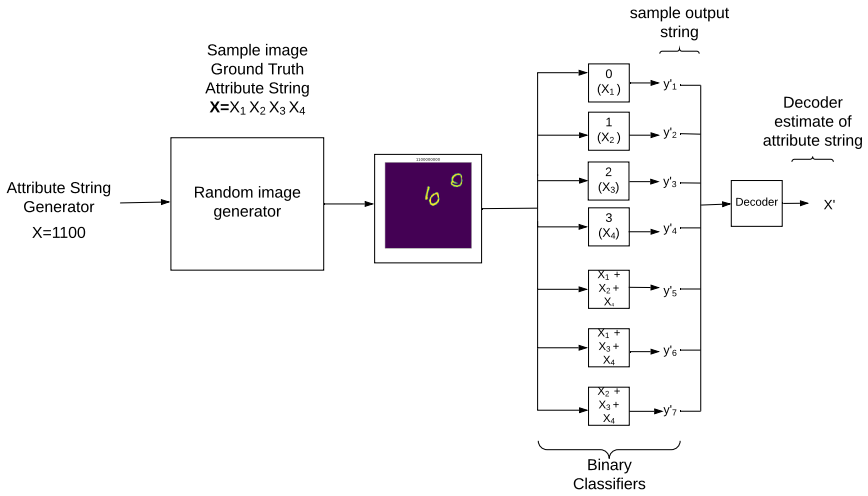
The central object is parity partition coding, a special case of error-correcting output codes in which the code bits are mod-2 sums (parities) of the primitive attribute labels. The mechanism has three parts: (1) a code construction that appends parity-check classifiers to primitive-attribute classifiers, (2) a decoding rule that maps the received bit string to the valid attribute string of minimum Hamming distance, and (3) the independent binary asymmetric channel model that translates code length into error probability, giving the $\mathcal{O}(K)$ savings argument. To make the parity checks learnable in practice, the paper applies a quadratic feature transformation—an outer product of the feature vector, retaining only the upper triangle—which makes XOR linearly separable and reduces training epochs from 7 to 3.
What would settle it
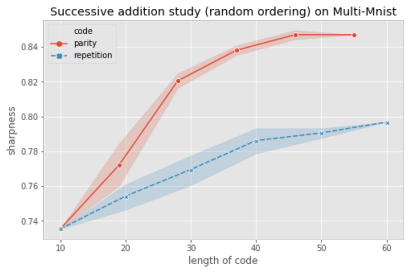
Train the same parity and repetition ensembles on a dataset with many attributes, hold model count fixed, and measure the joint error distribution of the classifiers. If the average pairwise error correlation among parity classifiers is substantially above zero, the independent-channel premise is violated; the parity error curve should then fail to fall exponentially faster than the repetition curve as code length grows, which would settle the claim's scope.
Extended reading notes
Core claim
On the paper's own terms: a K-attribute classifier need not be a K-output network or a repetition ensemble; it can be an error-correcting code whose bits are parity functions of the attributes, and this code, decoded by Hamming distance, is more accurate than repetition at equal model count. The theoretical engine models each binary classifier as an independent binary asymmetric channel; under that model a Shannon-type code of length $N$ has error probability $e^{-cN}$, while a repetition code of the same total length gives only $e^{-c'N/K}$, so the parity code reaches the same error with $\mathcal{O}(K)$ fewer classifiers. The paper further claims that the required parity attributes are learnable: quadratic feature transformation makes XOR linearly separable, cutting training epochs by more than half, and targeted bagging decorrelates the models. Empirically, parity decoding improves both f1 score and Hamming distance over identity and repetition baselines on multiMNIST and CelebA, and achieves state-of-the-art bit accuracy on 8 of 10 CelebA attributes.
Load-bearing premise
The $\mathcal{O}(K)$ savings argument assumes each trained classifier is an independent, balanced binary channel, so if real classifiers share correlated errors the predicted exponential gap over repetition codes does not follow and the advantage rests on the empirical results.
Editorial extensions
If this is right
- For a fixed number of trained models, the parity partition ensemble yields higher f1 score and lower Hamming distance than the repetition baseline on both multiMNIST and CelebA.
- To reach a target error rate, the required number of binary classifiers scales as $\mathcal{O}(K)$ smaller than for repetition codes, under the independent asymmetric channel model.
- Sharpness can be estimated with a rigorous confidence bound via fraction-accurate estimation, giving a category-balance-aware evaluation that standard test-set accuracy misses.
- Quadratic feature transformation cuts the number of training epochs needed for parity attributes by more than half, making the coding approach practical.
- The technique reaches state-of-the-art bit accuracy on 8 of the 10 CelebA attributes tested, while using fewer parameters than the baseline.
Reading between the lines
- Because shared feature extractors and dataset biases create correlated classifier errors, the practical benefit may be smaller than the predicted $\mathcal{O}(K)$; a natural extension is to measure error correlation directly and add stronger decorrelation steps beyond targeted bagging.
- Parity partition coding should transfer to any multi-label problem with many attributes, but the quadratic transformation and training tricks likely need re-tuning as $K$ grows; a stress test with hundreds of attributes would clarify the limits.
- The sharpness metric and fraction-accurate estimation are independent of the coding scheme and could serve as a generic audit tool for category balance in any classifier, including fairness evaluations that care about per-group accuracy.
Signed reviews
Editorial analysis
A structured set of objections, weighed in public.
Referee Report
Summary. The paper proposes parity partition coding, a special case of error-correcting output codes in which primitive attribute classifiers are augmented with classifiers for parity (XOR) combinations of attributes, with Hamming-distance decoding to recover the primitive attribute string. It also introduces a 'sharpness' metric, defined as the fraction of attribute categories above an accuracy threshold, together with a sampling-based fraction-accurate estimator and a binomial-tail confidence bound. Experiments on multiMNIST and CelebA compare parity coding with identity and repetition baselines and report f1 and Hamming distance; the authors claim an O(K) asymptotic saving in the number of binary classifiers relative to repetition coding, under an idealized independent asymmetric channel model.
Significance. The paper draws a useful connection between multi-label classification and error-correcting output codes, and the empirical multiMNIST comparison is carefully ablated and reported with standard deviations. The fraction-accurate estimator is a clean application of binomial tail bounds and is a sensible way to evaluate sharpness when exhaustive category testing is impossible. If the O(K) savings were established for the proposed construction, the contribution would be substantial. As it stands, the theoretical claim is not connected to the code actually tested, and two secondary claims (state-of-the-art bit accuracy and CelebA sharpness) are overstated; the demonstrated contribution is a modest but consistent empirical improvement on two datasets.
major comments (4)
- [Section 4 and Section 7, Table 1] Section 4's asymptotic argument compares a Shannon code of length N_s = K/R with exponential error e^{-c1 N_s} to a repetition code of length K n_r, concluding an O(K) saving. But the construction implemented in Section 7 and Table 1 is the all-pairs parity code: the message string of length K is appended with all C(K,2) pairwise parity checks, giving code length K + C(K,2) = O(K^2) and rate R = 2/(K+1), which tends to 0. For K=10 this is 55 outputs, barely larger than the 50 outputs of the 5-repetition baseline, so the experiments never enter the constant-rate regime in which the e^{-c1 N_s} bound is invoked. The O(K) saving is therefore an existence statement about some Shannon code, not a proven property of the parity code tested. To support the claim, the authors would need either a separate analysis of the all-pairs code or experiments with constant-rate parity codes (e.g., Hamming-like or sparse random parity checks) at larger K.
- [Appendix Table 3 and Abstract] The abstract and Section 7 state that the CelebA bit accuracies exceed state of the art for 8 of 10 attributes. Counting Table 3, the parity-corrected accuracy is strictly higher than the Sener et al. column in only six rows (Wearing Necktie, Gray Hair, Chubby, Wearing Hat, Blond Hair, Eyeglasses), ties on Bald, and is lower on Male, Heavy Makeup, and No Beard. If the claim instead counts the repetition or baseline columns as 'our models', the count is still at most six strict improvements. The '8 out of 10' statement and the phrase 'exceeding state of the art accuracy on individual labels' in the abstract are not supported by the presented table and should be corrected.
- [Section 6 and Section 7, CelebA study] The fraction-accurate estimator in Section 6 is defined for a distribution over all categories in C, but the CelebA study in Section 7 deliberately restricts to categories for which the dataset has multiple instances. This is a selected subset of the 2^10 attribute categories, not all categories, so the reported 12%, 35%, and 27% estimates are not estimates of the sharpness parameter theta over the full category space as defined in Definition 5. The paper should either bound the selection bias or explicitly present these numbers as conditional on the sampled subset, and the conclusion that the sharpness of the models is 27% versus 35% should be reworded accordingly.
- [Section 4] The error-decay comparison treats the binary classifiers as independent binary asymmetric channels and assumes attribute bits are i.i.d. Bernoulli(1/2). The trained ensemble violates both assumptions: multiMNIST targets are chunked and share feature-extractor weights, and CelebA attributes are noticeably imbalanced in the paper's own description. The exponential form e^{-c2 n_r} for repetition coding itself relies on independence, so the claimed O(K) saving is an idealized calculation, not a guarantee for the trained system. A concrete way to support the claim would be to measure pairwise error correlations among the trained classifiers and show the bit-error process is close to independent; without that, Section 4 should be presented as a motivating heuristic and the contribution should rest on the empirical results.
minor comments (5)
- [Section 6, Theorem 1] As typeset, the formula for the confidence lower bound is not parseable: it contains '1−ccα,M', stray '⌋⌋' characters, and unbalanced parentheses. Please rewrite the expression cleanly so the bound can be checked.
- [Appendix Table 3] The table header says 'Sender et. al'; the cited reference [22] is Sener and Koltun, so the header should read 'Sener et al.'.
- [Table 1] The entry '0.261 0.018' is missing a plus-minus sign, and the header row (Code, Weight transfer, Targeted Bagging) is difficult to parse. Please clarify which cells correspond to which conditions.
- [Abstract and Section 7] The abstract claims the method requires 'fewer parameters', but no parameter counts or model-size table is provided anywhere. Either supply the counts or rephrase the claim to 'comparable model counts'.
- [Section 7] The paper does not state how the reported f1 scores are computed (macro vs micro, per-attribute vs decoded-category), nor does it give dataset splits or training epochs for the main tables. Please add these details for reproducibility.
Circularity Check
No significant circularity: the O(K) savings argument is standard coding theory, and the only self-citation is peripheral.
full rationale
The central derivation in Section 4 is not circular: it compares a Shannon code with error probability e^{-c1 N_s} and length N_s = K/R to a K-bit repetition code of length K n_r with error e^{-c2 n_r}, equates the exponents to obtain n_r = c' N_s, and concludes N_r = c' K N_s. This is a standard coding-theory comparison rather than a restatement of the paper's conclusion; the constants are not fitted to the experimental outcomes. The fraction-accurate confidence bound in Theorem 1 is a binomial-tail argument that minimizes over the unknown theta and does not assume the target quantity it bounds. The experimental comparisons in Tables 1-2 are measured results, not quantities forced by construction. The only self-citation is reference [17], the first author's PhD thesis, used to assert that Shannon codes have close-to-optimal encoding and decoding complexity; this is peripheral to the O(K) savings claim and is not load-bearing, so it does not make the derivation circular. The paper also explicitly flags its independence assumption as 'admittedly overly simple' in Section 4. The gap between the constant-rate Shannon-code argument and the all-pairs O(K^2) parity code tested in the experiments is a correctness or external-validity limitation, not a circular reduction.
Assumptions & free parameters
free parameters (2)
- Fraction-accurate estimator parameters for multiMNIST =
alpha=0.5, eps1=0.19, eps2=0.19, N=100, M=20
- Fraction-accurate estimator parameters for CelebA =
alpha=0.1, eps1=0.2, eps2=0.2, N=100, M=10
assumptions (5)
- domain assumption Each binary classifier is an independent binary asymmetric channel (Section 4).
- domain assumption Test attributes are independent and each occurs with probability 1/2 (Section 4).
- standard math Shannon codes exist with error probability decaying as e^{-c1 Ns} and close-to-optimal complexity (Section 4, refs [15,16,17]).
- domain assumption Categories and instances can be sampled i.i.d. from well-defined distributions for the fraction-accurate estimator (Section 6).
- standard math Quadratic feature transformation makes XOR linearly separable (Section 5.1).
Cite this review
Pith. "Pith review of Parity Partition Coding for Sharp Multi-Label Classification." pith.science (2026). https://pith.science/paper/5N7OPJUV
@misc{pith2026190809651,
  author       = {Pith},
  title        = {Pith review of: Parity Partition Coding for Sharp Multi-Label Classification},
  year         = {2026},
  howpublished = {\url{https://pith.science/paper/5N7OPJUV}},
  note         = {Machine review of arXiv:1908.09651}
}
read the original abstract
The problem of efficiently training and evaluating image classifiers that can distinguish between a large number of object categories is considered. A novel metric, sharpness, is proposed which is defined as the fraction of object categories that are above a threshold accuracy. To estimate sharpness (along with a confidence value), a technique called fraction-accurate estimation is introduced which samples categories and samples instances from these categories. In addition, a technique called parity partition coding, a special type of error correcting output code, is introduced, increasing sharpness, while reducing the multi-class problem to a multi-label one with exponentially fewer outputs. We demonstrate that this approach outperforms the baseline model for both MultiMNIST and CelebA, while requiring fewer parameters and exceeding state of the art accuracy on individual labels.
Figures


Figures from the paper (2 more)

Reference graph
Works this paper leans on
-
[1]
Erin L. Allwein, Robert E. Schapire, and Yoram Singer. Reducing multiclass to binary: A unifying approach for margin classifiers.J. Mach. Learn. Res., 1:113–141, September 2001
work page 2001
-
[2]
Thomas G. Dietterich and Ghulum Bakiri. Solving multiclass learning problems via error-correcting output codes. J. Artif. Int. Res., 2(1):263–286, January 1995
work page 1995
-
[3]
M. Abbe, E. Wainwright. Information theory and machine learning (tutorial). InISIT, June 2015
work page 2015
-
[4]
Ensemblemethodsinmachinelearning
ThomasG.Dietterich. Ensemblemethodsinmachinelearning. In Proceedings of the First International Workshop on Multiple Classifier Systems, MCS ’00, pages 1–15, London, UK, UK, 2000. Springer- Verlag
work page 2000
-
[5]
C. H. Lampert, H. Nickisch, and S. Harmeling. Learning to detect unseen object classes by between- class attribute transfer. InIEEE Conf. on Comp. Vision and Pattern Recogn., pages 951–958, June 2009
work page 2009
-
[6]
J. Liu, B. Kuipers, and S. Savarese. Recognizing human actions by attributes. InCVPR 2011, pages 3337–3344, June 2011
work page 2011
-
[7]
C. E. Shannon. A mathematical theory of communication.Bell Sys. Techn. J., 27(3):379–423 & 623–656, 1948
work page 1948
-
[8]
S. Ferdowsi and Voloshynovskiy. Content identification: Machine learning meets coding. InProc. 35th WIC Symp. Info. Theory, May 2014. 11
work page 2014
Show all 22 references
-
[9]
Error-correcting output codes for multi-label emotion classification.Multimedia Tools and Applications, 75, 05 2016
Chao Li, Zhiyong Feng, and Chao Xu. Error-correcting output codes for multi-label emotion classification.Multimedia Tools and Applications, 75, 05 2016
2016
-
[10]
Neural network ensembles.IEEE Trans
Lars Kai Hansen and Peter Salamon. Neural network ensembles.IEEE Trans. Pattern Anal. Mach. Intell., 12:993–1001, 1990
1990
-
[11]
Effectiveness of error correcting output codes in multiclass learning problems
Francesco Masulli and Giorgio Valentini. Effectiveness of error correcting output codes in multiclass learning problems. InMultiple Classifier Systems, 2000
2000
-
[12]
Multiclass learning, boosting, and error-correcting codes
Venkatesan Guruswami and Amit Sahai. Multiclass learning, boosting, and error-correcting codes. In Proceedings of the Twelfth Annual Conference on Computational Learning Theory, COLT ’99, pages 145–155, New York, NY, USA, 1999. ACM
1999
-
[13]
L. G. Valiant. A theory of the learnable.Commun. ACM, 27(11):1134–1142, November 1984
1984
-
[14]
R. W. Hamming. Error detecting and error correcting codes.The Bell System Technical Journal, 29(2):147–160, April 1950
1950
-
[15]
David Forney, Jr
G. David Forney, Jr. Concatenated codes, December 1965
1965
-
[16]
Hassani, K
S. Hassani, K. Alishahi, and R. Urbanke. Finite-length scaling for polar codes.IEEE Trans. Info. Theory, 60(10):5875–5898, July 2014
2014
-
[17]
C. G. Blake. Energy Consumption of Error Control Coding Circuits. PhD thesis, University of Toronto, Toronto, June 2017
2017
-
[18]
Are efficient deep representations learnable? ICLR 2018 Workshop Submission
Maxwell Nye and Andrew Saxe. Are efficient deep representations learnable? ICLR 2018 Workshop Submission
2018
-
[19]
Piazza, A
F. Piazza, A. Uncini, and M. Zenobi. Artificial neural networks with adaptive polynomial activation function, 1992
1992
-
[20]
Bagging predictors.Machine Learning, 24:123–140, 1996
Leo Breiman. Bagging predictors.Machine Learning, 24:123–140, 1996
1996
-
[21]
Kingma and Jimmy Ba
Diederik P. Kingma and Jimmy Ba. Adam: A method for stochastic optimization. In3rd International Conference on Learning Representations, ICLR 2015, San Diego, CA, USA, May 7-9, 2015, Conference Track Proceedings, 2015
2015
-
[22]
Multi-task learning as multi-objective optimization
Ozan Sener and Vladlen Koltun. Multi-task learning as multi-objective optimization. CoRR, abs/1810.04650, 2018. 12 9 Appendix: Bit Accuracies Attribute Sender et. al Baseline accuracy Repetition- corrected accuracy Parity- corrected accuracy Wearing Necktie 0.965 0.965 0.970 0...
2018 arXiv
Reviewed August 14, 2026 · model on record in the stance chip above.
Discussion (0). Continue with ORCID to comment.