REVIEW 4 major objections 5 minor 28 references
Deep Reinforcement Learning-Based Motion Planning and PDE Control for Flexible Manipulators
T0 review · 4 major / 5 minor · reviewed 2026-08-07 · deepseek-v4-flash
Pith's one-line read DRL-based motion planning plus a nonlinear PDE controller can track flexible-arm angles while suppressing endpoint vibration.
desk verdict Real hardware and a plausible planner-controller integration, but the central Lyapunov stability theorem is wrong as stated and the evaluation has a self-training bias. read the letter →
The pith
A machine-rendered reading of the paper's core claim, the machinery that carries it, and where it could break.
The reading
What carries the argument
The load-bearing mechanism is a high-level/low-level loop. The high level is a soft actor-critic policy $\pi_\phi(a_t|s_t)$ over the state $s_t = \langle e_T(t), \theta(t), \dot{\theta}(t), \tau(t), \omega(L,t), \dot{\omega}(L,t)\rangle$, with actions chosen as normalized joint velocities; the low level is the nonlinear PDE controller of equation (17), which feeds beam boundary information $\omega''(0,t)$ and $\omega(L,t)$ into the torque. To keep the PDE model tractable, the paper applies the homogenizing transformation $z(x,t) = \omega(x,t) + \nu(x,t)$ of equation (9), with $\nu$ given in closed form so that the payload boundary condition becomes homogeneous and an assumed-mode solution can be used. The intended exponential-stability argument is carried by the cross term $\alpha I_m e\dot{e}$ in the Lyapunov function: the paper uses it to convert a stability margin into the decay inequality $\dot{V}<-\lambda V$.
What would settle it
Simulate a raising-lowering maneuver with the paper's gains and compute $\dot{V}$ from equation (24) pointwise; if $\dot{V}(t)>0$ at any time when $e(t)$ and $\dot{e}(t)$ have opposite signs, the asserted inequality $\dot{V}<-\lambda V$ fails and Theorem 1's proof does not establish exponential stability.
Extended reading notes
Core claim
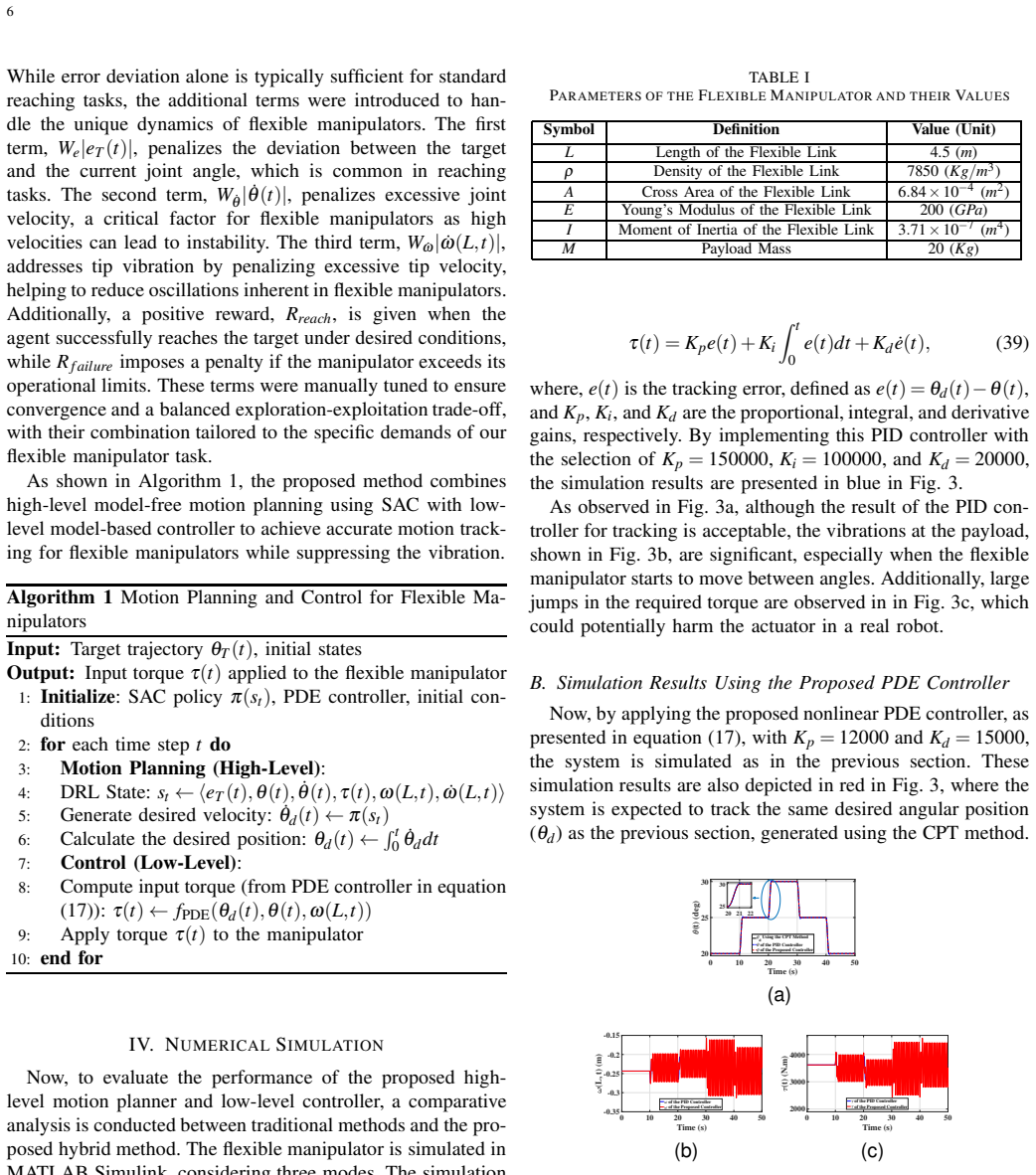
On the paper's own terms, the discovery is that trajectory planning, not feedback alone, is the deciding factor for vibration suppression in an underactuated flexible arm. With a single input torque, the nonlinear PDE controller $\tau(t) = K_p e(t) + K_d \dot{e}(t) - H(t)$, with $H(t) = EI\,\omega''(0,t) - \tfrac{1}{2}mgL\cos\theta(t) + Mg\,\omega(L,t)\sin\theta(t) - I_m\ddot{\theta}_d(t)$, can track the desired angle but leaves the bending mode largely untouched. The proposed fix is a two-level loop: a SAC policy trained with domain randomization emits normalized joint velocities $\dot{\theta}_d = \dot{\theta}_{\max} a_t$, integration produces $\theta_d(t)$, and the PDE controller realizes the tracking torque. In simulation the combined scheme lowers the tip-velocity RMSE to $1.2906\times 10^{-4}$ m/s, roughly an order of magnitude below the PDE-with-cubic-trajectory baseline, and in hardware it keeps endpoint deflection within about 3–6 mm. Theorem 1 states that the same control law guarantees exponential tracking; the proof rests on the Lyapunov function $V = \tfrac{1}{2}K_p e^2 + \tfrac{1}{2}I_m\dot{e}^2 + \alpha I_m e\dot{e}$ and the asserted decay $\dot{V} < -\lambda V$.
Load-bearing premise
The stability proof assumes the mixed error term in the Lyapunov function can never work against decay; because that term changes sign, the claimed negative bound is not guaranteed by the stated conditions.
Editorial extensions
If this is right
- For underactuated flexible arms, shaping the reference path becomes a first-class vibration-suppression tool rather than a separate planning concern.
- A 10 Hz model-free planner can be safely coupled to a 1 kHz model-based controller, so the scheme is real-time compatible with hydraulic actuation.
- Because the planner needs no endpoint actuation, the architecture transfers to arms where only a base torque is available.
- Domain randomization over link parameters produces a policy that carries over from simulation to hardware without retraining, as reflected in the reported 3–6 mm endpoint amplitudes.
Reading between the lines
- A direct extension would be a multi-link flexible arm, with per-link versions of the tip-velocity penalty $W_{\dot{\omega}}|\dot{\omega}(L,t)|$; the paper does not test that setting.
- The ±10% domain-randomization envelope defines the planner's expected operating range; retraining would likely be needed for substantially different payloads or link stiffness.
- The reward weights are manually tuned; scheduling them during training could be an automatic way to balance reaching speed against vibration, but the paper fixes them.
Editorial analysis
A structured set of objections, weighed in public.
Referee Report
Summary. The manuscript proposes a two-layer framework for a single-link flexible manipulator: a soft actor-critic (SAC) motion planner generates a desired joint-angle trajectory, and a nonlinear PDE controller (Eq. 17) tracks that trajectory using a single base torque. The flexible link is modeled as an Euler-Bernoulli beam with a payload, leading to the PDE system in Eqs. (4)-(8), with a transformation in Eqs. (9)-(16) used to homogenize non-homogeneous boundary conditions. The authors claim exponential closed-loop stability via Lyapunov analysis (Theorem 1) and validate the approach in MATLAB simulations and on a 4.5 m hydraulically actuated flexible manipulator, reporting improved tracking and reduced endpoint vibration compared with PID control and cubic-polynomial-trajectory baselines.
Significance. If fully established, the proposed division of labor between learned motion planning and model-based PDE control would be a useful contribution for underactuated flexible robots, and the hardware experiments on a large-scale manipulator are a valuable practical element. The paper also provides an explicit PDE model with non-homogeneous boundary conditions and uses domain randomization during DRL training, which are positive features. However, the central theoretical claim of exponential closed-loop stability is not proven as stated, and the experimental evaluation is too thin to fully support the performance claims. The framework may be salvageable with a corrected theorem, additional evaluation metrics, and repeated experimental trials, but the current manuscript does not establish its main contributions.
major comments (4)
- [III.A, Eqs. (24)-(30)] The step from Eq. (28) to Eq. (30) is invalid. The cross term -λ3(αIme e_dot) in Eq. (28) is sign-indefinite because e e_dot can be negative. Choosing λ < min{λ1, λ2, λ3} in Eq. (29) only controls the coefficients of the positive quadratic terms; it does not control the cross term. For states with e e_dot < 0, the inequality V_dot < -λV can fail. Concretely, with α=0.9, Im=1, Kp=Kd=0.95, λ=0.09, e=1, and e_dot=-10, one obtains V_dot + λV ≈ 6.43 > 0, contradicting Eq. (30). The exponential-stability conclusion in Theorem 1 therefore does not follow from the given Lyapunov argument.
- [III.A, Theorem 1] The Lyapunov function V in Eq. (19) contains only the tracking error e and its derivative e_dot; it contains no measure of the beam state ω(x,t) or its energy. Because H(t) in Eq. (18) cancels all beam terms in the e_dot dynamics, the argument at best proves exponential convergence of e to zero. It cannot establish exponential stability of the full infinite-dimensional closed loop. In fact, if θ = θd, e = 0, e_dot = 0, but the beam has nonzero initial deflection, the control torque τ = -H leaves θ_ddot = 0, and the undamped Euler-Bernoulli equation (5) with boundary conditions (7) permits persistent oscillation. Exponential stability of the full closed-loop system is therefore false as stated unless structural damping is added to the model. The theorem and contribution 1 must be reformulated, or the model must include damping.
- [III.B and IV.C, Eq. (38)] The principal evaluation metric for vibration suppression, the RMSE of ω_dot(L,t), is exactly the quantity penalized by the reward term W_ωdot |ω_dot(L,t)| in Eq. (38). The DRL planner is directly optimized on this quantity, so the reported improvement over the CPT baseline is partly by construction. To substantiate the claim of superior vibration suppression, the authors should report evaluation metrics that are not part of the reward, such as peak elastic deflection, settling time, or a frequency-domain vibration metric, and compare against a non-learning trajectory-optimization baseline or an ablation without the tip-velocity penalty.
- [V, Fig. 7] The experimental validation consists of a single run for each condition. No repeated trials, error bars, or statistical measures are reported, so the claimed differences in vibration amplitude (e.g., 'below 3 mm when raising and 6 mm when lowering') cannot be assessed against run-to-run variability. The robustness study in Table III covers parameter uncertainty for the PDE controller only, not for the DRL planner; a comparable uncertainty or repeatability study is needed for the combined method.
minor comments (5)
- [Table III] The heading 'RSME' should be 'RMSE'.
- [Fig. 7c and Section V.C] The text reports vibration amplitudes of 3 mm and 6 mm, but the vertical axis shows absolute elastic deviations around -0.23 m; please specify the baseline used to define amplitude (e.g., static deflection) and clarify whether the quoted values are deviations from that baseline.
- [Section IV.C] The statement that vibrations are kept under 1.5 cm should be reconciled with the axis range in Fig. 5b; clarify whether this refers to oscillation amplitude around the static deflection rather than absolute elastic deviation.
- [Eq. (38)] The reward terms are described as penalties but are written with negative weights; a short explanation of the sign convention would improve readability.
- [General] The manuscript does not mention software or data availability; releasing the training code and recorded experimental data would improve reproducibility, which is especially important for a learning-based method.
Circularity Check
DRL vibration-suppression result is partly by construction: the training reward includes the exact tip-velocity metric later used as the main evaluation criterion.
-
fitted input called prediction
[Section III-B, Eq. (38); Section IV-C, RMSE comparison paragraph]
"Rt = We|eT (t)| + W ˙θ| ˙θ (t)| + W ˙ω| ˙ω(L,t)| + Rreach + R f ailure. ... The third term, W ˙ω| ˙ω(L,t)|, addresses tip vibration by penalizing excessive tip velocity, helping to reduce oscillations inherent in flexible manipulators. ... To evaluate vibration suppression at the flexible link tip, we compared the RMSE of ˙ω(L,t). Our PDE controller with DRL motion planner achieved the lowest RMSE of 1.2906×10⁻⁴ m/s, compared to 1.6×10⁻³ m/s for PDE controller with CPT method and 2.0807×10⁻⁴ m/s for PID controller with CPT method, confirming its superior vibration mitigation."
The SAC agent is trained to maximize a reward that includes the penalty W_ωdot|ωdot(L,t)|, i.e., the magnitude of the tip velocity at every step. The paper's principal vibration-suppression evidence is then the RMSE of ωdot(L,t) over the trajectory. Because the optimized policy is explicitly rewarded for minimizing the very signal whose RMSE is reported, the comparison is a restatement of the training objective rather than an independent test. Baselines trained without this objective are expected to fare worse on this metric, so the claimed vibration reduction is partly by construction.
full rationale
The PDE controller derivation itself is self-contained: substituting (17) into (23) cancels the beam terms through H, and the remaining calculation is an algebraic Lyapunov argument over e and edot. The homogenization transformation (9)-(16) is cited to [14], which overlaps with the authors, but the equations are written out and checkable, so that self-citation is not load-bearing. The mathematical flaw in the λ step of Theorem 1 involving the sign-indefinite αIm e edot term is a correctness defect, not a circularity, so it is not scored here. The one genuine circular element is the DRL planner: Eq. (38) includes W_ωdot|ωdot(L,t)| as a reward term, and Section IV-C evaluates success by the RMSE of the same ωdot(L,t) signal. That makes the headline claim that the DRL planner suppresses tip vibrations partly by construction, although the real-world experiments and tracking results give the framework some independent content. Hence partial circularity rather than full circularity.
Assumptions & free parameters
free parameters (9)
- Kp (PDE controller proportional gain) =
12000 (simulation; experimental value not stated)
- Kd (PDE controller derivative gain) =
15000 (simulation; experimental value not stated)
- Reward weight We =
-5e-3
- Reward weight W_theta_dot =
-1e-3
- Reward weight W_omega_dot =
-3e-1
- Rreach =
+200
- Rfailure =
-200
- Maximum joint velocity theta_dot_max =
5 deg/s
- Domain randomization range =
±10%
assumptions (5)
- domain assumption Euler-Bernoulli beam theory with small deformations and linear elastic material holds for the 4.5 m steel link
- domain assumption The Assumed Mode Method with three modes accurately represents the infinite-dimensional beam dynamics in simulation
- ad hoc to paper Equation (30), Vdot < -lambda V, holds for all e and edot with lambda < min(lambda1, lambda2, lambda3)
- standard math The homogenization transformation z = omega + nu from reference [14] is correct and applicable to the non-homogeneous boundary condition (8)
- domain assumption The simulation environment with domain randomization transfers to the real hydraulic manipulator without fine-tuning
Cite this review
Pith. "Pith review of Deep Reinforcement Learning-Based Motion Planning and PDE Control for Flexible Manipulators." pith.science (2026). https://pith.science/paper/5NLKIY2Y
@misc{pith2026250608639,
  author       = {Pith},
  title        = {Pith review of: Deep Reinforcement Learning-Based Motion Planning and PDE Control for Flexible Manipulators},
  year         = {2026},
  howpublished = {\url{https://pith.science/paper/5NLKIY2Y}},
  note         = {Machine review of arXiv:2506.08639}
}
read the original abstract
This article presents a motion planning and control framework for flexible robotic manipulators, integrating deep reinforcement learning (DRL) with a nonlinear partial differential equation (PDE) controller. Unlike conventional approaches that focus solely on control, we demonstrate that the desired trajectory significantly influences endpoint vibrations. To address this, a DRL motion planner, trained using the soft actor-critic (SAC) algorithm, generates optimized trajectories that inherently minimize vibrations. The PDE nonlinear controller then computes the required torques to track the planned trajectory while ensuring closed-loop stability using Lyapunov analysis. The proposed methodology is validated through both simulations and real-world experiments, demonstrating superior vibration suppression and tracking accuracy compared to traditional methods. The results underscore the potential of combining learning-based motion planning with model-based control for enhancing the precision and stability of flexible robotic manipulators.
Figures


Figures from the paper (4 more)


Reference graph
Works this paper leans on
-
[13]
J. K. Viswanadhapalli, V . K. Elumalai, S. Shivram, S. Sh ah, and D. Mahajan, “Deep reinforcement learning with reward shapi ng for tracking control and vibration suppression of flexible link manipulator,” Applied Soft Computing , vol. 152, p. 110756, 2024
work page 2024
-
[17]
Reinforcement learning control of a flexible two-link manipulator: An experimental investiga- tion,
W. He, H. Gao, C. Zhou, C. Y ang, and Z. Li, “Reinforcement learning control of a flexible two-link manipulator: An experimental investiga- tion,” IEEE Transactions on Systems, Man, and Cybernetics: System s, vol. 51, no. 12, pp. 7326–7336, 2020
work page 2020
-
[1]
A critical review of control techniques for flexible and rigid link manipulators,
E. A. Alandoli and T. S. Lee, “A critical review of control techniques for flexible and rigid link manipulators,” Robotica, vol. 38, no. 12, pp. 2239–2265, 2020
work page 2020
-
[2]
A variable length, variable stiffness flexible inst rument for transoral robotic surgery,
J. Chen, Q. Ding, W. Y an, K. Y an, J. Chen, J. Y .-K. Chan, and S. S. Cheng, “A variable length, variable stiffness flexible inst rument for transoral robotic surgery,” IEEE Robotics and Automation Letters , vol. 7, no. 2, pp. 3835–3842, 2022
work page 2022
-
[3]
Y . Hu, W. Li, L. Zhang, and G.-Z. Y ang, “Designing, protot yping, and testing a flexible suturing robot for transanal endoscopic m icrosurgery,” IEEE Robotics and Automation Letters , vol. 4, no. 2, pp. 1669–1675, 2019
work page 2019
-
[4]
Revie w of modelling and control of flexible-link manipulators,
M. Sayahkarajy, Z. Mohamed, and A. A. Mohd Faudzi, “Revie w of modelling and control of flexible-link manipulators,” Proceedings of the Institution of Mechanical Engineers, Part I: Journal of Sys tems and Control Engineering, vol. 230, no. 8, pp. 861–873, 2016
work page 2016
-
[5]
Model predictive control applied to different time- scale dynamics of flexible joint robots,
M. Iskandar, C. van Ommeren, X. Wu, A. Albu-Sch¨ affer, an d A. Diet- rich, “Model predictive control applied to different time- scale dynamics of flexible joint robots,” IEEE Robotics and Automation Letters , vol. 8, no. 2, pp. 672–679, 2022
work page 2022
-
[6]
Dyna mic modelling and vibration suppression of a single-link flexib le manipulator with two cables,
L. Tang, M. Gouttefarde, H. Sun, L. Yin, and C. Zhou, “Dyna mic modelling and vibration suppression of a single-link flexib le manipulator with two cables,” Mechanism and Machine Theory , vol. 162, p. 104347, 2021
work page 2021
Show all 28 references
-
[7]
Visual servoing of fl exible-link manipulators by considering vibration suppression withou t deformation measurements,
K. Li, H. Wang, X. Liang, and Y . Miao, “Visual servoing of fl exible-link manipulators by considering vibration suppression withou t deformation measurements,” IEEE Transactions on Cybernetics , vol. 52, no. 11, pp. 12 454–12 463, 2021
2021
-
[8]
Backstepping cont rol for vibration suppression of 2-d euler–bernoulli beam based on nonlinear saturation compensator,
Z. Jing, Y . Ma, X. Wu, X. He, and Y . Sun, “Backstepping cont rol for vibration suppression of 2-d euler–bernoulli beam based on nonlinear saturation compensator,” IEEE Transactions on Systems, Man, and Cybernetics: Systems , vol. 53, no. 5, pp. 2562–2571, 2022
2022
-
[9]
Vibration control of a flexible beam wit h output constraint,
W. He and S. S. Ge, “Vibration control of a flexible beam wit h output constraint,” IEEE Transactions on Industrial Electronics , vol. 62, no. 8, pp. 5023–5030, 2015
2015
-
[10]
Boundary disturbance obse rver- based control of a vibrating single-link flexible manipulat or,
Z. Zhao, X. He, and C. K. Ahn, “Boundary disturbance obse rver- based control of a vibrating single-link flexible manipulat or,” IEEE Transactions on Systems, Man, and Cybernetics: Systems , vol. 51, no. 4, pp. 2382–2390, 2019
2019
-
[11]
Boundary control for a flexib le manipulator based on infinite dimensional disturbance observer,
T. Jiang, J. Liu, and W. He, “Boundary control for a flexib le manipulator based on infinite dimensional disturbance observer,” Journal of sound and Vibration, vol. 348, pp. 1–14, 2015
2015
-
[12]
Deep learning-based deflection correction and end-point contro l of heavy-duty vertical single-link flexible manipulators,
A. H. Barjini, S. Y aqubi, S. M. Tahamipour-Z, and J. Matt ila, “Deep learning-based deflection correction and end-point contro l of heavy-duty vertical single-link flexible manipulators,” in 2024 IEEE International Conference on Robotics and Biomimetics (ROBIO) . IEEE, 2024, pp...
2024
-
[14]
Semi-an alytical de- sign of pde endpoint controller for flexible manipulator wit h non- homogenous boundary conditions,
S. Y aqubi, S. M. Tahamipour-Z, and J. Mattila, “Semi-an alytical de- sign of pde endpoint controller for flexible manipulator wit h non- homogenous boundary conditions,” IEEE Transactions on Automation Science and Engineering , 2023
2023
-
[15]
Boundary force control of t wo one-link flexible manipulator to accomplish safe grasping task,
H. Sayyaadi and M. Hejrati, “Boundary force control of t wo one-link flexible manipulator to accomplish safe grasping task,” in 29th Annu. Int. Conf. Iran. Assoc. Mech. Eng. 8th Int. Conf. Therm. Powe r Plants Ind., 2021
2021
-
[16]
Neural network contro l of a two- link flexible robotic manipulator using assumed mode method ,
H. Gao, W. He, C. Zhou, and C. Sun, “Neural network contro l of a two- link flexible robotic manipulator using assumed mode method ,” IEEE Transactions on Industrial Informatics , vol. 15, no. 2, pp. 755–765, 2018
2018
-
[18]
Design of a sliding mode controller for suppressing coupled axial & torsional v ibrations in horizontal drill strings using extended kalman filter,
A. H. Barjini, M. Khoshnazar, and H. Moradi, “Design of a sliding mode controller for suppressing coupled axial & torsional v ibrations in horizontal drill strings using extended kalman filter,” Journal of Sound and Vibration, vol. 586, p. 118477, 2024
2024
-
[19]
A review of r ecent trend in motion planning of industrial robots,
M. G. Tamizi, M. Y aghoubi, and H. Najjaran, “A review of r ecent trend in motion planning of industrial robots,” International Journal of Intelligent Robotics and Applications , vol. 7, no. 2, pp. 253–274, 2023
2023
-
[20]
A review of rob ot learning for manipulation: Challenges, representations, and algor ithms,
O. Kroemer, S. Niekum, and G. Konidaris, “A review of rob ot learning for manipulation: Challenges, representations, and algor ithms,” Journal of machine learning research , vol. 22, no. 30, pp. 1–82, 2021
2021
-
[21]
R. S. Sutton, A. G. Barto et al., Reinforcement learning: An introduction. MIT press Cambridge, 1998, vol. 1, no. 1
1998
-
[22]
A review of deep reinforcement learning approaches for smart manufact uring in industry 4.0 and 5.0 framework,
A. del Real Torres, D. S. Andreiana, ´A. Ojeda Rold´ an, A. Hern´ andez Bustos, and L. E. Acevedo Galicia, “A review of deep reinforcement learning approaches for smart manufact uring in industry 4.0 and 5.0 framework,” Applied Sciences , vol. 12, no. 23, p. 12377, 2022
2022
-
[23]
Deep reinf orcement learning for robotic manipulation with asynchronous off-p olicy updates,
S. Gu, E. Holly, T. Lillicrap, and S. Levine, “Deep reinf orcement learning for robotic manipulation with asynchronous off-p olicy updates,” in 2017 IEEE international conference on robotics and automat ion (ICRA). IEEE, 2017, pp. 3389–3396
2017
-
[24]
Deep r einforcement learning-based path planning for multi-arm manipulators w ith periodi- cally moving obstacles,
E. Prianto, J.-H. Park, J.-H. Bae, and J.-S. Kim, “Deep r einforcement learning-based path planning for multi-arm manipulators w ith periodi- cally moving obstacles,” Applied Sciences, vol. 11, no. 6, p. 2587, 2021
2021
-
[25]
Soft actor-critic: Off-policy maximum entropy deep reinforcement learning with a stochastic actor,
T. Haarnoja, Zhou et al., “Soft actor-critic: Off-policy maximum entropy deep reinforcement learning with a stochastic actor,” pp. 1 861–1870, 2018
2018
-
[26]
End-to-e nd training of deep visuomotor policies,
S. Levine, C. Finn, T. Darrell, and P . Abbeel, “End-to-e nd training of deep visuomotor policies,” Journal of Machine Learning Research , vol. 17, no. 39, pp. 1–40, 2016
2016
-
[27]
Integrat ing deeprl with robust low-level control in robotic manipulators for n on-repetitive reaching tasks,
M. H. Shahna, S. A. A. Kolagar, and J. Mattila, “Integrat ing deeprl with robust low-level control in robotic manipulators for n on-repetitive reaching tasks,” in 2024 IEEE International Conference on Mechatronics and Automation (ICMA) . IEEE, 2024, pp. 329–336
2024
-
[28]
On the role of the action space in robot manipulation learning and sim-to- real transfer,
E. Aljalbout, F. Frank, M. Karl, and P . van der Smagt, “On the role of the action space in robot manipulation learning and sim-to- real transfer,” IEEE Robotics and Automation Letters , 2024
2024
Reviewed August 7, 2026 · model on record in the stance chip above.
Discussion (0). Sign in to comment.