REVIEW 4 major objections 5 minor 46 references
Real-CATS: A Practical Training Ground for Emerging Research on Cryptocurrency Cybercrime Detection
T0 review · 4 major / 5 minor · reviewed 2026-08-10 · deepseek-v4-flash
Pith's one-line read Real-CATS puts 200K labeled crypto addresses in researchers' hands.
desk verdict A valuable multi-chain labeled dataset, but the benign labels are contaminated by exchange change addresses and the evaluation tables have inconsistencies; worth repairing and then publishing. read the letter →
The pith
A machine-rendered reading of the paper's core claim, the machinery that carries it, and where it could break.
The reading
What carries the argument
The central object is the dataset construction pipeline: criminal addresses and labels are aggregated from victim-submitted abuse reports, benign addresses are selected from the outputs of exchange hot wallets under the assumption that exchanges enforce strict Know-Your-Customer checks, and every address is turned into a transaction profile (32 features for Bitcoin, 52 for Ethereum, including token interactions on Ethereum) plus released transaction records. The load-bearing mechanism is the C3R claim—Comprehensiveness, Classifiability, Customizability, and Real-world Transferability—because those four properties are what make the dataset a usable benchmark rather than a mere list of addresses. Sup-CATS, a supplementary single-day Ethereum sample with newly labeled criminal addresses, is the device that converts the transferability claim into a concrete test.
What would settle it
Take the released benign address list and intersect it with new victim-submitted abuse reports appearing after the collection cutoff and with known laundering-cluster heuristics; if a non-negligible fraction, say 1-2% or more, of supposed benign addresses are flagged, the benign-selection premise fails and the classifiability and transferability numbers become suspect.
Extended reading notes
Core claim
The paper's central claim is that Real-CATS is the first practical training ground for cryptocurrency cybercrime detection research: a dual-chain dataset whose criminal labels come from real-world victim reports rather than heuristic inference, whose benign labels come from customers of centralized exchanges under the Know-Your-Customer assumption, and whose released data include both hand-crafted transaction profiles and raw transaction records. It further claims that this design satisfies the C3R characteristics, and that the supplementary Sup-CATS set provides a temporal deployment test in which a model trained on older Real-CATS data is evaluated on all addresses active on a single day. On that test, a random-forest classifier trained on the profiles detects roughly three-quarters of the day's newly labeled criminal addresses, while a gradient-boosted model that looked strong on random splits degrades sharply, which the paper reads as evidence that Real-CATS exposes real-world transferability gaps that simpler evaluation schemes miss.
Load-bearing premise
The whole benign class rests on the assumption that centralized exchanges enforce strict Know-Your-Customer checks, so addresses that receive funds from exchange hot wallets are clean; the paper never quantifies how much contamination remains after removing only explicitly criminal-labeled addresses.
Editorial extensions
If this is right
- Researchers can for the first time compare feature-engineering and graph-embedding detectors on a shared 200K-address, two-chain benchmark with consistent labels and a published benign set.
- The temporal Sup-CATS split gives a concrete way to test whether a model that performs well on random splits will survive deployment on a future day's active addresses.
- Because transaction records are included, address profiles can be extended or replaced by user-defined features, attributed graphs, or token-interaction representations without recollecting blockchain data.
- Any detector trained on Real-CATS inherits the dataset's real-world noise, so good results are more likely to transfer to live settings than results on heuristically labeled or 'cleaner' datasets.
- The dataset also supports measurement studies beyond detection, such as estimating cybercrime revenue, tracking money flow, and studying how criminals move funds.
Reading between the lines
- A natural next test is to measure label noise in the benign set by checking whether released benign addresses later appear in abuse reports or in known laundering clusters; the paper does not quantify this.
- The Sup-CATS scenario covers only Ethereum, so the paper's real-world transferability claim is strongest for Ethereum; extending the same single-day sampling to Bitcoin would close that gap.
- Because raw transaction records are released, the dataset invites a broader comparison: profile-based detectors versus graph neural networks and random-walk embeddings on exactly the same address set, which the paper only begins with a 2,500-address subset.
- The C3R recipe could generalize to other chains, such as Polygon or Solana, if abuse-report coverage and exchange hot-wallet identification exist there; this is the authors' stated hope, not yet demonstrated.
Signed reviews
Editorial analysis
A structured set of objections, weighed in public.
Referee Report
Summary. The paper introduces Real-CATS, a dual-chain labeled address dataset for cryptocurrency cybercrime detection, containing 103,203 criminal and 106,196 benign addresses on Bitcoin and Ethereum, together with statistical transaction profiles (32 features for Bitcoin, 52 for Ethereum), detailed transaction records, and Ethereum token-interaction files. It also introduces Sup-CATS, a one-day Ethereum test set intended to simulate real-world deployment. The authors claim four C3R properties, demonstrate classifiability with five machine-learning models, show customizability by extending a small subset into a transaction graph for Trans2Vec, and evaluate real-world transferability by training on Real-CATS and testing on Sup-CATS.
Significance. If validated, Real-CATS would be a genuinely useful community resource: it is substantially larger than Elliptic, it covers both Bitcoin and Ethereum, it provides both aggregate profiles and raw transaction records, and its Sup-CATS temporal split goes beyond the random splits commonly used in this literature. The authors release the data publicly, which supports reproducibility, and the Chainabuse-based labeling and manual category aggregation are described in enough detail to be audited. However, the current evidence for the dataset's central claims is weakened by label-construction issues in the benign set and the Sup-CATS test set, and by numerical inconsistencies in the reported evaluation tables.
major comments (4)
- [§3.1] The benign-address collection method labels every non-sender output of an outgoing exchange-hot-wallet transaction as a benign customer address. In Bitcoin, a standard outgoing payment normally creates two outputs: the recipient's payment and a change output controlled by the exchange itself. Because no change-address detection is applied, these exchange-controlled change addresses enter the benign set, and the subsequent deletion of addresses that also appear in the criminal list does not remove them. The 76.56% zero-balance fraction among Bitcoin benign addresses reported in Section 4.1 is consistent with a large population of swept change addresses, though not conclusive. Since the benign class is load-bearing for the classifiability results in Table 5 and the transfer results in Section 4.3, the authors should either apply and report change-address heuristics (for example, one-input/two-output clustering with the sender), quantify the fraction of suspected exchange-internal change addresses, or otherwise demonstrate that the benign set consists of KYC-verified exchange customers rather than exchange-owned infrastructure.
- [§4.3] The construction of Sup-CATS explicitly treats all unlabeled addresses sampled on August 12, 2024, as benign: 'We scan and sample the unlabeled addresses as benign with a 1% probability.' Unlabeled addresses on a blockchain are not necessarily benign; they can include criminal addresses not yet reported or attributed. This untested assumption contaminates the confusion matrices in Table 6 and therefore the claimed real-world transferability. In addition, the row and column labels of Table 6 are ambiguous, and the counts do not reconcile with the stated Sup-CATS totals: under the conventional reading, the Random Forest matrix implies 5,264 actual criminal and 8,938 actual benign addresses, while the LGBM matrix implies 2,989 actual criminal and 11,213 actual benign addresses, neither matching the reported 3,147 and 11,058. Please clarify the matrix orientation, report how many addresses were excluded by preprocessing and why, and provide sensitivity analysis for the 1% sampling rate.
- [§4.1, Table 5] The Ethereum Random Forest row reports Precision=0.9085, Recall=0.8237, F1=0.8640, and Accuracy=0.7116. Under the standard definitions, these precision and recall values imply an accuracy of at least about 0.74 for any positive-class prevalence, so the reported accuracy of 0.7116 is numerically impossible. This suggests an error in the computation or reporting of at least one metric. Because Table 5 is the primary evidence for the Classifiability characteristic, these numbers must be corrected and regenerated before the central claim can be assessed.
- [§4.2] The customizability experiment uses a single random subset of 2,500 addresses with a 1:1 criminal-to-benign ratio and reports Trans2Vec results without a random seed, repeated trials, or confidence intervals. As this experiment is used to argue that Real-CATS supports node-embedding methods, the authors should report the variance over multiple subsamples or explain why a single draw is sufficient, especially since the subsample and the extended graph are not otherwise characterized.
minor comments (5)
- [Abstract and Section 1] There are several typos and grammatical errors, including 'satifies' and 'fundemental' in the abstract, 'we presents Real-CATS' and 'comprises include' in Section 1, and 'Li f etime' in the captions of Figures 2-4.
- [§4.1] The sentence 'We use the implication in sklearn' should read 'We use the implementation in sklearn'; also, the authors should state explicitly which features were used for training, since Table 1 includes transaction-hash fields that are non-numeric and would be inappropriate for the sklearn models.
- [§3.1] The sentence 'we delete all addresses labeled as benign and criminal simultaneously' is ambiguous: it should specify whether an address appearing in both lists is removed from one set, both sets, or excluded from the analysis entirely, and how many addresses were affected.
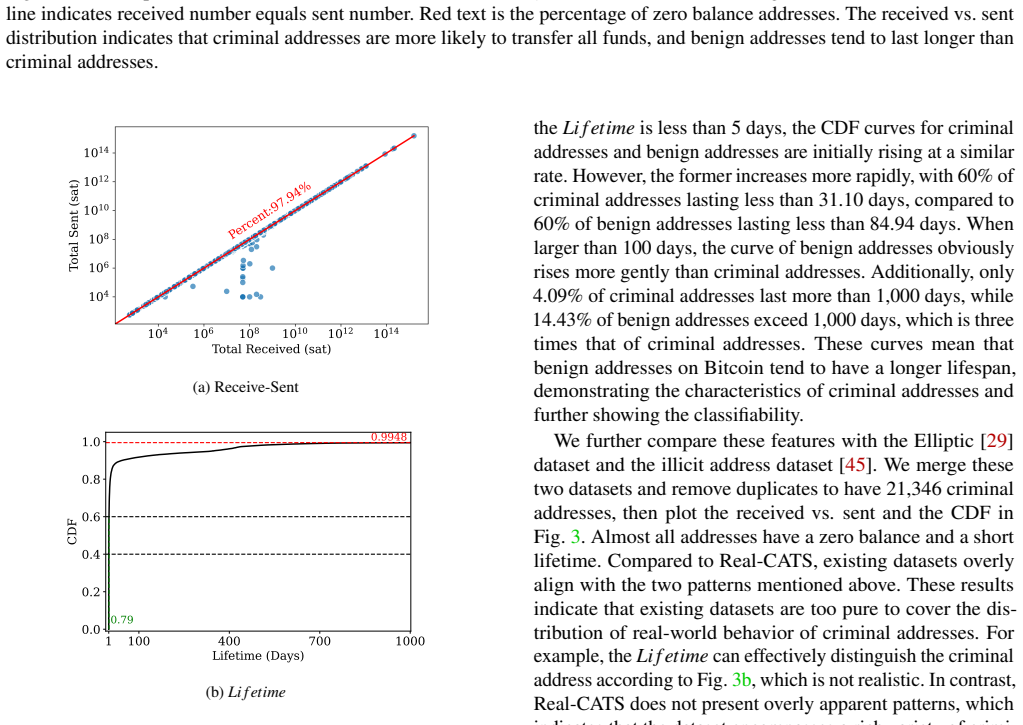
- [§4.1] The comparison with existing datasets in Figure 3 is based on a merged set of Elliptic and the illicit-address dataset, but the paper does not describe the merging process, the overlap removal, or the feature-extraction pipeline used for those addresses; this should be documented for reproducibility.
- [§4.3] The claim that 'the high false positive rate severely affects the detection performance' is not directly supported by the reported Random Forest confusion matrix, which shows about 790 false positives; the sentence should be tied to the specific metric and model being discussed.
Circularity Check
No significant circularity: the dataset claims are supported by externally sourced labels and an out-of-sample Sup-CATS evaluation, not by fitting the target conclusion into the inputs.
full rationale
The paper's central claims are empirical properties of a newly constructed dataset. Criminal labels are taken from Chainabuse victim reports and (for Sup-CATS) from Etherscan labels; benign labels are selected from exchange hot-wallet outputs under an explicit KYC assumption. These labels are external to the features and to the classification models, so the classifiability experiments in Table 5 are separability checks, not predictions forced by fitted parameters. The Sup-CATS experiment is a genuine out-of-sample temporal evaluation on addresses active on August 12, 2024, with criminal labels from Etherscan, which provides an external benchmark rather than a circular reuse of the training data. The C3R characteristics are defined by the authors and then assessed through pattern analysis and classification, but no equation or label is derived from the target claim by construction, and no load-bearing self-citation chain appears in the references. The benign-label contamination concern (e.g., change addresses labeled as customers) is a validity and robustness issue, not a circularity of the derivation chain, because the paper does not define the target conclusion in terms of that labeling assumption. Overall, the derivation chain is self-contained and externally benchmarked, and I found no specific circular reduction to report.
Assumptions & free parameters
free parameters (1)
- Sup-CATS benign sampling rate =
1%
assumptions (4)
- domain assumption Exchange KYC makes exchange hot wallet outputs reliable proxies for benign addresses
- domain assumption Chainabuse reports are verified and reliable sources of criminal addresses
- domain assumption Etherscan labels provide authoritative ground truth for criminal addresses in Sup-CATS
- ad hoc to paper Unlabeled addresses in Sup-CATS are benign
Cite this review
Pith. "Pith review of Real-CATS: A Practical Training Ground for Emerging Research on Cryptocurrency Cybercrime Detection." pith.science (2026). https://pith.science/paper/5OIHVSSN
@misc{pith2026250115553,
  author       = {Pith},
  title        = {Pith review of: Real-CATS: A Practical Training Ground for Emerging Research on Cryptocurrency Cybercrime Detection},
  year         = {2026},
  howpublished = {\url{https://pith.science/paper/5OIHVSSN}},
  note         = {Machine review of arXiv:2501.15553}
}
abstract
Cybercriminals pose a significant threat to blockchain trading security, causing $40.9 billion in losses in 2024. However, the lack of an effective real-world address dataset hinders the advancement of cybercrime detection research. The anti-cybercrime efforts of researchers from broader fields, such as statistics and artificial intelligence, are blocked by data scarcity. In this paper, we present Real-CATS, a Real-world dataset of Cryptocurrency Addresses with Transaction profileS, serving as a practical training ground for developing and assessing detection methods. Real-CATS comprises 103,203 criminal addresses from real-world reports and 106,196 benign addresses from exchange customers. It satifies the C3R characteristics (Comprehensiveness, Classifiability, Customizability, and Real-world Transferability), which are fundemental for practical detection of cryptocurrency cybercrime. The dataset provides three main functions: 1) effective evaluation of detection methods, 2) support for feature extensions, and 3) a new evaluation scenario for real-world deployment. Real-CATS also offers opportunities to expand cybercrime measurement studies. It is particularly beneficial for researchers without cryptocurrency-related knowledge to engage in this emerging research field. We hope that studies on cryptocurrency cybercrime detection will be promoted by an increasing number of cross-disciplinary researchers drawn to this versatile data platform. All datasets are available at https://github.com/sjdseu/Real-CATS
Figures


Figures from the paper (2 more)


Reference graph
Works this paper leans on
-
[1]
Bitcoin: A peer-to-peer electronic cash system
NAKAMOTO , S. Bitcoin: A peer-to-peer electronic cash system. bitcoin.org/bitcoin.pdf, 2008
work page 2008
-
[2]
On the economic signifi- cance of ransomware campaigns: A bitcoin transactions perspective
CONTI , M., G ANGWAL , A., AND RUJ, S. On the economic signifi- cance of ransomware campaigns: A bitcoin transactions perspective. Computers & Security 79, 1 (2018), 162–189. 11
work page 2018
-
[3]
HUANG , D. Y., A LIAPOULIOS , M. M., L I, V. G., I NVERNIZZI , L., BURSZTEIN , E., M CROBERTS , K., L EVIN , J., L EVCHENKO , K., S NO- EREN , A. C., AND MCCOY, D. Tracking ransomware end-to-end. In Proceedings of 39th IEEE Symposium on Security and Privacy (2018), pp. 618–631
work page 2018
-
[4]
Ran- somware payments in the Bitcoin ecosystem
PAQUET-CLOUSTON , M., H ASLHOFER , B., AND DUPONT , B. Ran- somware payments in the Bitcoin ecosystem. Journal of Cybersecurity 5, 1 (2019), 003
work page 2019
-
[5]
An ego network analysis of sextortionists
OGGIER , F., D ATTA, A., AND PHETSOUVANH , S. An ego network analysis of sextortionists. Social Network Analysis and Mining 10, 1 (2020), 1–14
work page 2020
-
[6]
PORTNOFF , R. S., H UANG , D. Y., D OERFLER , P., A FROZ , S., AND MCCOY, D. Backpage and bitcoin: Uncovering human traffickers. In Proceedings of the 23rd ACM SIGKDD International Conference on Knowledge Discovery and Data Mining (2017), p. 1595–1604
work page 2017
-
[7]
Spams meet cryptocurrencies: Sextortion in the bitcoin ecosys- tem
PAQUET-C LOUSTON , M., R OMITI , M., H ASLHOFER , B., AND CHAR - VAT, T. Spams meet cryptocurrencies: Sextortion in the bitcoin ecosys- tem. In Proceedings of the 1st ACM Conference on Advances in Financial Technologies(2019), p. 76–88
work page 2019
-
[8]
Cryptocurrency scams: Analysis and perspectives
BARTOLETTI , M., L ANDE , S., L ODDO , A., P OMPIANU , L., AND SERUSI , S. Cryptocurrency scams: Analysis and perspectives. IEEE Access 9 (2021), 148353–148373
work page 2021
Show all 46 references
-
[9]
Txphishscope: Towards detecting and un- derstanding transaction-based phishing on ethereum
HE, B., C HEN , Y., C HEN , Z., H U, X., H U, Y., W U, L., C HANG , R., WANG , H., AND ZHOU , Y. Txphishscope: Towards detecting and un- derstanding transaction-based phishing on ethereum. In Proceedings of the 30th ACM SIGSAC Conference on Computer and Communications Security...
2023
-
[10]
Double and nothing: Understanding and detecting cryptocurrency giveaway scams
LI, X., Y EPURI , A., AND NIKIFORAKIS , N. Double and nothing: Understanding and detecting cryptocurrency giveaway scams. In Pro- ceedings of 30th Annual Network and Distributed System Security Symposium (2023), pp. 1–17
2023
-
[11]
Fishing for fraudsters: Uncovering ethereum phishing gangs with blockchain data
LIU, J., C HEN , J., W U, J., W U, Z., FANG , J., AND ZHENG , Z. Fishing for fraudsters: Uncovering ethereum phishing gangs with blockchain data. IEEE Transactions on Information Forensics and Security 19 (2024), 3038–3050
2024
-
[12]
Phishing scam detection on ethereum: towards financial security for blockchain ecosystem
CHEN , W., G UO, X., C HEN , Z., Z HENG , Z., AND LU, Y. Phishing scam detection on ethereum: towards financial security for blockchain ecosystem. In Proceedings of the 29th International Joint Conference on Artificial Intelligence (2021), pp. 4506–4512
2021
-
[13]
Breaking the anonymity of ethereum mixing services using graph feature learning
DU, H., C HE, Z., S HEN , M., Z HU, L., AND HU, J. Breaking the anonymity of ethereum mixing services using graph feature learning. IEEE Transactions on Information Forensics and Security 19(2024), 616–631
2024
-
[14]
SIEGE: Self- supervised incremental deep graph learning for ethereum phishing scam detection
LI, S., W ANG , R., W U, H., Z HONG , S., AND XU, F. SIEGE: Self- supervised incremental deep graph learning for ethereum phishing scam detection. In Proceedings of the 31st ACM International Conference on Multimedia (2023), p. 8881–8890
2023
-
[15]
The chainalysis 2025 crypto crime re- port
CHAINALYSIS . The chainalysis 2025 crypto crime re- port. Available at https://www.chainalysis.com/blog/ 2025-crypto-crime-report-introduction , 2025
2025
-
[16]
Cybercriminal minds: an investigative study of cryptocurrency abuses in the dark web
LEE, S., Y OON , C., K ANG , H., K IM, Y., K IM, Y., H AN, D., S ON, S., AND SHIN , S. Cybercriminal minds: an investigative study of cryptocurrency abuses in the dark web. InProceedings of 26th Network and Distributed System Security Symposium (2019), pp. 1–15
2019
-
[17]
Traveling the silk road: a measurement analysis of a large anonymous online marketplace
CHRISTIN , N. Traveling the silk road: a measurement analysis of a large anonymous online marketplace. In Proceedings of the 22nd International Conference on World Wide Web(2013), p. 213–224
2013
-
[18]
How did dread pirate roberts acquire and protect his bitcoin wealth? In Proceedings of Financial Cryptography and Data Security - 18th International Conference (2014), vol
RON, D., AND SHAMIR , A. How did dread pirate roberts acquire and protect his bitcoin wealth? In Proceedings of Financial Cryptography and Data Security - 18th International Conference (2014), vol. 8438, pp. 3–15
2014
-
[19]
F., T EYTELBOYM , A., E LBAHRAWY, A., D E LOIZAGA , I., AND BARONCHELLI , A
DOS REIS , E. F., T EYTELBOYM , A., E LBAHRAWY, A., D E LOIZAGA , I., AND BARONCHELLI , A. Identifying key players in dark web mar- ketplaces through bitcoin transaction networks. Scientific Reports 14 (2024), 2385
2024
-
[20]
Data mining for detecting bitcoin ponzi schemes
BARTOLETTI , M., P ES, B., AND SERUSI , S. Data mining for detecting bitcoin ponzi schemes. In proceedings of 8th Crypto Valley Conference on Blockchain Technology(2018), pp. 75–84
2018
-
[21]
ALARAB , I., P RAKOONWIT , S., AND NACER , M. I. Comparative analysis using supervised learning methods for anti-money laundering in bitcoin. In Proceedings of 5th International Conference on Machine Learning Technologies (2020), pp. 11–17
2020
-
[22]
I., A PARÍCIO , D., A SCENSÃO , J
OLIVEIRA , C., T ORRES , J., S ILVA, M. I., A PARÍCIO , D., A SCENSÃO , J. T., AND BIZARRO , P. Guiltywalker: Distance to illicit nodes in the bitcoin network. Preprint at https://arxiv.org/abs/2102.05373, 2021
2021 arXiv
-
[23]
Who are the phishers? phishing scam detection on ethereum via network embedding
WU, J., Y UAN, Q., L IN, D., Y OU, W., C HEN , W., C HEN , C., AND ZHENG , Z. Who are the phishers? phishing scam detection on ethereum via network embedding. IEEE Transactions on Systems, Man, and Cybernetics: Systems 52, 2 (2022), 1156–1166
2022
-
[24]
Modeling and under- standing ethereum transaction records via a complex network approach
LIN, D., W U, J., Y UAN, Q., AND ZHENG , Z. Modeling and under- standing ethereum transaction records via a complex network approach. IEEE Transactions on Circuits and Systems II: Express Briefs 67, 11 (2020), 2737–2741
2020
-
[25]
T-EDGE: temporal weighted multidigraph embedding for ethereum transaction network analysis
WU, J., L IN, D., Z HENG , Z., AND YUAN, Q. T-EDGE: temporal weighted multidigraph embedding for ethereum transaction network analysis. Preprint at http://arxiv.org/abs/1905.08038, 2019
1905 arXiv
-
[26]
Graph-based LSTM for anti- money laundering: Experimenting temporal graph convolutional net- work with bitcoin data
ALARAB , I., AND PRAKOONWIT , S. Graph-based LSTM for anti- money laundering: Experimenting temporal graph convolutional net- work with bitcoin data. Neural Processing Letters 55, 1 (2023), 689– 707
2023
-
[27]
TTAGN: Temporal transaction aggregation graph network for ethereum phishing scams detection
LI, S., G OU, G., L IU, C., H OU, C., L I, Z., AND XIONG , G. TTAGN: Temporal transaction aggregation graph network for ethereum phishing scams detection. In Proceedings of the ACM Web Conference(2022), p. 661–669
2022
-
[28]
2dyneth- net: A two-dimensional streaming framework for ethereum phishing scam detection
YANG , J., YU, W., WU, J., LIN, D., WU, Z., AND ZHENG , Z. 2dyneth- net: A two-dimensional streaming framework for ethereum phishing scam detection. IEEE Transactions on Information Forensics and Security 19, 1 (2024), 9924–9937
2024
-
[29]
WEBER , M., D OMENICONI , G., C HEN , J., W EIDELE , D. K. I., BELLEI , C., ROBINSON , T., AND LEISERSON , C. E. Anti-money laun- dering in bitcoin: Experimenting with graph convolutional networks for financial forensics. Preprint at http://arxiv.org/abs/1908.02591, 2019
1908 arXiv
-
[30]
Watch your back: Identifying cybercrime financial relationships in bitcoin through back-and-forth exploration
GOMEZ , G., M ORENO -S ANCHEZ , P., AND CABALLERO , J. Watch your back: Identifying cybercrime financial relationships in bitcoin through back-and-forth exploration. In Proceedings of the 29th ACM SIGSAC Conference on Computer and Communications Security (2022), p. 1291–1305
2022
-
[31]
Toward understanding asset flows in crypto money laun- dering through the lenses of ethereum heists
WU, J., L IN, D., F U, Q., Y ANG , S., C HEN , T., Z HENG , Z., AND SONG , B. Toward understanding asset flows in crypto money laun- dering through the lenses of ethereum heists. IEEE Transactions on Information Forensics and Security 19, 1 (2024), 1994–2009
2024
-
[32]
Cybercrime bitcoin revenue estimations: Quantifying the impact of methodology and coverage
GOMEZ , G., VAN LIEBERGEN , K., AND CABALLERO , J. Cybercrime bitcoin revenue estimations: Quantifying the impact of methodology and coverage. In Proceedings of the 30th ACM SIGSAC Conference on Computer and Communications Security (2023), p. 3183–3197
2023
-
[33]
Retrieved December 26, 2023 from https: //eips.ethereum.org/EIPS/eip-20, 2015
Erc-20: Token standard. Retrieved December 26, 2023 from https: //eips.ethereum.org/EIPS/eip-20, 2015
2023
-
[34]
Retrieved December 26, 2023 from https://eips.ethereum.org/EIPS/eip-721, 2018
Erc-721: Non-fungible token standard. Retrieved December 26, 2023 from https://eips.ethereum.org/EIPS/eip-721, 2018
2023
-
[35]
Retrieved December 26, 2023 from https://eips.ethereum.org/EIPS/eip-1155, 2018
Erc-1155: Multi token standard. Retrieved December 26, 2023 from https://eips.ethereum.org/EIPS/eip-1155, 2018. 12
2023
-
[36]
Evaluating user privacy in bitcoin
ANDROULAKI , E., K ARAME , G., R OESCHLIN , M., S CHERER , T., AND CAPKUN , S. Evaluating user privacy in bitcoin. In Proceedings of Financial Cryptography and Data Security - 17th International Conference (2013), vol. 7859, pp. 34–51
2013
-
[37]
M., AND SAVAGE, S
M EIKLEJOHN , S., P OMAROLE , M., J ORDAN , G., L EVCHENKO , K., MCCOY, D., V OELKER , G. M., AND SAVAGE, S. A fistful of bitcoins: characterizing payments among men with no names. In Proceedings of the 13th Internet Measurement Conference (2013), pp. 127–140
2013
-
[38]
W., KULATILLEKE , G
LO, W. W., KULATILLEKE , G. K., S ARHAN , M., L AYEGHY, S., AND PORTMANN , M. Inspection-l: self-supervised GNN node embeddings for money laundering detection in bitcoin. Applied Intelligence 53, 16 (2023), 19406–19417
2023
-
[39]
Demystifying fraudulent transactions and illicit nodes in the bitcoin network for financial forensics
ELMOUGY , Y., AND LIU, L. Demystifying fraudulent transactions and illicit nodes in the bitcoin network for financial forensics. In Proceedings of the 29th ACM SIGKDD Conference on Knowledge Discovery and Data Mining (2023), pp. 3979–3990
2023
-
[40]
E., A RVIND , AND CHEN , J
BELLEI , C., X U, M., P HILLIPS , R., R OBINSON , T., W EBER , M., KALER , T., L EISERSON , C. E., A RVIND , AND CHEN , J. The shape of money laundering: Subgraph representation learning on the blockchain with the elliptic2 dataset. Preprint at https://doi.org/10.48550/ arXiv....
-
[41]
On the dark side of the coin: Characterizing bitcoin use for illicit activities
ROSENQUIST , H., H ASSELQUIST , D., A RLITT , M., AND CARLSSON , N. On the dark side of the coin: Characterizing bitcoin use for illicit activities. In Proceedings of Passive and Active Measurement: 25th International Conference (2024), p. 37–66
2024
-
[42]
Detecting ponzi schemes on ethereum: Towards healthier blockchain technology
CHEN , W., ZHENG , Z., C UI, J., N GAI , E., Z HENG , P., AND ZHOU , Y. Detecting ponzi schemes on ethereum: Towards healthier blockchain technology. In Proceedings of the 27th International Conference on World Wide Web(2018), p. 1409–1418
2018
-
[43]
A deep dive into nft rug pulls
HUANG , J., H E, N., M A, K., X IAO, J., AND WANG , H. A deep dive into nft rug pulls. Preprint at https://arxiv.org/abs/2305.06108, 2023
2023 arXiv
-
[44]
S., D AS, D., B OSE , P., K RUEGEL , C., V IGNA , G., AND NILIZADEH , S
ROY, S. S., D AS, D., B OSE , P., K RUEGEL , C., V IGNA , G., AND NILIZADEH , S. Unveiling the risks of NFT promotion scams. In Proceedings of the 18th International AAAI Conference on Web and Social Media, (2024), pp. 1367–1380
2024
-
[45]
Identifying illicit addresses in bitcoin network
LI, Y., CAI, Y., TIAN , H., X UE, G., AND ZHENG , Z. Identifying illicit addresses in bitcoin network. In Blockchain and Trustworthy Systems - Second International Conference, BlockSys 2020 (2020), pp. 99–111
2020
-
[46]
Visualizing data using t-sne
VAN DER MAATEN , L., AND HINTON , G. Visualizing data using t-sne. Journal of Machine Learning Research 9, 86 (2008), 2579–2605. 13
2008
Reviewed August 10, 2026 · model on record in the stance chip above.
Discussion (0). Continue with ORCID to comment.