REVIEW 4 major objections 4 minor 32 references
Converting GQA models to MLA can silently cripple their value as speculative drafts; a post-conversion functional-repair step recovers most of the lost acceptance.
Reviewed by Pith at T0; open to challenge. T0 means a machine referee read the full paper against a public rubric. the ladder, T0–T4 →
T0 review · deepseek-v4-flash
2026-08-01 10:49 UTC pith:5OQVFI4S
load-bearing objection A genuinely new training-time fix for MLA-converted drafts with a full matched evaluation, but the headline count rests on a single seed and an unexamined train/inference activation mismatch. the 4 major comments →
Beyond KV Reconstruction: Functional Reconstruction for MLA Draft Models in Speculative Decoding
The pith
A machine-rendered reading of the paper's core claim, the machinery that carries it, and where it could break.
Core claim
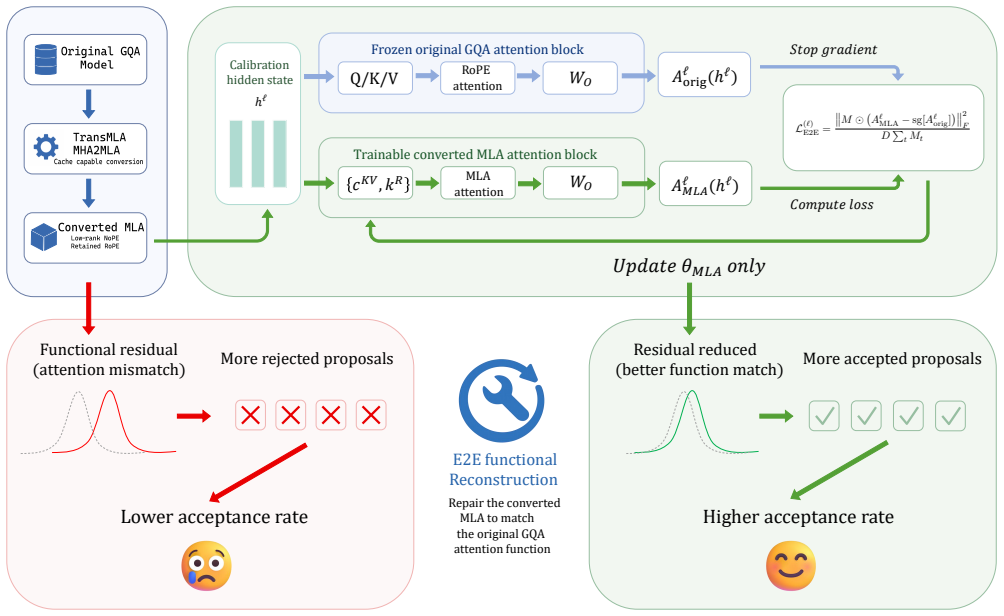
The paper's central discovery is a failure mode and a repair. Direct MHA/GQA-to-MLA conversion introduces two kinds of attention error—low-rank K/V factorization and RoPE routing—that leave standalone generation almost unchanged but systematically lower the probability that a draft token is accepted by the verifier in greedy speculative decoding. The repair is end-to-end functional reconstruction: for each layer, a masked mean-squared loss between the converted MLA block's post-output-projection output and the frozen original GQA block's output on calibration hidden states, with gradients stopped through the original and applied only to converter-introduced query and KV projections. Under a
What carries the argument
The load-bearing object is the masked functional-reconstruction loss: for each layer, the squared difference between the converted MLA attention block's output and the frozen original GQA/MHA block's output, evaluated on real calibration hidden states after the output projection, masked to valid tokens and normalized per token. This objective turns 'conversion' from a one-time structural mapping into an ongoing optimization: it reroutes all converter-introduced error through the complete attention function—low-rank Q/KV factorization, RoPE handling, softmax, value aggregation, and W_O—rather than trying to match factor-level matrices. The loss is layer-local, uses no verifier logits or super
Load-bearing premise
The paper's mechanism rests on treating the layer-local, continuous mean-squared error between converted and original attention outputs on calibration hidden states as a reliable proxy for the discrete, multi-layer event that a draft token is the verifier's top choice; if calibration states are unrepresentative or later layers wash out the correction, the 37-of-64 improvement count would not reproduce.
What would settle it
Run the same functional reconstruction with calibration hidden states from one domain (e.g., code) and evaluate acceptance on a very different domain (e.g., long documents), and check whether acceptance still improves at the same rate. If the layer-local MSE drops while acceptance does not track it—or if acceptance degrades even when every layer's MSE is reduced—the surrogate assumption fails.
If this is right
- If the claim holds, converter quality should be judged by draft acceptance, not just by cache validity or standalone generation quality.
- The same training-time objective is converter-agnostic, so it can be dropped into any existing MHA/GQA-to-MLA pipeline as a post-conversion refinement stage.
- Since the loss is training-only and changes no inference operation or cache budget, acceptance gains can translate into wall-clock speedups once MLA kernels mature; 12 of the 37 improved cells already show throughput gains.
- The cross-over pattern between model families and converters implies that headroom is set by converter initialization, so future converters can allocate rank layer-wise based on functional residual.
- The method separates three nested success criteria—structural validity, functional fidelity, and draft utility—giving a diagnostic workflow for conversion failures.
Where Pith is reading between the lines
- A natural testable extension is to weight the layer-local loss by how much each layer's residual influences later hidden states or by token-margin sensitivity, which could push acceptance beyond the 37-of-64 count.
- Because the calibration is done on hidden states, the same reconstruction objective might be applied to other cheap-draft mechanisms (e.g., feature-space drafts) to improve their proposal fidelity as well.
- If functional fidelity is what matters, then 'conversion' could be treated as any low-rank attention approximation, and the same objective might repair quantized or pruned attention too.
- The severe unrecovered gaps under some converter/backend combinations suggest that conversion and kernel correctness are prerequisites; reconstruction can correct representable error but not missing rank or changed tensor semantics—a boundary worth mapping systematically.
Editorial analysis
A structured set of objections, weighed in public.
Referee Report
Summary. This paper studies a failure mode of MHA/GQA-to-MLA conversion: converted checkpoints may preserve standalone generation quality but lose top-1 agreement with the target model, hurting speculative decoding. The authors formulate MLA draft construction as functional reconstruction: starting from TransMLA or MHA2MLA converted checkpoints, they optimize each converted MLA attention block, per layer, to minimize the masked MSE between its post-WO output and that of the frozen original GQA block on calibration hidden states (Eq. 11). Only converter-introduced query/KV projections are trained; the cache topology and inference graph are unchanged, and no verifier logits or labels are used. They evaluate four draft-target pairs (Llama-1B/3B to Llama-8B, Qwen-1.5B/3B to Qwen-7B), two converters, HF and vLLM backends, and four 200-prompt tasks, reporting acceptance and throughput in the full 64-cell matched matrix (Table 1). Compared with the converter-local Partial RoPE baseline, they report 37 material acceptance improvements, 26 practically unchanged, and 1 material decrease under a 0.5 pp descriptive tolerance, with 12 of the improvements also materially faster. The paper is careful to frame acceptance as an empirical consequence and to state limitations: one seed, local-surrogate non-monotonicity, and no end-to-end speedup claim over original GQA.
Significance. If the result holds, this is a useful contribution. It separates structural conversion validity from draft utility and demonstrates a verifier-free, training-only post-processing stage that often improves acceptance in matched cells. Strengths include the full matrix in Table 1, controlled Partial-Ours comparisons that fix latent rank, cache budget, proposal length, and inference graph, coverage of two converter families and two backends, a released code/artifact link, and an honest limitations section. However, the central 37/64 count rests on single-seed, no-confidence-interval point estimates and on an underspecified calibration distribution. These issues need to be addressed before the empirical claim is fully reproducible and robust.
major comments (4)
- [Functional Reconstruction / Eq. (11)] The paper never specifies the calibration distribution that defines H_l^b. It is not stated whether these 'cached layer inputs' come from a forward pass of the original GQA model or from the converted MLA model, nor what prompts, sequence length, or number of sequences are used. Because Eq. (11) optimizes each layer independently, if H_l^b are original-model activations, the training distribution differs from what the deployed converted model will produce after the first converted layer changes the residual stream. This covariate shift is not corrected end-to-end. The manuscript must state the calibration source and composition; if original-model states are used, it should report sensitivity to this choice or justify the independence assumption.
- [Evaluation Protocol / Table 1] The 37/64 material-improvement count is based on one seed, 200 prompts per task, and a descriptive 0.5 pp tolerance. Several cells are close to the threshold: the sole material decrease is -0.55 pp (Qwen-3B, TransMLA, vLLM, CNN/DM), and many reported gains are only a few pp. No confidence intervals or repeated seeds are given, so the count is not a statistical claim and could shift under resampling. Provide per-cell uncertainty (bootstrap or multiple seeds) and report the distribution of margins. Additionally, under greedy decoding the 36 'deterministic repeats' in HumanEval produce identical outputs and therefore do not contribute independent samples; the effective N for HumanEval cells is 164, not 200.
- [Method / Discussion (2)] The paper's motivating causal statement is that reducing the Eq. (11) residual preserves proposal rankings and thereby improves acceptance (Fig. 1). The authors correctly concede in Discussion (2) that acceptance is discrete and end-to-end while Eq. (11) is continuous and layer-local, so non-monotonicity is possible. However, no quantitative evidence links achieved per-layer loss reductions to acceptance changes. Without this, the 37/64 result supports the procedure but not the hypothesized mechanism. A scatterplot or table of Eq. (11) loss reduction versus acceptance change, at least for a subset of layers and cells, would substantiate the mechanism claim.
- [Functional Reconstruction / Experiments] Training hyperparameters are not reported: optimizer, learning rate, number of steps, batch size, calibration sequence length, and compute budget are absent. Since Eq. (11) is the main contribution, these details are necessary for reproducibility. The code link helps, but the manuscript itself should contain the essential experimental configuration.
minor comments (4)
- [Evaluation Protocol] The description '200 valid outputs per configuration' is misleading for HumanEval, which uses 164 unique problems plus 36 deterministic repeats. Under greedy decoding, repeats are exact duplicates and add no information; please report the effective sample size.
- [Table 1] The table is dense. Consider splitting acceptance and throughput into separate tables or panels, and clearly mark the direction of bold: currently bold is applied to Ours only when it exceeds matched Partial by more than the tolerance, but it is easy to misread as best overall.
- [Eq. (11)] The denominator 'D P_t M_{b,t}' should be written explicitly (e.g., D times the number of valid tokens). As typeset, it is ambiguous whether the normalization is over hidden channels and valid tokens.
- [Preliminary / Eq. (8)] The derivation would benefit from a one-sentence note that d_k is the same key dimension in the original and converted paths, so the logit difference is dimensionally consistent.
Circularity Check
No significant circularity: Eq. (11) optimizes against the original draft attention block, while the acceptance metric Eq. (10) is measured against a separate verifier; the residual-to-acceptance link is presented as empirical, not derived.
full rationale
The paper's central derivation is not circular. Eq. (11) fits the converted MLA attention module to the frozen original GQA block's post-W_O output on calibration hidden states; Eq. (10) defines greedy acceptance as top-1 agreement between the converted draft distribution p_x^D and the target model distribution p_x^T. No parameter fitted in Eq. (11) enters the definition of p_x^T, and the paper states that the target verifier is not part of the optimization: 'The target verifier is not part of this optimization' and 'uses no verifier-model logits or supervision.' The paper explicitly disavows a guaranteed monotonic link between the loss and acceptance: 'Acceptance nevertheless remains a discrete, end-to-end consequence of many layers, whereas Eq. (11) is a continuous, layer-local surrogate,' and Figure 1 labels the residual-to-acceptance relationship as 'the empirical pathway tested.' The only same-author citation, TransMLA (Meng et al. 2025), is used as a converter implementation and is counterbalanced by the independent MHA2MLA converter; it is not invoked to force the method or exclude alternatives. The skeptic's calibration-distribution concern (the paper does not specify whether H_l^b come from the original or converted forward pass, nor the calibration prompts) is a genuine threat to external validity and reproducibility, but it is an empirical covariate-shift issue, not a definitional reduction of the prediction to the fitted input. Accordingly, no circular step is established by the paper's own equations or citations.
Axiom & Free-Parameter Ledger
free parameters (4)
- Training hyperparameters for E2E (learning rate, number of steps, batch size, calibration set composition)
- Reporting tolerance for 'material' change =
0.5 percentage points / 0.5 tok/s
- Proposal length gamma =
4 (1B/1.5B drafts), 3 (3B drafts)
- Masked MSE normalization and stop-gradient scheme
axioms (6)
- standard math Low-rank factorization cannot exactly reproduce stacked K/V maps when the rank requirement in Eq. (7) is violated
- standard math RoPE logit residual decomposition in Eq. (8) captures the main conversion errors
- domain assumption Greedy decoding acceptance is determined by top-1 agreement between draft and target (Eq. (10))
- domain assumption Calibration hidden states are representative of deployment-state distribution
- ad hoc to paper Reducing layer-local post-WO MSE is an effective proxy for improving top-1 agreement
- domain assumption The converted MLA family with fixed latent rank and retained RoPE path can represent the corrections needed
Cite this review
Pith. "Pith review of Beyond KV Reconstruction: Functional Reconstruction for MLA Draft Models in Speculative Decoding." pith.science (2026). https://pith.science/paper/5OQVFI4S
@misc{pith2026260727269,
  author       = {Pith},
  title        = {Pith review of: Beyond KV Reconstruction: Functional Reconstruction for MLA Draft Models in Speculative Decoding},
  year         = {2026},
  howpublished = {\url{https://pith.science/paper/5OQVFI4S}},
  note         = {Machine review of arXiv:2607.27269}
}
read the original abstract
Multi-head latent attention (MLA) is increasingly important for long-context LLM inference because compact latent states replace the growing key-value (KV) cache and reduce decoding memory traffic. Yet most capable open checkpoints use multi-head or grouped-query attention (MHA/GQA), so conversion is needed to obtain MLA's cache efficiency without retraining from scratch. Speculative decoding offers complementary acceleration, but its speedup depends on agreement between draft proposals and target verification. We find that direct MHA/GQA-to-MLA conversion can sharply reduce this agreement: low-rank factorization and RoPE handling introduce attention-function errors that may be tolerable for standalone generation but substantially lower draft-token acceptance. We therefore formulate MLA draft construction as functional reconstruction rather than cache compression. Our end-to-end (E2E) method optimizes each converted MLA attention module to reproduce the post-output-projection response of its original MHA/GQA counterpart on calibration hidden states. This converter-agnostic post-conversion procedure preserves the converted cache and inference graph and requires neither verifier logits nor verifier supervision. We evaluate 192 model-converter-backend-method-task configurations spanning four Llama/Qwen draft-target pairs, TransMLA and MHA2MLA, HF and vLLM, and four 200-prompt tasks. With a 0.5-percentage-point reporting tolerance, Functional Reconstruction materially improves acceptance in 37 of 64 matched task cells, leaves 26 practically unchanged, and materially decreases one. Code and evaluation artifacts are available at https://github.com/swyhahaha/FunctionalMLA.
Figures
Reference graph
Works this paper leans on
-
[1]
Advances in Neural Information Processing Systems , year=
Attention is All You Need , author=. Advances in Neural Information Processing Systems , year=
-
[2]
Proceedings of the 2023 Conference on Empirical Methods in Natural Language Processing , pages=
GQA: Training Generalized Multi-Query Transformer Models from Multi-Head Checkpoints , author=. Proceedings of the 2023 Conference on Empirical Methods in Natural Language Processing , pages=
2023
-
[3]
arXiv preprint arXiv:1911.02150 , year=
Fast Transformer Decoding: One Write-Head is All You Need , author=. arXiv preprint arXiv:1911.02150 , year=
Pith/arXiv arXiv 1911
-
[4]
Neurocomputing , volume=
RoFormer: Enhanced Transformer with Rotary Position Embedding , author=. Neurocomputing , volume=
-
[5]
arXiv preprint arXiv:2405.04434 , year=
DeepSeek-V2: A Strong, Economical, and Efficient Mixture-of-Experts Language Model , author=. arXiv preprint arXiv:2405.04434 , year=
-
[6]
arXiv preprint arXiv:2502.07864 , year=
TransMLA: MLA Is All You Need , author=. arXiv preprint arXiv:2502.07864 , year=
-
[7]
arXiv preprint arXiv:2502.14837 , year=
Towards Economical Inference: Enabling DeepSeek's Multi-Head Latent Attention in Any Transformer-based LLMs , author=. arXiv preprint arXiv:2502.14837 , year=
-
[8]
Proceedings of the 40th International Conference on Machine Learning , pages=
Fast Inference from Transformers via Speculative Decoding , author=. Proceedings of the 40th International Conference on Machine Learning , pages=
-
[9]
arXiv preprint arXiv:2302.01318 , year=
Accelerating Large Language Model Decoding with Speculative Sampling , author=. arXiv preprint arXiv:2302.01318 , year=
-
[10]
Proceedings of the ACM SIGOPS 29th Symposium on Operating Systems Principles , pages=
Efficient Memory Management for Large Language Model Serving with PagedAttention , author=. Proceedings of the ACM SIGOPS 29th Symposium on Operating Systems Principles , pages=
-
[11]
Advances in Neural Information Processing Systems , year=
FlashAttention: Fast and Memory-Efficient Exact Attention with IO-Awareness , author=. Advances in Neural Information Processing Systems , year=
-
[12]
arXiv preprint arXiv:2307.08691 , year=
FlashAttention-2: Faster Attention with Better Parallelism and Work Partitioning , author=. arXiv preprint arXiv:2307.08691 , year=
-
[13]
arXiv preprint arXiv:2305.09781 , year=
SpecInfer: Accelerating Generative Large Language Model Serving with Tree-Based Speculative Inference and Verification , author=. arXiv preprint arXiv:2305.09781 , year=
-
[14]
Proceedings of the 41st International Conference on Machine Learning , year=
Medusa: Simple LLM Inference Acceleration Framework with Multiple Decoding Heads , author=. Proceedings of the 41st International Conference on Machine Learning , year=
-
[15]
arXiv preprint arXiv:2401.15077 , year=
EAGLE: Speculative Sampling Requires Rethinking Feature Uncertainty , author=. arXiv preprint arXiv:2401.15077 , year=
-
[16]
arXiv preprint arXiv:2402.02057 , year=
Break the Sequential Dependency of LLM Inference Using Lookahead Decoding , author=. arXiv preprint arXiv:2402.02057 , year=
-
[17]
NIPS Deep Learning and Representation Learning Workshop , year=
Distilling the Knowledge in a Neural Network , author=. NIPS Deep Learning and Representation Learning Workshop , year=
-
[18]
arXiv preprint arXiv:1910.01108 , year=
DistilBERT, a Distilled Version of BERT: Smaller, Faster, Cheaper and Lighter , author=. arXiv preprint arXiv:1910.01108 , year=
Pith/arXiv arXiv 1910
-
[19]
arXiv preprint arXiv:2306.14048 , year=
Zhang, Zhenyu and Sheng, Ying and Zhou, Tianyi and Chen, Tianlong and Zheng, Lianmin and Cai, Ruisi and Song, Zhao and Tian, Yuandong and R. arXiv preprint arXiv:2306.14048 , year=
-
[20]
arXiv preprint arXiv:2309.17453 , year=
Efficient Streaming Language Models with Attention Sinks , author=. arXiv preprint arXiv:2309.17453 , year=
-
[21]
Liu, Zirui and Yuan, Jiayi and Jin, Hongye and Zhong, Shaochen and Xu, Zhaozhuo and Braverman, Vladimir and Chen, Beidi and Hu, Xia , journal=
-
[22]
arXiv preprint arXiv:2412.19437 , year=
DeepSeek-V3 Technical Report , author=. arXiv preprint arXiv:2412.19437 , year=
-
[23]
arXiv preprint arXiv:2309.08168 , year=
Draft & Verify: Lossless Large Language Model Acceleration via Self-Speculative Decoding , author=. arXiv preprint arXiv:2309.08168 , year=
-
[24]
arXiv preprint arXiv:2404.16710 , year=
LayerSkip: Enabling Early Exit Inference and Self-Speculative Decoding , author=. arXiv preprint arXiv:2404.16710 , year=
-
[25]
arXiv preprint arXiv:2402.12374 , year=
Sequoia: Scalable, Robust, and Hardware-Aware Speculative Decoding , author=. arXiv preprint arXiv:2402.12374 , year=
-
[26]
Li, Yuhui and Wei, Fangyun and Zhang, Chao and Zhang, Hongyang , journal=
-
[27]
arXiv preprint arXiv:2107.03374 , year=
Evaluating Large Language Models Trained on Code , author=. arXiv preprint arXiv:2107.03374 , year=
-
[28]
, howpublished=
Taori, Rohan and Gulrajani, Ishaan and Zhang, Tianyi and Dubois, Yann and Li, Xuechen and Guestrin, Carlos and Liang, Percy and Hashimoto, Tatsunori B. , howpublished=. Stanford Alpaca: An Instruction-Following
-
[29]
Proceedings of the 61st Annual Meeting of the Association for Computational Linguistics , pages=
Self-Instruct: Aligning Language Models with Self-Generated Instructions , author=. Proceedings of the 61st Annual Meeting of the Association for Computational Linguistics , pages=
-
[30]
Transactions of the Association for Computational Linguistics , volume=
Natural Questions: A Benchmark for Question Answering Research , author=. Transactions of the Association for Computational Linguistics , volume=
-
[31]
Advances in Neural Information Processing Systems , volume=
Teaching Machines to Read and Comprehend , author=. Advances in Neural Information Processing Systems , volume=
-
[32]
Abstractive Text Summarization Using Sequence-to-Sequence
Nallapati, Ramesh and Zhou, Bowen and dos Santos, Cicero and Gulcehre, Caglar and Xiang, Bing , booktitle=. Abstractive Text Summarization Using Sequence-to-Sequence
discussion (0)
Sign in with ORCID, Apple, or X to comment. Anyone can read and Pith papers without signing in.