Group-Equivariant Poincar\'e Convolutional Networks
Pith reviewed 2026-07-02 15:59 UTC · model grok-4.3
The pith
Equivariant Poincaré ResNets embed discrete symmetry groups into hyperbolic space to reduce optimization space and accelerate convergence while respecting manifold boundaries.
A machine-rendered reading of the paper's core claim, the machinery that carries it, and where it could break.
Core claim
Embedding equivariance drastically reduces the optimisation space, accelerating convergence while respecting the boundary constraints of the Poincaré ball and preserving spatial-group equivariance, achieved through adaptations that maintain hyperbolic geometry.
What carries the argument
Geometrically safe tensor reshaping combined with left-regular permutations for hyperbolic group convolutions and joint-orientation Poincaré Midpoint Batch normalisation, which allow discrete group actions to be applied in hyperbolic space.
If this is right
- Equivariance reduces redundant parameter usage by treating transformed versions of objects as the same hierarchical concept.
- Convergence accelerates because the optimization space is smaller while still respecting manifold constraints.
- Spatial-group equivariance is preserved, meaning the network respects both spatial transformations and the group symmetries.
- The methods ensure no hidden distortions are introduced to the hyperbolic manifold.
Where Pith is reading between the lines
- These techniques could extend to other manifolds where standard Euclidean equivariance methods fail due to curvature.
- Applications in hierarchical data like trees or graphs might benefit from combined hyperbolic and equivariant properties.
- Testing on datasets with rotational symmetries could show improved generalization.
Load-bearing premise
The proposed geometrically safe tensor reshaping, left-regular permutations, and joint-orientation Poincaré Midpoint Batch normalisation actually maintain both hyperbolic geometry and group equivariance without introducing hidden distortions or breaking the manifold constraints.
What would settle it
An experiment measuring whether the proposed batch normalisation keeps all points strictly inside the Poincaré ball after transformations, or if group convolutions produce outputs that violate the manifold geometry.
Figures
read the original abstract
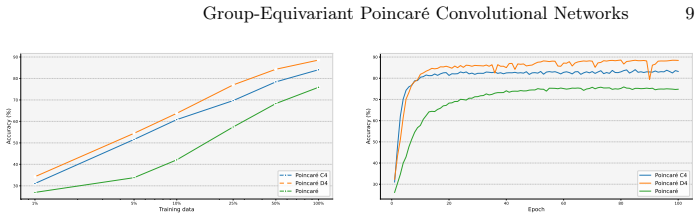
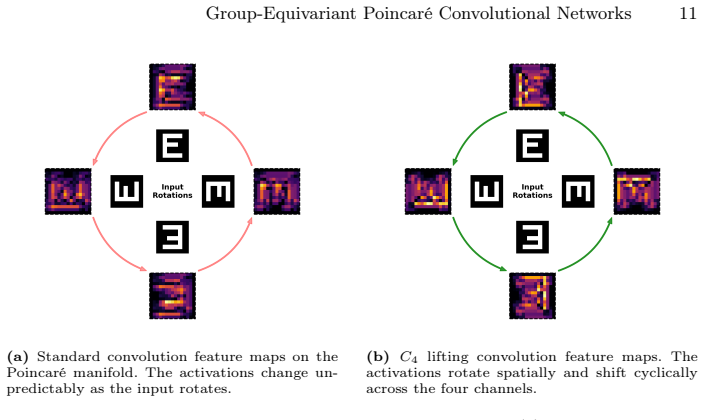
While recent advancements like the Poincar\'e ResNet have demonstrated the potential of learning visual representations directly in hyperbolic space, their optimisation remains hampered by the computationally intensive nature of Riemannian gradients and the strict boundaries of the manifold. Furthermore, standard hyperbolic networks treat spatial transformations of the same object as distinct hierarchical concepts, leading to redundant parameter usage and vanishing signals. We propose Equivariant Poincar\'e ResNets, combining hyperbolic geometry with discrete symmetry groups ($C_4$ and $D_4$). We identify critical roadblocks in applying Euclidean equivariance to hyperbolic space and propose geometrically safe tensor reshaping, left-regular permutations for hyperbolic group convolutions, and joint-orientation Poincar\'e Midpoint Batch normalisation. Empirically, embedding equivariance drastically reduces the optimisation space, accelerating convergence while accelerating convergence while respecting the boundary constraints of the Poincar\'e ball and preserving spatial-group equivariance.
Editorial analysis
A structured set of objections, weighed in public.
Referee Report
Summary. The manuscript proposes Equivariant Poincaré ResNets that integrate discrete group equivariance (C4 and D4) into hyperbolic Poincaré ball networks. It identifies roadblocks in applying Euclidean equivariance to hyperbolic space and introduces three adaptations: geometrically safe tensor reshaping, left-regular permutations for hyperbolic group convolutions, and joint-orientation Poincaré Midpoint Batch normalisation. The central claim is that embedding equivariance drastically reduces the optimisation space, accelerates convergence, respects the boundary constraints of the Poincaré ball, and preserves spatial-group equivariance.
Significance. If the proposed adaptations are shown to maintain both hyperbolic geometry and group equivariance without distortions, the work could advance efficient representation learning in hyperbolic spaces for symmetric visual data by reducing redundant parameters and mitigating vanishing signals, building on prior Poincaré ResNet results.
major comments (2)
- [Abstract] Abstract: The empirical claim that the adaptations 'drastically reduce the optimisation space, accelerating convergence while respecting the boundary constraints' supplies no quantitative results, error bars, baselines, or experiment details, rendering the central claim unverifiable from the provided text.
- [Abstract] Abstract: The assertion that geometrically safe tensor reshaping, left-regular permutations, and joint-orientation Poincaré Midpoint Batch normalisation 'maintain both hyperbolic geometry and group equivariance without introducing hidden distortions or breaking the manifold constraints' is stated without derivation, proof, or verification that these operations commute with C4/D4 actions and preserve the Poincaré ball radius, which is load-bearing for the strongest claim.
minor comments (1)
- [Abstract] Abstract: The phrase 'accelerating convergence while accelerating convergence' contains an obvious repetition that should be removed.
Simulated Author's Rebuttal
We thank the referee for highlighting issues in the abstract. We agree the claims require better support and will revise the abstract in the next version to address both points directly.
read point-by-point responses
-
Referee: [Abstract] Abstract: The empirical claim that the adaptations 'drastically reduce the optimisation space, accelerating convergence while respecting the boundary constraints' supplies no quantitative results, error bars, baselines, or experiment details, rendering the central claim unverifiable from the provided text.
Authors: We acknowledge the abstract presents the empirical benefits at a high level without numbers. The full manuscript reports experiments with baselines, convergence metrics, and parameter counts demonstrating the claimed reductions. We will revise the abstract to include specific quantitative results (e.g., convergence speed-ups and optimization-space reductions with error bars) drawn from those experiments. revision: yes
-
Referee: [Abstract] Abstract: The assertion that geometrically safe tensor reshaping, left-regular permutations, and joint-orientation Poincaré Midpoint Batch normalisation 'maintain both hyperbolic geometry and group equivariance without introducing hidden distortions or breaking the manifold constraints' is stated without derivation, proof, or verification that these operations commute with C4/D4 actions and preserve the Poincaré ball radius, which is load-bearing for the strongest claim.
Authors: The body of the manuscript contains the geometric arguments, permutation definitions, and batch-norm derivations showing preservation of the Poincaré ball and commutation with C4/D4 actions. The abstract is intended as a summary. We will revise it to note that these properties are verified in Sections 3–4 and, if space permits, add a one-sentence indication of the key invariance arguments. revision: yes
Circularity Check
No significant circularity; claims rest on proposed architectural adaptations without reduction to inputs by construction.
full rationale
The provided abstract and context describe identification of roadblocks in applying Euclidean equivariance to hyperbolic space, followed by proposals for geometrically safe tensor reshaping, left-regular permutations, and joint-orientation Poincaré Midpoint Batch normalisation. These are presented as novel solutions whose empirical effects (reduced optimisation space, faster convergence, preserved constraints) are asserted as outcomes rather than derived quantities. No equations, fitted parameters, or self-citations are quoted that would make any prediction equivalent to its inputs by definition. The derivation chain is self-contained against external benchmarks, with no load-bearing self-referential steps or renamings of known results.
Axiom & Free-Parameter Ledger
Reference graph
Works this paper leans on
-
[1]
In: Proceedings of the IEEE/CVF conference on computer vision and pattern recognition
Atigh, M.G., Schoep, J., Acar, E., Van Noord, N., Mettes, P.: Hyperbolic image segmentation. In: Proceedings of the IEEE/CVF conference on computer vision and pattern recognition. pp. 4453–4462 (2022)
2022
-
[2]
VICReg: Variance-Invariance-Covariance Regularization for Self-Supervised Learning
Bardes, A., Ponce, J., LeCun, Y.: Vicreg: Variance-invariance-covariance regular- ization for self-supervised learning. arXiv preprint arXiv:2105.04906 (2021)
work page internal anchor Pith review Pith/arXiv arXiv 2021
-
[3]
Advances in neural information processing systems34, 18673– 18684 (2021)
Bietti, A., Venturi, L., Bruna, J.: On the sample complexity of learning under geometric stability. Advances in neural information processing systems34, 18673– 18684 (2021)
2021
-
[4]
Journal of High Energy Physics2024(3), 1–66 (2024)
Bogatskiy, A., Hoffman, T., Miller, D.W., Offermann, J.T., Liu, X.: Explainable equivariant neural networks for particle physics: Pelican. Journal of High Energy Physics2024(3), 1–66 (2024)
2024
-
[5]
Flavors of geometry31(59-115), 2 (1997)
Cannon, J.W., Floyd, W.J., Kenyon, R., Parry, W.R., et al.: Hyperbolic geometry. Flavors of geometry31(59-115), 2 (1997)
1997
-
[6]
Advances in neural information processing systems32(2019)
Chami, I., Ying, Z., Ré, C., Leskovec, J.: Hyperbolic graph convolutional neural networks. Advances in neural information processing systems32(2019)
2019
-
[7]
In: International conference on machine learning
Chen, T., Kornblith, S., Norouzi, M., Hinton, G.: A simple framework for con- trastive learning of visual representations. In: International conference on machine learning. pp. 1597–1607. PMLR (2020)
2020
-
[8]
In: Proceedings of the IEEE conference on computer vision and pattern recognition
Cimpoi, M., Maji, S., Kokkinos, I., Mohamed, S., Vedaldi, A.: Describing textures in the wild. In: Proceedings of the IEEE conference on computer vision and pattern recognition. pp. 3606–3613 (2014)
2014
-
[9]
In: Interna- tional conference on machine learning
Cohen, T., Welling, M.: Group equivariant convolutional networks. In: Interna- tional conference on machine learning. pp. 2990–2999. PMLR (2016)
2016
-
[10]
In: International conference on machine learning
Elesedy, B., Zaidi, S.: Provably strict generalisation benefit for equivariant models. In: International conference on machine learning. pp. 2959–2969. PMLR (2021)
2021
-
[11]
In: International Conference on Machine Learning
Elsayed, G., Ramachandran, P., Shlens, J., Kornblith, S.: Revisiting spatial invari- ance with low-rank local connectivity. In: International Conference on Machine Learning. pp. 2868–2879. PMLR (2020)
2020
-
[12]
In: International conference on machine learning
Finzi, M., Welling, M., Wilson, A.G.: A practical method for constructing equivari- ant multilayer perceptrons for arbitrary matrix groups. In: International conference on machine learning. pp. 3318–3328. PMLR (2021)
2021
-
[13]
Advances in neural information processing systems31(2018)
Ganea, O., Bécigneul, G., Hofmann, T.: Hyperbolic neural networks. Advances in neural information processing systems31(2018)
2018
-
[14]
Knowledge-Based Systems291, 111590 (2024) 16 A
Huang, B., Yu, W., Xie, R., Luo, J., Xiao, J., Huang, J.: Lorentz equivariant model for knowledge-enhanced hyperbolic collaborative filtering. Knowledge-Based Systems291, 111590 (2024) 16 A. Durrant et al
2024
-
[15]
In: International Conference on Machine Learning
Kaba, S.O., Mondal, A.K., Zhang, Y., Bengio, Y., Ravanbakhsh, S.: Equivariance with learned canonicalization functions. In: International Conference on Machine Learning. pp. 15546–15566. PMLR (2023)
2023
-
[16]
arXiv preprint arXiv:2312.09016 (2023)
Kaba, S.O., Ravanbakhsh, S.: Symmetry breaking and equivariant neural networks. arXiv preprint arXiv:2312.09016 (2023)
-
[17]
In: Proceedings of the IEEE/CVF Conference on Com- puter Vision and Pattern Recognition
Khrulkov, V., Mirvakhabova, L., Ustinova, E., Oseledets, I., Lempitsky, V.: Hyper- bolic image embeddings. In: Proceedings of the IEEE/CVF Conference on Com- puter Vision and Pattern Recognition. pp. 6418–6428 (2020)
2020
-
[18]
Advances in Neural Infor- mation Processing Systems36, 18582–18612 (2023)
Kim, J., Nguyen, D., Suleymanzade, A., An, H., Hong, S.: Learning probabilistic symmetrization for architecture agnostic equivariance. Advances in Neural Infor- mation Processing Systems36, 18582–18612 (2023)
2023
-
[19]
In: International conference on machine learning
Kondor, R., Trivedi, S.: On the generalization of equivariance and convolution in neural networks to the action of compact groups. In: International conference on machine learning. pp. 2747–2755. PMLR (2018)
2018
-
[20]
Krioukov, D., Papadopoulos, F., Kitsak, M., Vahdat, A., Boguná, M.: Hyperbolic geometryofcomplexnetworks.PhysicalReviewE—Statistical,Nonlinear,andSoft Matter Physics82(3), 036106 (2010)
2010
-
[21]
Krizhevsky, A., Hinton, G., et al.: Learning multiple layers of features from tiny images. . (2009)
2009
-
[22]
In: Proceedings of the 57th annual meeting of the association for computational linguistics
Le, M., Roller, S., Papaxanthos, L., Kiela, D., Nickel, M.: Inferring concept hier- archies from text corpora via hyperbolic embeddings. In: Proceedings of the 57th annual meeting of the association for computational linguistics. pp. 3231–3241 (2019)
2019
-
[23]
Advances in neural information processing systems33, 21464–21475 (2020)
Liu, W., Wang, X., Owens, J., Li, Y.: Energy-based out-of-distribution detection. Advances in neural information processing systems33, 21464–21475 (2020)
2020
-
[24]
In: Proceedings of the IEEE/CVF conference on computer vision and pattern recognition
Long, T., Mettes, P., Shen, H.T., Snoek, C.G.: Searching for actions on the hyper- bole. In: Proceedings of the IEEE/CVF conference on computer vision and pattern recognition. pp. 1141–1150 (2020)
2020
-
[25]
In: International conference on machine learning
Lou, A., Katsman, I., Jiang, Q., Belongie, S., Lim, S.N., De Sa, C.: Differentiating through the fréchet mean. In: International conference on machine learning. pp. 6393–6403. PMLR (2020)
2020
-
[26]
In: Medical Imaging with Deep Learning (2026)
Mishra, S.S., van Spengler, M., Berkhout, E., Mettes, P.: Hyperbolic u-net for ro- bust medical image segmentation. In: Medical Imaging with Deep Learning (2026)
2026
-
[27]
Hyperbolic Graph Neural Networks Under the Microscope: The Role of Geometry-Task Alignment
Naddeo, D., Linkerhägner, J., Toschi, N., Skenderi, G., Lachi, V.: Hyperbolic graph neural networks under the microscope: The role of geometry-task alignment. arXiv preprint arXiv:2602.01828 (2026)
work page internal anchor Pith review Pith/arXiv arXiv 2026
-
[28]
In: NIPS workshop on deep learning and unsupervised feature learning
Netzer, Y., Wang, T., Coates, A., Bissacco, A., Wu, B., Ng, A.Y., et al.: Reading digits in natural images with unsupervised feature learning. In: NIPS workshop on deep learning and unsupervised feature learning. vol. 2011, p. 4. Granada (2011)
2011
-
[29]
Advances in neural information processing systems30(2017)
Nickel, M., Kiela, D.: Poincaré embeddings for learning hierarchical representa- tions. Advances in neural information processing systems30(2017)
2017
-
[30]
Advances in Neural Information Processing Systems36, 61936–61959 (2023)
Petrache, M., Trivedi, S.: Approximation-generalization trade-offs under (approxi- mate) group equivariance. Advances in Neural Information Processing Systems36, 61936–61959 (2023)
2023
-
[31]
arXiv preprint arXiv:2110.03336 , year=
Puny, O., Atzmon, M., Ben-Hamu, H., Misra, I., Grover, A., Smith, E.J., Lipman, Y.: Frame averaging for invariant and equivariant network design. arXiv preprint arXiv:2110.03336 (2021)
-
[32]
In: International conference on machine learning
Ravanbakhsh, S., Schneider, J., Poczos, B.: Equivariance through parameter- sharing. In: International conference on machine learning. pp. 2892–2901. PMLR (2017) Group-Equivariant Poincaré Convolutional Networks 17
2017
-
[33]
arXiv preprint arXiv:2010.10241 (2020)
Richemond, P.H., Grill, J.B., Altché, F., Tallec, C., Strub, F., Brock, A., Smith, S., De, S., Pascanu, R., Piot, B., et al.: Byol works even without batch statistics. arXiv preprint arXiv:2010.10241 (2020)
-
[34]
In: International Symposium on Graph Drawing
Sarkar, R.: Low distortion delaunay embedding of trees in hyperbolic plane. In: International Symposium on Graph Drawing. pp. 355–366. Springer (2011)
2011
-
[35]
In: International Conference on Artificial Intelligence and Statistics
Shakerinava, M., Sohrabi, M.M., Ravanbakhsh, S., Lacoste-Julien, S.: Weight- sharing regularization. In: International Conference on Artificial Intelligence and Statistics. pp. 4204–4212. PMLR (2024)
2024
-
[36]
arXiv preprint arXiv:2006.08210 (2020)
Shimizu, R., Mukuta, Y., Harada, T.: Hyperbolic neural networks++. arXiv preprint arXiv:2006.08210 (2020)
-
[37]
arXiv preprint arXiv:2303.14027 (2023)
van Spengler, M., Berkhout, E., Mettes, P.: Poincar\’e resnet. arXiv preprint arXiv:2303.14027 (2023)
-
[38]
In: Proceedings of the 31st ACM International Conference on Multimedia
van Spengler, M., Wirth, P., Mettes, P.: Hypll: The hyperbolic learning library. In: Proceedings of the 31st ACM International Conference on Multimedia. pp. 9676–9679 (2023)
2023
-
[39]
Poincar\'e GloVe: Hyperbolic Word Embeddings
Tifrea, A., Bécigneul, G., Ganea, O.E.: Poincar\’e glove: Hyperbolic word embed- dings. arXiv preprint arXiv:1810.06546 (2018)
work page internal anchor Pith review Pith/arXiv arXiv 2018
-
[40]
Springer Nature (2022)
Ungar, A.: A gyrovector space approach to hyperbolic geometry. Springer Nature (2022)
2022
-
[41]
Synthesis Lec- tures on Mathematics and Statistics1(1), 1–194 (2008)
Ungar, A.A.: A gyrovector space approach to hyperbolic geometry. Synthesis Lec- tures on Mathematics and Statistics1(1), 1–194 (2008)
2008
-
[42]
In: Proceedings of the IEEE/CVF International Conference on Computer Vision
Van Spengler, M., Berkhout, E., Mettes, P.: Poincare resnet. In: Proceedings of the IEEE/CVF International Conference on Computer Vision. pp. 5419–5428 (2023)
2023
-
[43]
CoRRabs/1809.01703(2018),http://arxiv.org/abs/1809.01703
Vinh, T.D.Q., Tay, Y., Zhang, S., Cong, G., Li, X.: Hyperbolic recommender sys- tems. CoRRabs/1809.01703(2018),http://arxiv.org/abs/1809.01703
-
[44]
In: The 29th International Conference on Artificial Intelligence and Statistics
Vlasenko, M., Atigh, M.G., Mettes, P.: Hyperbolic part-whole image segmentation. In: The 29th International Conference on Artificial Intelligence and Statistics
-
[45]
In: International Conference on Machine Learning
Wang, R., Walters, R., Yu, R.: Approximately equivariant networks for imper- fectly symmetric dynamics. In: International Conference on Machine Learning. pp. 23078–23091. PMLR (2022)
2022
-
[46]
In: Proceedings of the IEEE Conference on Computer Vision and Pattern Recognition
Weiler, M., Hamprecht, F.A., Storath, M.: Learning steerable filters for rotation equivariant cnns. In: Proceedings of the IEEE Conference on Computer Vision and Pattern Recognition. pp. 849–858 (2018)
2018
-
[47]
In: Proceedings of the IEEE/CVF Conference on Computer Vision and Pattern Recognition
Yan, J., Luo, L., Deng, C., Huang, H.: Unsupervised hyperbolic metric learning. In: Proceedings of the IEEE/CVF Conference on Computer Vision and Pattern Recognition. pp. 12465–12474 (2021)
2021
-
[48]
ACM Transactions on Infor- mation Systems44(5), 1–27 (2026)
Zhang, Q., Wen, H., Yuan, W., Chen, C., Yang, M., Yiu, S.M., Yin, H.: Hmamba: Hyperbolic mamba for sequential recommendation. ACM Transactions on Infor- mation Systems44(5), 1–27 (2026)
2026
-
[49]
IEEE transactions on pattern analysis and machine intelligence40(6), 1452–1464 (2017) 18 A
Zhou, B., Lapedriza, A., Khosla, A., Oliva, A., Torralba, A.: Places: A 10 million image database for scene recognition. IEEE transactions on pattern analysis and machine intelligence40(6), 1452–1464 (2017) 18 A. Durrant et al. A Prerequisites A.1 Hyperbolic Learning: The Poincaré Ball Model Hyperbolic spaceB n is the unique simply connectedn-dimensional ...
2017
discussion (0)
Sign in with ORCID, Apple, or X to comment. Anyone can read and Pith papers without signing in.