A Switching Beamformer for Highly Non-Stationary Environments
Pith reviewed 2026-06-27 18:22 UTC · model grok-4.3
The pith
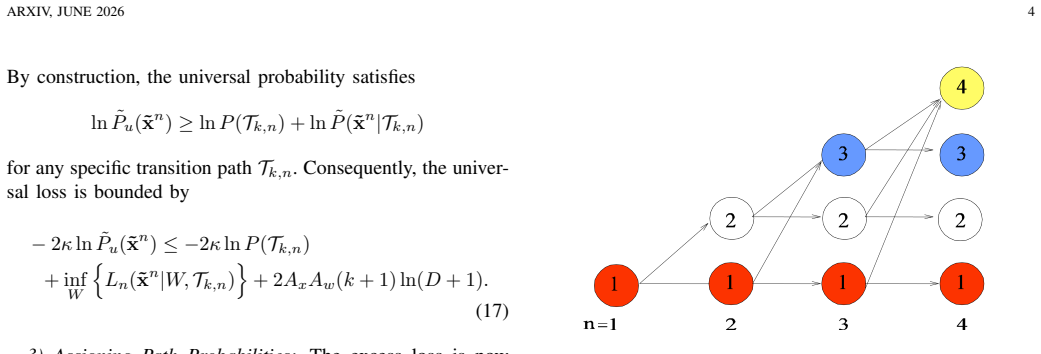
The Universal Switching Beamformer maintains an exponentially large family of covariance histories and re-weights them by cumulative output power to adapt its memory length automatically.
A machine-rendered reading of the paper's core claim, the machinery that carries it, and where it could break.
Core claim
The USB employs a linear transition diagram to maintain an exponentially large family of candidate covariance histories and dynamically re-weights them according to cumulative output power. This mechanism automatically varies the effective memory length and carries a theoretical upper bound on regret relative to an omniscient oracle that selects the single best piecewise-stationary covariance model in hindsight.
What carries the argument
The linear transition diagram that implicitly maintains and competitively re-weights an exponentially large family of covariance histories using cumulative output power as the driving loss.
If this is right
- The beamformer matches the agility of short-window estimators while retaining the precision of long-term integration without any change-detection step.
- Effective memory length varies automatically as the re-weighting process favors recent or stable histories as needed.
- No heuristic parameters for window length or forgetting factor are required.
- The same architecture yields a concrete regret guarantee against the best hindsight piecewise-stationary choice.
Where Pith is reading between the lines
- The same re-weighting idea could be applied to other online covariance-based estimators such as Kalman filters or subspace trackers in non-stationary settings.
- Because the method needs only output power as feedback, it may integrate directly into existing beamformer pipelines with minimal extra computation.
- In environments that deviate strongly from piecewise stationarity the performance gap to an oracle would grow, providing a practical test of the modeling assumption.
Load-bearing premise
The interference environment admits a useful piecewise-stationary covariance model and cumulative output power is a suitable loss for re-weighting the candidate histories.
What would settle it
A controlled experiment in which the USB regret exceeds the stated upper bound when the true interference switches between a small number of known stationary covariance matrices at known times.
Figures

read the original abstract
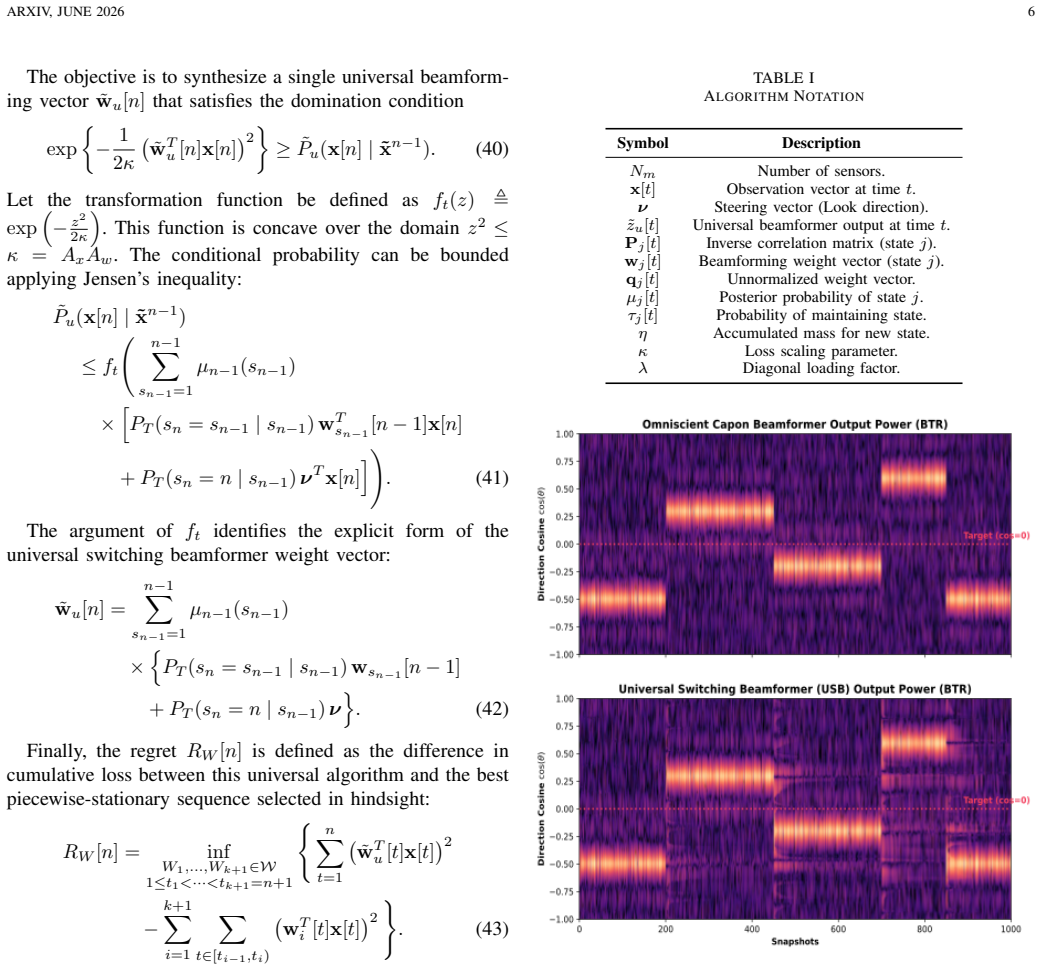
Adaptive beamforming is a cornerstone of array signal processing, yet its performance often collapses in the face of complex, rapidly changing interference. When interferers appear or move unpredictably, conventional estimators encounter a fundamental memory trade-off: short windows enable rapid tracking but suffer from high estimation variance, while long windows provide stable rejection but fail to adapt to shifts. This challenge is resolved by introducing the Universal Switching Beamformer (USB), which integrates competitive sequential prediction into the beamforming architecture. By employing a linear transition diagram, the USB implicitly maintains an exponentially large family of candidate covariance histories and dynamically re-weights them based on their cumulative output power. This mechanism allows the beamformer to automatically vary its effective memory length without explicit change detection or heuristic parameter tuning. A theoretical upper bound is proven on the regret relative to an omniscient oracle that selects the best piecewise-stationary covariance model in hindsight. Extensive simulations and experiments on the SwellEx-96 dataset demonstrate that the USB achieves the agility of short-window estimators and the precision of long-term integration, providing a principled solution for tracking highly non-stationary scenes.
Editorial analysis
A structured set of objections, weighed in public.
Referee Report
Summary. The manuscript introduces the Universal Switching Beamformer (USB) for adaptive beamforming in highly non-stationary interference environments. It integrates competitive sequential prediction via a linear transition diagram that implicitly maintains an exponentially large family of candidate covariance histories, dynamically re-weights them according to cumulative output power to automatically vary effective memory length without explicit change detection or tuning, proves an upper bound on regret relative to an omniscient oracle that selects the best piecewise-stationary covariance model in hindsight, and reports supporting simulations plus experiments on the SwellEx-96 dataset.
Significance. If the regret bound derivation is correct and the experiments are reproducible, the work supplies a principled, parameter-free mechanism for balancing tracking speed and estimation stability in array signal processing by importing switching-expert techniques; this could be significant for applications involving rapidly varying interferers where conventional fixed-window estimators fail.
major comments (2)
- [Abstract] Abstract: the central claim of a proven regret bound relative to the piecewise-stationary oracle rests on the linear transition diagram and re-weighting rule, yet the abstract provides no derivation steps, conditions on the loss, or tightness analysis, leaving the bound's validity unverified from the given text.
- [Abstract] Abstract: the re-weighting is defined directly as a function of observed output power, but the manuscript does not demonstrate why this loss is aligned with the beamforming objective (e.g., SINR maximization or interference suppression) rather than being an arbitrary surrogate; this choice is load-bearing for the competitive guarantee.
minor comments (2)
- The description of the SwellEx-96 experimental protocol (data segmentation, covariance estimation details, performance metrics) is absent from the abstract and would need expansion for reproducibility.
- Notation for the transition diagram and the exact form of the re-weighting update should be introduced with equations even in the abstract for clarity.
Simulated Author's Rebuttal
We thank the referee for the thoughtful review and the opportunity to address the comments on the Universal Switching Beamformer manuscript. We respond to each major comment below, focusing on the substance of the concerns.
read point-by-point responses
-
Referee: [Abstract] Abstract: the central claim of a proven regret bound relative to the piecewise-stationary oracle rests on the linear transition diagram and re-weighting rule, yet the abstract provides no derivation steps, conditions on the loss, or tightness analysis, leaving the bound's validity unverified from the given text.
Authors: Abstracts are concise summaries and do not contain derivations; the full proof appears in Section 3. There we state the loss conditions (non-negative and bounded), detail how the linear transition diagram implicitly tracks an exponential number of covariance histories, and derive the regret bound relative to the piecewise-stationary oracle, including a discussion of its order and dependence on the number of switches. The bound is therefore verifiable from the manuscript body rather than the abstract. revision: no
-
Referee: [Abstract] Abstract: the re-weighting is defined directly as a function of observed output power, but the manuscript does not demonstrate why this loss is aligned with the beamforming objective (e.g., SINR maximization or interference suppression) rather than being an arbitrary surrogate; this choice is load-bearing for the competitive guarantee.
Authors: Section 2 formulates the MVDR beamformer as minimizing output power subject to a distortionless constraint on the desired signal; the cumulative output power is therefore the natural performance measure for any covariance estimate used by the beamformer. The re-weighting rule inherits this alignment, so that lower regret on the power loss directly improves realized SINR. This connection is not arbitrary and is used to translate the theoretical guarantee into the reported simulation and SwellEx-96 results. revision: no
Circularity Check
No significant circularity identified
full rationale
The USB construction applies a standard online-learning switching-experts framework (linear transition diagram maintaining an exponential family of covariance histories, re-weighted by cumulative observed output power) to produce a regret bound against an external omniscient piecewise-stationary oracle. The bound is stated as proven in the paper; the loss is the directly observed output power rather than a fitted surrogate. No self-definitional reduction, fitted-input-called-prediction, or load-bearing self-citation chain appears in the abstract or described mechanism. The modeling assumption (piecewise-stationary covariance) is explicitly the target of the method, not an unstated premise. This is a self-contained application of known regret analysis.
Axiom & Free-Parameter Ledger
axioms (1)
- domain assumption Interference can be adequately represented by a piecewise-stationary sequence of covariance matrices.
invented entities (1)
-
Universal Switching Beamformer (USB) with linear transition diagram
no independent evidence
Reference graph
Works this paper leans on
-
[1]
High-resolution frequency-wavenumber spectrum analysis,
J. Capon, “High-resolution frequency-wavenumber spectrum analysis,” Proceedings of the IEEE, vol. 57, no. 8, pp. 1408–1418, 1969
1969
-
[2]
H. L. Van Trees,Optimum array processing: Part IV of detection, estimation, and modulation theory. John Wiley & Sons, 2002
2002
-
[3]
D. H. Johnson and D. E. Dudgeon,Array signal processing: concepts and techniques. Simon & Schuster, Inc., 1992
1992
-
[4]
Bayesian Online Changepoint Detection
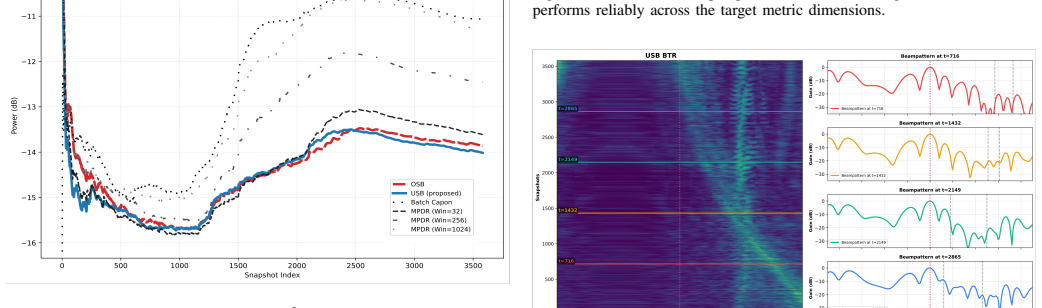
R. P. Adams and D. J. MacKay, “Bayesian online changepoint detec- tion,”arXiv preprint arXiv:0710.3742, 2007. Fig. 18. Accumulated output power and white noise gain at0 ◦. The USB performs reliably across the target metric dimensions. Fig. 19. Bearing time record and beampatterns for the SwellEx dataset at marked times for the universal switching beamform...
work page internal anchor Pith review Pith/arXiv arXiv 2007
-
[5]
Robust adaptive beamforming,
H. Cox, R. Zeskind, and M. Owen, “Robust adaptive beamforming,” IEEE Transactions on Acoustics, Speech, and Signal Processing, vol. 35, no. 10, pp. 1365–1376, 1987
1987
-
[6]
Beamforming with dominant mode rejection,
D. A. Abraham and N. L. Owsley, “Beamforming with dominant mode rejection,” inOCEANS’90. IEEE, 1990, pp. 470–475
1990
-
[7]
Time Segmented Beamforming via Dynamic Programming: Theory and Implementation
M. Mittal, R. M. Corey, D. Cuji, J. R. Buck, and A. C. Singer, “Time segmented beamforming via dynamic programming: Theory and implementation,”arXiv preprint arXiv:2605.24825, 2026
work page internal anchor Pith review Pith/arXiv arXiv 2026
-
[8]
Cesa-Bianchi and G
N. Cesa-Bianchi and G. Lugosi,Prediction, learning, and games. Cambridge university press, 2006
2006
-
[9]
Universal prediction,
N. Merhav and M. Feder, “Universal prediction,”IEEE Transactions on Information Theory, vol. 44, no. 6, pp. 2124–2147, 1998
1998
-
[10]
Universal switching linear prediction,
S. S. Kozat and A. C. Singer, “Universal switching linear prediction,” IEEE Transactions on Signal Processing, vol. 56, no. 1, pp. 189–204, 2008. ARXIV , JUNE 2026 11
2008
-
[11]
A performance-weighted blended dominant mode rejection beamformer,
J. R. Buck and A. C. Singer, “A performance-weighted blended dominant mode rejection beamformer,” in2018 IEEE 10th Sensor Array and Multichannel Signal Processing Workshop (SAM), 2018, pp. 124–128
2018
-
[12]
Rapid convergence rate in adaptive arrays,
I. S. Reed, J. D. Mallett, and L. E. Brennan, “Rapid convergence rate in adaptive arrays,”IEEE Transactions on Aerospace and Electronic Systems, vol. AES-10, no. 6, pp. 853–863, 1974
1974
-
[13]
A consol- idated perspective on multimicrophone speech enhancement and source separation,
S. Gannot, E. Vincent, S. Markovich-Golan, and A. Ozerov, “A consol- idated perspective on multimicrophone speech enhancement and source separation,”IEEE/ACM Transactions on Audio, Speech, and Language Processing, vol. 25, no. 4, pp. 692–730, 2017
2017
-
[14]
Experimental evaluation of a universal dominant mode rejection beamformer,
k. E. Wage and J. R. Buck, “Experimental evaluation of a universal dominant mode rejection beamformer,” in2018 IEEE 10th Sensor Array and Multichannel Signal Processing Workshop (SAM), 2018, pp. 119– 123
2018
-
[15]
The performance of universal encod- ing,
R. Krichevsky and V . Trofimov, “The performance of universal encod- ing,”IEEE Transactions on Information Theory, vol. 27, no. 2, pp. 199– 207, 1981
1981
-
[16]
Coding for a piecewise stationary source,
F. M. J. Willems, “Coding for a piecewise stationary source,”IEEE Transactions on Information Theory, vol. 42, no. 6, pp. 2236–2243, 1996
1996
-
[17]
Adaptive Diagonal Loading using Krylov Subspaces for Robust Beamforming
M. Mittal, R. M. Corey, J. R. Buck, and A. C. Singer, “Adaptive diagonal loading using krylov subspaces for robust beamforming,”arXiv preprint arXiv:2605.11286, 2026
work page internal anchor Pith review Pith/arXiv arXiv 2026
-
[18]
Online Segmented Beamforming via Dynamic Programming
M. Mittal, R. M. Corey, D. Cuji, J. R. Buck, and A. C. Singer, “Online segmented beamforming via dynamic programming,”arXiv preprint arXiv:2605.08554, 2026
work page internal anchor Pith review Pith/arXiv arXiv 2026
discussion (0)
Sign in with ORCID, Apple, or X to comment. Anyone can read and Pith papers without signing in.