REVIEW 4 major objections 3 minor 3 references
Enhancing tutoring systems by leveraging tailored promptings and domain knowledge with Large Language Models
T0 review · 4 major / 3 minor · reviewed 2026-08-16 · deepseek-v4-flash
Pith's one-line read A tutoring system that pulls each student's portfolio before prompting produces faster, more readable feedback.
desk verdict A clear, modest pilot of portfolio-based RAG prompt design for tutoring, but the headline comparison is uncontrolled and the evidence is synthetic, so the effectiveness claim is unproven. read the letter →
The pith
A machine-rendered reading of the paper's core claim, the machinery that carries it, and where it could break.
The reading
What carries the argument
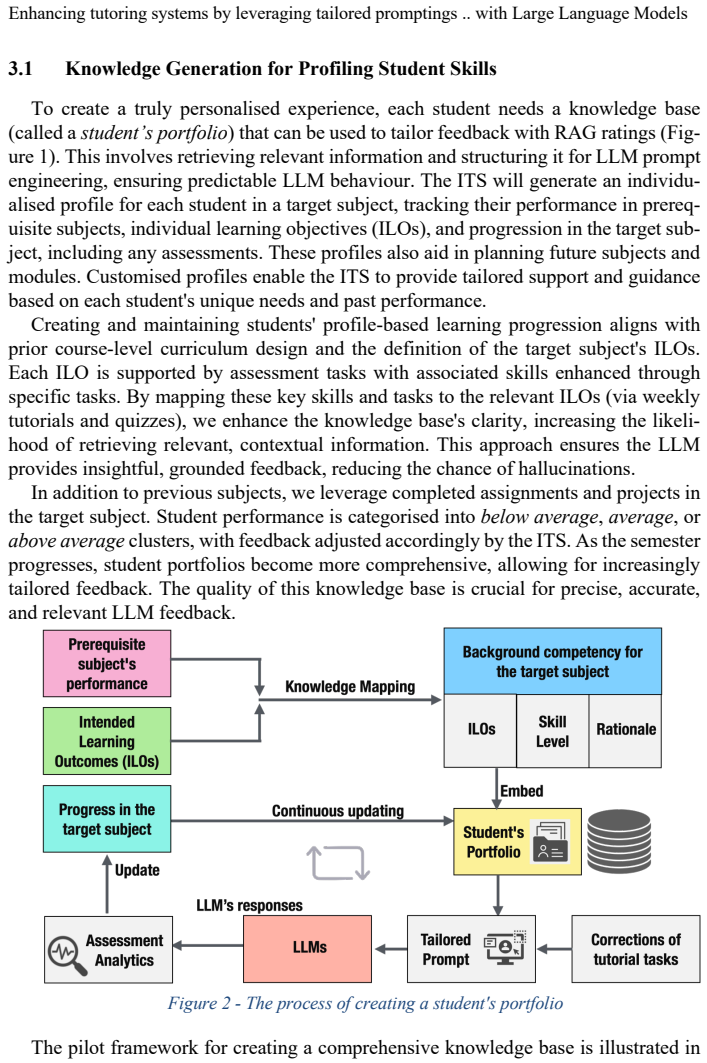
The load-bearing component is the student portfolio knowledge base, a structured record of prerequisite-subject marks, tutorial and quiz scores in the target subject, and mappings to intended learning outcomes. At generation time, retrieval-augmented generation pulls the relevant portfolio entries into the prompt, and the prompt is tiered by skill category (below average, average, above average) with chain-of-thought steps, few-shot examples, and self-consistency majority voting over five sampled responses. This combination is what converts a generic LLM call into feedback that is supposed to be grounded in the student's actual trajectory and tuned to their level.
What would settle it
Run the identical three tasks on real submissions from a programming course and compare the tailored pipeline against the general prompt on FKRS, response time, and instructor-rated feedback usefulness; the central claim fails if the tailored condition does not beat the general condition on at least readability and usefulness for students at their actual skill levels.
Extended reading notes
Core claim
On the paper's own terms, the central discovery is that conditioning an LLM's feedback on a student skill profile—built from prerequisite-subject marks, current tutorial and quiz scores, and intended learning outcomes—changes the quality of the generated feedback in measurable ways. In the pilot, feedback generated for students in each of three manually assigned skill categories scored higher on the Flesch-Kincaid readability scale than general feedback for the groups that need it most, took less wall-clock time than general feedback even after five responses and a majority vote, and contained more sentences of guidance, explanation, and external resources. The paper presents this as evidence that skill-aligned prompt engineering plus RAG can make tutoring systems more adaptive and effective than a one-size-fits-all prompt.
Load-bearing premise
The pilot's evidence rests on a synthesized dataset of 30 students whose marks were drawn from a normal distribution; the authors state that real student data is needed to evaluate the approach in a genuine educational environment, so the current results show what the pipeline does for simulated profiles, not yet for actual learners.
Editorial extensions
If this is right
- Tutoring systems can deliver level-appropriate feedback without fine-tuning or model changes, by changing only what is retrieved and how the prompt is structured.
- Students who are struggling can receive more readable, more explanatory feedback than a generic assistant gives, while stronger students get shorter, more advanced pointers.
- The response-time advantage of tailored prompts suggests that structured prompting can reduce the perceived latency of LLM-based tutoring, even when majority voting is used.
- If the same design is applied to other subjects, the skill-profile mapping to intended learning outcomes would let institutions reuse existing assessment data to drive personalisation.
Reading between the lines
- A natural extension the paper does not test is whether these gains persist with real student data, where skill categories are noisy and performance changes over a semester; the authors explicitly list this as future work.
- The sentence-count proxy for feedback specificity implies that quality is being measured by quantity; an instructor-blind rating of feedback usefulness would test whether longer feedback is actually better for learning.
- Because the underlying LLM is not named, response-time differences could be influenced by model nondeterminism or API variability; re-running the same prompts many times per condition would separate prompt design from variance.
- The same RAG-plus-tiered-prompt pattern could be adapted to homework help or workplace training, where a portfolio of past work and learning objectives exists, but that extension is not established by this pilot.
Signed reviews
Editorial analysis
A structured set of objections, weighed in public.
Referee Report
Summary. The paper proposes an intelligent tutoring system that builds a per-student portfolio knowledge base, retrieves relevant prior performance via Retrieval-Augmented Generation (RAG), and combines chain-of-thought, few-shot, and self-consistency prompting with skill-tiered instructions to generate feedback. The pilot evaluation uses a synthetic dataset of 30 simulated students across three programming tasks of increasing complexity, reporting Flesch-Kincaid Readability Score, response time, and feedback specificity (measured by sentence count) for tailored versus general feedback. Based on these results, the paper claims that the proposed approach demonstrates better effectiveness and adaptability compared to general methods.
Significance. If the claims were adequately supported, the paper would address a practically important gap: adapting LLM-generated feedback to individual student skill levels in programming education. The concrete prompt templates in Tables 3 and 4 are a useful starting point for replication, and the paper is transparent about its synthetic data and manual skill grouping in Section 5. However, the current evaluation is a one-shot descriptive comparison without statistical controls, and the central comparative claim substantially overreaches the evidence. The contribution is best viewed as a proof-of-concept pipeline description, not as an empirically established effectiveness result.
major comments (4)
- [Section 3.2 vs. Section 4.3 (Figures 5-7)] The tailored-versus-general comparison is not controlled. Section 3.2 introduces four interventions simultaneously: RAG retrieval over the student portfolio, chain-of-thought prompting, few-shot examples, self-consistency via majority voting, and skill-tiered instruction. Section 4.3 describes the baseline only as 'general feedback, without tailored prompt techniques' with no prompt text, no matched instruction length, no indication of whether the baseline also uses chain-of-thought or few-shot examples, and no number of repeated runs. Under these conditions, any observed difference in FKRS, response time, or specificity could be driven entirely by the presence of richer structured prompting rather than by RAG or skill-level personalization. The central claim of 'better effectiveness and adaptability compared to general methods' therefore lacks causal attribution.
- [Section 4.2 and Figures 5-7] The quantitative evidence is statistically unanchored. For each metric, Figures 5-7 report single values per condition with no error bars, confidence intervals, or significance tests. Response time in Figure 6 is particularly fragile because the system generates five responses per task before majority voting and the underlying LLM is unnamed; a single set of measurements is subject to server load and model variance. These issues are not merely cosmetic: the paper's headline comparison rests on the shape of these figures, and without repeated runs or significance testing the reported ordering of conditions cannot be distinguished from noise.
- [Section 3.2 and Section 4.3] Part of the reported skill-level differentiation is true by construction. Table 3 and Table 4 explicitly specify that below-average students should receive basic explanations, step-by-step instructions, and additional basic-practice links, while above-average students should receive advanced techniques and concise, high-level guidance. The evaluation in Section 4.3 then 'finds' that below-average feedback has higher readability and greater length, and that above-average feedback is more concise. This is an expected consequence of the prompt design, not an empirical discovery about system effectiveness. The authors should reframe these observations as validation that the pipeline follows its own prompt specifications, rather than as evidence of learning benefit.
- [Section 4.1 and Section 5] The generalization to real students is unsupported and the abstract overstates it. The data are synthesized from a normal distribution with mean 72 and standard deviation 8, and the category boundaries are fixed thresholds; Section 5 admits that 'an important recommendation for future work is to utilise actual student data.' The abstract and Section 4.3 nonetheless claim that the system 'successfully sorted simulated students' and 'demonstrated better effectiveness' without acknowledging in the conclusion that these results are simulation-only. The authors should soften the causal language and explicitly restrict the effectiveness claim to the simulated pilot context.
minor comments (3)
- [References] In the reference list, entry 20 combines two distinct works (DAIR.AI's Prompt Engineering Guide and Wang et al.'s self-consistency paper), and the citation numbering in the text appears to use [20] for both; this should be split into separate numbered entries.
- [Section 4.1] The category definitions cover marks between 50 and 65, 65 and 80, and above 80, but the description does not state how students with marks below 50 are treated; the pass mark of 50 is mentioned, but the below-pass range is never discussed in the evaluation or prompt design.
- [Section 4.2] The evaluation does not report the identity or version of the LLM, the temperature setting, or the number of repeated runs per condition; these details are needed for reproducibility, especially for the response-time measurements in Figure 6.
Circularity Check
Feedback specificity and tier-dependent differences are encoded in the prompt design, so the adaptability claim partially restates the input.
-
self definitional
[Section 3.2 (Tables 3 and 4) and Section 4.3 (Figure 7)]
"Table 3. Chain of Thought prompts design. Below average: Identify and describe basic machine learning methods. ... Offer additional external links for more basic practices. Above average: Deeply understand the mathematical foundations ... Encourage to integrate advanced techniques to implement. ... 4.3: For student performance categorised as below average, detailed feedback is provided with many sentences and explanations ... Feedback for above-average performing students is concise, focusing on advanced techniques and assuming greater prior knowledge."
Section 4.2 defines specificity as 'detailed, tailored feedback that explains mistakes, reasons, and corrections' plus 'external sources', measured by 'the number of relevant sentences'. The Table 3/4 prompts explicitly mandate exactly those contents per tier: below-average students are told to get basic descriptions, step-by-step instructions, and 'additional external links for more basic practices'; above-average students are told to get 'mathematical foundations' and 'advanced techniques'. Section 4.3 then reports that below-average feedback has 'many sentences and explanations' with extra resources and above-average feedback is 'concise, focusing on advanced techniques'.
full rationale
The paper's central claim of 'better effectiveness and adaptability compared to general methods' rests on three metrics: FKRS, response time, and feedback specificity. The specificity result and the tier-dependent feedback profile are not independent discoveries: the Chain-of-Thought and few-shot prompt tables in Section 3.2 explicitly instruct the model to give basic, step-by-step, link-rich feedback to below-average students and concise advanced-technique feedback to above-average students. Figure 7 and the accompanying interpretation then report exactly those instructed differences, so the adaptability evidence reduces in part to the prompt design. The response-time and FKRS comparisons are empirically measured and not directly encoded, and the paper does not rely on load-bearing self-citation, so the circularity is partial rather than total. The uncontrolled 'general feedback' baseline and the synthetic dataset are additional validity concerns, but they are evaluation weaknesses rather than definitional circularity. Overall score 6: one of the main 'predictions' (tier-specific feedback specificity) reduces by construction.
Assumptions & free parameters
free parameters (3)
- Skill-category thresholds =
below average 50-65, average 65-80, above average >80
- Synthetic data distribution parameters =
mean 72, SD 8, n=30
- Self-consistency sample count =
5 responses per task
assumptions (5)
- domain assumption Chain-of-thought, few-shot, and self-consistency prompting improve the reliability and consistency of LLM output
- domain assumption Retrieval-augmented generation over the student portfolio grounds responses and reduces hallucinations
- domain assumption Flesch-Kincaid Readability Score is a meaningful quality measure for feedback containing code and domain jargon
- domain assumption Number of sentences is a valid proxy for specificity and quality of feedback
- ad hoc to paper The pass mark of 50 and the three fixed category boundaries reflect meaningful skill levels
invented entities (1)
-
Student portfolio knowledge base
Cite this review
Pith. "Pith review of Enhancing tutoring systems by leveraging tailored promptings and domain knowledge with Large Language Models." pith.science (2026). https://pith.science/paper/5PG4HDJK
@misc{pith2026250502849,
  author       = {Pith},
  title        = {Pith review of: Enhancing tutoring systems by leveraging tailored promptings and domain knowledge with Large Language Models},
  year         = {2026},
  howpublished = {\url{https://pith.science/paper/5PG4HDJK}},
  note         = {Machine review of arXiv:2505.02849}
}
read the original abstract
Recent advancements in artificial intelligence (AI) and machine learning have reignited interest in their impact on Computer-based Learning (CBL). AI-driven tools like ChatGPT and Intelligent Tutoring Systems (ITS) have enhanced learning experiences through personalisation and flexibility. ITSs can adapt to individual learning needs and provide customised feedback based on a student's performance, cognitive state, and learning path. Despite these advances, challenges remain in accommodating diverse learning styles and delivering real-time, context-aware feedback. Our research aims to address these gaps by integrating skill-aligned feedback via Retrieval Augmented Generation (RAG) into prompt engineering for Large Language Models (LLMs) and developing an application to enhance learning through personalised tutoring in a computer science programming context. The pilot study evaluated a proposed system using three quantitative metrics: readability score, response time, and feedback depth, across three programming tasks of varying complexity. The system successfully sorted simulated students into three skill-level categories and provided context-aware feedback. This targeted approach demonstrated better effectiveness and adaptability compared to general methods.
Figures
Reference graph
Works this paper leans on
-
[1]
Better to consider data pre-pro-cessing
Specific correction of missing splitting data - Explanation 1. Better to consider data pre-pro-cessing. - Explanation - Coding examples 2. Load Data: - Explanation - Coding examples 2. Libraries and tech-niques recommenda-tion: using techniques like train_test_split from scikit-learn. - Coding examples
-
[2]
- Explanation - Coding examples 8 List of author names…
Better solution using k-fold cross-validation. - Explanation - Coding examples 8 List of author names…
-
[3]
A Perceived Risk Perspective on Narrow Artificial In-telligence
Split Data: - Explanation - Coding examples - 3. Integration using pipelines. - Explanation - Coding examples 4. Create and Train Model. - Explanation - Coding examples - - Additional External Links for More Basic Practices: - URL links Additional External Links for advanced ML topics: - URL links Additional External Links for con-tinuous improvement in a...
arXiv 1970
Reviewed August 16, 2026 · model on record in the stance chip above.
Discussion (0). Continue with ORCID to comment.