REVIEW 4 major objections 5 minor 36 references
SimPhony: A Device-Circuit-Architecture Cross-Layer Modeling and Simulation Framework for Heterogeneous Electronic-Photonic AI System
T0 review · 4 major / 5 minor · reviewed 2026-08-12 · deepseek-v4-flash
Pith's one-line read SimPhony is an open-source cross-layer simulator that claims end-to-end latency, energy, and area estimates for heterogeneous electronic-photonic AI systems, from device models to chip floorplan.
desk verdict A solid open-source framework for EPIC AI simulation with a genuinely new PTC representation; validation is mostly against the authors' prior sims, so treat accuracy numbers as provisional. read the letter →
The pith
A machine-rendered reading of the paper's core claim, the machinery that carries it, and where it could break.
The reading
What carries the argument
The core object is the hierarchical netlist built from a minimal building block called a node, with directed two-pin nets capturing optical signal flow and scaling rules that replicate the node into a full multi-core architecture. The netlist is converted into a weighted directed acyclic graph whose longest path gives the critical insertion loss and whose topological order guides the layout-aware floorplanner. This representation carries the whole argument: it unifies PTC topologies, enables parametric architecture construction, supplies the link-budget and area analyses, and lets device library power models be applied per actual operand values.
What would settle it
Take an EPIC accelerator description in SimPhony and replace the unlimited-interconnect assumption with a cycle-accurate electrical and optical interconnect contention model for the same workload; if the contention-aware total latency exceeds SimPhony's estimate by more than the stated memory and reconfiguration margins on a bandwidth-heavy attention task, the end-to-end latency claim is falsified. Alternatively, compare SimPhony's auto-generated floorplan area against fabricated chip layouts for a diverse set of PTC netlists, not just the single node example in the paper.
Extended reading notes
Core claim
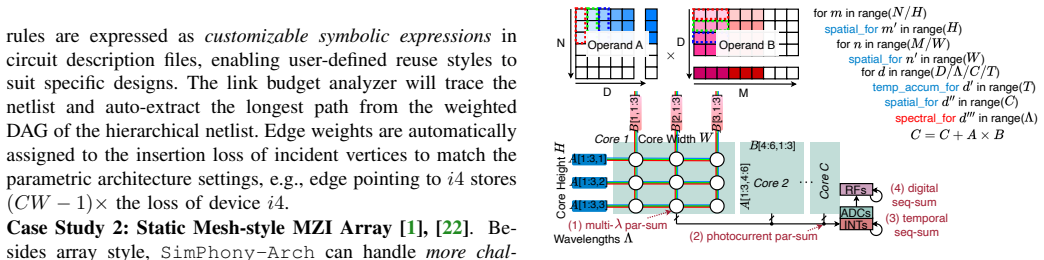
The central claim is that a single hierarchical netlist representation with directed two-pin nets and user-defined scaling rules can uniformly describe diverse photonic tensor core topologies, including array-style TeMPO cores and Clements-style MZI meshes. From that representation, SimPhony automatically derives critical-path insertion loss, link budget and laser power, signal-flow-aware floorplan area, and data-dependent device power that reflects actual operand values. The paper validates the simulator against area and energy breakdowns from TeMPO and power and area breakdowns from Lightening-Transformer, and shows that layout-unaware area estimation understates node area by 72 percent while data-aware phase-shifter energy drops by about 60 percent versus data-unaware estimates.
Load-bearing premise
The load-bearing premise is that memory bandwidth is the only data-movement bottleneck, with on-chip and cross-chiplet interconnects assumed to always provide enough bandwidth; if interconnect bandwidth is actually limiting, SimPhony's latency and energy estimates will be too optimistic.
Editorial extensions
If this is right
- Designers can sweep architecture parameters such as number of wavelengths, tensor bitwidth, tile count, and core size and read out energy, area, and latency trade-offs before any fabrication; the paper demonstrates such sweeps for TeMPO-style cores.
- Different photonic tensor core designs can be compared on the same memory hierarchy and layout assumptions, making reported area and energy numbers from different papers more directly comparable.
- Heterogeneous accelerators that map different neural network layers to different photonic sub-architectures, such as SCATTER convolutions plus MZI-mesh linear layers, can be simulated with a shared memory system.
- Data-dependent energy modeling makes pruning and power-gating effects visible in system-level energy, so algorithmic sparsity and device-level power savings can be co-optimized in simulation.
Reading between the lines
- Editorial extension: If the data-aware energy model is correct, then energy comparisons against EPIC accelerators that ignore actual operand values are likely to overstate phase-shifter and modulator energy for pruned or sparse workloads, making sparsity-aware scheduling a directly testable optimization in this simulator.
- Editorial extension: The unlimited-interconnect assumption means the framework cannot yet tell where optical broadcast or electrical interconnect bandwidth becomes the bottleneck; adding a contention-aware interconnect model would likely change latency estimates for broadcast-heavy transformer workloads.
- Editorial extension: Because the netlist representation already auto-derives device counts and critical paths, it could be reused as a front end for automatic control-signal scheduling or physical-design closure, not just performance estimation.
Editorial analysis
A structured set of objections, weighed in public.
Referee Report
Summary. The paper presents SimPhony, an open-source cross-layer simulation framework for heterogeneous electronic-photonic AI systems. SimPhony provides a hierarchical netlist-based architecture representation, optics-specific dataflow modeling, bandwidth-adaptive memory hierarchy analysis, link budget analysis, data-aware energy estimation, and layout-aware chip area estimation. The framework is validated against two prior architecture simulation studies, TeMPO and Lightening-Transformer, and is demonstrated on use cases including wavelength and bitwidth sweeps, layout-aware area estimation, data-dependent energy modeling, and heterogeneous layer-to-architecture mapping.
Significance. If the accuracy claims are sustained, SimPhony would fill a genuine gap: a flexible, open, extensible simulator spanning device, circuit, and architecture levels for EPIC AI hardware. The paper's contributions include a unified PTC representation, photonics-specific dataflow handling, and a layout-aware area estimator, which are useful tools for the community. However, the validation is currently against simulations from overlapping authors and includes a fitted area scaling factor, so the significance is conditional on addressing these validation concerns.
major comments (4)
- [Section III-C3] The assumption that on-chip and cross-chiplet interconnects provide sufficient data transaction bandwidth is load-bearing for the claimed latency and energy accuracy, but it is not validated. The paper states 'we focus on memory bandwidth analysis and assume on-chip and cross-chiplet interconnects provide sufficient data transaction bandwidth' and cites [31] as evidence, yet that reference is a specific optical interconnect for ML training and does not establish that all EPIC architectures are interconnect-unconstrained. In an interconnect-limited system, SimPhony would underestimate data-movement latency and energy. A concrete improvement would be to add an interconnect bandwidth model or, at minimum, a sensitivity study that reports the range of interconnect bandwidths over which the memory-only assumption is valid.
- [Section IV-A] The validation is partially circular: both reference architectures, TeMPO [17] and Lightening-Transformer [4], come from overlapping authorship with the SimPhony team, and the device library and reference numbers likely share the same origin, so agreement is partly by construction. For Lightening-Transformer, the paper states 'SimPhony accurately reproduces the chip area when appropriate scaling factors are applied,' which indicates a fitted adjustment rather than a parameter-free prediction. This undermines the claim that layout-aware area estimation is predictive without calibration. The power comparison also uses different memory technology nodes (CACTI-45nm vs. PCACTI-14nm), making the match less informative. The authors should validate against independent measurements or a simulator with different assumptions, and they should report the exact scaling factors and justify them from physical layout constraints.
- [Section IV-A] The paper's central claim includes accurate performance (latency) modeling, but the validation section reports only area, energy, and power comparisons; no latency validation is presented. The latency model in Section III-C2 includes several penalties (range-restricted PTCs, reconfiguration latency) that could significantly affect results, yet none are checked against any reference. Without any latency comparison, the claim of 'accurate performance analysis' is unsubstantiated. The authors should either add a latency validation study or explicitly scope the accuracy claim to energy, area, and power.
- [Section III-B] The claim of supporting 'arbitrary PTC topologies' is not demonstrated. The validation covers TeMPO and MZI meshes, and the use cases are limited to TeMPO, SCATTER, and MZI meshes, all of which are either from the same research group or well-known examples. To support the generality claim, the authors should demonstrate the framework on a PTC topology that is not represented in the prior work of the authors, for example an FFT-based ONN or a WDM weight bank, and show that the netlist-based scaling rules and link budget analysis work without ad hoc adjustments.
minor comments (5)
- [Title] The title contains spacing errors: 'Sim ulation', 'Pho tonic', and 'Sy stem' should be corrected to 'Simulation', 'Photonic', and 'System'.
- [Section III-C3] The word 'searchs' should be 'searches'.
- [Figures 7 and 8] Figures 7 and 8 appear to be duplicated in the manuscript; please ensure only one copy of each figure is included.
- [Section IV-A] The sentence 'we validate our simulation results' should begin with a capital letter after the section heading.
- [References] Reference [14], the SCATTER paper, is cited as appearing at ICCAD 2024 but the URL points to an arXiv preprint; the reference should be formatted consistently.
Assumptions & free parameters
free parameters (2)
- Area scaling factor for Lightening-Transformer validation =
not specified
- Memory technology node =
CACTI-45nm (vs LT's PCACTI-14nm)
assumptions (5)
- domain assumption Device power, area, and latency values in SimPhony-DevLib (from Lumerical HEAT simulations or experimental measurements) are representative of real fabrication processes.
- domain assumption On-chip and cross-chiplet interconnects provide sufficient data transaction bandwidth, so only the modeled memory hierarchy constrains data movement.
- domain assumption The row-based signal-flow-aware floorplan (longest-device row width, hiding other devices beneath it, topological order placement) yields near-accurate real layout area for arbitrary PTC topologies.
- domain assumption CACTI-simulated memory access energies and multi-block SRAM bandwidth scaling are accurate for the modeled technology nodes.
- domain assumption Equation (1) for laser power, derived from prior work [3],[4], correctly captures the required source power given PD sensitivity and extinction ratio.
Cite this review
Pith. "Pith review of SimPhony: A Device-Circuit-Architecture Cross-Layer Modeling and Simulation Framework for Heterogeneous Electronic-Photonic AI System." pith.science (2026). https://pith.science/paper/5PKTVPTZ
@misc{pith2026241113715,
  author       = {Pith},
  title        = {Pith review of: SimPhony: A Device-Circuit-Architecture Cross-Layer Modeling and Simulation Framework for Heterogeneous Electronic-Photonic AI System},
  year         = {2026},
  howpublished = {\url{https://pith.science/paper/5PKTVPTZ}},
  note         = {Machine review of arXiv:2411.13715}
}
read the original abstract
Electronic-photonic integrated circuits (EPICs) offer transformative potential for next-generation high-performance AI but require interdisciplinary advances across devices, circuits, architecture, and design automation. The complexity of hybrid systems makes it challenging even for domain experts to understand distinct behaviors and interactions across design stack. The lack of a flexible, accurate, fast, and easy-to-use EPIC AI system simulation framework significantly limits the exploration of hardware innovations and system evaluations on common benchmarks. To address this gap, we propose SimPhony, a cross-layer modeling and simulation framework for heterogeneous electronic-photonic AI systems. SimPhony offers a platform that enables (1) generic, extensible hardware topology representation that supports heterogeneous multi-core architectures with diverse photonic tensor core designs; (2) optics-specific dataflow modeling with unique multi-dimensional parallelism and reuse beyond spatial/temporal dimensions; (3) data-aware energy modeling with realistic device responses, layout-aware area estimation, link budget analysis, and bandwidth-adaptive memory modeling; and (4) seamless integration with model training framework for hardware/software co-simulation. By providing a unified, versatile, and high-fidelity simulation platform, SimPhony enables researchers to innovate and evaluate EPIC AI hardware across multiple domains, facilitating the next leap in emerging AI hardware. We open-source our codes at https://github.com/ScopeX-ASU/SimPhony
Figures


Figures from the paper (6 more)


Reference graph
Works this paper leans on
-
[31]
Sip-ml: high-bandwidth optical network interconnects for machine learning training,
M. Khani, M. Ghobadi, M. Alizadeh, Z. Zhu, M. Glick, K. Bergman, A. Vahdat, B. Klenk, and E. Ebrahimi, “Sip-ml: high-bandwidth optical network interconnects for machine learning training,” in Proceedings of the 2021 ACM SIGCOMM 2021 Conference , ser. SIGCOMM ’21. New York, NY , USA: Association for Computing Machinery, 2021, p. 657–675. [Online]. Availabl...
-
[17]
M. Zhang, D. Yin, N. Gangi, A. Begovi ´c, A. Chen, Z. R. Huang, and J. Gu, “Tempo: Efficient time-multiplexed dynamic photonic tensor core for edge ai with compact slow-light electro-optic modulator,” J. Appl. Phys, 2024
work page 2024
-
[4]
H. Zhu, J. Gu, H. Wang, Z. Jiang, Z. Zhang, R. Tang, C. Feng, S. Han et al., “Lightening-transformer: A dynamically-operated photonic tensor core for energy-efficient transformer accelerator,” in Proc. HPCA, 2024
work page 2024
-
[1]
Deep learning with coherent nanophotonic circuits,
Y . Shen, N. C. Harris, S. Skirlo et al. , “Deep learning with coherent nanophotonic circuits,” Nature Photonics, 2017
work page 2017
-
[2]
Parallel convolutional processing using an integrated photonic tensor core,
J. Feldmann, N. Youngblood, M. Karpov, H. Gehring, X. Li, M. Stappers, M. L. Gallo, X. Fu, A. Lukashchuk, A. Raja, J. Liu, D. Wright, A. Sebas- tian, T. Kippenberg, W. Pernice, and H. Bhaskaran, “Parallel convolutional processing using an integrated photonic tensor core,” Nature, 2021
work page 2021
-
[3]
C. Feng, J. Gu, H. Zhu, Z. Ying, Z. Zhao et al. , “A compact butterfly- style silicon photonic–electronic neural chip for hardware-efficient deep learning,” ACS Photonics, vol. 9, no. 12, pp. 3906–3916, 2022
work page 2022
-
[5]
Albireo: Energy- efficient acceleration of convolutional neural networks via silicon pho- tonics,
K. Shiflett, A. Karanth, R. Bunescu, and A. Louri, “Albireo: Energy- efficient acceleration of convolutional neural networks via silicon pho- tonics,” in Proc. ISCA, 2021, pp. 860–873
work page 2021
-
[6]
Photonics for Artificial Intelligence and Neuromorphic Computing,
B. J. Shastri, A. N. Tait et al., “Photonics for Artificial Intelligence and Neuromorphic Computing,” Nature Photonics, 2021
work page 2021
Show all 36 references
-
[7]
Large-scale pho- tonic chiplet taichi empowers 160-tops/w artificial general intelligence,
Z. Xu, T. Zhou, M. Ma, C. Deng, Q. Dai, and L. Fang, “Large-scale pho- tonic chiplet taichi empowers 160-tops/w artificial general intelligence,” Science, vol. 384, no. 6692, pp. 202–209, 2024
2024
-
[8]
Photonic-electronic integrated circuits for high-performance computing and ai accelerators,
S. Ning, H. Zhu, C. Feng, J. Gu, Z. Jiang, Z. Ying, J. Midkiff, S. Jain, M. H. Hlaing, D. Z. Pan, and R. T. Chen, “Photonic-electronic integrated circuits for high-performance computing and ai accelerators,” Journal of Lightwave Technology, pp. 1–26, 2024
2024
-
[9]
Femto- joule per MAC Neuromorphic Photonics: An Energy and Technology Roadmap,
A. R. Totovi ´c, G. Dabos, N. Passalis, A. Tefas, and N. Pleros, “Femto- joule per MAC Neuromorphic Photonics: An Energy and Technology Roadmap,” IEEE Journal of Selected Topics in Quantum Electronics , vol. 26, no. 5, pp. 1–15, 2020
2020
-
[10]
Towards Hardware-Efficient Optical Neural Networks: Beyond FFT Architecture via Joint Learnability,
J. Gu, Z. Zhao, C. Feng et al. , “Towards Hardware-Efficient Optical Neural Networks: Beyond FFT Architecture via Joint Learnability,” IEEE TCAD, 2020
2020
-
[11]
FLOPS: Effi- cient On-Chip Learning for Optical Neural Networks Through Stochastic Zeroth-Order Optimization,
J. Gu, Z. Zhao, C. Feng, W. Li, R. T. Chen, and D. Z. Pan, “FLOPS: Effi- cient On-Chip Learning for Optical Neural Networks Through Stochastic Zeroth-Order Optimization,” in Proc. DAC, 2020
2020
-
[12]
ROQ: A noise-aware quantization scheme towards robust optical neural networks with low-bit controls,
J. Gu, Z. Zhao, C. Feng, H. Zhu, R. T. Chen, and D. Z. Pan, “ROQ: A noise-aware quantization scheme towards robust optical neural networks with low-bit controls,” in Proc. DATE, 2020
2020
-
[13]
Pruning Coherent Integrated Photonic Neural Networks Using the Lottery Ticket Hypothesis,
S. Banerjee, M. Nikdast, S. Pasricha, and K. Chakrabarty, “Pruning Coherent Integrated Photonic Neural Networks Using the Lottery Ticket Hypothesis,” in 2022 IEEE Comput. Soc. Annu. Symp. VLSI ISVLSI , Jul. 2022, pp. 128–133
2022
-
[14]
Scatter: Algorithm-circuit co-sparse photonic accelerator with thermal- tolerant, power-efficient in-situ light redistribution,
Z. Yin, N. Gangi, M. Zhang, J. Zhang, R. Huang, and J. Gu, “Scatter: Algorithm-circuit co-sparse photonic accelerator with thermal- tolerant, power-efficient in-situ light redistribution,” in International Conference on Computer-Aided Design (ICCAD) , 2024. [Online]. Available...
2024 arXiv
-
[15]
Holylight: A nanophotonic accelerator for deep learning in data centers,
W. Liu, W. Liu, Y . Ye, Q. Lou, Y . Xie, and L. Jiang, “Holylight: A nanophotonic accelerator for deep learning in data centers,” in Proc. DATE, 2019
2019
-
[16]
LightBulb: A Photonic- Nonvolatile-Memory-based Accelerator for Binarized Convolutional Neu- ral Networks,
F. Zokaee, Q. Lou, N. Youngblood et al. , “LightBulb: A Photonic- Nonvolatile-Memory-based Accelerator for Binarized Convolutional Neu- ral Networks,” in Proc. DATE, 2020
2020
-
[18]
PIXEL: Photonic Neural Network Accelerator,
K. Shiflett, D. Wright, A. Karanth, and A. Louri, “PIXEL: Photonic Neural Network Accelerator,” in Proc. HPCA, 2020, pp. 474–487
2020
-
[19]
Mirage: An rns- based photonic accelerator for dnn training,
C. Demirkiran, G. Yang, D. Bunandar, and A. Joshi, “Mirage: An rns- based photonic accelerator for dnn training,” in Proc. ISCA , 2024, pp. 73–87
2024
-
[20]
Neuromorphic photonic networks using silicon photonic weight banks,
A. N. Tait, T. F. de Lima, E. Zhou et al. , “Neuromorphic photonic networks using silicon photonic weight banks,” Sci. Rep., 2017
2017
-
[21]
Experimental realization of any discrete unitary operator,
M. Reck, A. Zeilinger, H. Bernstein et al., “Experimental realization of any discrete unitary operator,” Physical review letters, 1994
1994
-
[22]
Optimal Design for Universal Multiport Interferometers,
W. R. Clements, P. C. Humphreys, B. J. Metcalf et al., “Optimal Design for Universal Multiport Interferometers,” Optica, 2018
2018
-
[23]
11 TOPS photonic convolutional accelerator for optical neural networks,
X. Xu, M. Tan, B. Corcoran, J. Wu, A. Boes, T. G. Nguyen, S. T. Chu, B. E. Little, D. G. Hicks, R. Morandotti, A. Mitchell, and D. J. Moss, “11 TOPS photonic convolutional accelerator for optical neural networks,” Nature, 2021
2021
-
[24]
Architecture-level modeling of photonic deep neural network accelerators,
T. Andrulis, G. I. Chaudhry, V . M. Suriyakumar, J. S. Emer, and V . Sze, “Architecture-level modeling of photonic deep neural network accelerators,” arXiv preprint arXiv:2405.07266 , 2024
2024 arXiv
-
[25]
Towards area-efficient optical neural networks: an FFT-based architecture,
J. Gu, Z. Zhao, C. Feng et al. , “Towards area-efficient optical neural networks: an FFT-based architecture,” in Proc. ASPDAC, 2020
2020
-
[26]
M3ICRO: Machine Learning-Enabled Compact Photonic Tensor Core based on PRogrammable Multi-Operand Multimode Interference,
J. Gu, H. Zhu, C. Feng, Z. Jiang, R. T. Chen, and D. Z. Pan, “M3ICRO: Machine Learning-Enabled Compact Photonic Tensor Core based on PRogrammable Multi-Operand Multimode Interference,” APL Machine Learning, 2023
2023
-
[27]
Photonic Tensor Cores for Machine Learning,
M. Miscuglio and V . J. Sorger, “Photonic Tensor Cores for Machine Learning,” Applied Physics Review , 2020
2020
-
[28]
Adept: Automatic differentiable design of photonic tensor cores,
J. Gu, H. Zhu, C. Feng, Z. Jiang, M. Liu, S. Zhang, R. T. Chen, and D. Z. Pan, “Adept: Automatic differentiable design of photonic tensor cores,” in Proc. DAC, 2022
2022
-
[29]
O-has: Optical hardware accelerator search for boosting both acceleration performance and devel- opment speed,
M. Li, Z. Yu, Y . Zhang, Y . Fu, and Y . Lin, “O-has: Optical hardware accelerator search for boosting both acceleration performance and devel- opment speed,” in Proc. ICCAD, 2021
2021
-
[30]
L2ight: Enabling On-Chip Learning for Optical Neural Networks via Efficient in-situ Subspace Optimization,
J. Gu, H. Zhu, C. Feng, Z. Jiang, R. T. Chen, and D. Z. Pan, “L2ight: Enabling On-Chip Learning for Optical Neural Networks via Efficient in-situ Subspace Optimization,” in Proc. NeurIPS, 2021
2021
-
[32]
Cacti 7: New tools for interconnect exploration in innovative off-chip memories,
R. Balasubramonian, A. B. Kahng, N. Muralimanohar, A. Shafiee, and V . Srinivas, “Cacti 7: New tools for interconnect exploration in innovative off-chip memories,” ACM Trans. Archit. Code Optim. , vol. 14, no. 2, jun 2017
2017
-
[33]
Bert: Pre-training of deep bidirectional transformers for language understanding,
J. Devlin, M.-W. Chang, K. Lee, and K. Toutanova, “Bert: Pre-training of deep bidirectional transformers for language understanding,” 2019. [Online]. Available: https://arxiv.org/abs/1810.04805
2019 arXiv
-
[34]
Imagenet: A large-scale hierarchical image database,
J. Deng, W. Dong, R. Socher, L.-J. Li, K. Li, and L. Fei-Fei, “Imagenet: A large-scale hierarchical image database,” in Proc. CVPR , 2009, pp. 248–255
2009
-
[35]
Fincacti: Architectural analysis and modeling of caches with deeply-scaled finfet devices,
A. Shafaei, Y . Wang, X. Lin, and M. Pedram, “Fincacti: Architectural analysis and modeling of caches with deeply-scaled finfet devices,” in 2014 IEEE Computer Society Annual Symposium on VLSI , 2014, pp. 290–295
2014
-
[36]
A sparse-group lasso,
N. Simon, J. Friedman, T. Hastie, and R. Tibshirani, “A sparse-group lasso,” Journal of Computational and Graphical Statistics , 2013
2013
Reviewed August 12, 2026 · model on record in the stance chip above.
Discussion (0). Continue with ORCID to comment.