FlexServe: A Fast and Secure LLM Serving System for Mobile Devices with Flexible Resource Isolation
Pith reviewed 2026-07-03 23:09 UTC · model grok-4.3
The pith
FlexServe decouples access from management permissions in TrustZone so the normal OS can allocate secure memory and NPU for LLMs without reading their contents.
A machine-rendered reading of the paper's core claim, the machinery that carries it, and where it could break.
Core claim
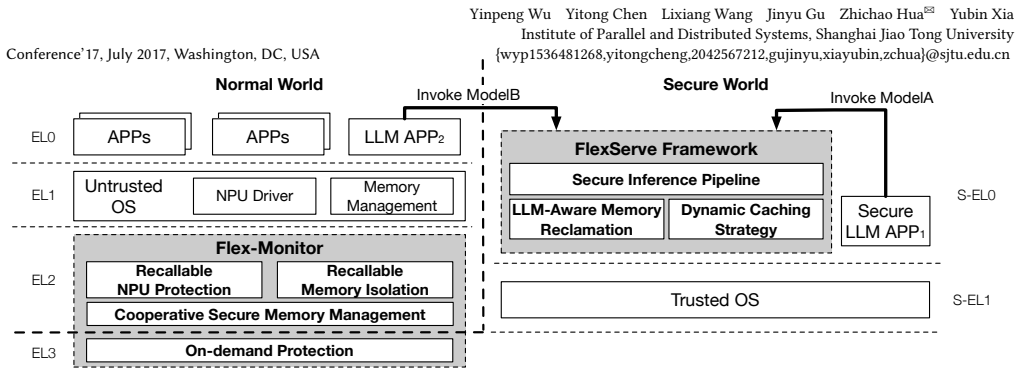
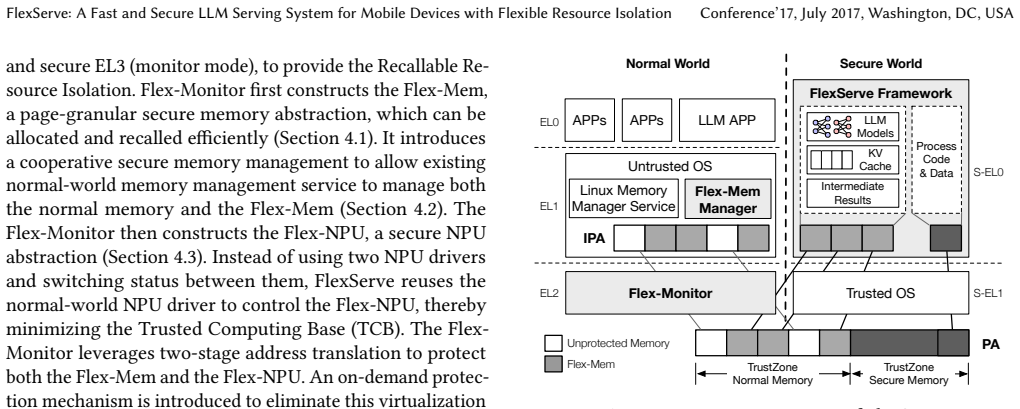
FlexServe presents Recallable Resource Isolation to construct Recallable Secure Memory (Flex-Mem) and Recallable Secure NPU (Flex-NPU). These resources remain accessible only to the secure world while the normal-world OS retains normal allocation and reclamation rights. The FlexServe Framework then coordinates with the normal OS for cooperative secure memory management during LLM inference, protecting both model weights and user data from kernel compromise.
What carries the argument
Recallable Resource Isolation, which separates access permission from management permission so the normal OS can handle allocation and reclamation without gaining read or write access.
If this is right
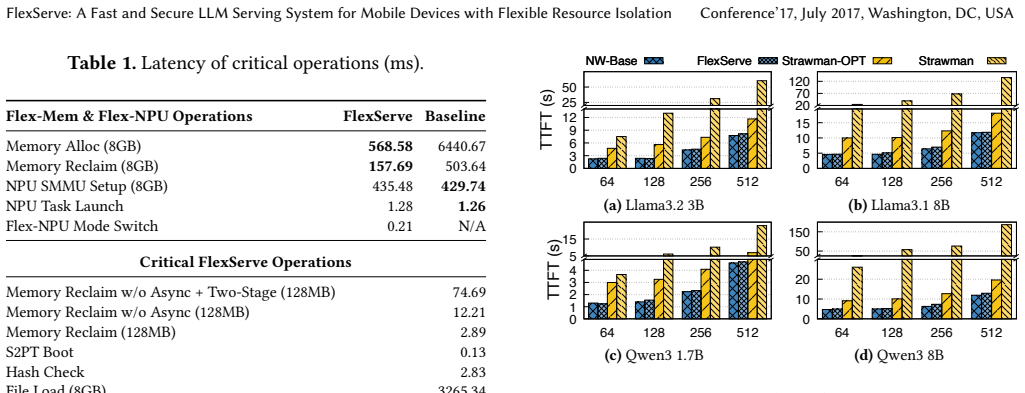
- Secure LLM inference runs with substantially lower time-to-first-token latency than prior TrustZone designs.
- The normal-world OS can manage secure resources at normal speed without impacting its own applications.
- Model weights and user data remain protected from kernel-level attackers throughout inference.
- Cooperative memory management between secure and normal worlds becomes feasible for other resource-heavy secure tasks.
Where Pith is reading between the lines
- The same decoupling pattern could apply to other on-device accelerators or memory pools beyond NPU.
- It may allow secure-world applications to scale to larger models without requiring dedicated hardware reservations.
- Similar permission separation might reduce overhead in other ARM TrustZone use cases such as secure storage or authentication.
- Adoption would shift the design focus from static isolation to dynamic, revocable resource control in mobile security.
Load-bearing premise
The normal-world OS can be trusted to allocate and reclaim secure resources correctly even when compromised, without any ability to read or tamper with their contents.
What would settle it
A test in which a compromised normal-world kernel reads the contents of Flex-Mem or issues unauthorized commands to Flex-NPU after the isolation mechanism is applied.
Figures
read the original abstract
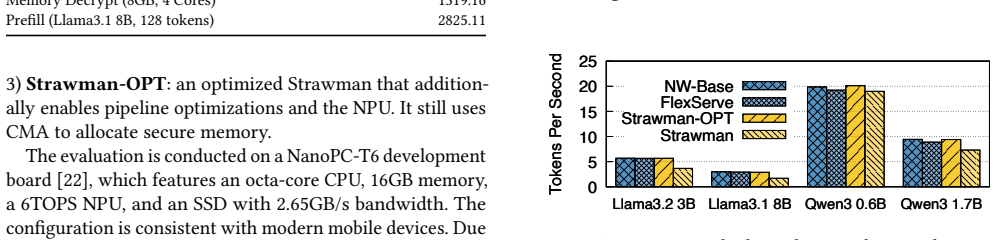
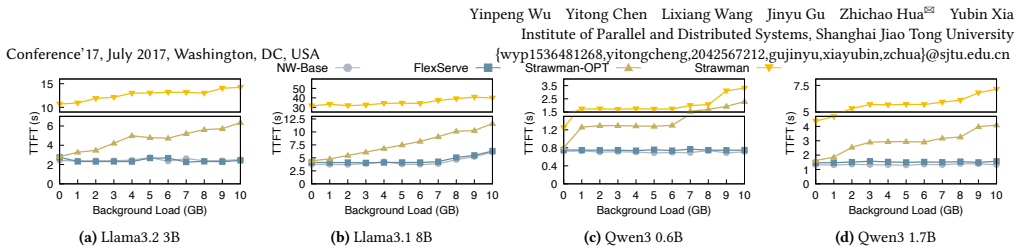
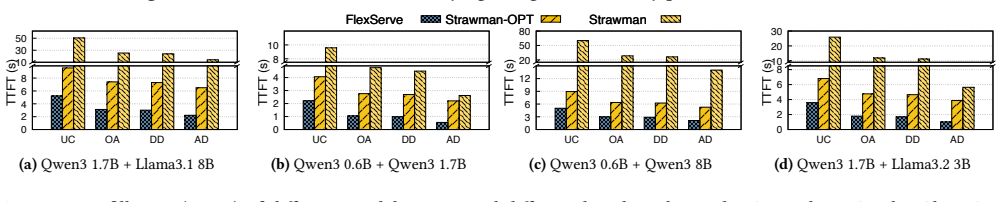
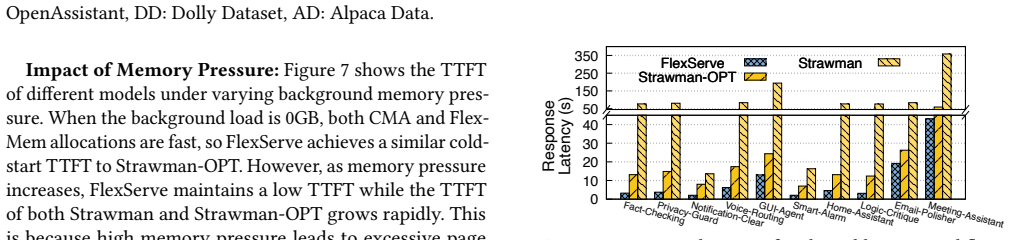
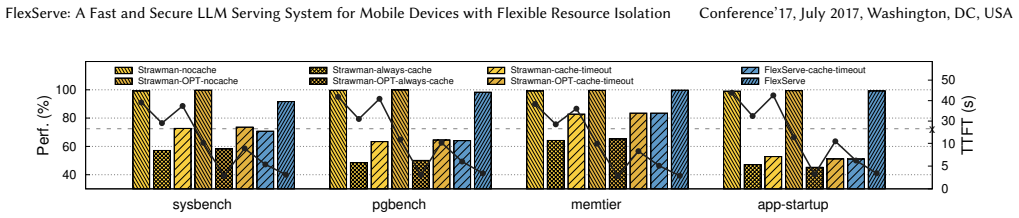
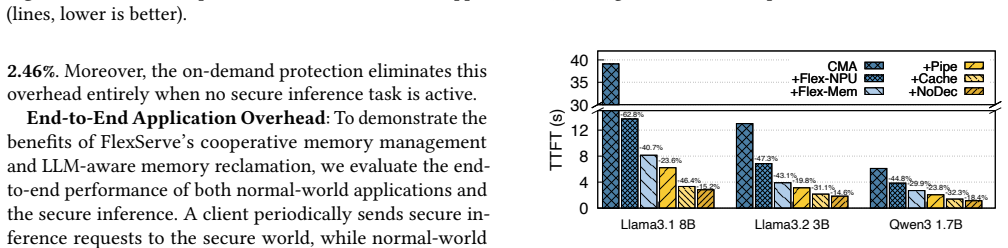
Device-side Large Language Models (LLMs) have grown explosively, offering stronger privacy and higher availability than their cloud-side counterparts. During LLM inference, both the model weights and the user data are valuable, and attackers may compromise the OS kernel to steal them. ARM TrustZone is the de facto hardware-based isolation technology on mobile devices, used to protect sensitive applications from a compromised OS. However, protecting LLM inference with TrustZone incurs significant overhead to both the secure inference and the normal aplications, due to two challenges: the inflexible resource isolation and the inefficient secure resource management. To address these challenges, this paper presents FlexServe, a fast and secure LLM inference system for mobile devices. The key idea is to decouple the access permission from the management permission of secure resources, so that the normal-world OS cannot access them but can still manage them as usual. First, FlexServe introduces a Recallable Resource Isolation mechanism to construct Recallable Secure Memory (Flex-Mem) and a Recallable Secure NPU (Flex-NPU). They can only be accessed by the secure world, but can be efficiently allocated and reclaimed by the normal-world OS. Based on them, FlexServe further introduces a FlexServe Framework to run secure LLM inference in the secure world. It works together with the normal-world OS to perform cooperative secure memory management. We implement a prototype of FlexServe and compare it with two TrustZone-based strawman designs. The results show that FlexServe achieves average TTFT speedups of 10.05X over the strawman and 2.44X over an optimized strawman.
Editorial analysis
A structured set of objections, weighed in public.
Referee Report
Summary. The manuscript claims to introduce FlexServe, a system for fast and secure LLM inference on mobile devices protected by ARM TrustZone. It proposes Recallable Resource Isolation to construct Flex-Mem and Flex-NPU, which decouple access permission (restricted to the secure world) from management permission (allowing the normal-world OS to allocate and reclaim them). This is said to overcome inflexible isolation and inefficient management in prior TrustZone uses for LLMs. A prototype is reported to achieve average TTFT speedups of 10.05X versus a basic strawman and 2.44X versus an optimized strawman.
Significance. If the claimed separation between access and management can be enforced without introducing new attack surfaces, the approach could meaningfully reduce the overhead of hardware-isolated LLM inference on resource-constrained mobile devices, improving the practicality of on-device models under a compromised-OS threat model. The performance numbers, if reproducible, would indicate a substantial improvement over existing TrustZone-based designs for this workload.
major comments (1)
- [Abstract] Abstract: The central security claim—that Flex-Mem and Flex-NPU 'can only be accessed by the secure world' while remaining 'efficiently allocated and reclaimed by the normal-world OS'—is stated without any description of the underlying hardware primitive, TrustZone memory-region configuration, NPU access-control mechanism, or secure-monitor call sequence that would prevent a compromised normal-world kernel from reading or tampering with the resources during reclamation. This mechanism is load-bearing for both the security argument and the relevance of the reported TTFT speedups.
Simulated Author's Rebuttal
We thank the referee for the constructive feedback. The point about the abstract's security claim is well-taken, and we address it directly below.
read point-by-point responses
-
Referee: [Abstract] Abstract: The central security claim—that Flex-Mem and Flex-NPU 'can only be accessed by the secure world' while remaining 'efficiently allocated and reclaimed by the normal-world OS'—is stated without any description of the underlying hardware primitive, TrustZone memory-region configuration, NPU access-control mechanism, or secure-monitor call sequence that would prevent a compromised normal-world kernel from reading or tampering with the resources during reclamation. This mechanism is load-bearing for both the security argument and the relevance of the reported TTFT speedups.
Authors: We agree that the abstract, as a high-level summary, does not include the low-level enforcement details. The manuscript body provides these descriptions (TrustZone memory region attributes set to secure-world only, NPU access control via secure-world ownership, and SMC sequences for allocation/reclamation that revoke normal-world access). However, to make the central claim self-contained in the abstract, we will revise it to briefly reference the hardware primitives and SMC-based reclamation protocol. This addresses the concern without altering the reported performance results. revision: yes
Circularity Check
No circularity; claims rest on measured speedups vs. strawmen, not derived equations or self-referential fits
full rationale
The abstract contains no equations, parameters, or derivation steps. The reported TTFT speedups (10.05X and 2.44X) are explicitly presented as results from a prototype implementation compared against two strawman designs. No self-citations, fitted inputs renamed as predictions, or ansatzes appear. The design description (decoupling access and management permissions via Recallable Resource Isolation) is a proposed mechanism whose correctness is left to implementation details outside the abstract; it does not reduce to a tautology or self-citation chain within the provided text.
Axiom & Free-Parameter Ledger
axioms (1)
- domain assumption ARM TrustZone provides a secure world that can be isolated from a compromised normal-world kernel
invented entities (2)
-
Recallable Secure Memory (Flex-Mem)
no independent evidence
-
Recallable Secure NPU (Flex-NPU)
no independent evidence
discussion (0)
Sign in with ORCID, Apple, or X to comment. Anyone can read and Pith papers without signing in.