REVIEW 3 major objections 5 minor 1 cited by
ActiveCheerios: 3D-Printed Marangoni-Driven Active Particles at an Interface
T0 review · 3 major / 5 minor · reviewed 2026-08-12 · deepseek-v4-flash
Pith's one-line read This paper argues that 3D-printed particles, powered by ethanol-driven Marangoni flow and guided by capillary Cheerios attraction, provide a tunable, low-cost platform for studying active matter at fluid interfaces.
desk verdict A robust, low-cost Marangoni-surfer platform with modular design; the particle-interaction claims need quantitative support or softer wording. read the letter →
The pith
A machine-rendered reading of the paper's core claim, the machinery that carries it, and where it could break.
The reading
What carries the argument
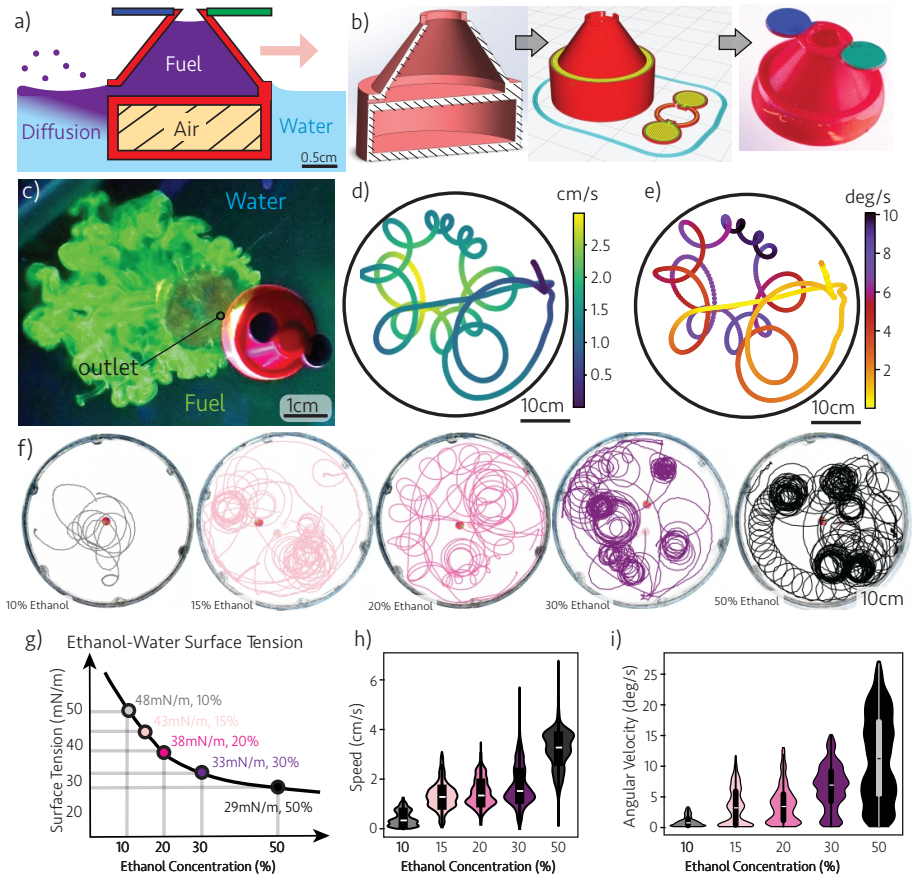
The central object is the 3D-printed 'ActiveCheerios' particle: a centimeter-scale buoy with an air-filled base, a conical ethanol-water fuel reservoir, and one or two sub-millimeter outlets positioned at the water line. Propulsion comes from the Marangoni effect—the fuel lowers the local surface tension, creating a gradient that produces thrust both by direct contact-line forcing and by Marangoni flow, with estimated speeds of order 1 cm/s. Interactions come from the Cheerios effect: the meniscus each hydrophilic particle deforms creates capillary attraction to other particles, while super-hydrophobic containment rings provide repulsive walls. The design space is explored via rapid 3D printing, which enables chiral outlet geometries (two tangential outlets for rotation) and rigid linkages between particles for modular constructs.
What would settle it
Place two active particles in a basin whose water has been pre-saturated with ethanol so no surface tension gradient can form; if the fueled particle still repels its neighbor, the repulsion is not Marangoni-driven and the interaction-control claim is falsified. Alternatively, measure the force-deflection curve between two particles with a calibrated force sensor: the claimed mechanism predicts a repulsive force that scales with ethanol concentration and a short-range attractive force whose magnitude matches the capillary Cheerios prediction.
Extended reading notes
Core claim
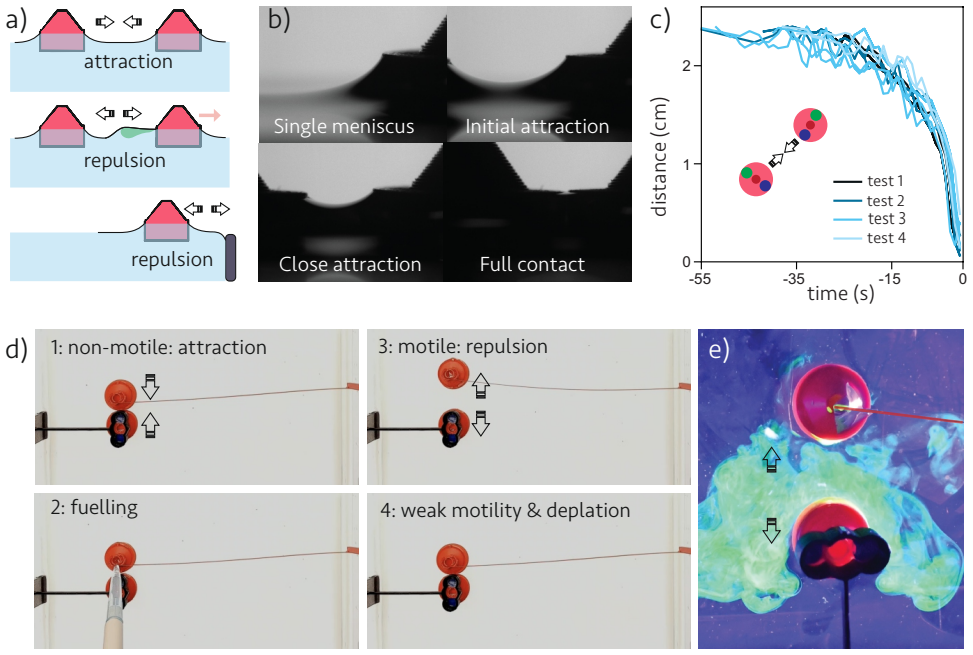
On the paper's own terms, the central discovery is that a single 3D-printed design—a buoyant body with a conical ethanol reservoir and a 500 µm outlet at the air-water interface—can serve as a versatile Marangoni surfer whose propulsion and interaction are both controlled by surface-tension-mediated forces. The authors demonstrate that the surface tension gradient set by ethanol concentration sets both the translational speed (order 1 cm/s) and the angular velocity (order 1–10 deg/s), with higher concentrations producing faster, more strongly spiraling motion. They further show that the same particles, when passive, attract via the Cheerios effect, so a fueled particle first repels a neighbor hydrodynamically and then, as its fuel depletes, is captured by capillary attraction; the assembly time grows with ethanol concentration. Finally, they use the modularity of 3D printing to construct chiral spinners and mechanically linked assemblies that execute prescribed trajectories (linear, curved, on-axis spin, off-axis spin), arguing that this platform opens a low-cost route to studying inertial active particles and collective interfacial dynamics.
Load-bearing premise
The claim that particle-particle interactions are controllable rests on the assumption that the repulsion between fueled particles is a Marangoni hydrodynamic effect and the later attraction is the capillary Cheerios force—forces the paper was unable to quantify directly.
Editorial extensions
If this is right
- Ethanol concentration gives a simple dial for motility: increasing concentration raises speed, angular velocity, and path curvature, and delays Cheerios-driven assembly.
- Two-particle and multi-particle experiments show a reproducible sequence of activity-driven repulsion followed by capillary attraction, with assembly time scaling with fuel concentration.
- Chiral particles convert Marangoni thrust into steady rotation, with angular speed controlled by ethanol concentration.
- Mechanically linked assemblies of single-outlet and chiral particles can produce programmed trajectories: linear translation, curved motion, on-axis spin, and off-axis spin.
- The system operates in an inertial regime (Re >> 1), offering a tabletop window into inertial active matter and collective dynamics such as active crystals and weak self-avoidance.
Reading between the lines
- An implication the authors leave implicit is that the same 3D-printed platform could be used to screen particle designs systematically, with optimization or machine learning over outlet geometry, fuel viscosity, and surface chemistry, rather than trial and error.
- The unquantified repulsive force could be resolved by repeating the cantilever experiment with a stiffer, calibrated sensor or by particle-image velocimetry of the flow between two particles; if the repulsion persists in a basin pre-saturated with ethanol vapor, it would confirm a hydrodynamic rather than chemical signature.
- The modular linkage concept hints at a route toward programmable, reconfigurable interfacial robots whose trajectory is set by the orientation of fueled and unfueled modules, a consequence the authors note only as an outlook for 'adaptive, multifunctional devices.'
- The authors' observation of weak self-avoidance at high ethanol concentration suggests a testable bridge to memory-dependent active matter models (e.g., billiards with spatial memory), where the particle's past path modifies its future dynamics.
Editorial analysis
A structured set of objections, weighed in public.
Referee Report
Summary. The manuscript introduces 3D-printed, ethanol-fueled Marangoni particles that self-propel at an air-water interface. Single-outlet particles exhibit roughly ballistic, spinning motion, and the reported translational speed and angular velocity increase with ethanol concentration, consistent with a larger surface-tension gradient. The paper further claims that particle-particle interactions can be controlled by combining Marangoni-driven repulsion with the capillary 'Cheerios' attraction, and presents two- and many-body assembly experiments, chiral particles, and rigidly linked modular assemblies with programmed trajectories. Appendix C gives order-of-magnitude propulsion estimates, and appendices report contact-angle and viscosity-control experiments.
Significance. If the interaction-control claim were quantitatively established, this would be a valuable frugal platform for studying inertial active matter, chiral motion, and interfacial self-assembly. The paper's strengths are the accessible 3D-printing workflow, the direct flow visualization, the reproducible ethanol-concentration trends in motility, the chiral and modular demonstrations, and the parameter-free order-of-magnitude propulsion estimate. However, the central claim of controlled particle-particle interactions rests on an attribution of long-range attraction to the Cheerios effect that is neither quantitatively measured nor reconciled with the exponential range of lateral capillary forces. The propulsion and modular-design results are likely to stand on their own, but the interaction and self-assembly conclusions require substantial additional support or a significant weakening of the claims.
major comments (3)
- [Section III, Fig. 2c] The statement that the Cheerios effect was observed for initial separations of 4-10 cm is not quantitatively supported and is in tension with the exponential range of lateral capillary forces. With an air-water capillary length of about 2.7 mm, the lateral capillary force between two small floating objects at separations of 15-37 capillary lengths is expected to be exponentially small, far below the level needed to move centimeter-scale particles at the rates shown. The manuscript provides no force-distance measurement at these separations and no control experiment that excludes a background meniscus from the hydrophobic containment ring, surface contamination, or evaporation-driven flows. Because 'controlled particle-particle interactions' is a central claim, the authors should either provide quantitative force data at the reported separations or substantially restrict the Cheerios claim to the short-range contact regime demonstrated in Fig. 2d.
- [Section III, cantilever measurements] The authors explicitly state that the cantilever measurements were 'insufficient to quantify the propulsion and attraction force values' and describe the repulsion as 'likely indicating a force vector.' This means that the repulsive interaction between active particles is inferred from a cantilever deflection rather than quantified. Since the paper claims controlled repulsion between active particles, the absence of any quantitative force data leaves open alternative explanations such as ethanol-driven surface flows, contamination, and wall-mediated flows. A concrete test would be to measure cantilever deflection as a function of separation and to compare with a passive particle advected by an externally imposed surface flow; without such a control, the Marangoni-repulsion mechanism is not established.
- [Section III, Fig. 3] The multi-body assembly experiments are performed in a 15 cm containment ring with particles released adjacent to one another. As particles slow down, the ring strongly confines them, so the observed 'assembly' may partly reflect boundary-induced accumulation and momentum rather than a controlled capillary attraction. The paper does not compare the measured approach dynamics in the multi-particle experiments with single-particle trajectory statistics in the same ring, nor does it vary the ring size to demonstrate that assembly is due to mutual attraction. To support the self-assembly claim, the authors should quantify the approach dynamics relative to a passive or single-active-particle baseline and demonstrate that assembly occurs reproducibly across different confinements.
minor comments (5)
- [Appendix E, Fig. V.3] There is a typo: 'hen using 50 % glycerine - 50 % ethanol' should read 'When using 50 % glycerine - 50 % ethanol.'
- [Fig. 4d] The y-axis label of Fig. 4d reads 'trans. Speed (deg/s)' although the text describes angular speed; the label and units should be corrected to avoid confusion.
- [Section II, Fig. 1h-i] The text says that n = 3 trajectories are shown for each ethanol concentration, but the speed and angular velocity distributions in Fig. 1h-i appear to be aggregates; please specify the number of particles, the total tracked time, and the binning procedure used to produce these distributions.
- [Section II, containment ring] The statement that the ring is removed and replaced after each test, 'however with the largest ring (45 cm) the ring is left in place,' leaves unclear whether ethanol accumulates in the large-ring experiments; please clarify how surface contamination is controlled for the long-time measurements.
- [Appendix C] After balancing the two propulsion mechanisms, the text concludes that 'we estimate Marangoni flow stresses play a more pronounced role,' but this estimate is not quantified; either provide a quantitative comparison of the two force contributions or state this as an assumption.
Circularity Check
No significant circularity: propulsion and interaction claims rest on external data, external literature, and unscaled order-of-magnitude estimates, not on fitted inputs or load-bearing self-citation.
full rationale
This is an experimental characterization paper, and its derivation chain does not reduce to its own inputs. Motility is obtained by direct tracking; surface-tension values are adopted from an external reference (Vazquez et al. [39]); the propulsion estimates in Appendix C are order-of-magnitude force balances that involve no parameters fitted to the reported speeds; and the Cheerios-effect attribution is justified by external literature (Vella & Mahadevan [38], Nicolson [46], Ho et al. [48]), not by a self-citation. The paper explicitly concedes that force measurements were 'insufficient to quantify the propulsion and attraction force values,' which weakens the mechanistic attribution of interactions but is a limitation, not a circular step. Self-citations [17] and [55] appear in introductory or concluding context as peripheral examples and are not load-bearing for any central claim. No equation or parameter is defined in terms of the quantity it purports to predict, and no fitted input is renamed as a prediction. The skeptical concern about the plausibility of the capillary Cheerios force at separations of 4-10 cm is a physical-correctness issue rather than a circularity of the paper's argument.
Assumptions & free parameters
assumptions (4)
- domain assumption Surface tension of the ethanol-water fuel mixture follows the literature values of Vazquez et al. [39], and the resulting gradient is the main control of propulsion.
- domain assumption The hydrophobic ring coating prevents attractive particle-wall interactions, so the containment ring behaves as a repulsive wall.
- ad hoc to paper Marangoni flow stresses dominate propulsion, estimated by balancing surface-tension gradients over scales L approximately Dp and a thin-layer height H approximately Dn.
- domain assumption In active two-body systems, Cheerios capillary attraction dominates when fuel is depleted, while Marangoni hydrodynamic flows dominate while active.
Cite this review
Pith. "Pith review of ActiveCheerios: 3D-Printed Marangoni-Driven Active Particles at an Interface." pith.science (2026). https://pith.science/paper/5RKIUTAW
@misc{pith2026241116011,
  author       = {Pith},
  title        = {Pith review of: ActiveCheerios: 3D-Printed Marangoni-Driven Active Particles at an Interface},
  year         = {2026},
  howpublished = {\url{https://pith.science/paper/5RKIUTAW}},
  note         = {Machine review of arXiv:2411.16011}
}
read the original abstract
Marangoni surfers are simple, cost-effective tabletop experiments that, despite their simplicity, exhibit rich dynamics and collective behaviors driven by physicochemical mechanisms, hydrodynamic interactions, and inertial motion. This work introduces self-propelled particles designed and manufactured through 3D printing to move on the air-water interface. We develop particles with tunable motility and controlled particle-particle interactions by leveraging surface tension-mediated forces, such as the Marangoni effect for propulsion and the Cheerios effect for interactions. Rapid prototyping through 3D printing facilitates the exploration of a wide design space, enabling precise control over particle shape and function. We exemplify this by creating translational and chiral particles. Additionally, we investigate self-assembly in this system and highlight its potential for modular designs where mechanically linked particles with varying characteristics follow outlined trajectories. This research offers a flexible, low-cost approach to designing active interfacial systems and opens new possibilities for further advancements of adaptive, multifunctional devices.
Figures

Figures from the paper (1 more)

Forward citations
Cited by 1 Pith paper
-
Propulsion and interaction of wave-propelled interfacial particles
A review of wave-propelled interfacial particles, describing how self-generated capillary waves drive motion and long-range interactions.
Reference graph
Works this paper leans on
-
[1]
Bioinspired aquatic microrobot capable of walking on water surface like a water strider
X. Zhang, J. Zhao, Q. Zhu, N. Chen, M. Zhang, and Q. Pan, “Bioinspired aquatic microrobot capable of walking on water surface like a water strider”, ACS applied materials & interfaces 3, 2630–2636 (2011)
work page 2011
-
[2]
Bio-inspired micro/mini propulsion at air-water interface: a review
J. Yuan and S. K. Cho, “Bio-inspired micro/mini propulsion at air-water interface: a review”, Journal of mechanical science and technology 26, 3761–3768 (2012)
work page 2012
-
[3]
How can interfacial phenomena in nature inspire smaller robots
D. Feldmann, R. Das, and B.-E. Pinchasik, “How can interfacial phenomena in nature inspire smaller robots”, Advanced Materials Interfaces 8, 2001300 (2021)
work page 2021
-
[4]
Surferbot: a wave-propelled aquatic vibrobot
E. Rhee, R. Hunt, S. J. Thomson, and D. M. Harris, “Surferbot: a wave-propelled aquatic vibrobot”, Bioinspiration & Biomimetics 17, 055001 (2022)
work page 2022
-
[5]
Capillary surfers: wave-driven particles at a vibrating fluid interface
I. Ho, G. Pucci, A. U. Oza, and D. M. Harris, “Capillary surfers: wave-driven particles at a vibrating fluid interface”, Physical Review Fluids 8, L112001 (2023)
work page 2023
-
[6]
Small-scale robots inspired by aquatic interfacial biolocomotion
D. Kim, C. J. Park, J.-S. Koh, and J. Ha, “Small-scale robots inspired by aquatic interfacial biolocomotion”, MRS Bulletin 49, 148–158 (2024)
work page 2024
-
[7]
C. W. Shields and O. D. Velev, “The Evolution of Active Particles: Toward Externally Powered Self-Propelling and Self- Reconfiguring Particle Systems”, en, Chem 3, 539–559 (2017)
work page 2017
-
[8]
X. Dong and M. Sitti, “Controlling two-dimensional collective formation and cooperative behavior of magnetic microrobot swarms”, en, The International Journal of Robotics Research 39, 617–638 (2020)
work page 2020
Show all 55 references
-
[9]
Walking on Water: Biolocomotion at the Interface
J. W. Bush and D. L. Hu, “Walking on Water: Biolocomotion at the Interface”, en, Annual Review of Fluid Mechanics 38, 339–369 (2006)
2006
-
[10]
Active colloids on fluid interfaces
J. Deng, M. Molaei, N. G. Chisholm, T. Yao, A. Read, and K. J. Stebe, “Active colloids on fluid interfaces”, Current Opinion in Colloid & Interface Science 61, 101629 (2022)
2022
-
[11]
Self-propulsion on liquid surfaces
V. Pimienta and C. Antoine, “Self-propulsion on liquid surfaces”, Current opinion in colloid & interface science 19, 290–299 (2014)
2014
-
[12]
The marangoni effects
L. Scriven and C. Sternling, “The marangoni effects”, Nature 187, 186–188 (1960)
1960
-
[13]
Xlii. on certain curious motions observable at the surfaces of wine and other alcoholic liquors
J. Thomson, “Xlii. on certain curious motions observable at the surfaces of wine and other alcoholic liquors”, The London, Edinburgh, and Dublin Philosophical Magazine and Journal of Science 10, 330–333 (1855)
-
[14]
Marangoni, Sull’espansione delle goccie d’un liquido galleggianti sulla superfice di altro liquido (Fratelli Fusi, 1865)
C. Marangoni, Sull’espansione delle goccie d’un liquido galleggianti sulla superfice di altro liquido (Fratelli Fusi, 1865)
-
[15]
Tuning active emulsion dynamics via surfactants and topology
S. Thutupalli and S. Herminghaus, “Tuning active emulsion dynamics via surfactants and topology”, The European Physical Journal E 36, 1–10 (2013)
2013
-
[16]
Microscale Marangoni Surfers
K. Dietrich, N. Jaensson, I. Buttinoni, G. Volpe, and L. Isa, “Microscale Marangoni Surfers”, en, Physical Review Letters 125, arXiv:2005.06811 [cond-mat], 098001 (2020)
2020 arXiv
-
[17]
Emergence of Bimodal Motility in Active Droplets
B. V. Hokmabad, R. Dey, M. Jalaal, D. Mohanty, M. Almukambetova, K. A. Baldwin, D. Lohse, and C. C. Maass, “Emergence of Bimodal Motility in Active Droplets”, en, Physical Review X 11, 011043 (2021)
2021
-
[18]
Active spheres induce marangoni flows that drive collective dynamics
M. Wittmann, M. N. Popescu, A. Dom´ ınguez, and J. Simmchen, “Active spheres induce marangoni flows that drive collective dynamics”, The European Physical Journal E 44, 1–11 (2021)
2021
-
[19]
Kolmogorovian Active Turbulence of a Sparse Assembly of Interacting Marangoni Surfers
M. Bourgoin, R. Kervil, C. Cottin-Bizonne, F. Raynal, R. Volk, and C. Ybert, “Kolmogorovian Active Turbulence of a Sparse Assembly of Interacting Marangoni Surfers”, en, Physical Review X 10, 021065 (2020)
2020
-
[20]
Self-propulsion of symmetric chemically active particles: point-source model and experiments on camphor disks
D. Boniface, C. Cottin-Bizonne, R. Kervil, C. Ybert, and F. Detcheverry, “Self-propulsion of symmetric chemically active particles: point-source model and experiments on camphor disks”, Physical Review E 99, 062605 (2019)
2019
-
[21]
Dynamical Quorum Sensing in Non-Living Active Matter
Y. Matsuda, K. Ikeda, Y. Ikura, H. Nishimori, and N. J. Suematsu, “Dynamical Quorum Sensing in Non-Living Active Matter”, en, Journal of the Physical Society of Japan 88, 093002 (2019)
2019
-
[22]
Two floating camphor particles interacting through lateral capillary force
Y. Hirose, Y. Yasugahira, M. Okamoto, Y. Koyano, H. Kitahata, M. Nagayama, and Y. Sumino, “Two floating camphor particles interacting through lateral capillary force”, en, Journal of the Physical Society of Japan 89, arXiv:1909.00545 [cond-mat, physics:nlin], 074004 (2020)
2020 arXiv
-
[23]
Acceleration or deceleration of self-motion by the marangoni effect
Y. Matsuda, N. J. Suematsu, H. Kitahata, Y. S. Ikura, and S. Nakata, “Acceleration or deceleration of self-motion by the marangoni effect”, Chemical Physics Letters 654, 92–96 (2016). 11
2016
-
[24]
Collective behavior of camphor floats migrating on the water surface
H. Nishimori, N. J. Suematsu, and S. Nakata, “Collective behavior of camphor floats migrating on the water surface”, Journal of the Physical Society of Japan 86, 101012 (2017)
2017
-
[25]
Marangoni effect inspired robotic self-propulsion over a water surface using a flow-imbibition-powered microfluidic pump
B. Kwak, S. Choi, J. Maeng, and J. Bae, “Marangoni effect inspired robotic self-propulsion over a water surface using a flow-imbibition-powered microfluidic pump”, en, Scientific Reports 11, 17469 (2021)
2021
-
[26]
Pen-drawn marangoni swimmer
S. W. Song, S. Lee, J. K. Choe, A. C. Lee, K. Shin, J. Kang, G. Kim, H. Yeom, Y. Choi, S. Kwon, et al. , “Pen-drawn marangoni swimmer”, Nature Communications 14, 3597 (2023)
2023
-
[27]
The effect of shape on the motion and stability of marangoni surfers
S. Sur, N. Uvanovic, H. Masoud, and J. P. Rothstein, “The effect of shape on the motion and stability of marangoni surfers”, Journal of fluids engineering 143, 011301 (2021)
2021
-
[28]
Easy demonstration of the marangoni effect by prolonged and directional motion:“soap boat 2.0
C. Renney, A. Brewer, and T. J. Mooibroek, “Easy demonstration of the marangoni effect by prolonged and directional motion:“soap boat 2.0””, Journal of Chemical Education 90, 1353–1357 (2013)
2013
-
[29]
A remotely controlled marangoni surfer
M. L. Timm, S. J. Kang, J. P. Rothstein, and H. Masoud, “A remotely controlled marangoni surfer”, Bioinspiration & biomimetics 16, 066014 (2021)
2021
-
[30]
Electric field control of propulsion force of a boat driven by chemical marangoni effect
S. Tsuchitani, T. Ikebe, H. Miki, and K. Kikuchi, “Electric field control of propulsion force of a boat driven by chemical marangoni effect”, Colloids and Surfaces A: Physicochemical and Engineering Aspects 592, 124570 (2020)
2020
-
[31]
How to capture active marangoni surfers
I. Tiwari and P. Parmananda, “How to capture active marangoni surfers”, Soft Matter 19, 2710–2715 (2023)
2023
-
[32]
Easy Demonstration of the Marangoni Effect by Prolonged and Directional Motion: “Soap Boat 2.0
C. Renney, A. Brewer, and T. J. Mooibroek, “Easy Demonstration of the Marangoni Effect by Prolonged and Directional Motion: “Soap Boat 2.0””, en, Journal of Chemical Education 90, 1353–1357 (2013)
2013
-
[33]
Molecular engine boat
D. Ivanov and S. Nikolov, “Molecular engine boat”, en, Physics Education 54, 045006 (2019)
2019
-
[34]
Biomimicry and the culinary arts
L. J. Burton, N. Cheng, C. Vega, J. Andr´ es, and J. W. M. Bush, “Biomimicry and the culinary arts”, en, Bioinspiration & Biomimetics 8, 044003 (2013)
2013
-
[35]
Inertial effects on trapped active matter
L. L. Gutierrez-Martinez and M. Sandoval, “Inertial effects on trapped active matter”, The Journal of Chemical Physics 153 (2020)
2020
-
[36]
Inertial active matter with coulomb friction
A. P. Antonov, L. Caprini, A. Ldov, C. Scholz, and H. L¨ owen, “Inertial active matter with coulomb friction”, Physical Review Letters 133, 198301 (2024)
2024
-
[37]
Small fire ant rafts are unstable
H. Ko, M. Hadgu, K. Komilian, and D. L. Hu, “Small fire ant rafts are unstable”, Physical Review Fluids 7, 090501 (2022)
2022
-
[38]
The “Cheerios effect
D. Vella and L. Mahadevan, “The “Cheerios effect””, en, American Journal of Physics 73, 817–825 (2005)
2005
-
[39]
Surface Tension of Alcohol Water + Water from 20 to 50 .degree.C
G. Vazquez, E. Alvarez, and J. M. Navaza, “Surface Tension of Alcohol Water + Water from 20 to 50 .degree.C”, en, Journal of Chemical & Engineering Data 40, 611–614 (1995)
1995
-
[40]
Dynamic aggregation of chiral spinners
B. A. Grzybowski and G. M. Whitesides, “Dynamic aggregation of chiral spinners”, Science 296, 718–721 (2002)
2002
-
[41]
Memory of elastic collisions drives high minority spin and oscillatory entropy in underdamped chiral spinners
S. Li, T. V. Phan, G. Wang, R. Khuri, J. W. Wilson, R. H. Austin, and L. Liu, “Memory of elastic collisions drives high minority spin and oscillatory entropy in underdamped chiral spinners”, Communications Physics 7, 136 (2024)
2024
-
[42]
Bidirectional wave-propelled capillary spinners
J.-W. Barotta, S. J. Thomson, L. F. Alventosa, M. Lewis, and D. M. Harris, “Bidirectional wave-propelled capillary spinners”, Communications Physics 6, 87 (2023)
2023
-
[43]
Surfactants and rotelles in active chiral fluids
C. Scholz, A. Ldov, T. P¨ oschel, M. Engel, and H. L¨ owen, “Surfactants and rotelles in active chiral fluids”, en, Science Advances 7, eabf8998 (2021)
2021
-
[44]
The OpenCV Library
G. Bradski, “The OpenCV Library”, Dr. Dobb’s Journal of Software Tools (2000)
2000
-
[45]
D. B. Allan, T. Caswell, N. C. Keim, C. M. van der Wel, and R. W. Verweij, Soft-matter/trackpy: v0.6.1, version v0.6.1, Feb. 2023
2023
-
[46]
The interaction between floating particles
M. Nicolson, “The interaction between floating particles”, in Mathematical proceedings of the cambridge philosophical society, Vol. 45, 2 (Cambridge University Press, 1949), pp. 288–295
1949
-
[47]
Capillary assembly of colloids: interactions on planar and curved interfaces
I. B. Liu, N. Sharifi-Mood, and K. J. Stebe, “Capillary assembly of colloids: interactions on planar and curved interfaces”, Annual Review of Condensed Matter Physics 9, 283–305 (2018)
2018
-
[48]
Direct measurement of capillary attraction between floating disks
I. Ho, G. Pucci, and D. M. Harris, “Direct measurement of capillary attraction between floating disks”, Physical Review Letters 123, 254502 (2019)
2019
-
[49]
Motile bacteria at oil–water interfaces: pseudomonas aeruginosa
J. Deng, M. Molaei, N. G. Chisholm, and K. J. Stebe, “Motile bacteria at oil–water interfaces: pseudomonas aeruginosa”, Langmuir 36, 6888–6902 (2020)
2020
-
[50]
Swashing motility: a novel propulsion-independent mechanism for surface migration in salmonella and e. coli
J. Panich, E. M. Dudebout, N. Wadhwa, and D. F. Blair, “Swashing motility: a novel propulsion-independent mechanism for surface migration in salmonella and e. coli”, bioRxiv (2024)
2024
-
[51]
As above, so below, and also in between: mesoscale active matter in fluids
D. Klotsa, “As above, so below, and also in between: mesoscale active matter in fluids”, Soft matter 15, 8946–8950 (2019)
2019
-
[52]
Fast-moving bacteria self-organize into active two-dimensional crystals of rotating cells
A. P. Petroff, X.-L. Wu, and A. Libchaber, “Fast-moving bacteria self-organize into active two-dimensional crystals of rotating cells”, Physical review letters 114, 158102 (2015)
2015
-
[53]
Odd dynamics of living chiral crystals
T. H. Tan, A. Mietke, J. Li, Y. Chen, H. Higinbotham, P. J. Foster, S. Gokhale, J. Dunkel, and N. Fakhri, “Odd dynamics of living chiral crystals”, en, Nature 607, 287–293 (2022)
2022
-
[54]
Self-avoidant memory effects on enhanced diffusion in a stochastic model of environmentally responsive swimming droplets
K. Daftari and K. A. Newhall, “Self-avoidant memory effects on enhanced diffusion in a stochastic model of environmentally responsive swimming droplets”, Physical Review E 105, 024609 (2022)
2022
-
[55]
Billiards with spatial memory
T. Albers, S. Delnoij, N. Schramma, and M. Jalaal, “Billiards with spatial memory”, Physical Review Letters 132, 157101 (2024). 12
2024
Reviewed August 12, 2026 · model on record in the stance chip above.
Discussion (0). Continue with ORCID to comment.