REVIEW 3 major objections 7 minor 18 references
Fairness-Aware Process Mining
T0 review · 3 major / 7 minor · reviewed 2026-08-14 · deepseek-v4-flash
Pith's one-line read The paper claims that treating the obvious cause as a sensitive attribute and removing its statistical link to the problem yields a fair decision tree for process root-cause analysis, at a small accuracy cost.
desk verdict A useful first mapping of fairness onto process mining, but the fairness guarantee is about labels, not rules, and the experiments are too thin to clinch the accuracy tradeoff. read the letter →
The pith
A machine-rendered reading of the paper's core claim, the machinery that carries it, and where it could break.
The reading
What carries the argument
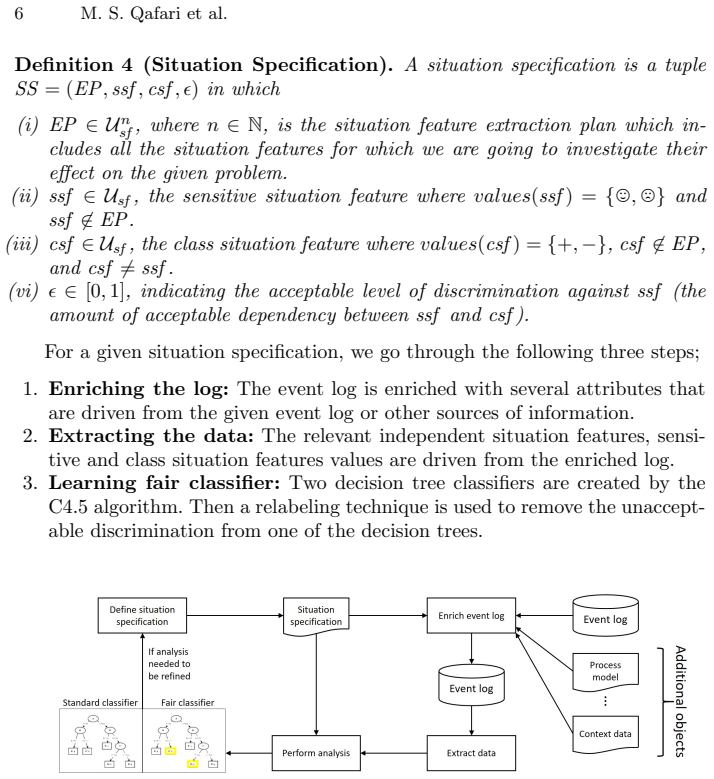
The mechanism is a two-tree workflow over a situation feature table. A situation is a trace or a trace prefix ending at the event of interest, and for each independent feature the value taken is the one occurring closest in time to the class event. A standard decision tree is built from this table, then leaves are relabeled; leaves are ordered by the ratio of discrimination removed to accuracy lost, and labels are flipped until the demographic-parity gap falls below epsilon. This relabeling is what removes the sensitive attribute's statistical association with the class while letting other features structure the tree.
What would settle it
Create a synthetic event log with known ground truth in which the true cause of a delay is the first occurrence of a feature, not the occurrence closest to the delay; run the method. If the fair tree does not identify the true cause, the temporal-proximity extraction rule is false and the central claim fails for that class of processes.
Extended reading notes
Core claim
The core claim, on the paper's own terms, is that a fair classifier can be constructed for process-mining root-cause analysis, and that doing so removes unacceptable discrimination against a sensitive situation feature while retaining as much accuracy as possible. The method defines a situation as a trace or a trace prefix ending at a target event, extracts a situation feature table by taking, for each feature, the value temporally closest to the class event, and then builds a standard decision tree plus a fair decision tree whose leaves are relabeled, by an approximate knapsack solution, until the demographic-parity difference between sensitive and favorable groups falls below a threshold epsilon. The authors validate this on two real event logs—a hospital billing log and a building-permit receipt log—using artificially injected discrimination with known ground truth; in their charts the fair tree consistently brings discrimination below epsilon, and in one conformance case it is even more accurate than the standard tree.
Load-bearing premise
The extraction rule assumes that the occurrence of an independent feature closest in time to the problem event is the one that most affects the outcome; if an earlier occurrence is the true cause, the data table misrepresents the process and the fair tree's rules will not be trustworthy.
Editorial extensions
If this is right
- A fair classifier can replace the standard decision tree in root-cause analysis, so process analysts can inspect rules that no longer load blame onto the sensitive group.
- The trade-off curve gives a principled way to choose the acceptable discrimination level epsilon: lower epsilon buys more fairness at higher accuracy cost, and the cost grows with the level of discrimination already in the data.
- Because the method removes dependency rather than deleting attributes, it handles proxy attributes that would otherwise smuggle the sensitive information back into the tree.
- In some cases, such as one conformance setting on the hospital log, the fair tree is more accurate than the standard tree, so fairness need not always cost accuracy.
- The situation-specification framework generalizes the same fairness treatment to any binary sensitive attribute, including non-demographic 'obvious cause' attributes such as resource workload.
Reading between the lines
- A natural extension the paper leaves implicit is repurposing the same masking machinery as a general 'what-if' tool: treat any dominant cause as the sensitive attribute to reveal secondary causes, not just for demographic fairness.
- The binary-sensitive and binary-class assumption limits applicability; extending to multi-valued or continuous sensitive attributes with a multi-group demographic parity measure is a direct next step, though the paper does not report such experiments.
- The temporal-proximity extraction rule could be tested against causal-inference baselines; if it fails on logs with feedback loops, the method could be repaired by incorporating causal discovery from event logs rather than relying on closest-in-time occurrence.
Signed reviews
Editorial analysis
A structured set of objections, weighed in public.
Referee Report
Summary. This paper introduces a framework for fairness-aware process mining. Given an event log, a Petri-net model, and a situation specification (independent situation features, a sensitive attribute, a binary class attribute representing the process problem, and a discrimination threshold), the method enriches the log, extracts a situation feature table, trains a C4.5/J48 decision tree, and then relabels leaves using a variant of the discrimination-aware relabeling technique of Kamiran et al. to reduce the demographic-parity discrimination measure below a threshold epsilon. The approach is implemented as a ProM plug-in and evaluated on two real event logs (receipt process and hospital billing) with artificially injected discrimination, measuring the trade-off between discrimination and accuracy. The paper claims that the resulting fair decision tree provides non-discriminatory root-cause diagnoses and can reveal less obvious causes of process problems.
Significance. If the central claim were fully established, this would be a useful first step toward introducing fairness considerations into process mining, an area where the authors correctly note no prior work exists. The formalization of situations and situation features is a reasonable adaptation of attribute-value data extraction from event logs, and the implementation as a ProM plug-in is a concrete, reusable artifact. The paper also honestly reports an accuracy-fairness trade-off and notes that the fair tree can sometimes outperform the standard tree. However, the significance is currently limited by a gap between the formal fairness guarantee (demographic parity of predicted labels) and the paper's broader claim of non-discriminatory root-cause diagnoses, as well as by an experimental evaluation that lacks statistical grounding. The contribution is more of an application of known discrimination-aware decision-tree methods to a new domain than a new fairness method.
major comments (3)
- [Section 1, Section 3 (Definition 6 and relabeling), Appendix A] The paper's central claim is that the fair decision tree provides non-discriminatory root-cause diagnoses (Section 1, 'Our Results'; Section 5). However, the fairness guarantee implemented in Section 3 is demographic parity of the predicted labels, as measured by the disc formula with class(pi_EP(inst)) in place of pi_csf(inst). The relabeling loop changes leaf labels until the discrimination of the classifier falls below epsilon, so the low discrimination of the fair tree is a direct consequence of the stopping criterion. This says nothing about whether the individual rules—the actual output for root-cause analysis—are free of proxy attributes for the sensitive group. A tree can satisfy aggregate demographic parity while a specific rule is heavily populated by sensitive-group instances, as the Appendix A example itself shows: a rule covering 9 sensitive, delayed situations is relabeled to 'on-time'. The interpretation that these situations 'would have been delayed even if they had been favorable' (Appendix A, final paragraph) is not supported by the relabeling procedure, which only balances group rates and establishes no counterfactual. The empirical evaluation in Figure 3 measures discrimination and accuracy of the classifier, not the discrimination content of the extracted rules. The claim about fair root-cause diagnoses is therefore not established by the presented evidence.
- [Section 4, Figure 3] The experimental evaluation consists of a single 60/40 train/test split for each scenario, with no error bars, no cross-validation, and no repeated trials. The description of how discrimination was artificially injected into the logs is omitted, making it impossible to assess whether the injected discrimination resembles realistic proxy correlations. The quantitative claims in the abstract ('we decreased the discrimination... while losing a small fraction of its accuracy') and the qualitative trend in Figure 3 (accuracy loss increases with data discrimination) are not supported with any statistical confidence. At minimum, the authors should report averaged results with standard deviations over multiple random splits or cross-validation folds, and should describe the discrimination injection procedure in detail.
- [Section 3, 'Extracting the data', rule 2] The data extraction rule 'the value of the independent situation feature with the closest occurrence time to the occurrence of csf must be collected' is justified by the assumption that the temporally closest feature value has the most causal effect on the class attribute. This is a strong, untested causality assumption. If a feature value occurring earlier in the trace is the actual driver of the outcome (for example, a resource assignment made at case start, or a deadline set days before the delay occurs), the extracted situation feature table will misrepresent the process and the decision-tree rules will not be trustworthy as root-cause diagnoses. The paper states the assumption but does not discuss its validity, conditions under which it might fail, or any sensitivity analysis. Since root-cause diagnosis is the paper's motivating application, this assumption should be explicitly flagged as a limitation with concrete failure scenarios.
minor comments (7)
- [Section 2, Definition 4] The list of tuple components uses '(vi)' for the fourth item; it should be '(iv)'.
- [Section 2, Definition 5] The text 'csf, ssf in U_ssf' uses the subscript 'ssf' where the universe of situation features is denoted 'U_sf' elsewhere; please make the notation consistent.
- [Section 4, Figure 3 caption] The caption contains an incomplete sentence: 'the yellow color curve exhibits, and, the green color curve exhibits the accuracy of the fair tree.' It should specify that the yellow curve is the accuracy of the standard tree.
- [Section 4, paragraph after Figure 3] The text says 'Chart (e) and chart (f) show the results ... conformance problem', but since charts (a)-(c) are the receipt process and (d)-(f) are hospital billing, the conformance results should be charts (c) and (f).
- [References] References [6] and [7] are the same paper (Hardt et al., 'Equality of opportunity in supervised learning') listed twice with the same bibliographic details; one should be removed or replaced with the correct source.
- [Appendix A, paragraph 2] There is a typo: 'we did not use te values of sftrace,responsible' should read 'the values'.
- [Section 4, Figure 4 caption] The caption mentions both 'purple' and 'pink' for the epsilon curve; the colors should be identified consistently.
Circularity Check
No circularity found: the fairness threshold is an enforced post-condition, while the accuracy trade-off and extracted rules are empirical outputs.
full rationale
The low discrimination reported for the fair trees is not a prediction or a first-principles derivation; it is the termination condition of the relabeling loop. The paper is transparent that leaves are relabeled 'until the discrimination in the classifier tree is lower than ϵ' (Section 3), and the experiments use a 60/40 train/test split, so the accuracy figures and the concrete rule content in Figure 6 are genuine empirical outputs. The fairness measure itself (demographic parity) is adopted from the external reference [10], and the relabeling method is explicitly credited to that same work, so there is no self-citation chain carrying the central argument. The only self-cited item, [14], is used for formal definitions of derived attributes and is not load-bearing. The assumption that the temporally closest occurrence has the most effect is an explicit modeling choice, not a result derived from the data. The Appendix's counterfactual interpretation of relabeled leaves ('would have been delayed even if they had been favorable') goes beyond what demographic parity establishes, but that is an overinterpretation or validity concern rather than a circular reduction of the output to the input. The paper even notes the limitation that restricted relabeling can leave discrimination close to epsilon, indicating the threshold is not being presented as an empirical discovery. Accordingly, no circular step is exhibited.
Assumptions & free parameters
free parameters (2)
- epsilon (acceptable discrimination threshold) =
0.05 in experiments
- delay threshold in appendix example =
2 percent of maximum trace duration
assumptions (5)
- ad hoc to paper The independent situation feature with the closest occurrence time to the class situation feature has the most effect on its value.
- domain assumption Class and sensitive attributes are binary (+, - and favorable, sensitive).
- domain assumption Demographic parity is the appropriate notion of fairness for process mining root cause analysis.
- standard math Event logs have unique events with unique timestamps.
- domain assumption The relabeling technique from Kamiran et al. (2010) preserves the usefulness of the decision tree for root cause analysis.
invented entities (3)
-
situation
-
situation feature
-
situation feature extraction plan
Cite this review
Pith. "Pith review of Fairness-Aware Process Mining." pith.science (2026). https://pith.science/paper/5RWZ3F4K
@misc{pith2026190811451,
  author       = {Pith},
  title        = {Pith review of: Fairness-Aware Process Mining},
  year         = {2026},
  howpublished = {\url{https://pith.science/paper/5RWZ3F4K}},
  note         = {Machine review of arXiv:1908.11451}
}
read the original abstract
Process mining is a multi-purpose tool enabling organizations to improve their processes. One of the primary purposes of process mining is finding the root causes of performance or compliance problems in processes. The usual way of doing so is by gathering data from the process event log and other sources and then applying some data mining and machine learning techniques. However, the results of applying such techniques are not always acceptable. In many situations, this approach is prone to making obvious or unfair diagnoses and applying them may result in conclusions that are unsurprising or even discriminating (e.g., blaming overloaded employees for delays). In this paper, we present a solution to this problem by creating a fair classifier for such situations. The undesired effects are removed at the expense of reduction on the accuracy of the resulting classifier. We have implemented this method as a plug-in in ProM. Using the implemented plug-in on two real event logs, we decreased the discrimination caused by the classifier, while losing a small fraction of its accuracy.
Figures


Figures from the paper (3 more)


Reference graph
Works this paper leans on
-
[1]
arXiv preprint arXiv:1903.10598 (2019)
Aghaei, S., Azizi, M.J., Vayanos, P.: Learning optimal and fair decision trees for non-discriminative decision-making. arXiv preprint arXiv:1903.10598 (2019)
arXiv 2019
-
[2]
Sociological Methods & Research p
Berk, R., Heidari, H., Jabbari, S., Kearns, M., Roth, A.: Fairness in criminal jus- tice risk assessments: The state of the art. Sociological Methods & Research p. 0049124118782533 (2018)
work page 2018
-
[3]
In: Proceedings of the 30th International Conference on Neural Information Pro- cessing Systems
Bolukbasi, T., Chang, K.W., Zou, J., Saligrama, V., Kalai, A.: Man is to com- puter programmer as woman is to homemaker? debiasing word embeddings. In: Proceedings of the 30th International Conference on Neural Information Pro- cessing Systems. pp. 4356–4364. NIPS’16, Curran Associates Inc., USA (2016), http://dl.acm.org/citation.cfm?id=3157382.3157584
arXiv 2016
-
[4]
In: Proceedings of the 3rd Innovations in Theoretical Computer Science Conference
Dwork, C., Hardt, M., Pitassi, T., Reingold, O., Zemel, R.: Fairness through awareness. In: Proceedings of the 3rd Innovations in Theoretical Computer Science Conference. pp. 214–226. ITCS ’12, ACM, New York, NY, USA (2012). https://doi.org/10.1145/2090236.2090255, http://doi.acm.org/10.1145/ 2090236.2090255
arXiv 2012
-
[5]
Fani Sani, M., van der Aalst, W., Bolt Irondo, A., Garc´ ıa-Algarra, J.: Subgroup discovery in process mining. In: Abramowicz, W. (ed.) Business Information Sys- tems. pp. 237–252. Lecture Notes in Business Information Processing, Springer, Germany (2017). https://doi.org/10.1007/978-3-319-59336-4 17
-
[7]
In: Proceedings of the 30th International Conference on Neural Information Processing Systems
Hardt, M., Price, E., Srebro, N.: Equality of opportunity in supervised learning. In: Proceedings of the 30th International Conference on Neural Information Processing Systems. pp. 3323–3331. NIPS’16, Curran Associates Inc., USA (2016), http:// dl.acm.org/citation.cfm?id=3157382.3157469
-
[8]
Kamiran, F., Calders, T.: Classification with no discrimination by preferential sam- pling. In: Informal proceedings of the 19th Annual Machine Learning Conference of Belgium and The Netherlands (Benelearn’10, Leuven, Belgium, May 27-28, 2010). pp. 1–6 (2010)
work page 2010
-
[9]
Knowledge and Information Systems 33(1), 1–33 (Oct 2012)
Kamiran, F., Calders, T.: Data preprocessing techniques for classification with- out discrimination. Knowledge and Information Systems 33(1), 1–33 (Oct 2012). https://doi.org/10.1007/s10115-011-0463-8, https://doi.org/10.1007/ s10115-011-0463-8
Show all 18 references
-
[10]
In: Proceedings of the 2010 IEEE International Conference on Data Mining
Kamiran, F., Calders, T., Pechenizkiy, M.: Discrimination aware decision tree learning. In: Proceedings of the 2010 IEEE International Conference on Data Mining. pp. 869–874. ICDM ’10, IEEE Computer Society, Washington, DC, USA (2010). https://doi.org/10.1109/ICDM.2010.50, htt...
2010 doi
-
[11]
SIGMETRICS Perform
Kleinberg, J.: Inherent trade-offs in algorithmic fairness. SIGMETRICS Perform. Eval. Rev. 46(1), 40–40 (Jun 2018). https://doi.org/10.1145/3292040.3219634, http://doi.acm.org/10.1145/3292040.3219634
2018
-
[12]
In: Guyon, I., Luxburg, U.V., Bengio, S., Wallach, H., Fergus, R., Vishwanathan, S., Garnett, R
Kusner, M.J., Loftus, J., Russell, C., Silva, R.: Counterfactual fairness. In: Guyon, I., Luxburg, U.V., Bengio, S., Wallach, H., Fergus, R., Vishwanathan, S., Garnett, R. (eds.) Advances in Neural Information Processing Systems 30. pp. 4066–4076. Curran Associates, Inc. (2017...
2017
-
[13]
46–50 (2014)
Leemans, S., Fahland, D., Aalst, van der, W.: Process and deviation exploration with inductive visual miner pp. 46–50 (2014)
2014
-
[14]
de Leoni, M., van der Aalst, W.M., Dees, M.: A general process mining framework for correlating, predicting and clustering dynamic behavior based on event logs. Inf. Syst. 56(C), 235–257 (Mar 2016). https://doi.org/10.1016/j.is.2015.07.003, https: //doi.org/10.1016/j.is.2015.07.003
2016 doi
-
[15]
In: Proceedings of the 8th International Symposium on Data- driven Process Discovery and Analysis (SIMPDA 2018), Seville, Spain, December 13-14, 2018
Rafiei, M., von Waldthausen, L., van der Aalst, W.M.P.: Ensuring confidentiality in process mining. In: Proceedings of the 8th International Symposium on Data- driven Process Discovery and Analysis (SIMPDA 2018), Seville, Spain, December 13-14, 2018. pp. 3–17 (2018), http://ceur...
2018
-
[16]
In: Dustdar, S., Fiadeiro, J.L., Sheth, A.P
Rozinat, A., van der Aalst, W.M.P.: Decision mining in ProM. In: Dustdar, S., Fiadeiro, J.L., Sheth, A.P. (eds.) Business Process Management. pp. 420–425. Springer Berlin Heidelberg, Berlin, Heidelberg (2006)
2006
-
[17]
In: Proceedings of the 26th International Confer- ence on World Wide Web
Zafar, M.B., Valera, I., Gomez Rodriguez, M., Gummadi, K.P.: Fairness be- yond disparate treatment & disparate impact: Learning classification with- out disparate mistreatment. In: Proceedings of the 26th International Confer- ence on World Wide Web. pp. 1171–1180. WWW ’17, Int...
2017
-
[18]
In: Proceedings of the 30th International Conference on International Confer- ence on Machine Learning - Volume 28
Zemel, R., Wu, Y., Swersky, K., Pitassi, T., Dwork, C.: Learning fair representa- tions. In: Proceedings of the 30th International Conference on International Confer- ence on Machine Learning - Volume 28. pp. III–325–III–333. ICML’13, JMLR.org (2013), http://dl.acm.org/citatio...
2013
-
[19]
Zliobaite, I.: A survey on measuring indirect discrimination in machine learning. arXiv preprint arXiv:1511.00148 (2015) Fairness-Aware Process Mining 15 A Example To demonstrate how creating a fair classifier may affect the results of the root cause analysis in a given process,...
2015 arXiv
Reviewed August 14, 2026 · model on record in the stance chip above.
Discussion (0). Continue with ORCID to comment.