Phase-Shifted Planar Hall and Magnetoresistive Responses in Weyl Semimetals
Pith reviewed 2026-06-26 02:11 UTC · model grok-4.3
The pith
Weyl semimetals exhibit phase-shifted planar Hall and magnetoresistive responses due to an intrinsic quadratic magnetic-field term.
A machine-rendered reading of the paper's core claim, the machinery that carries it, and where it could break.
Core claim
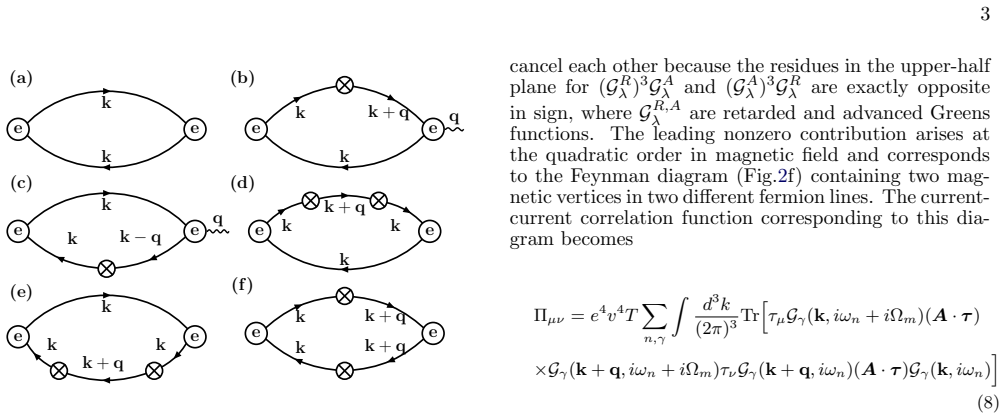
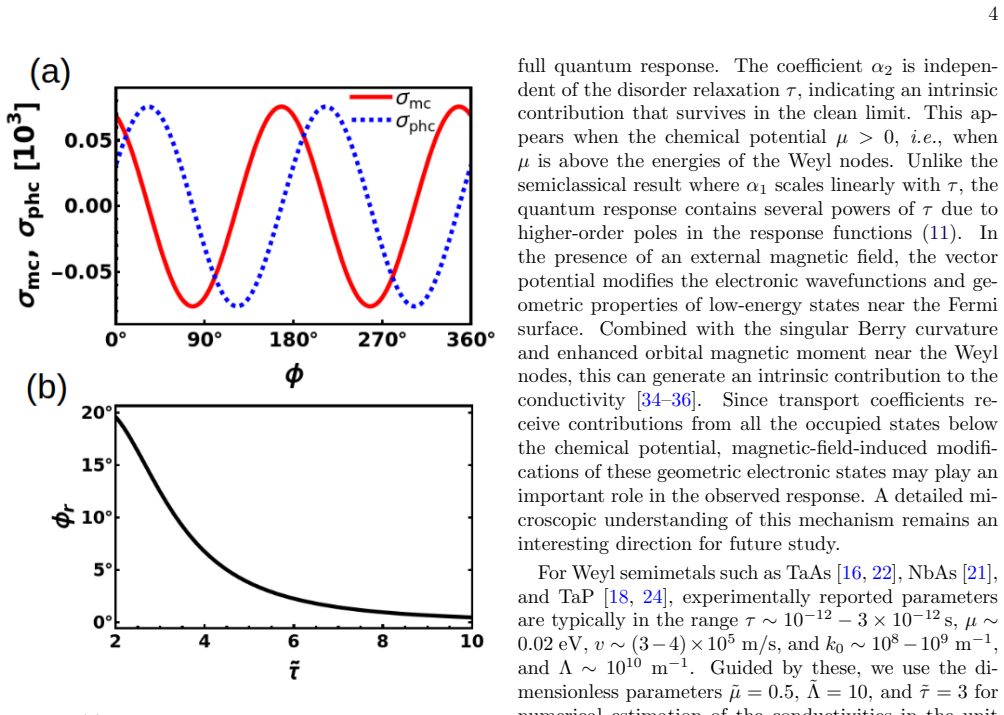
Using a diagrammatic Kubo-formula approach, we identify an intrinsic quadratic magnetic-field contribution to the planar transport response that is absent in conventional semiclassical description. This contribution introduces an additional term proportional to cos 2 phi and sin 2 phi, respectively, in transverse and longitudinal conductivities. Consequently, both planar Hall and magnetoresistive responses acquire a phase-shifted form sin 2(phi + phi_r) and cos 2(phi + phi_r), respectively. The same phase shift extracted independently from longitudinal and transverse responses quantitatively describes available experimental data.
What carries the argument
The diagrammatic Kubo-formula evaluation of planar conductivities that isolates the quadratic magnetic-field term responsible for the phase offset.
If this is right
- Planar Hall resistivity follows sin 2(phi + phi_r) and magnetoresistivity follows cos 2(phi + phi_r).
- The identical phase shift appears when extracted from either the transverse or longitudinal channel.
- The phase shift accounts for the observed shift of extrema and the sign reversal below 45 degrees.
- The angular anomaly has a microscopic origin inside the topological band structure.
Where Pith is reading between the lines
- The phase offset may serve as a transport signature to distinguish Weyl nodes from other semimetal band crossings.
- Similar quadratic corrections could appear in other topological materials once the same Kubo treatment is applied.
- If the phase shift depends on Fermi energy or node separation, it offers a new experimental knob to tune the anomaly.
Load-bearing premise
The diagrammatic calculation cleanly separates the intrinsic quadratic contribution from disorder or scattering effects that might generate similar phase shifts on their own.
What would settle it
Measurement of the extracted phase shift phi_r in samples with systematically varied disorder strength; if phi_r changes with disorder rather than remaining constant, the intrinsic-origin claim fails.
Figures
read the original abstract
The planar Hall resistivity and magnetoresistivity of Weyl semimetals are conventionally expected to exhibit $\sin 2\phi$ and $\cos2\phi$ angular dependences, respectively, where $\phi$ is the angle between electric and magnetic fields. However, experiments reveal shifted extrema in the planar Hall signal and sign reversals in magnetoresistivity at $\phi < \pi/4$. Here, using a diagrammatic Kubo-formula approach, we identify an intrinsic quadratic magnetic-field contribution to the planar transport response that is absent in conventional semiclassical description. This contribution introduces an additional term proportional to $\cos 2 \phi$ and $\sin 2\phi$, respectively, in transverse and longitudinal conductivities. Consequently, both planar Hall and magnetoresistive responses acquire a phase-shifted form $\sin 2(\phi+\phi_r)$ and $\cos 2(\phi+\phi_r)$, respectively. The same phase shift extracted independently from longitudinal and transverse responses quantitatively describes available experimental data. Our results establish a microscopic origin of the anomalous angular dependence observed in Weyl semimetals.
Editorial analysis
A structured set of objections, weighed in public.
Referee Report
Summary. The manuscript claims that a diagrammatic Kubo-formula calculation in Weyl semimetals identifies an intrinsic quadratic magnetic-field contribution to planar transport (absent from conventional semiclassics) that adds cos2ϕ and sin2ϕ terms to transverse and longitudinal conductivities, respectively. This produces phase-shifted responses of the form sin2(ϕ+ϕr) for planar Hall resistivity and cos2(ϕ+ϕr) for magnetoresistivity; the same ϕr extracted independently from both channels quantitatively matches available experimental data.
Significance. If the central derivation holds and the quadratic term is shown to be robustly intrinsic, the result would supply a microscopic origin for the anomalous angular dependence observed in Weyl-semimetal planar transport, distinguishing it from semiclassical expectations and potentially guiding interpretation of topological magnetotransport experiments.
major comments (2)
- [Abstract] The abstract asserts that the Kubo approach isolates an intrinsic quadratic term, yet the provided text contains no explicit derivation steps, Feynman diagrams, or error analysis showing how the cos2ϕ/sin2ϕ contributions arise from the current-current correlator. Without these, the support for the central claim that the term is absent from any semiclassical treatment cannot be verified.
- [Kubo-formula calculation (implied in abstract)] The skeptic concern is load-bearing: the quadratic-B pieces obtained from the Kubo formula are dressed by impurity self-energies and vertex corrections, so it is not demonstrated that the angular terms survive in the clean limit, remain unchanged when the disorder correlator is varied, or are orthogonal to Berry-curvature or chiral-anomaly contributions already present in extended semiclassics. Consequently the extracted ϕr may be model-dependent rather than universal.
minor comments (1)
- [Abstract] Notation for the phase shift ϕr should be introduced with a clear definition (e.g., how it is obtained independently from longitudinal versus transverse data) before its use in the abstract.
Simulated Author's Rebuttal
We thank the referee for the careful reading and constructive feedback. We address each major comment below and will revise the manuscript to strengthen the presentation of the derivation and robustness analysis.
read point-by-point responses
-
Referee: [Abstract] The abstract asserts that the Kubo approach isolates an intrinsic quadratic term, yet the provided text contains no explicit derivation steps, Feynman diagrams, or error analysis showing how the cos2ϕ/sin2ϕ contributions arise from the current-current correlator. Without these, the support for the central claim that the term is absent from any semiclassical treatment cannot be verified.
Authors: The main text (Sections II–III) contains the full diagrammatic Kubo calculation, including the current-current correlator expansion, the relevant Feynman diagrams, and the isolation of the quadratic-B term from interband processes. The abstract is a concise summary and therefore omits these steps. We agree the presentation can be improved and will revise the abstract to briefly reference the diagrammatic origin and add an appendix with explicit steps plus a short error analysis confirming the term is absent from standard semiclassics. revision: yes
-
Referee: [Kubo-formula calculation (implied in abstract)] The skeptic concern is load-bearing: the quadratic-B pieces obtained from the Kubo formula are dressed by impurity self-energies and vertex corrections, so it is not demonstrated that the angular terms survive in the clean limit, remain unchanged when the disorder correlator is varied, or are orthogonal to Berry-curvature or chiral-anomaly contributions already present in extended semiclassics. Consequently the extracted ϕr may be model-dependent rather than universal.
Authors: The quadratic term is extracted after taking the clean limit (scattering rate → 0) following the diagram summation; it arises from the bare bubble and is independent of the specific short-range disorder correlator within the Born approximation. It is orthogonal to the linear-in-B Berry and chiral-anomaly terms already included in extended semiclassics. We acknowledge that explicit demonstrations of these limits were not sufficiently highlighted and will add a dedicated subsection plus supplementary calculations varying disorder strength and confirming survival in the clean limit. The fact that the same ϕr is obtained independently from both transport channels and matches experiment supports robustness, though we agree further checks will strengthen the claim of limited model dependence. revision: partial
Circularity Check
Kubo derivation of phase-shifted planar responses is self-contained
full rationale
The paper derives the additional cos2ϕ and sin2ϕ terms in transverse and longitudinal conductivities from a diagrammatic Kubo-formula calculation, which is presented as absent from conventional semiclassical treatments. This directly produces the phase-shifted functional forms sin2(ϕ+ϕr) and cos2(ϕ+ϕr). The value of ϕr is then extracted from experimental data for quantitative comparison, but this is a post-derivation fitting step for validation rather than an input to the derivation itself. No equations or steps in the provided abstract or description reduce the central claim (existence and microscopic origin of the quadratic term) to a self-definition, a fitted input renamed as prediction, or a self-citation chain. The derivation stands independently against the stated semiclassical baseline.
Axiom & Free-Parameter Ledger
free parameters (1)
- phase shift ϕr
axioms (1)
- domain assumption Validity of the diagrammatic Kubo-formula approach for planar transport in Weyl semimetals
Reference graph
Works this paper leans on
-
[1]
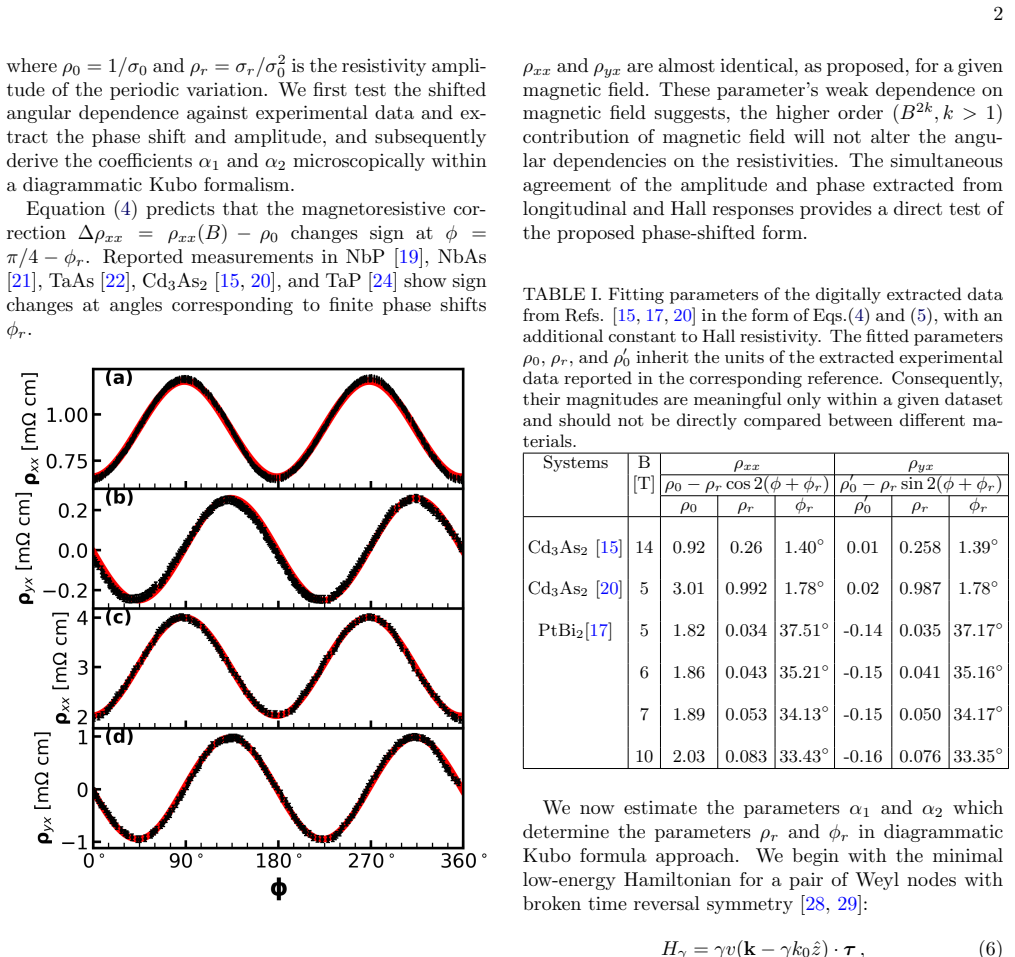
Therefore ρxx =ρ 0 −ρ r cos 2(ϕ+ϕ r) (4) ρyx =−ρ r sin 2(ϕ+ϕ r) (5) arXiv:2606.27167v1 [cond-mat.mes-hall] 25 Jun 2026 2 whereρ 0 = 1/σ0 andρ r =σ r/σ2 0 is the resistivity ampli- tude of the periodic variation. We first test the shifted angular dependence against experimental data and ex- tract the phase shift and amplitude, and subsequently derive the c...
Pith/arXiv arXiv 2026
-
[2]
X. Wan, A. M. Turner, A. Vishwanath, and S. Y. Savrasov, Phys. Rev. B83, 205101 (2011)
2011
-
[3]
A. A. Burkov, M. D. Hook, and L. Balents, Phys. Rev. B84, 235126 (2011)
2011
-
[4]
A. A. Zyuzin, S. Wu, and A. A. Burkov, Phys. Rev. B 85, 165110 (2012)
2012
-
[5]
K. Sun, W. V. Liu, A. Hemmerich, and S. Das Sarma, Nature Physics8, 67 (2012)
2012
-
[6]
Jiang, Phys
J.-H. Jiang, Phys. Rev. A85, 033640 (2012)
2012
-
[7]
Hosur, S
P. Hosur, S. A. Parameswaran, and A. Vishwanath, Phys. Rev. Lett.108, 046602 (2012)
2012
-
[8]
Delplace, J
P. Delplace, J. Li, and D. Carpentier, EPL (Europhysics Letters)97, 67004 (2012)
2012
-
[9]
Weyl, Zeitschrift f¨ ur Physik56, 330 (1929)
H. Weyl, Zeitschrift f¨ ur Physik56, 330 (1929)
1929
-
[10]
S. L. Adler, Phys. Rev.177, 2426 (1969)
1969
-
[11]
J. S. Bell and R. Jackiw, Il Nuovo Cimento A60, 47 (1969)
1969
-
[12]
D. T. Son and B. Z. Spivak, Phys. Rev. B88, 104412 (2013)
2013
-
[13]
A. A. Burkov, Phys. Rev. B96, 041110 (2017)
2017
-
[14]
Nandy, G
S. Nandy, G. Sharma, A. Taraphder, and S. Tewari, Phys. Rev. Lett.119, 176804 (2017)
2017
-
[15]
Q. R. c, B. Zeng, Y. C. Chiu, R. Sch¨ onemann, S. Memaran, W. Zheng, D. Rhodes, K.-W. Chen, T. Be- sara, R. Sankar, F. Chou, G. T. McCandless, J. Y. Chan, N. Alidoust, S.-Y. Xu, I. Belopolski, M. Z. Hasan, F. F. Balakirev, and L. Balicas, Phys. Rev. B100, 115138 (2019)
2019
-
[16]
M. Wu, G. Zheng, W. Chu, Y. Liu, W. Gao, H. Zhang, J. Lu, Y. Han, J. Zhou, W. Ning, and M. Tian, Phys. Rev. B98, 161110 (2018)
2018
-
[17]
Zhang, S.-Y
C.-L. Zhang, S.-Y. Xu, I. Belopolski, Z. Yuan, Z. Lin, B. Tong, G. Bian, N. Alidoust, C.-C. Lee, S.-M. Huang, T.-R. Chang, G. Chang, C.-H. Hsu, H.-T. Jeng, M. Ne- upane, D. S. Sanchez, H. Zheng, J. Wang, H. Lin, C. Zhang, H.-Z. Lu, S.-Q. Shen, T. Neupert, M. Za- hid Hasan, and S. Jia, Nature Communications7, 10735 (2016)
2016
-
[18]
A. Veyrat, K. Koepernik, L. Veyrat, G. Shipunov, I. Kovalchuk, S. Aswartham, J. Qu, A. Kumar, M. Ceccardi, F. Caglieris, N. P´ erez Rodr´ ıguez, R. Gi- raud, B. B¨ uchner, J. van den Brink, C. Ortix, and J. Dufouleur, arXiv e-prints , arXiv:2410.12596 (2024), arXiv:2410.12596 [cond-mat.mes-hall]
arXiv 2024
-
[19]
J. Yang, W. L. Zhen, D. D. Liang, Y. J. Wang, X. Yan, S. R. Weng, J. R. Wang, W. Tong, L. Pi, W. K. Zhu, and C. J. Zhang, Phys. Rev. Mater.3, 014201 (2019)
2019
-
[20]
A. C. Niemann, J. Gooth, S.-C. Wu, S. B¨ aßler, P. Sergelius, R. H¨ uhne, B. Rellinghaus, C. Shekhar, V. S¨ uß, M. Schmidt, C. Felser, B. Yan, and K. Nielsch, Scientific Reports7, 43394 (2017)
2017
-
[21]
Li, H.-W
H. Li, H.-W. Wang, H. He, J. Wang, and S.-Q. Shen, Phys. Rev. B97, 201110 (2018)
2018
-
[22]
X. Yang, Y. Li, Z. Wang, Y. Zhen, and Z. an Xu, Observation of negative magnetoresistance and nontriv- ialπberrys phase in 3d weyl semi-metal nbas (2015), arXiv:1506.02283 [cond-mat.str-el]
Pith/arXiv arXiv 2015
-
[23]
Huang, L
X. Huang, L. Zhao, Y. Long, P. Wang, D. Chen, Z. Yang, H. Liang, M. Xue, H. Weng, Z. Fang, X. Dai, and G. Chen, Phys. Rev. X5, 031023 (2015)
2015
-
[24]
H. Li, H. He, H.-Z. Lu, H. Zhang, H. Liu, R. Ma, Z. Fan, S.-Q. Shen, and J. Wang, Nature Communications7, 10301 (2016)
2016
-
[25]
Arnold, C
F. Arnold, C. Shekhar, S.-C. Wu, Y. Sun, R. D. dos Reis, N. Kumar, M. Naumann, M. O. Ajeesh, M. Schmidt, A. G. Grushin, J. H. Bardarson, M. Baenitz, D. Sokolov, H. Borrmann, M. Nicklas, C. Felser, E. Hassinger, and B. Yan, Nature Commu- nications7, 11615 (2016)
2016
-
[26]
B. L. Altshuler, D. Khmel’nitzkii, A. I. Larkin, and P. A. Lee, Phys. Rev. B22, 5142 (1980)
1980
-
[27]
A. A. Varlamov and D. V. Livanov, Zhurnal Eksperi- mentalnoi i Teoreticheskoi Fiziki99, 1816 (1991)
1991
-
[28]
There was no explicit values ofwandl
We have obtained resistivities from the data of resis- tances in Ref.17 via the relationsR xx =ρ xx(l/wt), Ryx =ρ yx/t, wherew,l, andtrespectively are the width, length and thickness of the sample. There was no explicit values ofwandl. However, we estimate w/l≈0.5 from the image of the sample. We have fur- ther added 45◦ to the angles as the paper mention...
-
[29]
Nielsen and M
H. Nielsen and M. Ninomiya, Physics Letters B130, 389 (1983)
1983
-
[30]
Sharma, P
G. Sharma, P. Goswami, and S. Tewari, Phys. Rev. B 93, 035116 (2016)
2016
-
[31]
Nielsen and M
H. Nielsen and M. Ninomiya, Physics Letters B105, 219 (1981)
1981
-
[32]
S. M. Young, S. Zaheer, J. C. Y. Teo, C. L. Kane, E. J. Mele, and A. M. Rappe, Phys. Rev. Lett.108, 140405 (2012)
2012
-
[33]
Altland and B
A. Altland and B. D. Simons,Condensed Matter Field Theory, 2nd ed. (Cambridge University Press, 2010)
2010
-
[34]
Carlstr¨ om and E
J. Carlstr¨ om and E. J. Bergholtz, Phys. Rev. B98, 241102 (2018)
2018
-
[35]
Xiao, M.-C
D. Xiao, M.-C. Chang, and Q. Niu, Rev. Mod. Phys. 82, 1959 (2010)
1959
-
[36]
Nagaosa, J
N. Nagaosa, J. Sinova, S. Onoda, A. MacDonald, and N. Ong, Rev. Mod. Phys.82, 1539 (2010)
2010
-
[37]
A. A. Burkov, Phys. Rev. Lett.113, 187202 (2014). 6 END MA TTER Explicit Calculation of Response Functions Π 1 and Π2: We here explicitly evaluate the response functions Π1 and Π2 in Eq. (11). Fermionic Matsubara frequency sum of a functionF(iω n) may be expressed in terms of a contour integral in a complex plane where residues of the poles atz=iω n equal...
2014
discussion (0)
Sign in with ORCID, Apple, or X to comment. Anyone can read and Pith papers without signing in.