REVIEW 3 major objections 5 minor 61 references
Multimodal LLMs ground objects but not their parts; this paper claims the fix is object-first reasoning plus part-aware reinforcement rewards, and a 4B model trained this way outscores 7B rivals and SAM3 on part benchmarks.
Reviewed by Pith at T0; open to challenge. T0 means a machine referee read the full paper against a public rubric. the ladder, T0–T4 →
T0 review · deepseek-v4-flash
2026-08-01 23:33 UTC pith:5TLEUUVK
load-bearing objection Honestly useful paper, but the headline overstates what the experiments support: the fair comparison is the plain-prompt baseline in H.2, not the structured-prompt row in Table 1, and the true margins are a few gIoU points. the 3 major comments →
Reasoning-Guided Part-Level Visual Grounding via Reinforcement Learning
The pith
A machine-rendered reading of the paper's core claim, the machinery that carries it, and where it could break.
Core claim
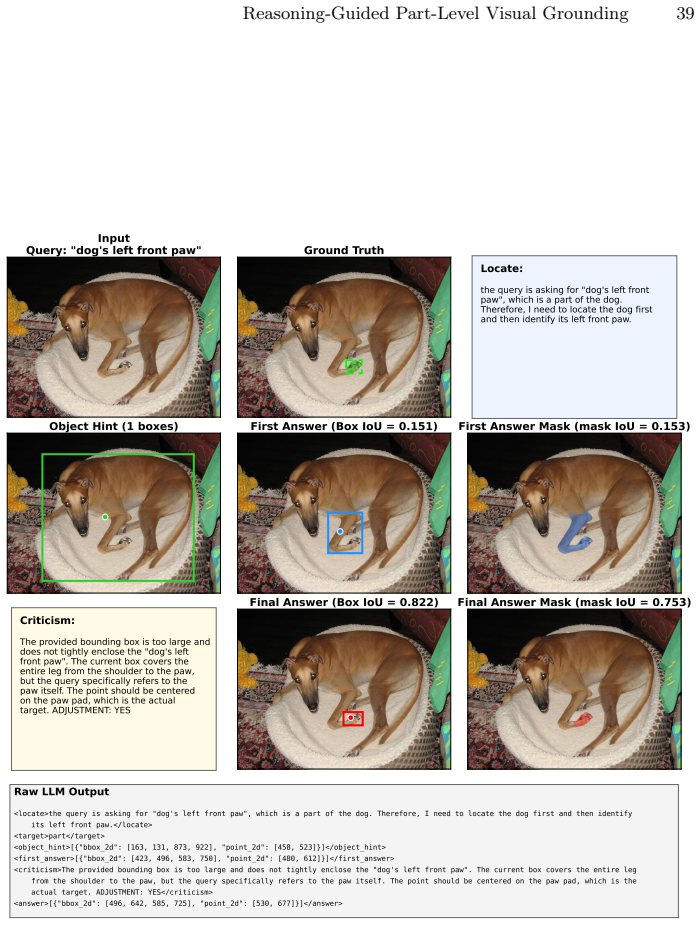
The central claim is that the object-part hierarchy is the missing inductive bias in MLLM grounding. If a query names a part, the right computation is coarse-to-fine: anchor on the parent object, then predict a tight box and interior point for the part, verify by self-reflection (strengthened by re-encoding the predicted crop), and finalize. The paper shows this chain can be taught entirely with verifiable rewards — no part-specific supervised fine-tuning — and that the resulting 4B model reaches 75.56 gIoU on InstructPart, 38.59 on PascalPart, 56.87 on PartImageNet, 87.50 on Pascal objects, and 69.6 on reasoning segmentation, surpassing larger baselines.
What carries the argument
The OP-HRG output protocol: a fixed sequence of tagged reasoning states (<locate>, <target>, <object_hint>, <first_answer>, <criticism>, <answer>) that exposes intermediate decisions so each can be rewarded. It is paired with a composite reward whose parts are base localization rewards (IoU, L1, point, compactness, format, non-repetition), hierarchical rewards active only for part queries (object-hint IoU, part containment), and reflective-refinement rewards (improvement over the stronger of the model's first answer or a precomputed baseline, plus an adjustment-consistency penalty). The active-perception variant re-encodes the predicted crops and injects them as fresh visual tokens before th
Load-bearing premise
The cross-dataset gains rest on 1,200 part-mask training images whose mask-to-box and deepest-point labels are faithful for thin, curved, or repeated parts, and on those images not overlapping the PascalPart and PartImageNet test sets.
What would settle it
A provenance audit comparing image hashes between the 1,200-image training set and the PascalPart/PartImageNet test sets, plus a per-part-type breakdown of gIoU for thin or curved parts (tails, handles, rims), would settle the transfer claim: leakage or label unfaithfulness on those parts would show the headline 38.59/56.87 scores are inflated.
If this is right
- Part grounding in MLLMs can be improved substantially without scale or part-specific supervised fine-tuning; a 4B model suffices.
- The reflective step's benefit is largely internalized during training, so at inference the model can often be run with a simpler prompt at nearly the same accuracy, saving tokens and time.
- The same reasoning-guided pipeline transfers to reasoning segmentation, suggesting the hierarchy and reward design generalize beyond part boxes.
- Object-level referring degrades only modestly (about 3 points), so part-centric reinforcement does not destroy general grounding competence.
- Decoder-agnostic: swapping the frozen mask decoder barely changes results, meaning the gains live in the language model's box and point predictions.
Where Pith is reading between the lines
- One testable extension: apply the same object-first plus reward framework to fine-grained attributes (color, texture, keypoints), where the same single-step bias may exist.
- The mask-derived training labels (connected-component boxes, deepest-interior points) plausibly cap performance on thin or curved parts; using polygon-aware or rotated labels could push the reported numbers higher, and that should be measured before adopting the approach as-is.
- The part-containment reward's tolerance of any matching parent object suggests multi-instance training data would be the next lever; the paper itself flags this limitation.
- Because the refinement step converges to verification, the active-perception crop loop may shift from correction to confidence calibration; testing on out-of-distribution images where first answers remain imperfect would reveal when crops still matter.
Editorial analysis
A structured set of objections, weighed in public.
Referee Report
Summary. The paper proposes Object-Part Hierarchical Reflective Grounding (OP-HRG), a structured prompting protocol for part-level visual grounding in which the model first decides whether the query is an object or a part, localizes the parent object for part queries, produces an initial part localization, self-critiques, and optionally re-encodes crops before giving a final answer. This is trained with a part-aware GRPO framework using stage-wise rewards: base localization rewards, hierarchical rewards (object hint, part containment), and reflective refinement rewards (improvement over the initial answer and an external baseline). Using Qwen3-VL-Instruct-4B with a frozen SAM2 decoder, trained on InstructPart train plus the VisionReasoner 7k set, the paper reports gIoU 75.56 on InstructPart, 38.59 on PascalPart, 56.87 on PartImageNet, 87.50 on Pascal-Obj, and 69.6 on ReasonSeg, surpassing 7B grounding MLLMs and SAM3 on the part benchmarks. Ablations show both the hierarchical structure and the reflective refinement contribute, and that the reflective step mostly acts as a train-time regularizer.
Significance. If the results hold, the paper makes a strong practical contribution: a 4B model, with a frozen mask decoder and no SFT cold-start, outperforms larger grounding MLLMs and a specialized text-promptable segmenter on fine-grained part grounding, with only a modest trade-off on RefCOCO. The paper is unusually transparent in several respects: the reward design is validated against reward exploitation (App. C.6, Fig. 6), the mask decoder is swapped out as a control (Table 2), a plain-prompt baseline is reported in App. H.2, and all baseline numbers are said to be recomputed under a single protocol (App. I). These are genuine strengths. The central claim, however, depends on two things that need attention: an unverified disjointness assertion for the zero-shot benchmarks, and a main-table comparison that uses a poorly parsed structured-prompt baseline rather than the model's actual plain-prompt capability.
major comments (3)
- [§4.2–4.3 (zero-shot claim)] The assertion that the model 'has seen neither images nor annotations from either benchmark' (PascalPart/PartImageNet) is load-bearing for the headline cross-dataset numbers (38.59/56.87 gIoU). The paper provides no provenance audit: no image-ID overlap check, no near-duplicate/hash verification, and no account of how the InstructPart train split and VisionReasoner 7k set were sourced relative to PASCAL-VOC and ImageNet. Since all three datasets are natural images, disjointness cannot be assumed. Please provide a concrete audit; without it, the zero-shot interpretation of these results is not established.
- [Table 1 vs App H.2] The main-table 'zero-shot OP-HRG prompt' baseline (31.45/21.95) is not a fair reference for the RL contribution: App. H.2 shows the same base model under a plain single-step prompt reaches 72.39/50.20, while the structured prompt parses only 52.7%/56.6% of the time without RL. Reporting only the structured-prompt baseline overstates the gain of RL (+44.11 vs +3.17 on InstructPart). The fair comparison still supports the method (+3.17 in-domain, +6.67 zero-shot PartImageNet), but the main text and abstract should be reframed around the plain-prompt baseline, and App. H.2 should be moved into the main results.
- [§4.2 and §3.5 (object-box supervision)] The hierarchical rewards require ground-truth object boxes for the object hint reward and part containment reward, but §4.2 only describes deriving part boxes and points from InstructPart part masks. It is not explained how object-level ground truth is obtained for the InstructPart training samples. Please specify the derivation (e.g., union of part masks per object, or a separate object-annotation stream) and validate that these boxes are sufficiently accurate to serve as reward targets. Without this, the hierarchical rewards are underspecified.
minor comments (5)
- [Eq. (2) / App. C.3, C.5] State explicitly in the main text that IoU_baseline is precomputed on the InstructPart training split only and is a fixed per-sample scalar, independent of the test evaluations in Table 1. This will preempt the appearance of a circular use of SAM3, which is also a baseline in Table 1.
- [Fig. 3] The <object_hint> example shows only a bbox field, but the prompt in Appendix B requires both bbox_2d and point_2d in that block. Make the figure consistent with the prompt.
- [Table 7 / H.2] The ablation 'Ours w/o hierarchy & refinement' (70.32) is below the plain-prompt base (72.39) reported in H.2. The paper should acknowledge this and explain why standard-reward RL under the OP-HRG prompt does not recover plain-prompt performance; otherwise it invites an interpretation that the structure itself is harmful without the hierarchical rewards.
- [§4.5 / Table 3] The analysis says the reflective step's benefit is 'internalized into the weights' and a plain single-answer prompt retains 75.40, yet the active-perception variant (Table 3) applies refinement at inference with additional gains. Clarify how these two findings are reconciled—specifically, whether the AP evaluation still uses the two-pass crop-refinement protocol.
- [Table 6] Report the inference time and token count for the plain-prompt base model as well, so readers can separate the cost of the structured protocol from the cost of RL-induced output compaction.
Circularity Check
No significant circularity: held-out benchmark evaluations, disclosed training signals, and no self-citation chain.
full rationale
Potential circularity candidates were checked and rejected. (1) The SAM3 reference in the improvement reward (Eq. 2 / App. C.3, C.5) is a per-sample IoU threshold computed on the InstructPart training split and is disclosed in Sec. 4.2. The headline comparison to SAM3 is on the InstructPart test split plus cross-dataset PascalPart/PartImageNet; the latter never saw the SAM3 reward, and the former is a held-out split. Optimizing against a baseline on train and evaluating on test is standard supervised/RL evaluation, not a prediction that is equal to its input by construction. (2) The paper contains no self-citation chain: closest prior pipelines (Seg-Zero, VisionReasoner) are external works, and no "uniqueness" theorem is invoked to force the design. (3) The object-part hierarchy is encoded both in the task definition and in rewards (object hint, containment), but the reported masks come from a frozen SAM2 decoder on images not used for the reward computation; there is no equation in which the output metric is defined as the optimized reward. (4) The H.2 plain-prompt baseline (72.39/50.20) exceeds the zero-shot OP-HRG prompt (31.45/21.95), and the paper analyzes this as a reasoning-execution gap; the final +3.17/+6.67 over the plain baseline is an empirical ablation, not a fitted artifact. (5) The zero-shot imageset disjointness is asserted but un-audited; that is an external validity/data-provenance risk, not a circularity. The paper's own limitations (reflective step converges to verification; containment can match the wrong same-category object) undercut strength but are not circular. No step reduces to its own input by definition; accordingly no circular steps are reported.
Axiom & Free-Parameter Ledger
free parameters (6)
- α_l1 (adaptive L1 box threshold scaling) =
0.10
- α_p (point distance threshold scaling) =
0.20
- τ clamps (L1 and point thresholds) =
ℓ1: 3–10 px; point: 5–30 px
- Reward weights (λ_iou = 2.0, others 1.0) =
2.0 for IoU; 1.0 otherwise
- External baseline IoU_baseline =
SAM3 box IoU per InstructPart train sample
- Training hyperparameters =
lr 1e-6, β_KL 1e-2, ϵ 0.2/0.3, temp 1.2, group 4, 1300 steps, MaxCrops 4
axioms (6)
- domain assumption Pretrained MLLMs already contain latent hierarchical part-reasoning capacity that structured prompting + RL can activate.
- domain assumption Frozen SAM2/SAM3 decoders turn box+point prompts into accurate masks.
- domain assumption InstructPart train masks converted to boxes + deepest-interior points are faithful part supervision.
- domain assumption No image-level overlap between InstructPart train images and PascalPart/PartImageNet test sets.
- domain assumption Hungarian-matched IoU/L1/point rewards monotonically track downstream mask gIoU.
- standard math Standard part-grounding evaluation: query only objects/parts known present, report gIoU.
read the original abstract
Multimodal large language models (MLLMs) ground whole objects well from free-form language queries, but they struggle when the query names a part rather than the object. We trace this to a missing object-part hierarchy, since parts are localized in the same single step used for objects. We propose Object-Part Hierarchical Reflective Grounding (OP-HRG), a coarse-to-fine reasoning-guided grounding strategy that first localizes the parent object and then the part within it. A self-check then reflects on the result, with an extension to re-encode the predicted crop to inspect the region it is correcting. We introduce a part-aware GRPO framework to train our pipeline with stage-wise rewards. A 4B model trained this way outperforms 7B grounding LLMs and SAM3 across PascalPart, PartImageNet, and InstructPart, and transfers to reasoning segmentation.
Figures




Reference graph
Works this paper leans on
-
[1]
arXiv preprint arXiv:2511.21631 (2025)
Bai, S., Cai, Y., Chen, R., Chen, K., Chen, X., Cheng, Z., Deng, L., Ding, W., Gao, C., Ge, C., et al.: Qwen3-VL technical report. arXiv preprint arXiv:2511.21631 (2025)
Pith/arXiv arXiv 2025
-
[2]
Bai, S., Chen, K., Liu, X., Wang, J., Ge, W., Song, S., Dang, K., Wang, P., Wang, S., Tang, J., Zhong, H., Zhu, Y., Yang, M., Li, Z., Wan, J., Wang, P., Ding, W., Fu, Z., Xu, Y., Ye, J., Zhang, X., Xie, T., Cheng, Z., Zhang, H., Yang, Z., Xu, H., Lin, J.: Qwen2.5-vl technical report. arXiv preprint arXiv:2502.13923 (2025).https: //doi.org/10.48550/arXiv.2...
-
[3]
arXiv preprint arXiv:2505.14231 (2025)
Bai, S., Li, M., Liu, Y., Tang, J., Zhang, H., Sun, L., Chu, X., Tang, Y.: UniVG-R1: Reasoning guided universal visual grounding with reinforcement learning. arXiv preprint arXiv:2505.14231 (2025)
Pith/arXiv arXiv 2025
-
[4]
arXiv preprint arXiv:2505.20272 (2025)
Cao, M., Zhao, H., Zhang, C., Chang, X., Reid, I., Liang, X.: Ground-R1: In- centivizing grounded visual reasoning via reinforcement learning. arXiv preprint arXiv:2505.20272 (2025)
arXiv 2025
-
[5]
In: International Conference on Learning Representations (2026)
Carion, N., Gustafson, L., Hu, Y.T., Debnath, S., Hu, R., Suris, D., Ryali, C., Al- wala, K.V., Khedr, H., Huang, A., et al.: SAM 3: Segment anything with concepts. In: International Conference on Learning Representations (2026)
2026
-
[6]
In: Proceedings of the IEEE/CVF Conference on Computer Vision and Pattern Recog- nition (CVPR)
Chen, B., Xu, Z., Kirmani, S., Ichter, B., Sadigh, D., Guibas, L., Xia, F.: Spa- tialVLM: Endowing vision-language models with spatial reasoning capabilities. In: Proceedings of the IEEE/CVF Conference on Computer Vision and Pattern Recog- nition (CVPR). pp. 14455–14465 (June 2024)
2024
-
[7]
arXiv preprint arXiv:2306.15195 (2023)
Chen, K., Zhang, Z., Zeng, W., Zhang, R., Zhu, F., Zhao, R.: Shikra: Unleash- ing multimodal llm’s referential dialogue magic. arXiv preprint arXiv:2306.15195 (2023)
Pith/arXiv arXiv 2023
-
[8]
In: Proceedings of the IEEE conference on computer vision and pattern recognition
Chen, X., Mottaghi, R., Liu, X., Fidler, S., Urtasun, R., Yuille, A.: Detect what you can: Detecting and representing objects using holistic models and body parts. In: Proceedings of the IEEE conference on computer vision and pattern recognition. pp. 1971–1978 (2014)
1971
-
[9]
In: Proceedings of the IEEE/CVF Conference on Computer Vision and Pattern Recognition Workshops
Chen, X., Li, W., Liu, C., Xie, C., Hu, X., Ma, C., Zhu, F., Zhao, R.: On the suitability of reinforcement fine-tuning to visual tasks. In: Proceedings of the IEEE/CVF Conference on Computer Vision and Pattern Recognition Workshops. pp. 3382–3386 (2025)
2025
-
[10]
In: Proceed- ings of the IEEE/CVF Conference on Computer Vision and Pattern Recognition (CVPR)
Chen, Z., Wu, J., Wang, W., Su, W., Chen, G., Xing, S., Zhong, M., Zhang, Q., Zhu, X., Lu, L., Li, B., Luo, P., Lu, T., Qiao, Y., Dai, J.: Internvl: Scaling up vi- sion foundation models and aligning for generic visual-linguistic tasks. In: Proceed- ings of the IEEE/CVF Conference on Computer Vision and Pattern Recognition (CVPR). pp. 24185–24198 (June 2024)
2024
-
[11]
In: Proceed- ings of the Computer Vision and Pattern Recognition Conference
Choi, J., Lee, S., Lee, M., Lee, S., Shim, H.: Fine-grained image-text correspon- dence with cost aggregation for open-vocabulary part segmentation. In: Proceed- ings of the Computer Vision and Pattern Recognition Conference. pp. 9782–9793 (2025) Reasoning-Guided Part-Level Visual Grounding 17
2025
-
[12]
In: Proceedings of the Computer Vision and Pattern Recognition Conference
Deitke, M., Clark, C., Lee, S., Tripathi, R., Yang, Y., Park, J.S., Salehi, M., Muen- nighoff, N., Lo, K., Soldaini, L., et al.: Molmo and PixMo: Open weights and open data for state-of-the-art vision-language models. In: Proceedings of the Computer Vision and Pattern Recognition Conference. pp. 91–104 (2025)
2025
-
[13]
Fu, X., Liu, M., Yang, Z., Corring, J., Lu, Y., Yang, J., Roth, D., Florencio, D., Zhang, C.: ReFocus: Visual editing as a chain of thought for structured image understanding.In:InternationalConferenceonMachineLearning.pp.17783–17805 (2025)
2025
-
[14]
In: European Conference on Computer Vision
He, J., Yang, S., Yang, S., Kortylewski, A., Yuan, X., Chen, J.N., Liu, S., Yang, C., Yu, Q., Yuille, A.: PartImageNet: A large, high-quality dataset of parts. In: European Conference on Computer Vision. pp. 128–145. Springer (2022)
2022
-
[15]
arXiv preprint arXiv:2601.09981 (2026)
He, Y., Chen, W., Jian, Z., Guo, T., Zhou, W., Li, M.: DR2Seg: Decomposed two- stage rollouts for efficient reasoning segmentation in multimodal large language models. arXiv preprint arXiv:2601.09981 (2026)
arXiv 2026
-
[16]
arXiv preprint arXiv:2602.09701 (2026)
Hegde, S., Chacko, J.S., Banerjee, D., Mahesh, U.: Genseg-r1: Rl-driven vision- language grounding for fine-grained referring segmentation. arXiv preprint arXiv:2602.09701 (2026)
arXiv 2026
-
[17]
In: Proceedings of the 2025 Conference on Empirical Methods in Natural Language Processing
Jian, P., Wu, J., Sun, W., Wang, C., Ren, S., Zhang, J.: Look again, think slowly: Enhancing visual reflection in vision-language models. In: Proceedings of the 2025 Conference on Empirical Methods in Natural Language Processing. pp. 9251–9270 (2025).https://doi.org/10.18653/v1/2025.emnlp-main.470
-
[18]
In: Proceedings of the IEEE/CVF international conference on computer vision
Kamath, A., Singh, M., LeCun, Y., Synnaeve, G., Misra, I., Carion, N.: Mdetr- modulated detection for end-to-end multi-modal understanding. In: Proceedings of the IEEE/CVF international conference on computer vision. pp. 1780–1790 (2021)
2021
-
[19]
In: Proceedings of the IEEE/CVF international conference on computer vision
Kirillov, A., Mintun, E., Ravi, N., Mao, H., Rolland, C., Gustafson, L., Xiao, T., Whitehead, S., Berg, A.C., Lo, W.Y., et al.: Segment anything. In: Proceedings of the IEEE/CVF international conference on computer vision. pp. 4015–4026 (2023)
2023
-
[20]
Naval research logistics quarterly2(1-2), 83–97 (1955)
Kuhn, H.W.: The hungarian method for the assignment problem. Naval research logistics quarterly2(1-2), 83–97 (1955)
1955
-
[21]
In: Proceedings of the IEEE/CVF Conference on Computer Vision and Pattern Recognition
Lai, X., Tian, Z., Chen, Y., Li, Y., Yuan, Y., Liu, S., Jia, J.: LISA: Reasoning seg- mentation via large language model. In: Proceedings of the IEEE/CVF Conference on Computer Vision and Pattern Recognition. pp. 9579–9589 (2024)
2024
-
[22]
In: European Conference on Computer Vision
Li, F., Zhang, H., Sun, P., Zou, X., Liu, S., Li, C., Yang, J., Zhang, L., Gao, J.: Segment and recognize anything at any granularity. In: European Conference on Computer Vision. pp. 467–484. Springer (2024)
2024
-
[23]
In: European Conference on Computer Vision
Li, J., Wu, J., Zhao, W., Bai, S., Bai, X.: PartGLEE: A foundation model for recognizing and parsing any objects. In: European Conference on Computer Vision. pp. 475–494. Springer (2024)
2024
-
[24]
In: Proceed- ings of the IEEE/CVF conference on computer vision and pattern recognition
Li, L.H., Zhang, P., Zhang, H., Yang, J., Li, C., Zhong, Y., Wang, L., Yuan, L., Zhang, L., Hwang, J.N., et al.: Grounded language-image pre-training. In: Proceed- ings of the IEEE/CVF conference on computer vision and pattern recognition. pp. 10965–10975 (2022)
2022
-
[25]
In: Chiruzzo, L., Ritter, A., Wang, L
Li, Z., Luo, R., Zhang, J., Qiu, M., Huang, X., Wei, Z.: VoCoT: Unleashing vi- sually grounded multi-step reasoning in large multi-modal models. In: Chiruzzo, L., Ritter, A., Wang, L. (eds.) Proceedings of the 2025 Conference of the Na- tions of the Americas Chapter of the Association for Computational Linguistics: Human Language Technologies (Volume 1: L...
2025
-
[26]
In: Proceedings of the IEEE/CVF conference on computer vision and pattern recognition
Liu, C., Ding, H., Jiang, X.: Gres: Generalized referring expression segmentation. In: Proceedings of the IEEE/CVF conference on computer vision and pattern recognition. pp. 23592–23601 (2023)
2023
-
[27]
In: Proceedings of the IEEE/CVF conference on computer vision and pattern recog- nition
Liu, M., Zhu, Y., Cai, H., Han, S., Ling, Z., Porikli, F., Su, H.: Partslip: Low-shot part segmentation for 3d point clouds via pretrained image-language models. In: Proceedings of the IEEE/CVF conference on computer vision and pattern recog- nition. pp. 21736–21746 (2023)
2023
-
[28]
In: European conference on computer vision
Liu, S., Zeng, Z., Ren, T., Li, F., Zhang, H., Yang, J., Jiang, Q., Li, C., Yang, J., Su, H., et al.: Grounding DINO: Marrying DINO with grounded pre-training for open-set object detection. In: European conference on computer vision. pp. 38–55. Springer (2024)
2024
-
[29]
Advances in Neu- ral Information Processing Systems38, 126078–126108 (2025),https://papers
Liu, Y., Ma, Z., Pu, J., Qi, Z., Wu, Y., Shan, Y., Wen, C.C.: Unipixel: Unified ob- ject referring and segmentation for pixel-level visual reasoning. Advances in Neu- ral Information Processing Systems38, 126078–126108 (2025),https://papers. nips.cc/paper_files/paper/2025/file/b783c44ba9adbc30344473dc633b4869- Paper-Conference.pdf
2025
-
[30]
arXiv preprint arXiv:2503.06520 (2025)
Liu, Y., Peng, B., Zhong, Z., Yue, Z., Lu, F., Yu, B., Jia, J.: Seg-Zero: Reasoning-chain guided segmentation via cognitive reinforcement. arXiv preprint arXiv:2503.06520 (2025)
Pith/arXiv arXiv 2025
-
[31]
In: International Conference on Learning Representations (2026)
Liu,Y.,Qu,T.,Zhong,Z.,Peng,B.,Liu,S.,Yu,B.,Jia,J.:VisionReasoner:Unified reasoning-integrated visual perception via reinforcement learning. In: International Conference on Learning Representations (2026)
2026
-
[32]
In: Proceedings of the IEEE/CVF Inter- national Conference on Computer Vision
Liu, Z., Sun, Z., Zang, Y., Dong, X., Cao, Y., Duan, H., Lin, D., Wang, J.: Visual- RFT: Visual reinforcement fine-tuning. In: Proceedings of the IEEE/CVF Inter- national Conference on Computer Vision. pp. 2034–2044 (2025)
2034
-
[33]
In: Proceedings of the IEEE/CVF conference on computer vision and pattern recog- nition
Lüddecke, T., Ecker, A.: Image segmentation using text and image prompts. In: Proceedings of the IEEE/CVF conference on computer vision and pattern recog- nition. pp. 7086–7096 (2022)
2022
-
[34]
Ma, X., Ding, Z., Luo, Z., Chen, C., Guo, Z., Wong, D.F., Feng, X., Sun, M.: DeepPerception: Advancing R1-like cognitive visual perception in MLLMs for knowledge-intensive visual grounding (2025),https://arxiv.org/abs/2503. 12797
2025
-
[35]
In: Proceedings of the IEEE/CVF Conference on Computer Vision and Pattern Recog- nition (2025)
Man, Y., Huang, D.A., Liu, G., Sheng, S., Liu, S., Gui, L.Y., Kautz, J., Wang, Y.X., Yu, Z.: Argus: Vision-centric reasoning with grounded chain-of-thought. In: Proceedings of the IEEE/CVF Conference on Computer Vision and Pattern Recog- nition (2025)
2025
-
[36]
arXiv preprint arXiv:2503.07365 (2025)
Meng, F., Du, L., Liu, Z., Zhou, Z., Lu, Q., Fu, D., Han, T., Shi, B., Wang, W., He, J., et al.: MM-Eureka: Exploring the frontiers of multimodal reasoning with rule-based reinforcement learning. arXiv preprint arXiv:2503.07365 (2025)
Pith/arXiv arXiv 2025
-
[37]
In: Proceedings of the IEEE/CVF Con- ference on Computer Vision and Pattern Recognition (CVPR)
Mitra, C., Huang, B., Darrell, T., Herzig, R.: Compositional chain-of-thought prompting for large multimodal models. In: Proceedings of the IEEE/CVF Con- ference on Computer Vision and Pattern Recognition (CVPR). pp. 14420–14431 (June 2024)
2024
-
[38]
In: Proceedings of the IEEE/CVF Conference on Computer Vision and Pattern Recognition
Rasheed,H.,Maaz,M.,Shaji,S.,Shaker,A.,Khan,S.,Cholakkal,H.,Anwer,R.M., Xing, E., Yang, M.H., Khan, F.S.: GLaMM: Pixel grounding large multimodal model. In: Proceedings of the IEEE/CVF Conference on Computer Vision and Pattern Recognition. pp. 13009–13018 (2024)
2024
-
[39]
In: International Conference on Learning Representations (2025) Reasoning-Guided Part-Level Visual Grounding 19
Ravi, N., Gabeur, V., Hu, Y.T., Hu, R., Ryali, C., Ma, T., Khedr, H., Rädle, R., Rolland, C., Gustafson, L., et al.: SAM 2: Segment anything in images and videos. In: International Conference on Learning Representations (2025) Reasoning-Guided Part-Level Visual Grounding 19
2025
-
[40]
arXiv preprint arXiv:2401.14159 (2024)
Ren, T., Liu, S., Zeng, A., Lin, J., Li, K., Cao, H., Chen, J., Huang, X., Chen, Y., Yan, F., et al.: Grounded SAM: Assembling open-world models for diverse visual tasks. arXiv preprint arXiv:2401.14159 (2024)
Pith/arXiv arXiv 2024
-
[41]
In: Proceedings of the IEEE/CVF Conference on Computer Vision and Pattern Recognition
Ren, Z., Huang, Z., Wei, Y., Zhao, Y., Fu, D., Feng, J., Jin, X.: Pixellm: Pixel rea- soning with large multimodal model. In: Proceedings of the IEEE/CVF Conference on Computer Vision and Pattern Recognition. pp. 26374–26383 (2024)
2024
-
[42]
arXiv preprint arXiv:2402.03300 (2024)
Shao, Z., Wang, P., Zhu, Q., Xu, R., Song, J., Bi, X., Zhang, H., Zhang, M., Li, Y., Wu, Y., et al.: DeepSeekMath: Pushing the limits of mathematical reasoning in open language models. arXiv preprint arXiv:2402.03300 (2024)
Pith/arXiv arXiv 2024
-
[43]
In: Workshop on Reasoning and Planning for Large Language Models (2025),https://openreview.net/forum?id=T2IHuIib74
Sharma, K., Vats, V.: Think to ground: Improving spatial reasoning in LLMs for better visual grounding. In: Workshop on Reasoning and Planning for Large Language Models (2025),https://openreview.net/forum?id=T2IHuIib74
2025
-
[44]
arXiv preprint arXiv:2505.19094 (2025)
Shen, C., Wei, W., Qu, X., Cheng, Y.: Satori-R1: Incentivizing multimodal reason- ing with spatial grounding and verifiable rewards. arXiv preprint arXiv:2505.19094 (2025)
arXiv 2025
-
[45]
arXiv preprint arXiv:2504.07615 (2025)
Shen, H., Liu, P., Li, J., Fang, C., Ma, Y., Liao, J., Shen, Q., Zhang, Z., Zhao, K., Zhang, Q., et al.: VLM-R1: A stable and generalizable R1-style large vision- language model. arXiv preprint arXiv:2504.07615 (2025)
Pith/arXiv arXiv 2025
-
[46]
arXiv preprint arXiv: 2409.19256 (2024)
Sheng, G., Zhang, C., Ye, Z., Wu, X., Zhang, W., Zhang, R., Peng, Y., Lin, H., Wu, C.: Hybridflow: A flexible and efficient rlhf framework. arXiv preprint arXiv: 2409.19256 (2024)
Pith/arXiv arXiv 2024
-
[47]
In: Proceedings of the IEEE/CVF Interna- tional Conference on Computer Vision
Sun, P., Chen, S., Zhu, C., Xiao, F., Luo, P., Xie, S., Yan, Z.: Going denser with open-vocabulary part segmentation. In: Proceedings of the IEEE/CVF Interna- tional Conference on Computer Vision. pp. 15453–15465 (2023)
2023
-
[48]
In: Proceedings of the 63rd Annual Meeting of the Association for Computational Linguistics (Volume 1: Long Papers)
Wan,Z.,Xie,Y.,Zhang,C.,Lin,Z.,Wang,Z.,Stepputtis,S.,Ramanan,D.,Sycara, K.P.: InstructPart: Task-oriented part segmentation with instruction reasoning. In: Proceedings of the 63rd Annual Meeting of the Association for Computational Linguistics (Volume 1: Long Papers). pp. 24202–24227 (2025)
2025
-
[49]
arXiv preprint arXiv:2409.12191 (2024)
Wang, P., Bai, S., Tan, S., Wang, S., Fan, Z., Bai, J., Chen, K., Liu, X., Wang, J., Ge, W., et al.: Qwen2-VL: Enhancing vision-language model’s perception of the world at any resolution. arXiv preprint arXiv:2409.12191 (2024)
Pith/arXiv arXiv 2024
-
[50]
Advances in Neural Information Processing Systems36, 70094–70114 (2023)
Wei, M., Yue, X., Zhang, W., Kong, S., Liu, X., Pang, J.: OV-PARTS: Towards open-vocabulary part segmentation. Advances in Neural Information Processing Systems36, 70094–70114 (2023)
2023
-
[51]
arXiv preprint arXiv:2312.17240 (2023)
Yang, S., Qu, T., Lai, X., Tian, Z., Peng, B., Liu, S., Jia, J.: Lisa++: An improved baseline for reasoning segmentation with large language model. arXiv preprint arXiv:2312.17240 (2023)
Pith/arXiv arXiv 2023
-
[52]
Yang, Y., He, X., Pan, H., Jiang, X., Deng, Y., Yang, X., Lu, H., Yin, D., Rao, F., Zhu, M., et al.: R1-Onevision: Advancing generalized multimodal reasoning throughcross-modalformalization.In:ProceedingsoftheIEEE/CVFInternational Conference on Computer Vision. pp. 2376–2385 (2025)
2025
-
[53]
In: International Conference on Learning Representations (2024)
You, H., Zhang, H., Gan, Z., Du, X., Zhang, B., Wang, Z., Cao, L., Chang, S.F., Yang, Y.: Ferret: Refer and ground anything anywhere at any granularity. In: International Conference on Learning Representations (2024)
2024
-
[54]
arXiv preprint arXiv:2506.22624 (2025)
You, Z., Wu, Z.: Seg-R1: Segmentation can be surprisingly simple with reinforce- ment learning. arXiv preprint arXiv:2506.22624 (2025)
Pith/arXiv arXiv 2025
-
[55]
arXiv preprint arXiv:2501.04001 (2025) 20 K
Yuan,H.,Li,X.,Zhang,T.,Sun,Y.,Huang,Z.,Xu,S.,Ji,S.,Tong,Y.,Qi,L.,Feng, J., et al.: Sa2VA: Marrying SAM2 with LLaVA for dense grounded understanding of images and videos. arXiv preprint arXiv:2501.04001 (2025) 20 K. Mehrab et al
Pith/arXiv arXiv 2025
-
[56]
In: Proceedings of the IEEE/CVF Conference on Computer Vision and Pattern Recognition
Yuan, Y., Li, W., Liu, J., Tang, D., Luo, X., Qin, C., Zhang, L., Zhu, J.: Os- prey: Pixel understanding with visual instruction tuning. In: Proceedings of the IEEE/CVF Conference on Computer Vision and Pattern Recognition. pp. 28202– 28211 (2024)
2024
-
[57]
arXiv preprint arXiv:2601.13633 (2026)
Zhan, G., Li, C., Liu, Z., Lu, Y., Wu, Y., Han, S., Zhu, L.: Scaling test-time inference for visual grounding. arXiv preprint arXiv:2601.13633 (2026)
Pith/arXiv arXiv 2026
-
[58]
In: Che, W., Nabende, J., Shutova, E., Pilehvar, M.T
Zhang, R., Zhang, B., Li, Y., Zhang, H., Sun, Z., Gan, Z., Yang, Y., Pang, R., Yang, Y.: Improve vision language model chain-of-thought reasoning. In: Che, W., Nabende, J., Shutova, E., Pilehvar, M.T. (eds.) Proceedings of the 63rd Annual Meeting of the Association for Computational Linguistics (Volume 1: Long Papers). pp. 1631–1662. Association for Compu...
-
[59]
Transactions on Machine Learning Re- search (2023)
Zhang, Z., Zhang, A., Li, M., Zhao, H., Karypis, G., Smola, A.: Multimodal chain- of-thought reasoning in language models. Transactions on Machine Learning Re- search (2023)
2023
-
[60]
arXiv preprint arXiv:2602.03547 (2026)
Zhou, D., He, M., Fang, Z., Yao, X., Liu, Y., Knoll, A., Cao, H.: AffordanceGrasp- R1: Leveraging reasoning-based affordance segmentation with reinforcement learn- ing for robotic grasping. arXiv preprint arXiv:2602.03547 (2026)
arXiv 2026
-
[61]
Zhu, L., Ouyang, B., Zhang, Y., Cheng, T., Hu, R., Shen, H., Ran, L., Chen, X., Yu, L., Liu, W., Wang, X.: LENS: Learning to segment anything with unified rein- forced reasoning. In: Proceedings of the AAAI Conference on Artificial Intelligence. vol. 40, pp. 13952–13960 (2026).https://doi.org/10.1609/aaai.v40i16.38405 Reasoning-Guided Part-Level Visual Gr...
discussion (0)
Sign in with ORCID, Apple, or X to comment. Anyone can read and Pith papers without signing in.