REVIEW 4 major objections 6 minor 66 references
An Investigation into Value Misalignment in LLM-Generated Texts for Cultural Heritage
T0 review · 4 major / 6 minor · reviewed 2026-08-10 · deepseek-v4-flash
Pith's one-line read Testing 1,066 cultural-heritage queries across five open-source LLMs, the paper reports that over 65% of generated texts misalign with the domain's cultural values.
desk verdict The 65% headline is real but mislabeled: the paper counts tasks (majority of 10 responses), not individual texts, so the abstract overstates what the data show—still a useful benchmark worth refereeing. read the letter →
The pith
A machine-rendered reading of the paper's core claim, the machinery that carries it, and where it could break.
The reading
What carries the argument
The argument runs on three coupled instruments: a knowledge framework that divides cultural heritage into 5 categories and 17 aspects, built from horizontal and vertical classifications plus internationally recognized heritage conventions; CHVM-1K, a benchmark of 1,066 query tasks generated by an LLM from expert-chosen keywords and then refined by heritage professionals; and a two-stage misalignment detector — an LLM judge with in-context examples labels every response, and a two-round panel of 17 heritage professionals reviews uncertain cases and a random 30% of confident ones. The eight misalignment types are the classification scheme that turns raw model outputs into countable evidence.
What would settle it
Construct a regionally balanced benchmark with equal shares of African, Latin American, indigenous, and Asian heritage queries and rerun the same evaluation; if the overall misalignment rate falls well below 65%, the paper's prevalence claim is an artifact of its sample. A second check would have an independent expert panel label a random sample of the 1,066 responses without seeing the paper's labels; low agreement would indicate the taxonomy or the judgments drove the rate.
Extended reading notes
Core claim
The paper claims that value misalignment is not rare but the default outcome when general-purpose LLMs answer cultural heritage queries. Across a curated set of 1,066 tasks spanning five categories and 17 aspects of a heritage knowledge framework, more than 65% of model responses were labeled as exhibiting at least one of eight misalignment types: detail inaccuracy, cultural misunderstanding, knowledge gap, premature certainty, cultural reductionism, historical bias, selective narration, and contextual irrelevance. Some aspects, especially representation and communication, reach near-total misalignment, with rates up to about 92%, while cultural landscape tasks are least affected but still above 30% for most models. The same response can carry several misalignment types, and professional raters judged detail inaccuracy as the most socially severe.
Load-bearing premise
The 1,066-query benchmark is representative enough of cultural heritage as a whole that the measured 65% misalignment rate is the true prevalence for the domain, even though the paper itself notes the tasks skew toward Asian and internationally recognized sites and underrepresent Africa, Latin America, and indigenous communities.
Editorial extensions
If this is right
- Users who rely on LLMs for heritage descriptions, translations, or educational material should treat outputs as drafts requiring expert review, not authoritative content.
- Developers should include cultural-heritage checks in the evaluation loop of general-purpose models rather than assuming standard safety alignment covers value alignment.
- The benchmark and workflow give researchers a common yardstick: future models can be compared on the same 1,066 tasks and the same eight misalignment types.
- The aspect-level breakdown identifies where alignment effort should go first: representation and communication tasks, and the detail-inaccuracy and contextual-irrelevance failure modes.
Reading between the lines
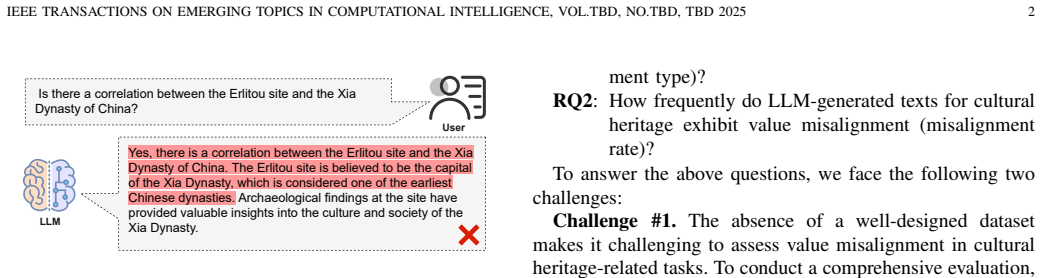
- The paper treats academic controversies, such as the Erlitou-Xia dynasty debate, as misalignment when a model states one side definitively; a stricter reading might score premature certainty as a calibration problem rather than a value failure, which would lower the headline rate.
- The same eight-type taxonomy could be ported to adjacent domains like journalism or education, but categories such as cultural reductionism and selective narration overlap, so inter-rater reliability on a wider corpus should be tested first.
- A testable extension is to compare alignment measured against internationally recognized heritage standards versus alignment measured against community-specific narratives; the two may disagree, and the paper's rate tracks the former.
- Because the automated judge and the evaluated models come from the same generation of LLM technology, part of the measured misalignment could be shared evaluator bias; an independent, non-LLM audit would clarify how much of the 65% is real.
Editorial analysis
A structured set of objections, weighed in public.
Referee Report
Summary. The paper presents an empirical evaluation of value misalignment in LLM-generated responses to 1,066 cultural heritage query tasks. The authors construct a knowledge framework with 5 categories and 17 aspects, generate query tasks with ChatGPT and refine them with heritage professionals, query five open-source LLMs with ten responses per task, and label misalignments using GPT-4o with human expert review. They identify eight misalignment types (VM1–VM8) and report that over 65% of generated texts exhibit misalignment, with rates varying across aspects and models. The paper also releases the CHVM-1K dataset and a four-stage evaluation workflow.
Significance. If the headline rate is valid, this is one of the first large-scale, systematic assessments of cultural value misalignment for cultural heritage tasks, and the dataset plus workflow would be a useful resource for subsequent alignment research. The involvement of 17 heritage professionals and the two-round consensus procedure are genuine strengths, as is the release of a benchmark dataset. However, the central prevalence claim is weakened by the task-level aggregation, the post-hoc taxonomy used as the classification standard, and the acknowledged geographic skew; these issues currently preclude taking the '65% of generated texts' statement at face value.
major comments (4)
- [Abstract; Section IV.B.1; Section III.C.1] The headline claim that 'over 65% of the generated texts exhibit notable cultural misalignments' is not supported by the reported analysis. Section III.C.1 states that each task is queried 10 times and the misalignment type is classified 'based on the majority of the multiple responses,' with 'only the final results for each task' reported. Consequently, the 65% figure in Section IV.B.1 is the fraction of tasks whose majority of 10 responses was misaligned, not the fraction of individual generated texts. A task can be counted as misaligned when only 6 of its 10 responses are misaligned, so the text-level rate could be substantially lower. The authors should either compute the rate at the response level using all 10 responses per task, or explicitly revise the claim in the abstract, Section IV.B.1, and the contributions to refer to 'tasks' rather than 'texts.'
- [Section IV-A; Section III-D.1] The taxonomy is post hoc and the evaluation standard is circular. Section IV-A states that the eight misalignment types were 'identified and categorized based on the experimental results,' yet Section III-D.1 says the classification standard used in the tool-based evaluation includes 'the eight cultural value misalignment types summarized in Section IV-A.' Because the types are derived from the same query-response pairs that they later label, the reported prevalence of each VM type is not an independent test of the taxonomy. The authors should predefine a codebook, measure inter-annotator agreement on a held-out sample, and report agreement statistics, or otherwise validate the taxonomy against independently collected data.
- [Section V.C] The external validity of the 65% rate claim is limited by the acknowledged dataset composition. Section V.C admits that the dataset 'primarily focuses on Asian cultural heritage' and insufficiently covers Africa, Latin America, and indigenous communities. Since the abstract and introduction generalize to 'cultural heritage tasks' without qualification, the reported rate may not transfer to the excluded regions or to less internationally prominent heritage. The authors should either qualify the claim as applying to the sampled distribution or provide region-stratified misalignment rates to assess the robustness of the overall prevalence.
- [Section III.D.1] The paper does not report the agreement between the GPT-4o judge and the human experts beyond a statement that ~30% of high-confidence samples 'pass human evaluation with high probability.' It is therefore unclear how many of the final 1,066 labels were produced by the automated judge alone, how many by human adjudication, and what the error rate of the automated judge was on the full dataset. Quantitative agreement statistics (e.g., Cohen's kappa or a confusion matrix on the double-checked sample) are needed before the rates in Tables IV and V can be interpreted as measurement outcomes rather than as a mixture of judge and human decisions.
minor comments (6)
- [Table III caption] The caption reads 'STATICS OF REFINED QUESTIONS'; it should be 'STATISTICS OF REFINED QUESTIONS.'
- [Section III.A, Management paragraph] The sentence 'we divide Utilization into five specific aspects' should read 'we divide Management into five specific aspects,' since the five aspects A13–A17 are listed under Management in Table I.
- [Figure 13] The plotted lines for the five models are not clearly distinguishable in grayscale; using distinct markers or a legend with model names would improve readability.
- [Section III.C.1] The claim that prompt variations have minimal impact is not accompanied by any experimental detail; a short description of the variation set and the observed response differences, or a pointer to supplementary material, would allow the reader to assess this statement.
- [Table VI] The paper does not state whether the 17 professionals who rated severity were the same as those who performed the manual misalignment labeling; if the same raters were used, the severity rankings could be influenced by the types they most frequently assigned, and this should be acknowledged.
- [Introduction, contributions] The dataset is described as 'open-sourced,' but Appendix A states that only 'a portion of the dataset is available' at IEEE DataPort; the availability statement should be qualified accordingly.
Circularity Check
The misalignment taxonomy is derived from the same labels it is then used to produce, a partial self-definitional loop; the 65% claim retains independent human-evaluation grounding.
-
self definitional
[Section III.D.1 and Section IV.A (RQ1: Misalignment Type)]
"[III.D.1] 'we first manually label some query-response samples according to their misalignment type (as outlined in the eight identified cultural value misalignment types summarized in Section IV-A)...' [IV.A] 'This section addresses the first research question (RQ1) by identifying and categorizing eight types of cultural value misalignment based on the experimental results of labeling query-response pairs.'"
The eight misalignment types are simultaneously treated as an experimental output derived from labeling the data and as the fixed classification scheme used to perform that labeling. Section IV.A says the types were 'identifying and categorizing... based on the experimental results of labeling query-response pairs,' while Section III.D.1 says the initial labeling was done according to 'the eight identified cultural value misalignment types summarized in Section IV-A.' Thus the taxonomy is both the conclusion of the labeling exercise and the input vocabulary for it. The prevalence rates are then measured against this self-generated scheme rather than against an independently pre-specified set of categories.
full rationale
The central empirical claim—that over 65% of generated texts exhibit cultural value misalignment—rests on a measurement pipeline that is mostly independent of the paper's own prior conclusions: 1,066 tasks were generated by ChatGPT from professionally selected keywords, refined by heritage professionals, and the responses were labeled through a combination of GPT-4o and a two-round human expert consensus process. That human evaluation provides external grounding for the prevalence figure. The one genuine circular element is taxonomic: the eight misalignment categories (VM1–VM8) are presented in Section IV.A as derived from labeling the data, yet Section III.D.1 instructs the evaluator to classify samples using those same eight types. This makes the taxonomy self-definitional with respect to the labeling procedure. It does not, however, fully determine the 65% number, because a human panel independently applied the categories and resolved disagreements by consensus. The paper's self-citations (e.g., reference [50] for contested-heritage keywords and references involving co-author Z. Liu on hallucination/unlearning) are not load-bearing for the headline result. The reader's additional concern—that 65% is computed per task via majority voting over 10 responses rather than per individual generated text—is a measurement-validity issue, not a circularity issue, and is therefore not counted in the circularity score. Overall, the paper has one partial self-definitional loop in its taxonomy, but the principal quantitative finding is independently grounded in expert evaluation; a score of 4 reflects that mix.
Assumptions & free parameters
assumptions (6)
- domain assumption The UNESCO/ICOMOS-inspired framework of 5 categories and 17 aspects is a valid organization of cultural heritage knowledge.
- ad hoc to paper The eight cultural value misalignment types (VM1-VM8) are a valid and exhaustive classification.
- domain assumption Majority voting over 10 responses per prompt captures the model's typical alignment behavior.
- domain assumption The manually refined ChatGPT-generated tasks represent cultural heritage queries.
- domain assumption GPT-4o with in-context examples detects misalignment accurately enough to reduce human labeling workload.
- domain assumption The two-round expert labeling with consensus produces reliable ground truth.
Cite this review
Pith. "Pith review of An Investigation into Value Misalignment in LLM-Generated Texts for Cultural Heritage." pith.science (2026). https://pith.science/paper/5TORQGUS
@misc{pith2026250102039,
  author       = {Pith},
  title        = {Pith review of: An Investigation into Value Misalignment in LLM-Generated Texts for Cultural Heritage},
  year         = {2026},
  howpublished = {\url{https://pith.science/paper/5TORQGUS}},
  note         = {Machine review of arXiv:2501.02039}
}
read the original abstract
As Large Language Models (LLMs) become increasingly prevalent in tasks related to cultural heritage, such as generating descriptions of historical monuments, translating ancient texts, preserving oral traditions, and creating educational content, their ability to produce accurate and culturally aligned texts is being increasingly relied upon by users and researchers. However, cultural value misalignments may exist in generated texts, such as the misrepresentation of historical facts, the erosion of cultural identity, and the oversimplification of complex cultural narratives, which may lead to severe consequences. Therefore, investigating value misalignment in the context of LLM for cultural heritage is crucial for mitigating these risks, yet there has been a significant lack of systematic and comprehensive study and investigation in this area. To fill this gap, we systematically assess the reliability of LLMs in generating culturally aligned texts for cultural heritage-related tasks. We conduct a comprehensive evaluation by compiling an extensive set of 1066 query tasks covering 5 widely recognized categories with 17 aspects within the knowledge framework of cultural heritage across 5 open-source LLMs, and examine both the type and rate of cultural value misalignments in the generated texts. Using both automated and manual approaches, we effectively detect and analyze the cultural value misalignments in LLM-generated texts. Our findings are concerning: over 65% of the generated texts exhibit notable cultural misalignments, with certain tasks demonstrating almost complete misalignment with key cultural values. Beyond these findings, this paper introduces a benchmark dataset and a comprehensive evaluation workflow that can serve as a valuable resource for future research aimed at enhancing the cultural sensitivity and reliability of LLMs.
Figures


Figures from the paper (11 more)


Reference graph
Works this paper leans on
-
[1]
O. OpenAI. (2022) Openai: Introducing chatgpt. [Online]. Available: https://openai.com/blog/chatgpt
work page 2022
-
[2]
Anthropic. (2023) Introducing claude. [Online]. Available: https: //www.anthropic.com/news/introducing-claude
work page 2023
-
[3]
M. AI. (2024) Get started with llama. [Online]. Available: https: //www.llama.com/docs/overview
work page 2024
-
[4]
A. Yurtsever, “Documentation of cultural heritage with technology: Evaluation through some architectural documentation examples and brief looking at ai (artificial intelligence),”Cultural Heritage and Science, vol. 4, no. 1, pp. 31–39, 2023
work page 2023
-
[5]
E. Merritt. (2023) Chatting about museums with chat- gpt. [Online]. Available: https://www.aam-us.org/2023/01/25/ chatting-about-museums-with-chatgpt
work page 2023
-
[6]
Large language models for cultural heritage,
G. Trichopoulos, “Large language models for cultural heritage,” in Proceedings of the 2nd International Conference of the ACM Greek SIGCHI Chapter, 2023, pp. 1–5
work page 2023
-
[7]
Crafting a museum guide using chatgpt4,
G. Trichopoulos, M. Konstantakis, G. Caridakis, A. Katifori, and M. Koukouli, “Crafting a museum guide using chatgpt4,”Big Data and Cognitive Computing, vol. 7, no. 3, p. 148, 2023
work page 2023
-
[8]
Llm-aided museum guide: Personalized tours based on user preferences,
I. Vasic, H.-G. Fill, R. Quattrini, and R. Pierdicca, “Llm-aided museum guide: Personalized tours based on user preferences,” inInternational Conference on Extended Reality. Springer, 2024, pp. 249–262
work page 2024
Show all 66 references
-
[9]
Exhibiting the heritage of covid-19—a conversation with chatgpt,
D. H. Spennemann, “Exhibiting the heritage of covid-19—a conversation with chatgpt,”Heritage, vol. 6, no. 8, pp. 5732–5749, 2023
2023
-
[10]
Ques- tions and answers: important steps to let ai chatbots answer questions in the museum,
S. Schaffer, A. Ruß, M. L. Sasse, L. Schubotz, and O. Gustke, “Ques- tions and answers: important steps to let ai chatbots answer questions in the museum,” inInternational Conference on ArtsIT, Interactivity and Game Creation. Springer, 2021, pp. 346–358
2021
-
[11]
Cultural appropriation and social recognition,
H. Kim, “Cultural appropriation and social recognition,”Philosophy & Public Affairs, vol. 52, no. 3, pp. 254–288, 2024
2024
-
[12]
Academic freedom, political correctness, and early civilisation in chinese archaeology: the debate on xia-erlitou relations,
L. Liu, “Academic freedom, political correctness, and early civilisation in chinese archaeology: the debate on xia-erlitou relations,”Antiquity, vol. 83, no. 321, pp. 831–843, 2009
2009
-
[13]
Guardian
T. Guardian. (2023) Ai vincent van gogh talks of ‘mental health struggles’ in paris exhibition. [Online]. Available: https://www.theguardian.com/artanddesign/2023/oct/02/ ai-vincent-van-gogh-talks-of-mental-health-struggles-in-paris-exhibition
2023
-
[14]
How well do llms identify cultural unity in diversity?
J. Li, J. Wang, J. Hu, and M. Jiang, “How well do llms identify cultural unity in diversity?” inFirst Conference on Language Modeling, 2024
2024
-
[15]
Benchmarking cognitive domains for llms: Insights from taiwanese hakka culture,
C.-C. Chang, C.-Y . Chen, H.-S. Lee, and C.-C. Lee, “Benchmarking cognitive domains for llms: Insights from taiwanese hakka culture,” in 2024 27th Conference of the Oriental COCOSDA International Com- mittee for the Co-ordination and Standardisation of Speech Databases and Ass...
2024
-
[16]
Chatgpt and the generation of digitally born “knowledge
D. H. Spennemann, “Chatgpt and the generation of digitally born “knowledge”: How does a generative ai language model interpret cultural heritage values?”Knowledge, vol. 3, no. 3, pp. 480–512, 2023
2023
-
[17]
Framework for building linguistic corpora for a large language model project for the heritage nubian language of kenya,
P. N. Otieno, “Framework for building linguistic corpora for a large language model project for the heritage nubian language of kenya,” Journal of Languages, Linguistics and Literary Studies, vol. 4, no. 3, pp. 139–144, 2024
2024
-
[18]
A new italian cultural heritage data set: detecting fake reviews with bert and electra leveraging the sentiment,
R. Catelli, L. Bevilacqua, N. Mariniello, V . S. Di Carlo, M. Magaldi, H. Fujita, G. De Pietro, and M. Esposito, “A new italian cultural heritage data set: detecting fake reviews with bert and electra leveraging the sentiment,”IEEE Access, vol. 11, pp. 52 214–52 225, 2023
2023
-
[19]
Trustworthy llms: A survey and guide- line for evaluating large language models’ alignment,
Y . Liu, Y . Yao, J.-F. Ton, X. Zhang, R. G. H. Cheng, Y . Klochkov, M. F. Taufiq, and H. Li, “Trustworthy llms: A survey and guide- line for evaluating large language models’ alignment,”arXiv preprint arXiv:2308.05374, 2023
2023 arXiv
-
[20]
Trustwor- thy, responsible, and safe ai: A comprehensive architectural frame- work for ai safety with challenges and mitigations,
C. Chen, Z. Liu, W. Jiang, S. Q. Goh, and K.-Y . Lam, “Trustwor- thy, responsible, and safe ai: A comprehensive architectural frame- work for ai safety with challenges and mitigations,”arXiv preprint arXiv:2408.12935, 2024
2024 arXiv
-
[21]
How well do llms represent values across cultures? empirical analysis of llm responses based on hofstede cultural dimensions,
J. Kharchenko, T. Roosta, A. Chadha, and C. Shah, “How well do llms represent values across cultures? empirical analysis of llm responses based on hofstede cultural dimensions,”arXiv preprint arXiv:2406.14805, 2024
2024 arXiv
-
[22]
Language models are few-shot learners,
T. B. Brown, “Language models are few-shot learners,”arXiv preprint arXiv:2005.14165, 2020
2005 arXiv
-
[23]
Artificial intelligence, values, and alignment,
I. Gabriel, “Artificial intelligence, values, and alignment,”Minds and machines, vol. 30, no. 3, pp. 411–437, 2020
2020
-
[24]
Self-alignment: Improving alignment of cultural values in llms via in-context learning,
R. Choenni and E. Shutova, “Self-alignment: Improving alignment of cultural values in llms via in-context learning,”arXiv preprint arXiv:2408.16482, 2024
2024 arXiv
-
[25]
Cultural heritage management: Project management,
J. H. Altschul, T. Majewski, and R. Ciolek-Torello, “Cultural heritage management: Project management,” inEncyclopedia of Global Archae- ology. Springer, 2020, pp. 3012–3021
2020
-
[26]
From generation to judg- ment: Opportunities and challenges of llm-as-a-judge,
D. Li, B. Jiang, L. Huang, A. Beigi, C. Zhao, Z. Tan, A. Bhat- tacharjee, Y . Jiang, C. Chen, T. Wuet al., “From generation to judg- ment: Opportunities and challenges of llm-as-a-judge,”arXiv preprint arXiv:2411.16594, 2024
2024
-
[27]
Human-like summarization evaluation with chatgpt,
M. Gao, J. Ruan, R. Sun, X. Yin, S. Yang, and X. Wan, “Human-like summarization evaluation with chatgpt,”arXiv preprint arXiv:2304.02554, 2023
2023 arXiv
-
[28]
Halu-j: Critique-based hallu- cination judge,
B. Wang, S. Chern, E. Chern, and P. Liu, “Halu-j: Critique-based hallu- cination judge,” inAAAI 2025 Workshop on Preventing and Detecting LLM Misinformation (PDLM), 2024
2025
-
[29]
Salad-bench: A hierarchical and comprehensive safety benchmark for large language models,
L. Li, B. Dong, R. Wang, X. Hu, W. Zuo, D. Lin, Y . Qiao, and J. Shao, “Salad-bench: A hierarchical and comprehensive safety benchmark for large language models,”arXiv preprint arXiv:2402.05044, 2024
2024 arXiv
-
[30]
A survey on llm-as-a-judge,
J. Gu, X. Jiang, Z. Shi, H. Tan, X. Zhai, C. Xu, W. Li, Y . Shen, S. Ma, H. Liuet al., “A survey on llm-as-a-judge,”arXiv preprint arXiv:2411.15594, 2024
2024 arXiv
-
[31]
Llms- as-judges: A comprehensive survey on llm-based evaluation methods,
H. Li, Q. Dong, J. Chen, H. Su, Y . Zhou, Q. Ai, Z. Ye, and Y . Liu, “Llms- as-judges: A comprehensive survey on llm-based evaluation methods,” arXiv preprint arXiv:2412.05579, 2024
2024 arXiv
-
[32]
Diving deeper into the concept of ‘cultural heritage’ and its relationship with epistemic diversity,
F. Mazzocchi, “Diving deeper into the concept of ‘cultural heritage’ and its relationship with epistemic diversity,”Social Epistemology, vol. 36, no. 3, pp. 393–406, 2022
2022
-
[33]
Thinking with heritage: Past and present in lived futures,
R. Sandford, “Thinking with heritage: Past and present in lived futures,” Futures, vol. 111, pp. 71–80, 2019
2019
-
[34]
Convention for the safeguarding of the intangible cultural heritage,
U. I. C. Heritage and P. Rii, “Convention for the safeguarding of the intangible cultural heritage,” inProceedings of the Report of the Eleventh Annual Coordination Meeting of Category, vol. 2, 2020
2020
-
[35]
(2021) Guidance on heritage impact assessments for cultural world heritage properties
ICOMOS. (2021) Guidance on heritage impact assessments for cultural world heritage properties. [Online]. Available: https://www.iccrom. org/sites/default/files/2018-07/icomos guidance on heritage impact assessments for cultural world heritage properties.pdf
2021
-
[36]
Heritage as a focus of research: past, present and new directions,
E. Waterton and S. Watson, “Heritage as a focus of research: past, present and new directions,” inThe Palgrave handbook of contemporary heritage research. Springer, 2015, pp. 1–17
2015
-
[37]
Rudolff,‘Intangible’ and ‘tangible’ heritage: a topology of culture in contexts of faith
B. Rudolff,‘Intangible’ and ‘tangible’ heritage: a topology of culture in contexts of faith. Scientia Bonnensis, 2010
2010
-
[38]
Cultural heritage authenticity: A producer view,
F. Farrelly, F. Kock, and A. Josiassen, “Cultural heritage authenticity: A producer view,”Annals of Tourism Research, vol. 79, p. 102770, 2019
2019
-
[39]
Research progress and knowledge system of world heritage tourism: a bibliometric analysis,
J. Zhang, K. Xiong, Z. Liu, and L. He, “Research progress and knowledge system of world heritage tourism: a bibliometric analysis,” Heritage Science, vol. 10, no. 1, p. 42, 2022
2022
-
[40]
Towards the contemporary conservation of cultural heritages: An overview of their conservation history,
L. Li and Y . Tang, “Towards the contemporary conservation of cultural heritages: An overview of their conservation history,”Heritage, vol. 7, no. 1, pp. 175–192, 2023
2023
-
[41]
Conserva- tion and protection treatments for cultural heritage: Insights and trends from a bibliometric analysis,
L. P ´erez-Gandarillas, C. Manteca, ´A. Yedra, and A. Casas, “Conserva- tion and protection treatments for cultural heritage: Insights and trends from a bibliometric analysis,”Coatings, vol. 14, no. 8, p. 1027, 2024
2024
-
[42]
Com- munity participation in cultural heritage management: A systematic literature review comparing chinese and international practices,
J. Li, S. Krishnamurthy, A. P. Roders, and P. Van Wesemael, “Com- munity participation in cultural heritage management: A systematic literature review comparing chinese and international practices,”Cities, vol. 96, p. 102476, 2020
2020
-
[43]
From cultural heritage to cultural tourism: A historical-conceptual approach,
P. Vaz Serra, C. Seabra, and A. Caldeira, “From cultural heritage to cultural tourism: A historical-conceptual approach,” inAdvances in Tourism, Technology and Systems: Selected Papers from ICOTTS 2022, Volume 1. Springer, 2023, pp. 91–101. IEEE TRANSACTIONS ON EMERGING TOPICS...
2022
-
[44]
U. W. H. Centre. (2023) World heritage list. [Online]. Available: https://whc.unesco.org/en/list/
2023
-
[45]
Digital cultural heritage design practice: a conceptual framework,
M. Mason and G. Vavoula, “Digital cultural heritage design practice: a conceptual framework,”The Design Journal, vol. 24, no. 3, pp. 405–424, 2021
2021
-
[46]
Archives, repatriation, and the challenges ahead,
A. Seeger, “Archives, repatriation, and the challenges ahead,” inThe Oxford handbook of musical repatriation. Oxford University Press Oxford, UK, 2018, pp. 1–16
2018
-
[47]
Repatriation of cultural property–who owns the past? an introduction to approaches and to selected statutory instru- ments,
C. A. Roehrenbeck, “Repatriation of cultural property–who owns the past? an introduction to approaches and to selected statutory instru- ments,”International Journal of Legal Information, vol. 38, no. 2, pp. 185–200, 2010
2010
-
[48]
Indigenous culture: both malleable and valuable,
L. L. Hill, “Indigenous culture: both malleable and valuable,”Journal of Cultural Heritage Management and Sustainable Development, vol. 1, no. 2, pp. 122–134, 2011
2011
-
[49]
Cultural effects of authenticity: Contested heritage practices in china,
Y . Zhu, “Cultural effects of authenticity: Contested heritage practices in china,”International Journal of Heritage Studies, vol. 21, no. 6, pp. 594–608, 2015
2015
-
[50]
‘we cannot, nor do we have the right to speak forgiveness for the grandmothers’: a study of visitor comment books at the chinese comfort women historical museum in shanghai,
F. Bu, Y . Chen, Y . Zhu, and S. Wang, “‘we cannot, nor do we have the right to speak forgiveness for the grandmothers’: a study of visitor comment books at the chinese comfort women historical museum in shanghai,”Museum Management and Curatorship, vol. 40, no. 3, pp. 386–410, 2025
2025
-
[51]
An investigation into misuse of java security apis by large language models,
Z. Mousavi, C. Islam, K. Moore, A. Abuadbba, and M. A. Babar, “An investigation into misuse of java security apis by large language models,” inProceedings of the 19th ACM Asia Conference on Computer and Communications Security, 2024, pp. 1299–1315
2024
-
[52]
Liu and X
L. Liu and X. Chen,The archaeology of China: from the late Paleolithic to the early Bronze Age. Cambridge University Press, 2012
2012
-
[53]
The development stages and regional system of chinese bronze culture,
B. Li, “The development stages and regional system of chinese bronze culture,”Huaxia Archeology, no. 2, pp. 82–91, 1990
1990
-
[54]
The kongo cross across centuries,
G. Heimlich, “The kongo cross across centuries,”African Arts, vol. 49, no. 3, pp. 22–31, 09 2016. [Online]. Available: https: //doi.org/10.1162/AFAR a 00297
2016 doi
-
[55]
Japan: Field archaeology,
Y . Nakanishi, “Japan: Field archaeology,” inEncyclopedia of Global Archaeology. Springer, 2020, pp. 6122–6124
2020
-
[56]
B. S. Joo,The arhat cult in China from the seventh through thirteenth centuries: Narrative, art, space and ritual. Princeton University, 2007
2007
-
[57]
Hickset al.,The Brutish Museums: The Benin bronzes, colonial violence and cultural restitution
D. Hickset al.,The Brutish Museums: The Benin bronzes, colonial violence and cultural restitution. Pluto Press London, 2020
2020
-
[58]
The life and death of confederate monuments,
J. Owley and J. Phelps, “The life and death of confederate monuments,” Buff. L. Rev., vol. 68, p. 1393, 2020
2020
-
[59]
Research on interaction of xi’an urban development with great heritage sites protection,
L. Lv and R. Y . Lv, “Research on interaction of xi’an urban development with great heritage sites protection,”Applied Mechanics and Materials, vol. 357, pp. 1928–1934, 2013
1928
-
[60]
Exploring large language models on cross- cultural values in connection with training methodology,
M. Kim and S. Baek, “Exploring large language models on cross- cultural values in connection with training methodology,”arXiv preprint arXiv:2412.08846, 2024
2024 arXiv
-
[61]
Likert scale: Explored and explained,
A. Joshi, S. Kale, S. Chandel, and D. K. Pal, “Likert scale: Explored and explained,”British journal of applied science & technology, vol. 7, no. 4, p. 396, 2015
2015
-
[62]
Data augmentation using llms: Data perspectives, learning paradigms and challenges,
B. Ding, C. Qin, R. Zhao, T. Luo, X. Li, G. Chen, W. Xia, J. Hu, L. A. Tuan, and S. Joty, “Data augmentation using llms: Data perspectives, learning paradigms and challenges,” inFindings of the Association for Computational Linguistics ACL 2024, 2024, pp. 1679–1705
2024
-
[63]
Bias and fairness in large language models: A survey,
I. O. Gallegos, R. A. Rossi, J. Barrow, M. M. Tanjim, S. Kim, F. Dernoncourt, T. Yu, R. Zhang, and N. K. Ahmed, “Bias and fairness in large language models: A survey,”Computational Linguistics, vol. 50, no. 3, pp. 1097–1179, 2024
2024
-
[64]
Attribution techniques for mitigating hallucination in rag-based question-answering systems: A survey,
Y . Zhao, Z. Liu, Y . Zheng, and K.-Y . Lam, “Attribution techniques for mitigating hallucination in rag-based question-answering systems: A survey,”TechRxiv, 2025
2025
-
[65]
A survey on federated unlearning: Challenges, methods, and future directions,
Z. Liu, Y . Jiang, J. Shen, M. Peng, K.-Y . Lam, X. Yuan, and X. Liu, “A survey on federated unlearning: Challenges, methods, and future directions,”ACM Computing Surveys, vol. 57, no. 1, pp. 1–38, 2024. APPENDIXA CHVM-1K DATASETSNAPSHOT This section provides a snapshot of the...
2024
-
[66]
Thank you very much for your cooperation!
Extremely Severe ... Thank you very much for your cooperation!
Reviewed August 10, 2026 · model on record in the stance chip above.
Discussion (0). Continue with ORCID to comment.