REVIEW 4 major objections 5 minor 26 references
VQ-VAD: Vector-quantized Motion Representation Learning for Human-centric Video Anomaly Detection
T0 review · 4 major / 5 minor · reviewed 2026-08-06 · deepseek-v4-flash
Pith's one-line read Adapting vector-quantized GANs to keypoint sequences yields a discrete motion vocabulary whose reconstruction error flags human behavior anomalies and transfers across datasets without retraining.
desk verdict Useful first step toward discrete motion vocabularies for pose VAD, but the central claim about quantization is not yet isolated from a matched continuous baseline. read the letter →
The pith
A machine-rendered reading of the paper's core claim, the machinery that carries it, and where it could break.
The reading
What carries the argument
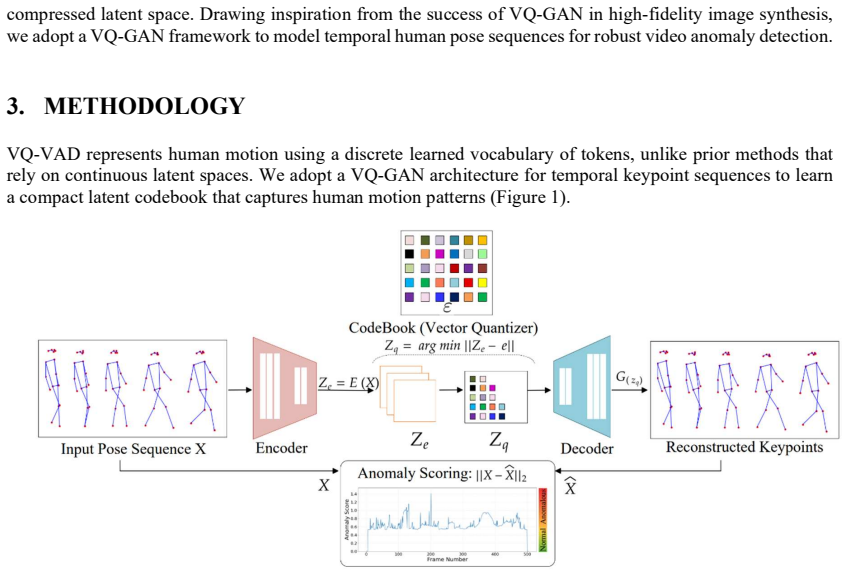
The load-bearing object is the vector-quantized autoencoder with adversarial training. A 1D temporal-convolutional encoder maps each keypoint sequence to a continuous latent, a finite codebook of 1024 learned motion embeddings replaces each latent by its nearest neighbor, and a decoder reconstructs the sequence from those discrete tokens. The training loss combines reconstruction MSE, a commitment loss that ties encoder outputs to codebook entries, and an adversarial loss from a discriminator that encourages temporally realistic motion. At inference, the squared reconstruction error over the quantized sequence acts as the anomaly score, and the codebook itself is the 'motion vocabulary' of normal behavior.
What would settle it
Take the same test videos, extract keypoints with two independent pose estimators, and run the frozen VQ-VAD model on both sets; if the AUC-ROC differs by more than a few points across estimators, or if adding controlled Gaussian noise to joint coordinates of normal sequences produces reconstruction errors as large as those of true anomalies, the anomaly signal is dominated by pose-estimation artifacts rather than behavioral content.
Extended reading notes
Core claim
On its own terms, the paper establishes a new application of discrete representation learning to pose-based video anomaly detection. VQ-VAD encodes 48-frame keypoint windows into continuous latents, maps each latent to its nearest neighbor in a learned 1024-entry motion codebook, and reconstructs the keypoint sequence from the discrete tokens. Training on normal sequences only, the model uses mean-squared reconstruction error as the anomaly score, taking the maximum error over individuals in a frame. The central result is that this tokenized representation generalizes: training on the Panoptic lab dataset reaches 75.09% AUC-ROC on SHT and 76.69% on HR-SHT without any target-domain adaptation, and in-domain training reaches 81.83% on HR-SHT. The paper argues this is because the codebook learns transferable motion primitives rather than scene-specific appearance, and shows the largest gains over a normalizing-flow baseline on the harder HuVAD dataset under domain shift (59.66% vs 54.32%).
Load-bearing premise
The input keypoint sequences must be clean, consistently normalized, and directly comparable across the source and target datasets, even though the paper does not specify the pose estimator, keypoint normalization, or how 2D and 3D keypoints are aligned, so measured reconstruction errors could partly reflect pose-estimation noise rather than abnormal behavior.
Editorial extensions
If this is right
- If the claim holds, pose-based anomaly detectors can be trained on one motion-capture domain and deployed on surveillance cameras without per-scene retraining, since the discrete tokens encode motion rather than appearance.
- Reconstruction-error thresholding with standard criteria like equal error rate is sufficient for deployment, giving a practical anomaly alarm from a single score per frame.
- Larger codebooks (up to 1024 tokens) and lower temporal compression (F4) improve reconstruction fidelity, so system designers can trade codebook size against compute for target accuracy.
- Frame-level scoring as the maximum over individuals means one deviant person flags the frame, making the method conservative toward missed anomalies while raising the risk of false alarms in dense crowds.
- The discrete representation supports interpretable analysis, since each reconstruction failure can be attributed to the nearest codebook entries the sequence fails to match.
Reading between the lines
- A natural extension beyond the paper is to use the discrete token sequence itself, not just its reconstruction error, for anomaly localization: the specific codebook entries that fail to explain a motion window could indicate which body region deviates.
- Because the paper does not specify the pose estimator or keypoint normalization, a controlled comparison of two pose detectors on identical video would reveal whether reconstruction errors reflect behavior or input noise; such an experiment would sharpen the method's claims of domain transfer.
- The motion vocabulary might serve as a shared representation for other human-centric tasks, such as activity recognition or motion retrieval, since the same tokens are learned without anomaly labels.
- An adaptive-scoring variant could maintain per-scene token statistics online and flag tokens that become rare, potentially improving sensitivity on datasets like HuVAD where the paper's cross-domain scores remain near 57-60%.
Signed reviews
Editorial analysis
A structured set of objections, weighed in public.
Referee Report
Summary. The paper proposes VQ-VAD, a pose-based video anomaly detection framework that adapts VQ-GAN to temporal keypoint sequences. An encoder maps a keypoint sequence to a continuous latent, a learned codebook quantizes it into discrete motion tokens, and a decoder reconstructs the sequence; the reconstruction error serves as the frame-level anomaly score. The model is trained only on normal motion. Experiments cover three protocols: in-domain, cross-domain (CMU Panoptic to SHT/HR-SHT/NWPUC/HuVAD), and cross-dataset (SHT to NWPUC/HuVAD). The paper reports competitive AUC-ROC values, e.g., 81.83% in-domain on HR-SHT, 76.69% cross-domain on HR-SHT, and 59.66% cross-dataset on HuVAD.
Significance. If the claims hold, the paper introduces a plausible and novel direction for pose-based VAD: learning a discrete motion vocabulary that transfers across domains. The training and inference pipeline is coherent, the use of no anomaly labels is a strength, and the evaluation across three protocols is broader than typical in this area. The promise of public code is also a plus. However, the central attribution of the results to vector quantization is not supported by a matched continuous-latent control, and the single-run AUC values with no variance estimates weaken the quantitative claims. These issues are addressable but currently limit confidence in the paper's main contribution.
major comments (4)
- [Section 4.2, Table 3] The central claim that discrete motion representations are beneficial is not isolated by any control condition. Every comparison in Table 3 is against a separately trained method with a different architecture, loss, and preprocessing. To support the claim that vector quantization is the decisive ingredient, the authors should compare VQ-VAD against a matched continuous-latent autoencoder using the same encoder, decoder, adversarial loss, and reconstruction-error scoring, with only the quantization step removed or replaced by a continuous bottleneck. Without this ablation, the reported in-domain and cross-domain results could be attributed to the temporal convolutional encoder-decoder, the adversarial loss, or the scoring mechanism rather than to the learned codebook.
- [Section 3.1] The pose extraction and preprocessing pipeline is critically underspecified. The paper does not state which pose detector is used for SHT, HR-SHT, NWPUC, or HuVAD, how keypoints are normalized across datasets with different camera viewpoints and skeleton scales, or how 2D (CMU Panoptic) and 2D/3D keypoints from other benchmarks are aligned into the common representation X ∈ R^{F×C}. Since all anomaly scores are computed in this input space, pose-estimation noise or inconsistent coordinate conventions could dominate the reconstruction error and drive the reported AUC differences. The authors should specify the detector, normalization, and any keypoint-confidence filtering, and ideally include an analysis of pose-estimation noise on the anomaly scores.
- [Section 4.2, Tables 3 and 4] All AUC-ROC results are reported as single runs with no standard deviations, confidence intervals, or significance tests. This is especially important for the headline cross-dataset and cross-domain comparisons: the HuVAD in-domain gap (VQ-VAD 65.33 vs. STG-NF 57.57) and the cross-dataset gap (59.66 vs. 54.32) could be within run-to-run variance, given the typical instability of adversarial training. The authors should report mean and standard deviation over multiple seeds (at least three) and, for the key comparisons, a paired significance test or an alternative such as multiple-run bootstrap intervals.
- [Section 4.1.3 and 4.2] The model configuration F4-K1024 is selected solely on reconstruction metrics from the CMU Panoptic validation set (Table 1), but no ablation studies the effect of codebook size K or temporal compression factor on anomaly detection performance. The mapping from reconstruction quality (MPJPE, L1, TS) to anomaly detection AUC is not established. To strengthen the paper, the authors should report at least a small ablation varying K and compression in the in-domain setting on one benchmark (e.g., SHT), showing whether the configuration chosen for reconstruction is also optimal for anomaly discrimination.
minor comments (5)
- [Section 3.1, Eq. (3)] The formula labeled L1 reconstruction error appears to square the absolute difference (the notation 'ห...หଶ' with subscript 2), which is inconsistent with the text describing an average of absolute differences and with the name L1. Please correct the formula to use the absolute value without squaring, or rename the metric.
- [Table 1] The first row is labeled '𝐹4−𝐾2556' which appears to be a typo for F4-K256; also, the ordering of rows is not strictly by increasing codebook size or compression, which makes the table harder to read.
- [Table 2] Table 2 lists SHT, NWPUC, and HuVAD but omits HR-SHT, although HR-SHT is a primary benchmark in Table 3. Please add the HR-SHT statistics or explain that they are part of the SHT row.
- [References] References [24] and [25] appear unrelated to video anomaly detection (radiation therapy planning and influencer impact on affective polarization). Please verify whether these citations are necessary and, if not, remove them to avoid distracting the reader.
- [Section 4.2.3 and Table 4] The cross-dataset experiment compares only VQ-VAD and STG-NF. Since the paper claims 'stronger robustness of VQ-VAD's discrete motion representations under domain shift,' including at least one additional recent pose-based baseline with published cross-dataset numbers would make the comparison more convincing.
Circularity Check
No circular derivation: VQ-VAD's reconstruction-error scores come from an unlabeled normal-only-trained model and are reported as threshold-free AUC-ROC.
full rationale
The derivation chain is not circular. Section 3.2 defines the anomaly score as the reconstruction error ||X - X_hat||^2 produced by an encoder-quantizer-decoder trained end-to-end on normal sequences only, with no anomaly labels in the training objective. The reported in-domain, cross-domain, and cross-dataset numbers in Tables 3 and 4 are AUC-ROC, a threshold-free ranking metric, so no threshold is fit to test labels; the threshold discussion in Section 3.2 is explicitly for deployment and is not used in the reported scores. Hyperparameters such as temporal compression F4 and codebook size K=1024 are selected in Section 4.1.3 by reconstruction quality (MPJPE, L1) on the CMU Panoptic validation split, not by anomaly-detection test performance; this is standard model selection, not circularity. Self-citations ([1], [6], [7], [19], [20], [26]) appear only as related-work context, benchmark citations, or comparison baselines; no load-bearing premise is justified solely by a self-citation, and no uniqueness theorem is imported from the authors' prior work. The absence of a matched continuous-latent ablation is a genuine internal-validity concern for the claim that quantization, rather than the architecture or adversarial loss, drives performance, but that is a missing control, not an equivalence between prediction and input. No equation or definition reduces the reported results to the training objective or to a fitted parameter by construction. Therefore no circular step is exhibited.
Assumptions & free parameters
free parameters (3)
- Codebook size K =
1024
- Temporal compression factor =
4x
- Adversarial loss weight lambda =
0.5
assumptions (3)
- domain assumption Reconstruction error separates normal from abnormal motion: normal motions are well covered by the learned codebook and anomalies are not.
- domain assumption Keypoint inputs are accurate enough that reconstruction error reflects behavioral abnormality rather than pose-estimation noise.
- domain assumption A motion codebook trained on CMU Panoptic transfers to real surveillance scenes.
Cite this review
Pith. "Pith review of VQ-VAD: Vector-quantized Motion Representation Learning for Human-centric Video Anomaly Detection." pith.science (2026). https://pith.science/paper/5UVWUVQM
@misc{pith2026260805069,
  author       = {Pith},
  title        = {Pith review of: VQ-VAD: Vector-quantized Motion Representation Learning for Human-centric Video Anomaly Detection},
  year         = {2026},
  howpublished = {\url{https://pith.science/paper/5UVWUVQM}},
  note         = {Machine review of arXiv:2608.05069}
}
read the original abstract
Video Anomaly Detection (VAD) is inherently challenging due to the scarcity of anomalies and the large visual variability in surveillance footage, including changes in lighting, viewpoint, and human appearance. To mitigate visual noise and address privacy concerns, recent work has shifted to pose-based VAD, which focuses on motion dynamics rather than raw video data. However, existing pose-based approaches model human behavior in continuous latent spaces, limiting their ability to learn compact motion patterns necessary for robust behavior analysis. We address this by proposing Vector-Quantized Video Anomaly Detection (VQ-VAD), a novel human-centric anomaly detection framework that learns discrete motion representations. VQ-VAD adapts Vector-Quantized GAN (VQ-GAN), originally developed for image generation, to operate on keypoint sequences and construct a motion codebook of normal behavior. Trained exclusively on normal motion sequences, VQ-VAD detects anomalies by identifying high reconstruction errors when an observed motion sequence cannot be mapped to the learned codebook. We conduct extensive experiments across three complementary evaluation settings, including in-domain, cross-domain, and cross-dataset generalization, on four anomaly detection benchmarks. VQ-VAD achieves strong in-domain accuracy (81.83% on HR-SHT [15]), effective cross-domain transfer from CMU Panoptic [14] (76.69% on HR-SHT [15] without retraining), and competitive cross-dataset robustness. The code base for this work is available at https://github.com/TeCSAR-UNCC/VQ-VAD.
Figures
Reference graph
Works this paper leans on
-
[1]
Understanding the challenges and opportunities of pose-based anomaly detection
Ghazal Alinezhad Noghre, Armin Danesh Pazho, Vinit Katariya, and Hamed Tabkhi. Understanding the challenges and opportunities of pose-based anomaly detection. In Proceedings of the 8th International Workshop on Sensor-Based Activity Recognition and Artificial Intelligence, New York, NY, USA, 2023. Association for Computing Machinery
work page 2023
-
[2]
Multi-task learning based video anomaly detection with attention
Mohammad Baradaran and Robert Bergevin. Multi-task learning based video anomaly detection with attention. In Proceedings of the IEEE/CVF Conference on Computer Vision and Pattern Recognition (CVPR) Workshops, pages 2886–2896, 2023
work page 2023
-
[3]
A new comprehensive benchmark for semi-supervised video anomaly detection and anticipation
Congqi Cao, Yue Lu, Peng Wang, and Yanning Zhang. A new comprehensive benchmark for semi-supervised video anomaly detection and anticipation. In Proceedings of the IEEE/CVF conference on computer vision and pattern recognition, pages 20392–20401, 2023
work page 2023
-
[4]
Xiaoyu Chen, Shichao Kan, Fanghui Zhang, Yigang Cen, Linna Zhang, and Damin Zhang. Multiscale spatial temporal attention graph convolution network for skeleton-based anomaly behavior detection. Journal of Visual Communication and Image Representation, 90:103707, 2023
work page 2023
-
[5]
Kai-Wen Cheng, Yie-Tarng Chen, and Wen-Hsien Fang. Gaussian process regression-based video anomaly detection and localization with hierarchical feature representation. IEEE Transactions on Image Processing, 24(12):5288–5301, 2015
work page 2015
-
[6]
Chad: Charlotte anomaly dataset
Armin Danesh Pazho, Ghazal Alinezhad Noghre, Babak Rahimi Ardabili, Christopher Neff, and Hamed Tabkhi. Chad: Charlotte anomaly dataset. In Scandinavian Conference on Image Analysis, pages 50–66. Springer, 2023
work page 2023
-
[7]
Armin Danesh Pazho, Shanle Yao, Ghazal Alinezhad Noghre, Babak Rahimi Ardabili, Vinit Katariya, and Hamed Tabkhi. Towards adaptive human-centric video anomaly detection: A comprehensive framework and a new benchmark. arXiv e-prints, pages arXiv–2408, 2024
work page 2024
-
[8]
Taming transformers for high-resolution image synthesis
Patrick Esser, Robin Rombach, and Bj¨orn Ommer. Taming transformers for high-resolution image synthesis. In Proceedings of the IEEE/CVF Conference on Computer Vision and Pattern Recognition (CVPR), pages 12873–12883. IEEE, 2021
work page 2021
Show all 26 references
-
[9]
Long video generation with time-agnostic vqgan and time sensitive transformer
Songwei Ge, Thomas Hayes, Harry Yang, Xi Yin, Guan Pang, David Jacobs, Jia-Bin Huang, and Devi Parikh. Long video generation with time-agnostic vqgan and time sensitive transformer. In Computer Vision – ECCV 2022, pages 102–118. Springer, 2022
2022
-
[10]
Learning temporal regularity in video sequences
Mahmudul Hasan, Jonghyun Choi, Jan Neumann, Amit K Roy-Chowdhury, and Larry S Davis. Learning temporal regularity in video sequences. In Proceedings of the IEEE conference on computer vision and pattern recognition, pages 733–742, 2016
2016
-
[11]
Normalizing flows for human pose anomaly detection
Or Hirschorn and Shai Avidan. Normalizing flows for human pose anomaly detection. In Proceedings of the IEEE/CVF International Conference on Computer Vision, pages 13545–13554, 2023
2023
-
[12]
Hierarchical graph embedded pose regularity learning via spatio-temporal transformer for abnormal behavior detection
Chao Huang, Yabo Liu, Zheng Zhang, Chengliang Liu, Jie Wen, Yong Xu, and Yaowei Wang. Hierarchical graph embedded pose regularity learning via spatio-temporal transformer for abnormal behavior detection. In Proceedings of the 30th ACM International Conference on Multimedia, pa...
2022
-
[13]
Posecvae: Anomalous human activity detection
Yashswi Jain, Ashvini Kumar Sharma, Rajbabu Velmurugan, and Biplab Banerjee. Posecvae: Anomalous human activity detection. In 2020 25th International Conference on Pattern Recognition (ICPR), pages 2927–2934. IEEE, 2021
2020
-
[14]
Panoptic studio: A massively multiview system for social motion capture
Hanbyul Joo, Hao Liu, Lei Tan, Lin Gui, Bart Nabbe, Iain Matthews, Takeo Kanade, Shohei Nobuhara, and Yaser Sheikh. Panoptic studio: A massively multiview system for social motion capture. In Proceedings of the IEEE international conference on computer vision, pages 3334–3342, 2015
2015
-
[15]
Future frame prediction for anomaly detection–a new baseline
Wen Liu, Weixin Luo, Dongze Lian, and Shenghua Gao. Future frame prediction for anomaly detection–a new baseline. In Proceedings of the IEEE conference on computer vision and pattern recognition, pages 6536–6545, 2018
2018
-
[16]
Regularity learning via explicit distribution modeling for skeletal video anomaly detection
Shoubin Yu, Zhongyin Zhao, Haoshu Fang, Andong Deng, Haisheng Su, Dongliang Wang, Weihao Gan, Cewu Lu, and Wei Wu. Regularity learning via explicit distribution modeling for skeletal video anomaly detection. IEEE Transactions on Circuits and Systems for Video Technology, 2023
2023
-
[17]
Graph embedded pose clustering for anomaly detection
Amir Markovitz, Gilad Sharir, Itamar Friedman, Lihi Zelnik Manor, and Shai Avidan. Graph embedded pose clustering for anomaly detection. In Proceedings of the IEEE/CVF Conference on Computer Vision and Pattern Recognition, pages 10539–10547, 2020
2020
-
[18]
Learning regularity in skeleton trajectories for anomaly detection in videos
Romero Morais, Vuong Le, Truyen Tran, Budhaditya Saha, Moussa Mansour, and Svetha Venkatesh. Learning regularity in skeleton trajectories for anomaly detection in videos. In Proceedings of the IEEE/CVF conference on computer vision and pattern recognition, pages 11996–12004, 2019
2019
-
[19]
An exploratory study on human-centric video anomaly detection through variational autoencoders and trajectory prediction
Ghazal Alinezhad Noghre, Armin Danesh Pazho, and Hamed Tabkhi. An exploratory study on human-centric video anomaly detection through variational autoencoders and trajectory prediction. In Proceedings of the IEEE/CVF Winter Conference on Applications of Computer Vision, pages 9...
2024
-
[20]
Shopformer: Transformer-based framework for detecting shoplifting via human pose
Narges Rashvand, Ghazal Alinezhad Noghre, Armin Danesh Pazho, Babak Rahimi Ardabili, and Hamed Tabkhi. Shopformer: Transformer-based framework for detecting shoplifting via human pose. In Proceedings of the Computer Vision and Pattern Recognition Conference, pages 5752–5761, 2025
2025
-
[21]
Multi-timescale trajectory prediction for abnormal human activity detection
Royston Rodrigues, Neha Bhargava, Rajbabu Velmurugan, and Subhasis Chaudhuri. Multi-timescale trajectory prediction for abnormal human activity detection. In Proceedings of the IEEE/CVF winter conference on applications of computer vision, pages 2626–2634, 2020
2020
-
[22]
Memory-augmented appearance-motion network for video anomaly detection
Le Wang, Junwen Tian, Sanping Zhou, Haoyue Shi, and Gang Hua. Memory-augmented appearance-motion network for video anomaly detection. Pattern Recognition, 138:109335, 2023
2023
-
[23]
Generative cooperative learning for unsupervised video anomaly detection
M Zaigham Zaheer, Arif Mahmood, M Haris Khan, Mattia Segu, Fisher Yu, and Seung-Ik Lee. Generative cooperative learning for unsupervised video anomaly detection. In Proceedings of the IEEE/CVF conference on computer vision and pattern recognition, pages 14744–14754, 2022
2022
-
[24]
and Ge, Y., 2025, October
Ghorbani, O., Helmy, A., Wu, Q.J. and Ge, Y., 2025, October. Examining Radiation Therapy Planning Knowledge in Large Language Models. In Proceedings of the 16th ACM International Conference on Bioinformatics, Computational Biology, and Health Informatics (pp. 1-1)
2025
-
[25]
and Terejanu, G., 2024, December
Rashid, R., Melton, J., Ghorbani, O., Krishnan, S., Reid, S. and Terejanu, G., 2024, December. Quantifying Influencer Impact on Affective Polarization. In 2024 International Conference on Machine Learning and Applications (ICMLA) (pp. 1135-1140). IEEE
2024
-
[26]
and Tabkhi, H., 2026
Yao, S., Rashvand, N., Pazho, A.D. and Tabkhi, H., 2026. From Offline to Periodic Adaptation for Pose-Based Shoplifting Detection in Real-world Retail Security. IEEE Internet of Things Journal
2026
Reviewed August 6, 2026 · model on record in the stance chip above.
Discussion (0). Continue with ORCID to comment.