REVIEW 3 major objections 6 minor 51 references
Union-Intersection Union-Find for Decoding Depolarizing Errors in Topological Codes
T0 review · 3 major / 6 minor · reviewed 2026-08-15 · deepseek-v4-flash
Pith's one-line read UIUF provably corrects depolarizing errors on toric and surface codes up to half the code distance in linear time, and outperforms MWPM on rotated surface codes in simulations.
desk verdict A genuinely new UF variant with strong simulations, but the half-distance proof has a load-bearing gap: diameter is substituted for erasure count, and the diameter bound itself is asserted, not proved. read the letter →
The pith
A machine-rendered reading of the paper's core claim, the machinery that carries it, and where it could break.
The reading
What carries the argument
The load-bearing object is the cluster produced by syndrome validation: a connected component of check nodes in a decoding graph, grown until it is consistent with some error matching the observed syndrome. The new mechanism is the intersection step, in which a qubit is added to the erasure set whenever the edge it represents in $G_X$ lies inside a cluster of $L_X$ and the corresponding edge in $G_Z$ lies inside a cluster of $L_Z$. This converts likely Y-error locations into known erasures before the final Union-Find calls, which is how the decoder uses X/Z correlations without iterating. The proof then uses cluster-diameter bounds, at most $2t+r$ for a Pauli error of weight $t$ with $r$ erasures, to show the enlarged erasure set still satisfies the erasure-plus-error condition of the standard Union-Find guarantee, so Lemma 6 applies.
What would settle it
Enumerate all Pauli errors of weight $\lfloor (d-1)/2\rfloor$ on a small code where the bound matters, such as the [[25,1,4]] surface code or the [[72,2,6]] toric code, and run UIUF on each syndrome; a single logical failure would disprove Theorem 8. To isolate the proof's weak step, construct two valid clusters, one in $G_X$ and one in $G_Z$, whose intersection as edge sets has diameter strictly larger than the smaller of the two cluster diameters; that would contradict the diameter claim used to derive the inequalities in the proof.
Extended reading notes
Core claim
The central discovery, stated on the paper's own terms, is that a non-iterative decoder can exploit X/Z correlations and still keep a distance guarantee. The UIUF procedure is: syndrome-validation on each decoding graph produces a collection of valid clusters; the intersection step marks a qubit as an erasure exactly when the edges it represents in $G_X$ and $G_Z$ are both covered by their respective clusters; two ordinary Union-Find calls then produce the corrections using the enlarged erasure set. Because a Y error contributes to both decoding graphs, its position tends to be covered by both clusters and is thereby turned into a known erasure, which makes the remaining X and Z subproblems easier. Theorem 8 states that on a distance-$d$ toric or surface code, UIUF corrects up to r erasure errors plus a Pauli error of weight t on the remaining qubits whenever $r+2t<d$; in particular it corrects all errors of weight at most $\lfloor (d-1)/2\rfloor$. The complexity remains $O(n)$, and the proof works by bounding the diameter of the intersection erasure set by the smaller of the two cluster diameters plus $r$, which reduces the required condition to the same $r+2t<d$ as the standard Union-Find guarantee.
Load-bearing premise
The proof of Theorem 8 rests on the asserted, not separately proved, bound that the erasure set formed by intersecting an X-cluster and a Z-cluster has diameter no larger than the smaller of the two cluster diameters; if that diameter bound gives way, the half-distance guarantee does not follow.
Editorial extensions
If this is right
- UIUF corrects every error of weight at most $\lfloor (d-1)/2\rfloor$ on a distance-$d$ toric or surface code, giving it the same half-distance guarantee as the standard Union-Find decoder.
- The guarantee is stated for the mixed setting of $r$ erasures plus $t$ Pauli errors with $r+2t<d$, so the decoder also applies directly to erasure-assisted decoding problems.
- The decoder keeps $O(n)$ worst-case complexity, with measured average runtime about 1.53 times that of Union-Find, so the performance gain does not sacrifice linear-time decoding.
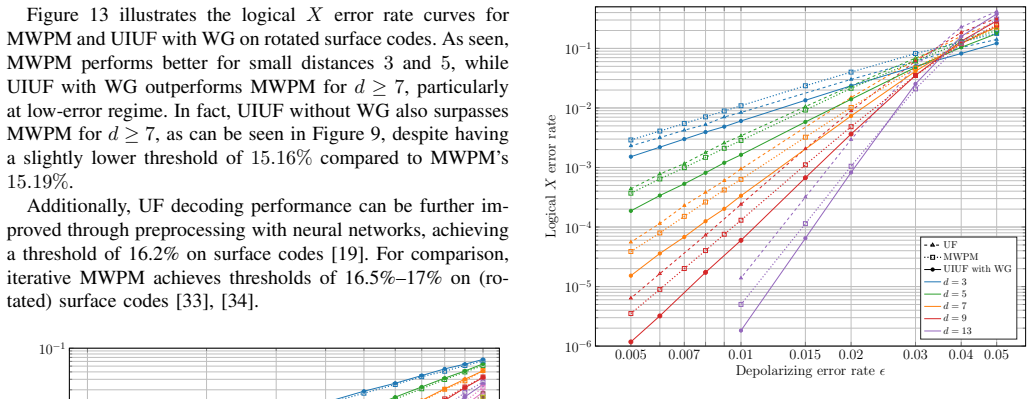
- On rotated surface codes, UIUF with weighted growth achieves lower logical error rates than MWPM for distance at least 7 under both code-capacity and phenomenological noise, even where its phenomenological threshold is lower than MWPM's.
- Under biased noise with $p_Y=p_X$, UIUF's advantage over Union-Find persists for bias ratios below 100 and disappears above about 1000.
Reading between the lines
- The diameter-based structure of the proof suggests the guarantee likely transfers to other bounded-degree CSS topological codes whose decoding graphs obey the same cluster-diameter bound, so UIUF is a natural candidate for other lattice geometries.
- The intersection erasure set could be exported as a preprocessing step for other decoders such as reweighted MWPM or belief propagation; one could test whether marking the same qubits as erasures improves their low-error-rate performance without iteration.
- Because UIUF's advantage over MWPM concentrates at low error rates and larger distances, a practical decoder might use UIUF's fast clustering for most shots and invoke a more expensive decoder only when the intersection step produces an unusually large or ambiguous erasure set.
Signed reviews
Editorial analysis
A structured set of objections, weighed in public.
Referee Report
Summary. The paper proposes the Union-Intersection Union-Find (UIUF) decoder for CSS topological codes, which uses the intersection of syndrome-validation clusters in the X and Z decoding graphs as an erasure set before running two UF decoding steps. The authors claim that UIUF corrects all errors of weight up to half the code distance while retaining O(n) time complexity, and they support this with extensive simulations under code-capacity, phenomenological, and biased noise models, reporting logical error rates below UF and, on rotated surface codes, below MWPM, as well as threshold estimates.
Significance. If the distance guarantee of Theorem 8 is valid, UIUF is a valuable practical decoder: it offers an order-of-magnitude improvement in logical error rate over UF in the low-error regime, a provable worst-case linear-time complexity, and a parameter-free algorithm with no fitted constants. The simulation study is broad (four code families, three noise models, runtime benchmarks) and the comparisons with standard UF and PyMatching-based MWPM are informative. However, the central theoretical contribution is Theorem 8, and the correctness of its proof is essential to the paper's claims. The manuscript's proof of Theorem 8 has significant gaps, detailed below; the numerical results alone cannot establish the claimed distance guarantee. With a complete proof, this would be a strong contribution; in its current form, the main theoretical claim is not rigorously supported.
major comments (3)
- [§IV-A, proof of Theorem 8] The proof asserts without proof that the set I of qubits covered by both an LX cluster and an LZ cluster has connected components of diameter at most min{2s+2q, 2t−2s}+r. A connected component of I may be formed by qubits whose GX-edges belong to one cluster while their GZ-edges belong to several different clusters (and vice versa); it need not be contained in any single GX or GZ cluster. The manuscript does not provide a bound for such alternating components, so the inequalities in Eqs. (2) and (3) are not justified.
- [§IV-A, invocation of Lemma 6] Lemma 6 is stated for r erasure qubits, i.e., an erasure count, not for an erasure set of bounded diameter. The proof of Theorem 8 substitutes a claimed diameter bound for the erasure count and then invokes Lemma 6 without deriving a separate statement that a UF decoder corrects t errors when the erasure set has diameter D and D+2t<d. Such a lemma is plausible and may follow from the methods of [13], but it is not stated or proved, so the logical step from diameter to correction is missing.
- [§IV-A, coverage of Y errors] The sentence 'Note that the Y errors are now covered by erasures' is central to the proof, but no argument is given that every Y error's edges are always contained in the final LX and LZ clusters. If a Y error lies outside either cluster, the remaining error counts in the subsequent UF subroutines exceed s or t−s−q, and the diameter bounds (2) and (3) no longer apply. The proof needs an explicit argument that the syndrome-validation clusters cover the support of every Y error.
minor comments (6)
- [§II-B] The word 'deomposed' should be 'decomposed'.
- [§I] The phrase 'Then we introduced the UIUF decoder' should be 'Then we introduce the UIUF decoder'.
- [Abstract and §V-C] The abstract claims that UIUF achieves lower logical error rates than MWPM on rotated surface codes under both noise models without qualification; in Figures 13 and 14, MWPM performs better for small distances (d=3,5) and, in the phenomenological model, for d=13 above ϵ=0.03. The abstract should state the regime where UIUF is superior.
- [Table II] The caption says 'total errors' but it is unclear what set of errors is counted; please clarify whether these are all weight-(t+1) Pauli errors and specify the counting convention.
- [§IV-A] The term 'diameter' is used throughout the proof of Theorem 8 but never formally defined; please specify the graph metric (decoding graph or lattice) and whether it applies to vertices or edges of the clusters and erasure sets.
- [Algorithm 1 and Figure 8] The notation for the iteration limit is inconsistent: 'iter max' in Algorithm 1, 'itermax' in Figures 8 and the text. Please unify.
Circularity Check
No significant circularity: UIUF's distance guarantee rests on external UF/peeling lemmas and simulation thresholds are fitted outputs, not fitted inputs.
full rationale
The derivation chain is self-contained relative to external prior work. Theorem 8's guarantee is built on Lemma 3 (the Delfosse–Zemor peeler) and Lemma 6 (the Delfosse–Nickerson Union-Find decoder), both cited from outside the authors' own prior results, so the central claim is not justified by a self-citation chain. Algorithm 2 contains no fitted constants: the intersection erasure set is defined directly from the valid clusters produced by syndrome validation, and the error-correction claim is argued from cluster-diameter bounds plus the external Lemma 6. All reported thresholds are outputs of Monte Carlo data fitting to the finite-size scaling ansatz pL = f(d^{1/ν}(ε−τ)), so the thresholds are not inputs disguised as predictions or renamed outputs. The self-citations that do appear ([26], [27], [45], [46], [47]) are used only for background on belief propagation, for the phenomenological-noise model definition, and for the logical-error-rate formula; none carries the load-bearing decoding guarantee. One genuine weakness should be flagged, but it is not circularity: in Section IV-A the proof asserts, without proof, that the intersection erasure set has diameter at most min{2s+2q, 2t−2s}+r, and it applies Lemma 6 using this diameter bound rather than Lemma 6's stated erasure-count condition r+2t<d. That is a possible correctness gap in the proof of Theorem 8, but it does not reduce the theorem to its own assumptions, to a fitted parameter, or to a self-citation. Because the central claim does not reduce by construction to its inputs, the circularity score is 0.
Assumptions & free parameters
assumptions (4)
- domain assumption Union-Find decoder guarantee (Lemma 6 of [13])
- domain assumption Peeling decoder erasure-correction capability (Lemma 3 of [12])
- domain assumption Cluster diameter bound after syndrome validation is at most 2t+r for t errors and r erasures
- ad hoc to paper Connected components of the intersection of LX and LZ clusters have diameter at most the minimum of the two cluster diameters
Cite this review
Pith. "Pith review of Union-Intersection Union-Find for Decoding Depolarizing Errors in Topological Codes." pith.science (2026). https://pith.science/paper/5V3NOJUW
@misc{pith2026250614745,
  author       = {Pith},
  title        = {Pith review of: Union-Intersection Union-Find for Decoding Depolarizing Errors in Topological Codes},
  year         = {2026},
  howpublished = {\url{https://pith.science/paper/5V3NOJUW}},
  note         = {Machine review of arXiv:2506.14745}
}
abstract
In this paper, we introduce the Union-Intersection Union-Find (UIUF) algorithm for decoding depolarizing errors in topological codes, combining the strengths of iterative and standard Union-Find (UF) decoding. While iterative UF improves performance at moderate error rates, it lacks an error correction guarantee. To address this, we develop UIUF, which maintains the enhanced performance of iterative UF while ensuring error correction up to half the code distance. Through simulations under code capacity, phenomenological, and biased noise models, we show that UIUF significantly outperforms UF, reducing the logical error rate by over an order of magnitude (at around $10^{-5}$). Moreover, UIUF achieves lower logical error rates than the Minimum Weight Perfect Matching (MWPM) decoder on rotated surface codes under both the code capacity and phenomenological noise models, while preserving efficient linear-time complexity.
Figures


Figures from the paper (13 more)




Reference graph
Works this paper leans on
-
[13]
Almost-linear time decoding algo- rithm for topological codes,
N. Delfosse and N. H. Nickerson, “Almost-linear time decoding algo- rithm for topological codes,” Quantum, vol. 5, p. 595, Dec. 2021
work page 2021
-
[1]
Algorithms for quantum computation: Discrete logarithms and factoring,
P. W. Shor, “Algorithms for quantum computation: Discrete logarithms and factoring,” in Proc. Annu. Symp. Found. Comput. Sci. (FOCS), 1994, pp. 124–134
work page 1994
-
[2]
A fast quantum mechanical algorithm for database search,
L. K. Grover, “A fast quantum mechanical algorithm for database search,” in Proc. Annu. ACM Symp. Theory Comput. (STOC) , 1996, pp. 212–219
work page 1996
-
[3]
Scheme for reducing decoherence in quantum computer memory,
P. W. Shor, “Scheme for reducing decoherence in quantum computer memory,” Phys. Rev. A, vol. 52, pp. 2493–2496, 1995
work page 1995
-
[4]
Good quantum error-correcting codes exist,
A. R. Calderbank and P. W. Shor, “Good quantum error-correcting codes exist,” Phys. Rev. A, vol. 54, p. 1098, 1996
work page 1996
-
[5]
Error correcting codes in quantum theory,
A. M. Steane, “Error correcting codes in quantum theory,” Phys. Rev. Lett., vol. 77, p. 793, 1996
work page 1996
-
[6]
Stabilizer codes and quantum error correction,
D. Gottesman, “Stabilizer codes and quantum error correction,” Ph.D. dissertation, California Institute of Technology, Pasadena, CA, USA,
-
[7]
Fault-tolerant quantum computation by anyons,
A. Y . Kitaev, “Fault-tolerant quantum computation by anyons,” Ann. Phys., vol. 303, no. 1, pp. 2–30, 2003, arXiv preprint quant-ph/9707021
arXiv 2003
Show all 51 references
-
[8]
Quantum codes on a lattice with boundary,
S. B. Bravyi and A. Y . Kitaev, “Quantum codes on a lattice with boundary,” arXiv preprint quant-ph/9811052 , 1998
1998 arXiv
-
[9]
Optimal resources for topolog- ical two-dimensional stabilizer codes: Comparative study,
H. Bombin and M. A. Martin-Delgado, “Optimal resources for topolog- ical two-dimensional stabilizer codes: Comparative study,” Phys. Rev. A, vol. 76, p. 012305, 2007
2007
-
[10]
Surface codes: Towards practical large-scale quantum computation,
A. G. Fowler, M. Mariantoni, J. M. Martinis, and A. N. Cleland, “Surface codes: Towards practical large-scale quantum computation,” Phys. Rev. A, vol. 86, p. 032324, 2012
2012
-
[11]
Topological quantum memory,
E. Dennis, A. Kitaev, A. Landahl, and J. Preskill, “Topological quantum memory,” J. Math. Phys. , vol. 43, no. 9, pp. 4452–4505, 2002
2002
-
[12]
Linear-time maximum likelihood decoding of surface codes over the quantum erasure channel,
N. Delfosse and G. Z ´emor, “Linear-time maximum likelihood decoding of surface codes over the quantum erasure channel,” Phys. Rev. Res. , vol. 2, p. 033042, Jul 2020
2020
-
[14]
Paths, trees, and flowers,
J. Edmonds, “Paths, trees, and flowers,” Can. J. Math. , vol. 17, pp. 449–467, 1965. 12
1965
-
[15]
An interpretation of union-find decoder on weighted graphs,
Y . Wu, N. Liyanage, and L. Zhong, “An interpretation of union-find decoder on weighted graphs,” 11 2022
2022
-
[16]
Worst-case analysis of set union algorithms,
R. E. Tarjan and J. van Leeuwen, “Worst-case analysis of set union algorithms,” J. ACM, vol. 31, no. 2, p. 245–281, Mar. 1984. [Online]. Available: https://doi.org/10.1145/62.2160
1984 doi
-
[17]
Union-find quantum decoding without union-find,
S. J. Griffiths and D. E. Browne, “Union-find quantum decoding without union-find,” Physical Review Research, vol. 6, p. 013154, Feb. 2024
2024
-
[18]
Fault-tolerant weighted union-find decoding on the toric code,
S. Huang, M. Newman, and K. R. Brown, “Fault-tolerant weighted union-find decoding on the toric code,” Physical Review A , vol. 102, no. 1, p. 012419, 2020
2020
-
[19]
Scalable neural decoder for topological surface codes,
K. Meinerz, C.-Y . Park, and S. Trebst, “Scalable neural decoder for topological surface codes,” Phys. Rev. Lett. , vol. 128, p. 080505, Feb
-
[20]
Fusion blossom: Fast mwpm decoders for qec,
Y . Wu and L. Zhong, “Fusion blossom: Fast mwpm decoders for qec,” in 2023 IEEE International Conference on Quantum Computing and Engineering (QCE), vol. 1. IEEE, 2023, pp. 928–938
2023
-
[21]
Sparse blossom: correcting a million errors per core second with minimum-weight matching,
O. Higgott and C. Gidney, “Sparse blossom: correcting a million errors per core second with minimum-weight matching,” Quantum, vol. 9, p. 1600, 2025
2025
-
[22]
Bubble clustering decoder for quantum topological codes,
D. Forlivesi, L. Valentini, and M. Chiani, “Bubble clustering decoder for quantum topological codes,” IEEE Transactions on Communications, pp. 1–1, 2025
2025
-
[23]
A decoding algorithm for CSS codes using the X/Z correlations,
N. Delfosse and J.-P. Tillich, “A decoding algorithm for CSS codes using the X/Z correlations,” in 2014 IEEE International Symposium on Information Theory, 2014, pp. 1071–1075
2014
-
[24]
Low-density parity-check codes,
R. G. Gallager, “Low-density parity-check codes,” IRE Trans. Inf. Theory, vol. 8, no. 1, pp. 21–28, 1962
1962
-
[25]
Pearl, Probabilistic reasoning in intelligent systems: networks of plausible inference
J. Pearl, Probabilistic reasoning in intelligent systems: networks of plausible inference. Kaufmann, 1988
1988
-
[26]
Refined belief propagation decoding of sparse-graph quantum codes,
K.-Y . Kuo and C.-Y . Lai, “Refined belief propagation decoding of sparse-graph quantum codes,” IEEE J. Sel. Areas Inf. Theory , vol. 1, no. 2, pp. 487–498, 2020
2020
-
[27]
Exploiting degeneracy in belief propagation decoding of quantum codes,
——, “Exploiting degeneracy in belief propagation decoding of quantum codes,” npj Quantum Inf., vol. 8, 2022, article no. 111. (See a complete version at https://arxiv.org/abs/2104.13659)
2022 arXiv
-
[28]
Degenerate quantum LDPC codes with good finite length performance,
P. Panteleev and G. Kalachev, “Degenerate quantum LDPC codes with good finite length performance,” Quantum, vol. 5, p. 585, 2021
2021
-
[29]
Decoding across the quantum low-density parity-check code landscape,
J. Roffe, D. R. White, S. Burton, and E. T. Campbell, “Decoding across the quantum low-density parity-check code landscape,” Phys. Rev. Res., vol. 2, p. 043423, 2020
2020
-
[30]
On belief propagation decoding of quantum codes with quaternary reliability statistics,
C.-F. Kung, K.-Y . Kuo, and C.-Y . Lai, “On belief propagation decoding of quantum codes with quaternary reliability statistics,” arXiv preprint arXiv:2305.03321, 2023
2023 arXiv
-
[31]
Optimal complexity correction of correlated errors in the surface code,
A. G. Fowler, “Optimal complexity correction of correlated errors in the surface code,” arXiv preprint arXiv:1310.0863 , 2013
2013 arXiv
-
[32]
Pipelined correlated minimum weight perfect matching of the surface code,
A. Paler and A. G. Fowler, “Pipelined correlated minimum weight perfect matching of the surface code,” Quantum, vol. 7, p. 1205, 2023
2023
-
[33]
A modified MWPM decoding algorithm for quantum surface codes over depolarizing channels,
Y . Yuan and C.-C. Lu, “A modified MWPM decoding algorithm for quantum surface codes over depolarizing channels,” arXiv preprint arXiv:2202.11239, 2022
2022 arXiv
-
[34]
Performance enhancement of surface codes via recursive minimum-weight perfect- match decoding,
A. d. iOlius, J. E. Martinez, P. Fuentes, and P. M. Crespo, “Performance enhancement of surface codes via recursive minimum-weight perfect- match decoding,” Physical Review A , vol. 108, no. 2, p. 022401, 2023
2023
-
[35]
A real-time, scalable, fast and highly resource efficient decoder for a quantum computer,
B. Barber, K. M. Barnes, T. Bialas, O. Bu ˘gdaycı, E. T. Campbell, N. I. Gillespie, K. Johar, R. Rajan, A. W. Richardson, L. Skoric, C. Topal, M. L. Turner, and A. B. Ziad, “A real-time, scalable, fast and highly resource efficient decoder for a quantum computer,” 2023. [Onlin...
2023 arXiv
-
[36]
Hierarchical decoding to reduce hardware requirements for quantum computing,
N. Delfosse, “Hierarchical decoding to reduce hardware requirements for quantum computing,” ArXiv, vol. abs/2001.11427, 2020. [Online]. Available: https://api.semanticscholar.org/CorpusID:210966495
2001 arXiv
-
[37]
Scalable quantum error correction for surface codes using fpga,
N. Liyanage, Y . Wu, A. Deters, and L. Zhong, “Scalable quantum error correction for surface codes using fpga,” in 2023 IEEE 31st Annual International Symposium on Field-Programmable Custom Computing Machines (FCCM), 2023, pp. 217–217
2023
-
[38]
Actis: A Strictly Local Union–Find Decoder,
T. Chan and S. C. Benjamin, “Actis: A Strictly Local Union–Find Decoder,” Quantum, vol. 7, p. 1183, Nov. 2023. [Online]. Available: https://doi.org/10.22331/q-2023-11-14-1183
2023 doi
-
[39]
Threshold error rates for the toric and planar codes,
D. S. Wang, A. G. Fowler, A. M. Stephens, and L. C. L. Hollenberg, “Threshold error rates for the toric and planar codes,” Quantum Inf. Comput., vol. 10, no. 5, pp. 456–469, 2010
2010
-
[40]
Fault-tolerant quantum computation by anyons,
A. Y . Kitaev, “Fault-tolerant quantum computation by anyons,” Annals of Physics, vol. 303, no. 1, pp. 2–30, 2003
2003
-
[41]
Projective plane and planar quantum codes,
M. H. Freedman and D. A. Meyer, “Projective plane and planar quantum codes,” Foundations of Computational Mathematics, vol. 1, pp. 325–332, 2001
2001
-
[42]
Fault-tolerant quantum computation with high threshold in two dimensions,
R. Raussendorf and J. Harrington, “Fault-tolerant quantum computation with high threshold in two dimensions,” Phys. Rev. Lett. , vol. 98, p. 190504, 2007
2007
-
[43]
Codes for the quantum erasure channel,
M. Grassl, T. Beth, and T. Pellizzari, “Codes for the quantum erasure channel,” Physical Review A , vol. 56, no. 1, p. 33, 1997
1997
-
[44]
Efficiency of a good but not linear set union algorithm,
R. E. Tarjan, “Efficiency of a good but not linear set union algorithm,” J. ACM, vol. 22, no. 2, p. 215–225, apr 1975
1975
-
[45]
Quantum data-syndrome codes,
A. Ashikhmin, C.-Y . Lai, and T. A. Brun, “Quantum data-syndrome codes,” IEEE J. Sel. Areas Commun. , vol. 38, no. 3, pp. 449–462, 2020
2020
-
[46]
Generalized quantum data-syndrome codes and belief propagation decoding for phenomenological noise,
K.-Y . Kuo and C.-Y . Lai, “Generalized quantum data-syndrome codes and belief propagation decoding for phenomenological noise,” IEEE Transactions on Information Theory , vol. 71, no. 3, pp. 1824–1840, 2025
2025
-
[47]
Entanglement-assisted quantum error- correcting codes with imperfect ebits,
C.-Y . Lai and T. A. Brun, “Entanglement-assisted quantum error- correcting codes with imperfect ebits,” Phys. Rev. A, vol. 86, p. 032319, Sep 2012
2012
-
[48]
T. M. Cover and J. A. Thomas, Elements of information theory . USA: Wiley-Interscience, 1991
1991
-
[49]
Confinement-Higgs transition in a disordered gauge theory and the accuracy threshold for quantum memory,
C. Wang, J. Harrington, and J. Preskill, “Confinement-Higgs transition in a disordered gauge theory and the accuracy threshold for quantum memory,” Ann. Phys., vol. 303, no. 1, pp. 31–58, 2003. 13
2003
-
[1997]
Available: https://doi.org/10.7907/rzr7-dt72
[Online]. Available: https://doi.org/10.7907/rzr7-dt72
-
[2022]
Available: https://link.aps.org/doi/10.1103/PhysRevLett
[Online]. Available: https://link.aps.org/doi/10.1103/PhysRevLett. 128.080505
Reviewed August 15, 2026 · model on record in the stance chip above.
Discussion (0). Continue with ORCID to comment.