REVIEW 4 major objections 6 minor 81 references
Universal asteroseismology relations mostly fail to predict proto-neutron-star frequencies in core-collapse supernova simulations.
Reviewed by Pith at T0; open to challenge. T0 means a machine referee read the full paper against a public rubric. the ladder, T0–T4 →
T0 review · deepseek-v4-flash
2026-08-01 04:09 UTC pith:5VCZBJSQ
load-bearing objection A careful but mostly visual benchmark of seven PNS universal relations against Chimera 3D/2D CCSN models; the cautionary conclusion is probably right, but the quantitative support is thinner than the prose. the 4 major comments →
Universal relations applied to proto-neutron star generated gravitational waves from three-dimensional core collapse supernova simulations
The pith
A machine-rendered reading of the paper's core claim, the machinery that carries it, and where it could break.
Core claim
The central claim is that universal asteroseismology relations should be used with caution when interpreting a core-collapse supernova detection: with one exception, they do not fit the authors' simulation data. Each relation matches the g-/f-mode feature—the maximum-power frequency in the high-frequency spectrogram—only briefly after bounce, then over- or under-predicts the peak. Solving the relations in reverse, using the simulated peak frequencies to recover mean density or surface gravity, yields similarly time-limited agreement. One relation intended for the 10^10 g/cm^3 surface tracks instead the mean density defined at the 10^11 g/cm^3 contour, so even an apparently successful relatio
What carries the argument
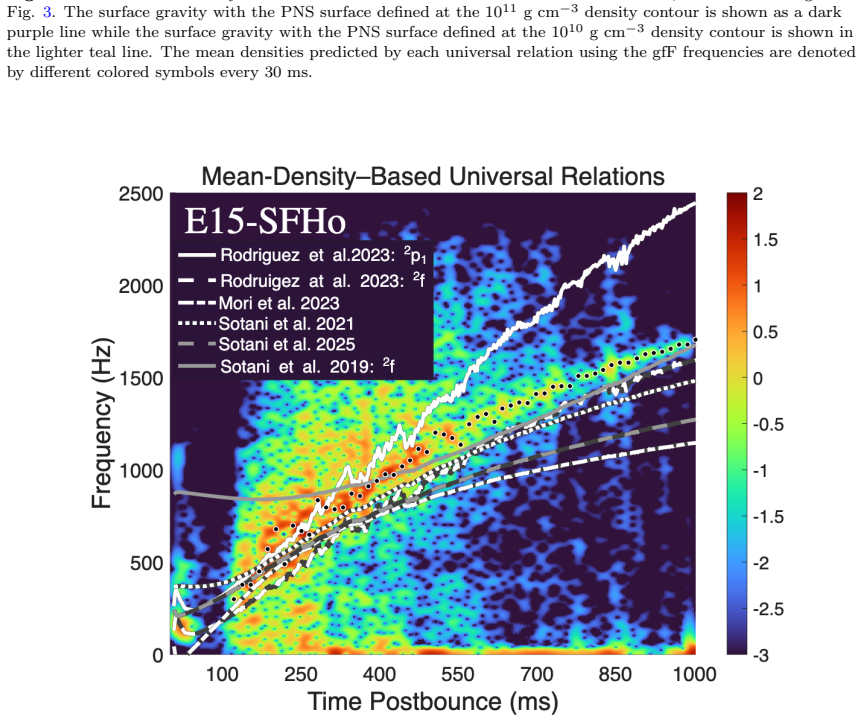
The load-bearing object is the universal relation itself: a polynomial fit f(x)=c1+c2 ln x+c3 x+c4 x^2+c5 x^3, where f is the proto-neutron-star oscillation frequency and x is mean density sqrt(M/R^3), surface gravity M/R^2, or compactness M/R. The paper compares two uses of these fits: forward prediction of the spectrogram peak from simulation-derived masses and radii, and inverse root-solving of the peak frequency to recover M/R^2 or sqrt(M/R^3). The yardstick is the g-/f-mode feature (gfF), the highest-power frequency track in the high-frequency band of the spectrogram. The authors also compare each relation's assumed PNS surface (10^10 vs 10^11 g/cm^3 density contour) and note that the s
Load-bearing premise
The comparison assumes the spectrogram's high-frequency peak is the visible trace of the same proto-neutron-star oscillation modes the universal relations describe; if accretion-driven stochastic ringing dominates that peak, the mismatch reflects excitation physics rather than a failure of the relations.
What would settle it
Perform a linear perturbative analysis of the simulated proto-neutron star using the same pseudo-Newtonian gravity as the simulation, identify the 2f and 2g mode frequencies from that analysis, and compare them directly to the gfF peak track; if the modes track the peak while every universal relation for those modes still misses by more than about 15%, the relations themselves are the failure.
If this is right
- A future galactic supernova detection analyzed with these relations could yield incorrect conclusions about which PNS mode dominated the signal and what the PNS properties are.
- The one relation that tracks the simulated peak does so for most of the signal in the three-dimensional model, suggesting a path toward a usable relation if its validity window and surface definition are respected.
- Agreement is largely confined to roughly 100–300 ms after bounce, so universal relations should be applied only within validated time windows.
- Discrepancies persist even in a noiseless, best-case comparison, so real detector noise will only widen the gap between predicted and true PNS properties.
- Interpreting a relation's success is complicated because a mode can track the peak while recovering a different density contour than the one it was derived for.
Where Pith is reading between the lines
- These results imply that the 'universal' label is premature for asteroseismology relations; a more honest use would be to quote a posterior distribution over relations, not a single PNS mass or radius estimate, when a real detection is analyzed.
- A testable extension: apply the same forward/inverse test to relations derived under pseudo-Newtonian gravity, or to simulations with fully relativistic gravity, which should remove the ~15% systematic and reveal whether the remaining scatter is intrinsic to the relations.
- If the stochastic behavior seen in the more massive model reflects accretion-driven excitation of the peak rather than quasi-normal modes, then universal relations may be fundamentally better suited to quiescent post-explosion phases; a spectrogram separated into pre- and post-explosion segments would probe this.
- The surface-contour ambiguity suggests a standardization problem: relations should report which density contour defines the PNS surface, and comparisons should be made on the same contour, otherwise 'agreement' is underdetermined.
Editorial analysis
A structured set of objections, weighed in public.
Referee Report
Summary. This paper tests seven published families of 'universal relations' that map proto-neutron-star (PNS) properties—mean density, surface gravity, and compactness—to high-frequency oscillation-mode frequencies, using four Chimera core-collapse supernova simulations (D15 and D25 in 3D, E15-LSBCK and E15-SFHo in 2D). Two analyses are performed: (i) using the simulated PNS mass and radius to predict mode frequencies, then overlaying them on spectrograms to compare with the tracked maximum-power high-frequency spectral feature (the 'gfF'); and (ii) inverting each relation with the gfF frequency to predict PNS properties and comparing those predictions with the simulated values. The central conclusion is that, with the exception of the Rodriguez et al. 2023 2p1 relation on D15, the universal relations do not track the simulated gfF well, so caution is warranted in applying them to a real gravitational-wave detection.
Significance. If substantiated, the paper would provide a valuable negative test for gravitational-wave asteroseismology of core-collapse supernovae: it would show that relations claimed to be universal can mispredict the dominant high-frequency peak, and that naively inverting them can misestimate PNS properties. The manuscript's strengths are its use of externally derived relations (no circularity), its two complementary forward/inverse comparison methods, its careful documentation of the differences among the relations (Table 2), and the public availability of the D-series data. However, the central conclusion currently rests on visual, single-peak comparisons over a small and partly two-dimensional sample; these need to be tightened before the negative claim is fully load-bearing.
major comments (4)
- [Section 2.2 and Section 3] The gfF is defined as the frequency of maximum spectral density in each window, and every universal relation is compared against this same single peak (e.g., Figs. 1, 5, 9, 11). For D15, prior work [25] supports an association between the strongest spectral peaks and the 2g1/2g2/2f modes, but for the E-series and for D25 no such mode identification is provided; the paper itself notes that D25's gfF is more stochastic because of accretion-induced ringing (Section 4). Because each universal relation describes a specific mode, a mismatch between a relation's prediction and the gfF peak could reflect the gfF being dominated by a different mode or by non-modal accretion noise, rather than a failure of the relation. The Conclusions even acknowledge that the 2p1/2f mode composition of the gfF changes over time. Without a mode-by-mode decomposition of the gfF, the claim that most relations 'do n
- [Section 3] The agreement assessment is qualitative throughout: relations 'approximately track,' 'briefly close,' and 'seems to have stopped diverging' (Figs. 1, 5, 9, 11 and related text). No quantitative misfit statistic—such as rms frequency deviation, fractional error, correlation, or time-averaged offset—is provided for either the forward or inverse comparisons. The error bars in Figs. 3–16 encode only the RBW frequency uncertainty, not the scatter of the gfF around the relation. Because the paper's central claim is that most relations fail, a metric is needed to define 'fit well' and to compare behavior across the four models and across time; without it, the strength of the negative conclusion is difficult to assess.
- [Section 2.2, Eq. (5)] The inverse method solves Eq. (5) for x_n for each gfF frequency, but the manuscript does not state how the root-finding is performed, whether multiple real roots are possible for the polynomial/transcendental forms in Table 1, or how roots outside the physical PNS range are rejected. For relations that are not monotonic over the relevant x interval, the plotted inferred quantities (Figs. 3, 4, 6, 8, 10, 12, 14, 16) could depend on an arbitrary root selection. The root-selection procedure should be described, and if multiple roots occur, the choice should be justified.
- [Section 3 and Section 4] The evidential basis for the general conclusion is four models, of which D15, E15-LSBCK, and E15-SFHo share the same 15 Msun progenitor, and the E-series are two-dimensional while the title and abstract emphasize 3D simulations. Only D15 shows the relatively good agreement for the Rodriguez 2p1 relation. This small, clustered sample limits the strength of the claim that most universal relations generically fail, as opposed to failing for this particular set of Chimera simulations. The paper is appropriately hedged, but the abstract's broad 'caution must be exercised' would be better supported by a larger or more diverse sample, or by explicitly framing the result as specific to these models.
minor comments (6)
- [Abstract] Typo: 'zero age man sequence' should be 'zero age main sequence.'
- [Table 1] The text states that the Torres-Forné et al. 2021 2g2 relation has c5 = 4.67e6, but Table 1 has no c5 column. Please add it or explain why it is omitted.
- [Fig. 3 caption] The sentence listing 'green triangles, blue rectangles, black diamonds, red circles, and magenta x's' maps five symbols to 'the relations from Mori et al., Sotani et al. 2021, Sotani and Sumiyoshi 2019, and Rodriguez et al. for their 2f and 2p1 modes, respectively.' The 'respectively' does not align with five symbols; please rephrase for clarity.
- [Section 2.2] The restriction of the gfF search to frequencies above 250 Hz is stated but not justified. A brief explanation would help the reader understand whether this cutoff could exclude relevant low-frequency mode tracks.
- [Title/Abstract] The title emphasizes three-dimensional simulations, but two of the four models are two-dimensional. Consider revising the title or explicitly stating in the abstract that the sample includes 2D and 3D models.
- [Eq. (6)] In Eq. (6), frequency f is in Hz, while Eq. (1) and Table 1 use kHz. Please make the units consistent across the manuscript.
Circularity Check
No significant circularity: externally derived universal relations are benchmarked against independently computed Chimera spectrogram peaks and PNS properties.
full rationale
The paper's central tests are genuinely two-sided comparisons rather than circular reductions. In the forward direction, the authors take Chimera's PNS mass and radius, evaluate externally fixed universal relations (Eq. 1 with constants from Refs. [27]-[33]), and overlay the resulting frequencies on simulations' spectrograms; the gfF peak frequencies are computed directly from the h+ strain, not from the relations. In the inverse direction, they root-solve Eq. 5 with the gfF frequency as input and compare the resulting x against the true Chimera PNS surface gravity/mean density. Neither direction defines the predicted quantity in terms of the benchmark quantity: the relation constants were fit by other groups on other simulations, and the gfF frequencies and PNS properties are independent simulation outputs. The self-citations ([25], [45], [79]) supply the spectrogram construction and peak-tracking methodology and the gfF nomenclature, but they do not provide the universal relations under test, so they are not load-bearing circularity. The paper itself flags the real limitations--boundary ambiguity, gravity-treatment mismatch, mode-classification differences, and stochastic accretion contamination in D25--but these are validity caveats about whether the spectral peak tracks a given oscillation mode, not cases where a prediction reduces by construction to its input. The closest concern is that the gfF may not always correspond to the mode each relation targets; however, this is an interpretive assumption in the benchmark, not a definitional equivalence between relation output and measured input. Accordingly, the paper's cautionary conclusion is externally constrained by its four simulation models and does not collapse into a fitted parameter renamed as a prediction.
Axiom & Free-Parameter Ledger
free parameters (3)
- Universal relation coefficients c1-c5 =
Table 1 values (e.g., Rodriguez 2p1: c3=184.6, c4=2194)
- Spectrogram analysis parameters (window length, overlap, RBW) =
45 ms/94.7% (D15, D25 25 ms/96%), overlap values 93.3% E-series; RBW 25, 7.3, 8.2 Hz
- gfF definitions (frequency floor, onset threshold) =
250 Hz; 1% of maximum PSD
axioms (5)
- domain assumption The high-frequency GW component from CCSN simulations is dominated by quasi-normal PNS oscillation modes.
- domain assumption The gfF peak frequency is a valid proxy for the PNS mode frequency predicted by the universal relations.
- domain assumption PNS mass and radius from spherically averaged density contours (10^10 and 10^11 g cm^-3) correspond to the quantities in the relations.
- standard math Kaiser-window spectrogram analysis and equivalent-noise-bandwidth estimate provide valid frequency peaks.
- standard math Root solving of Eq. (5) yields the relevant PNS quantity when the relation is monotonic over the relevant range.
read the original abstract
Using asteroseismology techniques, several relations have been developed that relate the quasi-normal, non-radial oscillation mode frequencies of the proto-neutron star (PNS) to the high frequency component of core collapse supernova (CCSN) generated gravitational waves predicted from simulation. These relations are universal in the sense that they are parameterized entirely by PNS properties, e.g., mean density or surface gravity, and are independent of both progenitor properties, e.g., zero age man sequence (ZAMS) mass or metallicity, and the physics included in CCSN simulations, e.g., nuclear equation of state (EOS). In this work, we apply several externally developed universal relations to PNS evolution data--specifically the mass, M, and radius, R,--generated from both two- and three-dimensional CCSN simulations and compare the resulting PNS oscillation frequencies predicted by the universal relations to the peak gravitational wave frequencies computed directly from the simulation-produced spectrogram. Additionally, we use the gravitational wave spectrogram peak frequencies as input to the universal relations and compare the predicted PNS properties from each relation to the true PNS properties as determined by the simulations. In this way, we show what these universal relations would predict for the PNS properties and their evolution from a real CCSN gravitational wave detection in the best case scenario, i.e., no detector noise. Our results indicate that caution must be exercised when using these universal relations, particularly when interpreting their predictions for PNS evolution from a gravitational wave detection, and that, given the extent to which we do see agreement between asteroseismological predictions and simulation outcomes, further development of universal relations would be beneficial.
Figures




Reference graph
Works this paper leans on
-
[1]
A New Gravitational-wave Signature from Standing Accretion Shock Instability in Supernovae
Takami Kuroda, Kei Kotake, and Tomoya Takiwaki. “A New Gravitational-wave Signature from Standing Accretion Shock Instability in Supernovae”. In:Astrophys. J.829.1, L14 (Sept. 2016), p. L14.doi:10.3847/2041-8205/829/1/L14. arXiv:1605.09215 [astro-ph.HE]
Pith/arXiv arXiv 2016
-
[2]
Takami Kuroda, Kei Kotake, Kazuhiro Hayama, and Tomoya Takiwaki. “Correlated Signatures of Gravitational-wave and Neutrino Emission in Three-dimensional General-relativistic Core-collapse Supernova Simulations”. In:Astrophys. J.851.1, 62 (Dec. 2017), p. 62.doi:10.3847/1538-4357/aa988d. arXiv:1708.05252 [astro-ph.HE]. 16 IOP PublishingJournalvv(yyyy) aaaaa...
Pith/arXiv arXiv 2017
-
[3]
The final core collapse of pulsational pair instability supernovae
Jade Powell, Bernhard M¨ uller, and Alexander Heger. “The final core collapse of pulsational pair instability supernovae”. In:Mon. Not. R. Ast. Soc.503.2 (May 2021), pp. 2108–2122. doi:10.1093/mnras/stab614. arXiv:2101.06889 [astro-ph.HE]
Pith/arXiv arXiv 2021
-
[4]
Core collapse supernova gravitational wave emission for progenitors of 9.6, 15, and 25 M ⊙
Anthony Mezzacappa et al. “Core collapse supernova gravitational wave emission for progenitors of 9.6, 15, and 25 M ⊙”. In:Phys. Rev. D107.4, 043008 (Feb. 2023), p. 043008. doi:10.1103/PhysRevD.107.043008. arXiv:2208.10643 [astro-ph.SR]
Pith/arXiv arXiv 2023
-
[5]
Gravitational Waves from Neutrino Emission Asymmetries in Core-collapse Supernovae
David Vartanyan and Adam Burrows. “Gravitational Waves from Neutrino Emission Asymmetries in Core-collapse Supernovae”. In:Astrophys. J.901.2, 108 (Oct. 2020), p. 108. doi:10.3847/1538-4357/abafac. arXiv:2007.07261 [astro-ph.HE]
Pith/arXiv arXiv 2020
-
[6]
Modeling core-collapse supernovae gravitational-wave memory in laser interferometric data
Colter J. Richardson, Michele Zanolin, Haakon Andresen, Marek J. Szczepa´ nczyk, Kiranjyot Gill, and Annop Wongwathanarat. “Modeling core-collapse supernovae gravitational-wave memory in laser interferometric data”. In:Phys. Rev. D105.10, 103008 (May 2022), p. 103008.doi:10.1103/PhysRevD.105.103008. arXiv:2109.01582 [astro-ph.HE]
Pith/arXiv arXiv 2022
-
[7]
Detecting Gravitational Wave Memory in the Next Galactic Core-Collapse Supernova
Colter J. Richardson, Haakon Andresen, Anthony Mezzacappa, Michele Zanolin, Michael G. Benjamin, Pedro Marronetti, Eric J. Lentz, and Marek J. Szczepa´ nczyk. “Detecting Gravitational Wave Memory in the Next Galactic Core-Collapse Supernova”. In: Phys. Rev. Lett.133.23, 231401 (Dec. 2024), p. 231401.doi: 10.1103/PhysRevLett.133.231401. arXiv:2404.02131 [a...
arXiv 2024
-
[8]
A New Mechanism for Core-Collapse Supernova Explosions
A. Burrows, E. Livne, L. Dessart, C. D. Ott, and J. Murphy. “A New Mechanism for Core-Collapse Supernova Explosions”. In:Astrophys. J.640 (2006), pp. 878–890.doi: 10.1086/500174. eprint:astro-ph/0510687
Pith/arXiv arXiv 2006
-
[9]
A. Marek, H.-T. Janka, and E. M¨ uller. “Equation-of-state dependent features in shock-oscillation modulated neutrino and gravitational-wave signals from supernovae”. In: Astron. Astrophys.496 (2009), pp. 475–494.doi:10.1051/0004-6361/200810883. arXiv: 0808.4136
Pith/arXiv arXiv 2009
-
[10]
Gravitational Wave Signatures in Black Hole Forming Core Collapse
Pablo Cerd´ a-Dur´ an, Nicolas DeBrye, Miguel A. Aloy, Jos´ e A. Font, and Martin Obergaulinger. “Gravitational Wave Signatures in Black Hole Forming Core Collapse”. In:Astrophys. J.779.2, L18 (Dec. 2013), p. L18.doi: 10.1088/2041-8205/779/2/L18. arXiv:1310.8290 [astro-ph.SR]
Pith/arXiv arXiv 2013
-
[11]
Bernhard M¨ uller, Hans-Thomas Janka, and Andreas Marek. “A New Multi-dimensional General Relativistic Neutrino Hydrodynamics Code of Core-collapse Supernovae. III. Gravitational Wave Signals from Supernova Explosion Models”. In:Astrophys. J.766.1, 43 (Mar. 2013), p. 43.doi:10.1088/0004-637X/766/1/43. arXiv:1210.6984 [astro-ph.SR]
Pith/arXiv arXiv 2013
-
[12]
Gravitational wave asteroseismology with protoneutron stars
Hajime Sotani and Tomoya Takiwaki. “Gravitational wave asteroseismology with protoneutron stars”. In:Phys. Rev. D94.4, 044043 (Aug. 2016), p. 044043.doi: 10.1103/PhysRevD.94.044043. arXiv:1608.01048 [astro-ph.HE]
Pith/arXiv arXiv 2016
-
[13]
Gravitational wave signals from 3D neutrino hydrodynamics simulations of core-collapse supernovae
H. Andresen, B. M¨ uller, E. M¨ uller, and H. Th. Janka. “Gravitational wave signals from 3D neutrino hydrodynamics simulations of core-collapse supernovae”. In:Mon. Not. R. Ast. Soc. 468.2 (June 2017), pp. 2032–2051.doi:10.1093/mnras/stx618. arXiv:1607.05199 [astro-ph.HE]
Pith/arXiv arXiv 2017
-
[14]
A Linear and Quadratic Time-Frequency Analysis of Gravitational Waves from Core-collapse Supernovae
Hajime Kawahara, Takami Kuroda, Tomoya Takiwaki, Kazuhiro Hayama, and Kei Kotake. “A Linear and Quadratic Time-Frequency Analysis of Gravitational Waves from Core-collapse Supernovae”. In:Astrophys. J.867.2, 126 (Nov. 2018), p. 126.doi: 10.3847/1538-4357/aae57b. arXiv:1810.00334 [astro-ph.HE]
Pith/arXiv arXiv 2018
-
[15]
Characterizing the Gravitational Wave Signal from Core-collapse Supernovae
David Radice, Viktoriya Morozova, Adam Burrows, David Vartanyan, and Hiroki Nagakura. “Characterizing the Gravitational Wave Signal from Core-collapse Supernovae”. In: Astrophys. J.876.1, L9 (May 2019), p. L9.doi:10.3847/2041-8213/ab191a. arXiv: 1812.07703 [astro-ph.HE]
Pith/arXiv arXiv 2019
-
[16]
Jade Powell and Bernhard M¨ uller. “Gravitational wave emission from 3D explosion models of core-collapse supernovae with low and normal explosion energies”. In:Mon. Not. R. Ast. Soc. 487.1 (July 2019), pp. 1178–1190.doi:10.1093/mnras/stz1304. arXiv:1812.05738 [astro-ph.HE]
Pith/arXiv arXiv 2019
-
[17]
Gravitational-wave signal of a core-collapse supernova explosion of a 15 M ⊙ star
Anthony Mezzacappa et al. “Gravitational-wave signal of a core-collapse supernova explosion of a 15 M ⊙ star”. In:Phys. Rev. D102.2, 023027 (July 2020), p. 023027.doi: 10.1103/PhysRevD.102.023027. arXiv:2007.15099 [astro-ph.HE]. 17 IOP PublishingJournalvv(yyyy) aaaaaa Authoret al
Pith/arXiv arXiv 2020
-
[18]
Gravitational-wave signature of core-collapse supernovae
David Vartanyan, Adam Burrows, Tianshu Wang, Matthew S. B. Coleman, and Christopher J. White. “Gravitational-wave signature of core-collapse supernovae”. In:Phys. Rev. D107.10, 103015 (May 2023), p. 103015.doi:10.1103/PhysRevD.107.103015. arXiv: 2302.07092 [astro-ph.HE]
Pith/arXiv arXiv 2023
-
[19]
Alejandro Torres-Forn´ e, Pablo Cerd´ a-Dur´ an, Andrea Passamonti, and Jos´ e A. Font. “Towards asteroseismology of core-collapse supernovae with gravitational-wave observations - I. Cowling approximation”. In:Mon. Not. Roy. Ast. Soc.474.4 (Mar. 2018), pp. 5272–5286. doi:10.1093/mnras/stx3067. arXiv:1708.01920 [astro-ph.SR]
Pith/arXiv arXiv 2018
-
[20]
Alejandro Torres-Forn´ e, Pablo Cerd´ a-Dur´ an, Andrea Passamonti, Martin Obergaulinger, and Jos´ e A. Font. “Towards asteroseismology of core-collapse supernovae with gravitational wave observations - II. Inclusion of space-time perturbations”. In:Mon. Not. Roy. Ast. Soc.482.3 (Jan. 2019), pp. 3967–3988.doi:10.1093/mnras/sty2854. arXiv:1806.11366 [astro-ph.HE]
Pith/arXiv arXiv 2019
-
[21]
The Gravitational Wave Signal from Core-collapse Supernovae
Viktoriya Morozova, David Radice, Adam Burrows, and David Vartanyan. “The Gravitational Wave Signal from Core-collapse Supernovae”. In:Astrophys. J.861.1, 10 (July 2018), p. 10.doi:10.3847/1538-4357/aac5f1. arXiv:1801.01914 [astro-ph.HE]
Pith/arXiv arXiv 2018
-
[23]
Consistent perturbative modeling of pseudo-Newtonian core-collapse supernova simulations
John Ryan Westernacher-Schneider. “Consistent perturbative modeling of pseudo-Newtonian core-collapse supernova simulations”. In:Phys. Rev. D101.8, 083021 (Apr. 2020), p. 083021. doi:10.1103/PhysRevD.101.083021. arXiv:2002.04468 [astro-ph.HE]
Pith/arXiv arXiv 2020
-
[24]
Shuai Zha, Oliver Eggenberger Andersen, and Evan P. O’Connor. “Unveiling the nature of gravitational-wave emission in core-collapse supernovae with perturbative analysis”. In:Phys. Rev. D109.8, 083023 (Apr. 2024), p. 083023.doi:10.1103/PhysRevD.109.083023. arXiv: 2403.02067 [astro-ph.HE]
Pith/arXiv arXiv 2024
-
[25]
Daniel Murphy, Anthony Mezzacappa, Eric J
R. Daniel Murphy, Anthony Mezzacappa, Eric J. Lentz, and Pedro Marronetti.Core collapse supernova gravitational wave sourcing and characterization based on three-dimensional models. Sept. 2025.doi:10.1103/5z9g-yr28. arXiv:2503.06406 [astro-ph.HE]
Pith/arXiv arXiv 2025
-
[26]
Chimera: A Massively Parallel Code for Core-collapse Supernova Simulations
Stephen W. Bruenn et al. “Chimera: A Massively Parallel Code for Core-collapse Supernova Simulations”. In:Astrophys. J. Suppl.248.1 (2020), p. 11.issn: 1538-4365.doi: 10.3847/1538-4365/ab7aff
-
[27]
Alejandro Torres-Forn´ e, Pablo Cerd´ a-Dur´ an, Martin Obergaulinger, Bernhard M¨ uller, and Jos´ e A. Font. “Erratum: Universal Relations for Gravitational-Wave Asteroseismology of Protoneutron Stars [Phys. Rev. Lett. 123, 051102 (2019)]”. In:Phys. Rev. Lett.127.23, 239901 (Dec. 2021), p. 239901.doi:10.1103/PhysRevLett.127.239901
-
[28]
Hajime Sotani and Kohsuke Sumiyoshi. “Determination of properties of protoneutron stars toward black hole formation via gravitational wave observations”. In:Phys. Rev. D100.8, 083008 (Oct. 2019), p. 083008.doi:10.1103/PhysRevD.100.083008. arXiv:1909.11816 [astro-ph.HE]
Pith/arXiv arXiv 2019
-
[29]
Universal relation for supernova gravitational waves
Hajime Sotani, Tomoya Takiwaki, and Hajime Togashi. “Universal relation for supernova gravitational waves”. In:Phys. Rev. D104.12, 123009 (Dec. 2021), p. 123009.doi: 10.1103/PhysRevD.104.123009. arXiv:2110.03131 [astro-ph.HE]
Pith/arXiv arXiv 2021
-
[30]
Effects of multidimensional treatment of gravity in simulations on supernova gravitational waves
Hajime Sotani, Bernhard M¨ uller, and Tomoya Takiwaki. “Effects of multidimensional treatment of gravity in simulations on supernova gravitational waves”. In:Phys. Rev. D 112.8, 083018 (Oct. 2025), p. 083018.doi:10.1103/317p-9hxm. arXiv:2509.19724 [gr-qc]
arXiv 2025
-
[31]
Masamitsu Mori, Yudai Suwa, and Tomoya Takiwaki. “Long-term gravitational wave asteroseismology of supernovae: From core collapse to 20 seconds postbounce”. In:Phys. Rev. D107.8, 083015 (Apr. 2023), p. 083015.doi:10.1103/PhysRevD.107.083015. arXiv: 2302.00292 [astro-ph.HE]
Pith/arXiv arXiv 2023
-
[32]
Three approaches for the classification of protoneutron star oscillation modes
M. C. Rodriguez, Ignacio F. Ranea-Sandoval, C. Chirenti, and D. Radice. “Three approaches for the classification of protoneutron star oscillation modes”. In:Mon. Not. Roy. Ast. Soc. 523.2 (Aug. 2023), pp. 2236–2246.doi:10.1093/mnras/stad1459. arXiv:2304.00033 [astro-ph.HE]. 18 IOP PublishingJournalvv(yyyy) aaaaaa Authoret al
Pith/arXiv arXiv 2023
-
[33]
Inference of protoneutron star properties from gravitational-wave data in core-collapse supernovae
Marie-Anne Bizouard, Patricio Maturana-Russel, Alejandro Torres-Forn´ e, Martin Obergaulinger, Pablo Cerd´ a-Dur´ an, Nelson Christensen, Jos´ e A. Font, and Renate Meyer. “Inference of protoneutron star properties from gravitational-wave data in core-collapse supernovae”. In:Phys. Rev. D103.6, 063006 (Mar. 2021), p. 063006.doi: 10.1103/PhysRevD.103.06300...
Pith/arXiv arXiv 2021
-
[34]
A. Marek, H. Dimmelmeier, H.-T. Janka, E. M¨ uller, and R. Buras. “Exploring the relativistic regime with Newtonian hydrodynamics: an improved effective gravitational potential for supernova simulations”. In:Astron. Astrophys.445 (2006), pp. 273–289.doi: 10.1051/0004-6361:20052840. eprint:arXiv:astro-ph/0502161
Pith/arXiv arXiv 2006
-
[35]
R. Buras, M. Rampp, H.-T. Janka, and K. Kifonidis. “Two-dimensional hydrodynamic core-collapse supernova simulations with spectral neutrino transport. I. Numerical method and results for a 15M ⊙ star”. In:Astron. Astrophys.447 (2006), pp. 1049–1092.doi: 10.1051/0004-6361:20053783. eprint:arXiv:astro-ph/0507135
Pith/arXiv arXiv 2006
-
[36]
Thermonuclear Kinetics in Astrophysics
W. R. Hix and B. S. Meyer. “Thermonuclear Kinetics in Astrophysics”. In:Nucl. Phys. A777 (2006), pp. 188–207.doi:10.1016/j.nuclphysa.2004.10.009. eprint:astro-ph/0509698
Pith/arXiv arXiv 2006
-
[37]
Nucleosynthesis in thermonuclear supernovae
C. Travaglio and W. R. Hix. “Nucleosynthesis in thermonuclear supernovae”. In:Frontiers of Physics8 (2013), pp. 199–216.doi:10.1007/s11467-013-0315-y
-
[38]
Nucleosynthesis and remnants in massive stars of solar metallicity
S. E. Woosley and A. Heger. “Nucleosynthesis and remnants in massive stars of solar metallicity”. In:Phys. Rep.442 (2007), pp. 269–283.doi:10.1016/j.physrep.2007.02.009. eprint:arXiv:astro-ph/0702176
Pith/arXiv arXiv 2007
-
[39]
Nucleosynthesis and Evolution of Massive Metal-free Stars
Alexander Heger and S. E. Woosley. “Nucleosynthesis and Evolution of Massive Metal-free Stars”. In:Astrophys. J.724 (2010), pp. 341–373.doi:10.1088/0004-637X/724/1/341. arXiv:0803.3161
Pith/arXiv arXiv 2010
-
[40]
Daniel Murphy, Anthony Mezzacappa, Eric J
R. Daniel Murphy, Anthony Mezzacappa, Eric J. Lentz, and Pedro Marronetti.Chimera D-Series Gravitational Wave Emission Sourced from Matter. Constellation by Oak Ridge Leadership Computing Facility. https://doi.org/10.13139/OLCF/2571921. 2025.doi: 10.13139/OLCF/2571921
arXiv 2025
-
[41]
A generalized equation of state for hot, dense matter
J. M. Lattimer and F. D. Swesty. “A generalized equation of state for hot, dense matter”. In: Nucl. Phys. A535 (1991), pp. 331–376
1991
-
[42]
Type II supernovae in 12 M ⊙ and 15 M ⊙ stars: The equation of state and general relativity
E. Baron, J. Cooperstein, and S. Kahana. “Type II supernovae in 12 M ⊙ and 15 M ⊙ stars: The equation of state and general relativity”. In:Phys. Rev. Lett.55.1 (July 1985), pp. 126–129.doi:10.1103/PhysRevLett.55.126
-
[43]
Core-collapse Supernova Equations of State Based on Neutron Star Observations
A. W. Steiner, M. Hempel, and T. Fischer. “Core-collapse Supernova Equations of State Based on Neutron Star Observations”. In:Astrophys. J.774.1, 17 (Sept. 2013), p. 17.doi: 10.1088/0004-637X/774/1/17. arXiv:1207.2184 [astro-ph.SR]
Pith/arXiv arXiv 2013
-
[44]
Sensitivity of Neutrino-Driven Core-Collapse Supernova Models to the Microphysical Equation of State
Ryan E. Landfield. “Sensitivity of Neutrino-Driven Core-Collapse Supernova Models to the Microphysical Equation of State”. PhD Dissertation. Univeristy of Tennessee Knoxville, 2018
2018
-
[45]
R. Daniel Murphy, Alejandro Casallas-Lagos, Anthony Mezzacappa, Michele Zanolin, Ryan E. Landfield, Eric J. Lentz, Pedro Marronetti, Javier M. Antelis, and Claudia Moreno. “Dependence of the reconstructed core-collapse supernova gravitational wave high-frequency feature on the nuclear equation of state in real interferometric data”. In:Phys. Rev. D110.8, ...
Pith/arXiv arXiv 2024
-
[46]
Nonradial g-mode oscillations of warm neutron stars
P. N. McDermott, H. M. van Horn, and J. F. Scholl. “Nonradial g-mode oscillations of warm neutron stars”. In:Astrophys. J.268 (May 1983), pp. 837–848.doi:10.1086/161006
doi:10.1086/161006 1983
-
[47]
Hajime Sotani, Takami Kuroda, Tomoya Takiwaki, and Kei Kotake. “Dependence of the outer boundary condition on protoneutron star asteroseismology with gravitational-wave signatures”. In:Phys. Rev. D99.12, 123024 (June 2019), p. 123024.doi: 10.1103/PhysRevD.99.123024. arXiv:1906.04354 [astro-ph.HE]
Pith/arXiv arXiv 2019
-
[48]
Universality in supernova gravitational waves with protoneutron star properties
Hajime Sotani, Bernhard M¨ uller, and Tomoya Takiwaki. “Universality in supernova gravitational waves with protoneutron star properties”. In:Phys. Rev. D109.12, 123021 (June 2024), p. 123021.doi:10.1103/PhysRevD.109.123021. arXiv:2405.09030 [astro-ph.HE]. 19 IOP PublishingJournalvv(yyyy) aaaaaa Authoret al
Pith/arXiv arXiv 2024
-
[49]
Universal Relations for Gravitational-Wave Asteroseismology of Protoneutron Stars
Alejandro Torres-Forn´ e, Pablo Cerd´ a-Dur´ an, Martin Obergaulinger, Bernhard M¨ uller, and Jos´ e A. Font. “Universal Relations for Gravitational-Wave Asteroseismology of Protoneutron Stars”. In:Phys. Rev. Lett.123.5, 051102 (Aug. 2019), p. 051102.doi: 10.1103/PhysRevLett.123.051102. arXiv:1902.10048 [gr-qc]
Pith/arXiv arXiv 2019
-
[50]
Astrophysical magnetohydrodynamics and radiative transfer: numerical methods and applications
Martin Obergaulinger. “Astrophysical magnetohydrodynamics and radiative transfer: numerical methods and applications”. PhD Thesis. M¨ unchen, Germany: Technische Universit¨ at M¨ unchen, 2008
2008
-
[51]
A new multidimensional, energy-dependent two-moment transport code for neutrino-hydrodynamics
O. Just, M. Obergaulinger, and H.-T. Janka. “A new multidimensional, energy-dependent two-moment transport code for neutrino-hydrodynamics”. In:Mon. Not. Roy. Ast. Soc.453 (2015), pp. 3386–3413.doi:10.1093/mnras/stv1892. arXiv:1501.02999 [astro-ph.HE]
Pith/arXiv arXiv 2015
-
[52]
Harald Dimmelmeier, J´ erˆ ome Novak, Jos´ e A. Font, Jos´ e M. Ib´ a˜ nez, and Ewald M¨ uller. “Combining spectral and shock-capturing methods: A new numerical approach for 3D relativistic core collapse simulations”. In:Phys. Rev. D71.6, 064023 (Mar. 2005), p. 064023. doi:10.1103/PhysRevD.71.064023. arXiv:astro-ph/0407174 [astro-ph]
Pith/arXiv arXiv 2005
-
[53]
The evolution and explosion of massive stars
S. E. Woosley, A. Heger, and T. A. Weaver. “The evolution and explosion of massive stars”. In:Rev. Mod. Phys.74 (2002), pp. 1015–1071.doi:10.1103/RevModPhys.74.1015
-
[54]
Improved constrained scheme for the Einstein equations: An approach to the uniqueness issue
Isabel Cordero-Carri´ on, Pablo Cerd´ a-Dur´ an, Harald Dimmelmeier, Jos´ e Luis Jaramillo, J´ erˆ ome Novak, and Eric Gourgoulhon. “Improved constrained scheme for the Einstein equations: An approach to the uniqueness issue”. In:Phys. Rev. D79.2, 024017 (Jan. 2009), p. 024017.doi:10.1103/PhysRevD.79.024017. arXiv:0809.2325 [gr-qc]
Pith/arXiv arXiv 2009
-
[55]
Relativistic numerical model for close neutron-star binaries
J. R. Wilson, G. J. Mathews, and P. Marronetti. “Relativistic numerical model for close neutron-star binaries”. In:Phys. Rev. D54 (1996), pp. 1317–1331
1996
-
[56]
Waveless Approximation Theories of Gravity
James A. Isenberg. “Waveless Approximation Theories of Gravity”. In:International Journal of Modern Physics D17.2 (Jan. 2008), pp. 265–273.doi:10.1142/S0218271808011997. arXiv:gr-qc/0702113 [gr-qc]
Pith/arXiv arXiv 2008
-
[57]
New equation of state for astrophysical simulations
G. Shen, C. J. Horowitz, and S. Teige. “New equation of state for astrophysical simulations”. In:Phys. Rev. C83.3, 035802 (2011), p. 035802.doi:10.1103/PhysRevC.83.035802. arXiv: 1101.3715 [astro-ph.SR]
Pith/arXiv arXiv 2011
-
[58]
Relativistic Equation of State for Core-collapse Supernova Simulations
H. Shen, H. Toki, K. Oyamatsu, and K. Sumiyoshi. “Relativistic Equation of State for Core-collapse Supernova Simulations”. In:Astrophys. J. Suppl.197 (2011), p. 035802
2011
-
[59]
Sarmistha Banik, Matthias Hempel, and Debades Bandyopadhyay. “New Hyperon Equations of State for Supernovae and Neutron Stars in Density-dependent Hadron Field Theory”. In: Astrophys. J. Suppl.214.2, 22 (Oct. 2014), p. 22.doi:10.1088/0067-0049/214/2/22. arXiv: 1404.6173 [astro-ph.HE]
Pith/arXiv arXiv 2014
-
[60]
Shoichi Yamada. “An Implicit Lagrangian Code for Spherically Symmetric General Relativistic Hydrodynamics with an Approximate Riemann Solver”. In:Astrophys. J.475.2 (Feb. 1997), pp. 720–739.doi:10.1086/303548. arXiv:astro-ph/9601042 [astro-ph]
Pith/arXiv arXiv 1997
-
[61]
Neutrino transport in type II supernovae: Boltzmann solver vs. Monte Carlo method
Shoichi Yamada, Hans-Thomas Janka, and Hideyuki Suzuki. “Neutrino transport in type II supernovae: Boltzmann solver vs. Monte Carlo method”. In:Astron. Astrophys.344 (Apr. 1999), pp. 533–550.doi:10.48550/arXiv.astro-ph/9809009. arXiv:astro-ph/9809009 [astro-ph]
-
[62]
Postbounce Evolution of Core-Collapse Supernovae: Long-Term Effects of the Equation of State
K. Sumiyoshi, S. Yamada, H. Suzuki, H. Shen, S. Chiba, and H. Toki. “Postbounce Evolution of Core-Collapse Supernovae: Long-Term Effects of the Equation of State”. In:Astrophys. J. 629 (2005), p. 922.doi:10.1086/431788. eprint:arXiv:astro-ph/0506620
Pith/arXiv arXiv 2005
-
[63]
The Evolution and Explosion of Massive Stars. II. Explosive Hydrodynamics and Nucleosynthesis
S. E. Woosley and Thomas A. Weaver. “The Evolution and Explosion of Massive Stars. II. Explosive Hydrodynamics and Nucleosynthesis”. In:Astrophys. J. Suppl.101 (1995), pp. 181–235.doi:10.1086/192237
doi:10.1086/192237 1995
-
[64]
N. Tominaga, H. Umeda, and K. Nomoto. “Supernova Nucleosynthesis in Population III 13-50 M⊙ Stars and Abundance Patterns of Extremely Metal-poor Stars”. In:Astrophys. J. 660 (2007), pp. 516–540.doi:10.1086/513063
doi:10.1086/513063 2007
-
[65]
Relativistic equation of state of nuclear matter for supernova and neutron star
H. Shen, H. Toki, K. Oyamatsu, and K. Sumiyoshi. “Relativistic equation of state of nuclear matter for supernova and neutron star”. In:Nucl. Phys. A637.3 (July 1998), pp. 435–450. doi:10.1016/S0375-9474(98)00236-X. arXiv:nucl-th/9805035 [nucl-th]
Pith/arXiv arXiv 1998
-
[66]
Relativistic Equations for Adiabatic, Spherically Symmetric Gravitational Collapse
C. W. Misner and D. H. Sharp. “Relativistic Equations for Adiabatic, Spherically Symmetric Gravitational Collapse”. In:Phys. Rep.136 (1964), pp. 571–576.doi: 10.1103/PhysRev.136.B571. 20 IOP PublishingJournalvv(yyyy) aaaaaa Authoret al
-
[67]
Takashi J. Moriya, Paolo A. Mazzali, Nozomu Tominaga, Stephan Hachinger, Sergei I. Blinnikov, Thomas M. Tauris, Koh Takahashi, Masaomi Tanaka, Norbert Langer, and Philipp Podsiadlowski. “Light-curve and spectral properties of ultrastripped core-collapse supernovae leading to binary neutron stars”. In:Mon. Not. R. Ast. Soc.466.2 (Apr. 2017), pp. 2085–2098....
Pith/arXiv arXiv 2017
-
[68]
T. Takiwaki, K. Kotake, and Y. Suwa. “Three-dimensional Hydrodynamic Core-collapse Supernova Simulations for an 11.2 M ⊙ Star with Spectral Neutrino Transport”. In: Astrophys. J.749, 98 (2012), p. 98.doi:10.1088/0004-637X/749/2/98. arXiv:1108.3989 [astro-ph.HE]
Pith/arXiv arXiv 2012
-
[69]
T. Takiwaki, K. Kotake, and Y. Suwa. “A Comparison of Two- and Three-dimensional Neutrino-hydrodynamics Simulations of Core-collapse Supernovae”. In:Astrophys. J.786, 83 (2014), p. 83.doi:10.1088/0004-637X/786/2/83. arXiv:1308.5755 [astro-ph.SR]
Pith/arXiv arXiv 2014
-
[70]
T. Takiwaki, K. Kotake, and Y. Suwa. “Three-dimensional simulations of rapidly rotating core-collapse supernovae: finding a neutrino-powered explosion aided by non-axisymmetric flows”. In:Mon. Not. Roy. Ast. Soc.461 (2016), pp. L112–L116.doi: 10.1093/mnrasl/slw105. arXiv:1602.06759 [astro-ph.HE]
Pith/arXiv arXiv 2016
-
[71]
Composition and thermodynamics of nuclear matter with light clusters
S. Typel, G. R¨ opke, T. Kl¨ ahn, D. Blaschke, and H. H. Wolter. “Composition and thermodynamics of nuclear matter with light clusters”. In:Phys. Rev. C81.1, 015803 (Jan. 2010), p. 015803.doi:10.1103/PhysRevC.81.015803. arXiv:0908.2344 [nucl-th]
Pith/arXiv arXiv 2010
-
[72]
S. Furusawa, H. Togashi, H. Nagakura, K. Sumiyoshi, S. Yamada, H. Suzuki, and M. Takano. “A new equation of state for core-collapse supernovae based on realistic nuclear forces and including a full nuclear ensemble”. In:Journal of Physics G Nuclear Physics44.9 (Sept. 2017), p. 094001.doi:10.1088/1361-6471/aa7f35. arXiv:1707.06410 [astro-ph.HE]
Pith/arXiv arXiv 2017
-
[73]
Nuclear equation of state for core-collapse supernova simulations with realistic nuclear forces
H. Togashi, K. Nakazato, Y. Takehara, S. Yamamuro, H. Suzuki, and M. Takano. “Nuclear equation of state for core-collapse supernova simulations with realistic nuclear forces”. In: Nucl. Phys. A961 (May 2017), pp. 78–105.doi:10.1016/j.nuclphysa.2017.02.010. arXiv: 1702.05324 [nucl-th]
Pith/arXiv arXiv 2017
-
[74]
Accuracy of the relativistic Cowling approximation in protoneutron star asteroseismology
Hajime Sotani and Tomoya Takiwaki. “Accuracy of the relativistic Cowling approximation in protoneutron star asteroseismology”. In:Phys. Rev. D102.6, 063025 (Sept. 2020), p. 063025. doi:10.1103/PhysRevD.102.063025. arXiv:2009.05206 [astro-ph.HE]
Pith/arXiv arXiv 2020
-
[75]
A new open-source code for spherically symmetric stellar collapse to neutron stars and black holes
Evan O’Connor and Christian D. Ott. “A new open-source code for spherically symmetric stellar collapse to neutron stars and black holes”. In:Classical and Quantum Gravity27.11, 114103 (June 2010), p. 114103.doi:10.1088/0264-9381/27/11/114103. arXiv:0912.2393 [astro-ph.HE]
Pith/arXiv arXiv 2010
-
[76]
An Open-source Neutrino Radiation Hydrodynamics Code for Core-collapse Supernovae
Evan O’Connor. “An Open-source Neutrino Radiation Hydrodynamics Code for Core-collapse Supernovae”. In:Astrophys. J. Suppl.219.2, 24 (Aug. 2015), p. 24.doi: 10.1088/0067-0049/219/2/24. arXiv:1411.7058 [astro-ph.HE]
Pith/arXiv arXiv 2015
-
[77]
Core-collapse Supernovae from 9 to 120 Solar Masses Based on Neutrino-powered Explosions
T. Sukhbold, T. Ertl, S. E. Woosley, J. M. Brown, and H.-T. Janka. “Core-collapse Supernovae from 9 to 120 Solar Masses Based on Neutrino-powered Explosions”. In: Astrophys. J.821, 38 (2016), p. 38.doi:10.3847/0004-637X/821/1/38. arXiv:1510.04643 [astro-ph.HE]
Pith/arXiv arXiv 2016
-
[78]
A High-resolution Study of Presupernova Core Structure
Tuguldur Sukhbold, S. E. Woosley, and Alexander Heger. “A High-resolution Study of Presupernova Core Structure”. In:Astrophys. J.860.2, 93 (June 2018), p. 93.doi: 10.3847/1538-4357/aac2da. arXiv:1710.03243 [astro-ph.HE]
Pith/arXiv arXiv 2018
-
[79]
Gravitational waves as a probe of core collapse supernova progenitor structure
R. Daniel Murphy, Elle Brinkman, Colter J. Richardson, Evan Semenak, Anthony Mezzacappa, Pedro Marronetti, Eric J. Lentz, and Stephen W. Bruenn. “Gravitational waves as a probe of core collapse supernova progenitor structure”. In:Phys. Rev. D113.8, 084005 (Apr. 2026), p. 084005.doi:10.1103/2bdz-783t. arXiv:2511.21895 [astro-ph.HE]
arXiv 2026
-
[80]
Jade Powell and Bernhard M¨ uller. “Inferring astrophysical parameters of core-collapse supernovae from their gravitational-wave emission”. In:Phys. Rev. D105.6, 063018 (Mar. 2022), p. 063018.doi:10.1103/PhysRevD.105.063018. arXiv:2201.01397 [astro-ph.HE]
Pith/arXiv arXiv 2022
-
[81]
Gravitational Wave Eigenfrequencies from Neutrino-driven Core-collapse Supernovae
Noah E. Wolfe, Carla Fr¨ ohlich, Jonah M. Miller, Alejandro Torres-Forn´ e, and Pablo Cerd´ a-Dur´ an. “Gravitational Wave Eigenfrequencies from Neutrino-driven Core-collapse Supernovae”. In:Astrophys. J.954.2, 161 (Sept. 2023), p. 161.doi: 10.3847/1538-4357/ace693. arXiv:2303.16962 [astro-ph.HE]. 21 IOP PublishingJournalvv(yyyy) aaaaaa Authoret al
Pith/arXiv arXiv 2023
discussion (0)
Sign in with ORCID, Apple, or X to comment. Anyone can read and Pith papers without signing in.