Sexualised synthetic personas encode and amplify gendered power asymmetries through voice
Pith reviewed 2026-06-26 13:11 UTC · model grok-4.3
The pith
Commercial AI voice platforms encode gendered power asymmetries by linking female-coded voices to sexualised and submissive terms while associating male-coded voices with dominance and positive traits.
A machine-rendered reading of the paper's core claim, the machinery that carries it, and where it could break.
Core claim
By evaluating male- and female-coded voices with sexualised scripts or neutral text through adjective selection and free-text responses, the authors establish that the platform's synthetic personas encode and amplify gendered power asymmetries, revealing a narrow binary and heteronormative range of gender expression where female-coded voices are more frequently described using sexualised and submissive terms and male-coded voices are more often associated with dominance and positive traits.
What carries the argument
A listening experiment that combines quantitative adjective selection, qualitative free-text responses, and acoustic analysis on male- and female-coded voices presented with sexualised scripts or neutral text.
If this is right
- Commercial voice AI systems reproduce particular binary and heteronormative performances of gender rather than supporting diversity.
- Female-coded voices are tied more often to sexualised and submissive framing, reinforcing power imbalances.
- Male-coded voices receive more associations with dominance and positive traits.
- The pattern holds across both sexualised scripts and neutral text, indicating it is embedded in the voice synthesis.
- New voice technologies may circulate toxic masculinity and heteronormativity online instead of enabling empowerment.
Where Pith is reading between the lines
- The asymmetries identified could shape user perceptions and interactions with voice AI in everyday applications beyond the tested platform.
- Similar encoding patterns might appear in other synthetic media such as chatbots or virtual agents that default to gendered voices.
- Adjusting script design or adding explicit gender diversity options could reduce the observed amplification of power imbalances.
Load-bearing premise
The chosen sexualised scripts and neutral texts from the commercial platform together with the listener sample accurately capture how the system encodes gendered power asymmetries rather than reflecting listeners' pre-existing cultural perceptions or selection effects in the experiment design.
What would settle it
A study that finds equivalent frequencies of sexualised and submissive descriptors for both male-coded and female-coded voices, or that documents a wide non-binary range of gender expressions in the same platform's voices, would challenge the central claim.
Figures
read the original abstract
This work examines sexualised AI-generated English-speaking voices offered by a popular commercial platform. New technologies may enable sexual empowerment and greater diversity in gender expression, yet toxic masculinity, heteronormativity, and the abuse of women and LGBTQ+ people remain pervasive online. Drawing on a Feminist HCI perspective, we examine how commercial voice AI systems reproduce and circulate particular performances of gender. We conducted a listening experiment with a diverse group of listeners, combining quantitative adjective selection, qualitative free-text responses, and acoustic analysis. Participants evaluated male- and female-coded voices presented with either sexualised scripts or neutral text. Results reveal a narrow range of gender expression, largely binary and heteronormative. Female-coded voices are more frequently described using sexualised and submissive terms, while male-coded voices are more often associated with dominance and positive traits.
Editorial analysis
A structured set of objections, weighed in public.
Referee Report
Summary. The paper claims that sexualised synthetic voices from a commercial platform encode and amplify gendered power asymmetries. Using a mixed-methods listening experiment (adjective selection, free-text responses, acoustic analysis) with diverse listeners evaluating male- and female-coded voices on sexualised vs. neutral scripts, it finds narrow binary heteronormative gender expression: female-coded voices are more often described with sexualised/submissive terms, male-coded voices with dominance and positive traits.
Significance. If the attribution to the system holds, the work provides empirical evidence from perceptual and acoustic data on how commercial voice AI reproduces heteronormative stereotypes, extending Feminist HCI into speech synthesis and offering a basis for design interventions. The mixed-methods design and primary data collection are strengths.
major comments (2)
- [Abstract/Methods] The experimental design (as described in the abstract) presents sexualised and neutral scripts to listeners but does not include a control condition with human speakers or non-gendered synthetic voices reading identical scripts. This leaves open whether the observed adjective patterns and free-text descriptions reflect encoding by the commercial platform or listeners' pre-existing cultural stereotypes, directly undermining the central claim that the system 'encodes and amplifies' the asymmetries.
- [Acoustic analysis] Acoustic analysis is reported to confirm binary pitch/formant differences, but the manuscript does not provide an independent mapping from these features to 'power asymmetries' or 'submissiveness' without relying on the subjective listener labels; this circularity weakens the integration of acoustic and perceptual results.
Simulated Author's Rebuttal
We thank the referee for these constructive comments, which help clarify the scope and integration of our methods. We address each point below with targeted revisions where appropriate.
read point-by-point responses
-
Referee: [Abstract/Methods] The experimental design (as described in the abstract) presents sexualised and neutral scripts to listeners but does not include a control condition with human speakers or non-gendered synthetic voices reading identical scripts. This leaves open whether the observed adjective patterns and free-text descriptions reflect encoding by the commercial platform or listeners' pre-existing cultural stereotypes, directly undermining the central claim that the system 'encodes and amplifies' the asymmetries.
Authors: The study is scoped to the commercial synthetic voices offered by the platform; the neutral scripts function as an internal control for script content within those voices. The observed patterns (e.g., differential adjective selection by voice gender and script type) therefore document how the platform's synthetic personas are presented and perceived. We agree that absence of a human-speaker arm limits direct attribution versus cultural stereotypes and will add an explicit limitations paragraph plus a sentence in the abstract clarifying that the encoding claim applies to the synthetic domain under study. revision: partial
-
Referee: [Acoustic analysis] Acoustic analysis is reported to confirm binary pitch/formant differences, but the manuscript does not provide an independent mapping from these features to 'power asymmetries' or 'submissiveness' without relying on the subjective listener labels; this circularity weakens the integration of acoustic and perceptual results.
Authors: The acoustic section reports objective measurements (F0, formant dispersion) that prior speech-science literature has independently linked to dominance/submissiveness perceptions. We will insert two sentences citing established acoustic correlates (e.g., lower pitch and formant spacing associated with perceived dominance) drawn from non-listener-label sources, thereby separating the acoustic characterisation from the perceptual labels. revision: yes
Circularity Check
Empirical listening study with no definitional or self-referential derivation chain
full rationale
The paper reports results from a new listening experiment (adjective selection, free-text responses) plus acoustic measurements on commercial voices. No equations, fitted parameters, predictions, or uniqueness theorems appear in the provided text. Conclusions are framed as observations from participant data rather than reductions to prior self-citations or input definitions. No load-bearing step matches any enumerated circularity pattern.
Axiom & Free-Parameter Ledger
axioms (1)
- domain assumption Feminist HCI perspective provides a valid framework for analyzing how voice AI systems reproduce gendered performances
Reference graph
Works this paper leans on
-
[1]
Introduction The internet and novel technologies can provide supportive spaces for marginalised people to create connections and per- form identity. While they can offer opportunities for women’s sexual empowerment [1, 2], or for queer and trans people to experiment with sexuality and gender (e.g., [3, 4]), harassment and victimisation of these groups per...
Pith/arXiv arXiv 2025
-
[2]
Related work Machine learning models, especially natural language mod- els using word embeddings, reproduce and amplify stereotypes present in their training data (e.g., [15]). In the study of hu- man speech, listeners have been found to make different judg- ments about information conveyed by voice quality in (per- ceived) male vs female speakers (e.g., ...
-
[3]
Stimuli Participants are presented with audio samples of different voices generated with ElevenLabs’ ‘V oice Library’1
Listening experiment 3.1. Stimuli Participants are presented with audio samples of different voices generated with ElevenLabs’ ‘V oice Library’1. Some voices are advertised with sexualised adjectives, e.g.,flirty,flirtor temptress, while others are advertised with non-sexualised ad- jectives, e.g.,informative,presenter, oreducational. For these adjectives...
-
[4]
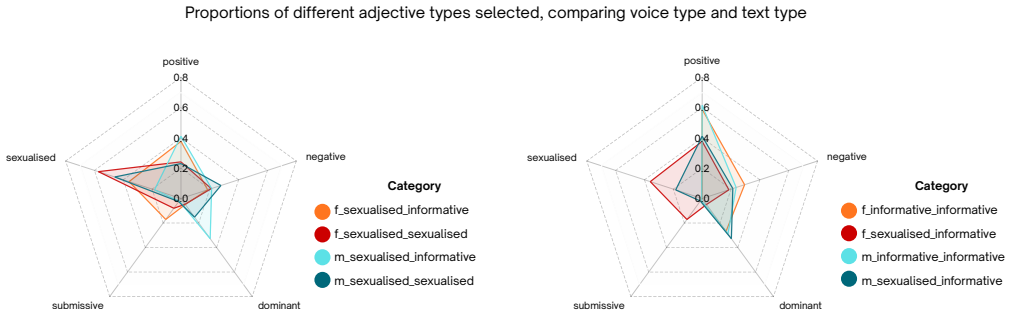
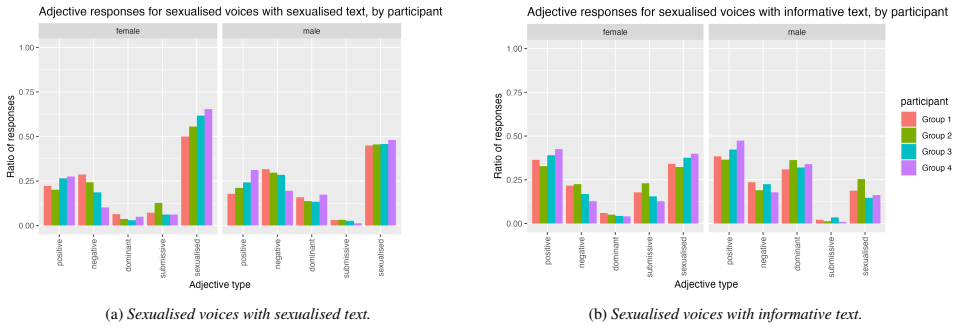
Results We first address the overall distribution of evaluative judgments for male- and female-coded voices. We fitted generalised lin- ear mixed effects regression models withnlminbwrapoptimiser, using lme4 in R, to examine the distribution of each group of adjectives with voice gender (female or male), text type (sex- ualised or Rainbow Passage), partic...
-
[5]
Discussion We found qualitative and quantitative differences in a diverse group of listeners’ reactions to male and female-coded sexu- alised voices showcased in ElevenLabs’ V oice Library. Namely, male voices were more likely to elicit positive adjectives and those relating to high agency or dominance compared to female voices, which more often elicit su...
-
[6]
Unlike actual online or phone sex work, though, it is unclear that any human woman retains agency, control, or profits from this performance
Conclusion and future directions Personas like ‘The Parisian temptress’, which listeners de- scribed as ‘soooo cringe’, ‘trying to sound sexy but it’s just annoying’ and ‘on drugs’, are auditory caricatures of a spe- cific performance of femininity. Unlike actual online or phone sex work, though, it is unclear that any human woman retains agency, control,...
-
[7]
The first authors are supported by the UKRI Centre for Doctoral Training in Natural Language Processing, funded by UKRI (grant EP/S022481/1)
Acknowledgments This study has been approved by the School of Informatics Ethics’ Committee at the University of Edinburgh, with ref- erence number 296750. The first authors are supported by the UKRI Centre for Doctoral Training in Natural Language Processing, funded by UKRI (grant EP/S022481/1). Kanhov is supported by the Swedish Research Council (grant ...
2024
-
[8]
Generative AI Use Disclosure Generative AI was not used to produce any part of this manuscript. The audio samples used in our listening test were produced using ElevenLabs TTSv3 model, a natural language promptable commercial TTS platform which may be consid- ered a form of Generative AI
-
[9]
‘Tumblr mostly, great empowering images’: blog- ging, reblogging and scrolling feminist, queer and BDSM de- sires,
A. Mondin, “‘Tumblr mostly, great empowering images’: blog- ging, reblogging and scrolling feminist, queer and BDSM de- sires,”Journal of Gender Studies, vol. 26, no. 3, pp. 282–292, 2017
2017
-
[10]
“My iPhone changed my life
J. K. McKeown, D. C. Parry, and T. Penny Light, ““My iPhone changed my life”: How digital technologies can enable women’s consumption of online sexually explicit materials,”Sexuality & Culture, vol. 22, no. 2, pp. 340–354, 2018
2018
-
[11]
O’Riordan and D
K. O’Riordan and D. Phillips,Queer online: Media technology & sexuality. Peter Lang, 2007, vol. 40
2007
-
[12]
Tum- blr was a trans technology: the meaning, importance, history, and future of trans technologies,
O. L. Haimson, A. Dame-Griff, E. Capello, and Z. Richter, “Tum- blr was a trans technology: the meaning, importance, history, and future of trans technologies,”Feminist media studies, vol. 21, no. 3, pp. 345–361, 2021
2021
-
[13]
Subjective -isms? on the danger of conflating hate and offence in abusive language detection,
A. C. Curry, G. Abercrombie, and Z. Talat, “Subjective -isms? on the danger of conflating hate and offence in abusive language detection,” inProceedings of the 8th Workshop on Online Abuse and Harms (WOAH 2024), 2024, pp. 275–282
2024
-
[14]
”What do you expect? You’re part of the internet
J. Twomey, S. Foley, S. Robinson, M. Quayle, M. P. Aylett, C. Linehan, and G. Murphy, “”What do you expect? You’re part of the internet”: Analyzing Celebrities’ Experiences as Usees of Deepfake Technology,” 2025. [Online]. Available: https://arxiv.org/abs/2507.13065
arXiv 2025
-
[15]
Sketching robots: Exploring the influence of gender-ambiguous voices on robot per- ception,
M. De Cet, M. Sturdee, M. Obaid, and I. Torre, “Sketching robots: Exploring the influence of gender-ambiguous voices on robot per- ception,” in2025 20th ACM/IEEE International Conference on Human-Robot Interaction (HRI). IEEE, 2025, pp. 103–112
2025
-
[16]
Social evaluation of text-to-speech voices by adults and children,
K. D. Lilley, E. Dossey, M. Cohn, C. G. Clopper, L. Wagner, and G. Zellou, “Social evaluation of text-to-speech voices by adults and children,”Speech Communication, p. 103163, 2024
2024
-
[17]
The Sound of Silencing: Identities and Ideologies in Commercial Text-To- Speech,
A. Ross, N. Markl, C. Lai, and L. A. Hall-Lew, “The Sound of Silencing: Identities and Ideologies in Commercial Text-To- Speech,” inProceedings of the Extended Abstracts of the 2026 CHI Conference on Human Factors in Computing Systems, 2026, pp. 1–6
2026
-
[18]
I’d blush if I could: clos- ing gender divides in digital skills through education,
M. West, R. Kraut, and H. Ei Chew, “I’d blush if I could: clos- ing gender divides in digital skills through education,” UNESCO, Tech. Rep., 2019
2019
-
[19]
Alexa, Google, Siri: What are your pronouns? Gender and anthropomor- phism in the design and perception of conversational assistants,
G. Abercrombie, A. C. Curry, M. Pandya, and V . Rieser, “Alexa, Google, Siri: What are your pronouns? Gender and anthropomor- phism in the design and perception of conversational assistants,” inProceedings of the 3rd Workshop on Gender Bias in Natural Language Processing, 2021, pp. 24–33
2021
-
[20]
The instantaneity of gen- dered voice assistant technology and manager perceptions of sub- ordinate help,
H. Weisman and N. S. Janardhanan, “The instantaneity of gen- dered voice assistant technology and manager perceptions of sub- ordinate help,” inAcademy of Management Proceedings, vol. 2020, no. 1. Academy of Management Briarcliff Manor, NY 10510, 2020, p. 21149
2020
-
[21]
A theoretical agenda for feminist HCI,
J. A. Rode, “A theoretical agenda for feminist HCI,”Interacting with Computers, vol. 23, no. 5, pp. 393–400, 2011
2011
-
[22]
D’Ignazio and L
C. D’Ignazio and L. F. Klein,Data feminism. MIT press, 2023
2023
-
[23]
Word embed- dings quantify 100 years of gender and ethnic stereotypes,
N. Garg, L. Schiebinger, D. Jurafsky, and J. Zou, “Word embed- dings quantify 100 years of gender and ethnic stereotypes,”Pro- ceedings of the National Academy of Sciences, vol. 115, no. 16, pp. E3635–E3644, 2018
2018
-
[24]
The effects of different voice qualities on the perceived personality of a speaker,
S. Pearsell and D. Pape, “The effects of different voice qualities on the perceived personality of a speaker,”Frontiers in Communi- cation, vol. 7, p. 909427, 2023
2023
-
[25]
Siri, you’ve changed! Acoustic properties and racialized judgments of voice assistants,
N. Holliday, “Siri, you’ve changed! Acoustic properties and racialized judgments of voice assistants,”Frontiers in Communi- cation, vol. 8, p. 1116955, 2023
2023
-
[26]
Creating an African American-Sounding TTS: Guide- lines, Technical Challenges, and Surprising Evaluations,
C. S. Pinhanez, R. Fernandez, M. C. Grave, J. Nogima, and R. Hoory, “Creating an African American-Sounding TTS: Guide- lines, Technical Challenges, and Surprising Evaluations,” inPro- ceedings of the 29th International Conference on Intelligent User Interfaces, 2024, pp. 259–273
2024
-
[27]
V oices of ‘cyborg awesomeness’: Posthuman embodiment of nonbinary gender expression in AI speech technologies,
M. Hope and ´E. Sz ´ekely, “V oices of ‘cyborg awesomeness’: Posthuman embodiment of nonbinary gender expression in AI speech technologies,” inProc. Interspeech. International Speech Communication Association, 2025, pp. 689–693
2025
-
[28]
Super Kawaii V ocalics: Amplifying the
Y . Mandai, K. Seaborn, T. Nakano, X. Sun, Y . Wang, and J. Kato, “Super Kawaii V ocalics: Amplifying the” Cute” Factor in Com- puter V oice,” inProceedings of the 2025 CHI Conference on Hu- man Factors in Computing Systems, 2025, pp. 1–19
2025
-
[29]
Different vocal parameters predict perceptions of dominance and attractive- ness,
C. R. Hodges-Simeon, S. J. Gaulin, and D. A. Puts, “Different vocal parameters predict perceptions of dominance and attractive- ness,”Human Nature, vol. 21, no. 4, pp. 406–427, 2010
2010
-
[30]
Female voice frequency in the context of dominance and attractiveness perception,
B. Borkowska and B. Pawlowski, “Female voice frequency in the context of dominance and attractiveness perception,”Animal Be- haviour, vol. 82, no. 1, pp. 55–59, 2011
2011
-
[31]
Pref- erences for very low and very high voice pitch in humans,
D. E. Re, J. J. O’Connor, P. J. Bennett, and D. R. Feinberg, “Pref- erences for very low and very high voice pitch in humans,”PloS one, vol. 7, no. 3, p. e32719, 2012
2012
-
[32]
Attractiveness of male speakers: effects of voice pitch and of speech tempo,
H. Quen ´e, G. Boomsma, and R. van Erning, “Attractiveness of male speakers: effects of voice pitch and of speech tempo,” in Proceedings of Speech Prosody, vol. 8, 2016, pp. 1086–1089
2016
-
[33]
Revisiting the rainbow: Culturally responsive updates to a standard clinical resource,
A. M. Dietsch, R. Mocarski, D. A. Hope, N. Woodruff, and M. McKelvey, “Revisiting the rainbow: Culturally responsive updates to a standard clinical resource,”American Journal of Speech-Language Pathology, vol. 32, no. 1, pp. 377–380, 2023
2023
-
[34]
Tourists’ attitudes towards linguistic variation in Scotland,
L. Hall-Lew, A. Fairs, and A. A. Lew, “Tourists’ attitudes towards linguistic variation in Scotland,”Language variation–European Perspectives V . Amsterdam/Philadelphia: John Benjamins Pub Co, pp. 99–110, 2015
2015
-
[35]
jsPsych: A JavaScript library for creating behav- ioral experiments in a Web browser,
J. R. De Leeuw, “jsPsych: A JavaScript library for creating behav- ioral experiments in a Web browser,”Behavior research methods, vol. 47, no. 1, pp. 1–12, 2015
2015
-
[36]
Norms of va- lence, arousal, and dominance for 13,915 English lemmas,
A. B. Warriner, V . Kuperman, and M. Brysbaert, “Norms of va- lence, arousal, and dominance for 13,915 English lemmas,”Be- havior research methods, vol. 45, no. 4, pp. 1191–1207, 2013
2013
-
[37]
Queer Data: Using Gender, Sex and Sexuality Data for Action,
K. Guyan, “Queer Data: Using Gender, Sex and Sexuality Data for Action,”Bloomsbury Publishing, pp. 50–56, 2022
2022
-
[38]
Rainbow trap: Queer lives, classifications and the dangers of inclusion,
——, “Rainbow trap: Queer lives, classifications and the dangers of inclusion,”Bloomsbury Publishing, pp. 1–8, 2025
2025
-
[39]
PRAAT scripts to mea- sure speed fluency and breakdown fluency in speech automati- cally,
N. H. De Jong, J. Pacilly, and W. Heeren, “PRAAT scripts to mea- sure speed fluency and breakdown fluency in speech automati- cally,”Assessment in education: Principles, policy & practice, vol. 28, no. 4, pp. 456–476, 2021
2021
-
[40]
“It’s not a representation of me
S. Michel, S. Kaur, S. E. Gillespie, J. Gleason, C. Wilson, and A. Ghosh, ““It’s not a representation of me”: Examining Accent Bias and Digital Exclusion in Synthetic AI V oice Services,” in Proceedings of the 2025 ACM Conference on Fairness, Account- ability, and Transparency, 2025, pp. 228–245
2025
-
[41]
La- bor, Power, and Belonging: The Work of V oice in the Age of AI Reproduction,
S. Almeda, R. Netzorg, I. Li, E. Tam, S. Ma, and B. T. Wei, “La- bor, Power, and Belonging: The Work of V oice in the Age of AI Reproduction,” inProceedings of the 2025 ACM Conference on Fairness, Accountability, and Transparency, 2025, pp. 1238– 1249
2025
-
[42]
Evidence of ambivalent sexism in female video game character designs,
T. Lynch, J. E. Tompkins, M. Gilbert, and S. Burridge, “Evidence of ambivalent sexism in female video game character designs,” Mass Communication and Society, vol. 27, no. 6, pp. 1529–1554, 2024
2024
-
[43]
Will AI shape the way we speak? The emerging sociolinguistic influence of synthetic voices,
´E. Sz´ekely, J. Miniota, and M. M. Hejn´a, “Will AI shape the way we speak? The emerging sociolinguistic influence of synthetic voices,” inProceedings of the 15th International Workshop on Spoken Dialogue Systems Technology, 2025, pp. 335–340
2025
-
[44]
Stereotypes and smut: The (mis) representation of non-cisgender identities by text-to- image models,
E. Ungless, B. Ross, and A. Lauscher, “Stereotypes and smut: The (mis) representation of non-cisgender identities by text-to- image models,” inFindings of the Association for Computational Linguistics: ACL 2023, 2023, pp. 7919–7942
2023
-
[45]
Un-Straightening Generative AI: How Queer Artists Surface and Challenge Model Normativity,
J. Taylor, J. Mire, F. Spektor, A. DeVrio, M. Sap, H. Zhu, and S. E. Fox, “Un-Straightening Generative AI: How Queer Artists Surface and Challenge Model Normativity,” inProceedings of the 2025 ACM Conference on Fairness, Accountability, and Trans- parency, 2025, pp. 951–963
2025
-
[46]
Tenbarge
K. Tenbarge. (2026) Grok will always be a harassment tool. Accessed: 24 February 2026. [Online]. Available: https: //spitfirenews.com/p/grok-will-always-be-a-harassment-tool
2026
-
[47]
Scarlett Johansson’s OpenAI clash is just the start of legal wrangles over artificial intelligence,
D. Milmo, “Scarlett Johansson’s OpenAI clash is just the start of legal wrangles over artificial intelligence,”The Guardian, 2024, accessed: 24 February 2026. [Online]. Avail- able: https://www.theguardian.com/technology/article/2024/may/ 27/scarlett-johansson-openai-legal-artificial-intelligence-chatgpt
2024
-
[48]
Ai-induced sexual ha- rassment: investigating contextual characteristics and user reac- tions of sexual harassment by a companion chatbot,
M. Namvarpour, H. Pauwels, and A. Razi, “Ai-induced sexual ha- rassment: investigating contextual characteristics and user reac- tions of sexual harassment by a companion chatbot,”Proceedings of the ACM on Human-Computer Interaction, vol. 9, no. 7, pp. 1–28, 2025
2025
discussion (0)
Sign in with ORCID, Apple, or X to comment. Anyone can read and Pith papers without signing in.