REVIEW 2 major objections 2 minor 35 references
A flow-matching TTS model provides continuous and disentangled control of vocal effort and articulation to simulate the Lombard effect.
Reviewed by Pith at T0; open to challenge. T0 means a machine referee read the full paper against a public rubric. the ladder, T0–T4 →
T0 review · grok-4.3
2026-06-26 06:47 UTC pith:5VYWPXZV
load-bearing objection The abstract outlines a flow-matching TTS with pseudo-label control for vocal effort and articulation to simulate Lombard speech, but supplies zero numbers, baselines, or label-validation details. the 2 major comments →
Synthesizing the Lombard Effect: Multi-Level Control of Speech Clarity and Vocal Effort in TTS
The pith
A machine-rendered reading of the paper's core claim, the machinery that carries it, and where it could break.
Core claim
The paper claims that its flow-matching based TTS model, trained with vocal effort and articulation pseudo-labels, achieves continuous and disentangled control of vocal effort and articulation, enables word-level emphasis for clarifying specific segments, effectively improves clarity-related acoustic features, and successfully simulates the intelligibility gains of human clear speech in noisy conditions.
What carries the argument
Flow-matching TTS model trained with vocal effort and articulation pseudo-labels that supports multi-level control of speech clarity and effort.
Load-bearing premise
The pseudo-labels for vocal effort and articulation derived from the training data accurately capture the acoustic and perceptual dimensions of the Lombard effect without systematic bias.
What would settle it
Measuring whether the model's synthesized speech in noise achieves similar word recognition rates or listener comprehension scores as actual human Lombard speech recordings would falsify the simulation claim if the gains do not match.
If this is right
- These control mechanisms improve clarity-related acoustic features.
- Disentangled control separates vocal effort from articulation adjustments.
- Word-level emphasis allows clarification of specific parts of an utterance.
- Speech-in-noise tests demonstrate intelligibility gains matching human clear speech.
Where Pith is reading between the lines
- Real-time noise detection could automatically activate higher vocal effort in deployed TTS systems.
- The disentangled controls might integrate with existing prosody models for combined effects.
- Applications in assistive listening devices could benefit from the simulated clear speech.
Editorial analysis
A structured set of objections, weighed in public.
Referee Report
Summary. The manuscript introduces a flow-matching TTS model trained using pseudo-labels for vocal effort and articulation to synthesize the Lombard effect. It claims to deliver continuous and disentangled control over vocal effort and articulation, word-level emphasis for clarification, measurable improvements in clarity-related acoustic features, and intelligibility gains in speech-in-noise conditions that match human clear speech.
Significance. If the claims hold after proper validation, the work would offer a practical route to multi-level, disentangled control in TTS that directly targets natural speech adaptations to noise, with clear utility for robust synthesis applications.
major comments (2)
- [Abstract and §4] Abstract and §4 (Experiments): The abstract asserts positive results on acoustic features and speech-in-noise intelligibility without reporting any quantitative numbers, baselines, statistical tests, or effect sizes, so the magnitude and reliability of the claimed gains cannot be assessed from the provided evidence.
- [Methods (pseudo-label extraction)] Methods section on pseudo-label extraction: No description or validation is given for how the vocal effort and articulation pseudo-labels were derived or checked against perceptual or acoustic ground truth; because the central claims of disentangled control and noise-condition intelligibility gains rest directly on these labels, any systematic bias or correlation between the two dimensions would render the reported results artifacts of the labeling pipeline rather than a true simulation of the Lombard effect.
minor comments (2)
- [Model Architecture] The flow-matching formulation and conditioning mechanism for the two control dimensions should be stated explicitly with equations to allow readers to verify the claimed disentanglement.
- [Figures] Figure captions and axis labels in the acoustic-feature and intelligibility plots should include units and confidence intervals for clarity.
Simulated Author's Rebuttal
We thank the referee for the constructive feedback. We address each major comment below and will revise the manuscript to improve quantitative reporting and methodological detail.
read point-by-point responses
-
Referee: [Abstract and §4] Abstract and §4 (Experiments): The abstract asserts positive results on acoustic features and speech-in-noise intelligibility without reporting any quantitative numbers, baselines, statistical tests, or effect sizes, so the magnitude and reliability of the claimed gains cannot be assessed from the provided evidence.
Authors: We agree that the abstract should include quantitative results to substantiate the claims. In the revised version, we will update the abstract to report key metrics from Section 4, including specific improvements in acoustic features, intelligibility scores, baselines, statistical tests, and effect sizes. revision: yes
-
Referee: [Methods (pseudo-label extraction)] Methods section on pseudo-label extraction: No description or validation is given for how the vocal effort and articulation pseudo-labels were derived or checked against perceptual or acoustic ground truth; because the central claims of disentangled control and noise-condition intelligibility gains rest directly on these labels, any systematic bias or correlation between the two dimensions would render the reported results artifacts of the labeling pipeline rather than a true simulation of the Lombard effect.
Authors: This is a valid point. The current manuscript does not provide sufficient detail on pseudo-label derivation or validation. We will revise the Methods section to describe the extraction process in full, including any validation against acoustic or perceptual ground truth, and discuss measures taken to assess independence between vocal effort and articulation labels. revision: yes
Circularity Check
No circularity: standard supervised TTS training on pseudo-labels with separate evaluation
full rationale
The paper describes a flow-matching TTS model trained with vocal effort and articulation pseudo-labels derived from data, then evaluated on clarity features and speech-in-noise intelligibility. No equations, derivations, or self-citations are present that reduce the claimed disentangled control or intelligibility gains to fitted parameters or inputs by construction. The pseudo-labels function as training inputs in a conventional supervised setup; downstream results are measured on held-out conditions rather than being forced by the labeling process itself. This matches the default case of a self-contained empirical ML paper.
Axiom & Free-Parameter Ledger
read the original abstract
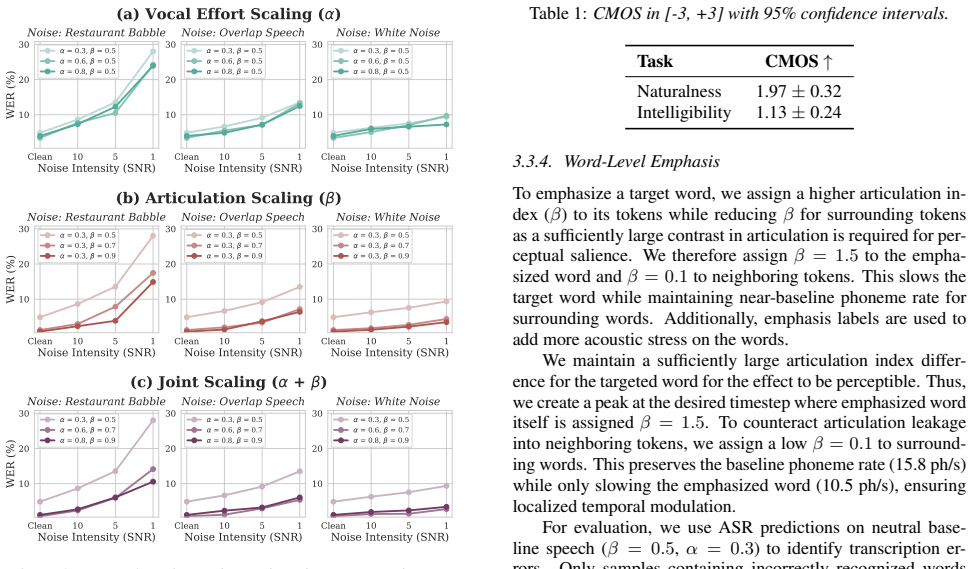
Humans tend to speak louder and clearer in challenging environments, such as noisy conditions or when addressing hearingimpaired listeners, which is called Lombard effect. To simulate this behavior in speech synthesis systems, we introduce a flow-matching based text-to-speech (TTS) model trained with vocal effort and articulation pseudo-labels. The proposed model achieves continuous and disentangled control of vocal effort and articulation, while also enabling word-level emphasis for clarifying specific segments of an utterance. Experimental results show that these control mechanisms effectively improve clarityrelated acoustic features. Furthermore, speech-in-noise experiments demonstrate that our model successfully simulates the intelligibility gains of human clear speech in noisy conditions.
Figures



Reference graph
Works this paper leans on
-
[1]
A prominent exam- ple is the Lombard effect, where speakers modify their speech in response to environmental noise or listener-related hearing difficulties
Introduction Humans naturally adapt their speaking style depending on the listener and the acoustic environment. A prominent exam- ple is the Lombard effect, where speakers modify their speech in response to environmental noise or listener-related hearing difficulties. Lombard speech is typically characterized by in- creased vocal effort, higher pitch, sl...
-
[2]
Synthesizing the Lombard Effect: Multi-Level Control of Speech Clarity and Vocal Effort in TTS
Method 2.1. Model Architecture We adopt Matcha-TTS [24] as our base architecture due to its strong balance between synthesis quality and inference effi- ciency. Matcha-TTS is a flow-matching-based TTS model that replaces iterative diffusion sampling with a deterministic flow 1https://seymanurakti.github.io/synthesizing-lombard-effect/ arXiv:2606.23176v1 [...
work page internal anchor Pith review Pith/arXiv arXiv 2026
-
[3]
Experiments and Results 3.1. Training Data We train our model using a subset of the Expresso dataset con- taining the default, enunciated, fast, and projected speaking styles, resulting in approximately 11 hours of speech including four speakers (two female and two male). Since the total duration of the Expresso subset is relatively limited for learning c...
-
[4]
Conclusion We proposed a multi-dimensional Lombard speech synthesis approach that jointly models vocal effort and articulation in a controllable TTS framework. Using flow-matching-based TTS and dual-level conditioning, the system enables continuous con- trol over global speaking style and word-level emphasis, yield- ing complementary gains in intelligibil...
-
[5]
101213369 (DVPS) and KIT Campus Transfer GmbH (KCT) in accordance with the collaboration with Carnegie-AI
Acknowledgments This research is supported by the European Union’s Horizon Europe programme grant agreement No. 101213369 (DVPS) and KIT Campus Transfer GmbH (KCT) in accordance with the collaboration with Carnegie-AI
-
[6]
Generative AI Use Disclosure During the preparation of this manuscript, the authors utilized generative AI technologies solely for the purposes of language polishing, grammar verification, and structural formatting of the content
-
[7]
The lombard reflex and its role on human listeners and automatic speech recognizers,
J.-C. Junqua, “The lombard reflex and its role on human listeners and automatic speech recognizers,”The Journal of the Acoustical Society of America, vol. 93, no. 1, pp. 510–524, 1993
1993
-
[8]
Specialized acoustic models for hy- perarticulated speech,
H. Soltau and A. Waibel, “Specialized acoustic models for hy- perarticulated speech,” inInternational Conference on Acoustics, Speech, and Signal Processing (ICASSP). IEEE, 2000
2000
-
[9]
Compensating hyperarticulation for automatic speech recognition,
H. Soltau, “Compensating hyperarticulation for automatic speech recognition,” Ph.D. dissertation, Karlsruhe Institute of Technol- ogy (KIT), 2005
2005
-
[10]
Compensating for hyper- articulation by modeling articulatory properties
H. Soltau, F. Metze, and A. Waibel, “Compensating for hyper- articulation by modeling articulatory properties.” inInterspeech, 2002
2002
-
[11]
Model-based and empirical evaluation of multimodal interactive error correction,
B. Suhm, B. Myers, and A. Waibel, “Model-based and empirical evaluation of multimodal interactive error correction,” inProceed- ings of the SIGCHI conference on Human Factors in Computing Systems, 1999, pp. 584–591
1999
-
[12]
Interactive multimodal robot dialog using pointing gesture recognition,
S. Constantin, F. I. Eyiokur, D. Yaman, L. B ¨armann, and A. Waibel, “Interactive multimodal robot dialog using pointing gesture recognition,” inEuropean Conference on Computer Vi- sion (ECCV). Springer, 2022, pp. 640–657
2022
-
[13]
Time and fre- quency dependent amplification for speech intelligibility enhance- ment in noisy environments,
H. Brouckxon, W. Verhelst, and B. D. Schuymer, “Time and fre- quency dependent amplification for speech intelligibility enhance- ment in noisy environments,” inInterspeech, 2008
2008
-
[14]
Near-end listening enhancement in the presence of bandpass noises,
B. Sauert and P. Vary, “Near-end listening enhancement in the presence of bandpass noises,” inSpeech Communication; 10. ITG Symposium. VDE, 2012, pp. 1–4
2012
-
[15]
Sii-based speech preprocessing for in- telligibility improvement in noise
C. H. Taal and J. Jensen, “Sii-based speech preprocessing for in- telligibility improvement in noise.” inInterspeech, 2013
2013
-
[16]
Speech energy redistribution for intelligibility improvement in noise based on a perceptual distortion measure,
C. H. Taal, R. C. Hendriks, and R. Heusdens, “Speech energy redistribution for intelligibility improvement in noise based on a perceptual distortion measure,”Computer Speech & Language, vol. 28, no. 4, pp. 858–872, 2014
2014
-
[17]
On spectral and time domain en- ergy reallocation for speech-in-noise intelligibility enhancement
T.-C. Zorila and Y . Stylianou, “On spectral and time domain en- ergy reallocation for speech-in-noise intelligibility enhancement.” inInterspeech, 2014
2014
-
[18]
Speech-in-noise intelligibility improvement based on spectral shaping and dynamic range compression,
V . Kandia, “Speech-in-noise intelligibility improvement based on spectral shaping and dynamic range compression,” inInterspeech, 2012
2012
-
[19]
Analysis of hmm- based lombard speech synthesis
T. Raitio, A. Suni, M. Vainio, and P. Alku, “Analysis of hmm- based lombard speech synthesis.” inInterspeech, 2011
2011
-
[20]
Online lombard-adaptation in incremental speech synthesis,
S. Rottsch ¨afer, H. Buschmeier, H. van Welbergen, and S. Kopp, “Online lombard-adaptation in incremental speech synthesis,” in Interspeech, 2015
2015
-
[21]
Lombard speech synthe- sis using transfer learning in a tacotron text-to-speech system,
B. Bollepalli, L. Juvela, and P. Alku, “Lombard speech synthe- sis using transfer learning in a tacotron text-to-speech system,” in Interspeech, 2019
2019
-
[22]
Enhancing speech intelligibility in text-to-speech synthesis using speaking style conversion,
D. Paul, M. P. Shifas, Y . Pantazis, and Y . Stylianou, “Enhancing speech intelligibility in text-to-speech synthesis using speaking style conversion,” inInterspeech, 2020
2020
-
[23]
Whispered and lombard neural speech synthesis,
Q. Hu, T. Bleisch, P. Petkov, T. Raitio, E. Marchi, and V . Lakshmi- narasimhan, “Whispered and lombard neural speech synthesis,” in IEEE Spoken Language Technology Workshop (SLT), 2021
2021
-
[24]
V ocal effort modeling in neural tts for improving the intelligibil- ity of synthetic speech in noise,
T. Raitio, P. Petkov, J. Li, M. Shifas, A. Davis, and Y . Stylianou, “V ocal effort modeling in neural tts for improving the intelligibil- ity of synthetic speech in noise,” inInterspeech, 2022
2022
-
[25]
D. Woszczyk, M. S. Ribeiro, T. Merritt, and D. Korzekwa, “V oice conversion for lombard speaking style with implicit and explicit acoustic feature conditioning,”arXiv preprint arXiv:2507.09310, 2025
-
[26]
Dynamically adaptive machine speech chain inference for tts in noisy environment: Lis- ten and speak louder
S. Novitasari, S. Sakti, and S. Nakamura, “Dynamically adaptive machine speech chain inference for tts in noisy environment: Lis- ten and speak louder.” inInterspeech, 2021
2021
-
[27]
Gradual modeling of the lom- bard effect by modifying speaker embeddings from a text-to- speech model,
T. H. G. Lobato and M. Sch ¨afer, “Gradual modeling of the lom- bard effect by modifying speaker embeddings from a text-to- speech model,” inInterspeech, 2025
2025
-
[28]
Analysis and syn- thesis of hypo and hyperarticulated speech,
B. Picart, T. Drugman, and T. Dutoit, “Analysis and syn- thesis of hypo and hyperarticulated speech,”arXiv preprint arXiv:2006.04136, 2020
-
[29]
Low- dimensional style token control for hyperarticulated speech syn- thesis,
M. Nishihara, D. Wells, K. Richmond, and A. Pine, “Low- dimensional style token control for hyperarticulated speech syn- thesis,” inInterspeech, 2024
2024
-
[30]
Matcha-tts: A fast tts architecture with conditional flow match- ing,
S. Mehta, R. Tu, J. Beskow, ´E. Sz ´ekely, and G. E. Henter, “Matcha-tts: A fast tts architecture with conditional flow match- ing,” inInternational Conference on Acoustics, Speech and Signal Processing (ICASSP). IEEE, 2024
2024
-
[31]
H. Siuzdak, “V ocos: Closing the gap between time-domain and fourier-based neural vocoders for high-quality audio synthesis,” arXiv preprint arXiv:2306.00814, 2023
work page Pith review arXiv 2023
-
[32]
Ex- presso: A benchmark and analysis of discrete expressive speech resynthesis,
T. A. Nguyen, W.-N. Hsu, A. d’Avirro, B. Shi, I. Gat, M. Fazel- Zarani, T. Remez, J. Copet, G. Synnaeve, M. Hassidet al., “Ex- presso: A benchmark and analysis of discrete expressive speech resynthesis,” inInterspeech, 2023
2023
-
[33]
Ieee recommended practice for speech quality measurements,
E. H. Rothauser, “Ieee recommended practice for speech quality measurements,”IEEE Transactions on Audio and Electroacous- tics, vol. 17, no. 3, pp. 225–246, 1969
1969
-
[34]
In- vestigation of a glottal related harmonics-to-noise ratio and spec- tral tilt as indicators of glottal noise in synthesized and human voice signals,
P. J. Murphy, K. G. McGuigan, M. Walsh, and M. Colreavy, “In- vestigation of a glottal related harmonics-to-noise ratio and spec- tral tilt as indicators of glottal noise in synthesized and human voice signals,”The Journal of the Acoustical Society of America, vol. 123, no. 3, pp. 1642–1652, 2008
2008
-
[35]
Bersting at the screams: a benchmark for distanced, emotional and shouted speech recogni- tion,
P. Tutt ¨os´ı, M. Dhillon, L. Sang, S. Eastwood, P. Bhatia, Q. M. Dinh, A. Kapoor, Y . Jin, and A. Lim, “Bersting at the screams: a benchmark for distanced, emotional and shouted speech recogni- tion,”Computer Speech & Language, vol. 95, p. 101815, 2026
2026
discussion (0)
Sign in with ORCID, Apple, or X to comment. Anyone can read and Pith papers without signing in.