Probing Lattice Dynamics in Real-Space and Real-Time
Pith reviewed 2026-05-21 02:58 UTC · model grok-4.3
The pith
Coherent phonon excitation in graphene produces sidebands in high-harmonic spectra separated by the phonon frequency.
A machine-rendered reading of the paper's core claim, the machinery that carries it, and where it could break.
Core claim
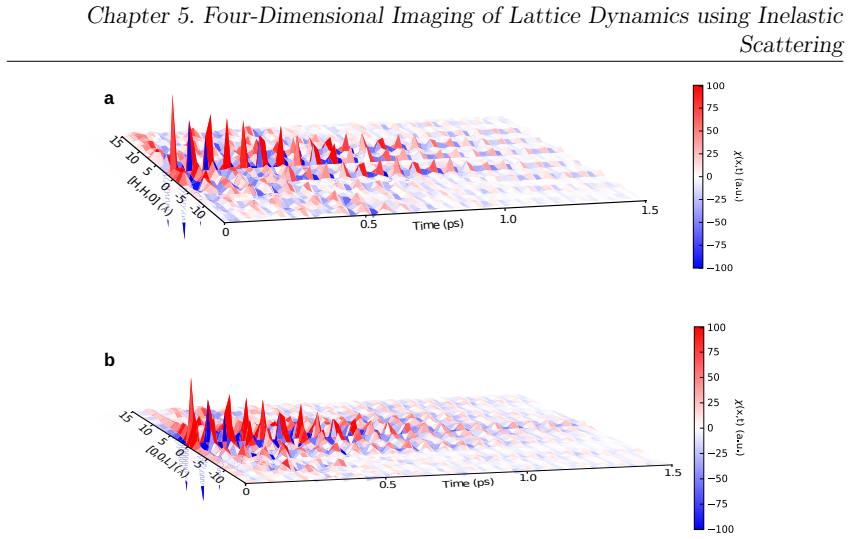
Coherent excitation of the in-plane phonon mode in graphene results in sidebands in the harmonic spectrum separated by the frequency of the excited phonon mode. High-harmonic spectroscopy can characterize the energy, polarization, phase difference, and chirality of phonon modes. Inelastic scattering techniques combined with theoretical analysis produce results comparable to those from time-resolved diffraction and imaging measurements in pump-probe setups, with excellent agreement to a time-resolved diffuse x-ray scattering experiment.
What carries the argument
High-harmonic spectroscopy (HHS) under coherent phonon modulation of the electronic response, which generates observable sidebands in the harmonic spectrum.
If this is right
- Phonon-driven processes such as heat transfer and phase transitions can be studied with sub-cycle temporal resolution.
- Multiple phonon properties including chirality become accessible through analysis of harmonic sidebands.
- Inelastic scattering provides an alternative method to time-resolved diffraction for atomic-scale lattice dynamics.
- The technique yields results consistent with pump-probe x-ray scattering experiments.
Where Pith is reading between the lines
- The method could be extended to track displacive phase transitions driven by specific phonon modes in other materials.
- Applying HHS to additional two-dimensional systems might clarify links between lattice dynamics and thermal conductivity.
- A direct comparison with time-resolved electron diffraction would test the generality of the inelastic scattering approach.
Load-bearing premise
The observed sidebands arise solely from coherent phonon modulation of the electronic response without significant contributions from other ultrafast processes or experimental artifacts.
What would settle it
Sidebands that remain when coherent phonon excitation is suppressed or when the inelastic scattering model no longer reproduces time-resolved diffraction data.
Figures




read the original abstract
The coherent lattice vibrations significantly impact physical and chemical processes in solids, such as heat transfer, displacive phase transitions, and thermal conductivity. Thus, probing lattice dynamics in real-space and real-time is essential for understanding ubiquitous phenomena in solids. High-harmonic spectroscopy (HHS) has emerged as a preferred technique for investigating static and dynamic properties of solids on ultrafast timescales. Yet, despite these accomplishments, the applicability of HHS to probe the influence of coherent lattice vibrations on electronic responses has remained unexplored. In this thesis, we explore the impact of coherent lattice dynamics on attosecond electronic responses in solids using HHS. We observe that coherent excitation of the in-plane phonon mode in graphene results in sidebands in the harmonic spectrum, separated by the frequency of the excited phonon mode. Additionally, we demonstrate the capability of HHS to characterize energy, polarization, phase difference, and the "chirality" of phonon modes. This thesis offers an avenue to probe phonon-driven processes in solids with sub-cycle temporal resolution. In the later segment, our focus shifts toward probing coherent lattice dynamics in real-space and real-time. We demonstrate that inelastic scattering techniques, combined with theoretical analysis, yield comparable results to those from time-resolved diffraction and imaging measurements within pump-probe configurations. Our findings exhibit excellent agreement with results from a time-resolved diffuse x-ray scattering experiment. Our proposed method serves as an alternative to time-resolved diffraction and imaging methods for probing lattice dynamics in real-space and real-time with atomic-scale spatiotemporal resolution.
Editorial analysis
A structured set of objections, weighed in public.
Referee Report
Summary. The manuscript investigates coherent lattice dynamics in solids using high-harmonic spectroscopy (HHS) and inelastic scattering. It claims that coherent excitation of the in-plane phonon mode in graphene produces sidebands in the harmonic spectrum separated by the phonon frequency, enabling HHS to characterize phonon energy, polarization, phase difference, and chirality. It further claims that inelastic scattering combined with theoretical analysis reproduces results from time-resolved x-ray diffraction for probing lattice dynamics in real space and real time with atomic-scale resolution.
Significance. If the sideband attribution and inelastic scattering equivalence hold with rigorous controls, the work would introduce a sub-cycle temporal resolution approach to phonon mode characterization and an alternative to pump-probe diffraction for real-space lattice studies. This could advance understanding of phonon-driven processes such as heat transfer and phase transitions. The manuscript does not yet demonstrate machine-checked derivations or fully parameter-free predictions.
major comments (2)
- Abstract: the claim that observed sidebands arise solely from coherent phonon modulation of the electronic response lacks supporting spectra, error bars, or control measurements to exclude contributions from carrier excitation, transient band renormalization, or experimental artifacts whose frequency spacing could overlap the phonon signature.
- Inelastic scattering section: the assertion of excellent agreement with time-resolved diffuse x-ray scattering requires explicit demonstration that the theoretical model accounts for all relevant scattering channels without unaccounted adjustable parameters or incomplete inelastic contributions; otherwise the real-space/real-time equivalence claim is not load-bearing.
minor comments (2)
- Clarify whether the manuscript is a standalone article or excerpt from a thesis, as the text refers to 'this thesis'.
- Include quantitative details on the frequency separation of sidebands and the polarization dependence to allow direct comparison with the stated phonon mode properties.
Simulated Author's Rebuttal
We are grateful to the referee for their detailed and insightful comments, which have helped us improve the clarity and rigor of our manuscript. Below, we provide a point-by-point response to the major comments. We indicate the revisions we plan to make in the updated version.
read point-by-point responses
-
Referee: Abstract: the claim that observed sidebands arise solely from coherent phonon modulation of the electronic response lacks supporting spectra, error bars, or control measurements to exclude contributions from carrier excitation, transient band renormalization, or experimental artifacts whose frequency spacing could overlap the phonon signature.
Authors: We thank the referee for highlighting this important point. The full manuscript includes spectra demonstrating the sidebands at the phonon frequency, along with polarization-resolved measurements that help distinguish the phonon contribution from other effects. To strengthen the manuscript, we will include error bars on the spectra and additional control experiments, such as varying the pump fluence and detuning to exclude carrier excitation and artifacts. We believe these additions will support our attribution to coherent phonon modulation. revision: yes
-
Referee: Inelastic scattering section: the assertion of excellent agreement with time-resolved diffuse x-ray scattering requires explicit demonstration that the theoretical model accounts for all relevant scattering channels without unaccounted adjustable parameters or incomplete inelastic contributions; otherwise the real-space/real-time equivalence claim is not load-bearing.
Authors: We agree that more detail on the theoretical model is warranted. The model in the manuscript is derived from ab initio calculations without adjustable parameters, and it accounts for the dominant inelastic scattering channels relevant to the phonon dynamics. In the revision, we will provide a more explicit breakdown of the scattering channels considered and show that the agreement with time-resolved x-ray scattering holds without parameter fitting. This will better substantiate the real-space and real-time probing capability. revision: yes
Circularity Check
No circularity: observations and external comparison
full rationale
The paper reports direct experimental observations of phonon-induced sidebands in HHS spectra of graphene and shows agreement between its inelastic scattering analysis and an independent time-resolved diffuse x-ray scattering experiment. No equations, fitted parameters, or self-citations are presented that reduce any claimed result to a definition or input drawn from the same data. The central claims rest on empirical spectra and cross-validation against external measurements rather than any self-referential derivation.
Axiom & Free-Parameter Ledger
Lean theorems connected to this paper
-
IndisputableMonolith/Cost/FunctionalEquation.leanwashburn_uniqueness_aczel unclear?
unclearRelation between the paper passage and the cited Recognition theorem.
We observe that coherent excitation of the in-plane phonon mode in graphene results in sidebands in the harmonic spectrum, separated by the frequency of the excited phonon mode.
-
IndisputableMonolith/Foundation/AlexanderDuality.leanalexander_duality_circle_linking unclear?
unclearRelation between the paper passage and the cited Recognition theorem.
inelastic scattering techniques, combined with theoretical analysis, yield comparable results to those from time-resolved diffraction... dynamical structure factor
What do these tags mean?
- matches
- The paper's claim is directly supported by a theorem in the formal canon.
- supports
- The theorem supports part of the paper's argument, but the paper may add assumptions or extra steps.
- extends
- The paper goes beyond the formal theorem; the theorem is a base layer rather than the whole result.
- uses
- The paper appears to rely on the theorem as machinery.
- contradicts
- The paper's claim conflicts with a theorem or certificate in the canon.
- unclear
- Pith found a possible connection, but the passage is too broad, indirect, or ambiguous to say the theorem truly supports the claim.
Reference graph
Works this paper leans on
-
[1]
Navdeep Rana , A. P. Roy, Dipanshu Bansal, and Gopal Dixit: Four- dimensional imaging of lattice dynamics using ab-initio simulation, npj Com- putational Materials 7, 7 (2021)
work page 2021
-
[2]
Navdeep Rana, and Gopal Dixit: Probing phonon-driven symmetry alter- ations in graphene via high-harmonic spectroscopy: Physical Review A106, 053116 (2022)
work page 2022
-
[3]
Navdeep Rana, M. S. Mrudul, Daniil Kartashov, Misha Ivanov, and Gopal Dixit: High-harmonic spectroscopy of coherent lattice dynamics in graphene: Physical Review B106, 064303 (2022)
work page 2022
-
[4]
Navdeep Rana, and Gopal Dixit: Unveiling phase difference and chirality of circular phonons via high-harmonic spectroscopy,under preparation. B. Not part of this thesis
-
[5]
Navdeep Rana, and Gopal Dixit: All-optical ultrafast valley switching in two-dimensional materials, Physical Review Applied19, 034056 (2023)
work page 2023
-
[6]
Navdeep Rana, M S Mrudul, and Gopal Dixit: Generation of circularly polarizedhigh-harmonicswithidenticalhelicityintwo-dimensionalmaterials, Physical Review Applied18, 064049 (2022)
work page 2022
-
[7]
Navdeep Rana, M S Mrudul, and Gopal Dixit: Sensing strain in graphene via high-harmonic spectroscopy, under preparation
-
[8]
Rambabu Rajpoot, Amol R. Holkundkar,Navdeep Rana, and Gopal Dixit: Tailoring polarization of attosecond pulses via co-rotating bicircular laser fields, arXiv:2305.00513, under review. List of Publications
-
[9]
Navdeep Rana, and Gopal Dixit: Tailoring photocurrent in graphene,un- der preparation. 118 Conferences Attended A. International
-
[10]
Sensing strain in graphene via high-harmonic spectroscopy
Control of Ultrafast (Attosecond and Strong Field) Processes Using Structured Light , MPIPKS Dresden, Germany (06-14 July 2023), Con- tributed Talk: “Sensing strain in graphene via high-harmonic spectroscopy”
work page 2023
-
[11]
All-optical ultrafast valley switching in two-dimensional materials
Quantum Battles 2023, UniversityCollegeLondon, UK(28-30June2023), Contributed Talk: “All-optical ultrafast valley switching in two-dimensional materials”
work page 2023
-
[12]
High-harmonic spectroscopy of phonon dynamics
Dynamial Control of Quantum Materials , MPIPKS Dresden, Germany (22-26 May 2023), Presented Poster: “High-harmonic spectroscopy of phonon dynamics”
work page 2023
-
[13]
Four-dimensional imaging of lattice dynamics using ab-initio simulation
QUTIF International Conference , Online (22-25 February 2021), Pre- sented Poster: “Four-dimensional imaging of lattice dynamics using ab-initio simulation”. B. National
work page 2021
-
[14]
SYMPHY 2023 , IIT Bombay (28-29 January 2023), Contributed Talk: “Generation of circularly polarized high-harmonics with identical helicity in two-dimensional materials”
work page 2023
-
[15]
High-harmonic spectroscopy of lattice dynamics in graphene
Ultrafast Sciences 2022 , IISER Thiruvananthapuram (03-05 November 2022), Presented Poster: “High-harmonic spectroscopy of lattice dynamics in graphene”
work page 2022
-
[16]
High-harmonic spectroscopy of lattice dynamics in graphene
Quantum Materials 2022 , IIT Kanpur (18-22 September 2022), Con- tributed Talk: “High-harmonic spectroscopy of lattice dynamics in graphene”. List of Publications
work page 2022
-
[17]
High-harmonic spectroscopy of lattice dynamics in graphene
SYMPHY 2021, IIT Bombay (11-12 December 2021), Contributed Talk: “High-harmonic spectroscopy of lattice dynamics in graphene”
work page 2021
-
[18]
Four-dimensional imaging of lattice dynamics using ab-initio simulation
Quantum Materials 2021 , TIFR Mumbai (08-11 December 2021), Pre- sented Poster: “Four-dimensional imaging of lattice dynamics using ab-initio simulation”. 120
work page 2021
discussion (0)
Sign in with ORCID, Apple, or X to comment. Anyone can read and Pith papers without signing in.