REVIEW 4 major objections 5 minor 37 references
Sample Efficient Robot Learning in Supervised Effect Prediction Tasks
T0 review · 4 major / 5 minor · reviewed 2026-08-11 · deepseek-v4-flash
Pith's one-line read One acquisition score, multiplying predictive variance, learning progress, and input distance, improves sample efficiency in robot effect-prediction tasks.
desk verdict A useful heuristic combination of three known sampling signals for robot regression, presented with an overclaimed conceptual decomposition and thin statistical evidence for its edge over the strongest baseline. read the letter →
The pith
A machine-rendered reading of the paper's core claim, the machinery that carries it, and where it could break.
The reading
What carries the argument
The load-bearing object is the multiplicative uncertainty decomposition $U(x)=\sigma(x)=U_{model}(x)U_{data}(x)$, adopted from the literature, together with the assumption that learning-progress rate and distance to training data jointly capture irreducible data uncertainty. Learning progress is computed on a grid of regions in input space: per-region average errors over the last $p$ iterations are linearly fitted against step counts, and the fitted slope is mapped into $[10^{-4},1]$ via an arctan transform. The product in equation (8) ranks candidate inputs, and the top-$k$ are executed and incorporated into the training set, with the Stochastic Variational Deep Kernel Learning model providing $\sigma(x)$ and the predictive mean.
What would settle it
On a deterministic task where the effect function is noiseless, true data uncertainty is zero, so $U_{data}$ should collapse to a constant; if $U_{model}$ computed with the paper's formula still changes sample selection and improves RMSE relative to using $\sigma$ alone, then the gain comes from heuristics rather than from the claimed decomposition. A direct check would compare the ranking produced by $\sigma(x)\ell(x)\mathrm{LP}(x)$ against a ground-truth decomposition obtained by repeatedly training models on growing datasets to isolate the reducible error for each input.
Extended reading notes
Core claim
On the paper's own terms, the central discovery is that model uncertainty for a continuous state–action input $x$ can be extracted from the total predictive uncertainty $\sigma(x)$ by dividing out an estimate of data uncertainty $U_{data}(x)=1/(\ell(x)\,\mathrm{LP}(x))$, where $\ell(x)$ is the minimum Euclidean distance to training inputs and $\mathrm{LP}(x)$ is a region-level learning-progress estimate. The resulting acquisition score $U_{model}(x)=\sigma(x)\ell(x)\mathrm{LP}(x)$ is used to rank candidates from a population sampled over the continuous input space, and the top-$k$ are executed and added to the training set. The paper reports that this score outperforms random selection and single-criterion selection in a one-sphere push task, and exceeds even the strongest single component (minimum-distance sampling) in a two-sphere collision task, where convergence is noticeably earlier.
Load-bearing premise
The whole scheme assumes that the product of learning progress and minimum distance to training inputs correctly measures the part of prediction error that no amount of extra data can remove, and that this factorization holds as a plain multiplication of three scalar signals.
Editorial extensions
If this is right
- If the score is right, self-supervised effect prediction can run with fewer executed robot actions, lowering energy, oversight, and experimental time in real-robot deployment.
- The two-sphere result suggests the advantage over random and MD-only sampling grows with task complexity, and earlier convergence may make the method usable in online learning settings.
- Because the score uses only quantities available during training (predictive variance, prediction errors, and input distances), it can be added to an existing SVDKL-based learner without an external oracle.
- The ablation experiments imply the three terms are partly redundant: dropping minimum distance hurts most, while dropping learning progress or predictive variance hurts least, so a leaner variant may retain most of the benefit.
Reading between the lines
- The paper does not compare MUSEL against a simple additive combination of the same three normalized components; if a weighted sum matched its performance, the multiplicative factorization would not be the essential ingredient.
- In the paper's deterministic simulator, true aleatoric data uncertainty is near zero, so the theory predicts $U_{data}\approx 1$; a direct comparison of $\sigma$-only sampling with full MUSEL in that regime would separate the factorization's contribution from the coverage effect of minimum-distance sampling.
- The $7\times7\times7$ LP grid is a fixed free parameter, and its adequacy will need re-examination as the state–action dimensionality grows in more complex robot tasks.
- The claimed generality to any effect-prediction setting presumes a metric, locally smooth input space; discrete or symbolic state representations would break the minimum-distance and region-local learning-progress estimates.
Editorial analysis
A structured set of objections, weighed in public.
Referee Report
Summary. This paper introduces MUSEL, an active-learning score U_model(x) = sigma(x) * ell(x) * LP(x) (Eq. 8) for selecting state-action pairs in continuous supervised effect-prediction regression. The score is motivated by a factorization of SVDKL total uncertainty sigma into model and data parts (Eqs. 3-4), with data uncertainty taken to be the inverse product of minimum distance to training inputs ell and region-level learning progress LP. The method is evaluated in two simulated tabletop pushing tasks against random sampling, single-component sampling, and component-ablated versions, reporting RMSE over 3000 iterations with 10 seeds. The paper claims lower RMSE and higher sample efficiency, particularly in the two-sphere task.
Significance. If substantiated, MUSEL would be a practical and relatively simple active-learning criterion for continuous robot regression, and the use of SVDKL to obtain both total uncertainty and a learned feature space is sensible. The experimental design has strengths: ten seeds with SEM error bars, component ablations, two tasks, and diagnostic analyses of sampling distributions and LP profiles. However, the central decomposition is asserted rather than verified, and the empirical advantage over the strongest baseline, MD-only sampling, is not established statistically. The contribution would be more convincing with paired significance tests, numeric RMSE tables, and an analysis of how much of the ranking is driven by ell alone. No code or supplementary material is referenced, which limits repeatability.
major comments (4)
- [Section 3.4, Eqs. (3)-(4)] The factorization U(x) = sigma(x) = U_model(x) * U_data(x) with U_data(x) = 1/(ell(x) * LP(x)) is load-bearing for the paper, but it is adopted from [14] and is not tested on the deterministic tabletop tasks. In those tasks the environment transition is deterministic, so the aleatoric component of data uncertainty is arguably negligible; interpreting 1/(ell*LP) as data uncertainty is therefore not self-evident. A concrete check would be to compare the estimated U_model against the actual reduction in predictive error achieved by adding a candidate sample across multiple regions; without such a check, Eq. (8) is one of several possible weightings of sigma, ell, and LP rather than a grounded extraction of model uncertainty. I do not see a circularity problem, since Eq. (8) follows algebraically from the assumed definitions, but the assumption itself needs empirical justification.
- [Section 4.2-4.3, Figs. 4 and 6, Table 1] The central claim that MUSEL improves both learning accuracy and sample efficiency is not supported by statistical evidence. In the one-sphere task, MD-based selection closely approached MUSEL, and Table 1 reports only boundary-sample counts, not RMSE comparisons; in the two-sphere task the advantage is described as more pronounced without numeric RMSE values, effect sizes, or test statistics. With ten seeds per condition, paired significance tests (e.g., Wilcoxon signed-rank at each iteration) and a table of mean RMSE with confidence intervals should be reported. This is load-bearing because MD-only is the strongest baseline and the abstract's claim depends on a reliable advantage over it.
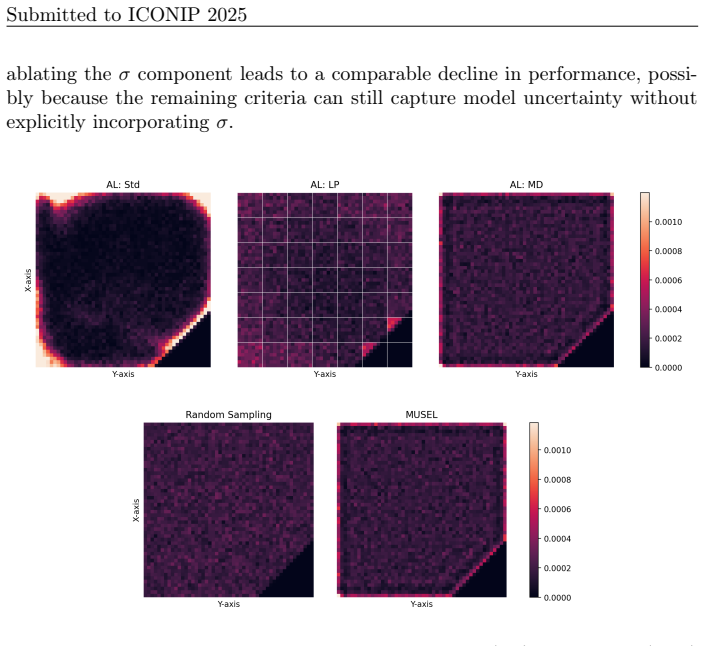
- [Section 3.4, Eq. (8)] The proposed score may be dominated by the ell factor. ell(x) is the minimum distance to training inputs and sigma(x) tends to be large in the same low-density regions, while LP(x) is constant within each grid region by construction (Section 3.4). The paper does not quantify the rank correlation between U_model and ell, nor does it provide an ablation that removes the sigma or LP contribution without also changing ell. Reporting the marginal contribution of each factor, or an experiment in which one factor is held fixed in the ranking, would address the concern that the decomposition adds little over standard minimum-distance sampling.
- [Section 4.1, Eqs. (6)-(7)] Several hyperparameters that directly affect the LP term are missing or under-specified. The window p in 'last p average RMSE errors' is never given; the region-grid resolution is reported as 7x7x7, but the handling of LP for regions with no executed samples is not stated, and the exact mapping implied by Eq. (7) is not fully consistent with the claimed [10^-4, 1] range. The 'prioritized training scheme' with mtrain=2000 is also described only verbally. These omissions prevent reproduction of the experiments and leave open the possibility that the reported rankings depend sensitively on unstated choices.
minor comments (5)
- [Section 3.4, Eq. (6)] The notation |r_i|, used as the number of executed inputs in region i, is not defined before use; please add a definition.
- [Section 4.1] The test grid dimensions are given as 25x20x20 and 20x25x25, but it is not stated which axis corresponds to the push angle and which to posx/posy; clarify the ordering.
- [Figure 4] The right panel lacks a caption describing the line styles and the meaning of 'full MUSEL' in the ablation plot; the current caption only refers to the left panel.
- [Algorithm 1, line 7] The model uncertainty estimator Eq. (8) depends on LP computed from executed samples, but the algorithm does not state how LP is initialized for candidate regions that have not been visited yet; please clarify the default LP value.
- [Section 3.4] The sentence 'Note that the maximum of this value is often used in active learning algorithms for sample selection [34]' is ambiguous because Eq. (4) is an inverse product; rephrase to refer to ell(x) directly.
Circularity Check
MUSEL's model-uncertainty metric is definitional under the assumed factorization; the empirical sample-efficiency comparisons are independent, with no load-bearing self-citation circularity.
-
self definitional
[Section 3.4, Equations (3), (4), and (8)]
"Following [14], we assume a statistical independence between the model uncertainty, Umodel and data uncertainty, Udata and hence write U (x) = σ(x) = Umodel(x) Udata(x). (3) ... Based on the inverse relationship between these effects, we propose the following data uncertainty estimate: Udata(x) = 1 / (ℓ(x) LP(x)). (4) ... Substituting Udata in Equation 3 with Equation 4, model uncertainty becomes Umodel(x) = σ(x) ℓ(x) LP(x). (8)"
The claimed 'extraction' of model uncertainty from total uncertainty is not an independent derivation: U_model is obtained by substituting the assumed definition U_data = 1/(ℓ·LP) into the assumed factorization U = U_model·U_data. Equation (8) is therefore algebraically identical to the proposed acquisition score by construction, not a discovered quantity. The paper's contribution statement, 'Extraction of model uncertainty from total uncertainty using learning progress and input diversity,' is a restatement of this definition. The empirical RMSE comparisons against random, LP, σ-only, and MD-only baselines are independent and not forced by this definition, so the circularity is conceptual rather than statistical.
full rationale
No significant circularity is found in the central empirical claim. MUSEL's sample-selection rule is evaluated against held-out test grids with ten seeds, and the reported RMSE curves are measured outcomes rather than fitted values renamed as predictions. The closest baseline, MD-only sampling, is not a component of MUSEL that is being predicted from itself; it is an ablation-style competitor, and the claim that MUSEL improves over it is an empirical observation, even if not supported by significance tests. The self-citations in the paper ([1], [4], [23]) are related-work references and are not load-bearing for the proposed uncertainty decomposition or for the experimental results. The only definitional step is Equations (3)-(4) and (8), where 'model uncertainty' is defined, via the assumed factorization, as the product σ·ℓ·LP; this makes the conceptual framing circular in a mild sense, but it does not make the experimental evaluation circular. The lack of a ground-truth validation of the U_model/U_data decomposition, and the absence of paired significance tests for the MUSEL-vs-MD gap, are better classified as correctness-risk and statistical-rigor concerns rather than circularity.
Assumptions & free parameters
free parameters (6)
- LP window size p
- LP region grid resolution =
7 x 7 x 7
- LP normalization constants =
arctan scaling; floor 10^-4
- Component weights in U_model =
1, 1, 1
- Candidate pool size and selection count =
mcand=500, k=1
- Initial dataset size and training budget =
minit=1; m_train=2000; lr=5e-3; one epoch
assumptions (4)
- domain assumption Total uncertainty factors into independent model and data uncertainty: U(x)=U_model(x)*U_data(x).
- ad hoc to paper Data uncertainty is inversely proportional to the product of minimum distance and learning progress: U_data=1/(ell*LP).
- domain assumption Learning progress is constant within each uniformly partitioned region.
- domain assumption SVDKL predictive standard deviation is a well-calibrated total uncertainty estimate.
Cite this review
Pith. "Pith review of Sample Efficient Robot Learning in Supervised Effect Prediction Tasks." pith.science (2026). https://pith.science/paper/5W5BBJFL
@misc{pith2026241202331,
  author       = {Pith},
  title        = {Pith review of: Sample Efficient Robot Learning in Supervised Effect Prediction Tasks},
  year         = {2026},
  howpublished = {\url{https://pith.science/paper/5W5BBJFL}},
  note         = {Machine review of arXiv:2412.02331}
}
read the original abstract
In self-supervised robotic learning, agents acquire data through active interaction with their environment, incurring costs such as energy use, human oversight, and experimental time. To mitigate these, sample-efficient exploration is essential. While intrinsic motivation (IM) methods like learning progress (LP) are widely used in robotics, and active learning (AL) is well established for classification in machine learning, few frameworks address continuous, high-dimensional regression tasks typical of world model learning. We propose MUSEL (Model Uncertainty for Sample-Efficient Learning), a novel AL framework tailored for regression tasks in robotics, such as action-effect prediction. MUSEL introduces a model uncertainty metric that combines total predictive uncertainty, learning progress, and input diversity to guide data acquisition. We validate our approach using a Stochastic Variational Deep Kernel Learning (SVDKL) model in two robotic tabletop tasks. Experimental results demonstrate that MUSEL improves both learning accuracy and sample efficiency, validating its effectiveness in learning action effects and selecting informative samples.
Figures


Figures from the paper (3 more)


Reference graph
Works this paper leans on
-
[14]
Lee, H., Lee, S., Song, B.C.: Data and model uncertainty aware salient object detection. IEEE Access (2024)
work page 2024
-
[1]
Journal of Artificial Intelligence Research75, 709–745 (2022)
Ahmetoglu,A.,Seker,M.Y.,Piater,J.,Oztop,E.,Ugur,E.:Deepsym:Deepsymbol generation and rule learning for planning from unsupervised robot interaction. Journal of Artificial Intelligence Research75, 709–745 (2022)
work page 2022
-
[2]
Robotics and Autonomous Systems61(1), 49–73 (2013)
Baranes, A., Oudeyer, P.Y.: Active learning of inverse models with intrinsically motivated goal exploration in robots. Robotics and Autonomous Systems61(1), 49–73 (2013)
work page 2013
-
[3]
Journal of the American statistical Association 112(518), 859–877 (2017)
Blei, D.M., Kucukelbir, A., McAuliffe, J.D.: Variational inference: A review for statisticians. Journal of the American statistical Association 112(518), 859–877 (2017)
2017
-
[4]
IEEE Transactions on Cognitive and Developmental Systems13(2), 286–297 (2019)
Bugur, S., Oztop, E., Nagai, Y., Ugur, E.: Effect regulated projection of robot’s ac- tion space for production and prediction of manipulation primitives through learn- ing progress and predictability-based exploration. IEEE Transactions on Cognitive and Developmental Systems13(2), 286–297 (2019)
work page 2019
-
[5]
IEEE Robotics and Automation Letters6(2), 3365–3372 (2021) Submitted to ICONIP 2025
Chen, G., Sun, D., Dong, W., Sheng, X., Zhu, X., Ding, H.: Computationally efficient trajectory planning for high speed obstacle avoidance of a quadrotor with active sensing. IEEE Robotics and Automation Letters6(2), 3365–3372 (2021) Submitted to ICONIP 2025
work page 2021
-
[6]
Journal of artificial intelligence research4, 129–145 (1996)
Cohn, D.A., Ghahramani, Z., Jordan, M.I.: Active learning with statistical models. Journal of artificial intelligence research4, 129–145 (1996)
work page 1996
-
[7]
van Deursen, M.: Population-based Active Learning for Black-Box Regression. Master’s thesis, Delft University of Technology, Delft, Netherlands (October 2020), available athttp://repository.tudelft.nl/
work page 2020
Show all 37 references
-
[8]
IEEE Transactions on Knowledge and Data Engineering26(4), 808–822 (2013)
Fu, Y., Li, B., Zhu, X., Zhang, C.: Active learning without knowing individual instance labels: a pairwise label homogeneity query approach. IEEE Transactions on Knowledge and Data Engineering26(4), 808–822 (2013)
2013
-
[9]
arXiv preprint arXiv:2107.03342 (2021)
Gawlikowski, J., Tassi, C.R.N., Ali, M., Lee, J., Humt, M., Feng, J., Kruspe, A., Triebel, R., Jung, P., Roscher, R., et al.: A survey of uncertainty in deep neural networks. arXiv preprint arXiv:2107.03342 (2021)
2021 arXiv
-
[10]
IEEE Access7, 135413–135426 (2019)
Greigarn, T., Branicky, M.S., Çavuşoğlu, M.C.: Task-oriented active sensing via action entropy minimization. IEEE Access7, 135413–135426 (2019)
2019
-
[11]
arXiv preprint arXiv:1803.10122 (2018)
Ha, D., Schmidhuber, J.: World models. arXiv preprint arXiv:1803.10122 (2018)
2018 arXiv
-
[12]
arXiv preprint arXiv:1309.6835 (2013)
Hensman, J., Fusi, N., Lawrence, N.D.: Gaussian processes for big data. arXiv preprint arXiv:1309.6835 (2013)
2013 arXiv
-
[13]
Advances in neural information processing systems 29 (2016)
Houthooft, R., Chen, X., Duan, Y., Schulman, J., De Turck, F., Abbeel, P.: Vime: Variational information maximizing exploration. Advances in neural information processing systems 29 (2016)
2016
-
[15]
IEEE Transactions on Automation Science and Engineering (2023)
Li, K., Jin, X., Jia, Q.S., Ren, D., Xia, H.: An ocba-based method for efficient sample collection in reinforcement learning. IEEE Transactions on Automation Science and Engineering (2023)
2023
-
[16]
Pattern Recognition Letters142, 11–19 (2021)
Liu, Z., Jiang, X., Luo, H., Fang, W., Liu, J., Wu, D.: Pool-based unsupervised active learning for regression using iterative representativeness-diversity maximiza- tion (irdm). Pattern Recognition Letters142, 11–19 (2021)
2021
-
[17]
Sensors21(7), 2445 (2021)
Lluvia, I., Lazkano, E., Ansuategi, A.: Active mapping and robot exploration: A survey. Sensors21(7), 2445 (2021)
2021
-
[18]
Maeda, G., Ewerton, M., Osa, T., Busch, B., Peters, J.: Active incremental learning ofrobotmovementprimitives.In:ConferenceonRobotLearning.pp.37–46.PMLR (2017)
2017
-
[19]
In: Proceedings of the International Conference on Devel- opment and Learning (2004)
Marshall, J., Blank, D., Meeden, L.: An emergent framework for self-motivation in developmental robotics. In: Proceedings of the International Conference on Devel- opment and Learning (2004)
2004
-
[20]
ACM Computing Surveys (CSUR) 54(9), 1–35 (2021)
Mena, J., Pujol, O., Vitrià, J.: A survey on uncertainty estimation in deep learn- ing classification systems from a bayesian perspective. ACM Computing Surveys (CSUR) 54(9), 1–35 (2021)
2021
-
[21]
IEEE transactions on evolutionary computation 11(2), 265–286 (2007)
Oudeyer, P.Y., Kaplan, F., Hafner, V.V.: Intrinsic motivation systems for au- tonomous mental development. IEEE transactions on evolutionary computation 11(2), 265–286 (2007)
2007
-
[22]
Péré, A., Forestier, S., Sigaud, O., Oudeyer, P.Y.: Unsupervised learning of goal spacesforintrinsicallymotivatedgoalexploration.arXivpreprintarXiv:1803.00781 (2018)
2018 arXiv
-
[23]
In: 2023 IEEE International Conference on Robotics and Biomimetics (ROBIO)
Say, H., Oztop, E.: A model for cognitively valid lifelong learning. In: 2023 IEEE International Conference on Robotics and Biomimetics (ROBIO). pp. 1–7. IEEE (2023)
2023
-
[24]
Robotics and Autonomous Systems119, 173–184 (2019)
Seker, M.Y., Tekden, A.E., Ugur, E.: Deep effect trajectory prediction in robot manipulation. Robotics and Autonomous Systems119, 173–184 (2019)
2019
-
[25]
Advances in neural information processing systems31 (2018) Submitted to ICONIP 2025
Sensoy, M., Kaplan, L., Kandemir, M.: Evidential deep learning to quantify classi- fication uncertainty. Advances in neural information processing systems31 (2018) Submitted to ICONIP 2025
2018
-
[26]
Computer Sciences Technical Re- port 1648, University of Wisconsin–Madison (2009),https://minds.wisconsin
Settles, B.: Active learning literature survey. Computer Sciences Technical Re- port 1648, University of Wisconsin–Madison (2009),https://minds.wisconsin. edu/handle/1793/60660
2009
-
[27]
Machine Learning75, 249–274 (2009)
Sugiyama, M., Nakajima, S.: Pool-based active learning in approximate linear re- gression. Machine Learning75, 249–274 (2009)
2009
-
[28]
Mechatronics77, 102576 (2021)
Taylor, A.T., Berrueta, T.A., Murphey, T.D.: Active learning in robotics: A review of control principles. Mechatronics77, 102576 (2021)
2021
-
[29]
Journal of Computational Physics321, 191–223 (2016)
Tripathy, R., Bilionis, I., Gonzalez, M.: Gaussian processes with built-in dimension- ality reduction: Applications to high-dimensional uncertainty propagation. Journal of Computational Physics321, 191–223 (2016)
2016
-
[30]
Advances in neural information processing systems8 (1995)
Williams, C., Rasmussen, C.: Gaussian processes for regression. Advances in neural information processing systems8 (1995)
1995
-
[31]
Advances in neural information processing systems29 (2016)
Wilson, A.G., Hu, Z., Salakhutdinov, R.R., Xing, E.P.: Stochastic variational deep kernel learning. Advances in neural information processing systems29 (2016)
2016
-
[32]
In: Artificial intelligence and statistics
Wilson, A.G., Hu, Z., Salakhutdinov, R., Xing, E.P.: Deep kernel learning. In: Artificial intelligence and statistics. pp. 370–378. PMLR (2016)
2016
-
[33]
IEEE transactions on neural networks and learning systems30(5), 1348–1359 (2018)
Wu, D.: Pool-based sequential active learning for regression. IEEE transactions on neural networks and learning systems30(5), 1348–1359 (2018)
2018
-
[34]
Information Sciences 474, 90–105 (2019)
Wu, D., Lin, C.T., Huang, J.: Active learning for regression using greedy sampling. Information Sciences 474, 90–105 (2019)
2019
-
[35]
Current opinion in behavioral sciences11, 100–108 (2016)
Yang, S.C.H., Wolpert, D.M., Lengyel, M.: Theoretical perspectives on active sens- ing. Current opinion in behavioral sciences11, 100–108 (2016)
2016
-
[36]
In: 2016 23rd International Conference on Pattern Recognition (ICPR)
Yang, Y., Loog, M.: Active learning using uncertainty information. In: 2016 23rd International Conference on Pattern Recognition (ICPR). pp. 2646–2651. IEEE (2016)
2016
-
[37]
International Journal of Computer Vision 113, 113–127 (2015)
Yang, Y., Ma, Z., Nie, F., Chang, X., Hauptmann, A.G.: Multi-class active learn- ing by uncertainty sampling with diversity maximization. International Journal of Computer Vision 113, 113–127 (2015)
2015
Reviewed August 11, 2026 · model on record in the stance chip above.
Discussion (0). Continue with ORCID to comment.