REVIEW 5 major objections 5 minor 39 references
Explainable AI Approach using Near Misses Analysis
T0 review · 5 major / 5 minor · reviewed 2026-08-12 · deepseek-v4-flash
Pith's one-line read The paper claims that the near-miss labels a classifier almost chooses reveal a hierarchy of abstract concepts the network has learned, and that efficient architectures achieve similar accuracy at the cost of less human-aligned, less…
desk verdict A clear, reproducible confusion-based concept hierarchy that overclaims its ability to reveal latent concepts; the robustness conclusion is not supported by the experiments. read the letter →
The pith
A machine-rendered reading of the paper's core claim, the machinery that carries it, and where it could break.
The reading
What carries the argument
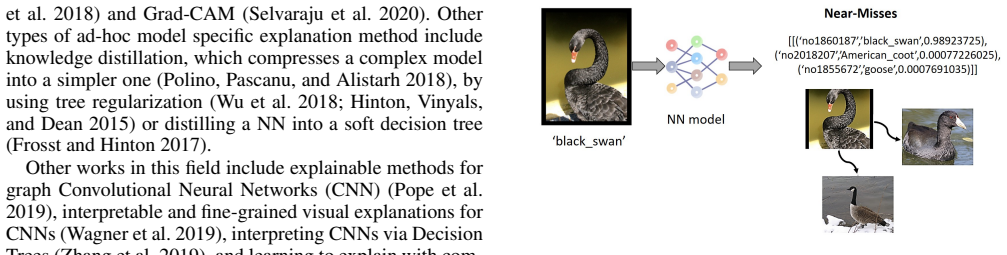
The central object is the K-near-miss set: the top K labels in the sorted output probability vector of a classifier, plus a cutoff variant that keeps all labels with probability above a threshold $t$. For each pair of labels $(i,j)$, the method averages $P(y=j\mid X=x)$ over all correctly classified test images of label $i$, calling this $p_{i,j}$, and uses its complement $1-p_{i,j}$ as an edge weight in a connections graph when $p_{i,j}\ge t$. Floyd-Warshall all-pairs shortest paths turn the graph into a metric, a hierarchical clustering routine turns the metric into a dendrogram, and a WordNet lowest-common-hypernym lookup names each cluster. The mechanism reads concept structure off output probabilities alone, with no access to weights, activations, or gradients.
What would settle it
Train the same architectures on ImageNet with labels randomly permuted inside each WordNet coarse class so that near misses are semantically meaningless, then run NMA: if the dendrogram still produces clean human concepts at comparable distances, the hierarchy is an artifact of dataset statistics rather than a trace of the network's latent decision-making.
Extended reading notes
Core claim
The paper's core claim is that the ranked probability vector of a classifier, and especially the top few labels it does not choose, is a trace of the concepts the network has formed. Averaging these near misses over all correctly classified test images yields a weighted connections graph; shortest paths on that graph define a metric, hierarchical clustering converts the metric into a dendrogram, and naming each cluster by its lowest common WordNet hypernym turns the dendrogram into sentences such as 'the black swan is part of water birds.' The paper reports that four architectures queried on the same images form markedly different hierarchies: ResNet's aligns best with human hypernym structure, VGG matches ResNet on animals and even separates cats from dogs more cleanly, while EfficientNet and MobileNet form visually or accidentally based clusters (for example grouping broccoli with woks because of a training image). The authors take these differences as evidence that efficient networks 'pay the price' of explainability and robustness in concept generation, and that the common assumption favoring deep, thin architectures over wide, shallow ones may be wrong.
Load-bearing premise
The load-bearing premise is that the average softmax probabilities of near-miss labels, taken only from correctly classified test images, faithfully represent the network's internal concept organization rather than visual similarity, dataset bias, or calibration artifacts.
Editorial extensions
If this is right
- Different architectures will generally exhibit different concept dendrograms on the same data, so NMA can be used as an architecture-comparison tool before deployment.
- A model can match another in top-5 accuracy yet be less explainable and more fragile: in the reported experiments, ResNet scored 0.89, VGG 0.82, EfficientNet 0.61, and MobileNet 0.52 on the proposed explanatory measurement.
- Concept quality does not track depth alone; the shallow but parameter-heavy VGG outperformed the deeper EfficientNet and MobileNet, suggesting that thin fully-connected layers may limit abstraction.
- The score $\phi(M)$ gives a quantitative, human-anchored proxy for explainability, allowing models trained on the same label set to be ranked on concept alignment.
Reading between the lines
- The method's sensitivity to dataset artifacts—EfficientNet's broccoli-in-wok cluster—suggests it could be used to audit training data for spurious correlations, an application the paper does not develop.
- The same near-miss graph could be inverted for adversarial purposes: the dendrogram identifies which labels are conceptually close, so an attacker could push an image toward a neighboring cluster and expect high confusion.
- A natural validation step, absent from the paper, would be to test whether the dendrogram aligns with layer-by-layer internal representations, which would turn NMA into a white-box probe for locating where concepts are formed.
Editorial analysis
A structured set of objections, weighed in public.
Referee Report
Summary. The paper proposes Near-Misses Analysis (NMA), a black-box explanation method that constructs a hierarchical clustering of class labels from the top-K softmax probabilities of a trained image classifier on test images. The resulting dendrogram is interpreted as the model's latent concept hierarchy, and clusters are assigned human-readable names via WordNet hypernyms. A query explanation is a path from the predicted label to the root, and a score measures overlap between the machine-generated concept set and a WordNet-based human annotation. The method is applied to ResNet50, EfficientNetB0, VGG16, and MobileNetV2 on ImageNet (via miniImageNet) and CIFAR100. The authors report architecture-specific dendrograms and scores, and conclude that more complex architectures form more human-compatible concepts, suggesting a trade-off between efficiency and explainability/robustness.
Significance. If the central claim were validated, NMA would offer a lightweight, black-box window into the conceptual organization learned by a classifier, complementary to white-box methods like TCAV. The method is simple, requires only output probabilities, and ships with code and a UI, which are strengths. However, the paper currently provides no evidence that softmax confusions correspond to internal representations, and the robustness conclusion is entirely speculative. The evaluation metric is recall-only and derived from the same WordNet resource used for naming, so the quantitative results largely measure WordNet consistency. The paper's significance therefore hinges on additional validation that is currently absent.
major comments (5)
- [§3.1 and §4] The definition of p_{i,j} in Section 3.1 averages over all images with ground-truth label i, but the experimental protocol in Section 4 states that NMA is performed 'for each correctly classified test image' and only those edges are updated. This conditional average over correct predictions is a different quantity and will change the graph weights whenever the model misclassifies some images of class i; the paper neither justifies this filtering nor analyzes its effect. Because the entire hierarchy is derived from these weights, the reported dendrograms depend on an arbitrary and undocumented choice.
- [§1, §3, and §6] The abstract and Section 3 claim that NMA reveals concepts 'inferred from the latent decision-making process' of the network, yet Section 6 explicitly defers white-box testing to future work. There is no comparison with internal activations, no probing, and no ablation showing that the dendrograms are not reproducible from low-level visual similarity or dataset co-occurrence. To support the central interpretability claim, the authors should include at least one of: (a) a comparison with hierarchies built from penultimate-layer activation similarities, (b) an ablation on a model with randomized final layers, or (c) a controlled dataset experiment demonstrating that the inferred clusters track the network's learned concept groups.
- [§1, §5.1, and §6] The abstract and Section 6 assert that efficient architectures 'pay the price of explainability and robustness in terms of concepts generation,' but no robustness experiment is performed. Section 5.1 contains the speculative statement that 'an adversarial image might easily cause it to confuse one object with another.' The paper should either include adversarial attack or perturbation experiments to support this claim, or explicitly remove the robustness claim from the abstract and conclusions.
- [§3.4, Eq. (1)] The explanation score φ is defined as |S_i ∩ U_i| / |S_i|, which is recall-only and never penalizes extra concepts in the machine-generated explanation. Moreover, both S_i and U_i are derived from WordNet hypernyms: the 'human annotation' is not an independent human judgment but the same lexical hierarchy used for the automatic concept naming. The score therefore measures consistency with WordNet rather than explainability to users. A proper evaluation would include a precision term, a comparison against a baseline clustering (e.g., a random label dendrogram or a static WordNet tree), or a human study.
- [§3.1, §4, and §5] The method has several free parameters—K=3, t=10^{-6}, the hierarchical linkage criterion, and the hand-picked 41-label subset—and no sensitivity analysis is reported. In particular, with t=10^{-6}, the 'otherwise ∞' case in the edge weight definition in Section 3.1 is unlikely to be triggered for any pair of labels on ImageNet, making the threshold effectively irrelevant; the authors should report the distribution of p_{i,j} values and show that the architectural differences in the dendrograms are stable under reasonable variation of K and t.
minor comments (5)
- [Authors and affiliations] The author line contains typos: 'A vivit Levy' and 'Collee of Engineering.Design.Art' should be corrected.
- [§4] The statement that 'The test set used for creating NNs explanations on ImageNet is the miniImageNet benchmark dataset' is ambiguous because miniImageNet is a few-shot learning benchmark, not a standard ImageNet test set; clarify its source, size, and how it was used as a test set.
- [Table 1] The 'Depth' column should define what is being counted (e.g., number of Keras layers, trainable layers, or total layers), and the 'Size (MB)' measurement should be applied consistently across models.
- [§5.1] Interpretations such as 'container ship is clustered with air transport probably due to its large size' are post-hoc and unsupported by quantitative evidence; the authors should either provide image statistics or attention maps to support such claims or present them as hypotheses.
- [§3.4] Equations (1) and (2) are not numbered in the text and the notation for S_i and U_i is introduced only in prose; please number the equations and clarify whether the 'human annotated explanations' are WordNet hypernym paths or independently collected human judgments.
Circularity Check
Only mild circularity: the explanation score uses WordNet for both automatic concept naming and the scoring reference, but the core NMA dendrogram is derived from network outputs and is not fitted to the score.
-
self definitional
[Section 3.3 (Automatic Concept Naming) and Section 3.4 (Explanatory Measurement), Eq. (1)]
"The automatic procedure scans WordNet hypernyms and finds the lowest common hypernym for all members in the group. ... assume that the explanation for the label 'apple' based on the WordNet hierarchy is 'apple-fruit-food-entity' while the machine generated explanation for label 'apple' is 'apple-fruit-entity'. Then, the machine explanation score of 'apple' is 1 (fruit) over 2 (fruit,food - the root (entity) and leaf (apple) are not counted)."
The machine explanation Ui is produced by WordNet lowest-common-hypernym naming, and the reference Si is operationalized through the WordNet hierarchy (the paper states ImageNet is organized according to WordNet and that the experiments exploit the WordNet-ImageNet connection for the query explanation analysis). Thus the score in Eq. (1) largely measures agreement between a WordNet-labeled dendrogram and the WordNet taxonomy, not an independently elicited human notion of explainability. Because both sides of the comparison derive from the same lexical resource, high scores are partly built in by construction. This does not make the dendrogram itself circular: the cluster structure is computed from classifier softmax outputs and is not fitted to the explanation score.
full rationale
The core NMA derivation is not circular: the dendrogram is computed from the model's softmax probability vectors via the connections graph and hierarchical clustering (Sections 3.1-3.2), and no fitted parameter is subsequently relabeled as a prediction; the explanation score is applied after clustering and does not influence it. There are no load-bearing self-citations and no imported uniqueness claims. The paper's own future-work passage acknowledges missing validation: 'In future work, we intend to perform white-box testing as well as examine the suggested approach effect on adversarial attacks construction and prevention.' This, together with the implementation's restriction to correctly classified test images, is a validation and generalization gap rather than a circular reduction. The only mild circularity is evaluative: automatic concept naming and the scoring reference both come from WordNet, so Eq. (1) largely rewards WordNet consistency rather than an independently measured human explanation. Hence score 1.
Assumptions & free parameters
free parameters (4)
- K =
3
- t =
1e-6
- hierarchical clustering linkage =
not specified
- 41-label subset =
chosen manually
assumptions (4)
- domain assumption Average softmax confusion probabilities between classes reflect conceptual similarity (Section 3.1).
- domain assumption The shortest-path metric on the confusion graph yields a valid dissimilarity for hierarchical clustering (Section 3.2).
- domain assumption WordNet hypernym chains are an appropriate human ground truth for explaining image classifications (Sections 3.3 and 5.2).
- ad hoc to paper The set of top-K labels after the correct class is empty at least as often as expected; threshold t avoids infinite weights (Section 3.1).
Cite this review
Pith. "Pith review of Explainable AI Approach using Near Misses Analysis." pith.science (2026). https://pith.science/paper/5WB7W3FX
@misc{pith2026241116895,
  author       = {Pith},
  title        = {Pith review of: Explainable AI Approach using Near Misses Analysis},
  year         = {2026},
  howpublished = {\url{https://pith.science/paper/5WB7W3FX}},
  note         = {Machine review of arXiv:2411.16895}
}
read the original abstract
This paper introduces a novel XAI approach based on near-misses analysis (NMA). This approach reveals a hierarchy of logical 'concepts' inferred from the latent decision-making process of a Neural Network (NN) without delving into its explicit structure. We examined our proposed XAI approach on different network architectures that vary in size and shape (e.g., ResNet, VGG, EfficientNet, MobileNet) on several datasets (ImageNet and CIFAR100). The results demonstrate its usability to reflect NNs latent process of concepts generation. We generated a new metric for explainability. Moreover, our experiments suggest that efficient architectures, which achieve a similar accuracy level with much less neurons may still pay the price of explainability and robustness in terms of concepts generation. We, thus, pave a promising new path for XAI research to follow.
Figures


Figures from the paper (3 more)


Reference graph
Works this paper leans on
-
[1]
Bau, D.; Zhou, B.; Khosla, A.; Oliva, A.; and Torralba, A. 2017. Network Dissection: Quantifying Interpretability of Deep Visual Representations. In 2017 IEEE Conference on Computer Vision and Pattern Recognition, CVPR 2017, Honolulu, HI, USA, July 21-26, 2017 , 3319--3327. IEEE Computer Society
work page 2017
-
[2]
D.; Ravi, S.; and Ramavajjala, V
Bui, T. D.; Ravi, S.; and Ramavajjala, V. 2018. Neural Graph Learning: Training Neural Networks Using Graphs. Proceedings of the Eleventh ACM International Conference on Web Search and Data Mining
work page 2018
-
[3]
Carvalho, D. V.; Pereira, E. M.; and Cardoso, J. S. 2019. Machine Learning Interpretability: A Survey on Methods and Metrics. Electronics, 8(8)
work page 2019
-
[4]
Doshi - Velez, F.; Kortz, M.; Budish, R.; Bavitz, C.; Gershman, S.; O'Brien, D.; Schieber, S.; Waldo, J.; Weinberger, D.; and Wood, A. 2017. Accountability of AI Under the Law: The Role of Explanation. CoRR, abs/1711.01134
arXiv 2017
-
[5]
G.; Amid, E.; Leskovec, J.; R \' e , C.; and Thrun, S
Fifty, C.; Duan, D.; Junkins, R. G.; Amid, E.; Leskovec, J.; R \' e , C.; and Thrun, S. 2023. Context-Aware Meta-Learning. CoRR, abs/2310.10971
arXiv 2023
-
[6]
Frosst, N.; and Hinton, G. E. 2017. Distilling a Neural Network Into a Soft Decision Tree. In Besold, T. R.; and Kutz, O., eds., Proceedings of the First International Workshop on Comprehensibility and Explanation in AI and ML 2017 co-located with 16th International Conference of the Italian Association for Artificial Intelligence (AI*IA 2017), Bari, Ital...
work page 2017
-
[7]
Predicting Adversarial Examples with High Confidence
Galloway, A.; Taylor, G. W.; and Moussa, M. A. 2018. Predicting Adversarial Examples with High Confidence. ArXiv, abs/1802.04457
work page Pith review arXiv 2018
-
[8]
J.; Shlens, J.; and Szegedy, C
Goodfellow, I. J.; Shlens, J.; and Szegedy, C. 2015. Explaining and Harnessing Adversarial Examples. In Bengio, Y.; and LeCun, Y., eds., 3rd International Conference on Learning Representations, ICLR 2015, San Diego, CA, USA, May 7-9, 2015, Conference Track Proceedings
2015
Show all 39 references
-
[9]
I.; Ferng, C.; Heydon, A.; Lu, C.; Pham, P.; Yu, G.; Fan, Y.; and Wang, Y
Gopalan, A.; Juan, D.; Magalhaes, C. I.; Ferng, C.; Heydon, A.; Lu, C.; Pham, P.; Yu, G.; Fan, Y.; and Wang, Y. 2021. Neural Structured Learning: Training Neural Networks with Structured Signals. In Lewin - Eytan, L.; Carmel, D.; Yom - Tov, E.; Agichtein, E.; and Gabrilovich, ...
2021
-
[10]
I.; Ferng, C.-S.; Heydon, A.; Lu, C.-T.; Pham, P.; and Yu, G
Gopalan, A.; Juan, D.-C.; Magalhaes, C. I.; Ferng, C.-S.; Heydon, A.; Lu, C.-T.; Pham, P.; and Yu, G. 2020. Neural Structured Learning: Training Neural Networks with Structured Signals. Proceedings of the 26th ACM SIGKDD International Conference on Knowledge Discovery & Data Mining
2020
-
[11]
E.; Vinyals, O.; and Dean, J
Hinton, G. E.; Vinyals, O.; and Dean, J. 2015. Distilling the Knowledge in a Neural Network. CoRR, abs/1503.02531
2015 arXiv
-
[12]
Holzinger, A.; Langs, G.; Denk, H.; Zatloukal, K.; and Müller, H. 2019. Causability and explainabilty of artificial intelligence in medicine. Wiley Interdisciplinary Reviews: Data Mining and Knowledge Discovery, 9: e1312
2019
-
[13]
Kanehira, A.; and Harada, T. 2019. Learning to Explain With Complemental Examples. In IEEE Conference on Computer Vision and Pattern Recognition, CVPR 2019, Long Beach, CA, USA, June 16-20, 2019 , 8603--8611. Computer Vision Foundation / IEEE
2019
-
[14]
J.; Wexler, J.; Vi \' e gas, F
Kim, B.; Wattenberg, M.; Gilmer, J.; Cai, C. J.; Wexler, J.; Vi \' e gas, F. B.; and Sayres, R. 2018. Interpretability Beyond Feature Attribution: Quantitative Testing with Concept Activation Vectors (TCAV) . In Dy, J. G.; and Krause, A., eds., Proceedings of the 35th Internat...
2018
-
[15]
Lee, H.; Kim, J.; Jung, S.; Kim, M.; Kim, B.; and Kim, S. 2020. Variable Importance Measures based on Ensemble Learning Methods for Convective Storm Tracking. In Joint 11th International Conference on Soft Computing and Intelligent Systems and 21st International Symposium on A...
2020
-
[16]
L.; and Anandkumar, A
Liu, A.; Chen, X.; Li, Y.; Xiao, C.; Yang, X.; Liu, X.; Song, D.; Tao, D.; Yuille, A. L.; and Anandkumar, A. 2021. ADVM'21: 1st International Workshop on Adversarial Learning for Multimedia. Proceedings of the 29th ACM International Conference on Multimedia
2021
-
[17]
M.; and Lee, S
Lundberg, S. M.; and Lee, S. 2017. A Unified Approach to Interpreting Model Predictions. In Guyon, I.; von Luxburg, U.; Bengio, S.; Wallach, H. M.; Fergus, R.; Vishwanathan, S. V. N.; and Garnett, R., eds., Advances in Neural Information Processing Systems 30: Annual Conferenc...
2017
-
[18]
B.; and Wu, J
Mao, J.; Gan, C.; Kohli, P.; Tenenbaum, J. B.; and Wu, J. 2019. The Neuro-Symbolic Concept Learner: Interpreting Scenes, Words, and Sentences From Natural Supervision. In 7th International Conference on Learning Representations, ICLR 2019, New Orleans, LA, USA, May 6-9, 2019 ....
2019
-
[19]
Molnar, C. 2022. Interpretable Machine Learning. 2 edition
2022
-
[20]
Polino, A.; Pascanu, R.; and Alistarh, D. 2018. Model compression via distillation and quantization. In 6th International Conference on Learning Representations, ICLR 2018, Vancouver, BC, Canada, April 30 - May 3, 2018, Conference Track Proceedings . OpenReview.net
2018
-
[21]
E.; Kolouri, S.; Rostami, M.; Martin, C
Pope, P. E.; Kolouri, S.; Rostami, M.; Martin, C. E.; and Hoffmann, H. 2019. Explainability Methods for Graph Convolutional Neural Networks. In IEEE Conference on Computer Vision and Pattern Recognition, CVPR 2019, Long Beach, CA, USA, June 16-20, 2019 , 10772--10781. Computer...
2019
-
[22]
Poulakakis - Daktylidis, S.; and Rad, H. J. 2024. BECLR: Batch Enhanced Contrastive Few-Shot Learning. In The Twelfth International Conference on Learning Representations, ICLR 2024, Vienna, Austria, May 7-11, 2024 . OpenReview.net
2024
-
[23]
T.; Singh, S.; and Guestrin, C
Ribeiro, M. T.; Singh, S.; and Guestrin, C. 2018. Anchors: High-Precision Model-Agnostic Explanations. In McIlraith, S. A.; and Weinberger, K. Q., eds., Proceedings of the Thirty-Second AAAI Conference on Artificial Intelligence, (AAAI-18), the 30th innovative Applications of ...
2018
-
[24]
R.; Cogswell, M.; Das, A.; Vedantam, R.; Parikh, D.; and Batra, D
Selvaraju, R. R.; Cogswell, M.; Das, A.; Vedantam, R.; Parikh, D.; and Batra, D. 2020. Grad-CAM: Visual Explanations from Deep Networks via Gradient-Based Localization. Int. J. Comput. Vis., 128(2): 336--359
2020
-
[25]
Simonyan, K.; Vedaldi, A.; and Zisserman, A. 2014. Deep Inside Convolutional Networks: Visualising Image Classification Models and Saliency Maps. In Bengio, Y.; and LeCun, Y., eds., 2nd International Conference on Learning Representations, ICLR 2014, Banff, AB, Canada, April 1...
2014
-
[26]
B.; and Wattenberg, M
Smilkov, D.; Thorat, N.; Kim, B.; Vi \' e gas, F. B.; and Wattenberg, M. 2017. SmoothGrad: removing noise by adding noise. CoRR, abs/1706.03825
2017 arXiv
-
[27]
T.; Dosovitskiy, A.; Brox, T.; and Riedmiller, M
Springenberg, J. T.; Dosovitskiy, A.; Brox, T.; and Riedmiller, M. A. 2015. Striving for Simplicity: The All Convolutional Net. In Bengio, Y.; and LeCun, Y., eds., 3rd International Conference on Learning Representations, ICLR 2015, San Diego, CA, USA, May 7-9, 2015, Workshop ...
2015
-
[28]
A.; Ravi, S.; and Tomkins, A
Stretcu, O.; Viswanathan, K.; Movshovitz-Attias, D.; Platanios, E. A.; Ravi, S.; and Tomkins, A. 2019. Graph Agreement Models for Semi-Supervised Learning. In NeurIPS
2019
-
[29]
Sundararajan, M.; Taly, A.; and Yan, Q. 2017. Axiomatic Attribution for Deep Networks. In Precup, D.; and Teh, Y. W., eds., Proceedings of the 34th International Conference on Machine Learning, ICML 2017, Sydney, NSW, Australia, 6-11 August 2017 , volume 70 of Proceedings of M...
2017
-
[30]
Tan, M.; and Le, Q. V. 2019. EfficientNet: Rethinking Model Scaling for Convolutional Neural Networks. In Chaudhuri, K.; and Salakhutdinov, R., eds., Proceedings of the 36th International Conference on Machine Learning, ICML 2019, 9-15 June 2019, Long Beach, California, USA , ...
2019
-
[31]
Tan, S.; Caruana, R.; Hooker, G.; and Lou, Y. 2018. Distill-and-compare: Auditing black-box models using transparent model distillation. In Proceedings of the 2018 AAAI/ACM Conference on AI, Ethics, and Society, 303--310
2018
-
[32]
Tjoa, E.; and Guan, C. 2021. A Survey on Explainable Artificial Intelligence (XAI): Toward Medical XAI. IEEE Transactions on Neural Networks and Learning Systems, 32(11): 4793--4813
2021
-
[33]
M.; Gindele, T.; Hetzel, L.; Wiedemer, J
Wagner, J.; K \" o hler, J. M.; Gindele, T.; Hetzel, L.; Wiedemer, J. T.; and Behnke, S. 2019. Interpretable and Fine-Grained Visual Explanations for Convolutional Neural Networks. In IEEE Conference on Computer Vision and Pattern Recognition, CVPR 2019, Long Beach, CA, USA, J...
2019
-
[34]
C.; Parbhoo, S.; Zazzi, M.; Roth, V.; and Doshi - Velez, F
Wu, M.; Hughes, M. C.; Parbhoo, S.; Zazzi, M.; Roth, V.; and Doshi - Velez, F. 2018. Beyond Sparsity: Tree Regularization of Deep Models for Interpretability. In McIlraith, S. A.; and Weinberger, K. Q., eds., Proceedings of the Thirty-Second AAAI Conference on Artificial Intel...
2018
-
[35]
A.; Lin, Z.; Brandt, J.; Shen, X.; and Sclaroff, S
Zhang, J.; Bargal, S. A.; Lin, Z.; Brandt, J.; Shen, X.; and Sclaroff, S. 2018. Top-Down Neural Attention by Excitation Backprop. Int. J. Comput. Vis., 126(10): 1084--1102
2018
-
[36]
Zhang, Q.; Yang, Y.; Ma, H.; and Wu, Y. N. 2019. Interpreting CNNs via Decision Trees. In IEEE Conference on Computer Vision and Pattern Recognition, CVPR 2019, Long Beach, CA, USA, June 16-20, 2019 , 6261--6270. Computer Vision Foundation / IEEE
2019
-
[37]
, " * write output.state after.block = add.period write newline
ENTRY address archivePrefix author booktitle chapter edition editor eid eprint howpublished institution isbn journal key month note number organization pages publisher school series title type volume year label extra.label sort.label short.list INTEGERS output.state before.all...
-
[38]
write newline
" write newline "" before.all 'output.state := FUNCTION n.dashify 't := "" t empty not t #1 #1 substring "-" = t #1 #2 substring "--" = not "--" * t #2 global.max substring 't := t #1 #1 substring "-" = "-" * t #2 global.max substring 't := while if t #1 #1 substring * t #2 gl...
-
[39]
write newline
" write newline "" before.all 'output.state := FUNCTION n.dashify 't := "" t empty not t #1 #1 substring "-" = t #1 #2 substring "--" = not "--" * t #2 global.max substring 't := t #1 #1 substring "-" = "-" * t #2 global.max substring 't := while if t #1 #1 substring * t #2 gl...
Reviewed August 12, 2026 · model on record in the stance chip above.
Discussion (0). Continue with ORCID to comment.