REVIEW 3 major objections 3 minor 47 references
Shake-down spectroscopy as state- and site-specific probe of ultrafast chemical dynamics
T0 review · 3 major / 3 minor · reviewed 2026-08-15 · deepseek-v4-flash
Pith's one-line read Time-resolved X-ray spectra capture shake-down satellites whose kinetic energy tracks the transient excited-to-ground energy gap, letting the internal-conversion product in photoexcited CS$_2$ be assigned and bound triplet population be…
desk verdict First time-resolved shake-down XPS that probably nails the CS2 singlet intermediate, but the 9.0–9.5 eV fit inconsistency and the leading-order spin-selection claim keep it from being unequivocal. read the letter →
The pith
A machine-rendered reading of the paper's core claim, the machinery that carries it, and where it could break.
The reading
What carries the argument
The load-bearing object is the shake-down satellite transition: in a core-ionization event, the valence hole created by the pump is filled by a valence electron while the core ion is formed, releasing energy into the outgoing photoelectron. Its kinetic-energy gain equals the momentary energy gap between the valence-excited state and the ground state, making the satellite position a direct readout of the excited-state potential surface being sampled. The second element is the spin-propensity rule derived in Section 4.3: using squared Dyson amplitudes and leading-order orbital overlaps, the authors show that singlet valence-excited states produce non-vanishing shake-down intensity (Eq. 10) whereas triplet states give vanishing or vanishingly small contributions (Eqs. 11-12), because the required spin couplings cannot produce the final doublet state. This rule is what converts the broad shake-down envelope into a spin-selective observable.
What would settle it
A multireference calculation, including spin-orbit coupling, of the squared Dyson amplitudes for triplet valence-excited CS2 at the bent and stretched geometries sampled during dissociation would settle the propensity rule: if any triplet shake-down line appears with intensity comparable to the observed 10.5–12.0 eV band, the assignment of that band solely to the $1\,{}^1\!B_2\,[{}^1\Delta_u]$ state and the conclusion of negligible bound triplet population would be unsupported. Equivalently, an experiment that prepares a molecule in a long-lived triplet state and detects a shake-down satellite would directly violate the rule.
Extended reading notes
Core claim
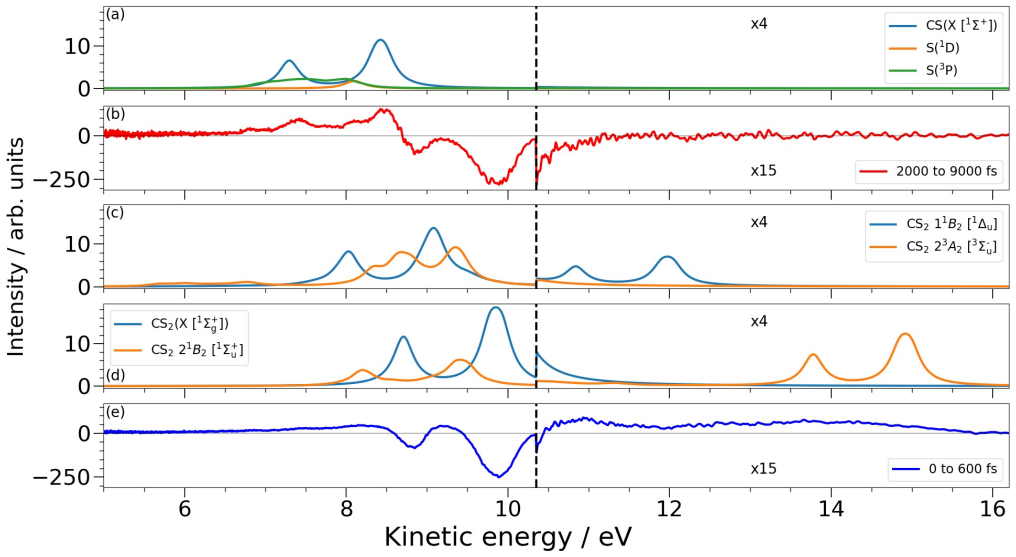
The central discovery is that shake-down satellites in time-resolved S 2p X-ray photoelectron spectra act as a state- and site-specific probe of ultrafast molecular dynamics. Upon core ionization of a valence-excited molecule, the excited electron pair collapses into the closed-shell ground configuration; the photoelectron's kinetic energy is increased by the energy gap $\Delta E$ between the valence-excited state and the ground state, so as the molecule bends, stretches, and changes electronic state, the satellite shifts by amounts that are large compared with the direct core-line shifts. For photoexcited CS$_2$, the measured shake-down signal shows two sequential kinetic components with time constants of $345\pm12$ fs and $167\pm15$ fs, matching prior valence photoelectron measurements. Combined with computed XPS spectra from multireference calculations, the authors assign the first component to the initially bright $2\,{}^1\!B_2\,[{}^1\Sigma_u^+]$ state and the second to the dark $1\,{}^1\!B_2\,[{}^1\Delta_u]$ state populated by internal conversion; the $1\,{}^1\!B_2\,[{}^1\Delta_u]$ population then decays on a 160 fs timescale to CS + S products. Because triplet states are predicted to give negligible shake-down intensity, the shake-down region exclusively tracks singlet population, which is why the paper concludes that bound triplet CS$_2$ population is essentially absent and that dissociation proceeds ballistically after intersystem crossing.
Load-bearing premise
The argument rests on the premise that triplet valence-excited states give negligible shake-down intensity, so all observed shake-down signal can be assigned to singlet states; the authors explicitly note that configuration interaction and spin-orbit coupling may weaken this rule.
Editorial extensions
If this is right
- Shake-down satellite positions give a direct time-resolved readout of the energy gap between the populated valence state and the ground state along a reaction path.
- Because triplet states contribute negligible shake-down intensity, the shake-down region monitors singlet excited-state population in isolation, without contamination from triplet population.
- For CS$_2$, the measurements assign the internal-conversion intermediate to the $1\,{}^1\!B_2\,[{}^1\Delta_u]$ state, with a $345\pm12$ fs conversion time and a $167\pm15$ fs decay time to products.
- The absence of a long-lived triplet shake-down signature, together with the matching product appearance times, supports the conclusion that bound triplet CS$_2$ population is negligible and the spin-forbidden product forms ballistically after intersystem crossing.
- In larger molecules, the site dependence of the shake-down propensity could make core ionization at different atoms a localized probe of the valence electronic character of the excited state.
Reading between the lines
- If the spin-propensity rule survives inclusion of configuration interaction and spin-orbit coupling at the geometries actually sampled, the same shake-down strategy could settle singlet/triplet branching questions in other photochemical systems where valence and core probes currently disagree.
- The strong geometry dependence of the shake-down energy suggests that a broadband or multidelay scan could turn the satellite envelope into a transient distribution of $\Delta E$ values, effectively imaging the wavepacket's motion on the excited-state surface, something the present paper does not do.
- A direct test of site specificity would compare shake-down spectra obtained by ionizing different core levels of the same molecule; the propensity rule predicts weaker shake-down when the core hole is localized away from the valence orbital that carries the excitation.
- The reliance on a seeded, low-jitter source implies the method should transfer to other seeded or high-repetition-rate X-ray facilities, which would make shake-down spectroscopy a general tool rather than a single-beamline demonstration.
Signed reviews
Editorial analysis
A structured set of objections, weighed in public.
Referee Report
Summary. The manuscript reports time-resolved S 2p X-ray photoelectron spectra of CS2 obtained at the seeded FEL FERMI after 200 nm excitation. The authors observe weak shake-down satellites at higher electron kinetic energy and, using MS-RASPT2/RASSI calculations with Dyson intensities, assign the early-time satellite band to the initially populated 2 1B2 [1Σ+u] state and the delayed band near 10.5-12.0 eV to the 1 1B2 [1Δu] state. Integrated-intensity fits to a sequential I0 -> I1 -> I2 kinetic model give time constants of 345 fs and 167 fs, matching earlier valence photoemission results. The paper derives a propensity rule that triplet valence-excited states give negligible shake-down intensity, which underpins the conclusion that the shake-down signal is exclusively singlet in origin and that bound triplet population in the pre-dissociation dynamics is negligible.
Significance. If the spin-selectivity propensity rule and the state assignments hold, the work introduces a genuinely useful observable: shake-down satellites in time-resolved core-level XPS that report on the instantaneous valence-excited-state energy gap with atomic-site specificity. The experiment is carefully executed with a seeded FEL, and the interpretation is supported by multireference calculations, by agreement with independent valence photoemission time constants (Refs. 12 and 21), and by a single global 0.76 eV energy shift that does not by itself fix the relative excited-state gaps. The main weaknesses are that the central spin-selectivity rule is demonstrated only in a leading-order single-configuration model and only at equilibrium geometries, and that one reported fit in the supporting information is inconsistent with the main-text description. These issues are fixable but currently leave part of the central claim under-supported.
major comments (3)
- [Section 4.3 (Eqs. 11-12) and Table S9] The load-bearing premise that triplet valence-excited states give negligible shake-down intensity is derived at leading order in orbital overlaps and is numerically checked only at the optimized equilibrium geometry of each state (Table S9, 10^-5 threshold). The manuscript itself concedes that configuration interaction and spin-orbit coupling may weaken the rule, and Section 2 states that a single dominant geometry is unlikely during the dynamics. At the bent and stretched geometries actually sampled, the cancellation in Eq. (12) or the smallness of the core-valence overlaps in Eq. (11) could be lifted, so the exclusive assignment of the 10.5-12.0 eV band to 1 1B2 [1Δu] and the inference that triplet population is negligible are not yet established. Please compute triplet shake-down Dyson intensities at representative non-equilibrium geometries along the IC/ISC path, or clearly restrict the claim to the geometries where the rule is verified.
- [Section 2 and SI Table S2] The main text states that the 9.0-9.5 eV transient decays with the same temporal profile as the 13.2-15.7 and 10.5-12.0 eV regions combined, but SI Table S2 reports for the 9-9.5 eV range a fit to I0 + I2 with 1/k1 = 20.8 ± 0.4 fs and 1/k2 = 739.1 ± 34.2 fs, not the 345/167 fs values quoted in the text. This discrepancy affects the claim that the 9.0-9.5 eV region reports on the same excited-state populations as the shake-down bands. Please reconcile the reported fit parameters with the text or revise the interpretation.
- [Section 2 and SI Section S1.5 (Eqs. S2-S4)] The sequential kinetic model in Fig. 3(e) assumes that population in state I1 decays exclusively into state I2, but the text also invokes a ballistic dissociation channel with a 20 fs product appearance time (Fig. 3(d)). If direct dissociation from I1 is non-negligible, the extracted 1/k1 = 345 fs is a total depopulation rate for I1 rather than the internal-conversion rate, and the statement that 'the remaining population internally converts to the 1B2 [1Δu] state on a 350 fs timescale' is not strictly supported by the model. Please include an explicit branching term for direct dissociation or reinterpret 1/k1 as an effective combined decay time.
minor comments (3)
- [Supporting Information header] The heading 'Supporting Information A vailable' contains a typo and should read 'Supporting Information Available'.
- [Section 2, final paragraph] The abbreviation 'Diss' is used without definition in the reaction scheme; spell out 'dissociation'.
- [Title and abstract] The phrase 'site-specific' is currently supported only for the S 2p core level that is probed; consider qualifying the title or abstract to 'S 2p site-specific' to avoid overclaiming generality.
Circularity Check
No circularity: the central assignment is an ab initio spectral comparison with a single global calibration shift, not a fitted-input/predicted-output loop.
full rationale
The paper's derivation chain is self-contained. The core observable, the kinetic energy of shake-down satellites, is compared to MS-RASPT2/RASSI Dyson-orbital spectra computed for each candidate initial state. The only empirical adjustment is a single global shift: 'The calculated kinetic energies for all states are shifted by 0.76 eV to match the ground-state energies obtained in the experiment. No other scaling or corrections are applied.' This shift is fixed to the ground-state S 2p line positions and therefore does not constrain the relative excited-state energy gaps, which are what determine the satellite positions used to assign the 10.5–12.0 eV band to 1 1B2 [1Δu]. The spin-selectivity propensity rule is derived from the squared Dyson amplitudes in Eqs. (9)–(12) under explicitly stated single-configuration and leading-order approximations, and the authors themselves caution that 'configuration interaction and spin-orbit coupling may complicate the picture and somewhat weaken our rule.' This is a stated approximation, not an ansatz smuggled in through citation. The 345/167 fs lifetimes are extracted from time-dependent integrated intensities and benchmarked against independent literature time constants and the paper's own TR-UPS measurement; they are not used as inputs to the spectral assignment. No load-bearing claim reduces to a self-citation: prior work (Gabalski et al., Wang et al., Smith et al.) supplies external comparison or independent empirical evidence, and no uniqueness theorem from the authors' prior work is invoked. The identified limitations—non-equilibrium geometry sampling and possible triplet shake-down at sampled geometries—are correctness risks or assumption sensitivities, not instances of the derivation reducing to its own inputs.
Assumptions & free parameters
free parameters (8)
- Global energy shift =
0.76 eV
- IRF width (sigma) =
108 ± 5.8 fs
- Shake-down decay constant 1/k1 (13.2-15.7 eV) =
345.3 ± 11.6 fs
- Shake-down decay constant 1/k2 (10.5-12.0 eV) =
166.8 ± 15.4 fs
- 9-9.5 eV transient fit constants =
1/k1 = 20.8 ± 0.4 fs, 1/k2 = 739.1 ± 34.2 fs
- CS product appearance times =
19.7 ± 10.0 fs and 685.5 ± 23.2 fs
- Lorentzian broadening FWHM =
0.3 eV
- Relative amplitudes A0, A1, A2 in kinetic model =
not reported numerically in main text (SI Table S2)
assumptions (4)
- standard math Sudden approximation: XPS intensities are proportional to squared Dyson amplitudes (Eq. 1).
- domain assumption MS-RASPT2/RASSI with the specified active spaces and HEXS core-hole projection yields accurate relative XPS energies and intensities.
- ad hoc to paper Single-configuration, leading-order orbital-overlap model for shake-down spin selectivity (Eqs. 5-12).
- ad hoc to paper Sequential first-order kinetic model with two excited states (I0, I1, I2) describes the population dynamics.
Cite this review
Pith. "Pith review of Shake-down spectroscopy as state- and site-specific probe of ultrafast chemical dynamics." pith.science (2026). https://pith.science/paper/5WEQOGPB
@misc{pith2026250614498,
  author       = {Pith},
  title        = {Pith review of: Shake-down spectroscopy as state- and site-specific probe of ultrafast chemical dynamics},
  year         = {2026},
  howpublished = {\url{https://pith.science/paper/5WEQOGPB}},
  note         = {Machine review of arXiv:2506.14498}
}
abstract
Tracking the multifarious ultrafast electronic and structural changes occurring in a molecule during a photochemical transformation is a challenging endeavor that benefits from recent experimental and computational progress in time-resolved techniques. Measurements of valence electronic states, which provide a global picture of the bonding structure of the molecule, and core electronic states, which provide insight into the local environment, traditionally require different approaches and are often studied separately. Here, we demonstrate that X-ray pulses from a seeded free-electron laser (FEL) enable the measurement of high-resolution, time-resolved X-ray photoelectron spectra (XPS) that capture weak satellite states resulting from shake-down processes in a valence-excited molecule. This approach effectively combines the advantages of both valence- and core-state investigations. We applied this method to investigate photoexcited CS$_2$ molecules, where the role of internal conversion (IC) and intersystem crossing (ISC) in determining the pre-dissociation dynamics is controversial. We present XPS spectra from photoexcited CS$_2$, obtained at the FERMI FEL. High-resolution measurements, compared to the corresponding spectra obtained from accurate multireference quantum chemical calculations, reveal that shake-down satellite channels are highly sensitive to both valence electronic and geometric changes. Previous studies of the pre-dissociation dynamics have led to uncertain assignments of the branching between singlet and triplet excited states. We derive a propensity rule that demonstrates the spin-selectivity of the shake-downs. This selectivity allows us to unequivocally assign contributions from the bright and dark singlet excited states, with populations tracked along the pre-dissociation dynamic pathway.
Figures


Figures from the paper (1 more)
Reference graph
Works this paper leans on
-
[1]
Time-resolved experiments on gas-phase atoms and molecules with XUV and X -ray free-electron lasers
Rolles, D. Time-resolved experiments on gas-phase atoms and molecules with XUV and X -ray free-electron lasers. Advances in Physics: X 2023, 8, 2132182
work page 2023
-
[2]
Blanchet, V.; Zgierski, M. Z.; Seideman, T.; Stolow, A. Discerning vibronic molecular dynamics using time-resolved photoelectron spectroscopy. Nature 1999, 401, 52--54
work page 1999
-
[3]
Egelhoff, J., W. F. Core-level Binding-energy Shifts at Surfaces and in Solids. Surf. Sci. Rep. 1987, 6, 253--415
work page 1987
-
[4]
Binding Energies and Chemical Shifts in ESCA
Gelius, U. Binding Energies and Chemical Shifts in ESCA . Phys. Scripta 1974, 9, 133--147
work page 1974
-
[5]
Vidal, M. L.; Krylov, A. I.; Coriani, S. Dyson orbitals within the fc-CVS-EOM-CCSD framework: theory and application to X-ray photoelectron spectroscopy of ground and excited states . Phys. Chem. Chem. Phys. 2020, 22, 2693--2703
work page 2020
-
[6]
Vidal, M. L.; Krylov, A. I.; Coriani, S. Correction: Dyson orbitals within the fc-CVS-EOM-CCSD framework: theory and application to X-ray photoelectron spectroscopy of ground and excited states . Phys. Chem. Chem. Phys. 2020, 22, 3744--3747
work page 2020
-
[7]
Mayer, D.; Lever, F.; Picconi, D.; Metje, J.; Alisauskas, S.; Calegari, F.; D \"u sterer, S.; Ehlert, C.; Feifel, R.; Niebuhr, M. et al. Following excited-state chemical shifts in molecular ultrafast x-ray photoelectron spectroscopy. Nat. Commun. 2022, 13, 198
work page 2022
-
[8]
Brau e, F.; Goldsztejn, G.; Amini, K.; Boll, R.; Bari, S.; Bomme, C.; Brouard, M.; Burt, M.; de Miranda, B. C.; D\"usterer, S. et al. Time-resolved inner-shell photoelectron spectroscopy: From a bound molecule to an isolated atom. Phys. Rev. A 2018, 97, 043429
work page 2018
Show all 47 references
-
[9]
S.; Schröder, H.; Beye, M.; Kunnus, K.; Schreck, S.; Düsterer, S.; Föhlisch, A
Leitner, T.; Josefsson, I.; Mazza, T.; Miedema, P. S.; Schröder, H.; Beye, M.; Kunnus, K.; Schreck, S.; Düsterer, S.; Föhlisch, A. et al. Time-resolved electron spectroscopy for chemical analysis of photodissociation: Photoelectron spectra of Fe(CO) _5 , Fe(CO) _4 , and Fe(CO)...
2018
-
[10]
S.; Schröder, H.; Beye, M.; Kunnus, K.; Schreck, S.; Radcliffe, P
Wernet, P.; Leitner, T.; Josefsson, I.; Mazza, T.; Miedema, P. S.; Schröder, H.; Beye, M.; Kunnus, K.; Schreck, S.; Radcliffe, P. et al. Communication: Direct evidence for sequential dissociation of gas-phase Fe ( CO )_5 via a singlet pathway upon excitation at 266 nm. J. Chem...
2017
-
[11]
Other processes such as shake-off are possible but we limit the discussion here for the sake of brevity
-
[12]
D.; Warne, E
Smith, A. D.; Warne, E. M.; Bellshaw, D.; Horke, D. A.; Tudorovskya, M.; Springate, E.; Jones, A. J. H.; Cacho, C.; Chapman, R. T.; Kirrander, A. et al. Mapping the Complete Reaction Path of a Complex Photochemical Reaction. Phys. Rev. Lett. 2018, 120, 183003
2018
-
[13]
H.; Burt, M.; Cryan, J
Gabalski, I.; Allum, F.; Seidu, I.; Britton, M.; Brenner, G.; Bromberger, H.; Brouard, M.; Bucksbaum, P. H.; Burt, M.; Cryan, J. P. et al. Time-Resolved X -ray Photoelectron Spectroscopy: U ltrafast Dynamics in CS _2 Probed at the S 2p Edge. J. Phys. Chem. Lett. 2023, 14, 7126--7133
2023
-
[14]
orneholm, O.; Svensson, S.; Sankari, R.; Hein\
Schulz, J.; Tchaplyguine, M.; Rander, T.; Bj\"orneholm, O.; Svensson, S.; Sankari, R.; Hein\"asm\"aki, S.; Aksela, H.; Aksela, S.; Kukk, E. Shakedown in core photoelectron spectra from aligned laser-excited Na atoms. Phys. Rev. A 2005, 72, 010702
2005
-
[15]
Townsend2006 , there is some inconsistency in the notation used in the existing literature for the state labels of CS _ 2
As pointed out in footnote 1 of Ref. Townsend2006 , there is some inconsistency in the notation used in the existing literature for the state labels of CS _ 2 . Therefore, we will refrain from using the adiabatic state labels or the standard empirical (tilde) notation for the ...
-
[16]
O.; Acheson, K.; Bucksbaum, P.; Centurion, M.; Champenois, E.; Gabalski, I.; Hoffman, M
Razmus, W. O.; Acheson, K.; Bucksbaum, P.; Centurion, M.; Champenois, E.; Gabalski, I.; Hoffman, M. C.; Howard, A.; Lin, M.-F.; Liu, Y. et al. Multichannel photodissociation dynamics in CS _2 studied by ultrafast electron diffraction. Phys. Chem. Chem. Phys. 2022, 24, 15416--15427
2022
-
[17]
H.; Driver, T.; Ekanayake, N.; Garg, D
Unwin, J.; Allum, F.; Britton, M.; Gabalski, I.; Bromberger, H.; Brouard, M.; Bucksbaum, P. H.; Driver, T.; Ekanayake, N.; Garg, D. et al. X-ray induced C oulomb explosion imaging of transient excited-state structural rearrangements in CS _2 . Commun. Phys. 2023, 6, 309
2023
-
[18]
Amini, K.; Sclafani, M.; Steinle, T.; Le, A.-T.; Sanchez, A.; M \"u ller, C.; Steinmetzer, J.; Yue, L.; Saavedra, J. R. M.; Hemmer, M. et al. Imaging the R enner-- T eller effect using laser-induced electron diffraction. Proc. Natl. Acad. Sci. U.S.A. 2019, 116, 8173--8177
2019
-
[19]
M.; Goff, N.; Hegazy, K
Gabalski, I.; Sere, M.; Acheson, K.; Allum, F.; Boutet, S.; Dixit, G.; Forbes, R.; Glownia, J. M.; Goff, N.; Hegazy, K. et al. Transient vibration and product formation of photoexcited CS _2 measured by time-resolved x-ray scattering . J. Chem. Phys. 2022, 157, 164305
2022
-
[20]
M.; Smith, A
Warne, E. M.; Smith, A. D.; Horke, D. A.; Springate, E.; Jones, A. J. H.; Cacho, C.; Chapman, R. T.; Minns, R. S. Time resolved detection of the S ( ^1 D ) product of the UV induced dissociation of CS _2 . J. Chem. Phys. 2021, 154, 034302
2021
-
[21]
Karashima, S.; Suzuki, Y.-I.; Suzuki, T. Ultrafast Extreme Ultraviolet Photoelectron Spectroscopy of Nonadiabatic Photodissociation of CS _2 from ^1 B _2 (^1 _u^+) State: Product Formation via an Intermediate Electronic State. J. Phys. Chem. Lett. 2021, 12, 3755--3761
2021
-
[22]
Hedin, L.; Eland, J. H. D.; Karlsson, L.; Feifel, R. An x-ray absorption and a normal A uger study of the fine structure in the S 2p ^ -1 region of the CS _2 molecule. J. Phys. B: At. Mol. Opt. Phys. 2009, 42, 085102
2009
-
[23]
A vibrationally resolved experimental study of the sulfur L -shell photoelectron spectrum of the CS _2 molecule
Wang, H.; B \"a ssler, M.; Hjelte, I.; Burmeister, F.; Karlsson, L. A vibrationally resolved experimental study of the sulfur L -shell photoelectron spectrum of the CS _2 molecule. J. Phys. B: At. Mol. Opt. Phys. 2001, 34, 1745--1755
2001
-
[24]
Svetina, C.; Grazioli, C.; Mahne, N.; Raimondi, L.; Fava, C.; Zangrando, M.; Gerusina, S.; Alagia, M.; Avaldi, L.; Cautero, G. et al. The Low Density Matter ( LDM ) beamline at FERMI : optical layout and first commissioning. J. Synchrotron Radiat. 2015, 22, 538--543
2015
-
[25]
B.; D'Auria, G.; Demidovich, A.; De Monte, R
Allaria, E.; Badano, L.; Bassanese, S.; Capotondi, F.; Castronovo, D.; Cinquegrana, P.; Danailov, M. B.; D'Auria, G.; Demidovich, A.; De Monte, R. et al. The FERMI free-electron lasers. J. Synchrotron Radiat. 2015, 22, 485--491
2015
-
[26]
B.; D'Auria, G.; Demidovich, A.; De Ninno, G.; Di Mitri, S
Allaria, E.; Castronovo, D.; Cinquegrana, P.; Craievich, P.; Dal Forno, M.; Danailov, M. B.; D'Auria, G.; Demidovich, A.; De Ninno, G.; Di Mitri, S. et al. Two-stage seeded soft-X-ray free-electron laser. Nat. Photonics 2013, 7, 913--918
2013
-
[27]
Cinquegrana, P.; Demidovich, A.; Kurdi, G.; Nikolov, I.; Sigalotti, P.; Susnjar, P.; Danailov, M. B. The seed laser system of the FERMI free-electron laser: design, performance and near future upgrades. High Power Laser Sci. Eng. 2021, 9, E61
2021
-
[28]
Finetti, P.; Demidovich, A.; Plekan, O.; Di Fraia, M.; Cucini, R.; Callegari, C.; Cinquegrana, P.; Sigalotti, P.; Ivanov, R.; Danailov, M. B. et al. Optical setup for two-colour experiments at the low density matter beamline of FERMI . J. Opt. 2017, 19, 114010
2017
-
[29]
Lyamayev, V.; Ovcharenko, Y.; Katzy, R.; Devetta, M.; Bruder, L.; LaForge, A.; Mudrich, M.; Person, U.; Stienkemeier, F.; Krikunova, M. et al. A modular end-station for atomic, molecular, and cluster science at the low density matter beamline of FERMI @ E lettra. J. Phys. B: A...
2013
-
[30]
J.; Sapunar, M.; Ponzi, A.; Richter, R.; Kivim \"a ki, A.; Plekan, O.; Finetti, P.; Sisourat, N.; Zhaunerchyk, V.; Marchenko, T
Squibb, R. J.; Sapunar, M.; Ponzi, A.; Richter, R.; Kivim \"a ki, A.; Plekan, O.; Finetti, P.; Sisourat, N.; Zhaunerchyk, V.; Marchenko, T. et al. Acetylacetone photodynamics at a seeded free-electron laser. Nat. Commun. 2018, 9, 63
2018
-
[31]
J.; Leopold, D
Hemley, R. J.; Leopold, D. G.; Roebber, J. L.; Vaida, V. The direct ultraviolet absorption spectrum of the ^1 ^+_g ^1B_2(^1 ^+_u) transition of jet‐cooled CS _2 . J. Chem. Phys. 1983, 79, 5219--5227
1983
-
[32]
Galván, I.; Alavi, A.; Aleotti, F.; Aquilante, F.; Autschbach, J.; Avagliano, D.; Baiardi, A.; Bao, J
Li Manni, G.; Fdez. Galván, I.; Alavi, A.; Aleotti, F.; Aquilante, F.; Autschbach, J.; Avagliano, D.; Baiardi, A.; Bao, J. J.; Battaglia, S. et al. The OpenMolcas Web: A Community-Driven Approach to Advancing Computational Chemistry. J. Chem. Theory Comput. 2023, 19, 6933--6991
2023
-
[33]
O.; Lindh, R.; Malmqvist, P.- .; Veryazov, V.; Widmark, P.-O
Roos, B. O.; Lindh, R.; Malmqvist, P.- .; Veryazov, V.; Widmark, P.-O. Main group atoms and dimers studied with a new relativistic ANO basis set. J. Phys. Chem. A 2004, 108, 2851--2858
2004
-
[34]
The D ouglas-- K roll-- H ess Approach
Nakajima, T.; Hirao, K. The D ouglas-- K roll-- H ess Approach. Chem. Rev. 2012, 112, 385--402
2012
-
[35]
Roos, B
Malmqvist, P. .; Roos, B. O.; Schimmelpfennig, B. The restricted active space ( RAS ) state interaction approach with spin--orbit coupling. Chem. Phys. Lett. 2002, 357, 230--240
2002
-
[36]
Malmqvist, P.- .; Roos, B. O. The CASSCF state interaction method. Chem. Phys. Lett. 1989, 155, 189--194
1989
-
[37]
Tenorio, B. N. C.; Ponzi, A.; Coriani, S.; Decleva, P. Photoionization observables from multi-reference Dyson orbitals coupled to B -spline DFT and TD-DFT continuum. Molecules 2022, 27, 1203
2022
-
[38]
G.; Sørensen, L
Delcey, M. G.; Sørensen, L. K.; Vacher, M.; Couto, R. C.; Lundberg, M. Efficient calculations of a large number of highly excited states for multiconfigurational wavefunctions. J. Comput. Chem. 2019, 40, 1789--1799
2019
-
[39]
Accurate Description of Photoionization Dynamical Parameters
Moitra, T.; Ponzi, A.; Koch, H.; Coriani, S.; Decleva, P. Accurate Description of Photoionization Dynamical Parameters. J. Phys. Chem. Lett. 2020, 11, 5330--5337
2020
-
[40]
Vidal, Marta L. and Krylov, Anna I. and Coriani, Sonia
Townsend, D.; Satzger, H.; Ejdrup, T.; Lee, A. M.; Stapelfeldt, H.; Stolow, A. ^1\! B _2(^1 _u^+) excited state dynamics in CS _2 . J. Chem. Phys. 2006, 125, 234302 mcitethebibliography achemso-demo.bib0000664000000000000000000012207615044152050012601 0ustar rootroot@Article V...
2006
-
[41]
A vibrationally resolved experimental study of the sulfur L -shell photoelectron spectrum of the CS _2 molecule
Wang, H.; Bässler, M.; Hjelte, I.; Burmeister, F.; Karlsson, L. A vibrationally resolved experimental study of the sulfur L -shell photoelectron spectrum of the CS _2 molecule. J. Phys. B: At. Mol. Opt. Phys. 2001, 34, 1745
2001
-
[42]
An experimental and theoretical study of the valence shell photoelectron spectrum of carbon disulphide
Baltzer, P.; Wannberg, B.; Lundqvist, M.; Karlsson, L.; Holland, D.; MacDonald, M.; Hayes, M.; Tomasello, P.; von Niessen , W. An experimental and theoretical study of the valence shell photoelectron spectrum of carbon disulphide. Chem. Phys. 1996, 202, 185--209
1996
-
[43]
Z.; Gohle, C.; Pinkert, T
Kandula, D. Z.; Gohle, C.; Pinkert, T. J.; Ubachs, W.; Eikema, K. S. E. Extreme Ultraviolet Frequency Comb Metrology. Phys. Rev. Lett. 2010, 105, 063001
2010
-
[44]
T.; Van Huis, T
Brown, S. T.; Van Huis, T. J.; Hoffman, B. C.; Schaefer, H. F., III Excited electronic states of carbon disulphide. Mol. Phys. 1999, 96, 693--704
1999
-
[45]
Epifanovsky, E.; Gilbert, A. T. B.; Feng, X.; Lee, J.; Mao, Y.; Mardirossian, N.; Pokhilko, P.; White, A. F.; Coons, M. P.; Dempwolff, A. L. et al. Software for the frontiers of quantum chemistry: An overview of developments in the Q -Chem 5 package. J. Chem. Phys. 2021, 155, 084801
2021
-
[46]
Molecular Structure Constants of Diatomic Molecules; Van Nostrand Reinhold: New York, 1979
Huber, K.-P.; Herzberg, G. Molecular Structure Constants of Diatomic Molecules; Van Nostrand Reinhold: New York, 1979
1979
-
[47]
q 2 #B R 3br w !1 AQ aq
Jmol : an open-source Java viewer for chemical structures in 3D . http://www.jmol.org mcitethebibliography SIbib.bib0000664000000000000000000003053515044152050011226 0ustar rootroot@article Baltzer96, title = An experimental and theoretical study of the valence shell photoelec...
1996
Reviewed August 15, 2026 · model on record in the stance chip above.
Discussion (0). Continue with ORCID to comment.