REVIEW 4 major objections 5 minor 1 cited by
INN-FF: A Scalable and Efficient Machine Learning Potential for Molecular Dynamics
T0 review · 4 major / 5 minor · reviewed 2026-08-07 · deepseek-v4-flash
Pith's one-line read INN-FF is a machine-learning force field that combines compact-supported interpolation functions with tensor decomposition to reach benchmark accuracy from 50 training configurations and with orders of magnitude fewer parameters.
desk verdict The numbers look too good to be true, and the paper gives us no way to verify them: it never defines the atomic input representation, so the headline claims are not supported. read the letter →
The pith
A machine-rendered reading of the paper's core claim, the machinery that carries it, and where it could break.
The reading
What carries the argument
The central object is the interpolating neural network built from C-HiDeNN interpolation functions, i.e., compact-supported convolution patches $W^{(k)}_j(x)$ assembled from radial basis functions $R_k(x)$ and $P$ activation functions $A_p(x)$, with nodal values as the trainable parameters. These give the 1D edge functions finite-element-like properties: compact support, partition of unity, Kronecker delta, and reproducing conditions. For multivariate systems the network uses CANDECOMP/PARAFAC (CP) tensor decomposition, writing a $d$-input function as $\sum_{m=1}^M \prod_{i=1}^d N_i(x_i) u_i^{(m)}$, so the total parameter count is $M d J$, linear in the number of inputs. This linear scaling is the mechanism claimed to deliver data efficiency and low memory cost, and it is what separates INN-FF from deep MLPs and graph-based message-passing potentials.
What would settle it
Take any rMD17 test configuration, apply a rigid rotation and a random permutation of identical atoms, and feed all versions to a trained INN-FF model: if the predicted energy or forces change by more than numerical precision, the potential is not invariant under the symmetries molecular dynamics requires.
Extended reading notes
Core claim
INN-FF is a force-field architecture in which each input dimension is processed by a learnable one-dimensional interpolation function, a compact-supported shape function with tunable nodal values, and the univariate responses are combined by CP tensor decomposition rather than deep-layer composition. The resulting network has only one hidden layer, and its parameter count scales linearly with the number of input variables, $M I J$, whereas MLPs and KANs scale quadratically with layer width. The paper reports that this architecture converges in fewer epochs with orders of magnitude fewer parameters, uses under 300 MB of GPU memory where an MLP baseline uses about 10 GB, and achieves state-of-the-art benchmark accuracy: an energy RMSE of 0.133 meV per water molecule and a force RMSE of 42.3 meV/Å on the bulk-water dataset, and force MAEs around 20 meV/Å on rMD17 molecules trained from 50 configurations.
Load-bearing premise
The load-bearing premise is that a network with no explicit symmetry constraints, trained on fixed-orientation snapshots, will assign the same energy and forces to physically equivalent configurations once atoms rotate, translate, or reorder, so the reported benchmark accuracy carries over to real molecular dynamics.
Editorial extensions
If this is right
- Training sets of roughly 50 configurations could suffice for small organic molecules, shrinking the cost of DFT label generation for new targets.
- On the bulk-water benchmark, the reported energy RMSE of 0.133 meV per water molecule is about ten times smaller than several published values, so an energy surface fit this tightly would give a smoother starting point for sampling.
- The linear parameter scaling and sub-300 MB GPU memory footprint mean training can run on a single consumer GPU, making MLIP development practical without large compute clusters.
- Because the architecture is compact, inference is cheap enough to embed in molecular dynamics engines; the paper identifies ASE as a target but has not yet run such simulations.
Reading between the lines
- A direct test the paper does not perform is to rotate, translate, and permute a held-out configuration and check that predicted energies and forces are unchanged; if they are not, the benchmark numbers are not yet evidence of an MD-ready potential.
- The mesh-compatible interpolation functions hint at a tighter coupling with finite-element or isogeometric simulation codes than typical graph-based potentials, since the same shape functions could discretize both the physics and the learned potential; the paper only gestures at this in its conclusion.
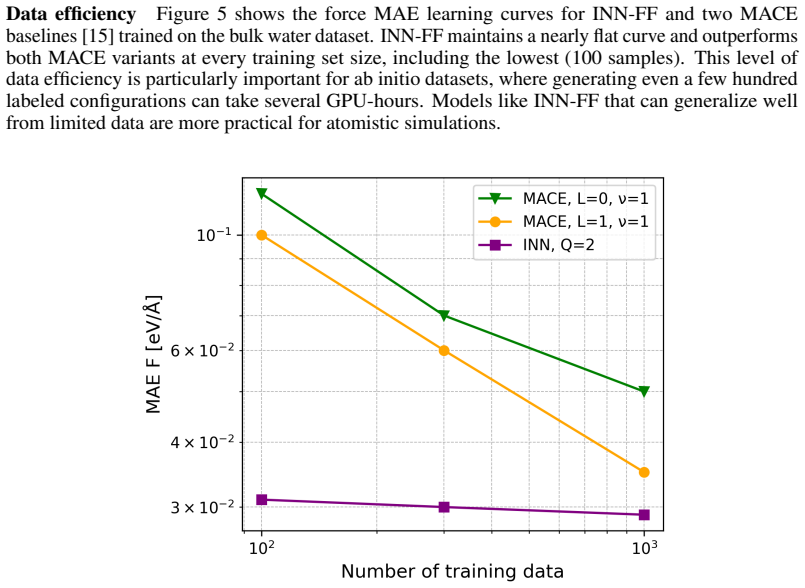
- The nearly flat force learning curve down to 100 water samples suggests the practical data floor may be below what was tested, so probing 10 to 50 configurations per molecule would reveal whether the small-data advantage is general.
Editorial analysis
A structured set of objections, weighed in public.
Referee Report
Summary. The paper proposes INN-FF, a machine-learned interatomic potential built from Interpolating Neural Networks (INNs), which combine finite-element-style interpolation and CP tensor decomposition. The authors claim that INN-FF achieves state-of-the-art or better accuracy on the bulk water and rMD17 benchmarks while using far fewer trainable parameters and less GPU memory than standard MLPs, and that it is particularly data-efficient when trained on small datasets. The manuscript reports energy and force errors in Tables 1 and 2, describes the INN architecture in Section 3, and discusses limitations in Section 5 and Appendix A.4, including the fact that full molecular dynamics simulations have not yet been performed and that physical symmetries are not explicitly enforced.
Significance. Data-efficient machine-learned force fields are an important goal, and the INN-FF architecture, based on C-HiDeNN interpolation and CP tensor decomposition, is cleanly formulated and offers linear scaling of parameters with input dimension. The inclusion of learning curves and an explicit limitations section is commendable. However, as written, the central claims are not supported: the atomic input representation is never defined, the architecture does not enforce the physical symmetries required of an interatomic potential, and the benchmark comparisons are not sufficiently controlled. These issues are load-bearing because they affect whether the reported accuracy numbers are meaningful and reproducible, and whether the model can function in molecular dynamics at all.
major comments (4)
- [Section 3.2, Eq. (2)] The paper never specifies how an atomic configuration (atomic species, positions, simulation cell, periodic boundary conditions) is mapped to the generic input vector x in Eq. (2). Section 3.2 defines the INN approximation for an abstract I-dimensional function, and Appendix A.3 provides only segment/mode counts and training splits. Without this mapping, the benchmark numbers in Tables 1 and 2 are not reproducible, and the claim that the model learns interatomic interactions cannot be verified.
- [Section 7] The text explicitly states that "the architecture does not explicitly enforce physical symmetries, which may affect generalization in highly symmetric domains." A machine-learned interatomic potential for MD must assign identical energies to configurations related by rotation, translation, and permutation of identical atoms; Eq. (2), combined with an unspecified input representation, provides no such invariance. Therefore, the fixed-orientation benchmark errors do not demonstrate that INN-FF is usable as a force field. A concrete test would be to evaluate energies on randomly rotated, translated, and permuted copies of the test configurations and report the resulting errors.
- [Tables 1 and 2] The benchmark results are reported as single point estimates with no error bars or uncertainty quantification. Appendix A.5 shows that training variability across five runs is non-negligible for loss curves, so the headline energy RMSE of 0.133 meV/H2O in Table 1 and the rMD17 MAEs in Table 2 need confidence intervals to support the claim of state-of-the-art accuracy, especially given the stated sensitivity to hyperparameter choices in Section 5.
- [Section 4.2.2, Table 2] The comparison with NequIP and MACE on rMD17 is not controlled. The text states that INN-FF was trained on 50 configurations, but it is not established that the cited baseline numbers in Table 2 were obtained under the same training-set size, validation split, and test set. If the baseline values are taken from the literature with different data regimes, the conclusion that INN-FF "achieves or surpasses state-of-the-art accuracy" is not supported. The paper should either retrain the baselines under identical protocols or clearly report the original data conditions for each cited number.
minor comments (5)
- [Section 4.1, Figure 3] The caption "Trainable parameters vs. epochs" is ambiguous: the figure appears to show two panels (parameters and epochs), but neither axis labels nor units are described in the caption. Please clarify what is plotted.
- [Appendix A.2.1 / Appendix A.3] The dataset description says the water dataset contains 1,593 configurations, but the training/validation/test split in Appendix A.3 sums to 1274 + 159 + 159 = 1,592. Please reconcile the total count.
- [Section 5] The paper is titled "...for Molecular Dynamics" but the text concedes that "the model has not yet been evaluated in full molecular dynamics simulations." This is a significant gap for the claimed applicability; either add MD stability tests or temper the title and abstract accordingly.
- [Appendix A.4] The statement that full code cannot be shared due to pending patent and proprietary restrictions is important for reproducibility and should be disclosed in the main text or at least in the abstract, not only in an appendix.
- [Table 2] The rMD17 dataset contains ten molecules, but Table 2 lists only eight; the paper should state whether the two omitted molecules were excluded and why, or include them for completeness.
Circularity Check
No circularity: the benchmark claims rest on external DFT labels and held-out test splits, and the architecture self-citations are not load-bearing.
full rationale
The central claimed result is that the INN architecture, when trained on external DFT labels, achieves low energy and force errors on held-out water and rMD17 configurations. The reported benchmark quantities are fitted to external reference data (revPBE0-D3 for bulk water, DFT for rMD17) and are evaluated on held-out test splits: 159 of 1,593 water configurations for testing, and 1,800 unseen rMD17 configurations for testing. No equation in the paper reduces a reported benchmark number to a parameter fitted from that same benchmark; the INN interpolation functions are specified by the explicit C-HiDeNN construction in Appendix A.1 (Eqs. 3-14), not by citation alone. Self-citations to Refs. [18]-[23] identify the architectural origin of INN, but the central claim is independently supported by the paper's own experiments against external baselines. The absence of a defined atomic-coordinate descriptor and the admitted lack of explicit symmetry enforcement in Section 7 are correctness and generalization concerns, not circularity: they do not make the reported test errors equivalent to the training inputs. Therefore no circular step can be exhibited from the paper's own equations or citation chain, and the circularity score is 0.
Assumptions & free parameters
free parameters (6)
- segments per input dimension (number of nodes J) =
9 (water), 2 (rMD17)
- number of TD modes M =
4 (water), 1 (rMD17)
- patch size s =
not reported
- activation basis A_p(x) =
not reported
- dilation parameter a in cubic spline =
not reported
- training hyperparameters =
not reported
assumptions (4)
- standard math The C-HiDeNN moment matrix G in Eq. (11) is invertible for the chosen nodes and basis functions.
- domain assumption The molecular potential energy surface is representable by a CP decomposition of products of 1D interpolations as in Eq. (2).
- ad hoc to paper The unspecified input coordinates are a sufficient and physically meaningful representation of an atomic configuration.
- domain assumption Published NequIP and MACE numbers are comparable to INN-FF trained on 50 rMD17 configurations.
Cite this review
Pith. "Pith review of INN-FF: A Scalable and Efficient Machine Learning Potential for Molecular Dynamics." pith.science (2026). https://pith.science/paper/5WOKPANI
@misc{pith2026250518141,
  author       = {Pith},
  title        = {Pith review of: INN-FF: A Scalable and Efficient Machine Learning Potential for Molecular Dynamics},
  year         = {2026},
  howpublished = {\url{https://pith.science/paper/5WOKPANI}},
  note         = {Machine review of arXiv:2505.18141}
}
read the original abstract
The ability to accurately model interatomic interactions in large-scale systems is fundamental to understanding a wide range of physical and chemical phenomena, from drug-protein binding to the behavior of next-generation materials. While machine learning interatomic potentials (MLIPs) have made it possible to achieve ab initio-level accuracy at significantly reduced computational cost, they still require very large training datasets and incur substantial training time and expense. In this work, we propose the Interpolating Neural Network Force Field (INN-FF), a novel framework that merges interpolation theory and tensor decomposition with neural network architectures to efficiently construct molecular dynamics potentials from limited quantum mechanical data. Interpolating Neural Networks (INNs) achieve comparable or better accuracy than traditional multilayer perceptrons (MLPs) while requiring orders of magnitude fewer trainable parameters. On benchmark datasets such as liquid water and rMD17, INN-FF not only matches but often surpasses state-of-the-art accuracy by an order of magnitude, while achieving significantly lower error when trained on smaller datasets. These results suggest that INN-FF offers a promising path toward building efficient and scalable machine-learned force fields.
Figures


Figures from the paper (4 more)



Forward citations
Cited by 1 Pith paper
-
VASP Plugins: Linking the Vienna ab-initio Simulation Package with Python
A C++/pybind11 shared-memory plugin layer exposes VASP SCF and ionic data as NumPy arrays so Python can modify structure, forces, local potential, and occupancies in place.
Reference graph
Works this paper leans on
-
[1]
Huan, T. D., Batra, R., Chapman, J. et al. A universal strategy for the creation of machine learning-based atomistic force fields. npj Computational Materials 3, 37 (2017). URL https: //doi.org/10.1038/s41524-017-0042-y
-
[2]
Vennelakanti, V ., Nazemi, A., Mehmood, R., Steeves, A. H. & Kulik, H. J. Harder, better, faster, stronger: large-scale qm and qm/mm for predictive modeling in enzymes and proteins. arXiv (2021). URL https://doi.org/10.48550/arXiv.2105.12873. ArXiv:2105.12873 [physics.chem-ph]
work page Pith review arXiv doi:10.48550/arxiv.2105.12873 2021
-
[3]
Noé, F., Tkatchenko, A., Müller, K.-R. & Clementi, C. Machine learning for molecular simulation. Annual Review of Physical Chemistry 71, 361–390 (2020). URL https:// doi.org/10.1146/annurev-physchem-042018-052331 . First published as a Review in Advance on February 24, 2020
-
[4]
Jones, J. E. On the determination of molecular fields. Proceedings of the Royal Society A 106, 441–462 (1924)
work page 1924
-
[5]
Daw, M. S. & Baskes, M. I. Embedded-atom method: Derivation and application to impurities, surfaces, and other defects in metals. Physical Review B 29, 6443 (1984)
work page 1984
-
[6]
Baskes, M. I. Modified embedded-atom potentials for cubic materials and impurities. Physical Review B 46, 2727 (1992)
work page 1992
-
[7]
Wang, H., Zhang, L. & E, W. Deep potential molecular dynamics: A scalable model with the accuracy of quantum mechanics. Nature Communications 11, 507 (2023)
work page 2023
-
[8]
Greener, J. G., Moffat, R. & Jones, T. J. Differentiable solutions for molecular dynamics force fields in complex systems. Journal of Computational Chemistry 45, 112–121 (2024)
work page 2024
Show all 38 references
-
[9]
J., Rowley, C
Maginn, E. J., Rowley, C. N. et al. Revisiting classical force fields with machine learning: Opportunities and challenges. Molecular Simulation 49, 191–209 (2023)
2023
-
[10]
& Ong, S
Chen, C. & Ong, S. P. M3gnet: A universal graph deep learning interatomic potential for the periodic table. Nature Computational Science 2, 223–234 (2023)
2023
-
[11]
Biamonte, J. et al. Quantum machine learning. Nature 549, 195–202 (2017). URL https: //doi.org/10.1038/nature23474
2017 doi
-
[12]
Zhang, L., Han, J., Wang, H., Car, R. & E, W. Deep potential molecular dynamics: A scalable model with the accuracy of quantum mechanics. Physical Review Letters 120, 143001 (2018)
2018
-
[13]
& Ong, S
Chen, C. & Ong, S. P. M3gnet: A universal graph deep learning interatomic potential for the periodic table. Nature Computational Science 2, 233–241 (2022)
2022
-
[14]
Benchmarking and advancing neural network potentials for molecules and materials
Fu, Y ., Gastegger, M., Nigam, J.et al. Benchmarking and advancing neural network potentials for molecules and materials. Chemical Science 14, 2345–2363 (2023)
2023
-
[15]
P., Simm, G., Ortner, C
Batatia, I., Kovacs, D. P., Simm, G., Ortner, C. & Csányi, G. Mace: Higher order equivariant message passing neural networks for fast and accurate force fields. In Advances in Neural Information Processing Systems, vol. 35, 11423–11436 (2022)
2022
-
[16]
Liu, Z. et al. Kolmogorov–arnold networks (kan). Preprint (2024). ArXiv:2404.19756
2024 arXiv
-
[17]
& Kuriyan, J
Karplus, M. & Kuriyan, J. Molecular dynamics and protein function. Proceedings of the National Academy of Sciences of the United States of America 102, 6679–6685 (2005). URL https://doi.org/10.1073/pnas.0408930102
2005 doi
-
[18]
Zhang, L. et al. Hierarchical deep-learning neural networks: finite elements and beyond. Computational Mechanics 67, 207–230 (2021)
2021
-
[19]
Saha, S. et al. Hierarchical deep learning neural network (hidenn): An artificial intelligence (ai) framework for computational science and engineering. Computer Methods in Applied Mechanics and Engineering 373, 113452 (2021)
2021
-
[20]
Convolution hierarchical deep-learning neural networks (c-hidenn): finite elements, isogeometric analysis, tensor decomposition, and beyond
Lu, Y .et al. Convolution hierarchical deep-learning neural networks (c-hidenn): finite elements, isogeometric analysis, tensor decomposition, and beyond. Computational Mechanics 72, 333– 362 (2023)
2023
-
[21]
Park, C. et al. Convolution hierarchical deep-learning neural network (c-hidenn) with graphics processing unit (gpu) acceleration. Computational Mechanics 1–27 (2023). 10
2023
-
[22]
explanatory
Harshman, R. A. et al. Foundations of the parafac procedure: Models and conditions for an “explanatory” multi-modal factor analysis. UCLA working papers in phonetics 16, 84 (1970)
1970
-
[23]
Park, C. et al. Interpolating neural network: A novel unification of machine learning and interpolation theory. arXiv preprint arXiv:2404.10296 (2024)
2024 arXiv
-
[24]
A., Behler, J., Dellago, C
Cheng, B., Engel, E. A., Behler, J., Dellago, C. & Ceriotti, M. Ab initio thermodynamics of liquid and solid water. Proceedings of the National Academy of Sciences 116, 1110–1115 (2019)
2019
-
[25]
Kühne, T. D. et al. Cp2k: An electronic structure and molecular dynamics software package – quickstep: Efficient and accurate electronic structure calculations. The Journal of Chemical Physics 152, 194103 (2020)
2020
-
[26]
& Markland, T
Marsalek, O. & Markland, T. E. Quantum dynamics and spectroscopy of ab initio liquid water: The interplay of nuclear and electronic quantum effects. The Journal of Physical Chemistry Letters 8, 1545–1551 (2017)
2017
-
[27]
& Jiang, B
Zhang, Y ., Xia, J. & Jiang, B. Physically motivated recursively embedded atom neural networks: Incorporating local completeness and nonlocality. Physical Review Letters 127, 156002 (2021)
2021
-
[28]
& Weinan, E
Wang, H., Zhang, L., Han, J. & Weinan, E. Deepmd-kit: A deep learning package for many-body potential energy representation and molecular dynamics. Computer Physics Communications 228, 178–184 (2018)
2018
-
[29]
& Jiang, B
Zhang, Y ., Hu, C. & Jiang, B. Accelerating atomistic simulations with piecewise machine- learned ab initio potentials at a classical force field-like cost. Physical Chemistry Chemical Physics 23, 1815–1821 (2021)
2021
-
[30]
Witt, W. C. et al. Acepotentials.jl: A julia implementation of the atomic cluster expansion. The Journal of Chemical Physics 159 (2023)
2023
-
[31]
Cartesian atomic cluster expansion for machine learning interatomic potentials
Cheng, B. Cartesian atomic cluster expansion for machine learning interatomic potentials. npj Computational Materials 10, 157 (2024)
2024
-
[32]
Chmiela, S. et al. Machine learning of accurate energy-conserving molecular force fields. Science Advances 3, e1603015 (2017)
2017
-
[33]
Batzner, S. et al. E(3)-equivariant graph neural networks for data-efficient and accurate interatomic potentials. Nature Communications 13, 2453 (2022)
2022
-
[34]
Larsen, A. H. et al. The atomic simulation environment—a python library for working with atoms. Journal of Physics: Condensed Matter 29, 273002 (2017)
2017
-
[35]
K., Jun, S
Liu, W. K., Jun, S. & Zhang, Y . F. Reproducing kernel particle methods.International journal for numerical methods in fluids 20, 1081–1106 (1995)
1995
-
[36]
Bradbury, J. et al. Jax: Composable transformations of python+numpy programs. GitHub repository (2018). 11 A Technical Appendices and Supplementary Material A.1 INN Training Functions This section introduces the detailed procedure of computing compact-supported nonlinear INN i...
2018
-
[37]
Kronecker delta: N {c} s = ∪kN (k) s W (k) j (x(i)) = δij
Compact support 3. Kronecker delta: N {c} s = ∪kN (k) s W (k) j (x(i)) = δij
-
[38]
Partition of unity: 4. Reproducing conditions:PJ j=1 N (j)(x) = 1, ∀x P j∈N (k) s W (k) j (x)Ap(x(j)) = Ap(x) A.2 Descriptions of the Datasets A.2.1 Bulk Water Computed using density functional theory (DFT) at the revPBE0-D3 level, the water dataset contains 1,593 configuratio...
Reviewed August 7, 2026 · model on record in the stance chip above.
Discussion (0). Continue with ORCID to comment.