REVIEW 3 major objections 6 minor 1 cited by
Effects of string cloud on Gauss-Bonnet holographic superconductors
T0 review · 3 major / 6 minor · reviewed 2026-08-14 · deepseek-v4-flash
Pith's one-line read This paper derives an analytic critical-temperature formula for a holographic superconductor in Einstein-Gauss-Bonnet gravity with a string cloud, and shows that a sufficiently dense string cloud destroys the superconducting phase.
desk verdict A clean variational calculation in a new GB + string-cloud background, but the central Tc(ρ) curves hold the ratio b = a/r_+^{d-2} fixed instead of solving the fixed-point equation, so the paper's claims about the string-cloud density dependence are not yet established. read the letter →
The pith
A machine-rendered reading of the paper's core claim, the machinery that carries it, and where it could break.
The reading
What carries the argument
The load-bearing machinery is the transformation of the scalar-field equation near $T_c$ into a Sturm-Liouville eigenvalue problem. The dimensionless string-cloud parameter $b=a/[(d-2)r_+^{d-2}]$ appears inside the blackening factor $f(z)$ and enters the weight functions $T(z)$, $Q(z)$, $P(z)$ of the eigenvalue equation; the smallest eigenvalue $\lambda_{\min}$ is found by minimising the Rayleigh quotient (40) over trial functions $F(z)=1-\beta z^2$. This $\lambda_{\min}$ is not just a bookkeeping device: it is the only place where the Gauss-Bonnet coupling enters $T_c$, and it also controls the string-cloud correction inside the temperature formula. The same Sturm-Liouville framework, extended one order higher, supplies the coefficient $\Theta$ in the condensation formula, so the entire calculation hangs on the eigenvalue evaluation and on the validity of the trial-function truncation.
What would settle it
Numerically integrate the full matter equations (28)-(29) with fixed physical string-cloud density $a$ and charge density $\rho$, imposing $b = a\lambda_{\min}/[(d-2)\rho]$ at the horizon, and compare $T_c(\rho)$ with Eq. (41); if the non-monotonic dependence or the no-critical-temperature threshold does not appear, the fixed-$b$ shortcut is the point of failure.
Extended reading notes
Core claim
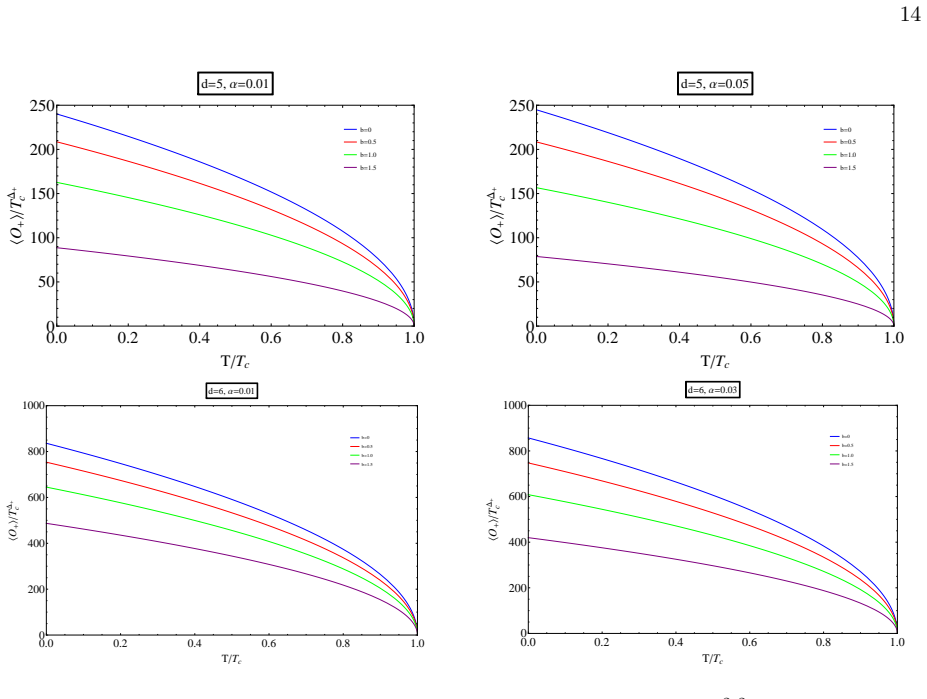
The central claim, stated on the paper's own terms, is that in the probe limit the critical temperature of an Einstein-Gauss-Bonnet holographic superconductor in a string-cloud background is given by Eq. (41) above. The eigenvalue $\lambda_{\min}$ is obtained by minimising the Sturm-Liouville quotient (40) with a trial function $F(z)=1-\beta z^2$, and it carries the dependence on the Gauss-Bonnet coupling and on the dimensionless string-cloud parameter $b=a/[(d-2)r_+^{d-2}]$. Because the bracket in $T_c$ can be negative, the paper concludes that the critical temperature exists only in an allowed region of parameter space, and that when the string-cloud density exceeds a critical value the eigenvalue square $\lambda_{\min}^2$ becomes negative, signalling the absence of any superconducting phase. A separate expansion of the gauge field near $T_c$ yields the condensation operator $\langle O_+\rangle \propto T_c^{\Delta_+}\sqrt{1-T/T_c}$, so the critical exponent is exactly $1/2$. The paper reports in addition that higher spacetime dimension raises $T_c$ and that Gauss-Bonnet coupling lowers it.
Load-bearing premise
The calculation treats $b = a/[(d-2) r_+^{d-2}]$ as an independent parameter when minimising $\lambda_{\min}$, but at the critical point $r_+^{d-2} = \rho/\lambda_{\min}$, so $b$ is tied to the physical string-cloud density, the charge density, and the eigenvalue; the paper does not solve this coupled system, and the fixed-$b$ curves may not represent a fixed physical string-cloud density.
Editorial extensions
If this is right
- For fixed charge density, a string-cloud density above a critical value makes $T_c$ nonexistent, so the superconducting phase cannot form no matter how low the temperature is.
- At low charge density, increasing string-cloud density suppresses $T_c$; at high charge density, it enhances $T_c$, so the string cloud can either hinder or help condensation depending on the regime.
- The Gauss-Bonnet coupling always decreases $T_c$, so higher-curvature corrections systematically make condensation harder.
- Higher spacetime dimension increases $T_c$ in the presence of the string cloud, implying that high-temperature superconductivity is easier in higher-dimensional holographic models.
- The condensation operator keeps the form $\langle O_+\rangle \propto T_c^{\Delta_+}\sqrt{1-T/T_c}$, with critical exponent $1/2$, independent of string-cloud density, Gauss-Bonnet coupling, and dimension.
Reading between the lines
- The fixed-$b$ analysis leaves an implicit self-consistency condition: at the critical point $b = a\lambda_{\min}/[(d-2)\rho]$, so a truly fixed physical string-cloud density would require solving for $\lambda_{\min}$ and $b$ simultaneously. Solving that coupled system is not done in the paper, and it could alter the reported curves.
- If $\lambda_{\min}^2$ turns negative, the Rayleigh-quotient 'eigenvalue' is no longer a standard Sturm-Liouville eigenvalue; the critical density $a_{\rm crt}$ may be an artifact of the one-parameter trial function. A direct numerical solution of the equations of motion would settle whether the disappearance of $T_c$ is genuine.
- A natural extension is to include backreaction of the gauge and scalar fields beyond the probe limit; the string-cloud geometry could shift or remove the allowed region, since the background would then respond to the condensate.
- The same Sturm-Liouville treatment could be applied to higher-spin condensates, such as p-wave or d-wave holographic superconductors, in this background to test whether the string-cloud threshold is universal or specific to s-wave holographic superconductors.
Signed reviews
Editorial analysis
A structured set of objections, weighed in public.
Referee Report
Summary. The manuscript studies holographic s-wave superconductors in d-dimensional Einstein-Gauss-Bonnet gravity in the presence of a string cloud, working in the probe limit. Section II constructs the planar black brane solution sourced by a string cloud and gives the Hawking temperature (20). Section III reduces the matter-field equations in this background to the Sturm-Liouville problem (38)–(40), computes the minimal eigenvalue λ_min with the trial function F(z)=1−βz², and obtains the critical temperature Eq. (41), the allowed-region condition Eq. (43), and a claimed critical string-cloud density a_crt above which no critical temperature exists. Section IV derives the condensation operator ⟨O+⟩ = Θ T_c^{Δ+} (1−T/T_c)^{1/2}, with critical exponent 1/2, via Eqs. (50)–(55). The paper concludes that the string cloud suppresses superconductivity at low charge density, enhances it at high charge density, and that a sufficiently large string-cloud density prevents the existence of a critical temperature.
Significance. The paper is clearly written and applies the standard analytic Sturm-Liouville method to a new background (Gauss-Bonnet gravity with a string cloud), which is a reasonable contribution to the holographic superconductor literature if the calculations are correct. Strengths include the clean fixed-b eigenvalue computation, the explicit mean-field critical exponent, and the analytic/numerical agreement reported in Table I for the fixed-b problem. However, the headline physical conclusions—the non-monotonic Tc(ρ) dependence on a and the existence of a critical string-cloud density—are not established, because the paper treats the dimensionless parameter b as independent even though b is related to the physical parameters a and ρ through the critical-point condition. The stress-test concern about this self-consistency gap lands: the central formula (41) is an implicit equation as it stands, and the figures and table do not represent fixed physical string-cloud density.
major comments (3)
- [Section III (Eqs. (34)–(41), Figs. 1–3, Table I)] Section III treats b ≡ a/[(d−2)r_+^{d−2}], defined below Eq. (39), as an independent parameter of the Sturm-Liouville problem (40) and writes the critical temperature (41) in terms of λ_min(b) and a. This is internally inconsistent: at the critical point Eq. (34) gives r_+^{d−2} = ρ/λ, so for fixed physical string-cloud density a and charge density ρ the parameter b satisfies the fixed-point equation b = a λ_min(b)/[(d−2)ρ]. Since λ_min is itself the b-dependent minimizer of Eq. (40), Eq. (41) is not an explicit formula for Tc(ρ,a); it is an implicit equation whose solution the manuscript never attempts. The curves in Figs. 1 and 3 and the rows of Table I compare states at fixed b, i.e. at fixed ratio a/r_+^{d−2}, rather than at fixed a; Fig. 2 additionally fixes r_+ = 1 while varying d and a, which conflicts with the critical-point condition r_+^{d−2} = ρ/λ_min (for the stated ρ = 2 and a typical λ_min of order a few, r_+ = 1 cannot satisfy this condition). Consequently the paper's claims that Tc decreases with a at low ρ and increases with a at high ρ are not supported by the calculation as presented.
- [Section III (text after Eq. (43); Eq. (42); abstract and Section V)] The claimed existence of a critical string-cloud density is not established. The example a_crt ≈ 5.55369 (text after Eq. (43)) is obtained at fixed r_+ = 1, but r_+ at the critical point is determined by ρ and λ_min, so this number does not define a threshold on the physical parameter a for a given ρ. The paper's own low-temperature limit, Eq. (42), gives b → (d−1)/2 as Tc → 0, which shows that b is a derived quantity rather than an input, yet the eigenvalue problem is only solved for arbitrary fixed b. A concrete test of the claim is to solve the fixed-point equation b = a λ_min(b)/[(d−2)ρ] for b(ρ,a), eliminate b from Eq. (41), and plot Tc(ρ) at fixed a; the result may differ qualitatively from Figs. 1–3. In particular, if λ_min(b) → 0 as b approaches the value where λ²_min crosses zero, then a = (d−2)ρ b/λ_min(b) diverges and arbitrarily large a would still admit a solution, potentially reversing the paper's conclusion that sufficiently large string-cloud density prevents superconductivity. The abstract and Section V state this conclusion without the required self-consistent analysis.
- [Section III, Table I and Eq. (41)] Table I does not test the physical predictions. For the reported entry b = 0.3, α = 0.01, Tc = 0.2ρ^{1/3} − 0.04ρ^{−2/3}, the coefficient of ρ^{−2/3} depends on a through Eq. (41) while the ρ^{1/3} coefficient depends on λ_min(b); since a and b are related by b = a λ_min/[(d−2)ρ], the two coefficients in a single row are not independent functions of one physical parameter. The numerical agreement shown in Table I therefore validates the fixed-b Sturm-Liouville computation, not the claimed dependence of Tc on the string-cloud density a.
minor comments (6)
- [Abstract and Section V] The abstract and conclusion contain the typo "prevent the the existence"; the Introduction contains "consideration attention" and "Inspired by these ideals", which should read "ideas".
- [Section III (Eqs. (33)–(41))] The notation for the horizon radius at the critical point is inconsistent: Eq. (33) uses r_c, but Eqs. (36)–(41) and the definition of b below Eq. (39) use r_+. This notational slippage obscures the fact that b must be evaluated at the critical horizon radius.
- [Eqs. (39) and (55)] The expansions in the Gauss-Bonnet coupling are truncated at O(ᾶ²) in T(z) and O(ᾶ³) in the integral A, and the plots use α up to 0.05–0.1 with no convergence estimate; a brief check of the magnitude of the omitted terms, or a comparison with the unexpanded integrand, would make the quantitative results more robust.
- [Fig. 2 caption] The caption fixes r_+ = 1 and ρ = 2 while varying d and a, but at the critical point r_+^{d−2} = ρ/λ_min, so these conditions cannot be imposed simultaneously; the caption should state which quantities are actually held fixed.
- [Section IV] The manuscript never reports the minimizing value β_min used in Eqs. (50)–(55) for the parameters of Figs. 3; providing this value would aid reproducibility.
- [References] References [31] and [36] are the same paper (Li, Cai, and Zhang, JHEP 04, 028 (2011)), and references [30] and [32] duplicate the same Barclay et al. paper with a punctuation typo; these should be consolidated.
Circularity Check
No circularity found: the critical temperature and condensation exponent are derived from a variational Sturm-Liouville eigenvalue problem and are not fitted to the output; the fixed-b/fixed-a mapping is a consistency caveat, not a circular step.
full rationale
The derivation chain is self-contained rather than circular. The critical temperature in Eq. (41) follows from the black-hole Hawking temperature Eq. (20) together with the Sturm-Liouville eigenvalue condition Eq. (40), where lambda_min is obtained by minimizing a functional with a trial function F(z)=1-beta z^2; neither lambda_min nor beta is calibrated against the predicted Tc values. The condensation result in Section IV likewise follows from a systematic expansion in <O+>^2, and the exponent 1/2 emerges from the structure of that expansion rather than from any fitted parameter. I find no load-bearing self-citation: the cited results are standard background material, and the trial-function ansatz is attributed to Siopsis-Therrien [7], not to the present author. The one substantive concern visible in the manuscript is that b is defined as a/((d-2)r_+^(d-2)) with r_+ being the horizon radius, which at the critical point satisfies lambda = rho/r_+^(d-2); hence b = a lambda_min/((d-2)rho) is an implicit fixed-point equation that the paper does not solve when it treats b as fixed. This is a real self-consistency and parameter-mapping issue affecting the physical interpretation of Figs. 1-3 and the examples quoted at r_+=1, but it is an internal consistency/correctness problem rather than a circular reduction in which a predicted quantity is assumed through its input. Since no step of the claimed derivation reduces to an input by construction, the circularity score is 0.
Assumptions & free parameters
free parameters (2)
- a (string cloud density parameter) =
not fitted; chosen as examples 1.5, 5.55369
- b = a/[(d-2) r_+^{d-2}] =
varied from 0 to about 1.85 in examples
assumptions (6)
- domain assumption AdS/CFT correspondence and the holographic dictionary for scalar and gauge fields in the probe limit
- domain assumption The string cloud energy-momentum tensor takes the Letelier form T_t^t = T_r^r = -a/r^{d-2}
- domain assumption Probe limit: backreaction of the gauge and scalar fields on the geometry is neglected
- ad hoc to paper Trial function ansatz F(z)=1-βz² with F(0)=1 and F'(0)=0
- ad hoc to paper Expansion in the Gauss-Bonnet coupling ~α is truncated at O(~α²) in T(z) and in the condensation integral A
- ad hoc to paper The eigenvalue λ_min computed for an assumed b applies directly to a black hole with the same b, without enforcing b = a λ_min/[(d-2)ρ]
Cite this review
Pith. "Pith review of Effects of string cloud on Gauss-Bonnet holographic superconductors." pith.science (2026). https://pith.science/paper/5X4FT5QR
@misc{pith2026190805031,
  author       = {Pith},
  title        = {Pith review of: Effects of string cloud on Gauss-Bonnet holographic superconductors},
  year         = {2026},
  howpublished = {\url{https://pith.science/paper/5X4FT5QR}},
  note         = {Machine review of arXiv:1908.05031}
}
read the original abstract
The effects of the string cloud on higher-dimensional holographic superconductors in Einstein-Gauss-Bonnet gravity are investigated in the probe limit. The critical temperature is analytically obtained using Sturm-Liouville eigenvalue method. It is observed that the critical temperature only exists in an allowed region of the parameter space. Also, the presence of the string cloud with the sufficiently large density should prevent the the existence of the critical temperature. As increasing the string cloud density parameter, the critical temperature decreases in the region of the sufficiently low charge density but increases in the region of the sufficiently high charge density. Whereas, the presence of Gauss-Bonnet terms always makes the critical temperature decreasing. In addition, the expression of the condensation operator and the critical exponent are computed analytically.
Figures


Forward citations
Cited by 1 Pith paper
-
Gauss-Bonnet holographic superconductors in exponential nonlinear electrodynamics
For a holographic superconductor with Gauss-Bonnet gravity and exponential nonlinear electrodynamics, higher GB coupling or nonlinearity lowers the critical temperature and makes condensation harder, while higher spac...
Reference graph
Works this paper leans on
-
[1]
φ →λ1φ, ψ →λ1ψ, q →λ−1 1 q
-
[2]
With new coordinate z = r+ r , Eqs
φ →λ2φ, ψ →λ1/ 2 2 ψ, a →λ2a, ~α →λ−1 2 ~α, l →λ−1/ 2 2 l, m →λ1/ 2 2 m, which can be used to set q =l = 1. With new coordinate z = r+ r , Eqs. (23) and (24) are rewritten as φ′′(z) + 4 −d z φ′(z) − 2r2 +φ(z) z4f (z) ψ2(z) = 0 , (28) ψ′′(z) + ( f ′(z) f (z) + 4 −d z ) ψ′(z) + r2 + z4 ( φ2(z) f 2(z) − m2 f (z) ) ψ(z) = 0 , (29) 1 The mass of the scalar fiel...
-
[3]
J. M. Maldacena, Adv. Theor. Math. Phys. 2, 231 (1998)
1998
-
[4]
S. A. Hartnoll, Class. Quant. Grav. 26, 224002 (2009)
work page 2009
-
[5]
S. A. Hartnoll, C. P. Herzog, and G. T. Horowitz, Phys. Rev. Let t. 101, 031601 (2008). 15
work page 2008
-
[6]
S. A. Hartnoll, C. P. Herzog, and G. T. Horowitz, JHEP 0812, 015 (2008)
2008
-
[7]
Franco, A
S. Franco, A. Garcia-Garcia, and D. Rodriguez-Gomez, JHEP 04, 092 (2010)
2010
- [8]
Show all 45 references
-
[9]
Siopsis and J
G. Siopsis and J. Therrien, JHEP 05, 013 (2010)
2010
-
[10]
X.-H. Ge, B. Wang, S.-F. Wu, and G.-H. Yang, JHEP 08, 108 (2010)
2010
-
[11]
J. Jing, Q. Pan, and S. Chen, JHEP 11, 045 (2011)
2011
-
[12]
H.-B. Zeng, X. Gao, Y. Jiang, and H.-S. Zong, JHEP 1105, 002 (2011)
2011
-
[13]
Cai, H.-F Li, and H.-Q
R.-G. Cai, H.-F Li, and H.-Q. Zhang, Phys. Rev. D 83, 126007 (2011)
2011
-
[14]
Ge and H.-Q
X.-H. Ge and H.-Q. Leng, Prog. Theor. Phys. 128, 1211 (2012)
2012
-
[15]
Gangopadhyay and D
S. Gangopadhyay and D. Roychowdhury, JHEP 05, 156 (2012)
2012
-
[16]
Z. Zhao, Q. Pan, S. Chen, and J. Jing, Nucl. Phys. B 871, 98 (2013)
2013
-
[17]
Erdmenger, X.-H
J. Erdmenger, X.-H. Ge, and D.-W. Pang, JHEP 11, 027 (2013)
2013
-
[18]
C. Lai, Q. Pan, J. Jing, and Y. Wang, Phys. Lett. B 749, 437 (2015)
2015
-
[19]
Ghorai and S
D. Ghorai and S. Gangopadhyay, Eur. Phys. J. C 76, 146 (2016)
2016
-
[20]
Y. Liu, Y. Gong, and B. Wang, JHEP 02, 116 (2016)
2016
-
[21]
M. K. Zangeneh, A. Dehyadegari, A. Sheykhi, and M. H. Dehgha ni, JHEP 1603, 037 (2016)
2016
-
[22]
Sheykhi, F
A. Sheykhi, F. Shaker, Phys. Lett. B 754, 281 (2016)
2016
-
[23]
Sheykhi, H
A. Sheykhi, H. R. Salahi, and A. Montakhab, JHEP 04, 058 (2016)
2016
-
[24]
Sheykhi, A
A. Sheykhi, A. Ghazanfari, and A. Dehyadegari, Eur. Phys. J. C 78, 159 (2018)
2018
-
[25]
Sheykhi, D
A. Sheykhi, D. H. Asl, A. Dehyadegari, Phys. Lett. B 781, 139 (2018)
2018
-
[26]
Zwiebach, Phys
B. Zwiebach, Phys. Lett. B 156, 315 (1985)
1985
-
[27]
D. J. Gross and E. Witten, Nucl. Phys. B 277, 1 (1986)
1986
-
[28]
D. J. Gross and J. H Sloan, Nucl. Phys. B 291, 41 (1987)
1987
-
[29]
Gregory, S
R. Gregory, S. Kanno, and J. Soda, JHEP 0910, 010 (2009)
2009
-
[30]
Q. Pan, B. Wang, E. Papantonopoulos, J. Oliveira, and A. B. Pav an, Phys. Rev. D 81, 106007 (2010)
2010
-
[31]
Pan and B
Q. Pan and B. Wang, Phys. Lett. B 693, 159 (2010)
2010
-
[32]
Barclay, R
L. Barclay, R. Gregory, S. Kanno, and P. Sutcliffe, JHEP 1012, 029 (2010)
2010
-
[34]
Barclay, R
L. Barclay, R. Gregory, S. Kanno, and P. Sutcliffe, JHEP 1012, 029 (2010),
2010
-
[35]
Kanno, Class
S. Kanno, Class. Quant. Grav. 28, 127001 (2011)
2011
-
[36]
J. Jing, L. Wang, Q. Pan, and S. Chen, Phys. Rev. D 83, 066010 (2011)
2011
-
[37]
Barclay, JHEP 10, 044 (2011)
L. Barclay, JHEP 10, 044 (2011)
2011
-
[38]
Li, R.-G
H.-F. Li, R.-G. Cai, and H.-Q. Zhang, JHEP 04, 028 (2011)
2011
-
[39]
Q. Pan, J. Jing, and B. Wang, JHEP 11, 088 (2011)
2011
-
[40]
J. Jing, Q. Pan, and S. Chen, Phys. Lett. B 716, 385 (2012)
2012
-
[41]
R.-G. Cai, L. Li, L.-F. Li, H.-Q. Zhang, and Y.-L. Zhang, Phys. Rev . D 87, 026002 (2013)
2013
-
[42]
Cui and Z
S.-L. Cui and Z. Xue, Phys. Rev. D 88, 107501 (2013). 16
2013
-
[43]
P. S. Letelier, Phys. Rev. D 20 (6), 1294 (1979)
1979
-
[44]
Herscovich and M
E. Herscovich and M. G. Richarte, Phys. Lett. B 689, 192 (2010)
2010
-
[45]
T.-H. Lee, D. Baboolal, and S. G. Ghosh, Eur. Phys. J. C 75, 297 (2015)
2015
-
[46]
Breitenlohner and D
P. Breitenlohner and D. Z. Freedman, Phys. Lett. B 115, 197 (1982)
1982
Reviewed August 14, 2026 · model on record in the stance chip above.
Discussion (0). Continue with ORCID to comment.