REVIEW 3 major objections 5 minor 61 references
A two-stage continual-learning framework lets a single humanoid controller track both everyday motions and acrobatic high-dynamics moves, even from noisy inertial motion-capture input.
Reviewed by Pith at T0; open to challenge. T0 means a machine referee read the full paper against a public rubric. the ladder, T0–T4 →
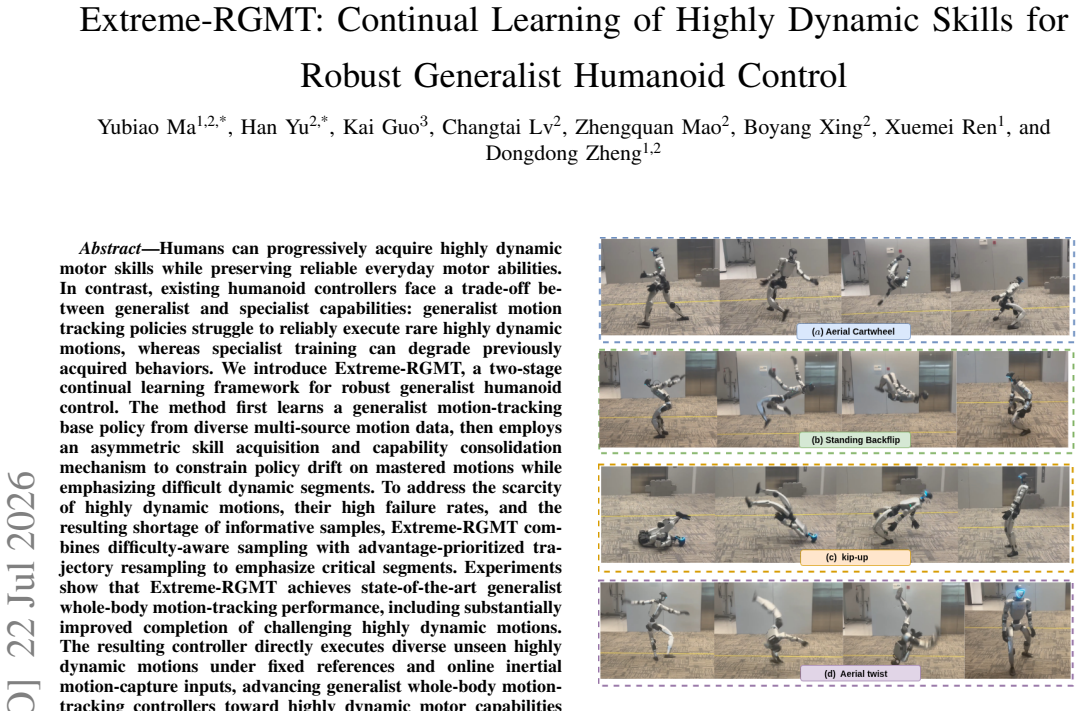
A two-stage continual-learning framework lets a generalist humanoid tracking policy acquire highly dynamic acrobatic skills while preserving its general-purpose motion capabilities.
T0 review reviewed 2026-08-01 challenge →
load-bearing objection Strong empirical system with a real data-leakage question: the AMASS Challenging test may be in the Stage-II training set, so the 'unseen' claim needs a fix before I'd trust the headline. the 3 major comments →
Extreme-RGMT: Continual Learning of Highly Dynamic Skills for Robust Generalist Humanoid Control
The pith
A machine-rendered reading of the paper's core claim, the machinery that carries it, and where it could break.
The reading
Core claim
The central claim is that highly dynamic skill acquisition and generalist capability retention need not be mutually exclusive if the training curriculum is organized asymmetrically by role. A consolidation branch constrains policy drift on motions the base policy already masters, using reference-policy regularization whose strength grows with training progress, while an acquisition branch focuses exclusively on challenging motions using difficulty-aware sampling and advantage-prioritized trajectory-fragment resampling. On the paper's own terms, the resulting augmented policy is the first generalist humanoid controller that directly executes diverse unseen highly dynamic motions under online
What carries the argument
The paper's central machinery is PACE (Progressive Acquisition and Consolidation for Expansion), which asymmetrically allocates parallel environments between acquisition on a challenging motion set and consolidation on a mastered set, coupling a PPO acquisition loss with a reference-policy action-alignment loss ∥aθ(s) − aref(s)∥² whose weight λcon rises adaptively as the fraction of valid acquisition samples increases. STAR (Segment-Aware Trajectory Advantage Resampling) converts bin-level difficulty priors into transition-level difficulty weights, normalizes advantages separately for high-difficulty versus remaining transitions, ranks contiguous trajectory fragments by average raw advantage
Load-bearing premise
The split of motions into 'mastered' and 'challenging' rests on the completion rate from just five stochastic rollouts under the base policy with an 80% threshold, and the entire second-stage curriculum is built on that noisy, metric-sensitive label.
What would settle it
Retrain Stage II using the same base policy but with motion stratification computed from 50 rollouts per clip instead of 5, or with thresholds of 70% and 90%: if specialist success on the challenging set drops substantially or generalist retention degrades, the curriculum is riding on the luck of a five-rollout estimate. On hardware, run the teleoperation policy with operators whose motion timing deviates more than roughly 20% from the training clips and see whether the completion rate collapses.
If this is right
- A single policy can span everyday motions and acrobatic skills, removing the need to switch between a generalist and a specialist controller depending on the task.
- Online teleoperation of highly dynamic motions becomes feasible from low-quality inertial motion-capture references, extending humanoid control from offline replay to real-time human-driven execution.
- Training on scarce, failure-prone data can be made more sample-efficient by concentrating optimization on high-advantage trajectory fragments in difficult temporal segments, not just on difficult bins.
- The consolidation mechanism offers a reusable template for continual robot learning in which new skills are built on stable base competencies without catastrophic forgetting.
Where Pith is reading between the lines
- The same two-role curriculum idea could transfer to other contact-rich and dynamic robot tasks—manipulation, loco-manipulation, or parkour—where decisive learning signals are concentrated in short segments and failure samples dominate the buffer.
- The motion-stratification step (five rollouts, 80% threshold, 0.2 m root-height failure) is the main sensitivity: the entire Stage-II curriculum inherits the noise of that label, so a confidence-weighted split or a robustness study over rollout counts and thresholds would clarify how reproducible the reported gains are.
- The gains on unseen motions hint that the framework may generalize beyond the training distribution, but the paper's own limitation statement concedes that motions with unfamiliar coordination patterns or timing still fail, so the practical boundary lies where the training data have no near-neighbor coverage.
Editorial analysis
A structured set of objections, weighed in public.
Referee Report
Summary. The paper proposes Extreme-RGMT, a two-stage continual learning framework for Unitree G1 whole-body motion tracking. Stage I trains a generalist base policy from LAFAN1, AMASS, and in-house Xsens data using an architecture with separated state/action/reference encoders and FSQ command quantization. Stage II freezes the base policy as a reference, splits motions into mastered and challenging sets, and trains an augmented policy with PACE, an asymmetric acquisition/consolidation objective with progress-adaptive regularization, and STAR, a fragment-level advantage resampling mechanism. The paper reports state-of-the-art generalist tracking success, high success on XtremeMotion and AMASS Challenging motions, and hardware demos for fixed-reference replay and Xsens teleoperation.
Significance. If the results hold, the paper makes a meaningful advance: it shows a single humanoid policy can retain broad generalist motion-tracking ability while substantially improving execution of highly dynamic, failure-prone motions, and it demonstrates this on hardware with online inertial motion-capture input. The work is strengthened by controlled retraining of ExBody2, BeyondMimic, and RGMT on the same Stage-I corpus, the use of a public external checkpoint (SONIC, OmniXtreme) as a comparison, component ablations in simulation and hardware, and five-seed error-metric reporting. The main risk is that the central 'unseen highly dynamic motions' claim is not yet supported by the quantitative specialist evaluation, because the AMASS Challenging test set appears to overlap the Stage-II acquisition set.
major comments (3)
- [Sec. IV-C and Sec. VI.A.3, Table VI(b)] The AMASS Challenging Motions test set is not shown to be disjoint from the Stage-II acquisition set D_c. Section IV-C constructs D_c from all AMASS clips whose completion rate under the base policy is below 80%, while Section VI.A.3 evaluates 'difficult motions selected from AMASS.' No sentence states that these test clips, or the AMASS sequences they are drawn from, are excluded from D_c. If the same clips or temporally overlapping windows are used in Stage-II training, the 90.91% specialist success on AMASS Challenging Motions is training-set fitting rather than evidence of generalization to unseen dynamic motions. The authors must report the exact overlap, or re-evaluate on held-out AMASS sequences. The same concern applies to hardware 'AMASS Replay' and the Xsens teleop motions, which may also be drawn from D_c. This is load-bearing for the abstract and conclusion claims about execu
- [Sec. IV-C] The motion stratification that defines D_m and D_c is based on only five stochastic rollouts per clip and an 80% completion-rate threshold. With five binary rollouts, the completion rate is quantized to 0, 20, 40, 60, 80, or 100 percent, so the 80% boundary is coarse. The entire Stage-II curriculum—which motions are consolidated versus acquired—inherits the noise and metric choice of this estimate. The paper provides no sensitivity analysis with respect to rollout count, threshold value, or seed. I request an analysis showing the D_c/D_m assignment is stable, or at least that the final simulation and hardware results are not sensitive to reasonable perturbations of the stratification procedure.
- [Table VI and Sec. VI.A.1] Success rates are the headline metric for both the generalist and specialist claims, but they are reported as point values without variance, despite the paper stating that all results are averaged over five random seeds. The error metrics include standard deviations; the success rates should also report per-seed values, confidence intervals, or a statistical comparison. This is especially important for differences such as Fine-Tuning (54.55%) versus Extreme-RGMT Full (90.91%) on AMASS Challenging Motions, and Extreme-RGMT Stage I versus Full on the Unseen Motion set. Currently the reader cannot judge whether the reported success-rate differences are significant at the five-seed scale.
minor comments (5)
- [Abstract and Sec. VII] The phrase 'directly executes diverse unseen highly dynamic motions' overstates the evidence if the AMASS Replay and Xsens hardware motions are drawn from the training corpus or from D_c. Please rephrase to 'motions not explicitly held out' or specify which evaluations are truly unseen.
- [Sec. VI.A.3] The name 'AMASS Challenging Motions' is easily confused with the training set D_c. Consider renaming the evaluation subset, e.g., 'AMASS Held-Out Challenging Motions' if it is in fact held out, and explicitly state its relationship to D_c.
- [Fig. 8] The time-step axes in Fig. 8 have no labels or units, and the two panels are not annotated. Please add axis labels and clarify whether the plot shows a specific seed, a representative rollout, or an aggregated statistic.
- [Table VII vs Table VIII] Table VII reports 'In-house Xsens Motions' while Table VIII reports 'Xsens Teleop.' Please state explicitly that Table VII is simulation and Table VIII is hardware, to avoid ambiguity.
- [Sec. IV-C] Please clarify whether the five randomized rollouts used for stratification follow the same randomization seed protocol as the evaluation rollouts, and whether the 80% threshold is applied to the mean or to each seed independently.
Circularity Check
No significant circularity; minor self-citation and an unquantified AMASS test-set overlap caveat.
full rationale
The central evaluations are anchored to external benchmarks rather than to the paper's own fitted quantities. Generalist capability is measured against a video-reconstructed Unseen Motion subset and in-source motions, while specialist capability includes the public XtremeMotion dataset and publicly released checkpoints of SONIC and OmniXtreme. The architecture does build on the authors' own RGMT [5] ('Building on the dynamics-guided command encoder [5]'), but the paper retrains RGMT on the same corpus and reports controlled comparisons, so this self-citation is incremental rather than load-bearing. Stage-II training on the base policy's own stratified 'challenging' set is a curriculum choice, not a disguised prediction, and the PACE consolidation objective is explicit about preserving generalist behavior. The one caveat worth flagging is experimental hygiene rather than demonstrated circularity: Sec. IV-C defines D_c as all clips from AMASS (and other sources) below an 80% completion threshold, while Sec. VI.A.3 defines the 'AMASS Challenging Motions' test set as 'difficult motions selected from AMASS' and never states that these test clips are excluded from D_c. If the same AMASS clips are used in Stage-II acquisition and in Table VI(b), the 90.91% success would be a training-set result, not unseen generalization. Because this is a possible overlap rather than an explicit reduction, and because the independent XtremeMotion and Unseen Motion results remain, I do not treat it as a demonstrated circular step. Score 2 reflects the minor self-citation and this unquantified overlap caveat.
Axiom & Free-Parameter Ledger
free parameters (10)
- Consolidation base weight λ_base =
0.3
- Consolidation gain κ =
5.0
- Acquisition-sample ratio threshold ρ_ref =
0.6
- EMA smoothing β =
0.99
- Acquisition environment fraction ξ =
0.8
- Fragment retention ratio ρ_topk =
0.05
- Resampling ratio ρ_star =
0.25
- Motion stratification completion threshold and rollout count =
80% from 5 rollouts
- FSQ token configuration =
two 32-dim tokens, levels unspecified
- Reward weights =
0.5–1.0 imitation, −0.1 to −10 regularizers (Table I)
axioms (7)
- domain assumption Root-relative reference tracking with success defined as root height deviation < 0.2 m forms a valid measure of whole-body motion completion.
- domain assumption Five randomized rollouts per clip are sufficient to estimate the completion rate used for the mastered/challenging split.
- domain assumption The local reference window plus proprioceptive/action history is a sufficient state representation for highly dynamic motions.
- domain assumption Domain randomization (Table II) makes the simulated policy transferable to the Unitree G1 for high-impact aerial motions.
- domain assumption FSQ quantization of the aggregated command representation preserves enough information for dynamic control.
- domain assumption MuJoCo simulation accurately models contact-rich, aerial humanoid dynamics for training.
- standard math PPO with GAE and the given reward is a suitable optimizer for the acquisition PPO loss.
Cite this review
Pith. "Pith review of Extreme-RGMT: Continual Learning of Highly Dynamic Skills for Robust Generalist Humanoid Control." pith.science (2026). https://pith.science/paper/5YDZ5Z5O
@misc{pith2026260720110,
  author       = {Pith},
  title        = {Pith review of: Extreme-RGMT: Continual Learning of Highly Dynamic Skills for Robust Generalist Humanoid Control},
  year         = {2026},
  howpublished = {\url{https://pith.science/paper/5YDZ5Z5O}},
  note         = {Machine review of arXiv:2607.20110}
}
read the original abstract
Humans can progressively acquire highly dynamic motor skills while preserving reliable everyday motor abilities. In contrast, existing humanoid controllers face a trade-off between generalist and specialist capabilities: generalist motion tracking policies struggle to reliably execute rare highly dynamic motions, whereas specialist training can degrade previously acquired behaviors. We introduce Extreme-RGMT, a two-stage continual learning framework for robust generalist humanoid control. The method first learns a generalist motion-tracking base policy from diverse multi-source motion data, then employs an asymmetric skill acquisition and capability consolidation mechanism to constrain policy drift on mastered motions while emphasizing difficult dynamic segments. To address the scarcity of highly dynamic motions, their high failure rates, and the resulting shortage of informative samples, Extreme-RGMT combines difficulty-aware sampling with advantage-prioritized trajectory resampling to emphasize critical segments. Experiments show that Extreme-RGMT achieves state-of-the-art generalist whole-body motion-tracking performance, including substantially improved completion of challenging highly dynamic motions. The resulting controller directly executes diverse unseen highly dynamic motions under fixed references and online inertial motion-capture inputs, advancing generalist whole-body motion-tracking controllers toward highly dynamic motor capabilities at the human-expert level.
Figures


Reference graph
Works this paper leans on
-
[1]
The role of delib- erate practice in the acquisition of expert performance,
K. A. Ericsson, R. T. Krampe, and C. Tesch-R ¨omer, “The role of delib- erate practice in the acquisition of expert performance,”Psychological Review, vol. 100, no. 3, pp. 363–406, 1993
1993
-
[2]
How do you learn to walk? Thousands of steps and dozens of falls per day,
K. E. Adolph, W. G. Cole, M. Komati, J. S. Garciaguirre, D. Badaly, J. M. Lingeman, G. L. Y . Chan, and R. B. Sotsky, “How do you learn to walk? Thousands of steps and dozens of falls per day,”Psychological Science, vol. 23, no. 11, pp. 1387–1394, 2012
2012
-
[3]
Consolidation in human motor memory,
T. Brashers-Krug, R. Shadmehr, and E. Bizzi, “Consolidation in human motor memory,”Nature, vol. 382, no. 6588, pp. 252–255, 1996
1996
-
[4]
SONIC: Supersizing motion tracking for natural humanoid whole-body control,
Z. Luo, Y . Yuan, T. Wang, C. Li, S. Chen, F. Casta˜neda, Z.-A. Cao, J. Li, D. Minor, Q. Ben, X. Da, R. Ding, C. Hogg, L. Song, E. Lim, E. Jeong, T. He, H. Xue, W. Xiao, Z. Wang, S. Yuen, J. Kautz, Y . Chang, U. Iqbal, L. Fan, and Y . Zhu, “SONIC: Supersizing motion tracking for natural humanoid whole-body control,”arXiv preprint arXiv:2511.07820, 2025
Pith/arXiv arXiv 2025
-
[5]
Robust and generalized humanoid motion tracking,
Y . Ma, H. Yu, J. Xie, C. Lv, Q. Luo, C. Zhang, Y . Yin, B. Xing, X. Ren, and D. Zheng, “Robust and generalized humanoid motion tracking,” arXiv preprint arXiv:2601.23080, 2026
arXiv 2026
-
[6]
GMT: General motion tracking for humanoid whole-body control,
Z. Chen, M. Ji, X. Cheng, X. Peng, X. B. Peng, and X. Wang, “GMT: General motion tracking for humanoid whole-body control,” arXiv preprint arXiv:2506.14770, 2025
Pith/arXiv arXiv 2025
-
[7]
UniTracker: Learning universal whole-body motion tracker for humanoid robots,
K. Yin, W. Zeng, K. Fan, M. Dai, Z. Wang, Q. Zhang, Z. Tian, J. Wang, J. Pang, and W. Zhang, “UniTracker: Learning universal whole-body motion tracker for humanoid robots,”arXiv preprint arXiv:2507.07356, 2025
arXiv 2025
-
[8]
KungfuBot2: Learning versatile motion skills for humanoid whole-body control,
J. Han, W. Xie, J. Zheng, J. Shi, W. Zhang, T. Xiao, and C. Bai, “KungfuBot2: Learning versatile motion skills for humanoid whole-body control,”arXiv preprint arXiv:2509.16638, 2025
arXiv 2025
-
[9]
BFM-Zero: A promptable behavioral foundation model for humanoid control using unsupervised reinforcement learning,
Y . Li, Z. Luo, T. Zhang, C. Dai, A. Kanervisto, A. Tirinzoni, H. Weng, K. Kitani, M. Guzek, A. Touati, A. Lazaric, M. Pirotta, and G. Shi, “BFM-Zero: A promptable behavioral foundation model for humanoid control using unsupervised reinforcement learning,” inInternational Conference on Learning Representations (ICLR), 2026
2026
-
[10]
CLONE: Closed-loop whole-body humanoid teleoperation for long- horizon tasks,
Y . Li, Y . Lin, J. Cui, T. Liu, W. Liang, Y . Zhu, and S. Huang, “CLONE: Closed-loop whole-body humanoid teleoperation for long- horizon tasks,” inProceedings of the 9th Conference on Robot Learning (CoRL), 2025
2025
-
[11]
Agility meets stability: Versatile humanoid control with heterogeneous data,
Y . Pan, R. Qiao, L. Chen, K. Chitta, L. Pan, H. Mai, Q. Bu, H. Zhao, C. Zheng, P. Luo, and H. Li, “Agility meets stability: Versatile humanoid control with heterogeneous data,”arXiv preprint arXiv:2511.17373, 2025
arXiv 2025
-
[12]
VMP: Ver- satile motion priors for robustly tracking motion on physical characters,
A. Serifi, R. Grandia, E. Knoop, M. Gross, and M. B ¨acher, “VMP: Ver- satile motion priors for robustly tracking motion on physical characters,” Computer Graphics Forum, vol. 43, no. 8, p. e15080, 2024
2024
-
[13]
TWIST2: Scalable, portable, and holistic humanoid data collection system,
Y . Ze, S. Zhao, W. Wang, A. Kanazawa, R. Duan, P. Abbeel, G. Shi, J. Wu, and C. K. Liu, “TWIST2: Scalable, portable, and holistic humanoid data collection system,”arXiv preprint arXiv:2511.02832, 2025
arXiv 2025
-
[14]
HOMIE: Humanoid loco-manipulation with isomorphic exoskeleton cockpit,
Q. Ben, F. Jia, J. Zeng, J. Dong, D. Lin, and J. Pang, “HOMIE: Humanoid loco-manipulation with isomorphic exoskeleton cockpit,” in Proceedings of Robotics: Science and Systems (RSS), Los Angeles, CA, USA, Jun. 2025
2025
-
[15]
Expressive whole-body control for humanoid robots,
X. Cheng, Y . Ji, J. Chen, R. Yang, G. Yang, and X. Wang, “Expressive whole-body control for humanoid robots,” inProceedings of Robotics: Science and Systems (RSS), Delft, Netherlands, Jul. 2024
2024
-
[16]
BeyondMimic: From motion tracking to versatile humanoid control via guided diffusion,
Q. Liao, T. E. Truong, X. Huang, Y . Gao, G. Tevet, K. Sreenath, and C. K. Liu, “BeyondMimic: From motion tracking to versatile humanoid control via guided diffusion,”arXiv preprint arXiv:2508.08241, 2025
Pith/arXiv arXiv 2025
-
[17]
KungfuBot: Physics-based humanoid whole-body control for learning highly-dynamic skills,
W. Xie, J. Han, J. Zheng, H. Li, X. Liu, J. Shi, W. Zhang, C. Bai, and X. Li, “KungfuBot: Physics-based humanoid whole-body control for learning highly-dynamic skills,”arXiv preprint arXiv:2506.12851, 2025
Pith/arXiv arXiv 2025
-
[18]
ZEST: Zero- shot embodied skill transfer for athletic robot control,
J.-P. Sleiman, H. Li, A. Adu-Bredu, R. Deits, A. Kumar, K. Bergamin, M. Bhardwaj, S. Biddlestone, N. Burger, M. A. Estrada, F. Iacobelli, T. Koolen, A. Lambert, E. Lin, M. E. Mungai, Z. Nobles, S. Rozen- Levy, Y . Shi, J. Wang, J. Welner, F. Yu, M. Zhang, A. Rizzi, J. Hodgins, S. Bertrand, Y . Abe, S. Kuindersma, and F. Farshidian, “ZEST: Zero- shot embod...
arXiv 2026
-
[19]
Track any motions under any disturbances,
Z. Zhang, J. Guo, C. Chen, J. Wang, C. Lin, Y . Lian, H. Xue, Z. Wang, M. Liu, J. Lyu, H. Liu, H. Wang, and L. Yi, “Track any motions under any disturbances,”arXiv preprint arXiv:2509.13833, 2025
arXiv 2025
-
[20]
Finite scalar quantization: VQ-V AE made simple,
F. Mentzer, D. Minnen, E. Agustsson, and M. Tschannen, “Finite scalar quantization: VQ-V AE made simple,” inProceedings of the International Conference on Learning Representations (ICLR), 2024. 16
2024
-
[21]
Attention-based map encoding for learning generalized legged locomo- tion,
J. He, C. Zhang, F. Jenelten, R. Grandia, M. B ¨acher, and M. Hutter, “Attention-based map encoding for learning generalized legged locomo- tion,”Science Robotics, vol. 10, no. 105, p. eadv3604, 2025
2025
-
[22]
N. Rudin, J. He, J. Aurand, and M. Hutter, “Parkour in the wild: Learning a general and extensible agile locomotion policy using multi-expert distillation and RL fine-tuning,”arXiv preprint arXiv:2505.11164, 2025
Pith/arXiv arXiv 2025
-
[23]
VPIES: Varia- tional privileged information encoder as scaffold for legged locomotion learning,
Y . Ma, H. Yu, K. Guo, B. Xing, X. Ren, and D. Zheng, “VPIES: Varia- tional privileged information encoder as scaffold for legged locomotion learning,”IEEE Robotics and Automation Letters, vol. 11, no. 4, pp. 5119–5126, 2026
2026
-
[24]
TerAdapt: Proprioceptive terrain-adaptive locomotion via codebook aligned representation learning,
Y . Ma, H. Yu, K. Guo, C. Chen, W. Huang, B. Xing, X. Ren, and D. Zheng, “TerAdapt: Proprioceptive terrain-adaptive locomotion via codebook aligned representation learning,”IEEE Robotics and Automa- tion Letters, vol. 11, no. 6, pp. 6831–6838, 2026
2026
-
[25]
MoRE: Mixture of residual experts for humanoid lifelike gaits learning on complex terrains,
D. Wang, X. Wang, X. Liu, J. Shi, Y . Zhao, C. Bai, and X. Li, “MoRE: Mixture of residual experts for humanoid lifelike gaits learning on complex terrains,”arXiv preprint arXiv:2506.08840, 2025
Pith/arXiv arXiv 2025
-
[26]
BeamDojo: Learning agile humanoid locomotion on sparse footholds,
H. Wang, Z. Wang, J. Ren, Q. Ben, T. Huang, W. Zhang, and J. Pang, “BeamDojo: Learning agile humanoid locomotion on sparse footholds,” inProceedings of Robotics: Science and Systems (RSS), Los Angeles, CA, USA, Jun. 2025
2025
-
[27]
APEX: Learning adaptive high-platform traversal for humanoid robots,
Y . Wang, T. Leng, C. Lin, S. Liu, S. Simon, B. Chen, J. Francis, and D. Zhao, “APEX: Learning adaptive high-platform traversal for humanoid robots,”arXiv preprint arXiv:2602.11143, 2026
arXiv 2026
-
[28]
Learning humanoid standing-up control across diverse postures,
T. Huang, J. Ren, H. Wang, Z. Wang, Q. Ben, M. Wen, X. Chen, J. Li, and J. Pang, “Learning humanoid standing-up control across diverse postures,” inProceedings of Robotics: Science and Systems (RSS), Los Angeles, CA, USA, Jun. 2025
2025
-
[29]
Learning getting-up policies for real-world humanoid robots,
X. He, R. Dong, Z. Chen, and S. Gupta, “Learning getting-up policies for real-world humanoid robots,” inProceedings of Robotics: Science and Systems (RSS), Los Angeles, CA, USA, Jun. 2025
2025
-
[30]
OmniXtreme: Breaking the generality barrier in high- dynamic humanoid control,
Y . Wang, S. Zhu, P. Zhi, Y . Li, J. Li, Y .-L. Li, Y . Xiao, X. Wang, B. Jia, and S. Huang, “OmniXtreme: Breaking the generality barrier in high- dynamic humanoid control,”arXiv preprint arXiv:2602.23843, 2026
arXiv 2026
-
[31]
HumanPlus: Humanoid shadowing and imitation from humans,
Z. Fu, Q. Zhao, Q. Wu, G. Wetzstein, and C. Finn, “HumanPlus: Humanoid shadowing and imitation from humans,” inProceedings of the Conference on Robot Learning (CoRL), 2024
2024
-
[32]
iCub3 avatar system: Enabling remote fully immersive embodiment of humanoid robots,
S. Dafarra, K. Darvish, R. Grieco, G. Milani, U. Pattacini, L. Rapetti, G. Romualdi, M. Salvi, A. Scalzo, I. Sorrentinoet al., “iCub3 avatar system: Enabling remote fully immersive embodiment of humanoid robots,”Science Robotics, vol. 9, no. 86, p. eadh3834, 2024
2024
-
[33]
C. Yang, Y . Sun, P. Ye, X. Chen, C. Yu, and T. Chen, “EGM: Efficiently learning general motion tracking policy for high dynamic humanoid whole-body control,”arXiv preprint arXiv:2512.19043, 2025
arXiv 2025
-
[34]
Visual imitation enables contextual humanoid control,
A. Allshire, H. Choi, J. Zhang, D. McAllister, A. Zhang, C. M. Kim, T. Darrell, P. Abbeel, J. Malik, and A. Kanazawa, “Visual imitation enables contextual humanoid control,”arXiv preprint arXiv:2505.03729, 2025
Pith/arXiv arXiv 2025
-
[35]
AMASS: Archive of motion capture as surface shapes,
N. Mahmood, N. Ghorbani, N. F. Troje, G. Pons-Moll, and M. J. Black, “AMASS: Archive of motion capture as surface shapes,” inProceedings of the IEEE/CVF International Conference on Computer Vision (ICCV), 2019, pp. 5442–5451
2019
-
[36]
Robust motion in-betweening,
F. G. Harvey, M. Yurick, D. Nowrouzezahrai, and C. J. Pal, “Robust motion in-betweening,”ACM Transactions on Graphics, vol. 39, no. 4, pp. 60:1–60:12, 2020
2020
-
[37]
Retargeting matters: General motion retargeting for humanoid motion tracking,
J. P. Ara ´ujo, Y . Ze, P. Xu, J. Wu, and C. K. Liu, “Retargeting matters: General motion retargeting for humanoid motion tracking,” arXiv preprint arXiv:2510.02252, 2025
arXiv 2025
-
[38]
L. Yang, X. Huang, Z. Wu, A. Kanazawa, P. Abbeel, C. Sferrazza, C. K. Liu, R. Duan, and G. Shi, “OmniRetarget: Interaction-preserving data generation for humanoid whole-body loco-manipulation and scene interaction,”arXiv preprint arXiv:2509.26633, 2025
Pith/arXiv arXiv 2025
-
[39]
Experience replay for continual learning,
D. Rolnick, A. Ahuja, J. Schwarz, T. P. Lillicrap, and G. Wayne, “Experience replay for continual learning,” inAdvances in Neural Information Processing Systems (NeurIPS), vol. 32, 2019, pp. 348–358
2019
-
[40]
Continual learning with global alignment,
X. Bai, J. Shang, Y . Sun, and N. Balasubramanian, “Continual learning with global alignment,” inAdvances in Neural Information Processing Systems (NeurIPS), 2024
2024
-
[41]
SAFE: Slow and fast parameter-efficient tuning for continual learning with pre- trained models,
L. Zhao, X. Zhang, K. Yan, S. Ding, and W. Huang, “SAFE: Slow and fast parameter-efficient tuning for continual learning with pre- trained models,” inAdvances in Neural Information Processing Systems (NeurIPS), 2024
2024
-
[42]
Learning to continually learn with the bayesian principle,
S. Lee, H. Jeon, J. Son, and G. Kim, “Learning to continually learn with the bayesian principle,” inProceedings of the 41st International Conference on Machine Learning (ICML), 2024
2024
-
[43]
CPPO: Continual learning for reinforcement learning with human feedback,
H. Zhang, Y . Lei, L. Gui, M. Yang, Y . He, H. Wang, and R. Xu, “CPPO: Continual learning for reinforcement learning with human feedback,” in International Conference on Learning Representations (ICLR), 2024
2024
-
[44]
A study of plasticity loss in on-policy deep reinforcement learning,
A. Juliani and J. T. Ash, “A study of plasticity loss in on-policy deep reinforcement learning,” inAdvances in Neural Information Processing Systems (NeurIPS), 2024
2024
-
[45]
Mitigating plasticity loss in continual reinforcement learning by re- ducing churn,
H. Tang, J. Obando-Ceron, P. S. Castro, A. Courville, and G. Berseth, “Mitigating plasticity loss in continual reinforcement learning by re- ducing churn,” inProceedings of the 42nd International Conference on Machine Learning (ICML), 2025
2025
-
[46]
Self-composing policies for scalable continual reinforcement learning,
M. Malag ´on, J. Ceberio, and J. A. Lozano, “Self-composing policies for scalable continual reinforcement learning,” inProceedings of the 41st International Conference on Machine Learning (ICML), 2024
2024
-
[47]
Continual reinforcement learning by planning with online world models,
Z. Liu, G. Fu, C. Du, W. S. Lee, and M. Lin, “Continual reinforcement learning by planning with online world models,” inProceedings of the 42nd International Conference on Machine Learning (ICML), 2025
2025
-
[48]
Knowledge retention in continual model-based reinforcement learning,
H. Fu, Y . Sun, M. L. Littman, and G. Konidaris, “Knowledge retention in continual model-based reinforcement learning,” inProceedings of the 42nd International Conference on Machine Learning (ICML), 2025
2025
-
[49]
Preserving and combining knowledge in robotic lifelong reinforcement learning,
Y . Meng, Z. Bing, X. Yao, K. Chen, K. Huang, Y . Gao, F. Sun, and A. Knoll, “Preserving and combining knowledge in robotic lifelong reinforcement learning,”Nature Machine Intelligence, vol. 7, no. 2, pp. 256–269, 2025
2025
-
[50]
AtomicVLA: Unlocking the poten- tial of atomic skill learning in robots,
L. Zhang, T. Tang, Z. Zhan, X. Chen, Z. Chen, J. Han, J. Zhu, P. Xu, H. Xu, H. Wu, L. Lin, and X. Liang, “AtomicVLA: Unlocking the poten- tial of atomic skill learning in robots,”arXiv preprint arXiv:2603.07648, 2026
arXiv 2026
-
[51]
J. Hu, J. Shim, C. Tang, Y . Sung, B. Liu, P. Stone, and R. Mart ´ın- Mart´ın, “Simple recipe works: Vision-language-action models are nat- ural continual learners with reinforcement learning,”arXiv preprint arXiv:2603.11653, 2026
Pith/arXiv arXiv 2026
-
[52]
H. Liu, C. Kim, B. Liu, M. Liu, and Y . Zhu, “Pretrained vision-language- action models are surprisingly resistant to forgetting in continual learn- ing,”arXiv preprint arXiv:2603.03818, 2026
arXiv 2026
-
[53]
Prox- imal policy optimization algorithms,
J. Schulman, F. Wolski, P. Dhariwal, A. Radford, and O. Klimov, “Prox- imal policy optimization algorithms,”arXiv preprint arXiv:1707.06347, 2017
Pith/arXiv arXiv 2017
-
[54]
Isaac Gym: High performance GPU-based physics simulation for robot learning,
V . Makoviychuk, L. Wawrzyniak, Y . Guo, M. Lu, K. Storey, M. Macklin, D. Hoeller, N. Rudin, A. Allshire, A. Handa, and G. State, “Isaac Gym: High performance GPU-based physics simulation for robot learning,” inProceedings of the Neural Information Processing Systems Track on Datasets and Benchmarks, J. Vanschoren and S. Yeung, Eds., vol. 1. Curran Associ...
2021
-
[55]
J. L. Ba, J. R. Kiros, and G. E. Hinton, “Layer normalization,”arXiv preprint arXiv:1607.06450, 2016
Pith/arXiv arXiv 2016
-
[56]
ALARM: Safe reinforcement learning with reliable mimicry for robust legged locomotion,
Q. Zhou, H. Ding, T. Chen, L. Man, H. Jiang, G. Zhang, B. Li, X. Rong, and Y . Li, “ALARM: Safe reinforcement learning with reliable mimicry for robust legged locomotion,”IEEE Robotics and Automation Letters, vol. 10, no. 7, pp. 6768–6775, 2025
2025
-
[57]
Learning to walk in minutes using massively parallel deep reinforcement learning,
N. Rudin, D. Hoeller, P. Reist, and M. Hutter, “Learning to walk in minutes using massively parallel deep reinforcement learning,” in Proceedings of the Conference on Robot Learning (CoRL), 2022
2022
-
[58]
Xsens MVN Animate,
Movella, “Xsens MVN Animate,” https://www.movella.com/products/ motion-capture/xsens-mvn-animate, accessed: 2026-07-09
2026
-
[59]
High- dimensional continuous control using generalized advantage estimation,
J. Schulman, P. Moritz, S. Levine, M. I. Jordan, and P. Abbeel, “High- dimensional continuous control using generalized advantage estimation,” inProceedings of the International Conference on Learning Represen- tations (ICLR), 2016
2016
-
[60]
ExBody2: Advanced expressive humanoid whole-body control,
M. Ji, X. B. Peng, F. Liu, J. Li, G. Yang, X. Cheng, and X. Wang, “ExBody2: Advanced expressive humanoid whole-body control,” inRSS 2025 Workshop on Whole-Body Control and Bimanual Manipulation, 2025
2025
-
[61]
MuJoCo: A physics engine for model-based control,
E. Todorov, T. Erez, and Y . Tassa, “MuJoCo: A physics engine for model-based control,” inProceedings of the IEEE/RSJ International Conference on Intelligent Robots and Systems (IROS), Vilamoura- Algarve, Portugal, Oct. 2012, pp. 5026–5033
2012
This paper was first reviewed by deepseek-v4-flash on August 1, 2026.
discussion (0)
Sign in with ORCID, Apple, or X to comment. Anyone can read and Pith papers without signing in.