REVIEW 4 major objections 8 minor 17 references
ActFovea claims that the many failure modes of deployed robot policies—corrupted images, delayed video, drifted action chunks, and replayed frames—share one underlying cause: the visual, proprioceptive, and action streams stop describing th
Reviewed by Pith at T0; open to challenge. T0 means a machine referee read the full paper against a public rubric. the ladder, T0–T4 →
T0 review · deepseek-v4-flash
2026-08-03 12:17 UTC pith:5YTYCAKD
load-bearing objection ActFovea is a plausible, well-integrated safeguard for VLA policies with strong claims, but undisclosed constants and no artifacts prevent verifying whether the headline results generalize beyond the evaluated disturbance types. the 4 major comments →
ActFovea: Runtime Safeguarding for VLA Policies via Spatiotemporal Visual-Action Consistency
The pith
A machine-rendered reading of the paper's core claim, the machinery that carries it, and where it could break.
Core claim
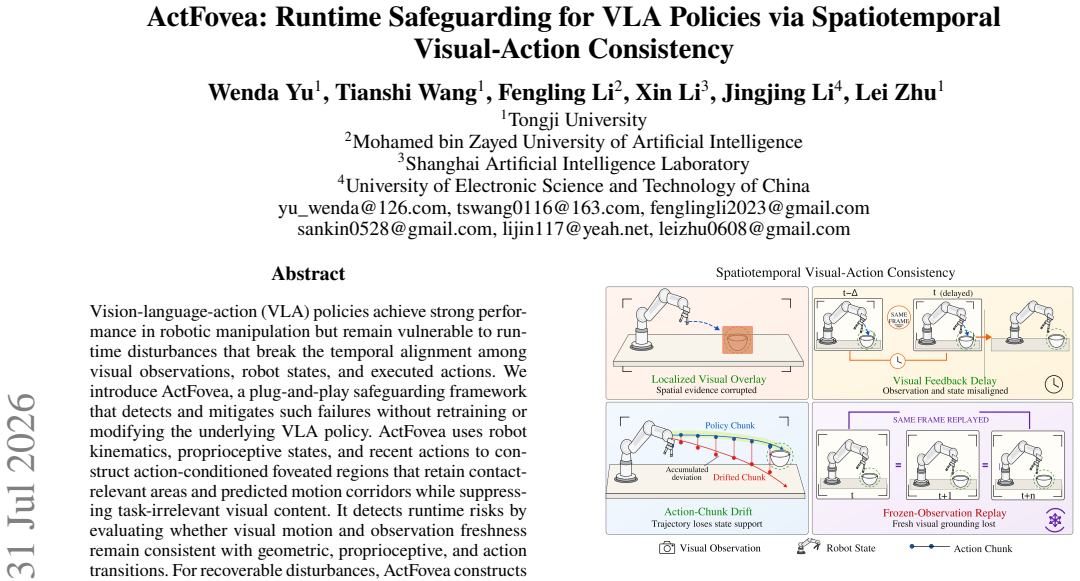
The paper's central claim is that a frozen VLA policy can be wrapped, without retraining or modifying its parameters, by a monitor that checks whether the stream of images, robot states, and action chunks still describes one coherent physical transition. When that consistency breaks, the wrapper classifies the disturbance type, constructs candidate observations suited to that disturbance, and accepts an action only after verifying the resulting chunk; when fresh visual evidence is irrecoverably lost, it switches to bounded motion suppression rather than continuing uncontrolled. The headline evidence: on a frozen flow-matching VLA policy across 40 LIBERO tasks, overlay success rises from 49.3
What carries the argument
The load-bearing object is the spatiotemporal visual-action consistency signal: the wrapper uses kinematics and action history to predict where visual change should occur, then measures whether observed motion, freshness, and proprioceptive transitions agree. All four disturbances are treated as violations of this single signal. Concretely, a projected contact disk and a predicted motion corridor form a preserve mask; a filtered observation desensitizes the background while keeping the contact area and motion corridor intact; a risk state combines geometric, dynamic, and temporal components; recoverable disturbances enter a candidate bank whose outputs are scored by an action-verification ut
Load-bearing premise
The load-bearing premise is that each disturbance family leaves a recognizable, separable signature in the runtime measurements and that the hand-set thresholds and fixed weights in the risk and verification scores tell those signatures apart; if a disturbance produces an unfamiliar or mixed signature, the deterministic router may mistype it and both the recovery and safe-failure decisions degrade.
What would settle it
Run ActFovea on an overlay that tracks the end-effector and moves into the foveated preserve region, or on a visual delay that varies in length over time; if success drops toward the disturbed baseline or the router emits the wrong disturbance type, the claim that spatiotemporal visual-action consistency is a sufficient basis for runtime safeguarding fails for disturbances outside the four evaluated signatures.
If this is right
- A single training-free loop can address spatial, temporal, and action-space disturbances, so deployment can add a wrapper without retraining or modifying the VLA policy.
- Action-chunk verification is the main mechanism turning temporal and action-side recovery into reliable gains: without it, gains under action drift and visual delay drop from +7.0 and +9.8 to -1.2 and +2.3 percentage points.
- Spatial recovery depends on observation construction: removing the recovery bank changes the overlay gain from +41.0 to -33.3 percentage points, and candidate expansion matters almost as much.
- When fresh visual grounding is lost, converting to a bounded safe-failure protocol rather than continued zero motion is what prevents unprotected failures: a timestamp-only hold never terminates, while ActFovea safely stops all 2,000 replay episodes.
- Clean-task performance is preserved across all suites, indicating that the safeguard does not degrade nominal operation when no disturbance is present.
Where Pith is reading between the lines
- The paper's framing implies a stronger thesis than the four evaluated disturbances: any disturbance that breaks closed-loop coherence, such as a moving patch, variable delay, or sensor dropout, should be catchable if it produces a readable signature. That generalization is not demonstrated; the router is deterministic and the thresholds are fixed.
- Because the component weights and thresholds in the risk and verification scores are described only as fixed implementation constants with no sensitivity analysis, the method's transferability to other policies, embodiments, or camera rigs rests on those hand-set values being robust; a systematic sweep would be the natural next test.
- The safe-failure result is defined as bounded motion suppression, not a formal collision-avoidance guarantee (the paper states this explicitly); pairing the consistency signal with a reactive geometric safety layer would be a natural, testable extension.
- The same consistency signal could be repurposed as an online trust monitor for replanning decisions, for instance to dynamically shorten action horizons as freshness degrades, rather than only as an intervention trigger.
Editorial analysis
A structured set of objections, weighed in public.
Referee Report
Summary. ActFovea is a training-free runtime wrapper for frozen VLA policies. Using calibrated kinematics, proprioception, and action history, it builds an action-conditioned foveated observation (Eqs. (2)--(3)) that preserves contact-relevant regions and predicted motion corridors; a deterministic consistency monitor (Eq. (4)) labels the runtime state as consistent/unknown/delay/drift/overlay/freeze; a candidate bank constructs disturbance-specific observations (raw, foveated, lag-stabilized, deblended via Eq. (5)) that are scored by an action-chunk verifier (Eq. (6)) before bounded execution; and a risk-adaptive executor (Eq. (7)) shortens horizons, damps motion, or triggers a bounded stop. Over 2,000 episodes per condition across four LIBERO suites with a frozen π0 checkpoint, the paper reports 93.7% recovery of the overlay-induced success loss (49.3%→90.3%), gains of +7.0 (drift) and +9.8 (delay) percentage points, preserved clean performance, and timely safe failure in all 2,000 frozen-replay episodes, with no unprotected failures. The method does not receive disturbance labels; Table 4's ablations attribute the overlay gain to threat typing and the recovery bank and the delay/drift gains to action verification.
Significance. If the reported numbers are reproducible, this is a practically significant result: a deployment-time monitor, with no retraining and no access to the disturbance label, restores most of the overlay-induced loss and converts replay-induced failures into bounded, low-motion stops. The evaluation has real strengths: matched policy and configuration across 2,000 episodes per cell; a clean operational separation of recoverable (finite delay) and unrecoverable (persistent replay) regimes; baselines that isolate competing explanations (Fixed Short Horizon transfers to drift but not to delay/overlay; Timestamp-Only Hold collapses under delay); and a quantified safe-failure protocol (99.23% reduction in post-detection actions, 99.87% in cumulative motion, no bound violations). The main weaknesses are the undisclosed 'fixed implementation constants' (Eqs. (4), (6), and the mask/threshold parameters), the absence of any sensitivity analysis, the lack of uncertainty quantification in Tables 1--4, and Table 4's 'w/o Threat Typing' row, which shows the safeguard can underperform the unprotected policy (41.7% vs 49.3%) when routing fails. The stress-test concern therefore lands as a reproducibil
major comments (4)
- [Method; Eqs. (3)--(6)] The router, verifier, and recovery gates depend on a large set of asserted-but-undisclosed constants: beta and the component weights in Eq. (4), the weight vector w and threat-conditioned bonus b_k in Eq. (6), the mask radii r_c, r_Γ, r_m and edit strength alpha in Eqs. (2)--(3), the overlay admission/stability thresholds, and the stale-streak/hold-latch parameters. No values, configuration listing, or code is provided, and no sensitivity analysis appears anywhere. Because the paper's claim is that one deterministic, training-free configuration transfers across disturbance families, the 49.3%→90.3% headline could, as far as the manuscript shows, be specific to a single threshold configuration; the reader cannot resolve this. Please release the full parameter set and report sensitivity over the most consequential thresholds (beta, overlay admission, stale-streak length), showing the headl
- [Table 4, 'w/o Threat Typing' row] This ablation is the key evidence about behavior outside the exact protocol. Without threat typing, overlay success drops to 41.7%, 7.6 points below the 49.3% disturbed Base. When the deterministic router mis-types a real disturbance, the foveated-candidate path plus verification therefore does not merely fail to recover; it actively degrades the policy below the unprotected baseline. This is in tension with the text's description of the raw action as the 'conservative fallback' and of unknown/consistent routings as safe. Any near-miss disturbance (moving overlay, overlay appearing before the clean warm-up, time-varying delay) plausibly lands in exactly this regime. Please analyze it explicitly: state conditions under which ActFovea can fall below Base, and evaluate at least one mis-specified disturbance variant that violates the admission/stability criteria.
- [Tables 1--4] All reported successes, gains, and NRRs are point estimates; no per-suite breakdown, per-task variance, or confidence interval is given. With 2,000 episodes per cell the 41-point overlay effect is unlikely to be sampling noise, but the Table 4 ablation cells swing by 31--33 points and several mechanistic claims rest on smaller differences (e.g., 'threat typing is especially important for Visual Delay', 80.5 vs 86.0; 'w/o Recovery Bank', 16.0 vs 'w/o Candidate Expansion', 17.6). Episodes are clustered in 50-episode tasks across four suites of differing difficulty, so task-level variance could dominate. Report per-suite success plus confidence intervals or a variance estimate for Table 1 and the key Table 4 cells.
- [Abstract/Conclusion vs. Method ('Consistency-Guided Recovery')] The abstract and conclusion claim that spatiotemporal visual-action consistency is 'an effective basis for runtime safeguarding,' but every positive result comes from a family whose signatures appear directly in the evidence features (lag estimate, replay similarity, overlay stability admission) and whose recovery path is purpose-built (Eq. (5) deblending against a clean-frame reference; lag-stabilized translation; drift verification). The unified principle is the detection framing; the recovery machinery is disturbance-specific. One hold-out disturbance outside the four families, or an explicit scope statement that the safeguard's guarantee covers only disturbances with the evaluated signatures, would materially change how the principle-level claim can be read. As written, the general claim exceeds the evidence.
minor comments (8)
- [Table 1 / Eq. (8)] NRR arithmetic: with the rounded SRs, 41.0/43.7 = 93.8% (not 93.7%) and 7.0/9.6 = 72.9% (not 73.1%). State that NRR is computed from unrounded values or correct the table.
- [Eq. (5)] P^v_t is used for both the detected overlay region and the pixel values to be reconstructed. Clarify that Eq. (5) operates on the image crop inside the detected box, and state the image dtype implied by the clip range 0--255.
- [Figure 4] The figure's content appears duplicated in the rendered manuscript (the same three-panel comparison is shown twice). If not a layout artifact, remove the duplicate; also state which task and overlay parameters the qualitative frames come from.
- [Risk-Adaptive Execution and Safe Failure] 'Safe failure' is defined as conservative motion suppression, and the paper admittedly provides no formal collision-avoidance guarantee. Consider renaming to 'bounded motion suppression' or stating the exact safety contract at first use, to avoid overpromising to readers outside the field.
- [Introduction / Experiments] The paper calls ActFovea 'plug-and-play,' but the pipeline requires calibrated joints and cameras, forward-kinematic projection, and several per-robot constants (radii, edit strength). One sentence quantifying the setup effort in the Experiments section would clarify the deployment claim.
- [Experiments, Disturbances] The disturbance protocols (3-frame delay, checker overlay with clean warm-up, phase-template drift) are the authors' instantiations; the mapping to the cited attack families (SilentDrift, FreezeVLA, patch attacks) is implicit. State explicitly whether these protocols reproduce the original attacks or are new instantiations of the same failure modes.
- [Table 1] The undisturbed success differs slightly across the three rows (92.7, 92.6, 93.0) even though the protocol is shared; a footnote explaining the source of this variation (e.g., matched seeds per disturbance block) would help.
- [Throughout] Several passages have missing inter-word spaces (abstract, Figure 2 label 'Froze n Observation', some reference entries). Please proofread the camera-ready text.
Circularity Check
No significant circularity: the reported gains are empirical outcomes, not derivations fitted to their own inputs.
full rationale
ActFovea is presented as an inference-time heuristic safeguard, not as a theorem with predicted quantities derived from first principles. The risk score (Eq. 4) and verification score (Eq. 6) are explicitly described as fixed weighted combinations of runtime evidence with 'fixed implementation constants'; the constants are undisclosed and no sensitivity/hold-out analysis is reported, which is a reproducibility and generality limitation, but the paper does not claim these weights are derived from the disturbances or from the success rates. The overlay reconstruction in Eq. (5) is an algebraic deblending operation using image-derived estimates (bQ, balpha) from a clean reference; it is the inverse of the assumed alpha-blend corruption model, not a fit to the reported success metric. The four disturbances are an explicitly declared threat model, and the ablations trace each component's contribution without using ground-truth disturbance labels. The cited prior attacks (SilentDrift, FreezeVLA, AttackVLA) are used as motivation and are not load-bearing for ActFovea's own claims; any overlapping authorship would therefore not raise the circularity score. The concern that the router may be implicitly tuned to the evaluated disturbance families is a validity/rigor question, not a demonstrated circular reduction, and cannot be asserted without evidence of fitting or by-construction equivalence.
Axiom & Free-Parameter Ledger
free parameters (6)
- α (foveation edit strength) =
not reported
- β and consistency component weights =
not reported
- Fovea mask radii r_c, r_Γ, r_m =
not reported
- Action verification weights w and bonus b_k =
not reported
- Overlay detection admission and stability thresholds =
not reported
- Replay hold-latch and stale-streak parameters =
not reported
axioms (5)
- domain assumption Forward kinematics and camera calibration are accurate and available
- domain assumption The clean initialization buffer contains unmodified reference observations
- domain assumption A VLA policy's visual reliance is related to geometric contact and motion corridors
- domain assumption The highest-verification-score action candidate is the safest to execute
- domain assumption LIBERO simulation and task success are representative of deployment conditions
read the original abstract
Vision-language-action (VLA) policies achieve strong performance in robotic manipulation but remain vulnerable to runtime disturbances that break the temporal alignment among visual observations, robot states, and executed actions. We introduce ActFovea, a plug-and-play safeguarding framework that detects and mitigates such failures without retraining or modifying the underlying VLA policy. ActFovea uses robot kinematics, proprioceptive states, and recent actions to construct action-conditioned foveated regions that retain contact-relevant areas and predicted motion corridors while suppressing task-irrelevant visual content. It detects runtime risks by evaluating whether visual motion and observation freshness remain consistent with geometric, proprioceptive, and action transitions. For recoverable disturbances, ActFovea constructs disturbance-specific candidate observations and accepts a recovery only after verifying the resulting action chunk. When stale or replayed observations make reliable recovery impossible, it invokes a bounded safe-failure procedure. In closed-loop evaluations of $\pi_0$ across multiple LIBERO suites, ActFovea increases success under localized visual overlays from 49.3\% to 90.3\%, closing 93.7\% of the gap to clean performance. It further improves success under action drift and visual delay by 7.0 and 9.8 percentage points, respectively, while preserving clean-task performance. Under frozen-observation replay, ActFovea triggers timely safe failure in all trials, with no unprotected failures. These results demonstrate that spatiotemporal visual-action consistency provides an effective basis for runtime safeguarding of VLA policies.
Figures


Reference graph
Works this paper leans on
-
[1]
Anthony Brohan and Noah Brown and Justice Carbajal and Yevgen Chebotar and Xi Chen and Krzysztof Choromanski and Tianli Ding and Danny Driess and Avinava Dubey and Chelsea Finn and Pete Florence and Chuyuan Fu and Montse Gonzalez Arenas and Keerthana Gopalakrishnan and Kehang Han and Karol Hausman and Alexander Herzog and Jasmine Hsu and Brian Ichter and ...
-
[2]
Moo Jin Kim and Karl Pertsch and Siddharth Karamcheti and Ted Xiao and Ashwin Balakrishna and Suraj Nair and Rafael Rafailov and Ethan Foster and Grace Lam and Pannag Sanketi and Quan Vuong and Thomas Kollar and Benjamin Burchfiel and Russ Tedrake and Dorsa Sadigh and Sergey Levine and Percy Liang and Chelsea Finn , year =. 2406.09246 , archivePrefix =
-
[3]
Kevin Black and Noah Brown and Danny Driess and Adnan Esmail and Michael Equi and Chelsea Finn and Niccolo Fusai and Lachy Groom and Karol Hausman and Brian Ichter and Szymon Jakubczak and Tim Jones and Liyiming Ke and Sergey Levine and Adrian Li-Bell and Mohith Mothukuri and Suraj Nair and Karl Pertsch and Lucy Xiaoyang Shi and James Tanner and Quan Vuon...
-
[4]
2023 , eprint =
Learning Fine-Grained Bimanual Manipulation with Low-Cost Hardware , author =. 2023 , eprint =
2023
-
[5]
Li, Jiayu and Zhao, Yunhan and Zheng, Xiang and Xu, Zonghuan and Li, Yige and Ma, Xingjun and Jiang, Yu-Gang , year =. 2511.12149 , archivePrefix =
-
[6]
2025 , eprint =
Adversarial Attacks on Robotic Vision Language Action Models , author =. 2025 , eprint =
2025
-
[7]
2025 , eprint =
Attention-Guided Patch-Wise Sparse Adversarial Attacks on Vision-Language-Action Models , author =. 2025 , eprint =
2025
-
[8]
Hanqing Liu and Shouwei Ruan and Jiahuan Long and Junqi Wu and Jiacheng Hou and Huili Tang and Tingsong Jiang and Weien Zhou and Wen Yao , year =. 2509.18953 , archivePrefix =
-
[9]
Xueyang Zhou and Guiyao Tie and Guowen Zhang and Hechang Wang and Pan Zhou and Lichao Sun , year =. 2505.16640 , archivePrefix =
-
[10]
2025 , eprint =
When Robots Obey the Patch: Universal Transferable Patch Attacks on Vision-Language-Action Models , author =. 2025 , eprint =
2025
-
[11]
Phantom Menace: Exploring and Enhancing the Robustness of
Lu, Xuancun and Chen, Jiaxiang and Xiao, Shilin and Jin, Zizhi and Chen, Zhangrui and Yu, Hanwen and Qian, Bohan and Zhou, Ruochen and Ji, Xiaoyu and Xu, Wenyuan , year =. Phantom Menace: Exploring and Enhancing the Robustness of. 2511.10008 , archivePrefix =
-
[12]
Xu, Bingxin and Shang, Yuzhang and Wang, Binghui and Ferrara, Emilio , year =. 2601.14323 , archivePrefix =
-
[13]
Wang, Xin and Li, Jie and Weng, Zejia and Wang, Yixu and Gao, Yifeng and Pang, Tianyu and Du, Chao and Teng, Yan and Wang, Yingchun and Wu, Zuxuan and Ma, Xingjun and Jiang, Yu-Gang , year =. 2509.19870 , archivePrefix =
-
[14]
Zhang, Borong and Zhang, Yuhao and Ji, Jiaming and Lei, Yingshan and Cai, Yishuai and Dai, Josef and Chen, Yuanpei and Yang, Yaodong , year =. 2503.03480 , archivePrefix =
-
[15]
Hu, Songqiao and Liu, Zeyi and Liu, Shuang and Cen, Jun and Meng, Zihan and Wang, Shihefeng and Li, Xiang and He, Xiao , year =. 2512.11891 , archivePrefix =
-
[16]
2024 , eprint =
Run-time Observation Interventions Make Vision-Language-Action Models More Visually Robust , author =. 2024 , eprint =
2024
-
[17]
2023 , doi =
Liu, Bo and Zhu, Yifeng and Gao, Chongkai and Feng, Yihao and Liu, Qiang and Zhu, Yuke and Stone, Peter , booktitle =. 2023 , doi =
2023
discussion (0)
Sign in with ORCID, Apple, or X to comment. Anyone can read and Pith papers without signing in.