Quantum work statistics and coherence effects in quenched bosonic Josephson junctions
Pith reviewed 2026-06-26 13:46 UTC · model grok-4.3
The pith
A sudden quench of a bosonic Josephson junction initialized in its ground state produces work statistics that follow a negative binomial distribution.
A machine-rendered reading of the paper's core claim, the machinery that carries it, and where it could break.
Core claim
Under the Holstein-Primakoff approximation the quenched bosonic Josephson junction maps onto a time-dependent quantum harmonic oscillator. For a junction prepared in the ground state of the pre-quench Hamiltonian the resulting work statistics are exactly those of a negative binomial distribution. When the initial state is a superposition of energy eigenstates, Kirkwood-Dirac quasiprobabilities must be used; these quasiprobabilities can be negative or complex, and the coherence content of the superposition can be tuned to maximize the work that can be extracted from the quench beyond any classical bound.
What carries the argument
Holstein-Primakoff approximation that maps the junction onto a time-dependent quantum harmonic oscillator, combined with Kirkwood-Dirac quasiprobabilities to capture coherence effects in the work distribution.
If this is right
- The work distribution matches the one obtained in fully-connected models driven across a critical point.
- Kirkwood-Dirac quasiprobabilities for work can become negative or complex when the initial state contains energy-basis coherence.
- Tuning the coherence of the initial state increases the extractable work above the classical limit.
- An interferometric protocol can directly measure the characteristic function of the work distribution.
Where Pith is reading between the lines
- The negative-binomial form may appear whenever a many-body system is approximated by a harmonic oscillator under a sudden parameter change.
- The same coherence-optimization strategy could be tested in other quench protocols that admit an oscillator mapping.
- Kirkwood-Dirac quasiprobabilities may reveal analogous non-classical signatures in the work statistics of finite-temperature or weakly dissipative junctions.
Load-bearing premise
The Holstein-Primakoff approximation remains accurate throughout the dynamics in the weak-interaction regime.
What would settle it
Prepare the junction in its ground state, apply the quench in the weak-interaction regime, measure the work distribution, and check whether the observed statistics match a negative binomial distribution.
Figures
read the original abstract
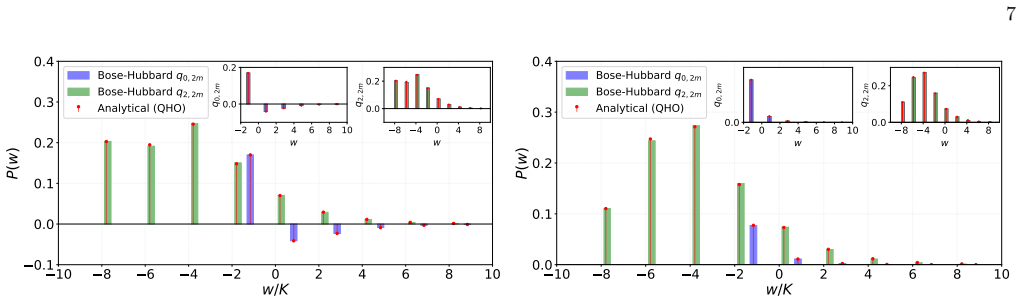
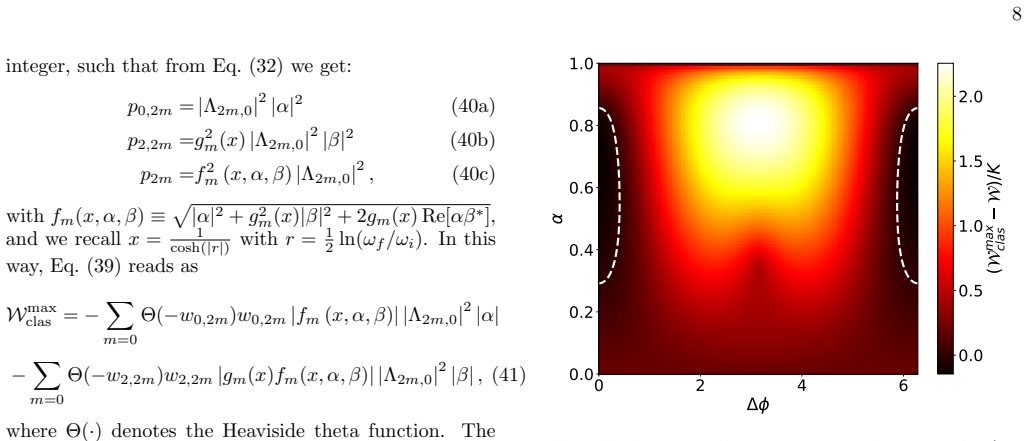
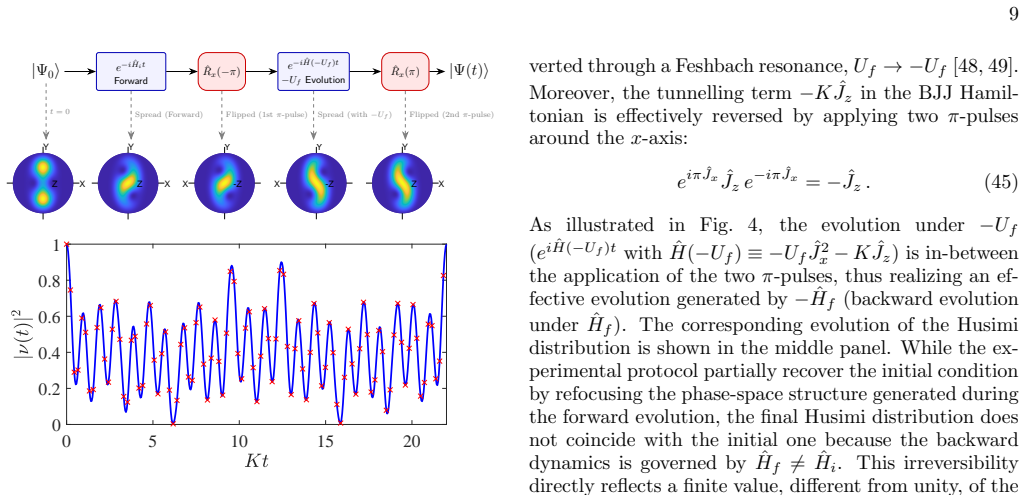
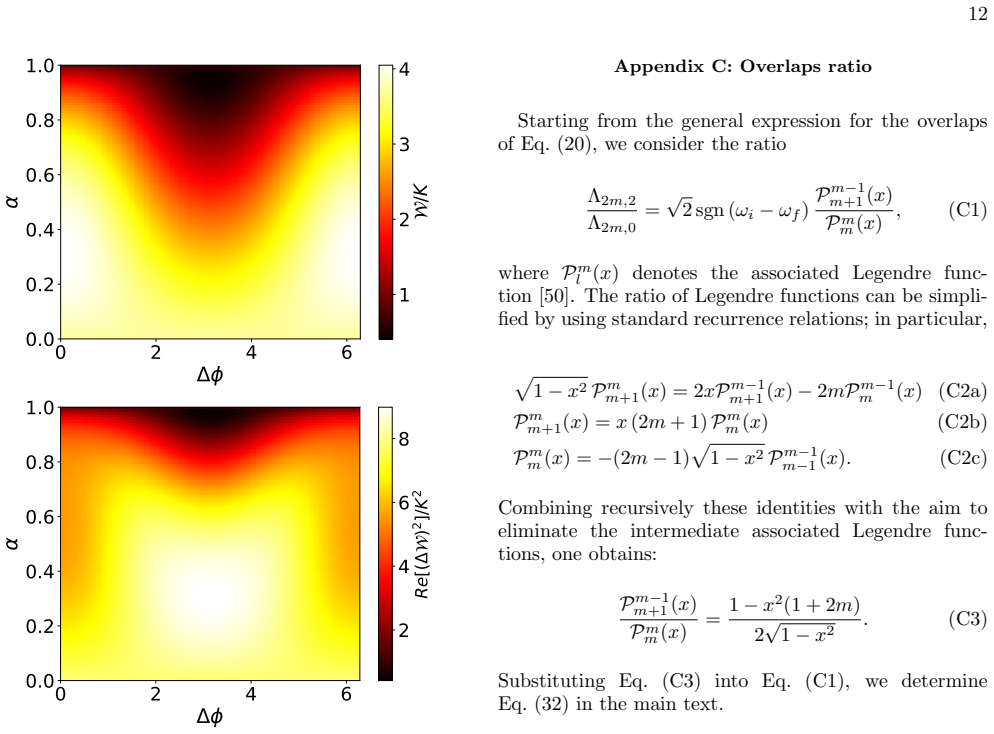
We investigate the non-equilibrium work statistics originating from a sudden quench in a bosonic Josephson junction. In particular, by employing the Holstein-Primakoff approximation, the work statistics are analytically characterized in the weak-interaction regime, where the dynamics map onto a time-dependent quantum harmonic oscillator. For a junction initialized in the ground state of the pre-quench Hamiltonian, we demonstrate that the work statistics are governed by a negative binomial distribution, as occurs in fully-connected models driven across a critical point. Furthermore, we also consider initial superposition states containing quantum coherences in the energy basis. To characterize the corresponding work distributions, we employ Kirkwood-Dirac quasiprobabilities (KDQ). Even in the simplest case, when the junction is initialized in a superposition of the ground and second excited states, the KDQ distribution of work exhibits negative or complex values, reflecting non-classical features. Moreover, the coherence content of the initial state can be optimized to enhance the extractable work extracted from the quench, beyond classical bounds. Finally, we propose an experimental interferometric protocol to directly measure the characteristic function of the work distribution in experimentally accessible settings.
Editorial analysis
A structured set of objections, weighed in public.
Referee Report
Summary. The paper studies non-equilibrium work statistics for a sudden quench in a bosonic Josephson junction. Employing the Holstein-Primakoff approximation in the weak-interaction regime, it maps the system to a time-dependent quantum harmonic oscillator and shows that ground-state initialization yields a negative-binomial work distribution. For initial states with energy-basis coherences it employs Kirkwood-Dirac quasiprobabilities, finds non-classical (negative or complex) values, and demonstrates that coherence can be tuned to increase extractable work beyond classical limits. An interferometric protocol to measure the work characteristic function is proposed.
Significance. If the mapping remains controlled, the work provides an exact analytical characterization of work statistics in a physically relevant two-mode system, recovers the negative-binomial form known from fully connected critical quenches, and supplies a concrete route to observe coherence-enhanced work extraction and non-classical quasiprobabilities in ultracold-atom experiments.
major comments (1)
- [Abstract] Abstract and the paragraph introducing the Holstein-Primakoff mapping: the central claim that the work statistics are exactly negative binomial (and that the KDQ results follow) rests on the statement that the two-mode BJJ maps onto a time-dependent QHO throughout the quench. No quantitative error bound, no comparison of the approximated versus exact two-mode Hamiltonian during time evolution, and no check that the sudden-quench protocol keeps the orthogonal-mode population sufficiently small are supplied, even though the abstract itself qualifies the result to the “weak-interaction regime.”
minor comments (1)
- The experimental protocol is only sketched; a short paragraph clarifying which observables are measured in each arm and how the characteristic function is reconstructed would improve clarity.
Simulated Author's Rebuttal
We thank the referee for the careful reading and for identifying the need for stronger validation of the Holstein-Primakoff mapping. We address the major comment below and will revise the manuscript accordingly.
read point-by-point responses
-
Referee: [Abstract] Abstract and the paragraph introducing the Holstein-Primakoff mapping: the central claim that the work statistics are exactly negative binomial (and that the KDQ results follow) rests on the statement that the two-mode BJJ maps onto a time-dependent QHO throughout the quench. No quantitative error bound, no comparison of the approximated versus exact two-mode Hamiltonian during time evolution, and no check that the sudden-quench protocol keeps the orthogonal-mode population sufficiently small are supplied, even though the abstract itself qualifies the result to the “weak-interaction regime.”
Authors: We agree that the manuscript would benefit from explicit quantitative checks on the validity of the Holstein-Primakoff (HP) approximation. Although the abstract and main text qualify all results to the weak-interaction regime, we do not currently supply error bounds, a direct comparison of the HP-mapped Hamiltonian against the exact two-mode BJJ Hamiltonian during the evolution, or an estimate of residual population in the orthogonal mode. In the revised manuscript we will add a new subsection (or appendix) that (i) compares the time-dependent HP Hamiltonian with the exact two-mode Hamiltonian, (ii) quantifies the orthogonal-mode population for the sudden-quench protocol under the stated weak-interaction conditions, and (iii) provides an estimate of the resulting error on the work distribution and Kirkwood-Dirac quasiprobabilities. These additions will make the domain of applicability of the negative-binomial result and the coherence-enhanced work extraction more transparent. revision: yes
Circularity Check
No significant circularity; results follow from stated approximation and standard definitions
full rationale
The derivation begins with the Holstein-Primakoff approximation as an external modeling assumption that maps the two-mode junction to a time-dependent harmonic oscillator in the weak-interaction regime; the negative-binomial work statistics and Kirkwood-Dirac quasiprobabilities then follow by direct solution of that oscillator's dynamics for the chosen initial states. No equation or claim reduces by construction to a parameter fitted inside the paper, no self-citation supplies a load-bearing uniqueness theorem, and no ansatz is smuggled via prior author work. The central claims are therefore independent of the paper's own outputs.
Axiom & Free-Parameter Ledger
axioms (1)
- domain assumption Holstein-Primakoff approximation holds throughout the quench dynamics in the weak-interaction regime
Reference graph
Works this paper leans on
-
[1]
High Per- formance Computer and Quantum Simulator hybrid (HPCQS)
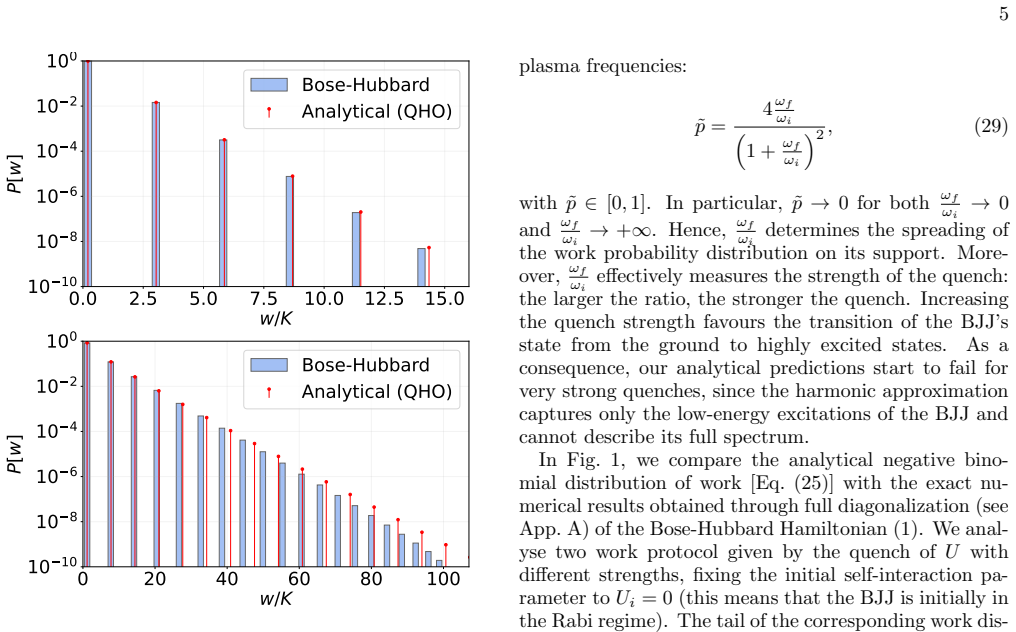
The Hamiltonian ˆHγ can thus be rewritten as ˆHγ = ωγ(ˆb† γˆbγ + 1 2), whose eigenstates|Ψ n⟩(i.e., the Fock or number states) are Ψ(γ) n E = (ˆb† γ)n √ n! Ψ(γ) 0 E ,(10) with corresponding eigenvaluesE (γ) n =ω γ n+ 1 2 . As a consequence, the Hamiltonian operators ˆHi, ˆHf in Eq. (8) admit the spectral decomposition ˆHγ = X n E(γ) n Ψ(γ) n ED Ψ(γ) n .(1...
2020
-
[2]
In all numerical results presented in this work, the Hamiltonian (A1) was diagonalized using the routine eighfrom thescipy.linalgPython library
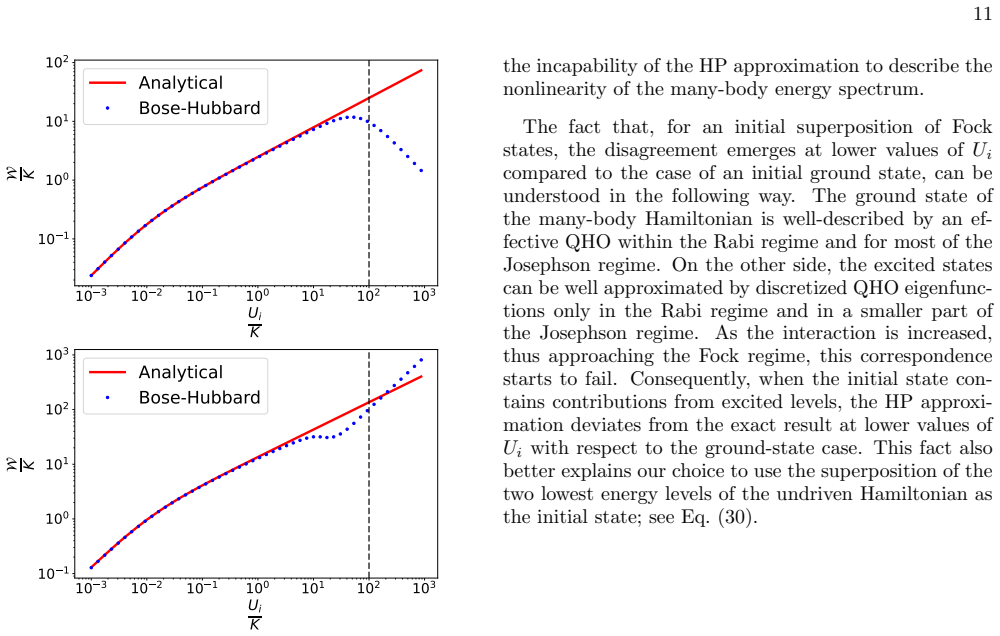
[5]. In all numerical results presented in this work, the Hamiltonian (A1) was diagonalized using the routine eighfrom thescipy.linalgPython library. As an illustration of the numerical technique described above, we now examine the range of validity of the HP approximation for the study of the work statistics of the BJJ. We consider a family of sudden que...
-
[3]
B. D. Josephson, Phys. Lett.1, 251 (1962)
1962
-
[4]
The Feynman Lectures on Physics Vol. III Ch. 21: The Schr¨ odinger Equation in a Classical Context: A Seminar on Superconductivity
-
[5]
Barone and G
A. Barone and G. Patern` o, Physics and Applications of the Josephson Effect (John Wiley & Sons, London, 1982)
1982
-
[6]
Zapata, F
I. Zapata, F. Sols, and A. J. Leggett, Phys. Rev. A57, R28 (1998)
1998
-
[7]
Gati and M
R. Gati and M. K. Oberthaler, J. Phys. B: At. Mol. Opt. Phys..40, R61–R89 (2007)
2007
-
[8]
Fundamentals and Frontiers of the Josephson Effect (Springer International Publishing, 2019)
2019
-
[9]
Trenkwalder, G
A. Trenkwalder, G. Spagnolli, G. Semeghini, S. Coop, M. Landini, P. Castilho, L. Pezz` e, G. Modugno, M. In- guscio, A. Smerzi, and M. Fattori, Nat. Phys.12, 826–829 (2016)
2016
-
[10]
Spagnolli, G
G. Spagnolli, G. Semeghini, L. Masi, G. Ferioli, A. Trenkwalder, S. Coop, M. Landini, L. Pezz` e, G. Mod- ugno, M. Inguscio, A. Smerzi, and M. Fattori, Phys. Rev. Lett.118, 230403 (2017)
2017
-
[11]
Smerzi, S
A. Smerzi, S. Fantoni, S. Giovanazzi, and S. R. Shenoy, Phys. Rev. Lett.79, 4950 (1997)
1997
-
[12]
F. S. Cataliotti, S. Burger, C. Fort, P. Maddaloni, F. Mi- nardi, A. Trombettoni, A. Smerzi, and M. Inguscio, Sci- ence293, 843–846 (2001)
2001
-
[13]
L. Pezz` e, K. Xhani, C. Daix, N. Grani, B. Donelli, F. Scazza, D. Hernandez-Rajkov, W. J. Kwon, G. Del Pace, and G. Roati, Nat. Commun.15, 10.1038/s41467-024-47759-7 (2024)
-
[14]
Biagioni, N
G. Biagioni, N. Antolini, B. Donelli, L. Pezz` e, A. Smerzi, M. Fattori, A. Fioretti, C. Gabbanini, M. Inguscio, L. Tanzi, and G. Modugno, Nature629, 773–777 (2024)
2024
-
[15]
Donelli, N
B. Donelli, N. Antolini, G. Biagioni, M. Fattori, A. Fioretti, C. Gabbanini, M. Inguscio, L. Tanzi, G. Modugno, A. Smerzi, and L. Pezz` e, Phys. Rev. A 112, L051302 (2025)
2025
-
[16]
Ala˜ na, M
A. Ala˜ na, M. Modugno, P. Capuzzi, and D. M. Jezek, Phys. Rev. A111, L051307 (2025). 13
2025
-
[17]
R. G. Lena, G. M. Palma, and G. De Chiara, Phys. Rev. A93, 053618 (2016)
2016
-
[18]
M. Orlandini, B. Donelli, L. Buffoni, and S. Gherardini, Eprint arXiv:2605.12124 (2026)
Pith/arXiv arXiv 2026
-
[19]
Gherardini, L
S. Gherardini, L. Buffoni, and N. Defenu, Phys. Rev. Lett.133, 113401 (2024)
2024
-
[20]
F. J. G´ omez-Ruiz, S. Gherardini, and R. Puebla, Quan- tum Sci. Technol.10, 045011 (2025)
2025
-
[21]
Levy and M
A. Levy and M. Lostaglio, PRX Quantum1, 010309 (2020)
2020
-
[22]
Lostaglio, A
M. Lostaglio, A. Belenchia, A. Levy, S. Hernandez- Gomez, N. Fabbri, and S. Gherardini, Quantum7, 1128 (2023)
2023
-
[23]
Gherardini and G
S. Gherardini and G. De Chiara, PRX Quantum5, 030201 (2024)
2024
-
[24]
D. R. M. Arvidsson-Shukur, W. F. Braasch Jr., S. De Bievre, J. Dressel, A. N. Jordan, C. Langrenez, M. Lostaglio, J. S. Lundeen, and N. Yunger Halpern, New J. Phys.26, 121201 (2024)
2024
-
[25]
Esposito, U
M. Esposito, U. Harbola, and S. Mukamel, Rev. Mod. Phys.81, 1665 (2009)
2009
-
[26]
Campisi, P
M. Campisi, P. H¨ anggi, and P. Talkner, Rev. Mod. Phys. 83, 771 (2011)
2011
-
[27]
Santini, A
A. Santini, A. Solfanelli, S. Gherardini, and M. Collura, Phys. Rev. B108, 104308 (2023)
2023
-
[28]
Hern´ andez-G´ omez, S
S. Hern´ andez-G´ omez, S. Gherardini, A. Belenchia, M. Lostaglio, A. Levy, and N. Fabbri, Phys. Rev. Res. 6, 023280 (2024)
2024
-
[29]
Donati, F
L. Donati, F. S. Cataliotti, and S. Gherardini, Sci. Rep. 14, 20145 (2024)
2024
-
[30]
S. Hern´ andez-G´ omez, T. Isogawa, A. Belenchia, A. Levy, N. Fabbri, S. Gherardini, and P. Cappellaro, Npj Quan- tum Inf.10, 10.1038/s41534-024-00913-x (2024)
-
[31]
Pezzutto, G
M. Pezzutto, G. De Chiara, and S. Gherardini, Quantum Sci. Technol.10, 035066 (2025)
2025
-
[32]
Donelli, G
B. Donelli, G. De Chiara, F. Scazza, and S. Gherardini, Phys. Rev. A113, 013311 (2026)
2026
-
[33]
B. Donelli, G. De Chiara, F. Scazza, and S. Gherardini, Eprint arXiv:2507.21313 (2025)
Pith/arXiv arXiv 2025
-
[34]
Macr` ı, A
T. Macr` ı, A. Smerzi, and L. Pezz` e, Phys. Rev. A94, 010102(R) (2016)
2016
-
[35]
Lipkin, N
H. Lipkin, N. Meshkov, and A. Glick, Nucl. Phys.62, 188 (1965)
1965
-
[36]
Dusuel and J
S. Dusuel and J. Vidal, Phys. Rev. B71, 224420 (2005)
2005
-
[37]
Kitagawa and M
M. Kitagawa and M. Ueda, Phys. Rev. A47, 5138 (1993)
1993
-
[38]
A. J. Leggett, Rev. Mod. Phys.73, 307 (2001)
2001
-
[39]
Paraoanu, S
G.-S. Paraoanu, S. Kohler, F. Sols, and A. J. Leggett, J. Phys. B: At. Mol. Opt. Phys.34, 4689 (2001)
2001
-
[40]
Holstein and H
T. Holstein and H. Primakoff, Phys. Rev.58, 1098 (1940)
1940
-
[41]
J. A. Gyamfi, Eprint arXiv:1907.07122 (2019)
Pith/arXiv arXiv 1907
-
[42]
J. v. Neumann, Mathematische Annalen104, 570 (1931)
1931
-
[43]
M. S. Kim, F. A. M. de Oliveira, and P. L. Knight, Phys. Rev. A40, 2494 (1989)
1989
-
[44]
Varr´ o, J
S. Varr´ o, J. Phys.: Conf. Ser.2249, 012013 (2022)
2022
-
[45]
M. H. DeGroot, Probability and Statistics, 2nd ed. (Addison-Wesley, Reading, MA, 1986) 1 dicembre 1986, English Edition
1986
-
[46]
In a classical scenario,p, r∈Nand the negative binomial distribution prob(k|r, p) = k+r−1 k pr(1−p) k gives the probability of havingkfailures before exactlyrsuccesses, in an infinite sequence of Bernoulli trials
-
[47]
D. R. M. Arvidsson-Shukur, J. C. Drori, and N. Y. Halpern, J. Phys. A: Math. Theor.54, 284001 (2021)
2021
-
[48]
R. W. Spekkens, Phys. Rev. A71, 052108 (2005)
2005
-
[49]
It is straightforward to see that it is obtained from the work characteristic function (16), when the initial state is pure, i.e., ˆρ=|Ψ (i) 0 ⟩ ⟨Ψ(i) 0 |
-
[50]
C. Chin, R. Grimm, P. Julienne, and E. Tiesinga, Rev. Mod. Phys.82, 1225 (2010), publisher: American Phys- ical Society
2010
-
[51]
Inouye, M
S. Inouye, M. R. Andrews, J. Stenger, H.-J. Miesner, D. M. Stamper-Kurn, and W. Ketterle, Nature392, 151–154 (1998)
1998
-
[52]
Abramowitz and I
M. Abramowitz and I. A. Stegun, eds., Handbook of Mathematical Functions, Applied Mathe- matics Series, Vol. 55 (National Bureau of Standards, Washington, D.C., 1972) without numerical tables
1972
-
[53]
Quantum work statistics and coherence effects in quenched bosonic josephson junctions
M. Orlandini, S. Gherardini, L. Buffoni, and B. Donelli, Codes for “Quantum work statistics and coherence effects in quenched bosonic josephson junctions”,https://gith ub.com/MattyPhysics/Quantum-work-statistics-and -coherence-effects-in-quenched-bosonic-Josephs on-junctions(2026)
2026
discussion (0)
Sign in with ORCID, Apple, or X to comment. Anyone can read and Pith papers without signing in.